


Key Takeaways
- A digital banking platform may combine onboarding, KYC, accounts, cards, transfers, FX, savings, business finance, transaction monitoring, notifications, and admin controls.
- Development scope depends on the number of financial modules, user roles, banking and payment integrations, security requirements, compliance-ready workflows, reporting, and operational complexity.
- Total development cost is influenced by platform architecture, mobile and web apps, third-party APIs, transaction processing, security controls, cloud infrastructure, testing, customization, and ongoing maintenance.
Feature & Cost Signals
- Core features can include account management, multi-currency balances, virtual or physical cards, domestic and international transfers, FX conversion, savings tools, transaction history, and beneficiary management.
- Costs can increase with advanced fraud detection, card issuing integrations, real-time FX rates, business accounts, recurring payments, reconciliation, automated compliance workflows, and complex admin permissions.
- Banking APIs, payment gateways, KYC providers, notification services, cloud hosting, encryption, audit logging, monitoring, backups, and scalability also contribute to development and operating expenses.
Founder Planning Insights
- Founders should define target users, supported currencies, transaction types, card requirements, banking partners, revenue model, compliance dependencies, and MVP priorities before estimating development cost.
- A phased roadmap can prioritize onboarding, accounts, transfers, cards, security, and essential admin controls first, then add FX, savings, business finance, automation, and advanced analytics as usage grows.
- Miracuves develops customizable digital banking platforms with onboarding, accounts, cards, transfers, FX, security controls, transaction monitoring, analytics, integrations, and admin management.
Digital banking is no longer limited to basic wallet transfers or simple mobile banking screens. Founders now want to launch platforms that can support multi-currency accounts, card controls, user verification, payment workflows, business finance tools, admin operations, and long-term compliance readiness.
That is why planning matters before development starts.
A digital banking platform is not just an app interface. It is a financial product ecosystem where user experience, backend logic, transaction accuracy, security controls, third-party integrations, and operational dashboards must work together. If one layer is weak, the entire product becomes difficult to scale.
For founders, the real question is not only, “What features should I build?” The better question is, “Which features should be ready from day one, which integrations affect cost, and how can I launch faster without losing control over the product?” For teams that want to move faster, a launch-ready digital banking solution can help reduce the time spent building every core banking workflow from zero.
This guide breaks down the core features, cost factors, planning decisions, and launch considerations founders should understand before building a digital banking platform.
Why Founders Need a Clear Digital Banking Platform Plan Before Development
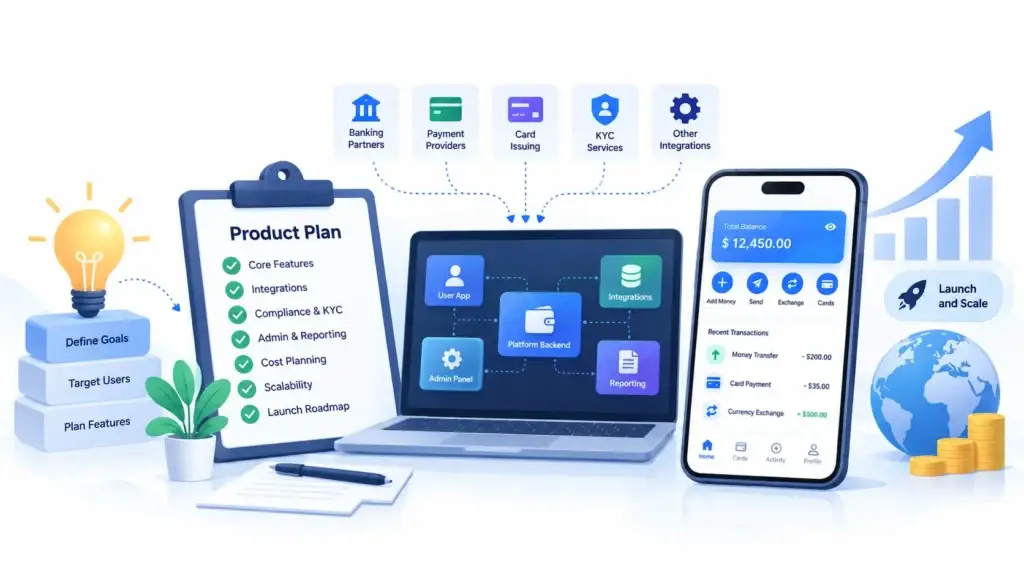
Digital banking products look simple from the outside. Users sign up, add money, send payments, exchange currency, manage cards, or view transactions. But behind every clean screen is a complex operating layer.
A founder needs to plan how balances update, how payments are recorded, how users are verified, how failed transactions are handled, how admin teams review activity, how fees are configured, and how the platform connects with payment, card, banking, or verification providers.
Without this planning, development usually becomes expensive in the wrong places. Teams may spend heavily on the front-end experience while underbuilding the wallet ledger, compliance workflow, admin dashboard, reporting layer, or integration architecture.
A stronger plan helps founders decide:
- Which banking features are essential for the first launch
- Which features can be added later
- Which APIs are needed before launch
- Which user segments the product should serve
- Which cost drivers need early budgeting
- Which parts of the system must be customizable
- Whether a ready-made foundation is more practical than building from zero
This is also where a launch-ready fintech solution from Miracuves can help. Instead of starting with a blank technical roadmap, founders can begin with an existing digital banking foundation and customize the product around their market, brand, integrations, and monetization model.
What Is a Digital Banking Platform?
A digital banking platform is a software ecosystem that allows users or businesses to manage financial activities through mobile apps, web dashboards, and backend systems.
Depending on the business model, it may include:
- User accounts
- Wallet or account balance management
- Money transfers
- Multi-currency support
- Card management
- Payment gateway integration
- KYC and user verification workflows
- Transaction history
- Notifications and alerts
- Admin dashboard
- Fee management
- Reporting and audit logs
- Business finance tools
- BaaS or financial API integrations
For founders, the platform should not be treated as just a mobile app. It should be planned as a controlled financial operating system where users get a smooth experience and the business owner gets visibility into users, transactions, fees, disputes, compliance checks, and product performance.
Core Banking Features Founders Should Plan From Day One
A strong digital banking platform begins with the right feature foundation. Not every product needs every advanced module at launch, but the core financial workflows should be planned properly from the beginning. Founders who want a deeper module-level view can review the essential digital banking app feature modules before finalizing their first launch scope.
User Onboarding and Account Setup
User onboarding is the first trust layer of a digital banking product. It should be simple enough for users to complete quickly but structured enough to collect the information required for verification, risk checks, and account activation.
A good onboarding flow may include mobile number or email registration, password or OTP verification, profile creation, identity document submission, address details, and account approval status.
Founders should avoid treating onboarding as a basic signup screen. In fintech, onboarding affects activation, compliance readiness, fraud prevention, and long-term customer trust.
KYC and Verification Workflows
KYC workflows help verify users before they access sensitive financial features. Depending on the market and product scope, this may involve document upload, identity checks, address verification, selfie checks, business verification, or third-party verification APIs.
The important planning question is not only whether KYC exists. Founders should ask whether the admin team can review, approve, reject, retry, or track user verification status from the backend.
A compliance-ready foundation should support verification workflows, but final compliance depends on jurisdiction, legal review, operating model, and the third-party providers selected.
Wallet, Account, and Balance Management
Wallet or account logic is one of the most important parts of a digital banking platform. Users need to see accurate balances, transaction history, credits, debits, holds, reversals, and failed transaction updates.
For a founder, this is not just a feature. It is the trust layer of the product.
If balances are unclear or transaction records are incomplete, users lose confidence quickly. That is why wallet ledger planning, transaction status handling, and admin visibility should be part of the first development discussion.
Money Transfers and Payment Flows
A digital banking product may support peer-to-peer transfers, bank transfers, wallet top-ups, bill payments, merchant payments, or business payouts. Each payment flow has different requirements.
Founders should plan:
- How users add funds
- How transfers are initiated
- How failed payments are handled
- How limits are applied
- How fees are charged
- How refunds or reversals are recorded
- How admins track payment activity
The more payment methods and geographies involved, the more complex the development scope becomes.
Multi-Currency and FX Workflows
Multi-currency support is valuable for users such as freelancers, travelers, exporters, remote workers, and global businesses. But it also adds complexity to the platform.
Founders need to plan currency wallets, exchange rates, FX markup, conversion history, transaction fees, supported currencies, and settlement logic.
From a business perspective, FX workflows can create monetization opportunities through exchange margins or transfer fees. From a technical perspective, they require careful backend planning to avoid confusion around balances, conversion values, and transaction records.
Card Management
Card features can make a digital banking product more useful and sticky. These may include virtual cards, physical card requests, card freeze and unfreeze controls, spending limits, card transaction history, and card status updates.
However, card features usually depend on external providers. That means development cost is affected by provider selection, API documentation, region availability, compliance requirements, and testing complexity.
A founder should confirm early whether card functionality is required at launch or should be added after the first version gains traction.
Transaction History and Statements
Users need clear transaction records. Admin teams need even more detail.
A strong transaction module should show payment type, amount, currency, sender, receiver, date, status, reference ID, fee, and failure reason where applicable.
For business users, downloadable statements, expense records, vendor payments, and reporting filters may also be important.
Transaction history reduces support pressure because users can understand what happened without contacting support for every activity.
Budgeting, Analytics, and Financial Insights
Budgeting tools and spending insights can improve retention because users return to the platform to understand their financial behavior, not just to move money.
These features may include category-wise spending, monthly summaries, budget limits, alerts, charts, and business finance insights.
For a first launch, founders should decide whether analytics are essential or whether basic transaction visibility is enough. Advanced analytics can increase cost if they require dashboards, custom reports, data pipelines, or AI-driven categorization.
Admin Dashboard Features That Matter More Than Founders Realize
Many founders focus heavily on the user app and under-plan the admin dashboard. That is a mistake.
The admin panel is where the platform operator manages the business. It controls users, transactions, KYC approvals, fees, limits, disputes, reports, integrations, and operational rules.
A digital banking product without a strong admin dashboard becomes difficult to operate once real users and real financial activity begin.
Important admin features include:
- User management
- KYC review and approval controls
- Transaction monitoring
- Wallet and balance visibility
- Fee and commission setup
- Currency and exchange rate controls
- Dispute and refund workflows
- Role-based admin access
- Audit logs
- Reports and analytics
- Notification management
- Integration status monitoring
- Risk and suspicious activity flags
For founders planning a serious fintech product, admin control is not optional. It decides how quickly the team can respond to user issues, monitor risk, manage financial activity, and adjust business rules without depending on developers for every small change.
Digital Banking Platform Feature Planning Table
| Feature Area | What It Includes | Why It Matters for Founders |
|---|---|---|
| User onboarding | Signup, profile setup, identity details, account activation | Improves activation while preparing users for verification workflows |
| KYC workflow | Document upload, review, approval, rejection, retry status | Supports safer onboarding and compliance-ready operations |
| Wallet/account logic | Balances, credits, debits, holds, failed transactions | Builds financial trust and reduces operational confusion |
| Transfers and payments | P2P payments, top-ups, withdrawals, bank transfers | Creates the core product utility users return for |
| Multi-currency support | Currency wallets, FX conversion, exchange history | Supports global users and monetization through FX margin |
| Card controls | Virtual cards, spending limits, freeze/unfreeze, card history | Adds convenience and improves product stickiness |
| Admin dashboard | Users, transactions, disputes, fees, reports, controls | Gives operators business visibility and backend control |
| Notifications | Payment alerts, KYC updates, card updates, security alerts | Builds user confidence and improves engagement |
| Security layer | Encryption, role-based access, audit logs, activity tracking | Protects sensitive financial actions and platform trust |
| Reports | Revenue, transactions, user activity, failed payments | Helps founders make operational and growth decisions |
Miracuves Digital Banking Platform Solution Cost and Tech Stack
Miracuves Pricing for a Digital Banking Platform developed in JavaScript For $15,999 USD (One-Time Price) in just 6 days
Get a fully developed, deployment-ready digital banking platform built for fintech startups, neobanks, financial institutions, payment companies, and founders planning to launch a modern banking product. Built on a modern JavaScript foundation, this complete package includes everything you need to launch and scale:
Core Workflows: User onboarding, KYC verification, digital account creation, wallet balance, money transfers, beneficiary management, transaction history, bill payments, card management, spending insights, and customer notifications.
Built-in Revenue Logic: Premium account plans, transaction fees, interchange revenue, card-related charges, foreign exchange margins, business account subscriptions, withdrawal fees, lending add-ons, partner offers, and platform service charges.
Management Hub: Centralized admin dashboard, user management, KYC review, account controls, transaction monitoring, wallet management, card controls, payment records, compliance logs, risk monitoring, support handling, and banking analytics.
Launch-Ready: Fully prepared for your custom branding, configuration, payment gateway setup, KYC/AML workflows, banking API integrations, card issuing connections, transaction rules, and immediate market entry.
Why Is Digital Banking Platform Development More Affordable?
Most digital banking platforms become expensive when businesses choose fully custom development from scratch. Building separate workflows for users, KYC, accounts, wallets, payments, cards, transaction monitoring, compliance, fraud controls, notifications, reporting, and admin operations can significantly increase cost, timeline, and technical complexity.
We took a smarter, more practical approach:
You Aren’t Paying for Ground-Up Development: Our digital banking platform engine is already developed, tested, and ready to deploy. You skip the inflated cost and long development cycles normally associated with building a complete digital banking ecosystem from scratch.
The Power of JavaScript: We built this solution on a modern JavaScript architecture that supports interactive banking dashboards, scalable transaction workflows, real-time account updates, API-driven financial integrations, and smooth administrative operations.
You get a launch-ready digital banking platform with practical account management, payments, card controls, compliance, monetization, and administrative features, source code access, and faster deployment without the high custom development price tag.
Note: This cost is for the solution, re-branding, deployment, and source code only.
What Actually Drives Digital Banking Platform Development Cost?
Development cost is not decided by the number of screens alone. A banking app with ten simple screens can be less complex than a platform with fewer screens but deeper transaction logic, third-party integrations, compliance workflows, and admin controls. For a more focused breakdown of pricing variables, integrations, and launch scope, founders can review this guide on digital banking platform development cost.
Founders should understand the cost drivers before asking for a quote.
Feature Depth
Basic wallet features cost less than a platform with multi-currency accounts, card management, business finance tools, FX workflows, and advanced reporting.
The more financial scenarios the platform needs to support, the more planning, development, testing, and backend logic are required.
Platform Scope
Cost changes depending on whether the product includes:
- Android app
- iOS app
- Web app
- Admin dashboard
- API layer
- Business dashboard
- Partner dashboard
A mobile-only product may be faster to launch, but fintech platforms often need a strong web or admin interface for operations.
Third-Party API Integrations
Digital banking products often depend on third-party providers for KYC, payments, cards, banking infrastructure, notifications, analytics, or fraud monitoring.
Each integration affects cost because developers need to study the API, configure workflows, handle errors, test edge cases, and connect the integration to user and admin flows.
Compliance Workflow Scope
Compliance is not a single switch. It depends on the country, business model, financial partners, and operating requirements.
A platform may need support for KYC workflows, AML workflow support, transaction monitoring, audit logs, user verification, suspicious activity flags, and reporting exports.
Founders should plan compliance-ready workflows early, while remembering that final legal compliance depends on jurisdiction, legal review, provider selection, and operating model.
Backend Architecture
The backend decides whether the product can handle real financial activity. It manages account records, wallet logic, transactions, APIs, permissions, notifications, reports, and data security.
A weak backend may look fine in a demo but become expensive when the founder needs to add new markets, more users, or complex financial features.
UI/UX and Branding
Design also affects cost. A clean white-label interface with brand customization is faster than a fully custom design system with unique journeys, illustrations, animations, and custom dashboards.
Founders should decide whether the first launch needs heavy custom design or whether speed, trust, and usability matter more at the validation stage.
Source-Code Ownership
Source-code ownership affects long-term cost. If the founder does not own the source code, every future change may depend on the vendor’s limitations, licensing rules, or recurring fees.
A source-code-owned foundation gives the business more control over roadmap, integrations, customization, scaling, and future development decisions.
Testing and Security Review
Fintech testing requires more care than a normal content or marketplace app. Payment flows, balance updates, failed transactions, KYC status, permissions, security controls, and admin actions should be tested carefully.
Skipping this layer may reduce upfront cost but increases operational risk after launch.
Ready-Made Foundation vs Custom Development: Which Path Makes Sense?
Founders usually compare two paths: building from zero or starting with a ready-made fintech foundation.
A custom build offers full flexibility but usually requires more time, planning, team coordination, and budget. This may make sense when the product has unusual workflows, deep banking infrastructure requirements, or a highly differentiated financial model.
A ready-made foundation is useful when the founder wants to launch faster with proven product flows already in place. It can include user apps, wallet logic, admin controls, branding, and source-code access, depending on the solution scope.
For founders who want to validate demand faster, Miracuves provides a white-label digital banking solution that can be delivered in 6 days when the selected scope is aligned. This gives businesses a faster route to market while still allowing customization, branding, admin control, and future feature expansion.
| Build Path | Best For | Main Advantage | Planning Risk |
|---|---|---|---|
| Custom development | Highly unique fintech models with complex proprietary workflows | Maximum flexibility | Longer timeline and higher planning load |
| Ready-made white-label foundation | Founders who want faster launch and market validation | Faster deployment with core modules already built | Scope should be reviewed carefully before launch |
| Hybrid approach | Founders who want speed first and custom expansion later | Balanced speed and flexibility | Roadmap must be planned in phases |
If you are still deciding between a ready-made foundation and a ground-up build, this comparison of a white-label fintech platform vs custom development explains when each route makes more sense for speed, ownership, customization, and long-term scalability.
Suggested Feature Roadmap for a First Launch
A founder does not need to launch with every advanced feature at once. A better approach is to separate core launch features from growth-stage features.
Phase 1: Launch-Ready Core
The first version should focus on trust, usability, and essential financial activity.
Recommended launch modules:
- User registration and onboarding
- KYC workflow support
- Wallet or account balance management
- Add money or payment gateway flow
- Send and receive money
- Transaction history
- Notifications
- Admin dashboard
- User management
- Transaction monitoring
- Basic reports
- Role-based admin access
- Audit logs
This phase helps founders test whether users trust the product, complete onboarding, use the payment flow, and return for repeat activity.
Phase 2: Monetization and Expansion
After the core platform is stable, founders can add monetization and advanced engagement features.
Possible Phase 2 modules:
- Multi-currency accounts
- FX conversion
- Card management
- Subscription plans
- Business accounts
- Spending insights
- Referral system
- Loyalty features
- Premium account tiers
- Advanced reports
This allows the business to expand based on user behavior instead of guessing every feature upfront.
Phase 3: Advanced Banking and Business Finance
Once the product has traction, founders can plan deeper financial workflows.
Possible advanced modules:
- Business finance dashboard
- Expense management
- Vendor payments
- Payroll workflows
- Credit or lending workflow support
- BaaS integrations
- Open banking connections
- Advanced risk monitoring
- Custom compliance reporting
This phased approach helps control cost and reduces the risk of overbuilding before market validation.
Monetization Models Founders Can Plan
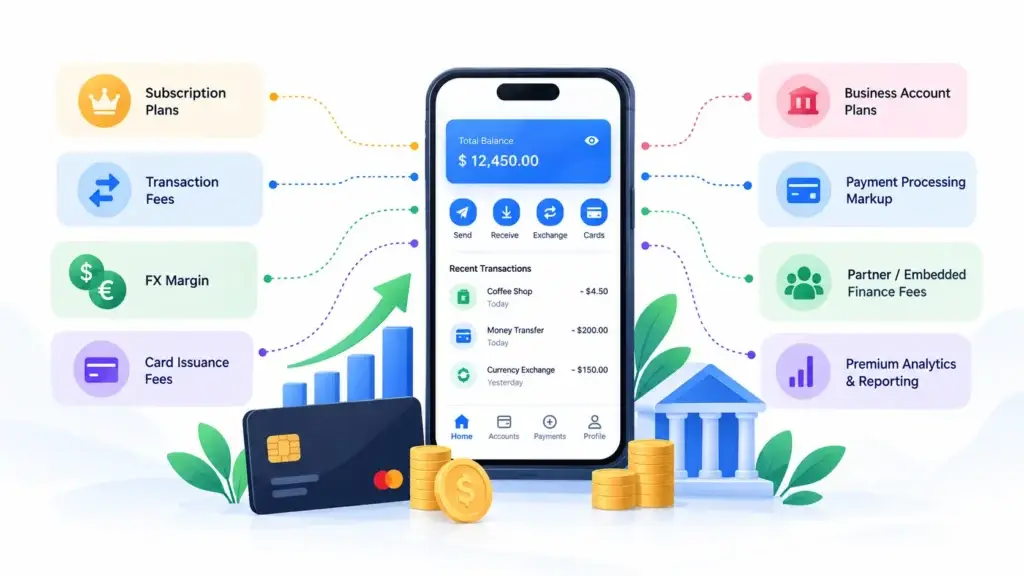
A digital banking platform can create revenue in multiple ways. The right model depends on the user segment, geography, providers, and financial workflows.
Common monetization options include:
- Subscription plans for premium accounts
- Transaction fees on transfers or withdrawals
- FX margin on currency conversion
- Card issuance or card usage fees
- Business account monthly plans
- Payment processing markup
- Partner or embedded finance fees
- Premium analytics or reporting features
- BaaS-enabled service fees where applicable
Founders planning fees, FX margin, premium accounts, card-based revenue, and transaction-based income should review the complete fintech platform revenue model before finalizing product scope and admin controls.
Founders should not add monetization as an afterthought. Fee logic, plan limits, transaction rules, and reporting should be planned early because they affect backend development and admin controls.
Security and Compliance Planning for Digital Banking Platforms
Security should be treated as part of the foundation, not a marketing add-on.
A digital banking platform handles sensitive user data, financial records, payment actions, verification documents, and admin permissions. Founders should plan security from the first build discussion.
Important security and control layers include:
- Encrypted data transfer
- Encrypted data storage
- Role-based access control
- Audit logs
- Secure API integration
- Tokenized payments where applicable
- User verification
- KYC workflow support
- AML workflow support
- Transaction monitoring
- Suspicious activity flags
- Admin access controls
- Activity logs
- Dispute management
- Compliance reporting support
For a deeper look at KYC workflows, admin risk controls, audit logs, transaction monitoring, and secure fintech operations, read this guide on digital banking security controls.
A careful note for founders: no software vendor should promise automatic legal compliance for every country. The stronger approach is to build a compliance-ready foundation that can be configured around the target market, selected providers, legal advice, and operating model.
Founder Decision Signals Before Choosing a Development Path
Speed
If your priority is market validation, a ready-made fintech foundation can help you launch faster than building every module from zero.
Cost
Cost depends on feature depth, platforms, integrations, compliance workflows, branding, and support scope. Avoid comparing quotes only by screen count.
Control
Source-code ownership matters because fintech products usually need ongoing changes, provider updates, security improvements, and new market features.
Scalability
The backend, admin dashboard, transaction logic, and API structure should be planned for future users, currencies, payment methods, and reporting needs.
Mistakes Founders Should Avoid
Choosing a Platform Based Only on the Feature List
A long feature list does not always mean a strong product. Founders should check whether the features are connected properly through backend logic, admin workflows, transaction records, and integration readiness.
A wallet screen without reliable transaction handling is not enough. A card screen without provider readiness is not enough. A KYC form without admin review logic is not enough.
Ignoring the Admin Dashboard
The admin dashboard is where the business runs. Without strong admin control, founders may struggle to manage users, approve verification, monitor transactions, adjust fees, handle disputes, or review reports.
For fintech products, backend visibility is just as important as user-facing design.
Underestimating Integration Complexity
Payment, card, banking, and verification integrations can affect cost and timeline significantly. Even if a provider has good documentation, the product still needs error handling, testing, user-flow mapping, admin visibility, and compliance workflow alignment.
Building Too Many Advanced Features Before Validation
Founders often want every feature in the first release. This increases cost and delays launch. A better approach is to launch with the core financial workflow, test demand, and add advanced modules based on real usage.
Not Clarifying Source-Code Ownership
If the business does not own the code, future customization can become difficult. Source-code access gives founders more flexibility over roadmap, integrations, maintenance, scaling, and long-term product direction.
These issues are common during early fintech planning, so founders should also review the most important digital banking launch mistakes before choosing their development scope.
How Miracuves Helps Founders Launch Faster
Miracuves helps founders build digital banking platforms with a ready-made, white-label approach designed for faster launch and practical customization.
Instead of starting from zero, founders can begin with a product foundation that supports important fintech workflows such as onboarding, wallet logic, transactions, admin controls, source-code ownership, branding, and integration readiness.
For founders comparing build options, the next step is to review the launch scope, confirm required modules, and see whether a ready-made digital banking platform fits the business model.
Miracuves’ 6-day solution delivery can be useful when the founder wants to move quickly with an aligned scope. Deeper customization, third-party provider work, compliance-specific workflows, or market-specific requirements may extend the final delivery timeline.
Cost Planning Checklist for Founders
Before requesting a digital banking platform quote, founders should prepare answers to these questions:
- Do you need Android, iOS, web, and admin from day one?
- Will the platform support one currency or multiple currencies?
- Do you need payment gateway integration?
- Do you need card issuing workflows?
- Which KYC or verification provider will be used?
- Do you need business accounts or only individual user accounts?
- Will the product support FX conversion?
- What monetization model will be used?
- What admin controls are required?
- Do you need audit logs and reporting exports?
- How much branding and UI customization is required?
- Do you need source-code ownership?
- What support is needed after launch?
This preparation helps avoid vague quotes and makes it easier to compare development options realistically.
Final Thoughts
A digital banking platform should be planned as a business system, not just a mobile app.
The strongest products combine user-friendly banking features with secure backend logic, admin visibility, transaction accuracy, compliance-ready workflows, monetization planning, and scalable integrations.
For founders, the smarter path is not always the longest build. It is the path that gives enough product control, faster market validation, and room to expand after launch.
Miracuves helps founders move faster with white-label, source-code-owned digital banking solutions that can be customized around brand, market, integrations, and business model. If your goal is to test the market without building every module from zero, a launch-ready foundation can reduce development friction and help you move from planning to product faster.
FAQs
How much does it cost to build a digital banking platform?
The cost depends on feature depth, platform scope, payment integrations, card workflows, KYC requirements, multi-currency support, admin dashboard complexity, branding, source-code access, and post-launch support. Founders should confirm the final quote based on selected modules and customization needs.
What are the most important digital banking platform features?
The most important features include user onboarding, KYC workflow support, wallet or account management, transfers, transaction history, payment gateway integration, card controls, notifications, admin dashboard, security controls, audit logs, and reporting.
Can a digital banking product be launched faster with a ready-made solution?
Yes, a ready-made fintech foundation can reduce launch time because core user flows, admin controls, and backend modules are already built. Miracuves offers 6-day solution delivery when the selected scope is aligned, while deeper customization or integration work may require additional time.
Why is the admin dashboard important in a fintech platform?
The admin dashboard helps platform operators manage users, transactions, KYC reviews, fees, disputes, reports, permissions, and risk signals. Without a strong admin layer, the business may struggle to operate the product after launch.
Do founders need multi-currency support from day one?
Not always. Multi-currency support is useful for cross-border users, freelancers, travelers, exporters, and global businesses. If the first launch targets one local market, founders may begin with single-currency workflows and add multi-currency features later.
What affects the cost of payment and card integrations?
Cost depends on the selected provider, API complexity, documentation quality, supported countries, testing requirements, error handling, admin visibility, compliance workflow needs, and whether the integration must support cards, bank transfers, wallet top-ups, or currency conversion.
Is source-code ownership important for digital banking platforms?
Yes. Source-code ownership gives founders more control over customization, integrations, security updates, scaling, maintenance, and long-term roadmap decisions. This is especially important for fintech products because requirements often change after launch.
Can a digital banking platform be compliance-ready?
A platform can be built with compliance-ready workflows such as KYC support, AML workflow support, transaction monitoring, audit logs, role-based access, and reporting controls. Final compliance depends on jurisdiction, legal review, provider selection, and the operating model.
Miracuves is an independent software development company. We are not affiliated with, connected to, sponsored by, or endorsed by any company or product named in this article.
Terms such as “X Clone” are used descriptively. It is how the software industry refers to building a platform with functionality comparable to a known service, and how clients search for it.
The entire design and codebase of our products is built by our own team. Our products contain no code, design, graphics, or content originating from any third-party website or applications.
All third-party names and marks referenced in this article are the property of their respective owners, referenced solely to identify the services discussed.