NFT Minting App · Production Ready

Rarible Clone App - White-Label Creator-First NFT Marketplace

Miracuves' ready-made, white-label Rarible clone is built around creators: a Studio for minting and scheduled drops, a marketplace site, two contracts, the API, an admin portal and Android and iOS apps, all source you own, rebranded on your servers in six working days.

A creator schedules a drop with start and end times, a total supply, a per-wallet limit and an optional allowlist, while collectors list in ETH, USDC or MATIC or place offers that expire. Layer 2 scaling, rarity scores, staking and loyalty are add-ons, and whether a token counts as regulated stays your call. Timed auctions with bidding or recurring creator plans are built to your brief, scoped and priced in writing, then delivered in 2-8 weeks.

Launch in 6 Days with

  • Source Code
  • Marketplace Site
  • Creator Studio
  • Admin Portal
  • Two Contracts
  • Android + iOS Apps

StackExpo · Next.js 14 · TypeScript · zod · PostgreSQL · Drizzle · Solidity 0.8 · wagmi

MXNFT console · MarketplaceIllustrative
Collections10
Live drops3
Open offers11

Marketplace activity

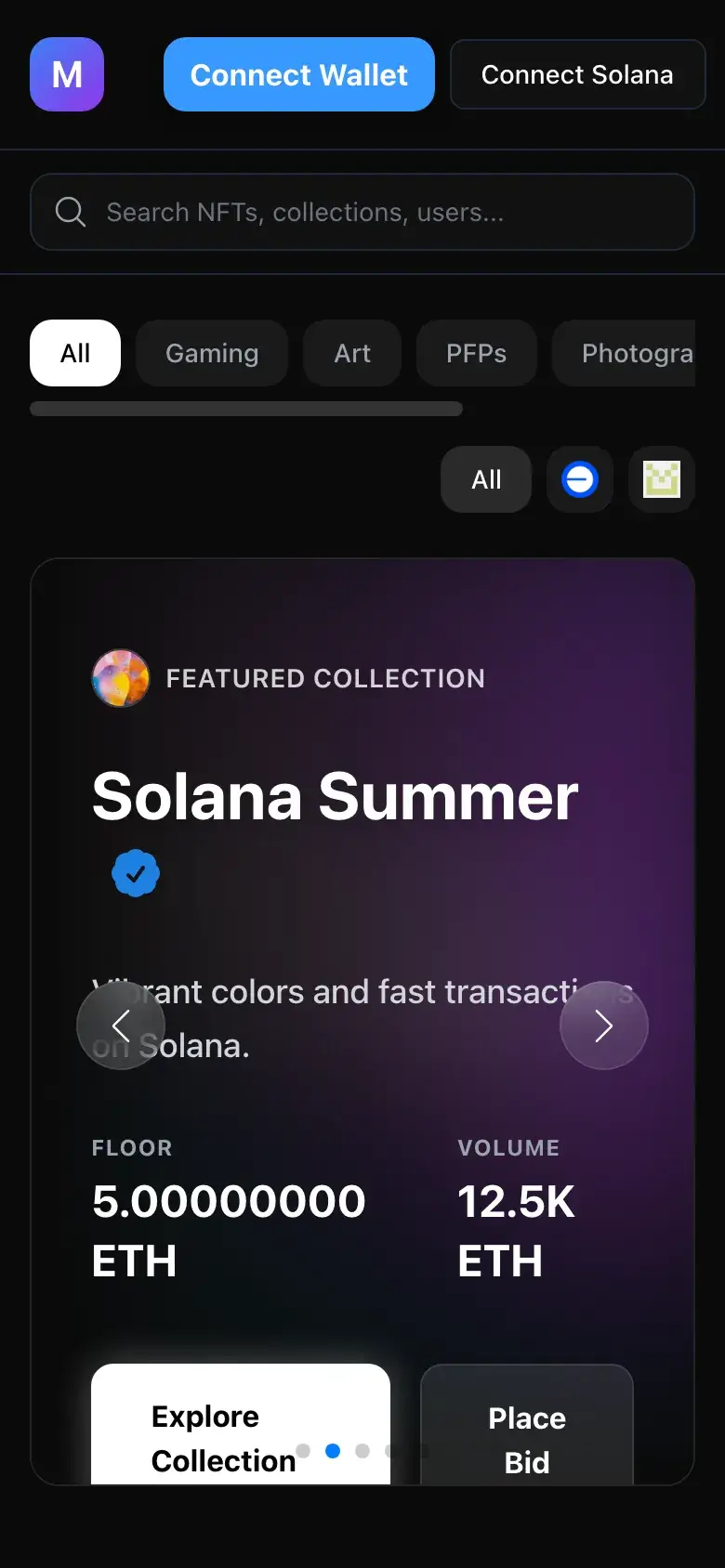
Rarible Clone home page on a phone with Connect Wallet and Connect Solana buttons, a search bar, category chips and a featured collection.
Every drop has a windowstart, end, supply and wallet limit
  • 3Studio Toolsan NFT form, a collection form and a drop scheduler
  • 4User Rolescollector, creator, moderator and admin
  • 0%Revenue Share With Miracuvesnothing taken from your fee or any creator's sale
  • 10%Contract Fee Capset your fee in basis points; the contract never charges above it
  • 6Days to Launchand if the delay is ours, we keep going free
  • $4,299Paid Once, Not Rentedsource code yours, no per-seat fee, no monthly rental

Live in six working days, or we keep working free until you launch. Every build carries 60 days guidance, 6 months bug fixes and 12 months updates.Verify every figure

Royalties Settle in the Sale

A collection can carry an ERC-2981 royalty, and the marketplace contract pays the recipient when a listing sells. One admin switch turns royalties on or off.

Every Report Gets a Decision

Each report shows the target, the reason, the reporter and a status. A moderator takes it down or dismisses it, and the action is recorded.

Paid Wallet to Wallet

A sale pays the seller, the royalty recipient and the fee address directly. Card payments through a provider are outside the base and raise custody or money-transmission questions for you to settle first.

Want a marketplace where creators come first?Talk to Product Expert

Chosen by 6,000+ clients across the globe

Miracuves is listed by Expertise.com as a managed IT service provider.Miracuves is an official member of the Forbes Business Council.Miracuves is a verified agency on DesignRush, listed among top design agencies in India.Miracuves is reviewed on Trustpilot as a software development company.Miracuves is listed by The Manifest among top managed software development companies.Miracuves is listed by DesignRush as a top software development company.Miracuves is recognized by GoodFirms as a top software development company.Miracuves is ranked among the top 1000 companies globally by Clutch.Miracuves is a top managed service provider in the United States on Clutch.

01See it live

Live in Action

Try the Rarible Clone: Website, Android App, Admin Portal & Studio

Walk through the Miracuves Rarible Clone as a collector first, as a creator second and as the operator last. The marketplace website and the Android app are open to try right now. The admin portal and the signed-in Studio are opened for you on a short call, so there is no password to hand over.

Rarible Clone Discover home with a featured collection, a Top Collections list and category filters in a dark marketplace layout.
Marketplace website

Rarible Clone - Marketplace Website

Open the live demo: the Discover home with a featured collection, trending lists over four time windows, category tiles, the Explore filters, collection pages and NFT pages.

  1. 1Open the demo in any browser
  2. 2Browse Discover, Collections and Explore
  3. 3Open a collection and an NFT page
Web demo:mxnft.mimeld.com
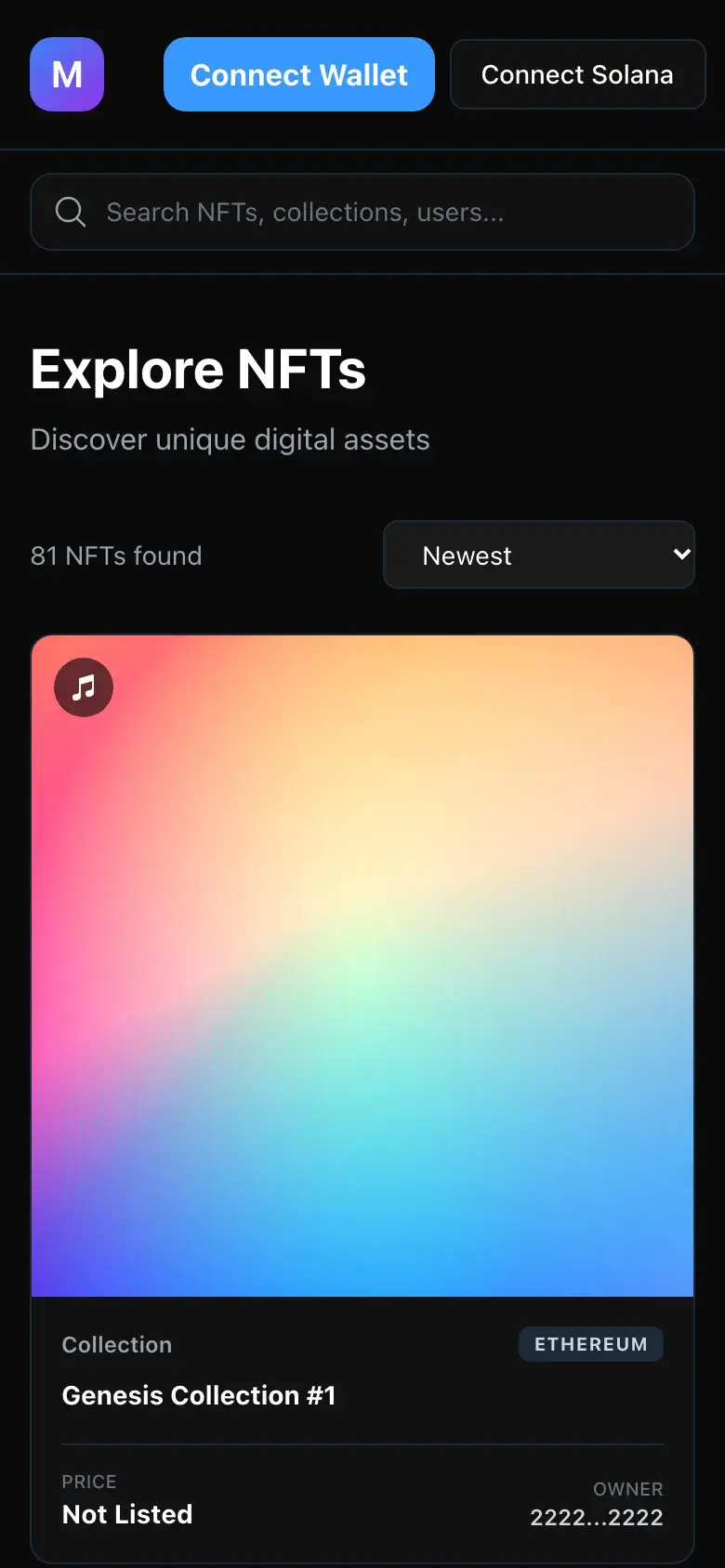
Rarible Clone home page on a phone with Connect Wallet and Connect Solana buttons, a search bar, category chips and a featured collection.Rarible Clone Explore NFTs page on a phone with a result count, a sort control and an NFT card.
Android app

Rarible Clone - Android App

An Android app that opens the same marketplace in a full-screen shell behind an animated splash. It is a demo of how your own branded app would feel on a phone.

  1. 1Open the app page on an Android phone
  2. 2Install the demo app
  3. 3Browse the marketplace in the shell
Android demo:mas.mimeld.com
Admin portal

Admin Portal - Collections, Drops, Moderation, Users & Settings

What the operator sees: a dashboard, analytics, the collection and drop tables, the moderation queue, users and roles, finance, settings and integrations.

  1. 1Book the admin tour
  2. 2Enter with the access we hand you
  3. 3Look at: Collections, Drops, Reports, Settings
Admin access:shared on the walkthrough call
Studio & drops

Studio - Create an NFT, a Collection & a Drop

The creator tools behind a wallet sign-in: the Create NFT and Create Collection forms, with royalty fields, and the drops form with start and end times, supply, a per-wallet limit and an allowlist option.

  1. 1Ask to see Studio on the call
  2. 2Connect your own wallet
  3. 3Try: Create NFT, Create Collection, Drops
Where to look:Studio, then Drops
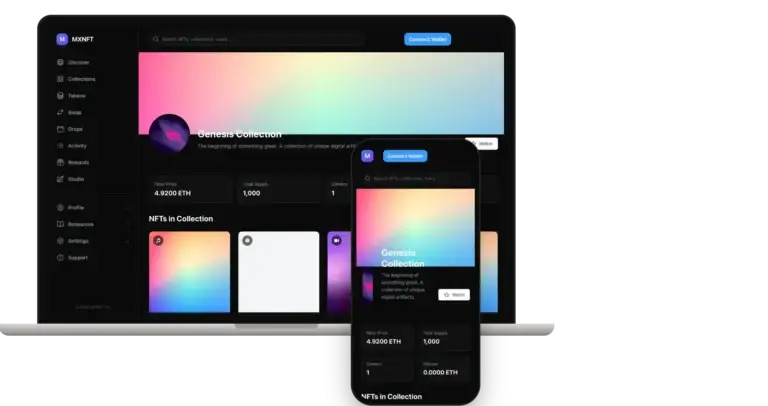
Rarible Clone shown across a laptop and phone: the collection page with stats and NFT grid and the collection page with floor price, supply and owners

Live With Us

A Guided Walkthrough of a Rarible-Style Marketplace: Studio, Drops, Collections & the Admin Portal

The fastest way to see the creator side is a guided call. In roughly 30 minutes we open Studio and create an NFT and a collection with a royalty, schedule a drop with an allowlist, list a piece for sale and make an offer on it, then switch to the admin portal to verify the collection, work the moderation queue and set your fee. Each step gets tied back to your own plan: your networks, your fee level and your launch date.

Arrange a walkthrough call.

Every Screen Mapped

Screens of an NFT Marketplace Like Rarible: Phone and Desktop Views

Screens from the public demo of Miracuves' Rarible clone, captured as a visitor sees them: the marketplace on a phone and the website at desktop width. Studio and the admin portal sit behind a wallet sign-in, so we walk you through them on a call. The artwork you see is sample content that ships with the demo.
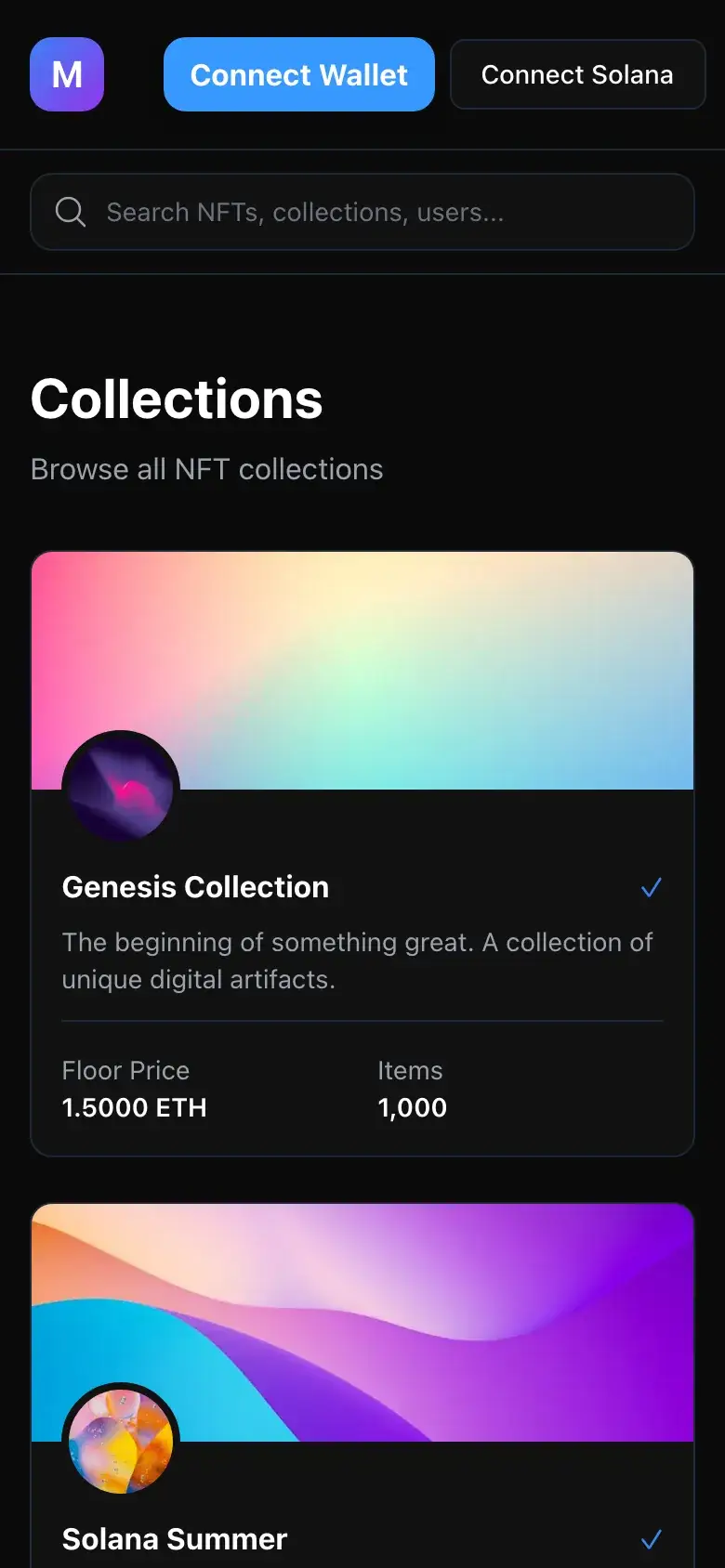
Rarible Clone home page on a phone with Connect Wallet and Connect Solana buttons, a search bar, category chips and a featured collection.
Rarible Clone Collections page on a phone with a collection card showing its banner, logo, floor price and item count.
Rarible Clone Explore NFTs page on a phone with a result count, a sort control and an NFT card.
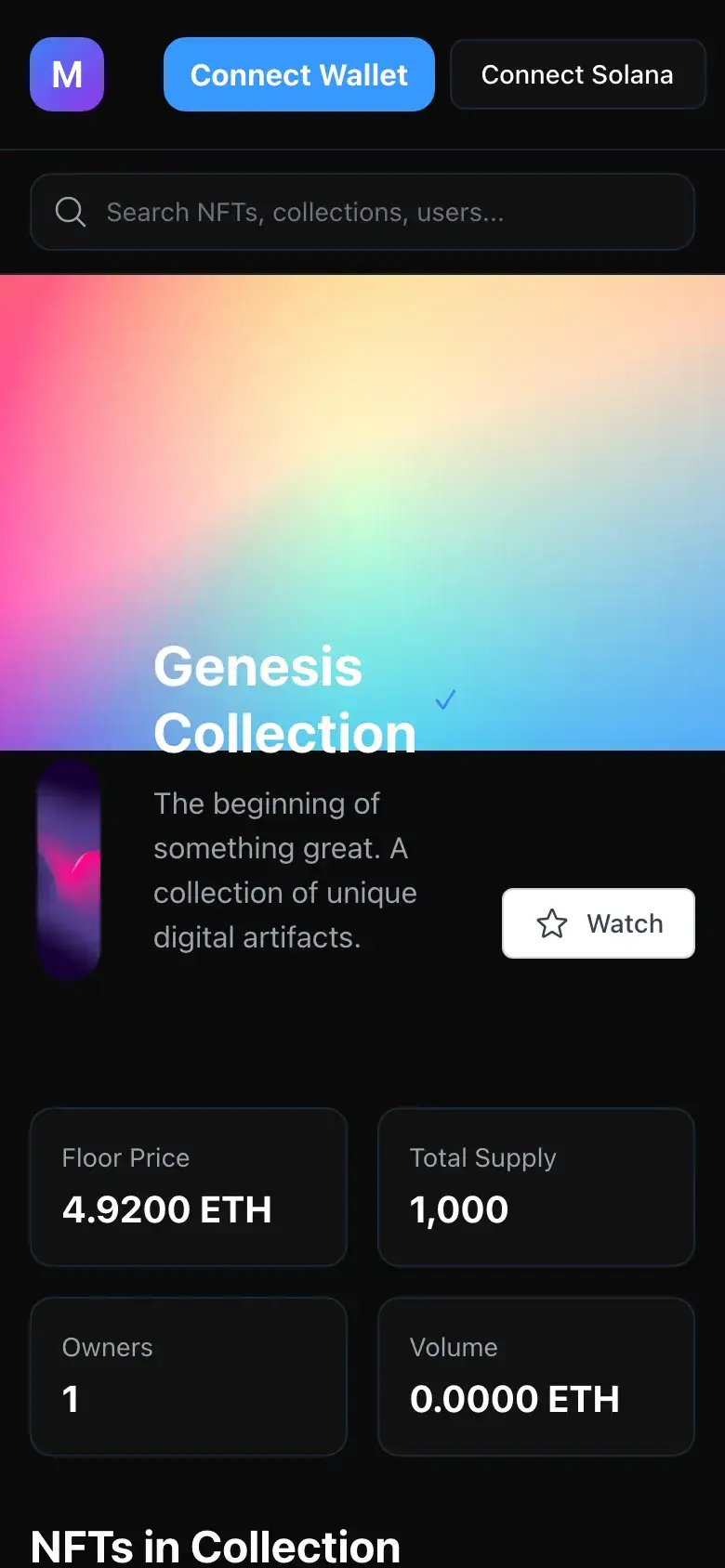
Rarible Clone collection page on a phone with a banner, a Watch button and floor price, supply, owners and volume tiles.
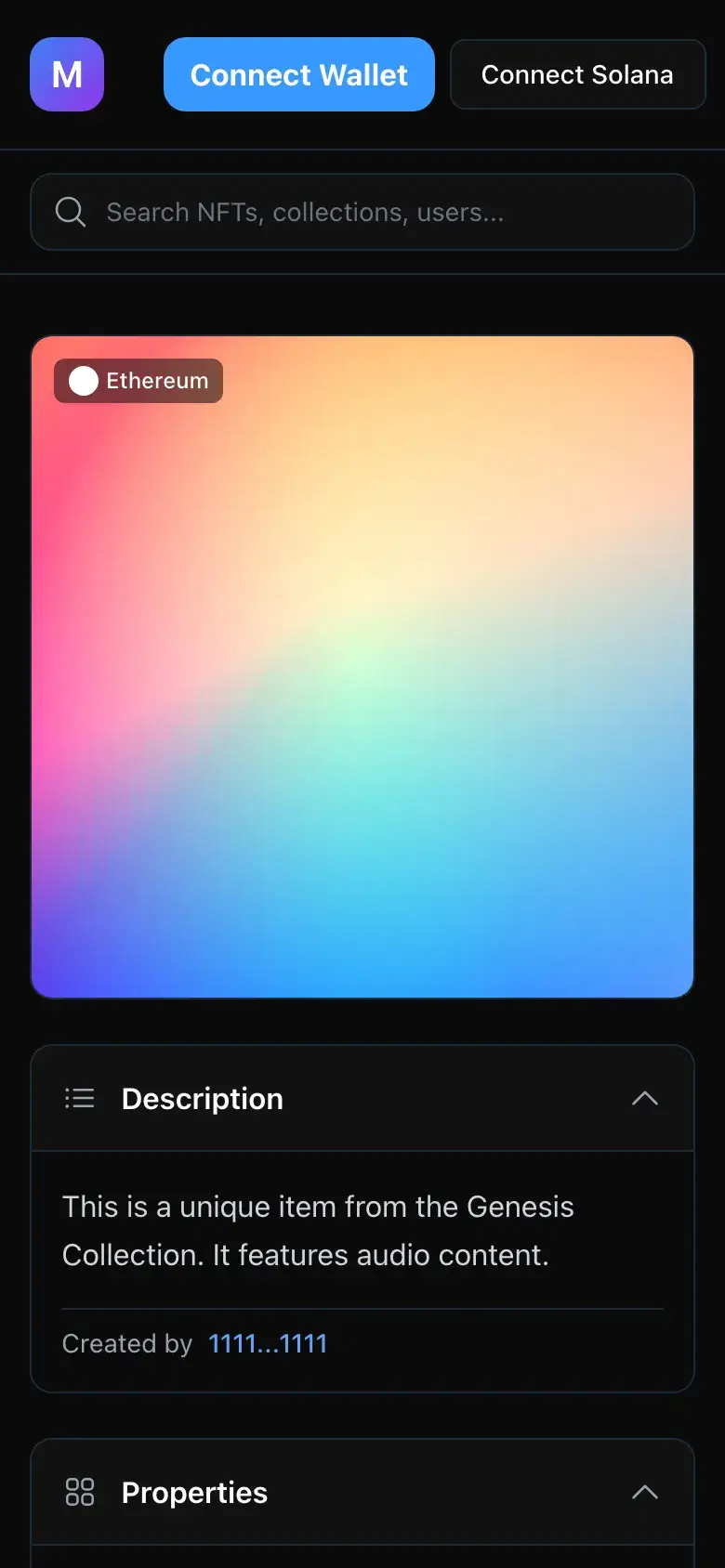
Rarible Clone NFT page on a phone with the artwork, a network label and an expandable description.
5 screens · scroll →
Rarible Clone Discover home with a featured collection, a Top Collections list and category filters in a dark marketplace layout.
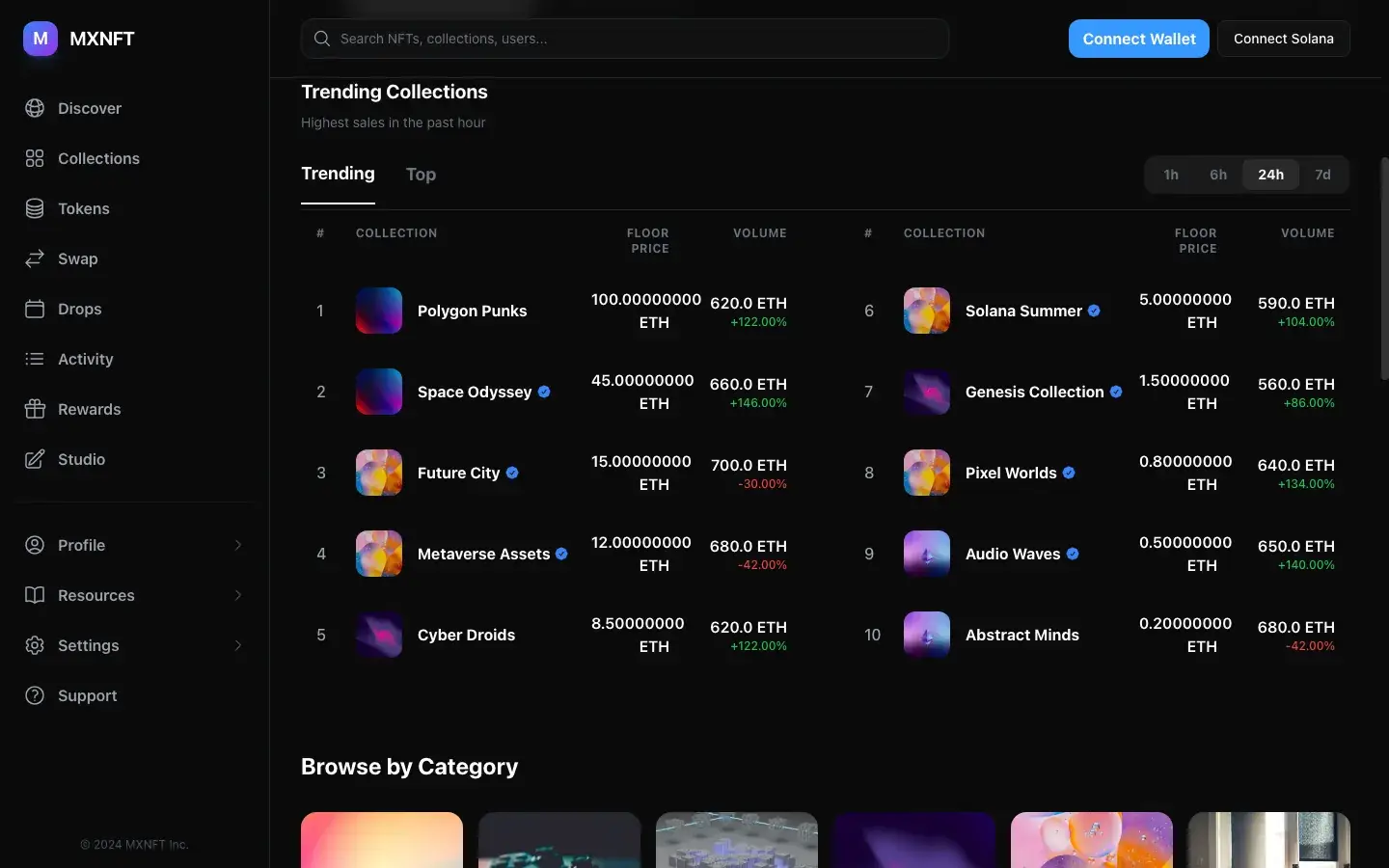
Rarible Clone home page with a Trending Collections table showing floor price and volume over 1h, 6h, 24h and 7d windows.
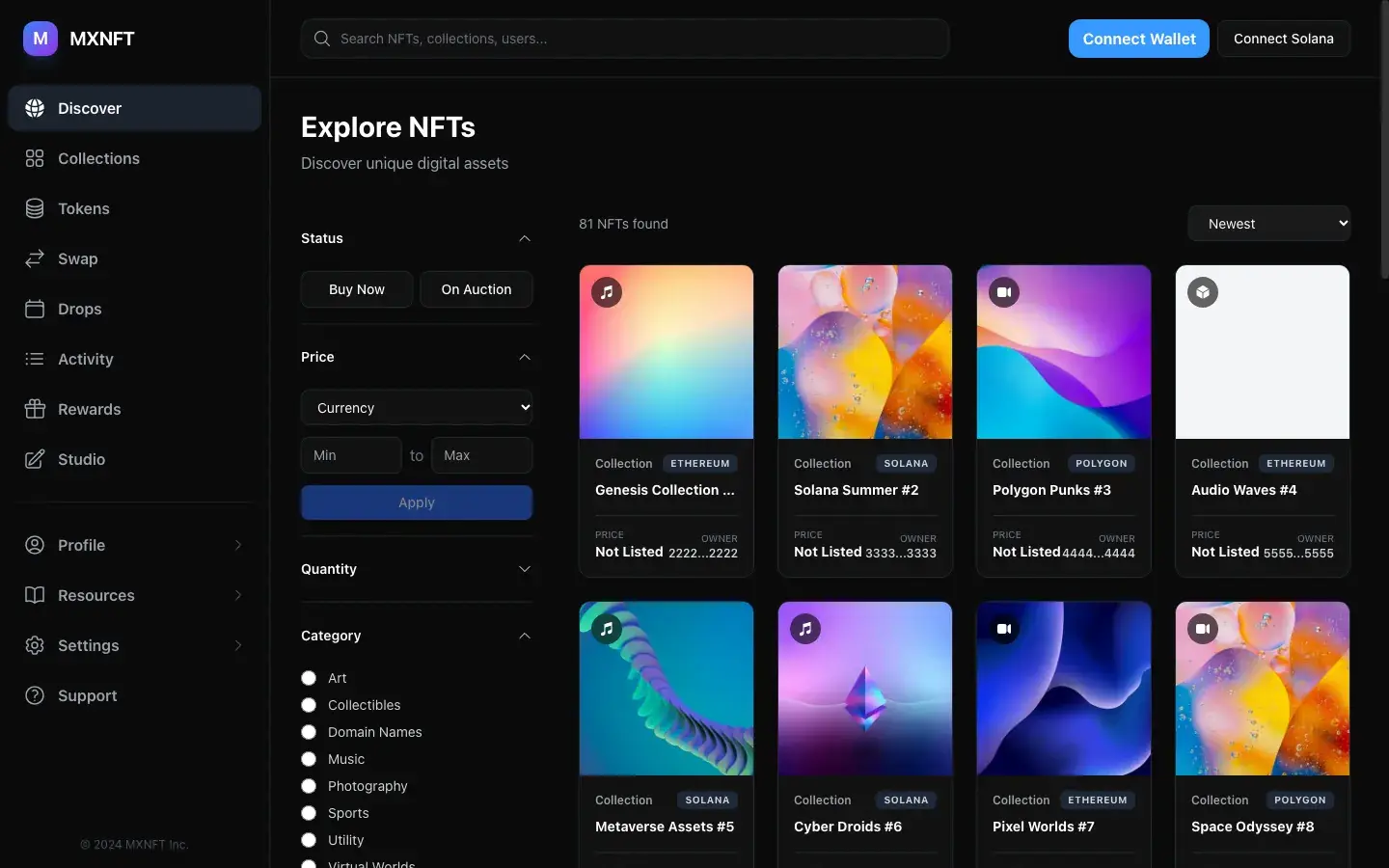
Rarible Clone Explore NFTs page with Status, Price, Quantity and Category filters beside a grid of NFT cards.
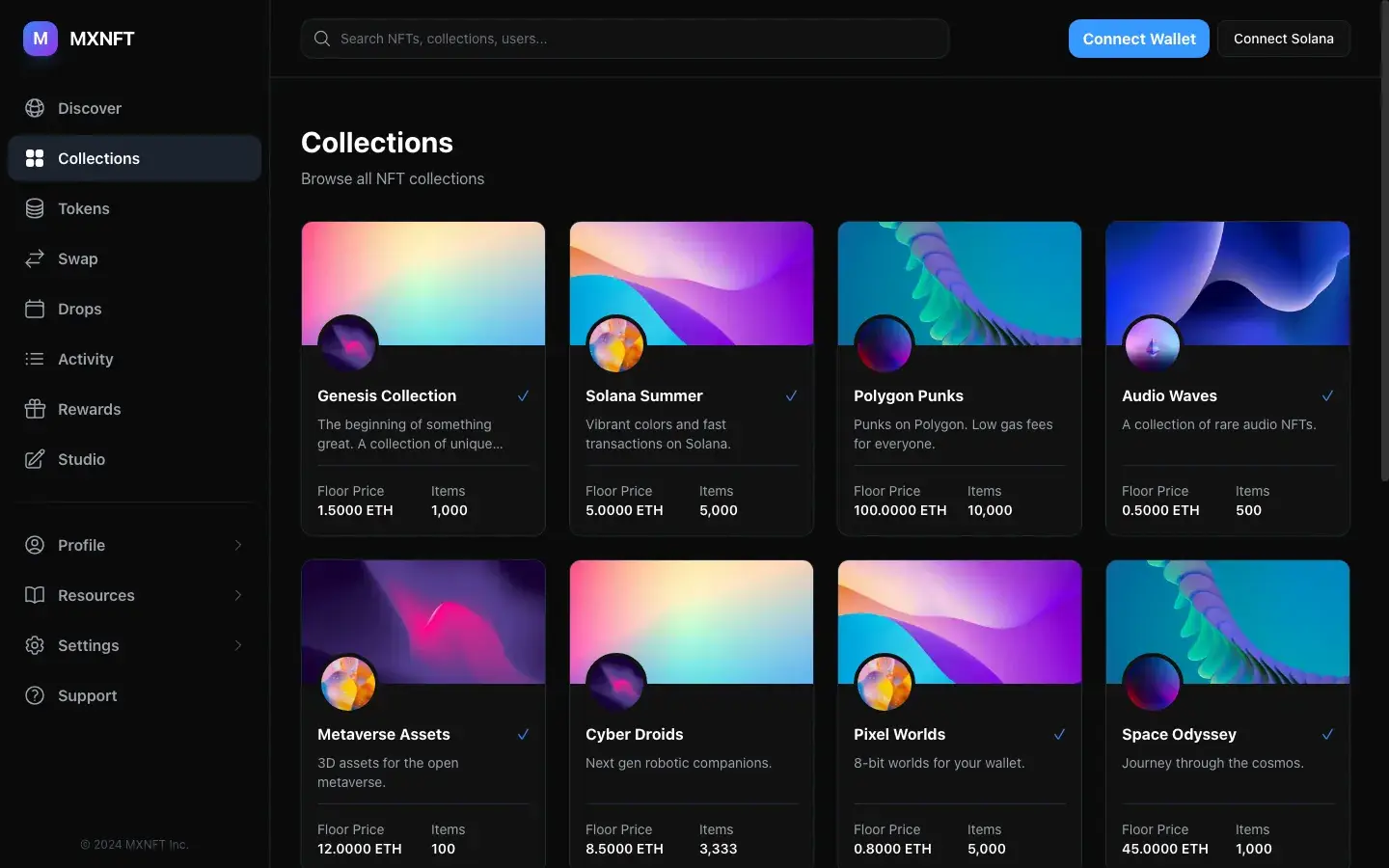
Rarible Clone Collections page with cards showing a banner, a logo, a verified tick, floor price and item count for each collection.
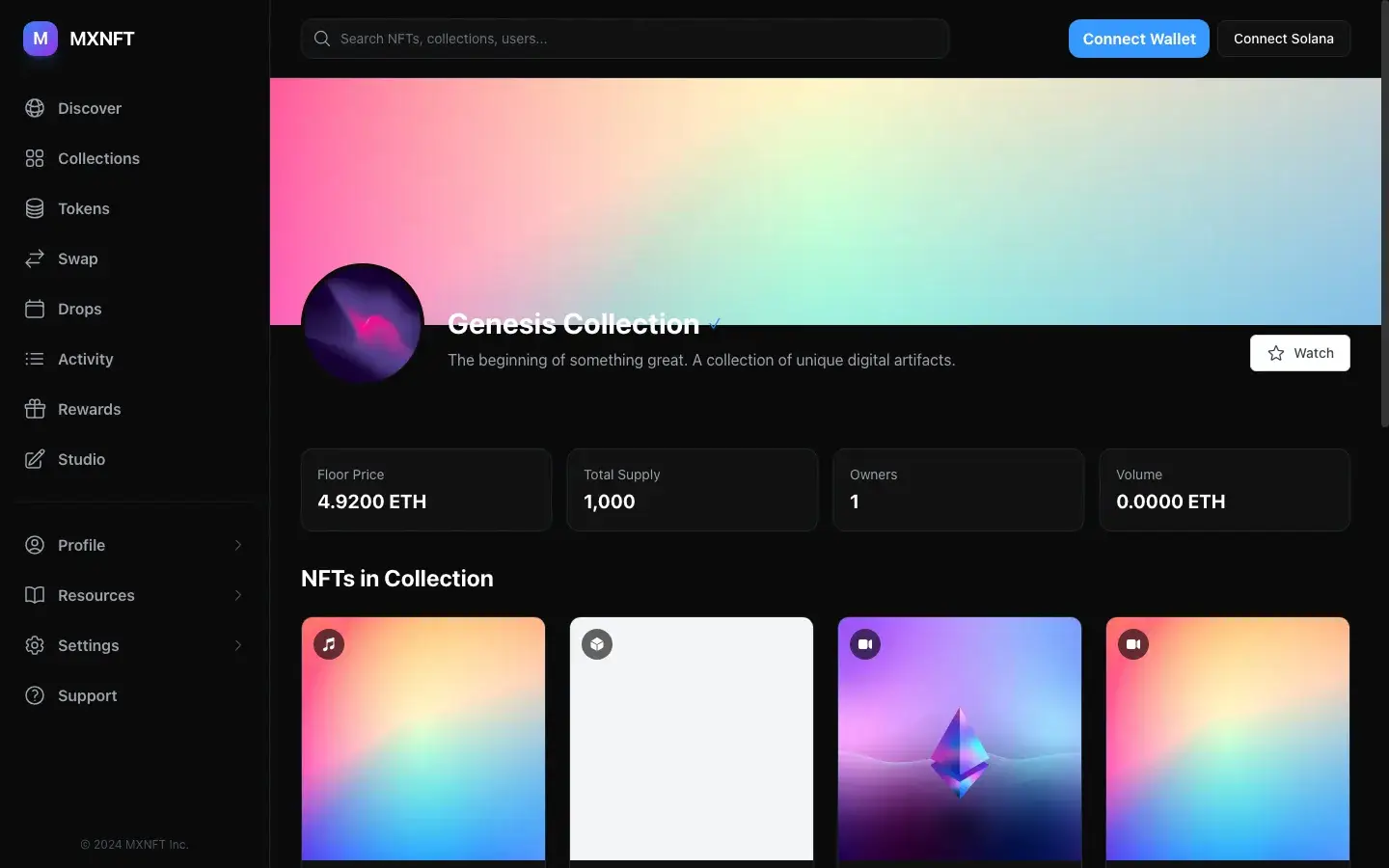
Rarible Clone collection page with a banner, a logo, a Watch button, floor price, total supply, owners and volume, and the NFTs in the collection.
5 screens · scroll →

Trace a single piece of work from its collection page to its NFT page, then on to a listing or drop, an offer or a purchase. Studio and the admin portal wait behind the sign-in.

See More Solutions

02Proof

Client Voices

Rarible Clone Client Reviews - Founders in Their Own Words

What clients say about launching on Miracuves bases. The first comes from a Web3 product family; the others come from other industries and appear exactly as their authors wrote them.

MMackenzie LoreeChief Product Officer, Ryke and Co
“We needed seven Web3 products off one spine rather than five engineering teams. Shared auth, KYC and wallet came from their suite. Each product landed in weeks rather than quarters, and our ops cost per product is a fraction of a stand-alone build.”
DDr. Vivek RungtaFounder & Chief Dermatologist, Dermacian
“Every HMS I tried was built for general physicians, with no lesion mapping, no before/after tracking, and no procedure-based billing. Their MXHealth base gave us the patient app, doctor app, EMR and video consult out of the box. Front-desk time on scheduling and follow-ups is down ~70%, and we went fully digital in 9 months, where a fully custom job would have been 18.”
AAndre GittensCEO, Ride Corporation
“Turo is the obvious reference, but the Caribbean specifics, from different insurance norms to different payment rails, meant we needed a real partner, not just a clone. Miracuves’s MXCar base covered the listing, the trip flow, and the host payouts. We launched in 6 working days and are live in three islands.”
MMarsha WilliamsFounder, Bmore On Demands LLC
“The team was running it on a dispatcher and a Google Sheet, and we needed a real platform quickly, because we were about to onboard a major retail client. Miracuves’s Delivery Genie base gave us the rider app, the dispatch console, and live tracking. We launched in 6 weeks and cleared 4x the previous order volume in the first month.”
TTiffany DandreaOperations Director, Best Cabo Yacht Rentals
“We were running it on phone calls and a paper calendar, and we were losing bookings to bigger OTAs. Miracuves’s GetmyBoat Clone base gave us the calendar, the booking flow, and the payment engine. Online bookings are up roughly 70% in the first six months, and the ops team finally has a live view of the fleet.”
DDr. Carlos A. PalermoCo-founder & CEO, Doctta Health
“Building a compliant telehealth stack from scratch in three markets would have been a year-plus effort. Miracuves’s MXHealth base covered the patient and doctor apps, video consult, e-prescription and the pharmacy integrations. We launched in our first market in 9 weeks and rolled out to two more in the following six months.”
BBrian LatailleVP Logistics Technology, IBC Tanks Canada
“We were juggling spreadsheets, a third-party GPS provider, and a phone. We needed a single operations console. Miracuves’s MXLogistics base covered the trip lifecycle, the driver app, and the customer tracking page. We’ve cut operations admin time by about 40%.”
See All Client TestimonialsFounders and operators, unedited

Evidence, Plainly

Rarible Clone Case Study: What We Have Published and What You Can Check

A few product pages name a client. This one has none to name, and we would rather admit that than stretch some other client's results over a creator marketplace.

Status
No Named Client Yet

No named creator marketplace built on this product is published by Miracuves, so nothing on this card is borrowed from another client or invented. The list beside it shows how to judge the product yourself.

Creator-led NFT marketplaceModel
Wallet sign-inAccess
Site, Studio and admin portalSurfaces
6 daysBuild time
3Studio tools
9Admin sections
Check it yourself
  • Visit the live demo, scroll Discover and Explore, and land on a collection page
  • On a guided call, watch Studio produce an NFT, a collection and a drop
  • In the admin portal, verify a collection and open the moderation queue
  • Find the platform fee, the royalty switch and maintenance mode in Settings
What we will not claim
  • Any client name, sales number or outcome that we cannot back up
  • Audited contracts, or a licensed or certified platform
  • Timed auctions with bidding in the base: that is custom scope
  • Legal, tax or securities advice for your market
What you receive
  • Your logo, icons and colors on the website and the admin portal
  • Installed on hosting you provide
  • The marketplace and collection contracts with their deploy scripts
  • Full source code, unencrypted
  • A 60-day guidance period, then 6 months of bug fixes and 12 months of product updates

03The product

In Short

What Creators, Collectors and Operators Get From the Rarible Clone App

Think of the Miracuves Rarible clone as a ready-made NFT marketplace with the creator in front. Someone signs in with a wallet and works in Studio, making NFTs and collections and scheduling drops, and every collection gets a page under their name. Collectors browse, make offers and buy; you verify collections, moderate reports and set the fee from an admin portal.

Rarible Clone shown across a laptop and phone: the collection page with stats and NFT grid and the collection page with floor price, supply and owners

Built Around the Creator

The value is in what a creator receives: Studio forms for NFTs, collections and drops, a collection page with banner and logo, a profile, followers, and an operator who can verify and feature their work.

Yours to Change

Because the source arrives unencrypted, your team can reshape screens, fees and flows whenever creators ask, without paying per seat.

Clear About What Costs Extra

Scaling on a layer 2 network, AI rarity scores, staking and loyalty are add-ons with their own prices, and timed auctions or recurring creator plans are custom work. None of these is counted as a base feature.

Website, Studio & Admin Portal

What Is a Rarible Clone Script?

A storefront is the easy part to demo. What takes real effort sits around it: somewhere for creators to set up supply, drops with a window and an allowlist, offers that expire, a moderation queue, admin screens split by role and a fee you can change. All of it ships in one codebase, so a creator's first drop has somewhere to land.

Rarible Clone collection page with a banner, a logo, a Watch button, floor price, total supply, owners and volume, and the NFTs in the collection.
  1. 01Sign-in by wallet with a signed message
  2. 02Studio for NFTs, collections and drops
  3. 03Listings, offers and Buy Now
  4. 04Moderation queue, takedowns and verification
  5. 05Admin settings for fees and maintenance

You receive it as one package: the site collectors browse, Studio for creators, the admin portal you operate, two contracts, the API behind all of it and the full source.

Everything Included

Rarible Clone Features: Studio, Drops, Collections, Royalties, Offers & Admin

Each feature Miracuves lists here for the Rarible clone can be checked in the demo, the admin portal or the product source. Whatever needs a separate module appears lower down as an add-on.

Feature 01 / 13

Wallet Sign-In

Creators and collectors connect an EVM wallet with the main button, or a Solana wallet with the second one, and sign a short challenge. The server checks the signature and opens a session.

  • Connect Wallet button for EVM wallets
  • Connect Solana button for Solana wallets
  • A one-time nonce the wallet signs, checked on the server
  • Sessions with refresh tokens and sign-out
  • Rate-limited sign-in attempts
Feature 02 / 13

Studio: Create an NFT

Studio opens on a Create NFT form: name, description, an image link, an optional link to video, audio or 3D media, the collection it belongs to and the chain.

  • Name and description
  • Image link, plus an optional video, audio or 3D link
  • Collection picked from the creator's own
  • Chain picked on the form
  • Media is referenced by link, not uploaded to your server
Feature 03 / 13

Studio: Create a Collection

A second tab sets up the collection itself: name, symbol, description, chain, one of eight categories, contract address, token standard, logo and banner.

  • Chains offered: Ethereum, Polygon, Solana and BNB Chain
  • Eight categories, from Art and Music to Sports and Virtual Worlds
  • Logo and banner by link
  • Royalty percentage and recipient, shown while the admin royalty switch is on
  • Scope for further networks confirmed in writing at order
Feature 04 / 13

Drops & Allowlists

A creator schedules a drop with a start and end time, a total supply, a per-wallet limit, a price and a currency, and chooses whether it is open to all or limited to an allowlist.

  • Public or allowlist drop
  • Start and end time
  • Total supply and a limit per wallet
  • Price and currency
  • Mint payments are checked against the chain receipt before they are recorded
  • A Drops page for collectors and a Drops table for the admin
Feature 05 / 13

Collection Pages

Each collection has its own page: banner, logo, description, floor price, total supply, owners and volume, a verified tick once the admin has verified it, and a grid of its NFTs.

  • Banner, logo and description
  • Floor price, supply, owners and volume
  • A verified tick set by the admin
  • A Watch button to follow the collection
  • The NFTs inside, in a grid
Feature 06 / 13

Discover & Explore

Discover opens on a featured collection with trending and top lists over 1h, 6h, 24h and 7d, category tiles and learning links, and Explore filters the whole catalog.

  • Featured collection banner
  • Trending and Top collection tables with four time windows
  • Explore filters: status, price, quantity and category
  • Sort control and a count of NFTs found
  • Search for NFTs, collections or people
Feature 07 / 13

Listings

An owner lists an NFT at a price in ETH, USDC or MATIC for a chosen length of time, from one day to three months, and sees the fee and the amount they will receive before confirming.

  • Price and currency
  • Duration: 1 day, 3 days, 7 days, 30 days or 3 months
  • Fee and earnings preview before confirming
  • Buy button on the NFT page
Feature 08 / 13

Offers

Collectors can make an offer on a single NFT or on a whole collection. The offer has an expiry and is signed from the wallet, and the owner can accept it, reject it or let it lapse.

  • Offer on one NFT
  • Offer across a collection
  • Seven-day expiry by default
  • Offer message signed from the wallet
  • Accept, reject or cancel
Feature 09 / 13

Follows, Favorites & Activity

The social layer keeps people coming back: follow creators, favorite NFTs, keep watchlists of collections, read an activity feed and manage notifications.

  • Follow and unfollow creators
  • Favorites and watchlists
  • A global activity feed
  • A notification inbox with read states
  • Notification preferences
Feature 10 / 13

Moderation & Takedowns

Reports go into a queue with the target, the reason, the reporter and a status. A moderator resolves one with a takedown or dismisses it, and the action is recorded.

  • A report queue in the admin portal
  • Resolve with a takedown or dismiss
  • Takedown and moderation action records
  • Roles for moderators and admins
  • Verification status on collections and users
Feature 11 / 13

Admin Portal

One portal covers a dashboard, analytics, collections, drops, moderation, users, finance, settings and integrations, with roles to decide who may enter.

  • Dashboard tiles and growth charts
  • Collections table with a verify control
  • Drops table with a Create New Drop page
  • Users table with roles and verification
  • Settings for fees, royalty switch and maintenance mode
Feature 12 / 13

API, Webhooks & Embeds

The marketplace is API-first. Route families under /api/v1 serve the website, and the same layer offers API keys, webhooks, a Discord webhook on payment events and a compact view of one NFT that another site can frame.

  • API routes for catalog, trading, social, minting and admin
  • API key and webhook management
  • A Discord notification hook on payments
  • An embeddable NFT view
  • An API documentation page
Feature 13 / 13

Creator Royalties

A creator can attach a royalty to a collection. The collection contract implements the ERC-2981 royalty standard, and the marketplace contract pays the royalty to the recipient when a listing sells, with an admin switch to turn royalties on or off.

  • Royalty percentage and recipient on Create Collection
  • ERC-2981 royalty on the collection contract
  • Paid to the recipient by the marketplace contract when a listing sells
  • An Enable Royalties switch in admin Settings

Worth knowing first: we hand over the platform rebranded to you and running on your hosting. Bring the hosting and domain, your brand and business details, a node or RPC provider, a PostgreSQL database, third-party keys and the gas for contract deployment. Those costs, plus any contract audit, are yours, and store review for the Android and iOS apps falls outside our 6-day build.

Talk to Our Team

How Operators Earn

How a Rarible Clone Earns: Platform Fees, Offers, Featured Slots & Drops

Income on a creator marketplace like Rarible comes from a few distinct places, which Miracuves keeps separate in the platform, so adjusting one setting does not disturb the rest.

Usually two lines carry the numbers: the percentage on each completed sale and whatever you agree for drops and featured slots.

  1. 01

    Cut on Sales

    A percentage in basis points, typed into the admin Settings page and applied to every completed sale. Because it is one number, lowering it to attract creators takes no code.

  2. 02

    Accepted Offers

    When an owner accepts an offer the same fee applies, so a negotiated sale earns just as a Buy Now sale does.

  3. 03

    Primary Drop Sales

    Each drop has a price, a supply and a window. Your share of mint proceeds is a deal you strike with the creator outside the software, not a built-in setting.

  4. 04

    Featured Collections

    The admin chooses which collection leads the Discover page. Whatever a creator or brand pays for that spot is a private arrangement.

  5. 05

    Creator Royalties

    A collection can carry a royalty percentage and a recipient while the admin switch is on. The creator is paid when a listing sells, so count it against your fee, not as income, and as a reason creators pick you.

Published selling fees from two public NFT marketplaces, plus how their fee pages describe creator earnings, each figure traced to its source.
Revenue streamHow it is chargedTake rateTypical take rateWhat sets the ceiling
Cut on SalesA percentage of the sale price, taken as the sale completes.On Solana Rarible shows 1.5% and on Ethereum, Base and Polygon 2%, both taken out of what the seller receives. OpenSea shows a 1% selling fee that sits inside the price a buyer sees.How much creators will tolerate when other venues charge less. Rarible's own rate was 2.5% on both sides until June 2022, when it cut the figure, so published prices have trended downward.
Accepted OffersThe same percentage, taken from the accepted offer price.The fee pages read here give one selling rate and nothing separate for offers: 1% at OpenSea, and 2% on Rarible's Ethereum, Base and Polygon.Whether offers come in and get accepted. Owners compare the net they would receive with a flat listing price somewhere else.
Creator RoyaltiesA slice of each sale paid to the creator, chosen per collection, while the admin switch is on.Chosen per collection on both marketplaces: OpenSea calls it enforced or optional depending on the collection, and Rarible says the collection sets it. Neither page lists one percentage for the whole platform.Creators compare venues on this figure, yet it is paid out of the sale price. Each collection sets its own percentage, and the admin switch turns the feature on or off for everyone.

How to read this. The selling fees below were read from OpenSea's fee help article (dated 12 May 2026) and from the fee table in Rarible's own FAQ (updated 1 September 2026). How they describe creator earnings comes from those same pages, and the older 2.5% per side from a Rarible blog post of 20 June 2022. Each number is a price another marketplace published. Drop proceeds and featured slots are negotiated one at a time and have no public benchmark that we could check, so the table leaves them out. Treat it as an input to your own model. It is not a quote, and it forecasts nothing about any marketplace's earnings; your own fee level is set in your admin portal.

Revenue Model

Rarible Clone Revenue Model, Stage by Stage

Miracuves built the Rarible clone so a creator marketplace, an NFT marketplace like Rarible, can open on a single number and add income lines as creators bring their own audiences.

Launch

A low cut on each completed sale draws the first creators: one basis-point figure in Settings, lowered without code, and an accepted offer earns the same fee as Buy Now.

Traction

When creators arrive with followers, drops with a window, a supply and an allowlist turn releases into events, and your share of mint proceeds is agreed with each creator.

Scale

Across a broad catalog, paid featured slots on Discover stack up beside the fee, while royalties paid inside the sale give creators a reason to keep listing with you.

Count royalties as a cost against your fee rather than income, and note that Miracuves keeps nothing from your fee or any creator's sale.

Want a revenue plan shaped around your own creator marketplace?Design My Revenue Model

Run It Day to Day

Admin Portal for a Rarible-Like Marketplace - Collections, Drops, Moderation, Users & Settings

Miracuves gives the Rarible clone operator one portal for the daily run: collections waiting for verification, drops on the calendar, reports in the queue, users and roles, and the fee and switches in Settings.

Admin Portal Sections

  • 01

    Dashboard & Analytics

    Tiles for total revenue, users, collections and NFTs, growth charts, and an analytics page for NFT data such as volume trends, traffic sources and top collections. The charts fill with your own marketplace figures once your data is connected.

  • 02

    Collections & Verification

    A searchable table of collections across chains with floor price, supply and a Verified or Unverified status that the admin can change.

  • 03

    Drops

    A table of drops with status, schedule, minted count and price, plus a Create New Drop page, so launches are scheduled in one place.

  • 04

    Moderation

    A queue of reports showing the target, the reason, the reporter and a status, with Resolve / Take Down and Dismiss actions.

  • 05

    Users & Roles

    Search users and manage each one's role and verification status. The roles are collector, creator, moderator and admin.

  • 06

    Finance

    Treasury, pending withdrawals and fees collected, with a recent transactions table. What feeds these figures is confirmed in writing at order.

  • 07

    Settings

    Site name, support email and maintenance mode, a royalty switch, platform and referral fees in basis points, feature flags, network configuration, and security and notification tabs.

  • 08

    Integrations

    Slots for a node provider, storage, a fiat on-ramp and an email service, alongside API keys and webhooks. Each is connected with your own accounts at deployment.

Fees & Switches

The numbers and toggles that shape how the marketplace earns and behaves.

  • Platform fee in basis points
  • Referral fee in basis points
  • Royalty switch
  • Maintenance mode and feature flags

Access & Tools

Who may enter the portal and what it connects to.

  • Admin role checked on admin routes
  • Site name and support email
  • Network configuration
  • API keys and webhooks

Need the portal to do more? A new report, an added approval stage, further roles or a different moderation flow each get their own scope. Describe the requirement and you will receive a written quote.

Talk to Our Team

04Package and price

The Full Package

What Ships in the Package: Source, Contracts & the Rarible Clone Script

What Miracuves ships is a working Rarible clone script, not a parts kit: website, Studio, admin portal, API, two contracts, database schema and all the source behind them. Ownership is yours outright, with no per-seat or per-run charge and no license to keep paying for.

01

Full Source Code

The complete monorepo: the Next.js web app and admin portal, the API routes, shared packages for database, blockchain, types, utilities and events, and the Solidity contracts, all unencrypted so your team can bend it to your business.

  • Web app and admin portal source
  • API route source
  • Shared packages
  • Solidity contracts and tests
02

Database & Migrations

The PostgreSQL schema behind collections, NFTs, listings, offers, drops, users, moderation and settings, delivered with migrations and a seed script that fills a demo database.

  • PostgreSQL schema with Drizzle migrations
  • Collections, NFTs, listings and offers
  • Drops, allowlists and mint requests
  • Moderation, roles and settings tables
03

Marketplace Contracts

Two Solidity contracts with a deploy script and tests: an ERC-721 collection contract and a fixed-price marketplace contract that takes the platform fee. Outside review of both contracts can be commissioned when you plan go-live, priced separately.

  • ERC-721 collection contract
  • Fixed-price marketplace contract
  • ERC-2981 royalty paid when a listing sells
  • Platform fee capped at 10% in the contract
  • Hardhat deploy script and tests
  • Pointed at a local test network until you deploy to your own
  • Review or audit billed on its own
Rarible Clone collection page with a banner, a logo, a Watch button, floor price, total supply, owners and volume, and the NFTs in the collection.
04

Marketplace Website

The responsive public site: Discover, Collections, Explore, collection and NFT pages, Activity, Drops, a profile with settings and a notification inbox.

  • Discover, Collections and Explore
  • Collection and NFT pages
  • Profile, settings and notifications
  • Activity feed and a Learn section
05

Studio & Drops

The creator tools behind the wallet sign-in: a Create NFT form, a Create Collection form and a drops form with allowlist and per-wallet limits.

  • Create NFT form
  • Create Collection form with royalty fields
  • Drops with allowlists
  • Mint requests through the API
06

Admin Portal

The operator portal: dashboard, analytics, collections, drops, moderation, users, finance, settings and integrations.

  • Dashboard and analytics screens
  • Collections, drops, users and moderation tables
  • Settings for fees, royalty switch and maintenance mode
  • Finance and integrations screens
07

API & Security Layer

API keys, webhooks and a Discord hook, plus nonce-checked sign-in, rate limits, CSRF tokens and security headers on every response.

  • API keys and webhooks
  • Signed sign-in with sessions
  • Rate limits and CSRF tokens
  • Security headers set in middleware
08

Android and iOS Shell & Handover

An Expo (React Native) app for Android and iOS that opens your marketplace in a WebView behind a splash screen, rebranding and deployment done for you, a handover pack and three support periods that run side by side.

  • Android and iOS shell source
  • Rebranding and deployment to your hosting
  • 60 days guidance, 6 months bug fixes, 12 months updates
  • Store publishing from your developer account, review outside the 6 days

Prefer to see it first? Try the web demo or the Android app today, or book a guided tour in which we walk Studio, a drop, a listing, an offer and the admin portal against your own marketplace plan.

Talk to Our Team

Transparent Pricing

What Does a Rarible-Style NFT Marketplace Cost to Launch?

The white-label Rarible Clone, ready to launch, costs one fixed $4,299. Add-ons, extra integrations and custom flows such as timed auctions with bidding or recurring creator plans get their own written quote. That price buys the platform and its delivery; gas, hosting, a database, outside APIs and any contract audit are charged on top.

Most Popular

Professional

Ready-Made Launch Package
$4,299one-time
Live in 6 days

Built for: artist collectives, music and game studios, NFT startups and brands running a creator economy marketplace of their own

The platform arrives as the demo shows it, wearing your logo, icons and colors and deployed on your hosting.

Get Started

Enterprise

Custom Builds for Larger Scope
Customquote
Go-live date follows the final scope

Built for: bigger marketplaces and teams with contract, fee or moderation rules of their own

Missing something in the base, such as timed auctions with bidding or recurring creator plans? We build it to your brief and agree scope and price before work begins.

Request a Quote
Development Cost

Rarible Clone Development Cost in 2026

Miracuves charges one fixed $4,299 for the Rarible clone: the marketplace site, Studio, admin portal, API, both contracts and the Android and iOS shell, handed over as an unencrypted monorepo and deployed to your hosting inside six working days.

$4,299 Paid once
6 working days Rebranded and live
0% Revenue share

Costs that stay with you, outside the one-time price

  • A node or RPC provider for each network you go live on
  • A PostgreSQL database, hosting, a domain and an email service
  • Storage for the media that creators link to
  • Gas for deploying the contracts, plus any outside contract audit
  • Apple and Google developer accounts to list the Expo shell

Bidding auctions on a timer and creator subscription plans are custom work, priced in writing first and typically taking 2-8 weeks, and bigger marketplaces with contract or moderation rules of their own go the Enterprise route.

Compare Your Options

Ready-Made Rarible Clone vs Custom Development vs SaaS

Creator-first marketplaces like the one Miracuves builds live on Studio, drops and royalties. Compare the ready-made Rarible Clone software, where those already run, with a bespoke Web3 NFT marketplace build and a hosted NFT storefront service.

CriteriaMiracuvesReady-Made Rarible CloneCustom DevelopmentSaaS
Launch timeSix working days of build timeQuoted in writing, 2-8 weeksFast setup on the vendor platform
Upfront cost$4,299 one-timeQuoted in writing to scopeLow setup fee, then subscription
Source code ownershipUnencrypted monorepo and contracts, yoursYours, if the contract says soStays with the vendor
CustomizationScaling, rarity, staking, loyalty add-onsAnything, priced per changeLimited to the vendor's settings
Ongoing feesNo share of creator salesMaintenance retainer as agreedMonthly or usage-based fees
Branding & app-store listingYour brand; Android and iOS apps includedYour brand, your store accountsOften vendor-branded or shared
Best forCreator drops and allowlist launchesUnusual workflows with time and budgetTesting demand before owning anything

Go Deeper

Four Reads on Building a Marketplace Like Rarible

Four posts from the Miracuves blog covering what a script includes and costs, how the model earns, how to attract creators and how to approach security. Each one goes further than this page.

Use Cases

Six Ways to Run a Creator Marketplace Like Rarible: Storefronts, Curated Drops, Allowlist Launches & Brand Collectibles

Not every operator uses Miracuves' Rarible clone the same way. A creator marketplace puts collections and a low fee up front, a curated drop relies on verification and the featured slot, and an allowlist launch centers on the drop window and supply limits. Settings in the configuration decide what takes the lead.

CreatorMarketplaceOpen Creator Marketplace

Approved creators open collections of their own and list work at a price, and you take a small platform fee whenever a sale completes.

01
Rarible Clone Collections page with cards showing a banner, a logo, a verified tick, floor price and item count for each collection.
CuratedDropsCurated Artist Drops

Verify collections before they headline the page and feature the best work on Discover, so the catalog feels chosen, not open to all.

02
Rarible Clone collection page with a banner, a logo, a Watch button, floor price, total supply, owners and volume, and the NFTs in the collection.
AllowlistLaunchesAllowlist Launch Events

Set a drop with start and end times, a total supply, a per-wallet limit and an allowlist, so the first buyers are the people you invited.

03
Rarible Clone Discover home with a featured collection, a Top Collections list and category filters in a dark marketplace layout.
MusicMediaMusic & Media Releases

Release audio and video collectibles, a collection for each album or series, with media linked from your own hosting.

04
Rarible Clone collection page on a phone with a banner, a Watch button and floor price, supply, owners and volume tiles.
GamingItemsGaming Item Trading

Offer a game community somewhere to swap items and avatars, filterable by category, with follows and favorites for every player.

05
Rarible Clone Explore NFTs page with Status, Price, Quantity and Category filters beside a grid of NFT cards.
BrandCollectiblesBrand Collectibles

Issue a limited run under your brand, keep the featured slot for yourself and choose which collections earn verification.

06
Rarible Clone NFT page on a phone with the artwork, a network label and an expandable description.
Business Model

Rarible Clone Business Model: Three Ways to Run It

Studio, the drops scheduler and the admin portal stay the same in every version of the Rarible clone; what changes is who your creators are and which sales line pays.

Artist collective

Member artists sell from one shared storefront, earn through the cut on each completed sale and decide together which new collections receive a verified tick.

Release label

Music, video and game studios turn each release into a timed, capped drop for allowlisted fans, earning the cut of the mint they negotiate with every artist.

Brand drops

A brand issues limited runs under its own name, holds the featured slot on Discover for itself and verifies every collection sold on its marketplace.

Whichever you pick, the basis-point fee and the ERC-2981 royalty switch sit in Settings, and Miracuves takes no revenue share.

One product behind all six. Each use shares the website, Studio and the admin portal. Only the open categories, the fee, the verified collections and the branding differ, so you maintain a single codebase.

Talk to Our Team

Market Timing

Why Launch a Creator-First NFT Marketplace in 2026?

General NFT marketplaces serve everybody, and Miracuves built its Rarible clone for the space that leaves: operators who concentrate on a single community, a single kind of work or a single rulebook, and who want the fee, the verification and the creator relationship to be theirs.

01

Little Room Left to Undercut

Published selling fees run from 1% to 2%, and Rarible trimmed its own from 2.5% per side in 2022. A smaller marketplace has to win through curation and creator service rather than a price war.

02

Creators Want Their Own Address

A collection page with banner, logo and creator name gives every artist a place that is theirs, which a line in a general feed never does.

03

Drops Put a Date on a Launch

Start and end times, a supply, a wallet limit and an allowlist make a release into an event that collectors can plan around.

04

Offers Keep Deals Moving

An offer on one NFT or a whole collection, with an expiry, lets buyers and owners agree a price even when nothing is listed.

05

You Decide What Wears Your Name

Collection verification, a report queue with takedowns and moderator and admin roles let you control what appears under your brand.

06

Tax Reporting Needs a Place in the Plan

The IRS counts NFTs as digital assets and applies Form 1099-DA broker reporting from 1 January 2025. Your own tax adviser can say whether that reaches your set-up.

Platform by the Numbers

6

Days to Launch

3

Studio Tools

9

Admin Sections

4

User Roles

The bulk of the work in a creator marketplace sits beside the storefront: where creators set up supply, how drops are scheduled, how offers lapse, who moderates and what the operator can switch. Here, those parts are done.

Industries

Industries Running Rarible-Style Creator Marketplaces

Any business that wants a digital collectibles marketplace under its own name can run the Rarible clone Miracuves delivers. A creator marketplace opens the categories to approved artists, art and photography spaces curate who is featured, and labels put out tracks or videos. Game and avatar communities trade items, sports, fashion and virtual-world projects list collectibles, and domain sellers can use the category that already exists. Brands run drops of their own, and agencies build white-label versions for clients.

  1. 01Creator Studios
  2. 02Illustration Prints
  3. 03Sound Albums
  4. 04Game Items
  5. 05Profile Avatars
  6. 06Wearables
  7. 07Photo Series
  8. 08Sports Moments
  9. 09Virtual Worlds
  10. 10Brand Drops
  11. 11Domain Names
  12. 12Agency Builds

With the Rarible Clone you get an NFT marketplace that bends to any collectible model, wallet sign-in, Studio, drops and the admin portal wearing your name from the very first screen.

06Under the hood

Step by Step

From Sign-In to Review: How the Rarible Clone Works

For a collector on the Miracuves Rarible clone, buying an NFT takes a few clicks. For the platform it is a chain of sign-in, creation, listing or drop, offer and review. What follows is that chain from a creator's first connection to a reviewed sale, then the architecture underneath it.

The Creator and Collector Journey, Wallet Connect to a Reviewed Sale

  1. Rarible Clone home page on a phone with Connect Wallet and Connect Solana buttons, a search bar, category chips and a featured collection.
    1Connect a Wallet: EVM or Solana

    Creators and collectors connect through the Connect Wallet button for an EVM wallet or Connect Solana, sign a short challenge, and the server opens their session.

    • Two connect buttons in the header
    • A signed, single-use challenge
    • Session and refresh token
  2. Rarible Clone NFT page on a phone with the artwork, a network label and an expandable description.
    2Create an NFT in Studio

    In Studio the creator completes the Create NFT form: name, description, an image link, an optional video, audio or 3D link, the collection and the chain.

    • Name and description
    • Image and optional media links
    • Collection and chain picked on the form
  3. Rarible Clone collection page on a phone with a banner, a Watch button and floor price, supply, owners and volume tiles.
    3Build a Collection Page

    Every collection gets its own page: banner, logo and description first, then the floor price, supply, owners and trading volume, then its NFTs.

    • Banner, logo and description
    • Floor, supply, owners and volume
    • A Watch button for followers
  4. Rarible Clone Collections page on a phone with a collection card showing its banner, logo, floor price and item count.
    4List for Sale or Schedule a Drop

    Owners put an NFT on sale at their price for a chosen period, and for bigger releases a creator schedules a drop with a time window, supply, per-wallet limit and optional allowlist.

    • Price, currency and duration
    • Fee and earnings preview
    • Drop window, supply and allowlist
  5. Rarible Clone Explore NFTs page on a phone with a result count, a sort control and an NFT card.
    5Buy an NFT or Make an Offer

    Collectors search, filter and sort, then buy a listing or offer on a single NFT or a whole collection, each offer carrying an expiry and a wallet signature.

    • Status, price and category filters
    • Offers with an expiry
    • Follows, favorites and watchlists
  6. Rarible Clone collection page on a phone with a banner, a Watch button and floor price, supply, owners and volume tiles.
    6Admin Review and Moderation

    The operator verifies collections, handles the report queue, resolves or dismisses reports and manages fees and switches in Settings, while activity and notifications keep users updated.

    • Verify a collection from the admin table
    • Resolve with a takedown or dismiss
    • Activity feed and notifications
Visual Flow DiagramConnectCreateCollectionList or dropOfferReview

Architecture

How a Rarible-Style Marketplace Is Put Together

Talk to Our Team
  1. Part 01

    App, API & Admin

    A single Next.js application serves the site, the admin portal and the /api/v1 routes, so a page and its data are released together.

  2. Part 02

    Creator Supply

    Studio creates NFTs and collections and schedules drops. Mint requests, drops and allowlists each have their own tables and routes.

  3. Part 03

    Trading

    An owner lists, a collector buys or makes an offer, and the app updates the listing, the activity feed and the notifications.

  4. Part 04

    Chain Layer

    A blockchain package and two Solidity contracts handle on-chain checks and sales, with indexer status and sync routes to watch how far the app has caught up.

  5. Part 05

    Fee Handling

    The platform fee in basis points comes from Settings and appears in the listing form, while the marketplace contract caps its own fee at 10%.

  6. Part 06

    Data Store

    PostgreSQL keeps collections, NFTs, listings, offers, social data, moderation and security events behind a Drizzle schema.

Under the Hood

Under the Hood of a Rarible-Like Platform: Next.js, PostgreSQL, Solidity, wagmi & Solana Wallet Adapter

A marketplace like this needs a web tier visitors can browse, an API, a database that stays consistent about listings and offers, wallet connections for more than one network family and contracts that record ownership. Here is the stack Miracuves runs the Rarible clone demo on.

WEB & ADMIN

Web Platform

Next.js 14 React TypeScript Tailwind
  • One Next.js app serves the website and the admin portal
  • App Router pages with a dark responsive interface
  • A strict content security policy set per request
  • An embed route for a single NFT
API

API Layer

Next.js route handlers zod checks versioned api v1
  • Route families for catalog, trading, social and minting
  • Admin, moderation and security families
  • Input checks with zod on key routes
  • An API documentation page
DATA

Data Tier

PostgreSQL Drizzle schema & migrations
  • A schema of 60+ tables
  • Migrations and a seed script
  • Cache tables for trending, search and analytics
  • Moderation, security and compliance records
WALLET

Wallet Connection

wagmi viem RainbowKit Solana wallet adapter
  • An EVM connect button and a Solana connect button
  • Networks offered in the forms: Ethereum, Polygon, Solana and BNB Chain, with more listed in the NFT form
  • Which networks go live in your package is confirmed in writing at order
  • Messages are signed in the wallet
CONTRACTS

Marketplace Contracts

Solidity 0.8 OpenZeppelin Hardhat tests
  • An ERC-721 collection contract
  • A fixed-price marketplace contract with a fee cap
  • A deploy script and tests
  • Deploying to your own network and verifying on a block explorer are launch steps
MOBILE & SERVICES

Android/iOS Shell & Services

Expo shell React Native WebView
  • An Android and iOS shell that opens your marketplace
  • Integration slots for node provider, storage, fiat on-ramp and email
  • Discord webhook on payment events
  • Your own accounts and keys for each
Tech buyer notes:

That is the stack the demo runs. A node or RPC provider, a PostgreSQL database, an email account and a storage service belong to you and are supplied at deployment, and running them costs extra on top of the platform price. Every piece is mainstream and easy to hire for.

Talk to Our Team

Build to Scale

Room to Grow: Shared Packages, Cache Tables, Indexer Controls & Headroom

The code is split into packages, the schema holds cache and index tables and the indexer has status and sync routes, so a larger catalog of collections and offers is a matter of capacity and configuration, not a rewrite.

One Monorepo, Separate Packages. Database, blockchain, shared types, utilities and an event bus each live in their own package, so one can change without upsetting the others.

Cache and Index Tables. The schema has tables for trending, search and analytics data, which is where busy Discover and Explore pages find their headroom.

Indexer Status and Sync. Admin-side routes show how far the blockchain indexer has caught up and can start a sync, which is where growth across networks gets managed.

Networks Are Configuration. The forms offer several chains and Settings has a network section; which of those belong to your package is confirmed in writing at order.

01

Shared Packages

Database, blockchain, types, utilities and an event bus live in separate packages of one monorepo, so a change in one does not ripple through the rest.

02
AppAPIChain

Cache Tables

The schema includes cache tables for trending collections, search and analytics, ready for busy pages.

  • Trending cache
  • Search index table
  • Analytics cache
  • Price history records
03

Indexer Controls

Routes report the indexer status and trigger a sync, so you can see how far the app has caught up with the chain.

  • Indexer status route
  • Sync route
  • Blockchain event records
  • Provenance for each NFT
04
CacheIndexTrends

Database Rate Limits

Rate limits are stored in the database, so they hold across several copies of the app.

  • Applied to sign-in attempts
  • Identifier-based limits
  • Security events recorded
  • Fraud flags in the schema
05

Media by Link

Artwork and media are referenced by link, so large collections do not fill your application server.

  • Image link on every NFT
  • Optional video, audio and 3D link
  • Hosting is the operator's choice
  • Restrict allowed domains if you need to
06

Complete Hand-Over

Source, schema, contracts and documentation all pass to you, so a different team could run the platform without us.

Built to Be Changed. Sooner or later each community asks for a feature of its own. With the whole source and a conventional stack, a new screen, rule or integration is ordinary development for your team or ours.

Planning a launch? Begin with the creators and niche you can bring, then grow on the single deployment you already own. Media is linked rather than uploaded, so storage and bandwidth sit with whoever hosts the files; anything beyond the base gets its own quote.

Talk to Our Team

07Safety and trust

Built to Be Checked

Security Posture of the White-Label Rarible Marketplace: Signed Sign-In, Roles, Limits & Honest Gaps

A Rarible clone from Miracuves stores wallet addresses, sessions, moderation records and the data behind every listing, so what counts is who signs in, who may do what and where the limits lie. This section says what the platform does and what still falls to you.

  1. 01 · Sign-in
    Signed Sign-In

    The wallet asks for a one-time nonce and signs a message containing it; the server verifies the signature, uses the nonce up and only then opens a session with a refresh token.

  2. 02 · Roles
    Roles & Admin Checks

    Every user has a role (collector, creator, moderator or admin), and admin routes check it before responding.

    • Hardening Pass:
  3. 03 · Limits
    Rate Limits & CSRF

    Sign-in attempts are rate limited through the database, and a CSRF token guards the payment endpoint.

  4. 04 · Headers
    Browser Headers

    Middleware attaches a content security policy with a per-request nonce, plus the usual security headers, to every response.

    • Media by Link: Images and media are links to files hosted elsewhere. Decide which domains you accept, and scan whatever you later let users upload.
  5. 05 · Contract
    Contract Guards

    The marketplace contract has a reentrancy guard, an owner role and a 10% fee cap. Who holds the owner key is settled before launch.

    • Contract Review: The contracts use standard OpenZeppelin parts and come with tests, but no outside audit is included or claimed, and the shipped configuration targets a local test network. A review and the move to a real network are launch tasks.
    • Named Launch Tasks: A penetration test, key rotation, a restore drill and a contract review are named as pre-launch work and are not presumed done.
  6. 06 · Audit trail
    Audit Trail

    Security events, fraud flags, takedowns and moderation actions each have their own tables, so a dispute can be traced.

    • Compliance Records: The schema holds tables for KYC, sanctions checks and tax exports, along with compliance routes. A provider integration to fill them is scoped at order.
    • Moderation Trail: Reports, takedowns and moderation actions are stored with their status, so any decision can be explained later.

The base ships signed sign-in, roles, rate limits, CSRF tokens and security headers. Penetration testing and contract review sit on your go-live calendar, booked with outside specialists who quote separately. Collector sessions and wallet data are built around ISO 27001, SOC 2, AML/KYC and GDPR controls. Any audit passes through independent audit partners, with the attestation filed under your own company rather than Miracuves (see framework audit note).

Discuss Security Before Launch

Marketplace Readiness

Operator Checklist for a Rarible-Style Marketplace: What Ships With It and What You Own

A creator marketplace puts unknown creators, valuable files and other people's money in one place. Miracuves provides Studio, listings, offers, moderation and admin tooling. Which creations may be sold, whether a particular token is a regulated instrument and which licences apply remain your calls as operator.

Built for a creator NFT marketplace, with licensing running through your entity.

On this page, ready describes software you can watch working in the demo or the admin portal. It makes no statement that the platform or Miracuves holds a licence, registration or certification, or that an NFT sits outside securities, payments or consumer rules. Nothing here amounts to legal advice.

What the Software Does

Wallet sign-in, Studio forms for NFTs, collections and drops, listings and offers, creator royalties, collection verification, a report queue with takedowns, roles, fee and royalty settings, an activity feed and an admin portal with tables for collections, drops and users.

Left to the Operator

Your terms and privacy policy, rules on what creators may make and sell, takedowns of infringing work, dispute handling, sanctions screening and identity checks (the schema has the tables; a screening provider is not built in), taxes, plus the accounts, keys and wallets that you link up.

How Money and Keys Work

In the sample contract a sale pays the seller, the royalty recipient and the fee address directly, and the contract owner key can also cancel a listing, so deciding who controls it is a governance matter. The admin Finance screen shows treasury and withdrawal views whose scope is confirmed at order. Taking card payments through a provider, or holding any user funds, raises custody or money-transmission questions, and the licensing route varies with your activity and country: in the US it may mean state money-transmitter licences, SEC analysis of some tokens and IRS broker reporting, while other regions apply a payments or crypto-asset framework. Get a lawyer's view before you start.

Where You Operate

Copyright takedowns, consumer protection, minors, sanctions and advertising rules vary by country, and any rewards or swap feature you add brings its own. Have qualified advisers check each market before you open. Creator royalties are money you will owe recipients, so keep a record of who they are. Miracuves does not provide legal advice.

08Extend it

Included coreMXNFT
  • Signed wallet entry
  • Studio and drops
  • Listings, offers, royalties
  • Admin portal and fees

Adding a module

  1. 1
    Choose a module

    Pick scaling, rarity, staking or loyalty, at launch or later on.

  2. 2
    Agree the price first

    Each module gets a written scope and quote before work starts.

  3. 3
    Receive it as code

    Once built, the module becomes part of the code you already hold.

Ask About Custom Modules

Go Further

Four Optional Add-Ons for a Rarible-Like Marketplace: Scaling, Rarity, Staking & Loyalty

The delivered platform already works end to end and can be shown in the demo. Rarible clone operators tend to ask Miracuves for these four modules next, and each carries its own price since scope varies with every marketplace.

  • Scale

    Rollup Scaling

    Rollup networks, optimistic or zero-knowledge, that lower what each transaction costs and keep launch days smooth for buyers.

    Layer 2 · Scaling
  • Scale

    Rarity Scoring (AI)

    A model that scores NFTs on several traits, so collectors can compare pieces on evidence rather than a hunch.

    Rarity · Scoring
  • Engagement

    NFT Staking

    Lock an NFT to earn rewards, which gives holders a reason to keep pieces on your marketplace instead of moving them away.

    Staking · Farming
  • Engagement

    Loyalty Points & Badges

    Points, badges and achievements that reward people for buying, making offers and joining in, so they return sooner.

    Loyalty · Badges

The Web3 Suite

Planning More Than an NFT Marketplace? These Platforms Sit Next to It.

Your marketplace can sit inside a larger Web3 suite. If the plan reaches beyond collectibles, these three platforms connect to it most naturally.
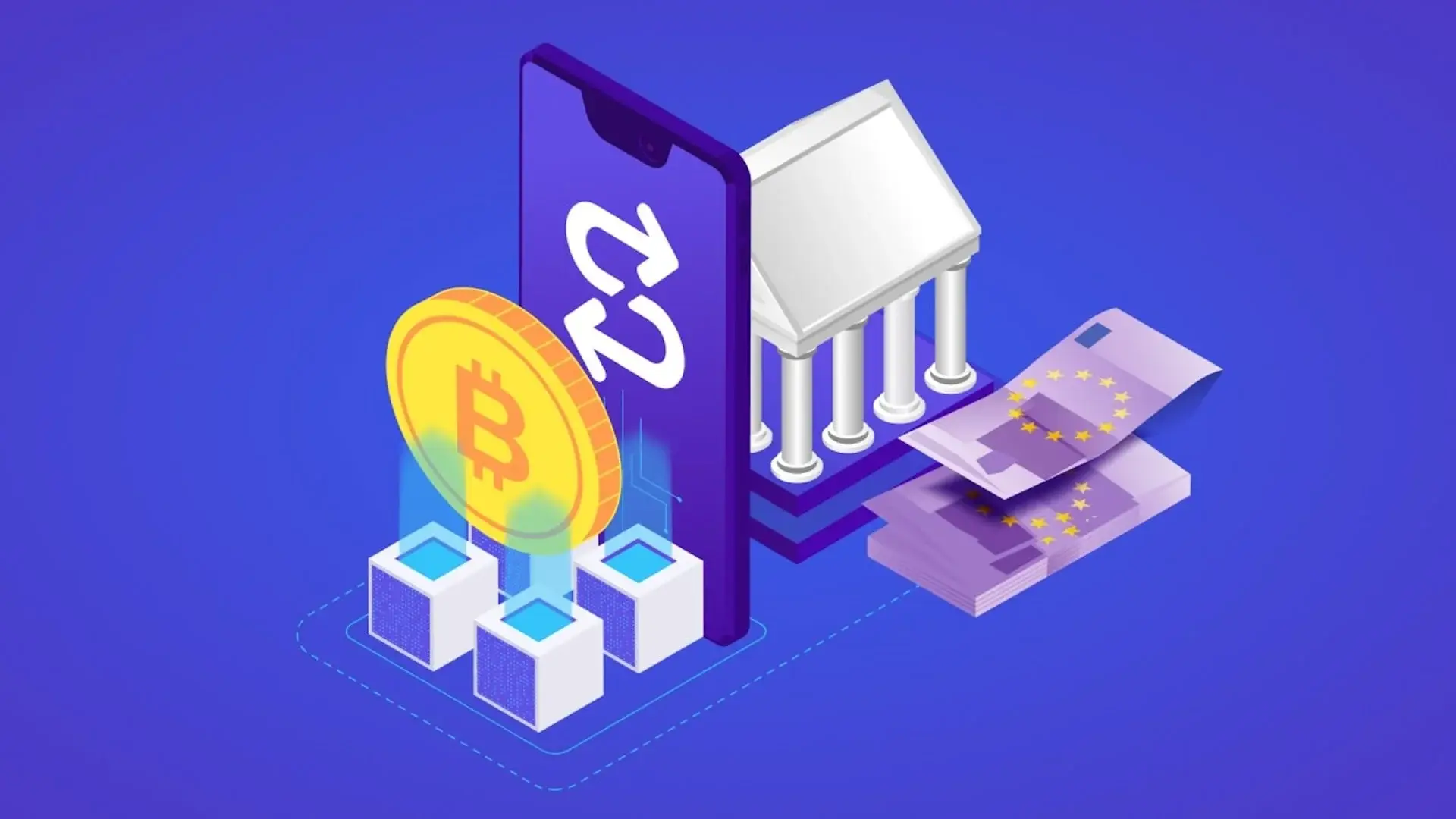
P2P exchange platform shown as a phone with a bitcoin coin beside a bank and a euro note.01
Pick it if: You want trading beside collectiblesP2P Exchange Script

Users swap crypto directly with each other while the operator runs the escrow step and settles disputes.

Explore Solution
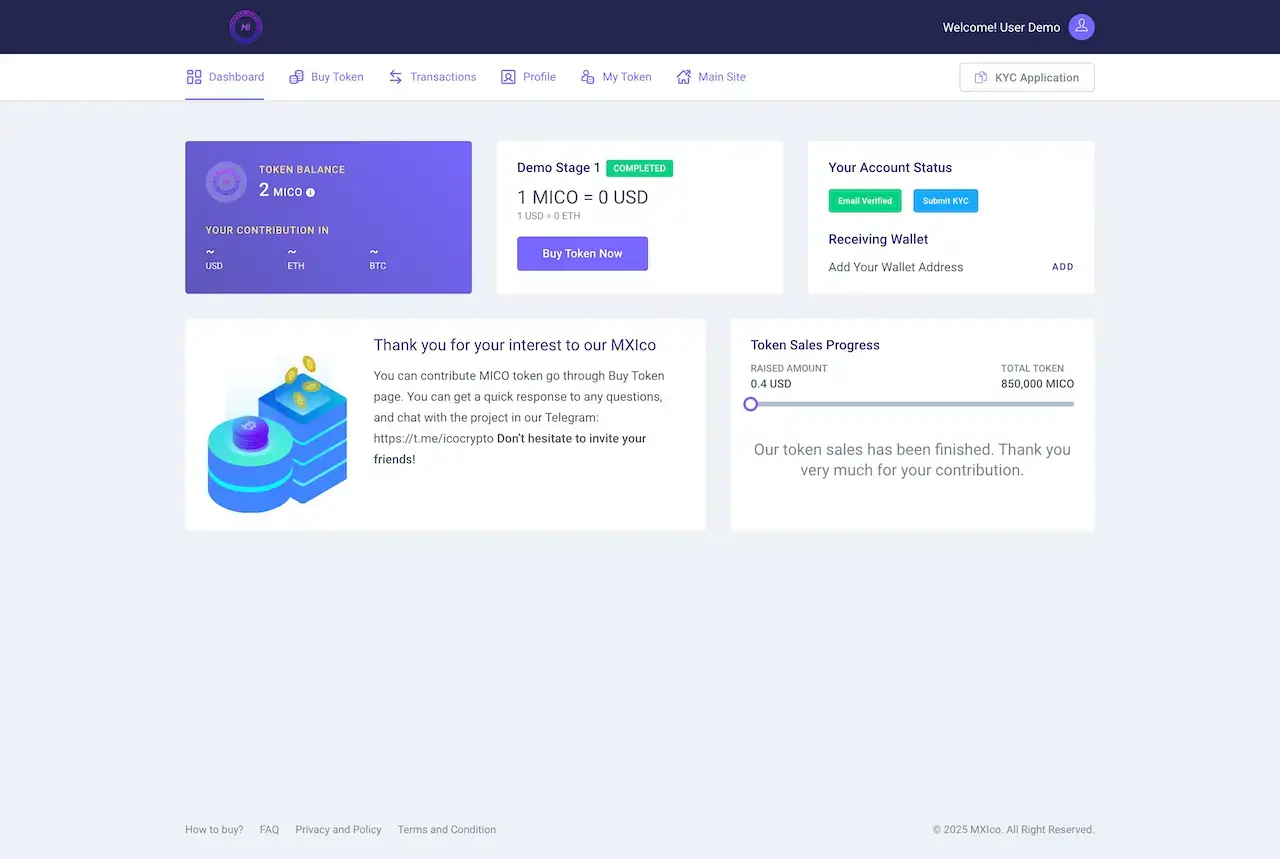
ICO Launchpad user dashboard with a token balance, a Buy Token Now button, an account status panel and token sales progress.02
Pick it if: Tokens are part of your launch planICO Launchpad Clone

Projects publish a token raise and a community takes part, all under an operator dashboard.

Explore Solution

A bitcoin coin standing on a laptop that shows a trading chart.03
Pick it if: Your users should also trade tokensGMX Clone

A trading product in the GMX mould, for operators who want a trading surface next to their collectibles business.

Explore Solution
CatalogAll 90+ solutions

09The money side

Market Benchmarks

NFT Marketplace Benchmarks - Independent 2025-2026 Data

The revenue models above are ours. The figures below are not. They are the fee pages of OpenSea and Rarible and the IRS digital assets guidance, reproduced as published. They show what the two best-known general-purpose NFT marketplaces charge sellers today and which tax reporting rules touch NFT sales, so you can test your own business case against sources you can check yourself.

OpenSea01

1% Seller Fee on OpenSea in 2026

OpenSea's help center, dated 12 May 2026, lists a 1 percent fee for selling NFTs, included in the price shown to buyers, and a 0 percent fee for swaps, with third-party provider fees possibly applying. Creator earnings are described as enforced or optional by collection, so the creator share is set per collection rather than by one platform rate.

Rarible02

2% Marketplace Fee on Rarible's Main Chains

Rarible's FAQ, last updated 1 September 2026, lists a marketplace fee of 2 percent of the sale price on Ethereum, Base and Polygon and 1.5 percent on Solana, deducted from the seller's proceeds, with no extra buyer fee. Creator royalties are set by the collection. Rarible states that Magic Eden and Tensor charge 2 percent on listings it aggregates.

IRS03

NFTs Named in IRS Digital Asset Reporting Rules

The IRS lists non-fungible tokens (NFTs) among digital assets and states that broker reporting on Form 1099-DA is required for transactions on or after 1 January 2025. For certain NFT sales, brokers may report on an aggregate basis to the extent the sales exceed respective de minimis thresholds. The page was last reviewed on 2 September 2026.

Where each figure comes from.

OpenSea, What fees do I pay on OpenSea?, help center, 12 May 2026 - support.opensea.io

Rarible, FAQ (Fees Summary), last updated 1 September 2026 - rarible.com

Internal Revenue Service, Digital assets, page last reviewed 2 September 2026 - irs.gov

All figures are the publishers’ own published fees and rules, reproduced as published. They describe what other marketplaces charge and what regulators say, not the performance of any platform Miracuves builds, and nothing here is a revenue projection for your business.

The Commercial Case

Marketability, Revenue Potential & Prospects for a Creator-First Marketplace

A creator marketplace built on Miracuves' Rarible clone earns once creators trust it enough to open shop and collectors trust it enough to make offers. What follows aims to make both decisions easier, and to keep the relationship alive after they are made.

  1. 01

    A Cut of Every Completed Sale

    You keep a percentage of each completed sale, so income scales with the number of creators and collectors, not with your payroll.

  2. 02

    Separate Controls, One Portal

    The fee, the royalty switch, the featured collection and the drop calendar are independent controls in a single admin portal, so tuning one never forces a redesign of another.

  3. 03

    A Community You Own

    Accounts, collections, follows, favorites and sales history stay in your database, which means the value you build belongs to your marketplace and to no platform above it.

  4. 04

    A Way Out

    The full source code and the schema are yours, so moving host, team or direction later asks nobody's approval.

Main Revenue Levers
  • Cut on Sales
  • Accepted Offers
  • Primary Drop Sales
  • Featured Collections
Long-Term Value

Creators and collectors make a marketplace hard to copy, more than any feature list.

  1. 01Creators with built collections and followers are slow to move
  2. 02Collectors with follows and watchlists keep returning
  3. 03The history sits in your own database from day one
  4. 04Verification and moderation earn a second layer of trust
Example Revenue Scenarios

Only the number of listing creators changes between these cases, and each names the lever that matters most at that size. Use them to start a planning conversation, not as a prediction of anything a marketplace will earn.

Boutique Collective10Creators Listing

Platform fee funds the early months.

Five to ten artists publish work, and the cut from completed sales covers the running costs. The size is illustrative and no forecast is implied.

Growing Community100Creators Listing

Fee income plus paid featured spots.

Creators now compete for visibility, so a paid featured slot becomes worth offering next to the platform fee. The size is illustrative and no forecast is implied.

Broad Catalog1,000Creators Listing

Fees, drops and featured spots combined.

Several categories are live, so the share of drop proceeds you agree with creators and the featured slots stack up beside the fee, while the admin tables show where to concentrate. The size is illustrative and no forecast is implied.

10Why Miracuves

Why Miracuves

Miracuves Against Other Rarible Clone Builders

Four roads lead to a marketplace: a generic script, a freelancer, a full agency build for Rarible clone script development, or a ready-made base from a team that has shipped one before.

Why Founders Choose Miracuves

  • 01

    Studio From Day One

    Creators get forms for NFTs, collections and drops immediately, so supply does not wait for a custom build.

  • 02

    Verification and Reports

    An admin verifies collections, and reports move through a queue where they are resolved with a takedown or dismissed.

  • 03

    Fees You Control

    The platform fee in basis points and the royalty switch share one Settings page and need no code change.

  • 04

    The Whole Codebase Is Yours

    The monorepo arrives unencrypted with the schema and contracts, so no one can reprice it or rewrite the terms afterwards.

  • 05

    Straight About Limits

    This page separates base features, add-ons and your own responsibilities, from audits and gas to hosting and legal review.

  • 06

    Signed Sign-In Included

    A nonce-checked wallet sign-in, roles and rate limits come with the base, and a security review is planned with you before launch.

Development Company

How to Choose a Rarible Clone Development Company

Have the vendor run Studio live, since creator marketplaces stand or fall on drops.

What to look for Miracuves

  • Creator tools you can watch Studio shown live on a call, from a royalty-bearing collection to an allowlist drop
  • Real drop controls One Studio form sets the window, supply, per-wallet caps and an approved-wallet list
  • Royalties settled in the sale ERC-2981 royalties paid by the marketplace contract, behind an admin switch
  • Moderation with a trail Reports resolved by takedown or dismissal, each action recorded
  • Code you own The whole monorepo, schema and contracts, unencrypted
  • Cover after launch Live in six working days, then three overlapping cover periods of up to a year

Walk away from any vendor who

  • Gives creators a mint button but no drop scheduler
  • Fixes the fee in code, so lowering it needs a developer
  • Promises royalties without paying them in the sale
  • Handles reports by email with no takedown trail
  • Licenses encrypted code or charges per seat

Rarible Clone Set Against Both Scripts and Agencies, Row by Row

Compare onMiracuvesMiracuves Rarible CloneOff-the-Shelf ScriptAgency Build
Launch speed6 days of our build timeUnknown, or DIYScoped per project, often months
Who owns the codeYou, complete and unencryptedOften limited or lockedUsually you
Tools for creatorsStudio forms for NFTs, collections and dropsOften just a mint buttonBuilt to order, extra cost
Fees and royaltiesFee and royalty switch in Settings, royalty per collectionOften fixed in codeBuilt to order
ContractsTwo contracts with a deploy script; contract review quoted on its ownDeployed by handBuilt and reviewed to order, extra cost
Admin toolingDashboard plus tables for collections, drops and usersThin or missingBuilt to order, extra cost
Verification and moderationVerified status and a report queue with takedownsSeldom presentBuilt to order
Price, pace and qualitySet price, fast delivery, proven foundationCheap but riskyCostly and slow
Help after launch60 days guidance, 6 months bug fixes, 12 months updatesSeldom offeredWhatever the contract says

Few routes get to a first real drop without a rewrite. Here is where they split.

Talk to Our Team

Let's build together

Let's turn your creator marketplace idea into a live platform.

Book a free call and you leave with a timeline, plain answers on wallets and fees, and a list of what you provide. Trust first, sale second.

  • Replies within 2 hours
  • Free first call
  • No lock-in contracts
  • You own the source code

11Keep reading

Blog & Resources

Reading List for Building an App Like Rarible: Guides & Insights

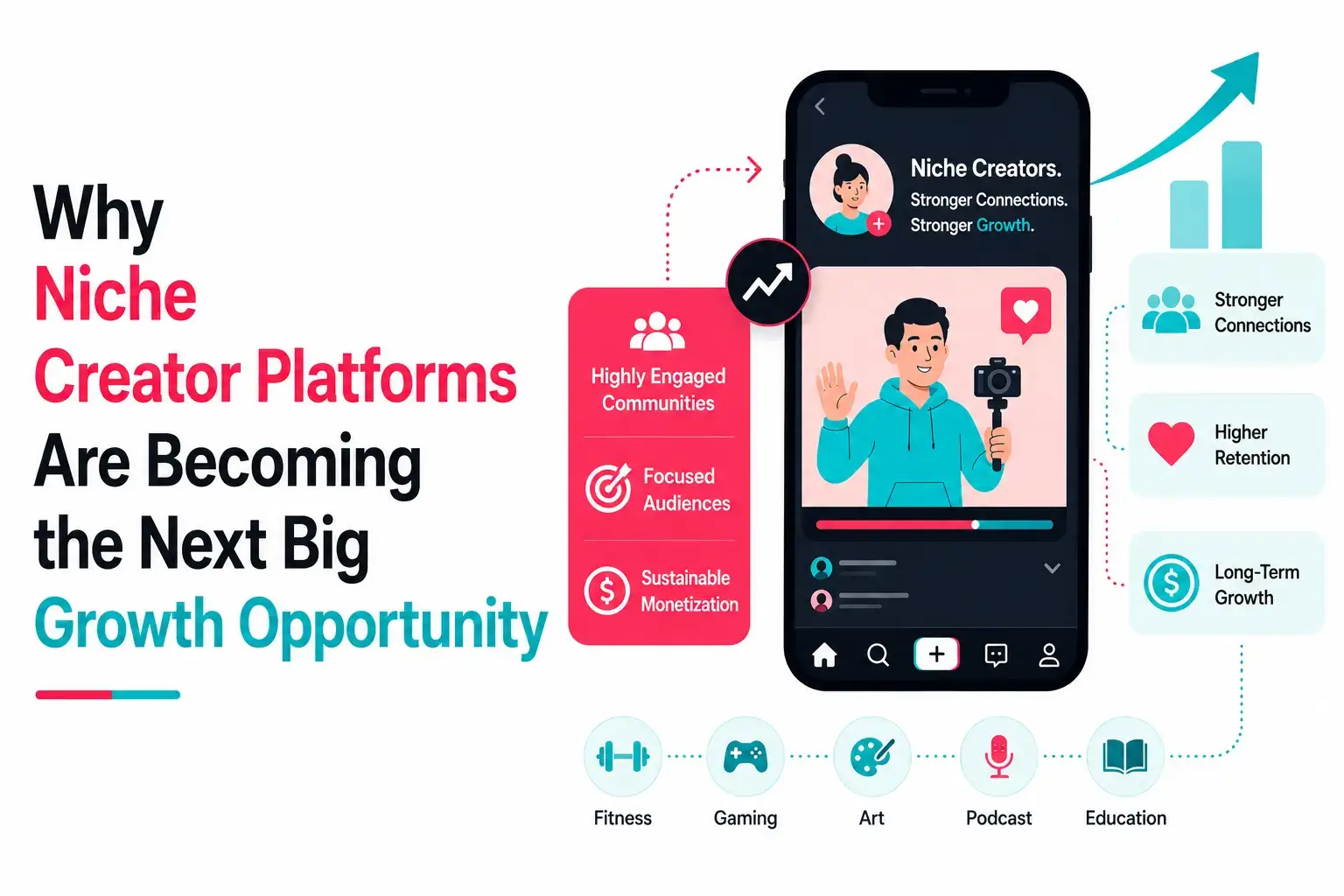
Fresh reading on what a Rarible-style script includes, why focused creator communities keep growing and where NFT marketplace apps are heading.

About the platform4 questions

01How does a Rarible clone differ from Rarible itself?

A Rarible clone follows the same creator-first pattern: creators publish collections, collectors discover pieces, make offers and purchase, and the operator collects a fee. Ours is a Next.js web app with Studio, an admin portal, a marketplace contract and a collection contract, white-labeled to your brand. It is a separate product. Nothing in it comes from the original, and it does only what this page describes, which is narrower than a very large public marketplace.

02What do I gain from running my own marketplace?

The platform fee is yours to set, as is the choice of which collections get verified and which niche you serve, and you own the relationships with creators and collectors along with the history that builds up. In return you carry moderation, takedown requests, taxes and any licences. A big shared marketplace is easier to join and offers reach; your own offers control.

03Can a non-developer run it day to day?

Yes for daily work: the admin portal handles collection verification, drops, reports, users and settings. Launch is different, because somebody has to be comfortable with wallets, a node or RPC provider and a PostgreSQL database. We provide documentation and the cover periods that come with every ready-made solution.

04Is launching a Rarible-style marketplace lawful?

Building and selling software that lets people create, list and trade NFTs is lawful in itself. What matters is how you use it: what may be created, whether a token counts as a security, how money moves, and the tax and consumer rules of your country. Ours shares no code, design or content with Rarible and runs under your name, so leave the Rarible name and logo out of your branding. Ask a lawyer in each market. Miracuves does not give legal advice.

Creating & trading6 questions

05How does a creator make an NFT or a collection?

After sign-in the creator opens Studio. Create NFT asks for a name, description, image link, an optional link to video, audio or 3D media, the collection and the chain. Create Collection asks for a name, symbol, description, chain, category, contract address, token standard, logo and banner, and adds royalty fields while royalties are switched on. Media is linked, not uploaded to your server, so the files stay wherever you host them.

06Which wallets can people sign in with?

The header has Connect Wallet for EVM wallets, which opens the standard wallet-connect modal, and Connect Solana for Solana wallets. Signing in means signing a short message that carries a one-time nonce, and the server checks the signature before it opens a session. Which wallet apps appear depends on the project ID and settings you supply at deployment.

07Who pays gas?

The blockchain charges network fees, not the marketplace, and the user's wallet pays them when someone transacts on chain. You pay gas once to deploy the contracts. The marketplace can add a platform fee, entered in basis points on the admin Settings page, and the marketplace contract limits its own fee to 10%.

08How do creator royalties work?

A collection can hold a royalty percentage and a recipient address, entered on Create Collection while the admin switch is on. The collection contract follows the ERC-2981 royalty standard, and the marketplace contract pays the royalty to the recipient when a listing sells. The contracts we ship target a local test network, and deployment to a real network is scheduled into your go-live plan.

09Can creators run timed auctions with bidding?

Timed auctions with bidding are built to your brief as custom work, priced in writing. The groundwork is already there, with an auction listing type in the data model and an On Auction filter in Explore, while fixed-price listings settle through the marketplace contract today.

10What does a drop with an allowlist involve?

The creator sets a start and end time, a total supply, a limit per wallet, a price and a currency, and decides whether the drop is public or restricted to an allowlist. Collectors find drops on the Drops page, and the admin portal lists every drop with its status and schedule. Mint payments are checked against the chain receipt before they are recorded.

Operator tools, fees & safety8 questions

11How far can I change the look and the behavior?

Rebranding is part of delivery: your logo, icons and colors go onto the website, the admin portal and the Android and iOS shell, and we deploy them. Settings covers the site name, support email, maintenance mode, feature flags and fee fields. Everything beyond the base gets a written scope and quote.

12Where do I manage fees and royalties?

On the Marketplace tab of admin Settings: an Enable Royalties switch, a platform fee and a referral fee, both in basis points. Each collection sets its own royalty percentage and recipient at creation. Timed auctions and recurring creator plans are not in the base.

13What protects users and the platform?

Wallet sign-in relies on a signed challenge that carries a one-time nonce, sessions have refresh tokens, sign-in attempts are rate limited, a CSRF token guards the payment endpoint and middleware sets a content security policy and other security headers. Users have a role of collector, creator, moderator or admin, and reports pass through a moderation queue with takedowns. A penetration test and a contract review join the launch calendar we build with you, with outside specialists quoted on their own.

14Does it run on more than one blockchain?

There is an EVM connect button and a Solana connect button, the Studio forms list Ethereum, Polygon, Solana and BNB Chain, and the NFT form lists more. The contracts we ship are EVM contracts. We confirm in writing at order which networks your package covers, and we do not claim that NFTs move between chains.

15Were the smart contracts audited?

The contracts use standard OpenZeppelin parts, a reentrancy guard and a fee cap, and come with tests. Whenever your sale calls for it, an independent review can be booked next to the move to a real network.

16Does the price cover KYC or identity checks?

No. The database contains tables meant for KYC records, sanctions screening results and tax exports, with compliance routes alongside, but connecting a provider to fill them is scoped at order and sits outside the base price. Identity checks alone do not meet anti-money-laundering rules, which vary with your country and activity.

17How soon can a creator marketplace expect its first revenue?

The first completed sale earns the platform fee, which is why most marketplaces start there. Drops open a second route once a creator brings an audience, and featured slots can follow when traffic justifies a price. Partner deals and licensing the white-label build to another operator are arrangements you negotiate, and creator royalties are a cost to budget for, paid out of each sale.

18What makes a creator marketplace hard to copy?

Creators and collectors make a marketplace hard to copy, more than any feature list. Creators who have built collections and followers are slow to move, and collectors with follows, favorites and watchlists keep coming back. Since all of that history sits in your own database from day one, it compounds in your favor, and trust earned through verification and moderation adds a layer that rivals cannot simply download.

Launch & working with Miracuves12 questions

19What is the launch time and the total cost?

You pay a fixed $4,299, and our build takes 6 working days, including rebranding and deployment to your hosting. Gas, hosting, a database, outside services and any contract audit are extra, and anything beyond the base gets a written scope and quote first.

20What must I bring to the project?

Hosting and a domain, a PostgreSQL database, your logo and brand details, a node or RPC provider, a wallet-connect project ID, gas for contract deployment, an email service, and legal documents of your own, for example terms and a privacy policy. Drafting them and applying for licences is not part of our work.

21Is there a mobile app?

There is an Android app that opens your marketplace full-screen behind a splash screen, and the site itself works on a phone. An iOS app comes in the package too, wrapping the same marketplace. Apple and Google handle store review outside our 6-day build, and publishing happens from your own developer accounts.

22Which optional modules can be added later?

Scaling on a layer 2 network, an AI rarity score, NFT staking and farming, and a loyalty and gamification layer can all be added, each with its own price. None belongs to the base, and neither do timed auctions with bidding.

23What help do I get after launch?

From launch day, three support windows overlap. Dedicated platform guidance lasts 60 days, priority bug resolution 6 months and continuous product evolution 12 months. You hear back within 2 hours, between 10:00 and 19:00 IST, Monday to Saturday.

24Do I keep the complete source code?

Yes. You receive the complete monorepo, unencrypted: the web app and admin portal, API routes, shared packages, Solidity contracts and the database schema with migrations, to change yourself or hand to another team.

25Why pick Miracuves for a Rarible clone?

Studio, drops, royalties, offers and the admin portal come ready to run, and this page separates base features from add-ons and from your own responsibilities. Software has been Miracuves' business since 2010, with 9,000+ projects done for 6,000+ clients and 90+ ready-made solutions on offer. The case for it: a fixed $4,299 price, launch inside 6 working days, and three support periods covering 60 days of guidance, 6 months of priority bug fixes and 12 months of product updates.

26Is a ready-made Rarible clone better than custom development?

For a creator-first marketplace it usually is. Studio, scheduled drops with allowlists, collection royalties, offers and the admin portal are working in the Rarible Clone, a fixed $4,299 with a six-working-day build. Commissioning that from a Web3 agency means designing contracts and creator tools before testing them, under a written quote. Buy the base and add scaling, rarity scoring, staking or loyalty only when your creators need them.

27What is the business model of a creator marketplace like Rarible?

Income comes from a few separate places. A percentage in basis points is taken on every completed sale, accepted offers included, and you can lower it to attract creators without touching code. Drops and featured slots are sold as arrangements you agree with creators and brands. Royalties flow to the creators who set them, which is what keeps them listing with you.

28What is the step-by-step process to launch my Rarible clone?

Open the demo, create an NFT in Studio and schedule a test drop. Then send your logo and brand details, hosting and domain, a PostgreSQL database and your RPC and wallet-connect details. We rebrand the website, admin portal and Android and iOS apps, deploy on your hosting and help you put the contracts on chain from your own wallet. Your marketplace is ready after six working days of build time.

29How does an NFT platform like Rarible work?

Creators publish collections, collectors discover pieces, make offers and buy, and the operator collects a fee. People sign in with a wallet by signing a short message, and fixed-price listings settle through the marketplace contract, which pays the creator royalty to the recipient when a piece sells. The operator runs daily work from the admin portal.

30Can I try the Rarible clone demo before I buy it?

Yes. The marketplace website and the Android app are open to try right now. Studio and the admin portal sit behind a wallet sign-in, so we unlock them for you on a short call. The demo shows the platform as a collector first, as a creator second and as the operator last.

Disclaimer

Miracuves is an independent software development company. We are not affiliated with, connected to, sponsored by, or endorsed by Rarible.

Read our full Legal Notice & Disclaimer →
Why this name

“Rarible Clone” is used descriptively. It is how the software industry refers to building a platform with functionality similar to Rarible, and how clients search for it.

Who built this

The entire design and codebase is built by our own team. The product contains no code, design, graphics, or content originating from the Rarible website or applications.

Trademarks

Rarible and all other third-party names and marks are the property of their respective owners, referenced here solely to describe the category of software offered.