



Grab App Development Cost : Complete Price Guide
Create a powerful, customizable streaming solution with Miracuves’ Grab, equipped with high-performance features and next-gen technology.
A Grab-style app is not just another ride-booking platform — it’s a multi-service ecosystem combining transportation, food, payments, courier, and financial services. That level of functionality requires powerful backend systems, real-time features, and regulatory compliance. This makes the Grab app development cost a key factor in shaping your business roadmap.
To better understand what goes into creating such a platform, you can also explore how a Grab clone app works — especially if you’re considering a white-label or customizable base that helps you launch faster at lower cost.
In this guide, we’ll break down the Grab app development cost for 2025, covering key cost factors, regional variations, app complexity, and proven strategies to optimize your budget.
Key Factors That Influence Grab App Development Cost
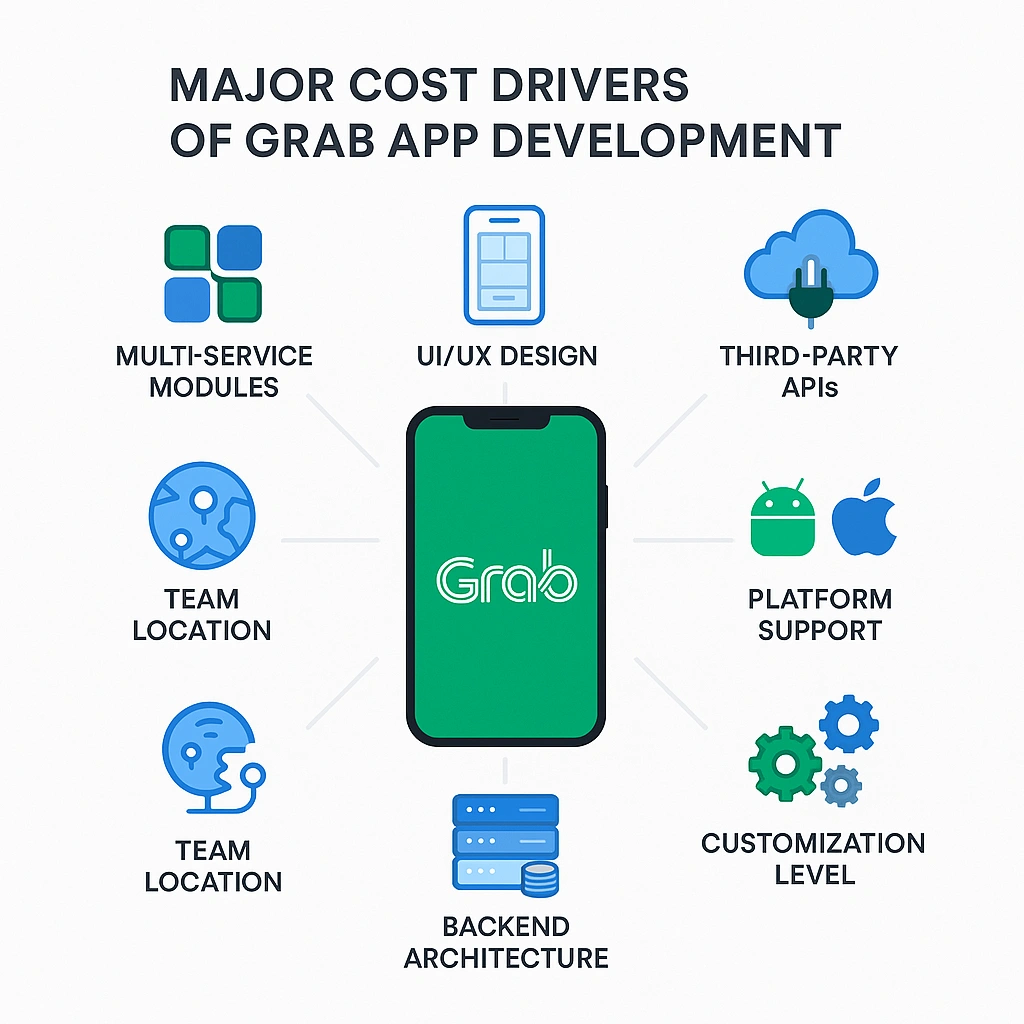
Your total budget depends on the scale of services and the technology stack you choose. The main cost drivers are:
Multi-Service Modules → Ride-hailing, food delivery, and payments form the core. Expanding to courier, groceries, or lending services increases cost.
UI/UX Design → Super apps require intuitive dashboards for customers, drivers, merchants, and admins. Clean design and smooth navigation add cost.
Third-Party Integrations → Maps, payment gateways, OTP login, cloud storage, and analytics tools all come with setup fees and recurring charges.
Platform Support → Supporting Android, iOS, and web apps increases build time and budget. Cross-platform frameworks like Flutter help cut costs.
Customization Level → White-label Grab clone apps offer speed and affordability, while fully custom builds are flexible but costly.
Backend Architecture → Real-time tracking, microservices, and high user concurrency demand a robust and scalable backend.
Team Location → Developer hourly rates vary widely across regions, making location a key factor in total cost.
Grab App Development Cost by App Complexity
The cost of developing a Grab-style app depends on whether you’re building a lean MVP or a full-featured super app.
|
App Type
|
Estimated Cost Range (USD)
|
Description
|
|---|---|---|
|
MVP (Minimum Viable Product)
|
$12,000 – $25,000
|
Basic matching, user registration, profiles, messaging, and swipe functionality
|
|
Standard Version
|
$25,000 – $60,000
|
Add premium filters, likes, push notifications, social logins, geolocation features
|
|
Full-Featured App
|
$60,000 – $120,000+
|
Includes video/audio chat, AI recommendations, subscriptions, analytics, admin panel
|
Note: These are development-only estimates. Hosting, marketing, and third-party service fees are separate. Want a scalable solution? Miracuves offers modular Grab clone apps that grow with your business.
Grab-Style Super App Development Cost by Miracuves (2026 Pricing)
When considering Grab Clone app development, understanding the potential cost across different build stages helps you plan your budget effectively. Whether you’re launching a lean MVP or a full-featured super app, feature scope and integrations can influence overall effort. Below is a clear breakdown of typical pricing stages—ending with Miracuves’ fixed package price.
|
App Type
|
Estimated Cost Range (USD)
|
Description
|
|---|---|---|
|
MVP (Minimum Viable Product)
|
$999 – $1,499
|
Core modules such as user onboarding, rider/driver profiles, service booking (ride/delivery), basic tracking, essential UI, and standard notifications—ideal for validating demand quickly.
|
|
Standard Version
|
$1,500 – $2,099
|
Adds real-time GPS upgrades, in-app chat/call, payment gateway setup, promo codes, ratings/reviews, service zone management, and a stronger admin panel—better for early-stage scaling.
|
|
Full-Featured App
|
$2,899 (Miracuves)
|
Complete Grab-style ecosystem with advanced dispatch, multi-service support (ride + delivery), wallet, multi-language, analytics, admin controls, vendor/driver management, and web + app integration—built for scale and long-term growth.
|
Note: These are development-only estimates. Hosting, marketing, and third-party service fees are separate. Want a scalable solution? Miracuves offers modular Grab clone apps that grow with your business.
Average Cost Estimates by Region
The region of your development partner has a major impact on cost.
|
Region
|
Hourly Rate (USD)
|
Typical Cost for Standard App
|
|---|---|---|
|
North America
|
$100 – $200/hr
|
$100,000 – $200,000+
|
|
Western Europe
|
$80 – $150/hr
|
$80,000 – $160,000+
|
|
Eastern Europe
|
$40 – $80/hr
|
$40,000 – $90,000+
|
|
India & Southeast Asia
|
$20 – $50/hr
|
$20,000 – $60,000+
|
Note: Estimates cover development, testing, and deployment, not infra or marketing.
Want cost-effective results? Miracuves’ offshore teams in Asia deliver secure, high-performance Grab clone apps at affordable rates.
Cost Breakdown by Development Stage: Grab Clone
Here’s how the total cost typically distributes across development stages:
|
Development Stage
|
Estimated % of Total Cost
|
Includes
|
|---|---|---|
|
Discovery & Planning
|
5–10%
|
Market research, competitor analysis, defining user personas, feature scoping, technical requirements.
|
|
UI/UX Design
|
10–15%
|
Wireframing, prototyping, responsive design, visual branding, user experience mapping.
|
|
Frontend & Backend Dev
|
40–50%
|
Core feature development, database architecture, APIs, payment integrations, dashboard and logic build.
|
|
Testing & QA
|
10–15%
|
Manual and automated testing, bug fixing, device/browser compatibility checks, performance tuning.
|
|
Deployment & Launch
|
5–10%
|
App store submission (Android/iOS), server setup, production deployment, performance monitoring tools.
|
|
Maintenance & Updates
|
10–20%
|
Post-launch bug fixes, new features, server maintenance, user support, compliance updates.
|
How to Reduce Grab App Development Costs (Without Compromising Quality)
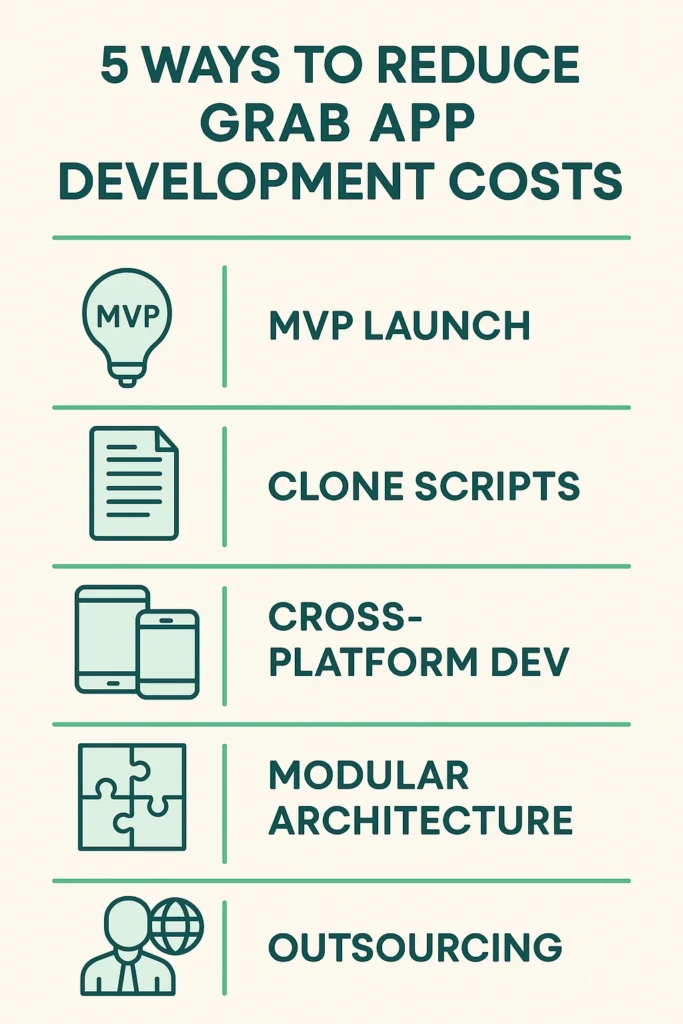
Building a super app is resource-intensive, but smart strategies help optimize your budget:
Start with an MVP → Focus on core services first, expand gradually.
Use Clone Solutions → A Grab clone script reduces cost by 30–40% and shortens launch time.
Cross-Platform Development → Flutter/React Native saves effort with one codebase.
Modular Architecture → Scale services independently without rebuilding the app.
Outsource Smartly → Teams in India & Eastern Europe combine affordability with expertise.
Choose the Right Development Partner
Even with planning and funding, building a Grab-style super app is a massive project. Your development partner defines your speed, quality, and scalability.
Look for:
Proven experience in super app development (rides, delivery, payments).
Portfolio of real-time apps with tracking, chat, and merchant services.
End-to-end support — from planning to post-launch maintenance.
Strong commitment to compliance, data security, and scalability.
At Miracuves, we build scalable, secure, and cost-effective Grab clone apps. Our ready-made solutions help founders launch fast, validate their model, and scale sustainably.
Conclusion
The Grab app development cost in 2026 ranges from $25,000 MVP builds to $250,000+ enterprise-grade super apps. The actual cost depends on features, complexity, and development region.
By starting lean with an MVP or leveraging a white-label Grab clone app, you can launch faster, reduce risk, and scale on demand.
Ready to launch your Grab-style super app? Talk to Miracuves today for a tailored roadmap and cost breakdown — built around your business goals.
Frequently Asked Questions
With Miracuves, a Grab-style app starts at $2,899. We deliver a launch-ready build in 3–9 days only, including setup, testing, and deployment.
With Miracuves, a Grab clone app is built and delivered in 3–9 days only, including setup, testing, and deployment (timelines may vary slightly based on selected features).
Yes. Many startups launch with ride-hailing + delivery modules, then expand into payments and logistics.
Yes. Clone scripts lower development cost by up to 40% and speed up time-to-market.
Plan for hosting, server scaling, maintenance, security, and updates, usually 15–20% of dev cost per year.