


Key Takeaways
- Remittance funnel optimization helps money transfer platforms improve signup, KYC completion, first transfer conversion, and repeat usage.
- The strongest funnel is not only about getting more app installs; it is about helping users move from interest to verified account to successful first transfer.
- Important funnel stages include landing page visit, signup, identity verification, recipient setup, fee check, payment initiation, payout confirmation, and repeat transfer.
- Small improvements in onboarding, KYC guidance, fee transparency, reminders, and trust signals can increase conversion across the full user journey.
- Long-term growth depends on activation quality, compliance speed, payment reliability, corridor trust, customer support, and retention after the first successful transfer.
Funnel Optimization Signals
- Signup conversion improves when the form is short, trust-building is clear, mobile flow is simple, and users understand why information is required.
- KYC completion improves when users get clear document instructions, real-time status updates, error guidance, and reminders through SMS or email.
- First transfer conversion depends on transparent fees, exchange rate clarity, recipient setup ease, payment method availability, and payout confidence.
- Activation quality can be measured through verified users, funded wallets, added recipients, transfer attempts, successful payouts, and first-repeat transfer behavior.
- Retention improves when users receive timely transfer updates, corridor-specific offers, referral prompts, support access, and personalized reminders for future transfers.
Real Insights
- A remittance funnel usually fails when users lose trust, face unclear KYC steps, see hidden costs, or do not feel confident sending money.
- Founders should track every drop-off point instead of treating signup, KYC, payment, and payout as separate product problems.
- The first successful transfer is the most important activation moment because it proves trust, speed, pricing, and payout reliability together.
- Compliance and conversion should work together; strict KYC can still feel smooth when the app explains steps clearly and reduces uncertainty.
- The best remittance funnel strategy combines simple onboarding, transparent pricing, guided KYC, reliable payment rails, strong notifications, and repeat-transfer triggers.
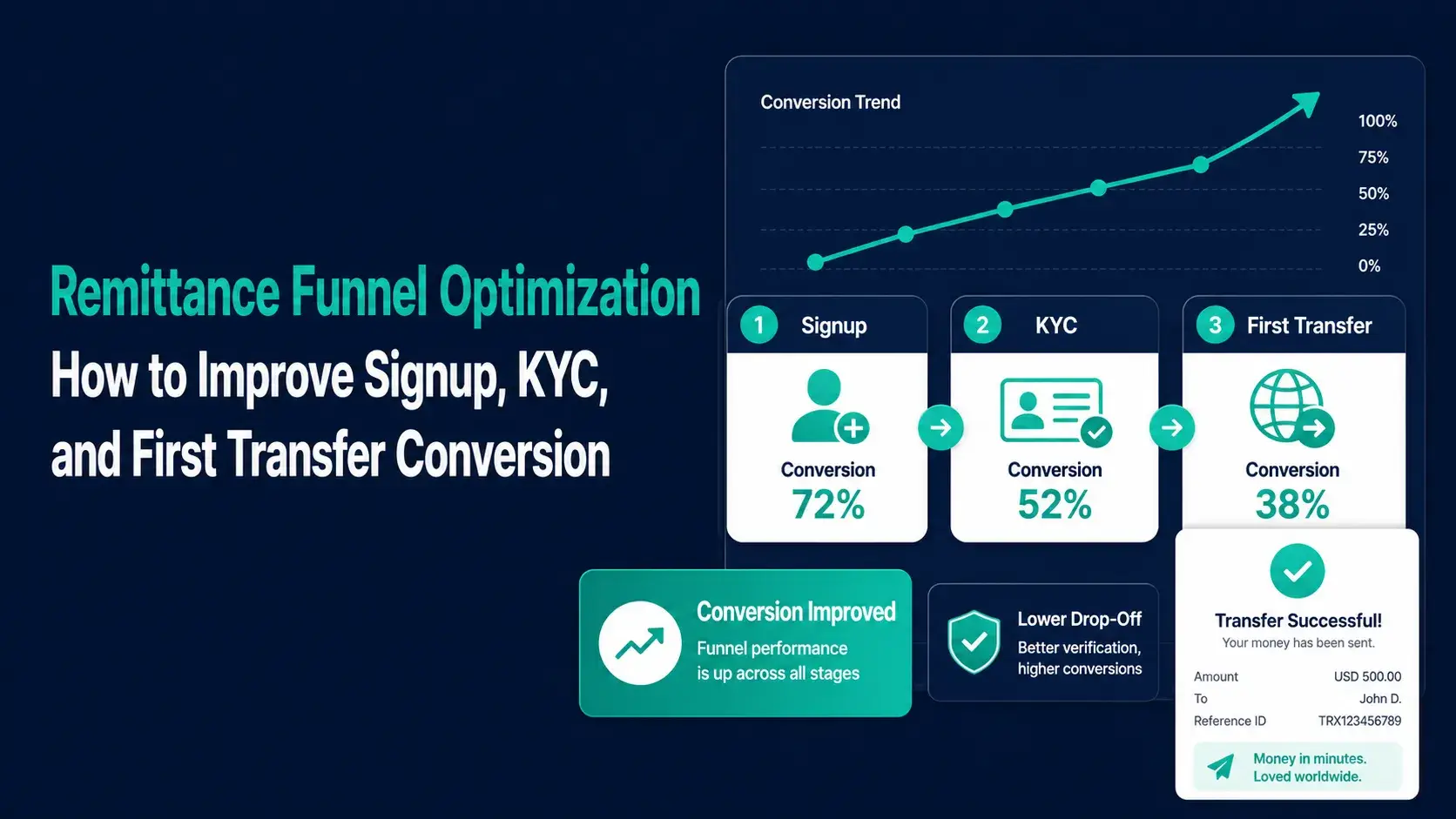
Remittance funnel optimization is the process of improving how users move from first app visit to signup, KYC completion, beneficiary setup, and their first successful money transfer.
For a remittance startup, the most important conversion event is not the app install. It is not even account creation. The real business milestone is the first successful transfer because that is where the user experiences value, the platform earns trust, and the business starts building repeat transaction behavior.
This matters because remittance is a high-intent but high-friction category. Users may urgently need to send money to family, pay education fees, support relatives, or move funds across borders. But before they can send money, they must pass identity checks, understand exchange rates, add recipient details, choose a payout method, and trust the platform with sensitive financial information.
The World Bank estimated remittance flows to low- and middle-income countries at $685 billion in 2024, showing why even small funnel improvements can matter in a large cross-border money movement market. For founders building a remittance app, improving conversion is not just a marketing task. It is a product, compliance, operations, lifecycle messaging, and admin analytics challenge.
Miracuves helps founders build fintech and remittance app foundations where signup, KYC, wallet logic, transaction flows, admin control, and user communication are planned as one connected product journey.
Why Remittance Funnel Optimization Matters More Than Signup Growth
Many fintech teams celebrate signup growth too early. A user who creates an account but never completes KYC is not active. A user who completes KYC but never sends money is still not delivering revenue. In remittance, the real funnel should be measured around movement toward the first successful transfer.
A basic remittance funnel usually looks like this:
| Funnel Stage | User Action | Business Meaning | Common Risk |
|---|---|---|---|
| Visit or install | User lands on app or website | Acquisition worked | Weak value proposition |
| Signup | User submits phone/email | Lead captured | OTP issues, long forms |
| KYC start | User begins verification | Trust barrier begins | Document anxiety |
| KYC approval | User passes checks | Compliance milestone | Delays, unclear status |
| Beneficiary setup | User adds recipient | Transfer intent becomes real | Form complexity |
| Quote view | User sees fee and exchange rate | Price comparison moment | Hidden fee concerns |
| Payment source | User funds transfer | Commitment point | Bank/card failure |
| First transfer | Money is sent successfully | Activation and revenue event | Low confidence, poor guidance |
Recent fintech onboarding discussions make a useful distinction: KYC completion is a compliance milestone, but the first funded action or transfer is the revenue milestone. That distinction is especially important for remittance products because users often compare fees, FX rates, payout speed, and trust before committing.
For founders, the key question is not “How many users signed up?” It is “How many signed-up users completed KYC, added a beneficiary, saw a quote, funded a transfer, and sent money successfully?”
What a Healthy Remittance Funnel Actually Looks Like
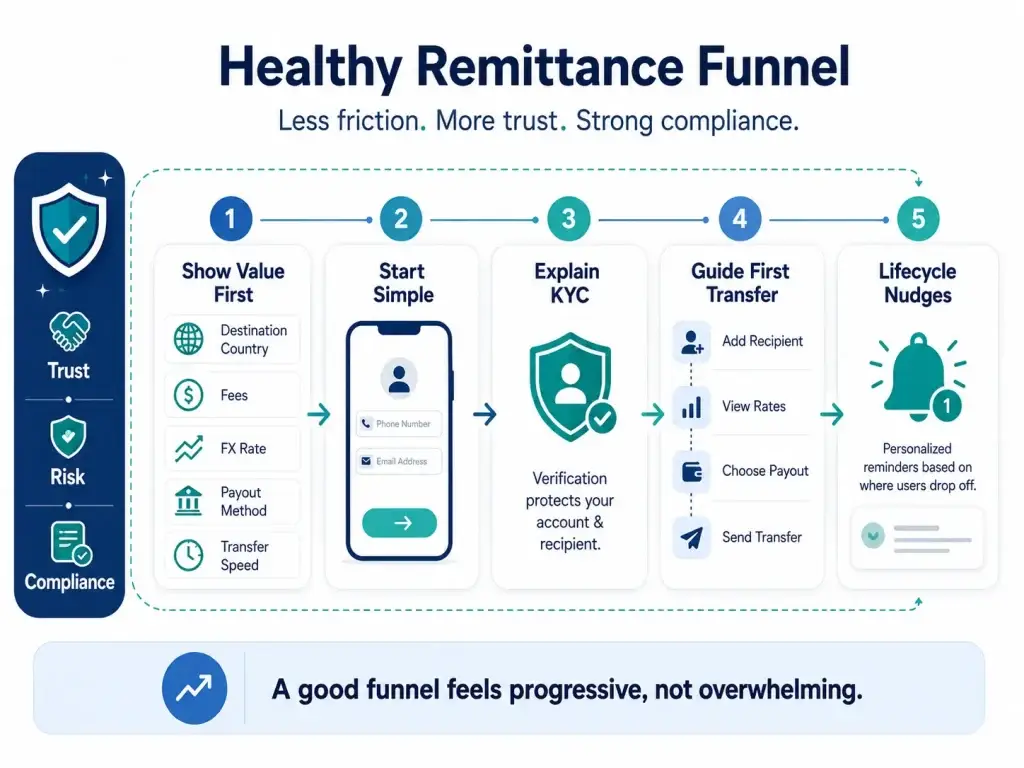
A healthy remittance funnel removes unnecessary friction while keeping the trust, risk, and compliance layers strong. Fintech onboarding cannot be treated like a social media signup flow because the user is sharing identity documents, financial details, recipient information, and payment instructions.
A better remittance funnel should feel progressive:
- Show value before asking for too much data
Let users check destination country, estimated fees, exchange rate, payout method, and transfer speed before long forms. - Ask only what is needed at the right moment
Collect phone/email first. Then request identity information when the user is ready to unlock transfers or higher limits. - Explain why KYC is required
Users are more likely to continue when the app explains that verification protects their account, transfer limits, and recipient safety. - Make the first transfer path visible
After KYC, the app should immediately guide users to add a recipient, view rates, select payout, and complete their first transfer. - Use lifecycle nudges based on behavior
A user who stops during document upload needs a different message than a user who completed KYC but did not start a transfer.
Appinventiv’s recent money transfer app guide highlights that compliance shapes product behavior, including onboarding flows and how quickly users can start sending money. This is why remittance funnel optimization should be planned with product, compliance, growth, and operations teams together.
Read More : The Hidden Cost of Remittance Compliance: Budgeting for KYC, AML, Screening, and Audits
Where Users Drop Off in Remittance Apps and Why It Happens
Drop-off usually happens when the user loses trust, effort feels too high, or the next step is unclear.
| Drop-Off Point | Why Users Leave | Optimization Opportunity |
|---|---|---|
| Signup form | Too many fields too early | Use phone/email-first onboarding |
| OTP verification | SMS delay or code failure | Add resend logic, alternate channel, timer clarity |
| KYC start | User does not understand why documents are needed | Explain benefits, limits, and security clearly |
| Document upload | Camera issues, file rejection, unclear instructions | Add examples, preview, retry guidance |
| KYC pending | No status update | Show progress, expected review logic, support option |
| Beneficiary form | Too many recipient fields | Use country-specific form logic |
| Quote screen | Fees or FX unclear | Show transparent fee, FX rate, delivery speed |
| Payment source | Card/bank failure | Offer alternate payment methods |
| First transfer | User hesitates before payment | Use trust cues, incentives, reminders |
The strongest funnel improvements usually come from identifying the exact stage where users stop. Without event-level tracking, teams end up redesigning screens based on assumptions.
How to Improve Signup Conversion Without Weakening Trust
Signup should be fast, but not careless. In remittance, users need to feel that the platform is secure before they share financial information.
A better signup flow should include:
- Phone number or email-first registration
- Fast OTP delivery with retry logic
- Clear country and corridor selection
- Early preview of fees, FX rate, and transfer speed
- Visible security reassurance
- Simple explanation of what happens next
Avoid asking for every personal detail before showing value. If the user has not yet seen the exchange rate, payout options, or transfer promise, a long form can feel like a demand rather than a service.
Founder decision logic
If users drop before OTP, the problem may be acquisition quality, weak landing-page messaging, or poor phone/email capture. If users pass OTP but stop before KYC, the problem is likely trust, perceived effort, or unclear value.
How to Reduce KYC Drop-Off With Better Sequencing and Status Design
KYC is one of the most sensitive parts of the remittance funnel. Users may worry about privacy, document misuse, rejection, or how long approval will take. KYC vendors and fintech onboarding resources repeatedly frame verification as a conversion issue, not just a compliance workflow.
A stronger KYC flow should include:
| KYC Element | Better Conversion Approach | Founder Impact |
|---|---|---|
| KYC explanation | Tell users why verification is required | Builds trust before document upload |
| Document capture | Show sample image and common rejection reasons | Reduces failed attempts |
| Progress state | Show “submitted,” “under review,” or “action needed” | Reduces confusion and support tickets |
| Retry flow | Let users fix failed documents quickly | Saves users from restarting |
| Risk-based steps | Request additional checks only when needed | Reduces unnecessary friction |
| Support access | Offer help during failed verification | Prevents silent abandonment |
KYC should not feel like a dead end. It should feel like a guided process.
Compliance caveat
A remittance app should support KYC, AML, transaction monitoring, audit logs, and user verification workflows. Final compliance depends on jurisdiction, legal review, integrations, operating model, licensing, and payment partners. Miracuves positions fintech security as a product foundation, not a marketing add-on, and uses compliance-ready language rather than unsupported compliance guarantees.
How to Increase First Transfer Conversion After KYC Approval
Many remittance apps lose users after KYC approval because the experience stops at verification. The app says “approved,” but does not guide the user toward the first transfer.
That is a costly mistake.
Once the user is verified, the app should immediately create momentum:
- Show a clear next step
“Add your recipient” is stronger than a generic dashboard. - Pre-fill what the app already knows
Use the selected destination country, preferred currency, and previous corridor intent. - Make the quote easy to compare
Display transfer amount, recipient amount, exchange rate, transfer fee, payout method, and expected delivery time. - Reduce beneficiary anxiety
Confirm recipient details before payment. Allow users to review bank/mobile wallet fields. - Use first-transfer reassurance
Show transaction tracking, receipt availability, support access, and cancellation/refund rules where applicable. - Place incentives at the commitment point
A first-transfer fee waiver works better when shown near quote or payment confirmation, not hidden in a generic promo banner.
First-transfer conversion table
| Lever | Example | Why It Works |
|---|---|---|
| Fee waiver | “No transfer fee on your first transfer” | Reduces price hesitation |
| FX lock | “Rate locked for 15 minutes” | Creates urgency without pressure |
| Recipient shortcut | Save beneficiary for repeat transfers | Builds repeat behavior |
| Transfer tracking | Status updates after payment | Builds trust |
| Corridor-specific prompt | “Send to Philippines bank account” | Makes the flow feel relevant |
| Support reassurance | “Need help? Chat before sending” | Reduces high-risk hesitation |
The goal is not to push users aggressively. The goal is to remove uncertainty before the first transfer.
SMS, Email, WhatsApp, and Push Timing for Remittance Activation
Lifecycle messaging should match funnel behavior. A generic “complete your profile” message is weaker than a message triggered by the exact point where the user stopped.
| User Behavior | Recommended Channel | Timing | Message Angle |
|---|---|---|---|
| Signed up but did not start KYC | SMS or WhatsApp | 10–30 minutes | “Verify to start sending money” |
| Started KYC but abandoned upload | Push + email | 30–60 minutes | “Continue your verification securely” |
| KYC submitted but pending | Email or in-app | Immediately + status updates | “We’re reviewing your verification” |
| KYC approved but no beneficiary | Push | Within 15 minutes | “Add your recipient to start your first transfer” |
| Beneficiary added but no quote | Push/SMS | 1–3 hours | “Check today’s rate before sending” |
| Quote viewed but no payment | Push/SMS | 15–60 minutes | “Your rate may change soon” |
| First transfer completed | Email + push | Immediately | “Your transfer is being processed” |
| No second transfer | Email/WhatsApp | Based on corridor cycle | “Send again to saved recipient” |
Timing principles
Do not send all channels at once. Start with the lowest-friction reminder and escalate only when the user shows strong intent. A user who viewed a quote but did not pay is more valuable than a user who only installed the app. The message timing should reflect that.
Read More : Referral Programs for Remittance Apps: How to Design Incentives That Drive User Growth
Incentive Design That Improves First Transfer Without Training Users to Wait for Discounts
Incentives can improve first transfer conversion, but poorly designed incentives can damage margins or attract low-quality users.
Better incentive options include:
- First transfer fee waiver
- Limited FX markup reduction
- Referral credit after completed transfer
- Recipient-side payout bonus where legally and operationally supported
- Corridor-specific promotion
- Cashback credited after successful transaction
- Loyalty credit for second transfer
Avoid giving incentives too early. If the user has not completed KYC or selected a corridor, the incentive may not create real action. Place the incentive close to the first transfer decision.
Better incentive logic
| Funnel Stage | Weak Incentive | Stronger Incentive |
|---|---|---|
| App install | Generic signup bonus | Show value first, then unlock first-transfer offer |
| KYC start | Discount before trust is built | “Verify to unlock your first-transfer fee waiver” |
| Quote screen | Hidden promo code | Auto-applied first transfer benefit |
| After first transfer | No follow-up | Referral or repeat-transfer credit |
The strongest incentive is not always the biggest discount. Often, transparent pricing, a clear exchange rate, fast payout confidence, and transfer tracking convert better than aggressive promotion.
Founder Decision Signals for Remittance Funnel Optimization
Founder Decision Signals
Speed
If users need too many steps before seeing transfer value, signup may grow while first transfer conversion stays weak.
Cost
Every KYC abandonment wastes acquisition spend. Funnel optimization protects paid marketing budgets by moving more users toward revenue events.
Scalability
Manual review, unclear status, and weak admin controls become operational bottlenecks as user volume grows.
Market Fit
First transfer behavior reveals whether users trust the corridor, price, payout method, and product experience enough to transact.
Admin Dashboard Metrics Founders Should Track
Remittance funnel optimization is impossible without admin visibility. Founders need to know not only how many users signed up, but where they stopped and why.
A useful admin dashboard should track:
| Metric | Why It Matters |
|---|---|
| Signup completion rate | Shows top-of-funnel quality |
| OTP success rate | Identifies technical delivery issues |
| KYC start rate | Shows whether users trust the verification step |
| KYC completion rate | Measures identity verification friction |
| KYC rejection reasons | Helps improve document guidance |
| Average KYC approval time | Shows operational bottlenecks |
| Beneficiary creation rate | Measures movement toward transfer intent |
| Quote view rate | Shows pricing and corridor interest |
| Payment attempt rate | Measures buying commitment |
| Payment failure rate | Reveals gateway or funding issues |
| First transfer completion rate | Measures activation |
| Repeat transfer rate | Shows retention and product trust |
| Message open/click rate | Measures lifecycle campaign quality |
| Corridor-level conversion | Shows which country routes need optimization |
For a remittance founder, corridor-level reporting is especially important. A funnel may perform well for one country pair and poorly for another due to payout options, documentation rules, delivery speed, local payment habits, or fee sensitivity.
Read More : From Zero to Revenue: How a Remittance Startup Can Scale Using a Wise Clone Foundation
Security and Compliance Layers That Support Remittance Funnel Conversion
Security is not just a backend requirement in a remittance app. It directly affects signup, KYC completion, and first transfer conversion. When users upload identity documents, add recipient details, or send money across borders, they need to feel that the platform is secure, transparent, and professionally controlled.
A strong remittance product should communicate security at the right moments: before KYC, before payment, and after the transfer is initiated.
Important security and compliance-ready layers include:
- Encrypted data transfer to protect sensitive information across the app, backend, payment gateways, and verification providers.
- Encrypted data storage to safeguard identity details, recipient information, and transaction records.
- KYC workflow support for document upload, approval status, rejection handling, and retry flows.
- AML workflow support to help monitor risk signals and suspicious transaction behavior.
- Transaction monitoring to review transfer activity and detect unusual patterns.
- Role-based access control so only authorized team members can access sensitive data.
- Audit logs and activity logs to track user actions, admin actions, KYC updates, and transaction changes.
- Secure payment gateway integration to support safer card, wallet, bank, or payment-source flows.
- Privacy-conscious data handling to help users understand how their personal information is protected.
These layers also improve operations. If KYC is rejected, users should see a clear reason and retry path. If a transfer is delayed, the admin team should be able to review transaction status, logs, and payment activity.
For founders, the goal is to build a compliance-ready foundation that supports KYC, AML, transaction monitoring, secure admin control, and safer payment workflows.
Final compliance depends on jurisdiction, legal review, licensing requirements, payment partners, KYC/AML integrations, payout methods, and operating model. The safer position is: the platform can be configured to support compliance workflows based on the target market and regulatory requirements.
Mistakes That Hurt Remittance Funnel Conversion
Mistakes Founders Should Avoid
Treating Signup as the Main Conversion Goal
A remittance user is not fully activated until they complete the first successful transfer. Track signup, but optimize for transfer completion.
Asking for Too Much Information Before Showing Value
If users cannot see fees, exchange rates, payout options, or transfer speed early, they may abandon before trusting the product.
Making KYC Feel Like a Black Box
Users need clear instructions, status updates, rejection reasons, and retry paths. Silence during verification creates anxiety and support pressure.
Sending Generic Lifecycle Messages
A user who abandoned document upload needs a different message from a user who viewed a quote but did not pay.
How Miracuves Helps Founders Build Remittance Apps With KYC and First Transfer Workflows
A successful remittance app needs more than a basic signup screen or payment form. It must guide users through a trust-heavy journey that includes account creation, identity verification, beneficiary setup, fee transparency, payment confirmation, and transfer tracking.
Miracuves helps founders build white-label fintech and remittance app solutions with user verification workflows, transaction flows, admin dashboard control, source-code ownership, and faster deployment for ready-made solutions.
The platform foundation can support key remittance workflows such as:
- Signup and OTP verification to help users create accounts securely.
- KYC workflow support for identity verification, document upload, approval status, and retry flows.
- Beneficiary management so users can add, save, and reuse recipient details.
- Transfer flow where users enter the amount, choose currency, view fees, and confirm recipient details.
- Exchange-rate and fee display to improve transparency before the user sends money.
- Payment gateway integration to support selected funding methods.
- Transaction tracking so users can monitor transfer progress after payment.
- Admin dashboard control for managing users, KYC status, transactions, fees, disputes, and operational settings.
- Security-focused workflows such as role-based access, activity logs, encrypted data handling, and transaction monitoring support.
For founders, this approach reduces the risk of building every core fintech module from zero. Instead, they can focus on corridor strategy, payout partnerships, pricing, compliance review, lifecycle messaging, and first-transfer conversion.
Miracuves’ white-label approach also supports custom branding, source-code ownership, admin control, and faster deployment for ready-made fintech solutions. Final configuration should depend on the target market, KYC provider, payment partners, payout methods, compliance requirements, and business model.
Final Thoughts: Optimize for the First Transfer, Not Just the First Signup
The strongest remittance apps do not treat onboarding as a form. They treat it as a trust journey.
Signup should create access. KYC should build confidence. Beneficiary setup should reduce effort. Quote screens should make pricing transparent. Lifecycle messaging should bring users back at the right moment. Admin dashboards should show exactly where conversion is leaking.
For founders, the smarter goal is not just more app installs or more registered users. It is more verified users completing their first successful transfer with enough trust to come back again.
Miracuves helps founders build ready-made, white-label, source-code-owned fintech app foundations that support faster launch, admin control, and conversion-ready user flows.
FAQs
What is remittance funnel optimization?
Remittance funnel optimization is the process of improving each step users take before sending money, including signup, OTP verification, KYC, beneficiary setup, quote review, payment source linking, and first transfer completion.
Why is first transfer conversion more important than signup conversion?
Signup only shows interest. First transfer conversion shows trust, payment intent, and revenue activation. In a remittance app, a user becomes truly valuable when they complete their first successful transfer.
How can remittance apps reduce KYC drop-off?
Remittance apps can reduce KYC drop-off by explaining why verification is required, simplifying document capture, showing progress status, providing retry options, using risk-based verification where appropriate, and offering support during failed verification.
When should a remittance app ask users to complete KYC?
The timing depends on the operating model and compliance requirements. Many apps show value first, then request KYC before users can send money or unlock transfer limits. Final sequencing should be reviewed based on jurisdiction, risk rules, and payment partner requirements.
What messages work best after KYC approval?
After KYC approval, messages should push users toward the next activation step, such as adding a recipient, checking today’s exchange rate, claiming a first-transfer fee waiver, or completing a saved transfer draft.
What incentives improve first transfer conversion?
Useful incentives include first-transfer fee waivers, FX rate locks, referral credits after completed transfers, corridor-specific offers, or cashback credited after successful transfer. Incentives should be placed close to the transfer decision point.
What metrics should founders track in a remittance funnel?
Founders should track signup rate, OTP success, KYC start, KYC completion, rejection reasons, approval time, beneficiary creation, quote view, payment attempt, payment failure, first transfer completion, repeat transfer, and corridor-level conversion.
Can Miracuves help build a remittance app with KYC and first transfer workflows?
Yes. Miracuves helps founders build white-label fintech and remittance app solutions with user verification workflows, transaction flows, admin dashboard control, source-code ownership, and faster deployment for ready-made solutions.