


Key Takeaways
- A Wise clone foundation helps remittance startups launch faster by starting with ready-made money transfer workflows instead of building from zero.
- The goal is not to copy Wise directly; it is to use a proven remittance structure and customize it for your own brand, market, corridor, and compliance needs.
- Core features include user onboarding, KYC support, multi-currency wallet flows, recipient management, FX rate display, transfer tracking, and admin controls.
- A launch-ready remittance foundation helps founders test pricing, transfer corridors, customer demand, payment partners, and revenue models faster.
- Long-term success depends on trust, compliance readiness, secure payments, transparent fees, reliable transfers, and scalable fintech infrastructure.
Startup Growth Signals
- Remittance startups can validate demand by testing specific transfer corridors, user segments, fee structures, and payout methods before scaling widely.
- Important product layers include exchange rate logic, transfer fee calculation, beneficiary management, transaction history, notifications, and compliance workflow support.
- Revenue can come from transfer fees, FX margins, premium transfer options, business accounts, API access, partner commissions, and value-added financial services.
- A Wise-like foundation gives founders more time to focus on users, partnerships, licensing strategy, customer acquisition, and market validation.
- Development cost changes based on tech stack, wallet logic, payment gateway setup, KYC/AML integrations, admin dashboard depth, corridor complexity, and customization level.
Real Insights
- A Wise clone foundation works best when founders use it as a fintech launch base, not as a fixed product with no customization.
- The strongest remittance platforms win through transparent pricing, fast transfers, secure onboarding, trusted payment partners, and simple user experience.
- Founders should avoid overbuilding before launch because real users, corridors, and compliance requirements often reveal what the platform actually needs.
- Admin visibility is critical because remittance businesses need control over users, transfers, fees, FX settings, refunds, disputes, and reporting.
- The best Wise-like remittance startup strategy combines fast launch, compliance-aware workflows, secure architecture, clear monetization, and continuous market learning.
Launching a remittance startup is not simply about creating a money transfer app. It is about building trust, solving a real cross-border payment problem, reducing transfer friction, managing compliance workflows, and proving that users will send money repeatedly through your platform.
That is why many fintech founders look for a faster and more structured way to enter the market. A Wise Clone Foundation gives remittance startups a ready-made product base with essential money transfer, wallet, admin, user, and compliance workflow modules already planned.
Instead of spending months building every transfer flow from zero, founders can focus on the areas that actually decide early traction: corridor selection, user trust, onboarding, pricing, liquidity partnerships, support operations, and repeat transaction behaviour.
This blog is written as a case-style growth blueprint, not a fabricated client story. It shows how a remittance startup can move from zero to early revenue using a Wise Clone Foundation, what PMF signals matter, and what founders should learn before scaling a cross-border payment business.
Why Remittance Startups Need a Strong Product Foundation
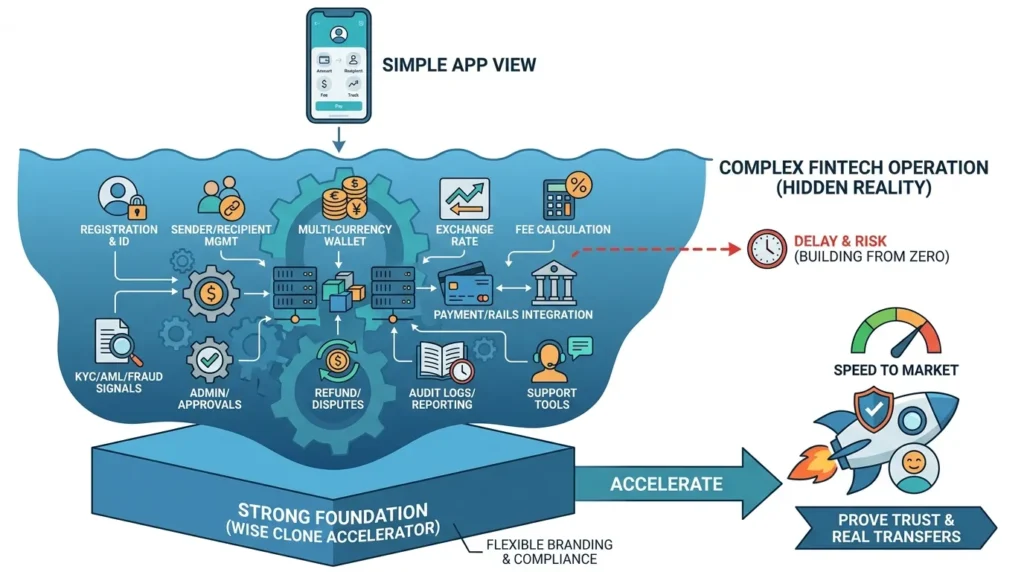
A remittance app may look simple to the user. They enter an amount, add a recipient, check the fee, pay, and track the transfer.
But behind that simple flow is a complex fintech operation.
A serious remittance startup needs:
- User registration and identity verification
- Sender and recipient management
- Multi-currency wallet logic
- Exchange rate display
- Transfer fee calculation
- Payment gateway or banking rail integration
- Transaction tracking
- KYC workflow support
- AML workflow support
- Fraud monitoring signals
- Admin approval controls
- Refund and dispute workflows
- Audit logs
- Reporting dashboards
- Customer support tools
Building all of this from zero can delay launch and increase execution risk. A Wise Clone Foundation gives founders a structured starting point so they can test the market faster while still keeping enough flexibility for branding, corridor strategy, compliance workflows, and monetization.
For a remittance startup, speed matters because the first goal is not to build a global fintech company overnight. The first goal is to prove that a specific user group will trust the platform enough to complete real transfers.
Read More: What is a Wise App and How Does It Work?
What Is a Wise Clone Foundation?
A Wise Clone Foundation is a white-label, ready-made fintech platform base that helps founders launch a cross-border money transfer business faster. It follows the core product logic of modern remittance platforms, then allows the founder to customise the experience for their own brand, target corridor, user segment, and revenue model.
It is not about copying another company’s brand, design, trademarks, or proprietary system. The goal is to use a proven remittance structure as a starting point and turn it into an original, branded fintech platform with the right features, workflows, and operational controls.
A Wise Clone Foundation can include key modules such as:
- Customer-facing platforms: user app, web platform, recipient management, transaction history, and transfer status tracking.
- Money movement workflows: multi-currency wallet flows, cross-border transfers, transfer fee calculation, exchange rate display, and payment gateway integration support.
- Admin and operational control: admin dashboard, reporting and analytics, role-based access, user review, and transaction oversight.
- Security and compliance workflows: KYC workflow support, AML workflow support, fraud monitoring logic, API-ready infrastructure, and audit visibility.
For founders, the value is practical. Instead of beginning with a blank technical roadmap, they can start with a launch-ready fintech foundation and adapt it to their market. This helps them focus earlier on corridor strategy, user trust, pricing, compliance planning, and repeat transfer growth.
Read More : Best Wise Clone Script in 2026: Features & Pricing Compared
The Startup Scenario: From Zero to First Revenue
Imagine a founder wants to launch a remittance platform for one high-demand corridor.
The target users may be:
- Migrant workers sending money home
- Students paying international education expenses
- Freelancers receiving global payments
- Small businesses paying overseas suppliers
- Families supporting relatives across borders
- Remote teams managing international payouts
The founder’s challenge is not only technical. It is commercial.
They need to answer:
- Why would users trust a new platform?
- Which corridor should be launched first?
- What fee model will users accept?
- How will the platform complete transfers reliably?
- What onboarding flow will reduce drop-offs?
- Which early users are most likely to repeat transfers?
- What PMF signals prove the startup is ready to scale?
A Wise Clone Foundation helps because it allows the founder to start from a working product structure instead of spending the entire early phase only on development.
Read More: Business Model of Wise: Explained for Startup Founders
Phase 1: Choose One Corridor Before Expanding Globally
One of the biggest mistakes remittance founders make is trying to launch too broadly.
A new remittance startup does not need to support every country in the first version. It needs one strong corridor with clear demand, reachable users, and manageable operations.
A practical corridor selection framework looks like this:
| Corridor Factor | Why It Matters |
|---|---|
| Sender population | A larger migrant, student, freelancer, or business base creates stronger demand |
| Transfer frequency | Monthly family support, payroll, education payments, and supplier payments create repeat usage |
| Fee sensitivity | Users are more likely to switch if current options feel expensive or unclear |
| Local payment access | Easy pay-in and payout options reduce friction |
| Compliance feasibility | The corridor must be practical from a regulatory and operational perspective |
| Community reach | Founders need affordable ways to reach early users |
The strongest early positioning is usually narrow and specific.
For example:
“Send money from Dubai to India with transparent fees and fast transfer tracking.”
That is much clearer than:
“A global money transfer app for everyone.”
The Wise Clone Foundation gives the founder the platform base. The corridor strategy gives the business its first market focus.
Read More: Revenue Model of Wise: How Wise Makes Money and What Startups Can Learn
Phase 2: Launch with the Minimum Trust Stack
In remittance, trust is the product.
Users are not only asking, “Does this app work?” They are asking, “Can I safely send my money through this platform?”
That means the first version must include a strong trust stack.
A launch-ready remittance platform should support:
- Secure onboarding
- Identity verification workflows
- Clear fee display
- Exchange rate transparency
- Recipient confirmation
- Transfer status tracking
- Transaction history
- Customer support access
- Admin review workflows
- Fraud monitoring signals
- Audit logs
- Dispute handling visibility
The user should never feel confused about where their money is, what fee they are paying, or what happens next.
For founders, this trust layer matters because early fintech users are cautious. A clean app interface may attract attention, but operational clarity creates repeat usage.
Founder Insight
A remittance startup does not win early users by having the longest feature list. It wins by making one transfer corridor feel safer, clearer, faster, and more reliable than the options users already know.
Phase 3: Acquire the First 100 Users Through Trust Channels
The first 100 users of a remittance startup are not just app users. They are validation partners.
Paid ads can create awareness, but remittance adoption often begins through trust-based communities.
Strong early acquisition channels include:
- Diaspora communities
- Student groups
- Migrant worker networks
- Freelancer communities
- Employer groups
- Local business associations
- Regional social media groups
- Community leaders
- Payroll and accounting partners
- Referral-based user groups
The founder should personally learn from early users.
Important questions include:
- How do they currently send money?
- What frustrates them about the current process?
- Do they care more about speed, fee, convenience, or support?
- What would make them trust a new platform?
- How often do they transfer money?
- Who receives the money?
- What payment method do they prefer?
- What would make them send again next month?
A Wise Clone Foundation gives the product base, but founder-led customer learning creates the GTM advantage.
Read More: Pre-launch vs Post-launch Marketing for Wise Clone Startups
Phase 4: Design the First Revenue Model
A remittance startup can generate revenue in different ways. The right model depends on the corridor, user segment, transaction size, payment partners, and operating costs.
Common revenue models include:
| Revenue Model | How It Works | Best For |
|---|---|---|
| Transfer fee | A fixed or percentage fee per transaction | Consumer remittance |
| FX margin | Revenue from currency conversion spread | High-volume corridors |
| Priority transfer fee | Additional charge for faster processing | Urgent transfers |
| Business subscription | Monthly plan for companies | SMEs, exporters, remote teams |
| API access fee | Partners pay to use transfer infrastructure | Embedded finance use cases |
| Payroll tools | Businesses pay for international payout workflows | Cross-border teams |
| Invoicing tools | Freelancers and businesses pay for payment management | Professional users |
For most early-stage remittance startups, the simplest revenue model is:
- Transfer fee
- FX margin
- Repeat-user incentives
- Business accounts
- API or partner-led expansion later
The key is not just earning from the first transfer. The real goal is proving that users will return.
Zero-to-Revenue Path for a Remittance Startup
| Stage | Founder Focus | Revenue Signal |
|---|---|---|
| Launch | One corridor, verified users, clear transfer flow | First completed transfers |
| Validation | Retention, referrals, support quality | Repeat transfers within 30 days |
| Scale | More corridors, business users, partner channels | Growing transaction volume and improving margins |
Phase 5: Track PMF Signals That Matter
A remittance startup should not measure success only by app downloads.
Downloads are weak signals. Completed transfers are stronger. Repeat transfers are even stronger.
Important PMF signals include:
| PMF Signal | What It Shows |
|---|---|
| Signup to KYC completion rate | Users trust the platform enough to verify identity |
| KYC approval to first transfer rate | The product solves a real transfer need |
| First transfer completion time | The user flow is clear and usable |
| Repeat transfer rate | Users are building habit |
| Referral-driven completed transfers | Users trust the platform enough to recommend it |
| Support tickets per transfer | Operational friction is under control |
| Failed transfer rate | Payment, partner, or workflow issues need attention |
| Corridor-level transaction volume | The selected market has real depth |
| Margin per transaction | The business model can become sustainable |
The strongest early PMF signal is repeat behaviour.
A user who transfers once may be testing the product. A user who transfers again is showing trust.
Read More: What Fintech Founders Should Learn Before Building
Phase 6: Improve the Product Based on Real Transfer Behaviour
After the first users begin transacting, the founder should avoid adding random features.
The roadmap should be driven by real transfer behaviour.
For example:
| User Behaviour | Product Decision |
|---|---|
| Users abandon during KYC | Simplify verification explanation and support |
| Users check rates but do not transfer | Review fee clarity and corridor pricing |
| Users contact support often | Improve transfer status updates and help content |
| Users repeat monthly | Add loyalty, reminders, or saved recipient flows |
| Business users ask for bulk payments | Add business dashboard and payroll workflows |
| Users request more countries | Expand corridors only after operations are ready |
A Wise Clone Foundation allows founders to customise faster because the base platform already supports essential remittance flows. The founder can then improve what matters most instead of rebuilding core modules.
Wise Clone Foundation vs Building from Zero
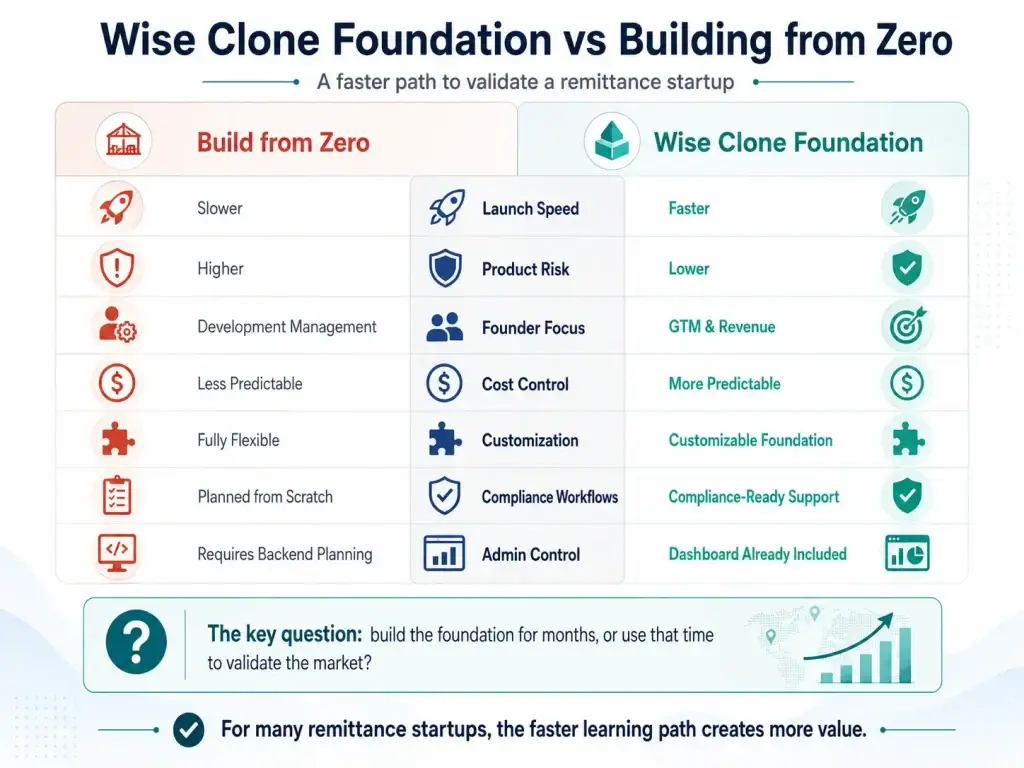
Building a fintech platform from zero can offer maximum flexibility, but it also increases development time, cost uncertainty, and early execution risk.
A Wise Clone Foundation gives founders a faster route to launch when the goal is market validation and early revenue.
| Decision Area | Build from Zero | Wise Clone Foundation |
|---|---|---|
| Launch speed | Slower because every core module must be built first | Faster because essential workflows already exist |
| Product risk | Higher if architecture is untested | Lower because the foundation is structured around proven remittance flows |
| Founder focus | Heavy development management | More focus on GTM, users, partnerships, and revenue |
| Cost control | Can increase with scope changes | More predictable starting point |
| Customization | Fully flexible but slower | Customizable on top of ready-made foundation |
| Compliance workflows | Must be planned from scratch | Can start with compliance-ready workflow support |
| Admin control | Requires backend planning | Admin dashboard logic is already part of the foundation |
For founders, the main question is not whether custom development is better or worse. The better question is:
“Do we need to spend the next several months building the foundation, or should we use that time to validate the market?”
For many remittance startups, the faster learning path is more valuable.
Read More: Which Jurisdictions Offer the Fastest Path to Launch for Wise-Like Platforms?
How Miracuves Helps Founders Launch and Validate a Remittance Startup Faster
Miracuves helps founders move from fintech idea to launch-ready execution with a white-label, source-code-owned Wise Clone Foundation. Instead of building every wallet, transfer, user, admin, and compliance workflow from zero, founders can start with a structured product base designed for cross-border remittance operations.
This foundation can support key launch layers such as:
- Money transfer and wallet flows: cross-border transfers, multi-currency wallet logic, recipient management, and transaction history.
- User and admin operations: user onboarding, admin control, reporting dashboards, role-based access, and support visibility.
- Security and compliance workflows: KYC workflow support, AML workflow support, transaction monitoring, fraud risk signals, and audit logs.
- Growth-ready customization: payment gateway integration support, web and mobile launch planning, API-ready expansion, and corridor-specific customization.
The advantage is not only faster development. It is faster business validation.
With Miracuves, founders can spend less time assembling the basic app structure and more time proving demand, building user trust, refining corridor strategy, testing pricing, and improving revenue quality.
How Founders Can Build a Trust-Led GTM Strategy with a Wise Clone Foundation
A strong GTM strategy for a remittance startup should be built around trust, not broad fintech promotion. Users are not only choosing an app; they are choosing a platform to move their money across borders.
For a founder using a Wise like app Foundation, the early strategy should focus on one user segment, one transfer corridor, and one repeat money movement problem.
1. Start with one clear user segment
Avoid targeting “everyone who sends money abroad.” A broad audience makes messaging weaker, acquisition harder, and product decisions unclear.
Instead, begin with one specific group, such as migrant workers sending salary support home, students paying overseas education fees, freelancers receiving international payments, SMEs paying suppliers abroad, remote teams managing contractor payouts, or families making monthly transfers.
A narrow audience helps the founder understand real pain points, build sharper landing pages, improve onboarding, and design support around actual user behaviour.
2. Build corridor-specific landing pages
Each target corridor should have its own landing page because remittance users search with location-specific intent. Someone sending money from UAE to India has different expectations, questions, and payment preferences than someone sending money from Canada to Ghana.
A strong corridor page should explain the transfer process, fee structure, expected delivery flow, supported payment methods, verification requirements, security controls, and customer support process.
Examples include:
- Send money from UAE to India
- Send money from UK to Nigeria
- Pay freelancers in the Philippines
- Business payments from Europe to India
This makes the platform feel more relevant and trustworthy than a generic money transfer page.
3. Make onboarding trust-first
The onboarding flow should reduce uncertainty at every step. Users should clearly understand why identity verification is required, what documents may be needed, how fees are calculated, when the recipient may receive funds, how transfer status is tracked, and what happens if a transfer fails.
In remittance, clarity improves conversion because users are cautious before sending money through a new platform. A smooth onboarding flow should not only collect information; it should build confidence.
4. Use community-led growth
Early remittance users often come from trusted networks. Instead of depending only on paid ads, founders should reach users through communities where trust already exists.
This can include diaspora communities, student groups, employer partnerships, freelancer networks, local business groups, WhatsApp and Telegram communities, community ambassadors, payroll partners, and HR partnerships.
The strongest early growth channel is usually the one where users already talk about money movement problems, transfer delays, fees, and trusted service recommendations.
5. Expand only after repeat usage is proven
A remittance startup should not add new corridors too quickly. Expansion should happen after the founder proves that users can complete KYC, make their first transfer, return for repeat transfers, and get support without operational friction.
Before scaling, founders should confirm that transaction failure rates are controlled, margins are improving, support load is manageable, and compliance workflows can handle higher volume.
Expansion should follow operational readiness, not excitement. For a Wise Clone Foundation, the smartest growth path is to validate one corridor deeply before using the same playbook across additional markets.
Security and Compliance Considerations for Remittance Startups
Security is not a feature that can be added later. In a remittance business, it is part of the product foundation because users are trusting the platform with real money, personal identity data, and cross-border financial activity.
A strong Wise Clone Foundation should support:
- Secure data and access control: encrypted data transfer, encrypted storage, role-based admin access, and permission-based dashboards.
- Identity and compliance workflows: KYC verification, AML workflow support, user review, and compliance-ready reporting.
- Transaction risk monitoring: fraud signals, suspicious activity flags, transaction monitoring, and admin approval controls.
- Operational traceability: audit logs, secure API integrations, dispute visibility, and reporting tools for internal review.
Founders should avoid assuming that software alone guarantees compliance. A Wise Clone Foundation can help prepare the right workflow and control layer, but final compliance depends on jurisdiction, legal review, licensing, payment partners, integrations, and the startup’s operating model.
Read More: How to Secure Data in Wise Clone Platforms
Common Mistakes Remittance Founders Should Avoid
A remittance startup can move faster with a Wise Clone Foundation, but the founder still needs strong execution discipline. The biggest risks usually come from expanding too early, underestimating trust, or treating financial operations as an afterthought.
1. Expanding into too many corridors too soon
Every new corridor adds more than a new country pair. It brings payout complexity, local payment preferences, compliance review, support requirements, liquidity planning, pricing decisions, and payment partner dependencies.
A stronger approach is to win one corridor first. Prove that users can complete verification, send money, receive funds reliably, and return for repeat transfers. Once the first corridor is operationally stable, expansion becomes a smarter growth decision instead of a risky distraction.
2. Competing only on low transfer fees
Lower fees can attract attention, but they rarely build long-term loyalty on their own. In remittance, users are trusting the platform with money that may support families, pay bills, or settle important business obligations.
Users also care about transfer clarity, delivery confidence, support quality, speed, recipient convenience, security, and transparent pricing. A founder who competes only on price may win first-time users but lose repeat users if the experience feels uncertain.
The better strategy is to combine fair pricing with trust, visibility, and dependable service.
3. Underestimating backend operations
A remittance app is not only a customer-facing product. The backend control layer is where the business manages risk, user verification, transaction visibility, support issues, failed transfers, and operational decisions.
The admin team should be able to review users, monitor transactions, track suspicious activity, manage disputes, view reports, resolve failed transfers, and control roles and permissions.
Without strong admin control, growth can quickly become difficult to manage. More users and more transfers will only increase the pressure on operations.
4. Measuring the wrong success signals
App downloads and signups may look impressive, but they do not prove market fit. A user who downloads the app has shown curiosity, not trust.
For remittance startups, stronger validation metrics include KYC completion, first transfer completion, repeat transfers, referral-driven transfers, margin per transaction, support load, failed transaction rate, and corridor-level transaction volume.
The most important question is not “How many users signed up?” It is “How many users trusted the platform enough to send money again?”
5. Treating compliance workflows as a later-stage task
Compliance should not be added after transaction volume grows. It should be part of the product foundation from the beginning.
KYC workflows, AML workflow support, audit logs, role-based admin access, transaction monitoring, suspicious activity flags, and reporting controls help founders build a safer operating structure. Final compliance depends on jurisdiction, legal review, licensing, payment partners, integrations, and business model, but the workflow foundation should be planned early.
For remittance startups, trust and compliance readiness are not separate from growth. They are what make sustainable growth possible.
Read More : Wise Clone App Development: Step-by-Step Guide for Developers & Founders
Why a Wise Clone Foundation Helps Founders Move Faster
The biggest benefit of a Wise Clone Foundation is not only development speed. It is decision speed.
Founders can test real business questions earlier:
- Which corridor has the strongest demand?
- Which users complete verification?
- What transfer fee is acceptable?
- Which acquisition channel brings repeat users?
- Which payout method matters most?
- What support problems appear after launch?
- Which user segment has better lifetime value?
These questions cannot be answered by planning alone. They require a working product, real users, and real transactions.
A Wise Clone Foundation helps founders reach that learning stage faster.
Final Thoughts: Build Faster, Validate Smarter, and Scale with Control
The real value of a Wise Clone Foundation is not copying another fintech brand. It is using a proven remittance product structure to launch faster, validate demand, and build a scalable money transfer business with stronger operational control.
For remittance founders, the first goal is not global domination. The first goal is one trusted corridor, one clear user segment, and repeat transfer behaviour.
Once that foundation is proven, the startup can expand into more corridors, business payments, payroll workflows, API partnerships, and advanced financial services.
Miracuves helps founders move from idea to launch-ready execution with white-label, source-code-owned fintech platforms designed for faster validation and scalable growth.
FAQs
What is a Wise Clone Foundation?
A Wise Clone Foundation is a ready-made white-label platform base for building a Wise-style remittance or cross-border payment app. It can include multi-currency wallets, recipient management, transfer workflows, KYC workflow support, AML workflow support, admin controls, reporting, and payment integration support.
Is a Wise Clone Foundation the same as copying Wise?
No. A Wise Clone Foundation should not copy trademarks, branding, copyrighted assets, or proprietary systems. It uses a proven remittance product model as inspiration and allows founders to launch their own branded platform with custom features, workflows, and market positioning.
How can a remittance startup get its first users?
A remittance startup can get its first users by focusing on one corridor and reaching trusted communities such as migrant groups, student networks, freelancer communities, employer groups, business associations, and referral-based user networks.
What PMF signals matter for a remittance startup?
The most important PMF signals include KYC completion rate, first transfer completion rate, repeat transfer rate, referral-driven transfers, transaction volume by corridor, support tickets per transfer, failed transaction rate, and margin per transaction.
How does a remittance startup make money?
A remittance startup can earn revenue through transfer fees, FX margins, priority transfer fees, business subscriptions, payroll tools, invoicing tools, API access fees, and partner integrations.
Why use Miracuves for a Wise Clone Foundation?
Miracuves helps founders launch white-label, source-code-owned fintech platforms faster with core wallet, transfer, admin, user, and compliance workflow modules already structured. This helps founders focus more on market validation, GTM strategy, early users, and revenue growth.
Miracuves is an independent software development company. We are not affiliated with, connected to, sponsored by, or endorsed by any company or product named in this article.
Terms such as “X Clone” are used descriptively. It is how the software industry refers to building a platform with functionality comparable to a known service, and how clients search for it.
The entire design and codebase of our products is built by our own team. Our products contain no code, design, graphics, or content originating from any third-party website or applications.
All third-party names and marks referenced in this article are the property of their respective owners, referenced solely to identify the services discussed.