


Key Takeaways
What You’ll Learn
- Liquor delivery apps must follow strict compliance, identity verification, and regional regulations.
- User data protection is critical for handling personal details, addresses, and payment information.
- Secure payment systems ensure safe transactions with encryption and fraud prevention mechanisms.
- Age verification systems help prevent unauthorized access and ensure legal compliance.
- Backend security is essential to protect orders, delivery flows, and admin operations.
Stats That Matter
- Online alcohol delivery demand is growing rapidly in urban and semi-urban markets.
- Cybersecurity threats in eCommerce and delivery apps continue to rise each year.
- Over 60% of users expect secure payments and data protection before placing orders.
- Compliance failures can lead to heavy fines and platform shutdowns.
- Security is becoming a core differentiator for digital liquor platforms.
Real Insights
- Trust drives conversions in liquor delivery platforms more than pricing alone.
- Strong apps combine compliance, security, and smooth user experience.
- Real-time order tracking and secure checkout improve customer retention.
- Regulation-ready systems scale faster across different regions.
- Long-term success depends on secure infrastructure and reliable operations.
You’ve heard the horror stories—liquor delivery apps leaking customer addresses, payment data being compromised, or entire platforms getting shut down because of compliance failures. In 2026, when alcohol commerce is tightly regulated and data privacy laws are unforgiving, app security is no longer optional. It is foundational.
If you are planning to launch a white-label Nestor Liquor Clone, your biggest concern should not only be its features or time to market. The real question is whether the platform can protect your business from regulatory, technical, and operational risks.
Alcohol delivery apps operate in one of the most sensitive digital commerce categories. They handle age-restricted transactions, real-time location data, payment information, and personally identifiable customer details. Any weakness in security can result in payment gateway restrictions, app store removal, legal penalties, regulatory action, or permanent loss of customer trust.
Safety matters more than ever in 2026 because:
- Data protection laws such as GDPR, CCPA, and India’s DPDP Act are actively enforced.
- Payment providers require strict PCI DSS compliance.
- App stores apply enhanced scrutiny to alcohol-related applications.
- Consumers are increasingly aware of privacy misuse and data breaches.
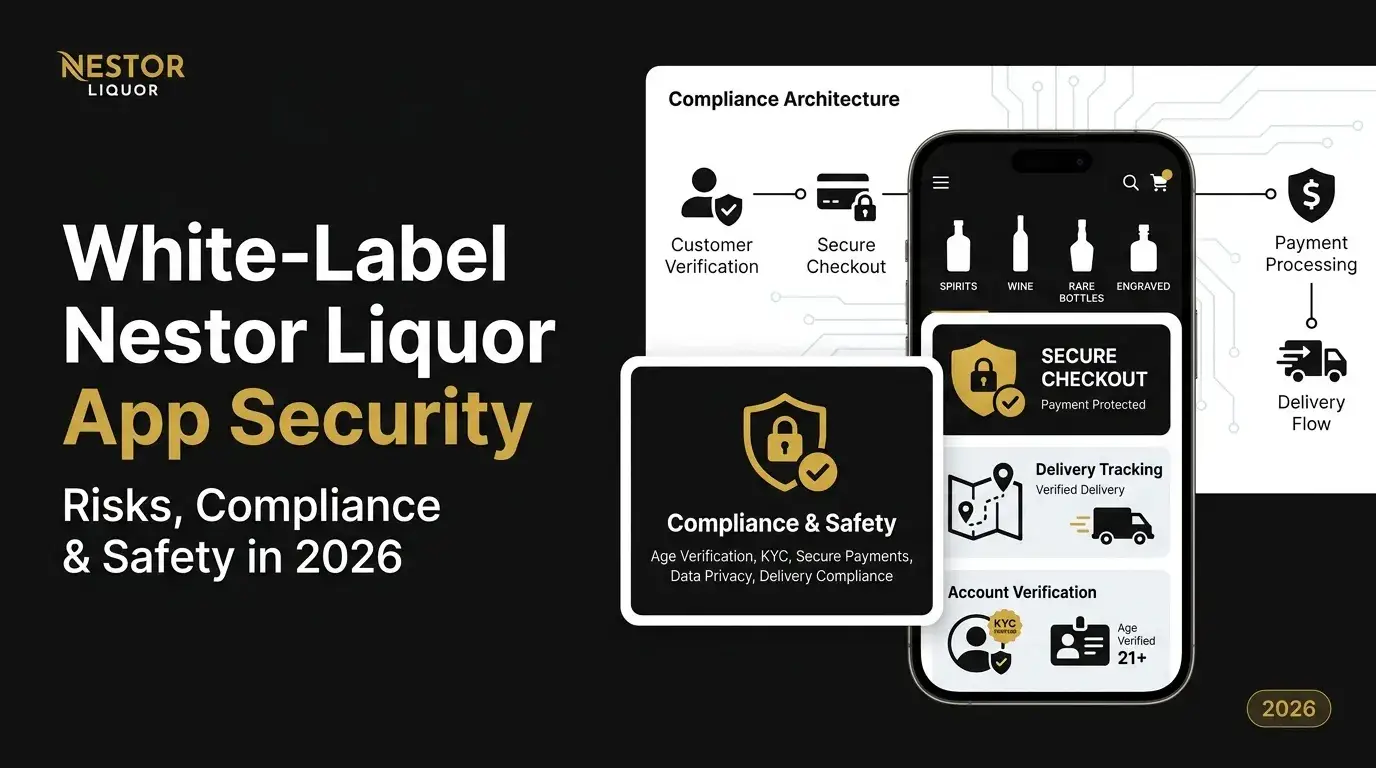
This guide provides a transparent and practical security analysis of a white-label Nestor Liquor app. It examines the real risks associated with launching a Nestor Liquor Clone, the mandatory compliance standards businesses must consider, the warning signs to avoid, and the steps required to build a secure and legally compliant liquor delivery platform.
You will get clarity, not sales talk—and practical guidance you can use before choosing a development partner..
Understanding White-Label Nestor Liquor App Security Landscape
What White-Label App Security Really Means
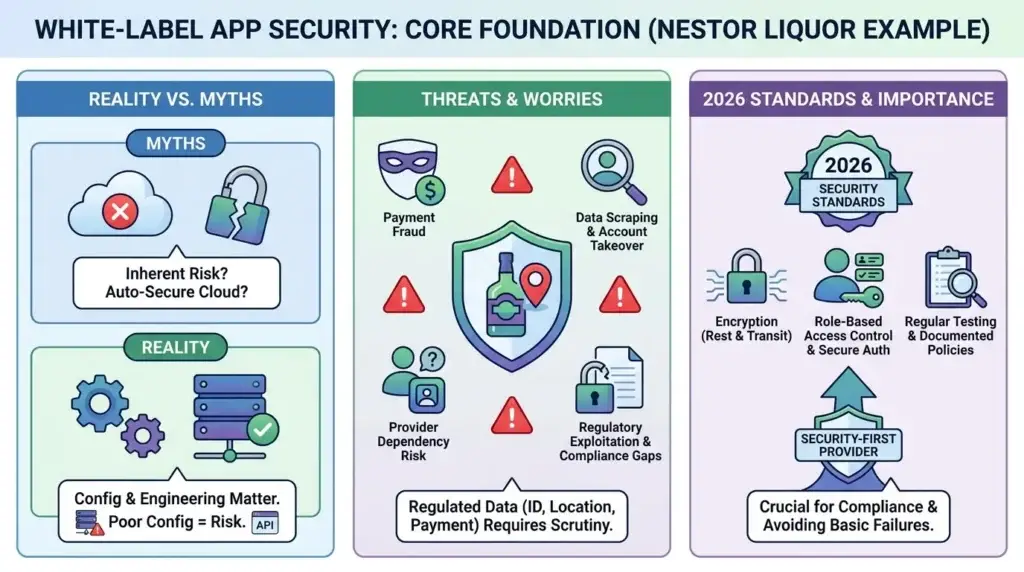
White-label app security refers to the protections built into the core architecture of the app before it is branded and launched for your business. In a liquor delivery app like Nestor Liquor, security is not something that can be safely added later. It must already exist at the code, server, and data-handling level.
A secure white-label Nestor Liquor app should already include hardened backend systems, secure APIs, encrypted databases, and compliance-ready workflows. If the underlying app is weak, no amount of branding or frontend customization can make it safe.
Common Security Myths vs Reality
Many founders believe that white-label apps are inherently unsafe because they are reused across multiple businesses. This is not accurate. The real risk is not the white-label model itself, but poor engineering practices.
Another common myth is that using popular frameworks or cloud hosting automatically makes an app secure. In reality, security depends on how servers are configured, how data is stored, and how access is controlled. A badly configured cloud setup can be more dangerous than on-premise infrastructure.
There is also a misconception that compliance certifications are only required after scaling. In regulated categories like liquor delivery, compliance gaps can shut down operations even at the pilot stage.
Why People Worry About White-Label Liquor Apps
Liquor delivery apps face more scrutiny than food or grocery apps because they involve regulated products and sensitive user data. Users share personal details, delivery addresses, government ID for age verification, and payment information. Any misuse or breach directly impacts legal compliance.
Founders also worry about dependency on the app provider. If the provider does not issue security updates, patch vulnerabilities, or respond to incidents quickly, your business carries the risk even if the fault is not yours.
Current Threat Landscape for Liquor Delivery Apps
In 2026, liquor delivery apps are exposed to multiple threat vectors. These include payment fraud, account takeover attacks, API abuse, and data scraping. Location data is a major target because it reveals customer behavior and home addresses.
Alcohol apps are also targeted for regulatory exploitation. Attackers may manipulate age verification systems or bypass compliance controls, which can expose the app owner to fines or license suspension.
Security Standards in 2026
Modern liquor delivery apps are expected to follow enterprise-level security practices. These include encryption of data at rest and in transit, secure authentication flows, strict role-based access control, and regular security testing.
Regulators and payment partners no longer accept vague assurances. They expect documented security policies, audit logs, and proof of compliance with recognized standards.
Real-World Security Incident Statistics
Recent industry reports show that a large percentage of app breaches originate from misconfigured servers, exposed APIs, or outdated libraries. Alcohol and delivery platforms are increasingly targeted because they combine payment data with physical location information.
Many reported incidents do not involve advanced hacking. They occur due to basic security hygiene failures, such as hardcoded credentials, unsecured admin panels, or missing rate limits on APIs.
These patterns highlight why choosing a security-first white-label Nestor Liquor app provider is far more important than choosing the cheapest option.
Key Security Risks & How to Identify Them
Data Protection and Privacy Risks
Liquor delivery apps process highly sensitive user information. This includes names, phone numbers, home addresses, payment details, and age verification data. If this information is not properly protected, the consequences are severe.
Poor data storage practices can expose user information through database leaks or unauthorized access. Insecure transmission of data between the app and servers can allow attackers to intercept information. Location tracking data is particularly sensitive because it reveals user behavior patterns and delivery routes.
From a compliance perspective, failure to protect personal data can violate GDPR, CCPA, and regional data protection laws. These violations often result in heavy fines, forced shutdowns, and long-term loss of customer trust.
Payment Data and Financial Security Risks
Payment security is one of the highest-risk areas for any liquor delivery app. If payment data is handled directly without proper safeguards, it can lead to fraud, chargebacks, and payment gateway bans.
Many unsafe white-label apps store card data improperly or fail to tokenize transactions. This creates direct exposure to PCI DSS violations. Once a payment provider flags an app for non-compliance, restoring access can be extremely difficult.
Location Tracking and Age Verification Concerns
Liquor delivery apps rely on location tracking for logistics and compliance. If location data is exposed or misused, it can create serious privacy risks for users.
Age verification systems are another weak point. Poorly implemented verification flows can be bypassed, allowing underage purchases. This exposes the app owner to legal penalties and license suspension, even if the technical fault lies in the app.
Technical Vulnerabilities in App Architecture
Many security issues originate from weak technical foundations. Low-quality code, outdated libraries, and insecure APIs create entry points for attackers.
Common vulnerabilities include exposed admin panels, missing authentication checks, insecure file uploads, and poor session management. Third-party integrations such as payment gateways, mapping services, and SMS providers can also introduce risks if not secured properly.
Server and Infrastructure Risks
Server misconfigurations are one of the most frequent causes of app breaches. Open ports, weak access controls, and lack of monitoring allow attackers to gain access without advanced techniques.
If backups are not encrypted or stored securely, ransomware attacks can completely halt operations. Without a proper disaster recovery plan, even short outages can result in financial losses and customer churn.
Business and Legal Risks
Security failures extend beyond technical damage. Data breaches can trigger legal action from users, regulators, and partners. Regulatory penalties for liquor delivery apps can include license revocation, fines, and mandatory audits.
Reputation damage is often irreversible. Users are far less forgiving when sensitive data related to home addresses and alcohol purchases is exposed.
Risk Assessment Checklist
Before choosing or launching a white-label Nestor Liquor app, you should evaluate:
- How user data is stored and encrypted
- Whether payment data is handled through compliant gateways
- How age verification is implemented and audited
- Whether APIs are protected with authentication and rate limiting
- How often security updates and patches are released
- What incident response and recovery plans exist
Identifying these risks early is the difference between launching a scalable liquor delivery app and inheriting hidden liabilities.
Read more : – Nestor Liquor Clone Revenue Model: How Nestor Liquor Makes Money in 2025
Security Standards Your White-Label Nestor Liquor App Must Meet
Essential Compliance Certifications
A white-label Nestor Liquor app must align with recognized security and compliance standards from the start. These certifications are not marketing badges. They are proof that structured security controls and audits are in place.
ISO 27001 is the foundation for information security management. It ensures that data handling, access control, risk management, and incident response processes are formally defined and audited.
SOC 2 Type II focuses on how data is protected over time. It validates security, availability, confidentiality, and processing integrity through continuous operational controls rather than one-time checks.
GDPR compliance is mandatory when handling data of users from the European Union. It governs how personal data is collected, stored, processed, and deleted. Similar obligations apply under CCPA in California and the DPDP Act in India.
HIPAA becomes relevant only if the app processes health-related data, which is uncommon but possible in cases involving medical alcohol delivery exemptions.
PCI DSS compliance is mandatory for any app that processes or facilitates card payments. Even if a third-party payment gateway is used, the app must meet baseline PCI security requirements.
Core Technical Security Requirements
A secure liquor delivery app must implement encryption for data both in transit and at rest. This prevents unauthorized access even if systems are compromised.
Authentication mechanisms must be strong and properly implemented. This includes secure login flows, optional multi-factor authentication, and token-based session management.
Regular security audits are essential to identify new vulnerabilities introduced by updates or integrations. Penetration testing simulates real-world attacks to uncover weaknesses before attackers do.
SSL certificates are required to secure communication between the app and backend servers. Secure API design ensures that endpoints cannot be abused or accessed without proper authorization.
Security Standards Comparison Overview
Enterprise-grade liquor delivery apps follow structured security frameworks rather than ad-hoc fixes. Apps that lack certifications often rely on reactive security, fixing issues only after incidents occur.
Certified platforms follow preventive security models. They document controls, audit logs, access policies, and update cycles. This difference directly impacts reliability, compliance readiness, and long-term scalability.
Meeting these standards is not about overengineering. It is about ensuring that your white-label Nestor Liquor app can legally operate, integrate with payment providers, and scale across regions without constant risk exposure.
Red Flags: How to Spot Unsafe White-Label Providers
Warning Signs You Should Not Ignore
One of the biggest mistakes founders make is assuming that all white-label app providers follow similar security practices. In reality, the gap between secure and unsafe providers is significant.
A major red flag is the absence of clear security documentation. If a provider cannot explain how data is stored, encrypted, and protected, it usually means security was never properly implemented.
Unrealistically cheap pricing is another warning sign. Security infrastructure, audits, and compliance certifications require investment. Providers offering extremely low costs often cut corners on backend security, testing, and monitoring.
Lack of compliance certifications such as ISO 27001 or PCI DSS indicates that the provider has not subjected their systems to independent security audits. This places all liability on the app owner.
Outdated technology stacks increase risk. Unsupported frameworks and unpatched libraries are common entry points for attackers. A secure provider actively maintains and updates their technology.
Poor code quality is harder to detect but equally dangerous. Messy codebases lead to hidden vulnerabilities, unstable updates, and slow incident response.
Operational and Infrastructure Red Flags
Unsafe providers often lack a defined security update policy. If updates are only released when something breaks, vulnerabilities remain open for long periods.
Absence of reliable data backup systems exposes your app to ransomware and accidental data loss. Backups must be encrypted, tested, and stored securely.
Another overlooked red flag is the lack of insurance coverage. Professional providers carry cyber liability insurance to mitigate the financial impact of security incidents.
Evaluation Checklist for Founders
Before selecting a white-label Nestor Liquor app provider, you should verify:
- Availability of security architecture documentation
- Proof of compliance certifications and audits
- Clear update and patch management policies
- Secure backup and disaster recovery processes
- Defined incident response and escalation procedures
Questions You Should Ask Providers
You should ask direct and specific questions during evaluation. How is user data encrypted? Who has access to production servers? How often are security audits conducted? What happens if a breach occurs?
Providers who hesitate, provide vague answers, or shift responsibility should be avoided. Transparency is a strong indicator of security maturity.
Identifying these red flags early prevents you from inheriting hidden risks that can damage your business long after launch.
Best Practices for Secure White-Label Nestor Liquor App Implementation
Pre-Launch Security Preparation
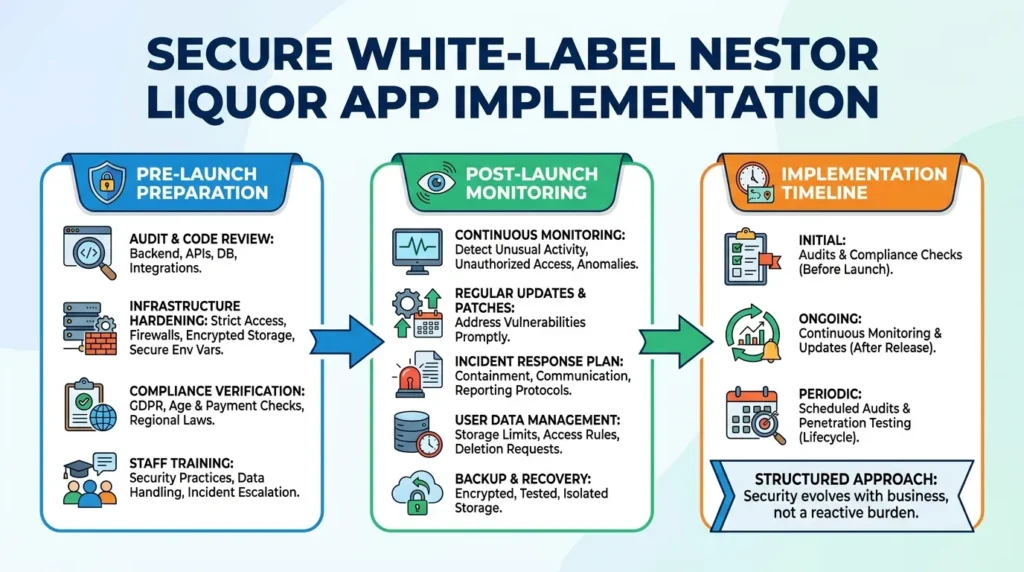
Security should be addressed before the app goes live, not after the first incident. A structured pre-launch process significantly reduces long-term risk.
A comprehensive security audit should be conducted on the entire app, including backend systems, APIs, databases, and third-party integrations. Code reviews help identify logic flaws, insecure data handling, and access control issues.
Infrastructure hardening is essential. Servers should be configured with strict access permissions, firewalls, intrusion detection systems, and encrypted storage. Default credentials must be removed, and environment variables should be securely managed.
Compliance verification must be completed before launch. This includes validating GDPR consent flows, age verification mechanisms, payment security requirements, and regional liquor regulations.
Staff training is often overlooked. Teams responsible for operations, support, and administration must understand basic security practices, data handling rules, and incident escalation procedures.
Post-Launch Security Monitoring
Once the app is live, security becomes an ongoing process. Continuous monitoring helps detect unusual activity, unauthorized access attempts, and system anomalies in real time.
Regular updates and patches are critical to address newly discovered vulnerabilities. Delaying updates increases exposure to known attack methods.
An incident response plan ensures that your team knows exactly what to do if a security issue arises. This includes containment steps, user communication protocols, and regulatory reporting requirements.
User data management policies must define how long data is stored, how it can be accessed, and how users can request deletion. These policies are mandatory under modern data protection laws.
Backup and recovery systems protect your business from data loss due to attacks, system failures, or human error. Backups should be encrypted, tested regularly, and stored in isolated environments.
Security Implementation Timeline
A secure white-label Nestor Liquor app follows a phased security approach. Initial audits and compliance checks happen before launch. Continuous monitoring and updates follow after release. Periodic audits and penetration testing should be scheduled throughout the app’s lifecycle.
This structured approach ensures that security evolves alongside your business rather than becoming a reactive burden.
Legal & Compliance Considerations
Regulatory Requirements for Liquor Delivery Apps
Liquor delivery apps are subject to stricter legal oversight than standard commerce platforms. Regulations vary by country and sometimes by state or city, making compliance a continuous responsibility rather than a one-time task.
Data protection laws govern how user information is collected, stored, and processed. GDPR applies to users in the European Union, CCPA applies to California residents, and India’s DPDP Act governs personal data handling within India. Each framework requires clear consent mechanisms, data access controls, and breach notification procedures.
Alcohol-specific regulations often require proof of age verification, restricted delivery zones, and compliance with local licensing rules. Failure to enforce these rules at the app level can result in penalties or operational bans, even if violations occur at the delivery stage.
User Consent and Privacy Requirements
User consent must be explicit, informed, and recorded. Privacy policies should clearly explain what data is collected, why it is collected, and how long it is retained.
Terms of service must define acceptable use, user responsibilities, and limitations of liability. These documents are not formalities. They are legal safeguards that protect the app owner during disputes or investigations.
Apps must also provide mechanisms for users to access, correct, or delete their data in accordance with regional laws.
Liability and Risk Mitigation
Legal liability does not disappear when using a white-label app. The business operating the app is typically responsible for compliance, even if technical failures originate from the provider.
Cyber liability insurance is increasingly recommended for liquor delivery apps. It helps cover legal costs, regulatory fines, and user compensation following security incidents.
Clear incident reporting protocols are essential. Many regulations require that breaches be reported within strict timelines. Failure to comply can increase penalties significantly.
Compliance Monitoring by Region
Operating across multiple regions requires ongoing compliance monitoring. Laws change, enforcement practices evolve, and new obligations emerge regularly.
A secure white-label Nestor Liquor app should support regional configuration, allowing consent flows, data storage rules, and compliance settings to adapt based on user location.
Legal and compliance readiness is not about avoiding risk entirely. It is about understanding responsibilities, minimizing exposure, and responding correctly when issues arise.
Read more : – Best Nestor Liquor Clone Scripts 2025: Launch Your Online Liquor Store Fast
Global Cost of Development for a Nestor Liquor-Like App
Nestor Liquor-Like Alcohol Delivery App Development — Market Price by Tech Stack
The tech stack affects product browsing, age verification, inventory updates, order processing, delivery tracking, and payment security in a Nestor Liquor-like app. PHP/Laravel works well for cost-effective launches, Node.js/React.js supports real-time inventory and delivery updates, while Go microservices suit high-volume, multi-location delivery platforms.
PHP/Laravel is often the most practical choice for launching a Nestor Liquor-like platform quickly and affordably. Node.js/Python fits real-time inventory and delivery workflows, while Go microservices are better suited for enterprise-scale platforms with high concurrency, multi-store operations, and complex infrastructure requirements.
These values reflect global development cost estimates. Final pricing varies based on age verification, product catalogs, store management, inventory sync, delivery tracking, payment gateways, compliance controls, admin features, and platform complexity.
Miracuves Nestor Liquor-Like App Solution Cost and Tech Stack
Miracuves Pricing for a Nestor Liquor-Like Alcohol Delivery and eCommerce App developed in PHP/Laravel with Flutter Apps for $2,199 USD (One-Time Price) in just 6 days
Get a fully developed, deployment-ready liquor delivery marketplace modeled after Nestor Liquor. Built on a stable PHP foundation, this complete package includes everything you need to launch and scale an online alcohol ordering platform with secure customer, vendor, payment, and delivery workflows:
- Core Workflows: Customer registration, age verification, product browsing, category management, cart checkout, order placement, delivery scheduling, order tracking, proof-of-delivery confirmation, and customer notifications.
- Built-in Revenue Logic: Product margins, vendor commissions, delivery charges, service fees, minimum-order fees, promoted products, subscription benefits, discount campaigns, and location-based pricing.
- Management Hub: Centralized admin dashboard, customer management, vendor management, product approval, inventory control, order monitoring, delivery partner management, payment records, refund handling, and marketplace analytics.
- Launch-Ready: Fully prepared for your custom branding, configuration, payment gateway setup, product catalog onboarding, delivery zone configuration, age-verification workflow, and immediate market entry.
Why Is Nestor Liquor-Like App Development More Affordable?
Most liquor delivery platforms become expensive when businesses choose fully custom development from scratch. A Nestor Liquor-style app usually needs customer ordering, vendor panels, inventory management, age checks, location restrictions, payment workflows, delivery tracking, refund controls, product moderation, and centralized admin operations. Building these components separately can increase both development cost and launch time.
We took a smarter, more practical approach:
- You Aren’t Paying for Ground-Up Development: Our alcohol delivery marketplace engine is already developed, tested, and ready to deploy. You avoid the inflated cost and extended development timeline associated with building every workflow from scratch.
- The Power of PHP: We built this solution on a reliable and cost-effective PHP architecture. It supports essential liquor commerce workflows such as product management, inventory updates, customer verification, checkout, delivery assignment, payment handling, and admin control.
You get a launch-ready Nestor Liquor-like platform with practical commerce, delivery, age-verification, and security-focused features, along with source code access and faster deployment.
Note: This cost is for the solution, re-branding, deployment, and source code only. Regional licensing, legal approvals, payment provider charges, third-party verification services, and custom security integrations are not included.
Why Miracuves White-Label Nestor Liquor App Is Your Safest Choice
Security-First Architecture by Design
Miracuves builds white-label apps with security embedded at the architectural level. The Nestor Liquor app is engineered using enterprise-grade security frameworks rather than add-on protections. This ensures that data protection, access control, and compliance are part of the core system, not optional upgrades.
From backend services to APIs and databases, every layer is designed to minimize attack surfaces and enforce strict security controls.
Compliance-Ready From Day One
Miracuves white-label Nestor Liquor app solutions are built to align with modern regulatory requirements. Data handling workflows are structured to support GDPR, CCPA, and regional data protection laws.
Payment processing is integrated through PCI DSS compliant gateways. Age verification, consent management, and audit logging are implemented in a way that supports regulatory reviews and inspections.
Continuous Security Monitoring and Updates
Security does not stop at launch. Miracuves maintains continuous monitoring to detect abnormal activity, access violations, and system anomalies.
Regular updates and patches are released to address emerging vulnerabilities and evolving compliance requirements. This proactive approach reduces exposure to known attack vectors and keeps the app aligned with current security standards.
Data Protection and Encryption Standards
All sensitive data within the Nestor Liquor app is protected using encryption in transit and at rest. Access to production systems is restricted through role-based controls and audited regularly.
Backup systems are encrypted and isolated to protect against data loss, ransomware, and infrastructure failures.
Operational Risk Reduction
Miracuves supports structured incident response planning. In the event of a security issue, clear escalation, containment, and recovery procedures are in place.
Insurance coverage and compliance documentation further reduce financial and legal risk for businesses operating the app.
Final Thought
Do not compromise on security for short-term savings. Miracuves white-label Nestor Liquor app solutions are designed for businesses that take compliance, data protection, and long-term trust seriously. With hundreds of successful deployments and a strong security track record, Miracuves helps you launch and scale liquor delivery apps with confidence. Talk to Our Security Experts Now and understand how a properly secured white-label app protects your business, users, and brand.
Launching a white-label Nestor Liquor app without strong security is not a calculated risk. It is an avoidable mistake. In regulated categories like alcohol delivery, safety, compliance, and trust determine whether an app survives beyond its initial launch.
Choosing a security-first app provider ensures that your business is protected from legal exposure, financial loss, and reputational damage. When security is built correctly from day one, growth becomes easier, partnerships become possible, and users feel confident using your platform.
FAQs
1. How secure is a white-label Nestor Liquor app compared to custom development?
A well-built white-label app can be just as secure as custom development when it follows enterprise security standards, regular audits, and compliance-first architecture.
2. What happens if there is a security breach?
A secure app should have an incident response plan that includes immediate containment, investigation, user notification, and regulatory reporting as required by law.
3. Who is responsible for security updates?
Security updates are typically managed by the app provider, while the business owner is responsible for applying updates and following operational security practices.
4. How is user data protected in a liquor delivery app?
User data is protected through encryption, access controls, secure servers, and compliance with data protection laws such as GDPR and regional regulations.
5. What compliance certifications should I look for?
You should look for ISO 27001, SOC 2 Type II, GDPR readiness, and PCI DSS compliance for payment processing.
6. Can white-label liquor apps meet enterprise security standards?
Yes, when the app is built with a security-first approach, documented controls, and regular testing, it can meet enterprise-grade requirements.
7. How often should security audits be conducted?
Security audits and penetration testing should be conducted at least annually, with additional testing after major updates or integrations.
8. What is included in Miracuves security coverage?
Miracuves provides secure architecture, compliance-ready workflows, encrypted data handling, regular updates, and monitoring support.
9. How is security handled across different countries?
A secure app supports regional configurations for consent, data storage, and compliance based on user location and local laws.
10. What type of insurance is recommended for app security?
Cyber liability insurance is recommended to cover legal costs, regulatory fines, and potential user claims in case of security incidents.
Related Articles: