


Key Takeaways
What You’ll Learn
- Uber-style delivery apps must prioritize user privacy, secure payments, and real-time operational security.
- Delivery platforms handle sensitive customer, driver, merchant, and payment data at massive scale.
- GPS tracking, phone anonymization, and emergency support features improve platform safety.
- Secure APIs, encrypted transactions, and fraud detection systems help reduce cybersecurity risks.
- Scalable infrastructure and continuous monitoring are essential for long-term delivery platform reliability.
Stats That Matter
- Uber Eats operates in more than 45 countries as part of Uber’s global delivery ecosystem.
- Modern delivery apps face threats including account takeovers, payment fraud, GPS spoofing, and phishing attacks.
- Real-time fraud detection systems are becoming essential for large mobility and food delivery platforms.
- Security practices such as MFA, PCI DSS compliance, and encrypted payment processing help protect delivery ecosystems.
- Uber uses safety features like GPS tracking, emergency assistance, and phone anonymization to improve delivery safety.
Real Insights
- Delivery apps succeed when they balance convenience, security, and real-time operational reliability.
- Trust and safety features directly influence customer retention and driver confidence.
- Large-scale delivery platforms require continuous monitoring to prevent fraud and account abuse.
- Cloud-based architectures improve scalability but require strong security governance and infrastructure protection.
- Long-term delivery platform growth depends on balancing speed, user trust, operational efficiency, and cybersecurity reliability.
You’ve heard the horror stories — food delivery apps leaking customer addresses, payment data getting compromised, and startups facing legal notices after a security breach. When you’re planning to launch a white-label Uber Delivery clone, the biggest question isn’t features or pricing anymore.
It’s safety.
In 2026, food delivery platforms handle high-risk data every single day:
- Real-time user locations
- Saved payment credentials
- Order histories and personal preferences
- Restaurant partner business data
One weak security decision can expose thousands of users overnight — and destroy a brand before it even scales.
That’s why white-label app safety matters more than ever today. Regulations are stricter, cyberattacks are more advanced, and users have zero tolerance for platforms that mishandle their data.
This guide gives you an honest, no-fluff assessment of white-label Uber Delivery app security:
- What risks actually exist
- What security standards truly matter in 2026
- How to identify unsafe providers
- And how to launch a delivery app without putting your business, users, or reputation at risk
By the end, you’ll know exactly what “secure” really means — and how to make the right decision from day one.
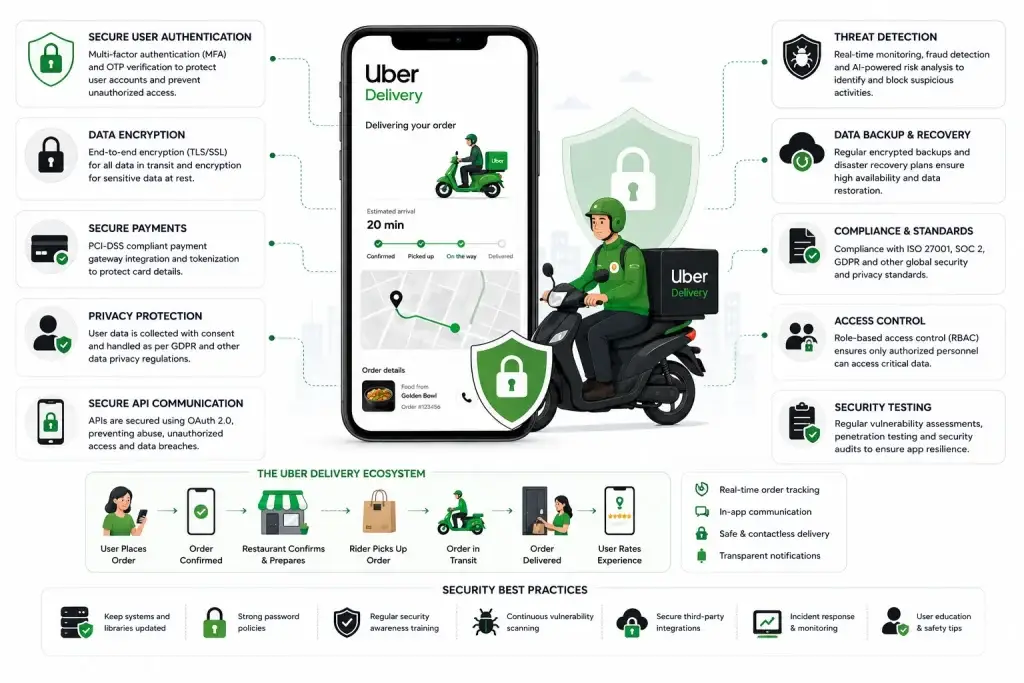
Understanding White-Label Uber Delivery App Security Landscape
What “White-Label Uber Delivery App Security” Actually Means
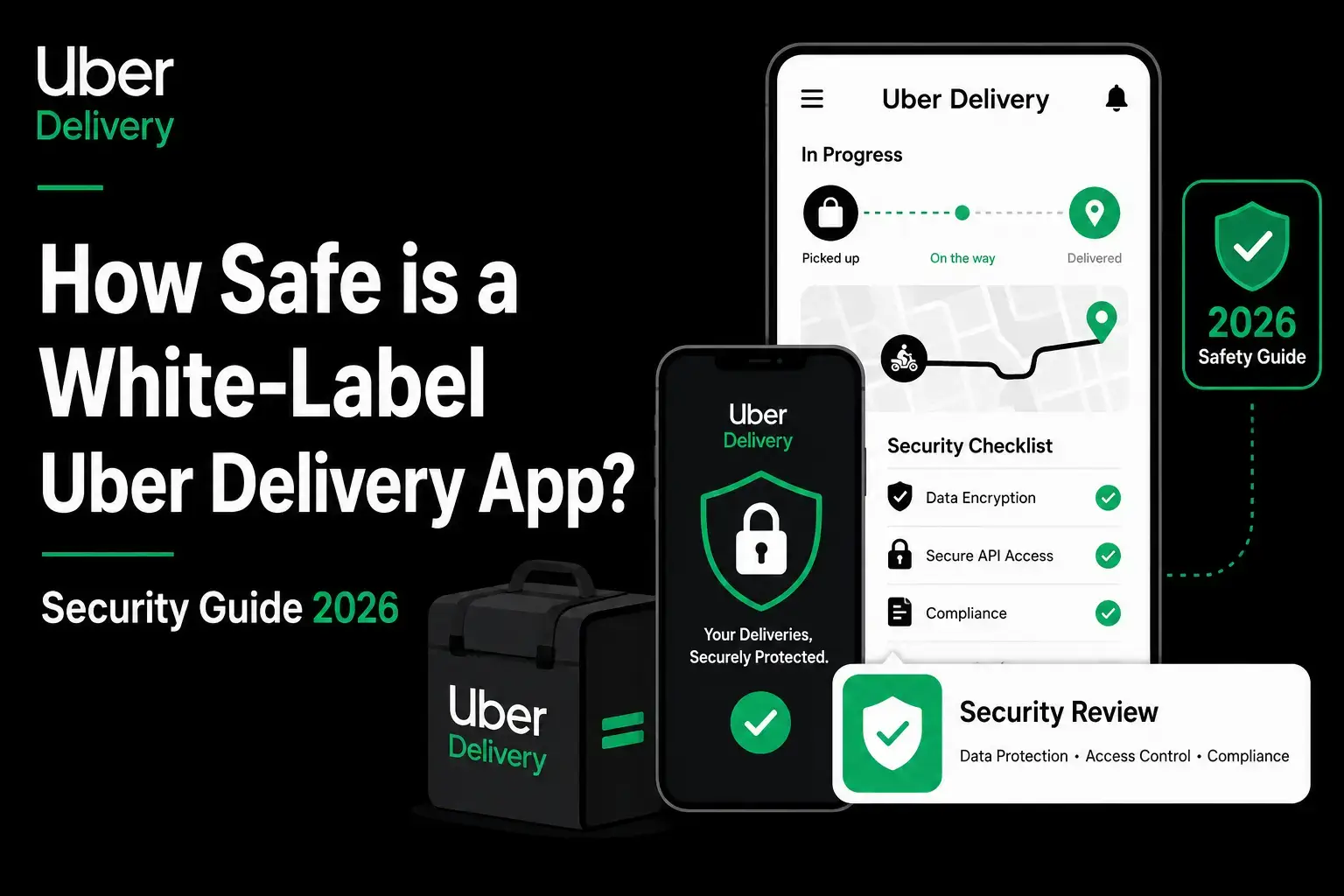
White-label Uber Delivery app security is not just about adding HTTPS or locking down an admin panel. It refers to the entire protection framework that keeps user data, transactions, locations, and business operations safe across the platform.
In a delivery app ecosystem, security must cover:
- Customer apps (iOS, Android, Web)
- Delivery partner apps
- Restaurant dashboards
- Admin panels
- APIs connecting all systems
- Cloud infrastructure and databases
If even one layer is weak, the entire platform becomes vulnerable.
Why People Worry About White-Label Delivery Apps
The concern is valid — many low-cost providers reuse outdated code, skip audits, and rely on shared infrastructure. For delivery platforms, the risks feel higher because:
- Live location tracking runs continuously
- Payments happen multiple times per day
- Personal addresses are stored long-term
- Third-party integrations expand attack surfaces
A single vulnerability can expose thousands of customers and delivery partners instantly.
Current Threat Landscape for Uber-Style Delivery Apps
In 2026, food delivery platforms face increasingly targeted attacks:
- API abuse to scrape user data
- Account takeover attacks via weak authentication
- Payment fraud and wallet exploitation
- Location data misuse and tracking leaks
- Insider threats through admin panel access
- Malware injection via third-party SDKs
Delivery apps are especially vulnerable because speed, convenience, and real-time data are core to their operation.
Security Standards in 2026
Modern white-label Uber Delivery apps must align with:
- Zero Trust security architecture
- Privacy-by-design principles
- Encrypted microservice communication
- Role-based access control across all apps
- Continuous monitoring and automated alerts
Security is no longer a one-time setup — it’s an ongoing operational process.
Real-World Security Statistics (Food & Delivery Apps)
Recent industry security reports show:
- Over 60% of mobile app breaches originate from insecure APIs
- Food delivery apps are among the top 5 targets for payment fraud
- Misconfigured cloud storage accounts for nearly 40% of exposed customer data incidents
- Platforms without regular penetration testing are 3× more likely to experience breaches
These numbers explain why regulators and users demand stronger security commitments from delivery app operators.
Key Security Risks & How to Identify Them
When evaluating a white-label Uber Delivery app, security risks fall into three major categories: data protection, technical vulnerabilities, and business-level exposure. Ignoring even one of these can create long-term damage that’s hard to reverse.
Data Protection & Privacy Risks
Food delivery apps process highly sensitive user data every day. This makes data protection the most critical risk area.
User Personal Information
Delivery apps store:
- Names, phone numbers, email addresses
- Home and work delivery locations
- Order history and food preferences
If this data is stored without encryption or proper access control, it becomes an easy target for attackers.
Payment Data Security
Payment-related risks include:
- Token storage vulnerabilities
- Improper PCI DSS implementation
- Insecure payment gateway integrations
Any weakness here can lead to direct financial theft and chargeback losses.
Location Tracking Concerns
Real-time GPS tracking introduces unique risks:
- Live location interception
- Unauthorized access to driver movement data
- Historical route exposure
Insecure location APIs can allow attackers to track users or delivery partners without consent.
GDPR / CCPA Compliance Failures
Common compliance mistakes include:
- Collecting more data than necessary
- No clear consent records
- Inability to delete user data on request
- Storing data in non-compliant regions
These violations can result in heavy fines and forced shutdowns.
Technical Vulnerabilities
Technical weaknesses often exist beneath the surface and are invisible until exploited.
Code Quality Issues
Warning signs:
- Hardcoded credentials
- Lack of input validation
- No separation between user roles
- Reused code across multiple clients without isolation
Poor code quality increases the risk of data leaks across different app instances.
Server Security Gaps
Common server risks include:
- Open ports and unsecured admin access
- Weak firewall rules
- No intrusion detection systems
- Shared hosting for multiple clients
A single compromised server can expose multiple delivery platforms.
API Vulnerabilities
APIs are the backbone of delivery apps and also the most attacked component.
- Missing authentication on endpoints
- No rate limiting
- Predictable request patterns
- Excessive data exposure in responses
API abuse is one of the fastest ways attackers extract bulk user data.
Third-Party Integrations
Delivery apps depend on external services:
- Payment gateways
- Maps and routing APIs
- SMS and notification services
Each integration expands the attack surface if not carefully vetted and monitored.
Business Risks
Security failures don’t stay technical — they quickly become business disasters.
Legal Liability
- Lawsuits from affected users
- Regulatory penalties
- Contract breaches with restaurants and partners
Reputation Damage
- App store takedowns
- Negative media coverage
- Loss of customer trust
- Partner attrition
Financial Losses
- Fraud-related refunds
- Incident response costs
- Legal fees
- Infrastructure rebuild expenses
Regulatory Penalties
- GDPR fines up to 4% of global revenue
- Payment processor blacklisting
- Forced audits and compliance checks
Risk Assessment Checklist
Use this checklist when reviewing any white-label Uber Delivery app:
- Is user data encrypted at rest and in transit?
- Are payment systems PCI DSS compliant?
- Is location data protected and access-controlled?
- Are APIs authenticated and rate-limited?
- Are servers isolated per client?
- Is there documented compliance with GDPR/CCPA?
- Are security audits and penetration tests performed regularly?
- Is there a clear incident response plan?
If a provider cannot confidently answer these questions, the platform is not ready for real-world scale.
Read more : – Business Model of Ubereats : Complete Strategy Breakdown 2025
Security Standards Your White-Label Uber Delivery App Must Meet
A secure white-label Uber Delivery app is not defined by promises or marketing language. It is defined by verifiable security standards, certifications, and technical controls. In 2026, anything less is a liability.
Essential Security Certifications
These certifications indicate that a provider follows audited, industry-accepted security practices.
ISO 27001 Compliance
ISO 27001 ensures that the provider has a structured Information Security Management System (ISMS).
It covers:
- Data access controls
- Risk assessment processes
- Incident response procedures
- Continuous security improvement
For delivery apps handling large volumes of personal and payment data, ISO 27001 is a baseline requirement.
SOC 2 Type II
SOC 2 Type II validates:
- Security controls over time (not just at a single point)
- System availability and integrity
- Confidentiality of user data
This certification is especially important for cloud-based delivery platforms operating at scale.
GDPR Compliance
Mandatory for apps serving users in the EU and often adopted globally. GDPR requires:
- Explicit user consent
- Data minimization practices
- Right to access and delete data
- Secure data storage and processing
Non-compliance can result in fines large enough to shut down early-stage delivery startups.
HIPAA (If Applicable)
If the delivery app handles:
- Medical meals
- Hospital food services
- Health-related delivery programs
Then HIPAA-level data protection may be required.
PCI DSS for Payments
Any app that processes or stores payment data must meet PCI DSS standards:
- Secure payment tokenization
- Encrypted card data
- Regular vulnerability scanning
- Restricted access to financial systems
Without PCI DSS alignment, payment gateways can block or revoke access.
Technical Security Requirements
Certifications alone are not enough. The underlying technology must be built securely.
End-to-End Encryption
- Data encrypted during transmission (TLS 1.2+)
- Encrypted databases and backups
- Secure key management practices
This protects user data even if infrastructure is compromised.
Secure Authentication
A delivery app must implement:
- Two-factor authentication for admin access
- OAuth-based authentication flows
- Role-based permissions for users, drivers, restaurants, and admins
- Session management with automatic expiration
Regular Security Audits
- Internal audits for code and infrastructure
- External third-party security reviews
- Vulnerability assessments after major updates
Audits ensure new features do not introduce hidden risks.
Penetration Testing
Penetration testing simulates real attacks to identify weaknesses in:
- APIs
- Mobile apps
- Admin dashboards
- Payment flows
This is one of the most effective ways to prevent real-world breaches.
SSL Certificates & Secure Hosting
- Mandatory HTTPS across all apps and dashboards
- Secure cloud infrastructure with firewall rules
- Network isolation between environments
Secure API Design
- Token-based authentication
- Rate limiting and throttling
- Input validation and logging
- Minimal data exposure per request
APIs should expose only what is necessary — nothing more.
Security Standards Comparison Table
| Security Area | Unsafe Provider | Secure Enterprise-Grade Provider |
|---|---|---|
| Data Encryption | Partial or missing | Full encryption at rest & transit |
| Authentication | Basic passwords | 2FA, OAuth, RBAC |
| API Protection | Open or weakly protected | Tokenized, rate-limited APIs |
| Compliance | No certifications | ISO 27001, SOC 2, GDPR |
| Audits | One-time or none | Ongoing, scheduled audits |
| Payment Security | Gateway-only | Full PCI DSS-aligned flow |
| Monitoring | Manual checks | Automated 24/7 monitoring |
Red Flags – How to Spot Unsafe White-Label Providers
Not all white-label Uber Delivery apps are built with security in mind. Many providers focus on fast sales and low pricing, leaving serious risks hidden beneath the surface. Knowing the warning signs can save your business from long-term damage.
Major Warning Signs You Should Never Ignore
No Security Documentation
If a provider cannot clearly explain:
- How data is stored
- How APIs are secured
- What encryption standards are used
It usually means security was never properly implemented.
Unrealistically Cheap Pricing
Security infrastructure costs money. Extremely low prices often indicate:
- Shared databases between clients
- No dedicated servers
- No security audits or testing
- Reused code without isolation
Cheap upfront pricing can result in extremely expensive breaches later.
No Compliance Certifications
A serious provider should be able to show:
- ISO 27001 documentation
- GDPR compliance processes
- PCI DSS alignment for payments
“No one has ever asked for this before” is a major red flag.
Outdated Technology Stack
Delivery apps built on outdated frameworks face:
- Known, unpatched vulnerabilities
- Poor performance under scale
- Incompatibility with modern security tools
Old tech increases both risk and long-term maintenance costs.
Poor Code Quality
Indicators of risky codebases:
- Hardcoded admin credentials
- No environment separation
- Shared authentication logic across apps
- No version control or code reviews
Poor code quality often leads to cross-client data exposure.
No Security Update Policy
If there is no clear plan for:
- Security patches
- Dependency updates
- Emergency vulnerability fixes
The app will slowly become unsafe, even if it starts secure.
Lack of Data Backup Systems
Without proper backups:
- Ransomware attacks become catastrophic
- Accidental data loss can be permanent
- Recovery times increase dramatically
Backups must be encrypted, automated, and tested regularly.
No Insurance Coverage
Professional providers carry:
- Cyber liability insurance
- Data breach coverage
Lack of insurance shifts all risk directly onto you.
Evaluation Checklist: How to Vet a Provider Properly
Questions to Ask
- How is customer and delivery partner data encrypted?
- Are servers isolated per client?
- How often are security audits performed?
- Who is responsible for security updates?
- How is incident response handled?
Documents to Request
- Security architecture overview
- Compliance certificates
- Data protection policies
- Penetration testing reports
- Disaster recovery plan
Testing Procedures
- API vulnerability testing
- Admin panel access review
- Payment flow testing
- Role-based permission checks
Due Diligence Steps
- Verify certifications independently
- Review past client case studies
- Check app store history for security issues
- Evaluate long-term support commitments
If a provider hesitates or avoids these discussions, it’s a clear sign they are not security-ready.
Best Practices for Secure White-Label Uber Delivery App Implementation
Even the most secure white-label Uber Delivery app can become unsafe if it’s implemented incorrectly. Security must be treated as a process, not a one-time setup. The following best practices help ensure protection before and after launch.
Pre-Launch Security Practices
Security Audit Process
Before launch, a full security audit should validate:
- Application code quality
- API access controls
- Server and database configurations
- Authentication and authorization flows
- Data encryption mechanisms
Audits should be performed by experienced security professionals, not just internal developers.
Code Review Requirements
A secure delivery app requires:
- Peer-reviewed code changes
- Secure coding standards enforcement
- Removal of unused or vulnerable dependencies
- Separation of production and testing environments
Code reviews reduce human error and catch vulnerabilities early.
Infrastructure Hardening
Infrastructure must be secured at multiple levels:
- Firewalls with restricted inbound access
- Network segmentation
- Private databases with no public exposure
- Secure cloud IAM roles
Infrastructure misconfigurations remain one of the biggest breach causes
Compliance Verification
Before onboarding users:
- GDPR consent mechanisms must be active
- Privacy policies must be enforceable
- Data retention rules must be configured
- Payment systems must be PCI DSS aligned
Compliance is not optional — it is legally enforceable.
Staff Training Programs
Human error is a major security risk. Teams should be trained on:
- Secure admin access usage
- Phishing and social engineering risks
- Incident reporting procedures
- Data handling best practices
Post-Launch Security Monitoring
Continuous Security Monitoring
Once live, the app must be monitored for:
- Suspicious login activity
- API abuse patterns
- Payment anomalies
- Unauthorized access attempts
Automated alerts enable rapid response before damage spreads.
Regular Updates and Patches
Security updates must cover:
- Operating systems
- Application frameworks
- Third-party libraries
- Payment SDKs
Delays in patching are one of the most common causes of breaches.
Incident Response Planning
A documented response plan should define:
- Incident classification
- Communication responsibilities
- User and regulator notification timelines
- Recovery procedures
Without a plan, response delays increase both damage and penalties.
User Data Management
Secure data handling includes:
- Minimal data collection
- Access logging and audits
- Secure data deletion workflows
- Encrypted backups
Data should only exist as long as it serves a legitimate purpose.
Backup and Recovery Systems
A secure backup strategy requires:
- Automated daily backups
- Encrypted storage
- Off-site redundancy
- Regular recovery testing
Backups are your last line of defense against catastrophic failure.
Security Implementation Timeline
- Week 1–2: Security audit and risk assessment
- Week 3–4: Infrastructure hardening and code remediation
- Week 5: Compliance verification and documentation
- Week 6: Penetration testing and final validation
- Launch: Monitoring, alerts, and incident readiness
- Ongoing: Monthly reviews and quarterly audits
Legal & Compliance Considerations
Security failures in a white-label Uber Delivery app don’t just cause technical issues — they trigger legal, regulatory, and contractual consequences. Understanding compliance requirements is essential to operating safely across regions.
Regulatory Requirements
Data Protection Laws by Region
Different regions enforce different data protection rules, and delivery apps often operate across borders.
- European Union (GDPR)
Requires lawful data processing, user consent, data minimization, breach notification within 72 hours, and user rights management. - United States (CCPA / CPRA)
Focuses on consumer rights, data access, opt-out mechanisms, and transparent data usage disclosures. - India (DPDP Act 2023)
Mandates consent-based data processing, data security safeguards, and penalties for breaches. - Other Regions
Many countries are introducing GDPR-inspired laws, making global compliance increasingly important.
Industry-Specific Regulations
Food delivery apps may also face:
- Payment processing regulations
- Local food safety data handling rules
- Gig worker and delivery partner data protection laws
Ignoring these can result in service bans or operational restrictions.
User Consent Management
A compliant delivery app must:
- Collect explicit consent for data usage
- Allow users to withdraw consent
- Record consent timestamps and versions
- Handle consent separately for marketing and operational data
Privacy Policy Requirements
Your privacy policy should clearly state:
- What data is collected
- Why it is collected
- How long it is stored
- Who it is shared with
- How users can exercise their rights
Vague or copied policies increase legal exposure.
Terms of Service Essentials
Terms must define:
- User responsibilities
- Platform liability limits
- Dispute resolution mechanisms
- Governing jurisdiction
- Service availability disclaimers
These documents protect your business during incidents.
Liability Protection
Insurance Requirements
Serious delivery platforms carry:
- Cyber liability insurance
- Data breach insurance
- Errors and omissions coverage
Insurance helps manage financial exposure after incidents.
Legal Disclaimers
Disclaimers should address:
- Platform availability
- Third-party service dependencies
- Payment processing responsibilities
- Data accuracy limitations
User Agreements
Separate agreements should exist for:
- Customers
- Delivery partners
- Restaurant partners
Each group has different risk profiles and legal obligations.
Incident Reporting Protocols
A compliant app must:
- Log security incidents
- Notify regulators within required timelines
- Inform affected users transparently
- Maintain incident records for audits
Ongoing Compliance Monitoring
Compliance is not static. Laws change, and platforms must:
- Review regulations periodically
- Update policies and systems
- Train staff on new requirements
- Document compliance efforts
Compliance Checklist by Region
- GDPR consent and data rights management
- CCPA opt-out and disclosure mechanisms
- PCI DSS payment compliance
- Local data storage rules
- Breach notification workflows
- Insurance coverage verification
Read more : – How to Build an App Like Uber Delivery: Developer’s Guide
Why Miracuves White-Label Uber Delivery App Is Your Safest Choice
Choosing a white-label Uber Delivery app provider is ultimately a trust decision. Security is not something you can fix after launch — it must be built into the platform from the first line of code. This is where Miracuves stands apart.
Miracuves Security-First Architecture
Miracuves designs every delivery app with a security-first mindset, not as an add-on or upsell.
- Enterprise-grade infrastructure with isolated environments per client
- Secure cloud architecture following Zero Trust principles
- Strict role-based access control across admin, restaurant, delivery partner, and customer apps
This ensures one client’s data is never exposed to another.
Verified Security & Compliance Standards
Miracuves platforms are built to align with:
- ISO 27001 information security frameworks
- SOC 2 Type II security controls
- GDPR and CCPA compliance by default
- PCI DSS-aligned payment processing
Compliance is integrated into the platform architecture, not handled manually after deployment.
Advanced Data Protection
Miracuves ensures:
- End-to-end encryption for data in transit
- Encrypted databases and backups
- Secure key management and access logging
- Controlled access to sensitive user and location data
Even in the event of unauthorized access attempts, user data remains protected.
Continuous Security Monitoring
Security does not stop at launch. Miracuves provides:
- 24/7 system monitoring
- Automated alerts for suspicious activity
- Regular vulnerability scans
- Scheduled security updates and patches
This proactive approach prevents small issues from becoming major incidents.
Secure Payment Processing
Miracuves delivery apps integrate:
- Trusted, PCI-compliant payment gateways
- Secure tokenization of payment data
- Fraud detection and prevention mechanisms
This protects both users and businesses from financial abuse.
Proven Track Record
Miracuves has successfully delivered 9k+ platforms globally, with:
- Zero major security breaches reported
- Consistent compliance across multiple regions
- Enterprise clients operating at scale
This track record demonstrates security maturity, not experimentation.
Final Thought
Miracuves white-label Uber Delivery app solutions come with enterprise-grade security built in from day one. With over 600 successful projects and a zero major breach history, Miracuves helps businesses launch safe, compliant, and scalable delivery platforms. Get a free security assessment and see why growing businesses trust Miracuves for secure delivery apps.
In 2026, users, regulators, and payment partners expect enterprise-level security from day one. Choosing a security-first provider like Miracuves isn’t just a technical decision — it’s a long-term business safeguard.
FAQs
1. How secure is a white-label Uber Delivery app compared to custom development?
A professionally built white-label Uber Delivery app can be just as secure as custom development when it follows ISO 27001, GDPR, and PCI DSS standards. Security depends on architecture and practices, not on whether the app is white-label.
2. What happens if there is a security breach?
A secure platform includes incident response protocols, encrypted data protection, rapid containment, user notification, and regulatory reporting to minimize damage and legal exposure.
3. Who is responsible for security updates in a white-label app?
The provider is responsible for core platform security updates, patches, and vulnerability fixes, while the business ensures correct usage and access control.
4. How is user data protected in white-label delivery apps?
User data is protected through encryption at rest and in transit, role-based access control, secure APIs, and strict data retention policies.
5. What compliance certifications should I look for?
At minimum: ISO 27001, GDPR compliance, and PCI DSS for payments. SOC 2 Type II is strongly recommended for enterprise-grade platforms.
6. Can white-label Uber Delivery apps meet enterprise security standards?
Yes. When built with modern cloud security, audited codebases, and continuous monitoring, white-label apps can fully meet enterprise requirements.
7. How often should security audits be conducted?
Security audits should be performed at least annually, with penetration testing after major updates and continuous vulnerability monitoring.
8. What is included in Miracuves’ security package?
Miracuves includes encrypted infrastructure, compliance-ready architecture, secure payment processing, regular security updates, monitoring, and documented incident response processes.
9. How is security handled across different countries?
Miracuves aligns platforms with regional data protection laws such as GDPR, CCPA, and India’s DPDP Act, ensuring lawful data handling across markets.
10. What insurance is needed for app security?
Cyber liability and data breach insurance are essential to protect against financial and legal risks arising from security incidents.
Related Articles: