


Key Takeaways
- Food delivery marketplace revenue can come from restaurant commissions, customer delivery fees, subscription plans, promoted listings, advertising, service charges, and other transaction-based models.
- Each revenue stream depends on different marketplace activity: commissions monetize orders, delivery fees support fulfillment, subscriptions encourage recurring usage, and promotions monetize restaurant visibility.
- A balanced model should improve platform revenue without making restaurant economics unattractive, delivery prices too high, or the customer ordering experience overly dependent on fees.
Revenue Model Signals
- Restaurant commissions can be structured as a percentage of order value, tiered rates, category-based pricing, or different plans based on delivery and promotional support.
- Delivery and service fees can vary by distance, order size, demand, delivery zone, time, logistics cost, and the level of fulfillment provided by the marketplace.
- Subscription plans may offer customers reduced delivery charges or exclusive benefits, while restaurant plans can bundle lower commission rates, analytics, marketing tools, or enhanced platform visibility.
Marketplace Monetization Insights
- Promoted listings, sponsored placements, featured restaurants, campaign tools, and targeted offers can generate additional revenue while helping restaurants compete for customer attention.
- Operators should monitor commission revenue, delivery margin, subscription conversion, promotional spend, average order value, order frequency, restaurant retention, and contribution margin by order.
- Miracuves develops customizable food delivery marketplaces with commission management, delivery fees, subscriptions, promotions, restaurant tools, payments, payouts, analytics, and admin controls.
A food delivery marketplace looks simple from the outside. A customer opens an app, chooses a restaurant, places an order, tracks the rider, and receives food at the door.
But for the platform owner, the real business is not just food ordering. It is the coordination of demand, restaurant supply, rider availability, payment flow, delivery zones, refunds, commissions, support, and operational visibility.
That is why understanding the food delivery marketplace model matters for founders. The model is not only about how orders are placed. It is about how every order moves through the system without breaking customer trust, restaurant confidence, or platform margins.
For founders planning to build a food ordering and delivery business, this article explains how ordering, fulfillment, and platform operations work together inside a modern food ordering and delivery platform. It also shows where monetization, admin control, and technology decisions affect long-term scalability.
What Is a Food Delivery Marketplace Model?
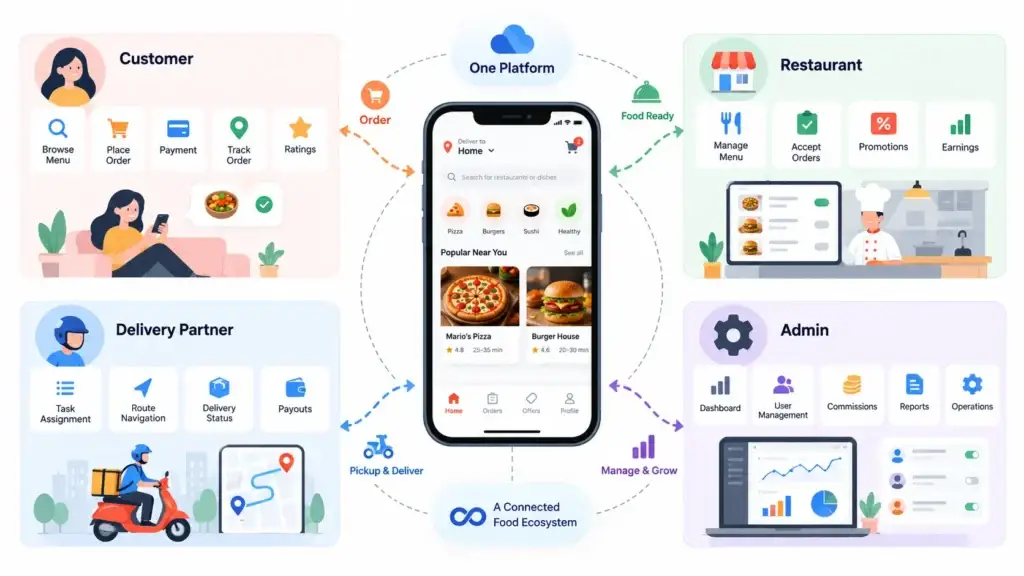
A food delivery marketplace model is a digital platform that connects customers, restaurants, and delivery partners under one operating system.
Customers use the platform to discover restaurants, browse menus, place orders, pay online or offline, track deliveries, and leave ratings. Restaurants use it to manage menus, accept orders, update availability, run promotions, and track earnings. Delivery partners use it to receive tasks, navigate routes, update delivery status, and receive payouts. The platform operator manages the entire network from an admin dashboard.
The marketplace earns by enabling the transaction and controlling the operating layer around that transaction. That may include restaurant commissions, delivery charges, subscription plans, featured listings, advertising placements, service fees, and customer membership programs.
For founders, the important point is this: a food delivery marketplace is not just an ordering app. It is a multi-sided operations business where every participant needs a clear workflow.
Why the Marketplace Model Works for Food Delivery
Food delivery is a high-frequency habit. People order because they want convenience, speed, variety, and reliability. Restaurants join because they want more orders, stronger digital visibility, and access to customers they may not reach through their own channels. Delivery partners participate because the platform gives them flexible earning opportunities.
The marketplace sits in the middle and creates value by solving coordination problems.
Without a marketplace, customers must contact restaurants manually, restaurants must manage delivery capacity on their own, and riders need direct relationships with every merchant. A marketplace simplifies this by bringing discovery, ordering, payment, dispatch, and support into one connected system.
The stronger the coordination layer, the better the customer experience becomes. A delayed order, wrong menu item, unavailable rider, failed payment, or unclear refund can damage trust quickly. That is why founders should think about the operational model before thinking only about design.
The Four Core Participants in a Food Delivery Marketplace
A food delivery marketplace depends on four main participants. Each one has different goals, workflows, and risks.
| Participant | What They Want | What the Platform Must Provide |
|---|---|---|
| Customers | Fast ordering, accurate menus, fair fees, reliable tracking | Customer app, restaurant discovery, cart, checkout, order tracking, support |
| Restaurants | More orders, menu control, predictable payouts | Restaurant panel, order management, menu tools, offers, earnings reports |
| Delivery partners | Clear tasks, route support, payout visibility | Rider app, assignment flow, status updates, navigation, payout records |
| Platform operator | Revenue, quality control, operational visibility | Admin dashboard, commission settings, zones, reports, refunds, dispute control |
A weak platform usually focuses too much on the customer side and ignores the restaurant, rider, and admin layers. That creates problems later because the customer experience depends on what happens behind the screen.
How Ordering Works Inside the Marketplace
The ordering layer begins when a customer opens the app or website. At this stage, the platform must answer a few questions instantly.
Which restaurants are available in the customer’s location? Which restaurants are open? Which menus are active? Which items are available? What is the estimated delivery time? What payment options can the customer use? Are there offers, coupons, wallet credits, or loyalty points available?
A strong ordering flow includes:
- Location-based restaurant discovery
- Menu browsing with categories and item variations
- Cart management with taxes, charges, and discounts
- Scheduled or instant ordering
- Delivery, takeaway, or dine-in options where relevant
- Online payment, wallet, cash, or offline payment support
- Real-time order confirmation
- Status notifications after the order is placed
For a deeper breakdown of customer-side modules such as menus, cart flow, checkout, live tracking, offers, and restaurant discovery, review the customer ordering, checkout, and tracking features that support a scalable delivery marketplace.
The business risk is simple: if the ordering flow feels slow, confusing, or unreliable, customers may not complete checkout. Even a small friction point can reduce conversion.
For a founder, this means the customer app should not be designed only for appearance. It should be built around order completion, repeat ordering, and trust.
Restaurant Acceptance and Preparation Flow
Once the customer places an order, the marketplace shifts from ordering to restaurant operations.
The restaurant needs to receive the order immediately, confirm it, prepare the food, update the order status, and coordinate with the delivery partner. If the restaurant misses the order, confirms late, or marks items incorrectly, the customer experience suffers.
A restaurant dashboard should allow merchants to:
- Accept or reject incoming orders
- Update food preparation status
- Mark items as unavailable
- Edit menus, prices, photos, and add-ons
- Manage opening hours
- Run discounts and promotions
- View order history
- Track earnings and settlements
- Handle takeaway or dine-in workflows if enabled
This is where many founders underestimate complexity. Restaurant operations are not static. Menus change, kitchens get busy, items sell out, opening hours shift, and order volume spikes during peak hours.
A marketplace platform must give restaurants enough control without allowing them to disrupt the customer experience. That balance is what turns a simple listing app into a real food delivery business.
Fulfillment: How Delivery Assignment Connects the Order to the Rider
Fulfillment begins after the restaurant accepts the order. This is the point where the platform must decide how the order reaches the customer.
Delivery assignment can be manual, automatic, zone-based, distance-based, or priority-based depending on the business model. Some operators use their own rider fleet. Some allow restaurants to deliver. Others use a hybrid model.
A practical delivery fulfillment system should consider:
- Restaurant location
- Customer location
- Delivery zone
- Rider availability
- Rider distance from pickup point
- Order preparation time
- Payment mode
- Cash handling limits
- Delivery fee rules
- Reassignment options
- Proof of delivery
The platform operator needs visibility here because delivery is where margin can disappear. Poor assignment can increase delivery time, rider idle time, customer complaints, and refund requests.
For founders, fulfillment is one of the most important layers of the marketplace model. It directly affects customer retention, restaurant satisfaction, delivery cost, and brand reputation.
Zone-Based Delivery Control
Food delivery is local by nature. A platform may serve one city, but not every restaurant can deliver everywhere. That is why zone-based delivery control is essential.
Zones help the operator define where restaurants can serve, how delivery charges are calculated, which riders operate in which areas, and how expansion should happen.
A zone-based system can support:
- Delivery radius rules
- Area-specific delivery charges
- Different fees for different locations
- Local taxes or service charges
- Rider allocation by region
- Restaurant visibility based on customer address
- Multi-city expansion planning
Without zone control, a platform can accidentally show restaurants that cannot deliver to a customer. That creates cancellations, support tickets, and poor customer experience.
Strong zone logic also helps founders expand carefully. Instead of launching everywhere at once, they can start with a focused area, improve density, and then move into new zones.
Payment Flow, Commission Logic, and Settlements
The money flow is one of the most important parts of the food delivery marketplace model.
Every order can include several financial components: item price, taxes, packaging charges, delivery fees, service fees, discounts, wallet usage, restaurant commission, rider payout, refund adjustments, and platform earnings.
The platform must calculate who gets paid, how much they get paid, and when the payout happens.
A strong payment and settlement layer should include:
- Multiple payment options
- Commission calculation per order
- Delivery fee configuration
- Restaurant earnings reports
- Rider payout records
- Refund adjustment handling
- Tax and invoice support
- Wallet or loyalty balance tracking
- Settlement history
- Exportable reports
This layer should not be treated as an afterthought. If commission, refunds, and payout records are unclear, the platform may face disputes with restaurants and delivery partners. Founders who want to go deeper into commissions, delivery fees, subscription logic, featured placements, and platform earnings can explore the food delivery revenue and commission model in more detail.
For founders, payment transparency builds trust with supply-side partners. Restaurants and riders are more likely to stay active when they understand how earnings are calculated.
How the Platform Operator Manages the Marketplace
The admin dashboard is the control room of the food delivery marketplace. It is where the platform owner manages users, restaurants, riders, orders, fees, zones, payouts, refunds, content, offers, and reports.
A founder should pay close attention to this layer because it decides how much control the business has after launch.
A strong operator dashboard should support:
- Restaurant approval and management
- Delivery partner approval and management
- Customer management
- Order monitoring
- Live order intervention
- Commission and fee settings
- Zone creation and pricing
- Coupon and campaign control
- Paid placement management
- Refund and cancellation rules
- Payout scheduling
- Staff roles and permissions
- Sales and operations reports
When the admin layer is weak, the founder becomes dependent on developers for every small operational change. That slows decision-making and makes the business harder to scale.
A strong admin dashboard gives the operator flexibility. Pricing, zones, commissions, promotions, and settings should be manageable from the platform, not hard-coded into the product.
Revenue Streams in a Food Delivery Marketplace
A food delivery marketplace usually earns from multiple revenue streams. The healthiest model does not rely on one fee only. It uses different monetization layers that match the value being provided.
| Revenue Stream | Who Pays? | What It Monetizes | Founder Risk If Mismanaged |
|---|---|---|---|
| Restaurant commission | Restaurant | Completed orders generated through the platform | High commission may reduce restaurant participation |
| Delivery fee margin | Customer or restaurant | Fulfillment and last-mile delivery | Poor route planning can reduce margin |
| Service fee | Customer | Platform convenience and transaction handling | Too many fees can reduce conversion |
| Restaurant subscription | Restaurant | Access to marketplace tools or lower commissions | Weak plan value can increase churn |
| Featured placement | Restaurant | Better visibility in listings | Overuse can hurt customer trust |
| Advertising | Restaurant or brand | Attention inside the app or website | Works only when the platform has enough active users |
| Membership program | Customer | Repeat ordering and loyalty benefits | Poor benefits may fail to retain users |
The right revenue mix depends on the market. A new marketplace may start with commissions and delivery fees, then add subscriptions, promotions, and memberships once there is enough restaurant and customer activity.
The goal is not to add every fee at launch. The goal is to create a model where each revenue stream has a clear value exchange.
Ordering, Fulfillment, and Operations Must Work as One System
A food delivery marketplace fails when ordering, fulfillment, and operations are treated as separate parts.
The customer app may look polished, but if the restaurant panel is slow, orders get delayed. If rider assignment is weak, delivery times increase. If settlement logic is unclear, restaurants lose trust. If refund rules are manual, support teams get overwhelmed. If reports are missing, the operator cannot identify where margin is leaking.
That is why the strongest platform model connects every layer.
| Marketplace Layer | What It Controls | Why It Matters |
|---|---|---|
| Ordering | Discovery, cart, checkout, payment | Drives conversion and customer trust |
| Restaurant operations | Acceptance, menu, preparation, offers | Keeps supply active and accurate |
| Fulfillment | Rider assignment, tracking, delivery status | Controls delivery speed and cost |
| Payments | Fees, commission, refunds, payouts | Protects platform economics |
| Admin operations | Zones, users, reports, disputes, rules | Gives the founder control after launch |
| Growth tools | Coupons, campaigns, loyalty, placement | Supports acquisition and repeat orders |
As delivery platforms mature, automation, smarter dispatch, AI-assisted support, operational analytics, and flexible fulfillment workflows become more important. These shifts are part of broader food delivery app development trends that founders should track before scaling across new zones or service categories.
Founders should evaluate a food delivery platform by how well these layers work together, not only by how many features are listed.
Founder Decision Signals
Speed
If the business needs to test demand quickly, a ready-made marketplace foundation can reduce the time spent rebuilding standard ordering, dispatch, payment, and admin flows.
Control
The operator should be able to adjust zones, fees, commissions, offers, payouts, and refund rules without depending on developers for every small update.
Scalability
A scalable platform should support more restaurants, riders, locations, payment methods, and order volume without forcing a full rebuild.
Market Fit
The model should match the local market, including restaurant density, delivery distance, customer payment habits, and fulfillment capacity.
Common Mistakes Founders Make With Food Delivery Marketplace Models
Many food delivery startups struggle because they focus on the visible app and ignore the operating system behind it.
Mistake 1: Building Only for Customers
The customer experience is important, but restaurants and delivery partners also need reliable workflows. If merchants cannot update menus or riders cannot manage tasks clearly, the customer experience eventually breaks.
Mistake 2: Ignoring Delivery Zones
Launching without delivery-zone logic can create operational chaos. Restaurants may appear in the wrong areas, delivery costs may rise, and customer expectations may become hard to manage.
Mistake 3: Treating Payments as a Simple Checkout
Food delivery payments include commissions, taxes, delivery charges, discounts, wallet usage, refunds, restaurant payouts, and rider payouts. A basic payment flow is not enough for a marketplace.
Because delivery marketplaces handle user accounts, payments, refunds, restaurant earnings, and rider payouts, founders should also plan for food delivery marketplace security controls such as role-based access, secure payments, fraud monitoring, activity logs, and admin permissions.
Mistake 4: Adding Too Many Revenue Streams Too Early
A new marketplace needs liquidity first. If customers see too many fees before the platform has strong restaurant choice and delivery reliability, conversion may drop.
Mistake 5: Depending on Manual Operations for Too Long
Manual order handling, restaurant onboarding, rider assignment, and payout calculations may work at small volume, but they quickly become expensive and error-prone as the platform grows.
What a Launch-Ready Food Delivery Platform Should Include
A founder evaluating a food delivery marketplace should look for a platform that supports the entire operating cycle.
At minimum, the platform should include a customer app or website, restaurant panel, delivery partner app, and admin dashboard. It should support restaurant discovery, menu management, cart and checkout, order tracking, delivery assignment, payout records, commission settings, coupons, ratings, notifications, and reporting.
More advanced platforms may also include wallet support, loyalty programs, POS-style ordering, takeaway, dine-in, scheduled orders, multiple payment gateways, staff roles, custom zones, promotional placements, and exportable reports. If the next step is vendor evaluation, choosing the right delivery app development partner matters because the build should support ordering, fulfillment, admin control, and post-launch flexibility.
This is where Miracuves can support founders who want to move faster. Instead of building every core workflow from zero, Miracuves provides a ready-made, white-label food delivery marketplace foundation with source-code ownership, branding flexibility, admin control, and 6-day solution delivery where the selected scope fits.
Ready-Made Marketplace Foundation vs Fully Custom Development
The right build path depends on the founder’s goals, budget, timeline, and operational complexity.
Before choosing between a ready-made foundation and a fully custom build, founders should understand the main factors behind food delivery platform development cost, including modules, integrations, branding, admin workflows, and operational scope.
| Build Option | Best For | Strength | Limitation |
|---|---|---|---|
| Ready-made marketplace foundation | Founders who want faster validation and standard food delivery workflows | Faster launch, existing modules, admin control, lower starting risk | Customization must fit the available foundation |
| Fully custom development | Operators with highly specific workflows or large enterprise requirements | Full flexibility from the first line of code | Longer timeline, higher planning load, more scope risk |
| Hybrid approach | Founders who want speed plus selected custom workflows | Launch faster while customizing important differentiators | Requires clear prioritization |
For most early-stage and growth-stage food delivery businesses, the stronger question is not “Can we build everything from scratch?” It is “Which parts must be custom, and which parts are already standard marketplace infrastructure?”
Ordering, restaurant dashboards, rider assignment, payments, commissions, refunds, and admin control are common foundation layers. The founder’s differentiation usually comes from market focus, restaurant onboarding, delivery density, brand experience, pricing strategy, and operational discipline.
How This Model Supports Local and Niche Food Delivery Businesses
A food delivery marketplace does not need to serve every restaurant in every city. In many cases, a focused market can be more practical.
Founders can build around:
- Premium restaurant delivery
- Local cuisine discovery
- Cloud kitchen networks
- Corporate meal delivery
- Restaurant group ordering
- Campus food delivery
- Late-night food delivery
- Healthy meal delivery
- Community-focused food ordering
- Multi-city regional delivery
The marketplace model is flexible because the same core system can support different positioning. The customer still orders, the restaurant still prepares, the delivery partner still fulfills, and the operator still controls the business from the dashboard.
The difference is the founder’s market strategy.
Operational Metrics Founders Should Track
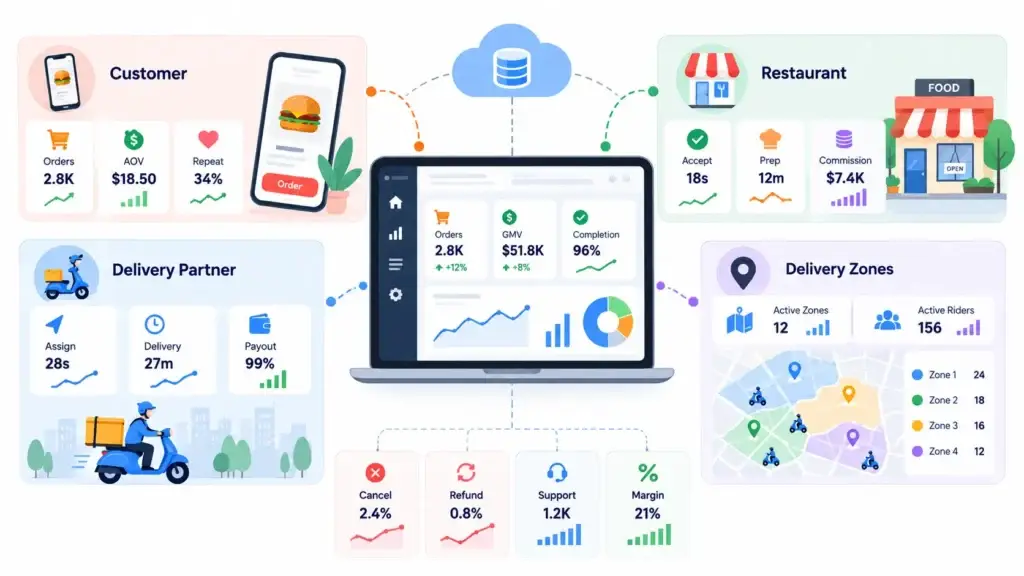
Once the marketplace is live, the founder should track the metrics that reveal whether the model is working.
Important marketplace metrics include:
- Order completion rate
- Average order value
- Repeat order rate
- Restaurant acceptance time
- Food preparation time
- Delivery partner assignment time
- Average delivery time
- Cancellation rate
- Refund rate
- Customer support tickets per order
- Restaurant payout accuracy
- Delivery fee margin
- Commission revenue per order
- Active restaurants by zone
- Active delivery partners by zone
These metrics help the operator understand where the marketplace is strong and where it needs improvement. Once the core operations are stable, the next layer is growth. A focused food delivery marketplace growth strategy can help founders improve repeat orders, restaurant visibility, customer retention, and campaign performance.
For example, if customers are ordering but cancellations are high, the issue may be restaurant availability or delivery assignment. If restaurants are active but order volume is weak, the issue may be customer acquisition or search visibility. If delivery time is increasing, the issue may be rider density or zone design.
The marketplace owner needs these insights inside the operating system, not only in external spreadsheets.
Where Miracuves Fits Into the Food Delivery Marketplace Journey
Miracuves helps founders, startups, and operators launch digital marketplaces faster using ready-made and white-label app foundations.
For food delivery businesses, the biggest advantage is not just speed. It is the ability to start with working marketplace infrastructure: customer ordering, restaurant workflows, delivery partner operations, admin control, payments, commissions, delivery rules, and reporting.
A founder can then focus on the market work that actually creates traction: onboarding restaurants, defining delivery zones, setting commission logic, building local partnerships, acquiring customers, and improving repeat orders.
Miracuves’ 6-day solution delivery can be useful when the founder wants to validate a food delivery marketplace without waiting months for core modules that already follow a proven operating pattern.
Final Thoughts
The food delivery marketplace model is not just about letting customers order food online. It is about connecting ordering, restaurant preparation, delivery fulfillment, payment settlement, and platform operations into one reliable system.
Founders who understand this model make better product decisions. They know why the restaurant panel matters. They know why rider assignment affects margin. They know why admin control is not optional. They know why payment and payout logic must be clear from the beginning.
A strong marketplace is built on coordination. When customers, restaurants, delivery partners, and operators work through one connected platform, the business has a stronger foundation for growth. Founders exploring adjacent opportunities can also review Miracuves’ broader delivery app solutions across food, grocery, pharmacy, parcel, and last-mile delivery models.
Miracuves helps founders move from marketplace idea to launch-ready execution with a white-label food delivery platform that can support ordering, fulfillment, monetization, and admin control from day one.
FAQs
What is a food delivery marketplace model?
A food delivery marketplace model connects customers, restaurants, delivery partners, and the platform operator through one digital system. Customers place orders, restaurants prepare them, delivery partners fulfill them, and the operator manages payments, commissions, zones, refunds, and reporting.
How does a food delivery marketplace make money?
A food delivery marketplace can earn through restaurant commissions, delivery fee margins, service fees, restaurant subscriptions, featured placements, in-app advertising, and customer membership programs. The right mix depends on the target market and order volume.
Why is the admin dashboard important in a food delivery business?
The admin dashboard gives the platform operator control over restaurants, riders, customers, orders, zones, fees, commissions, payouts, refunds, coupons, and reports. Without strong admin control, the operator may depend on developers or manual work for daily business decisions.
What is the role of delivery zones in a food ordering platform?
Delivery zones define where restaurants can serve, how delivery fees are calculated, which riders are assigned, and how the platform expands into new areas. Strong zone control helps reduce failed deliveries, wrong restaurant visibility, and margin leakage.
Should a founder build a food delivery platform from scratch?
It depends on the business model. A fully custom build may suit highly specific workflows, but many founders can start faster with a ready-made marketplace foundation and customize the parts that matter most for their market.
What features should a food delivery marketplace include?
A food delivery marketplace should include customer ordering, restaurant management, delivery partner workflows, admin control, live tracking, payments, commissions, refunds, coupons, ratings, notifications, reports, and zone-based delivery settings.
How does fulfillment work in a food delivery marketplace?
Fulfillment begins after the restaurant accepts an order. The platform assigns a delivery partner, tracks pickup and drop-off, updates the customer, and records delivery completion. Strong fulfillment logic helps improve delivery speed, customer trust, and operational margin.
How can Miracuves help launch a food delivery marketplace?
Miracuves can help founders launch a ready-made, white-label food delivery marketplace with customer, restaurant, delivery partner, and admin workflows. The solution can include branding, source-code ownership, monetization modules, and 6-day delivery where the selected scope fits.
Miracuves is an independent software development company. We are not affiliated with, connected to, sponsored by, or endorsed by any company or product named in this article.
Terms such as “X Clone” are used descriptively. It is how the software industry refers to building a platform with functionality comparable to a known service, and how clients search for it.
The entire design and codebase of our products is built by our own team. Our products contain no code, design, graphics, or content originating from any third-party website or applications.
All third-party names and marks referenced in this article are the property of their respective owners, referenced solely to identify the services discussed.



