
Key Takeaways
- A food delivery marketplace security strategy should protect customer accounts, restaurant dashboards, rider profiles, payments, orders, location data, payouts, and administrative operations.
- Layered protection can include identity verification, multi-factor authentication, encryption, secure payments, role-based access, fraud detection, session controls, and detailed audit logs.
- Security controls should follow the complete order lifecycle, from account login and checkout to restaurant acceptance, rider assignment, delivery confirmation, refunds, payouts, and support intervention.
User & Transaction Security Signals
- Customer protection can include secure authentication, device monitoring, payment tokenization, address privacy, suspicious-login alerts, account recovery controls, and transaction verification.
- Restaurant accounts should use verified onboarding, restricted staff permissions, payout-change protection, menu access controls, order history monitoring, and approval rules for sensitive account changes.
- Rider security can include identity checks, device binding, delivery verification, location-access controls, payout protection, fraud monitoring, proof-of-delivery workflows, and unusual activity detection.
Marketplace Operations Insights
- Admin systems should use role-based access, least-privilege permissions, approval workflows, audit trails, session monitoring, data masking, and stronger authentication for sensitive actions.
- Operators should monitor failed logins, suspicious orders, refund abuse, unusual payout changes, account takeovers, delivery disputes, fake accounts, payment failures, and abnormal admin activity.
- Miracuves develops customizable food delivery marketplaces with customer, restaurant, rider, payment, payout, fraud monitoring, role-based access, audit logging, analytics, and admin security controls.
A food delivery marketplace does not have one security problem. It has several connected security layers working at the same time.
Customers share names, phone numbers, addresses, payment details, food preferences, and live order updates. Restaurants manage menus, prices, staff access, preparation status, and payout records. Riders handle location tracking, delivery proof, route updates, cash handling in some markets, and customer handoff details. The admin team controls commissions, refunds, disputes, users, restaurants, riders, zones, promotions, and platform-wide settings.
That is why security for a food delivery marketplace should not be treated as a simple login feature or a payment gateway setting. It should be designed as a complete control system across customer apps, restaurant dashboards, rider apps, and admin panels.
For founders, this matters because the first version of a delivery platform is not only judged by how smoothly users can order food. It is also judged by how safely the platform handles identity, payments, operational control, location data, and dispute resolution.
Miracuves helps founders launch food delivery platforms faster with ready-made, white-label, source-code-owned solutions. But speed should not mean ignoring the control layer. A delivery marketplace needs practical safeguards from day one so the business can operate with confidence, reduce avoidable abuse, and scale without losing backend control.
Why Food Delivery Marketplace Security Is More Complex Than Normal Ecommerce
A standard ecommerce app usually manages buyers, products, payments, orders, and shipping updates. A food delivery marketplace has more moving parts because the order journey is live, local, time-sensitive, and operationally dependent on multiple parties.
A single order may involve a customer placing the order, a restaurant accepting it, a rider picking it up, an admin monitoring exceptions, a payment gateway processing the transaction, and a support team handling refunds or complaints.
This creates several risk points:
| Marketplace Area | What Can Go Wrong | Control Needed |
|---|---|---|
| Customer account | Account takeover, unauthorized address access, fake refund claims | Secure login, OTP, session control, order-level authorization |
| Restaurant dashboard | Unauthorized menu edits, price changes, payout changes | Role-based access, audit logs, approval workflows |
| Rider app | Fake pickup, fake delivery proof, location misuse | Identity checks, GPS validation, delivery proof controls |
| Payments | Failed settlements, refund abuse, exposed payment data | Tokenized gateways, transaction logs, refund permissions |
| Admin panel | Misuse of powerful platform controls | MFA, access levels, activity logs, approval rules |
| APIs | Data exposure between users, orders, restaurants, and riders | Object-level authorization and API rate limits |
This is why founders should ask a better question than “Is the app secure?”
The stronger question is: “Which controls protect each role in the marketplace?”
The Core Security Principle: Every Role Should Only See and Do What It Needs
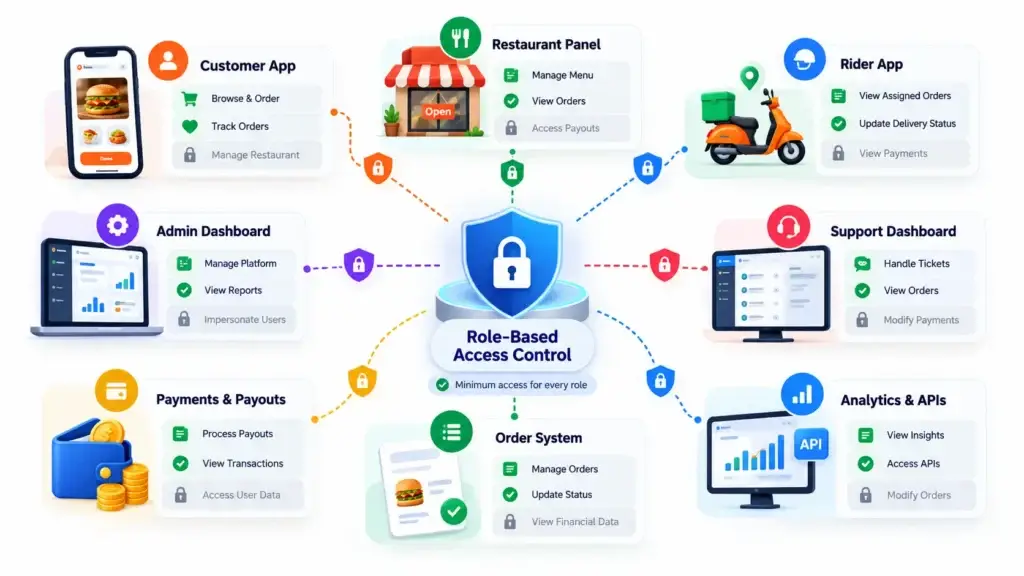
A food delivery platform has different users with different permissions. Customers should not see restaurant payout details. Restaurants should not access customer data beyond what is required to fulfil an order. Riders should not see unnecessary customer information after delivery completion. Support teams should not access sensitive admin settings unless their role requires it.
This is the principle behind role-based access control.
In a delivery marketplace, access control should apply across:
- Customer app
- Restaurant panel
- Rider app
- Admin dashboard
- Support dashboard
- Payment and payout workflows
- Order management system
- API endpoints
- Reporting and analytics panels
For founders reviewing the full product structure, Miracuves also breaks down the customer, restaurant, rider, and admin app features that support these operational workflows across ordering, delivery, restaurant management, payments, and backend control.
The control logic should be simple: every user gets the minimum access required to complete their task.
For founders evaluating a launch-ready delivery platform, this is one of the most important product questions. A beautiful interface can still become risky if the backend permissions are weak.
Customer Security Controls Every Food Delivery Marketplace Should Use
Customers are the most visible side of the platform. If they lose trust in account safety, payment security, or address privacy, retention becomes harder.
Customer security should focus on the following controls.
Secure Signup and Login
Customer onboarding should support secure account creation through phone, email, OTP, or social login depending on the target market. OTP-based verification is especially useful in food delivery because phone numbers are commonly used for delivery coordination.
The platform should also support session controls so users can log out from devices, recover accounts safely, and avoid unauthorized access after phone changes or device loss.
Order-Level Authorization
A customer should only be able to view orders connected to their own account. This sounds basic, but it is one of the most important API security controls in marketplace platforms.
Order IDs, invoices, delivery status, refund history, and saved addresses should never be exposed simply because someone changes a URL, API parameter, or request value.
Strong object-level authorization helps prevent users from accessing another user’s order details.
Address and Location Privacy
Food delivery apps rely on address and location data, but they should not collect or expose more than necessary.
Useful controls include:
- Showing rider location only during active delivery
- Limiting customer address visibility after order completion
- Avoiding unnecessary storage of precise location history
- Allowing users to manage saved addresses
- Masking sensitive delivery notes where possible
- Restricting customer support access to relevant order details only
Location trust is especially important because customers are sharing home, office, and real-time delivery information.
Payment Protection
A food delivery marketplace should avoid storing raw card details directly inside the app. Instead, it should use secure payment gateway integration and tokenized payment flows wherever applicable.
Payment security should include transaction records, refund logs, failed payment handling, order-payment matching, and admin approval rules for unusual refund or adjustment activity.
For markets where cash on delivery is active, the platform should also track cash collection, rider settlement, order completion, and admin reconciliation.
Refund and Dispute Visibility
Refund abuse can hurt unit economics quickly. At the same time, customers need a fair way to report missing items, late orders, wrong items, payment issues, or quality concerns.
Good customer security includes:
- Order-linked complaint submission
- Refund reason selection
- Photo or document upload where relevant
- Support ticket history
- Admin review before high-value refunds
- Clear records of who approved refunds and when
This helps the platform protect both customer trust and business margins.
Restaurant Security Controls for Menus, Orders, Staff, and Payouts
Restaurants are not just vendors in a food delivery marketplace. They control menus, pricing, food preparation, availability, offers, and sometimes staff-level workflows. Weak restaurant controls can create pricing errors, fake availability, order disputes, and payout issues.
Restaurant Owner Verification
Before a restaurant goes live, the platform should support verification workflows. Depending on the market, this may include business details, owner information, tax documents, food license information, payout account details, and admin approval.
The platform should not automatically give full access to every new restaurant account without review.
Staff-Level Role Permissions
Many restaurants have multiple people using the dashboard. The owner may manage payouts and settings. The manager may update menu availability. Kitchen staff may only need order status controls.
A secure restaurant panel should support role-based access such as:
| Restaurant Role | Access Needed | Access That Should Be Restricted |
|---|---|---|
| Owner | Business profile, payout details, staff access, menu, orders | Platform-wide admin controls |
| Manager | Menu availability, order acceptance, preparation status | Bank details and commission settings |
| Kitchen staff | Incoming orders, preparation status | Pricing, payouts, staff management |
| Accountant | Payout reports, settlement history | Menu editing and order cancellation |
This prevents one shared login from becoming a business risk.
Menu and Price Change Logs
Menu changes affect customer orders immediately. If a price, item name, add-on, tax setting, or availability status changes, the platform should record who made the change and when.
Audit logs help resolve questions such as:
- Who changed the price of an item?
- When was an item marked unavailable?
- Who edited the restaurant’s opening hours?
- Who changed packaging charges?
- Was a promotion applied manually or automatically?
These logs are not just security features. They are operational protection for the marketplace.
Order Acceptance and Cancellation Controls
Restaurants should not be able to manipulate order status in a way that creates confusion for customers, riders, or admins.
A secure order workflow should define clear status transitions such as:
- Order received
- Restaurant accepted
- Preparing
- Ready for pickup
- Picked up
- Delivered
- Cancelled
- Refunded
Each status should have clear permissions. For example, a restaurant may cancel before preparation under specific rules, but may require admin approval after a certain stage.
Payout and Settlement Protection
Payout workflows are high-risk because they involve money movement.
Restaurant payout controls should include:
- Verified payout account details
- Admin approval for payout account changes
- Settlement history
- Commission deduction records
- Refund adjustment logs
- Payout hold options for disputes
- Exportable reports for reconciliation
For founders, this layer matters because payout confusion can damage restaurant relationships faster than a front-end design issue.
Rider Security Controls for Identity, Location, Pickup, and Delivery Proof
Riders are the operational bridge between restaurants and customers. They interact with both sides of the marketplace, which makes rider security especially important.
Rider Identity and Document Verification
A marketplace should support rider onboarding controls such as profile verification, phone verification, document upload, vehicle details, bank details, and admin approval before activation.
The purpose is not only fraud reduction. Verification also helps the platform maintain accountability when disputes, failed deliveries, cash handling issues, or customer complaints occur.
App Session and Device Controls
Rider accounts should not be easy to share or misuse. A secure rider app should support login verification, device tracking, session expiry, and suspicious activity detection where possible.
Useful checks include:
- Multiple login alerts
- Unusual location changes
- Repeated failed login attempts
- Sudden device changes
- Abnormal order cancellation patterns
These signals help admins identify misuse before it becomes a larger operational problem.
Live Location Visibility Rules
Rider location is useful only when connected to active delivery operations. Customers need delivery visibility, restaurants may need pickup timing, and admins may need exception handling.
But live tracking should follow practical boundaries:
- Customers see rider location only for their active order
- Restaurants see pickup-related movement only when relevant
- Admins access live location for operational monitoring
- Historical location access should be restricted
- Location permissions should be explained clearly in the app
Location data should support delivery fulfilment, not unnecessary surveillance.
Pickup and Delivery Proof
Delivery proof helps reduce disputes around missing orders, incomplete handoffs, wrong addresses, and fake completion attempts.
Depending on the market and delivery model, proof controls may include:
- OTP at delivery
- Photo proof
- Customer signature
- QR code scan
- Restaurant pickup confirmation
- Timestamped delivery status
- GPS-based completion validation
The right proof method depends on order value, local delivery behavior, and customer expectations.
Cash Handling Controls
In regions where cash orders are common, rider settlement controls become essential.
The platform should track:
- Cash collected per order
- Rider wallet or payable balance
- Settlement due to platform
- Restaurant payment status
- Admin reconciliation
- Cash dispute history
Without cash tracking, a delivery marketplace can quickly lose visibility into real revenue, rider balances, and platform commissions.
Admin Panel Security: The Control Layer Founders Should Not Ignore
The admin panel is the most powerful part of a food delivery marketplace. It can control users, restaurants, riders, pricing, commissions, promotions, zones, refunds, settlements, support actions, and platform settings.
That makes admin security more important than almost any other layer.
Role-Based Admin Access
Not every admin user should have full control. A support agent may need order history and complaint records. A finance manager may need settlement data. An operations manager may need rider assignment and restaurant approval access.
A secure admin system should separate permissions across:
- Super admin
- Operations manager
- Support agent
- Finance user
- Restaurant onboarding manager
- Marketing or promotion manager
- Technical support user
This limits accidental changes and reduces misuse risk.
Multi-Factor Authentication for Sensitive Roles
Admin accounts should have stronger login protection than ordinary customer accounts. Multi-factor authentication is especially useful for roles that can access payouts, refunds, user data, restaurant records, or platform-wide settings.
For a food delivery marketplace, compromised admin access can create serious damage. It can lead to unauthorized refunds, payout changes, fake restaurant approvals, customer data exposure, or manipulated order records.
Audit Logs for Every Important Action
Audit logs should record important admin actions such as:
- Restaurant approval
- Rider approval
- Refund approval
- Commission changes
- Payout account changes
- Zone and fee changes
- Manual order cancellation
- Promotion creation
- User suspension
- Support note updates
A platform operator should be able to answer a simple question at any time: who changed what, and when?
Support Team Data Controls
Customer support teams need enough information to resolve issues, but they do not need unlimited data access.
A secure support dashboard should show only relevant order information, mask sensitive details where possible, and restrict actions such as refunds, account changes, or payout edits based on role.
This protects customers while still allowing the business to deliver fast support.
API Security Controls for Food Delivery Platforms
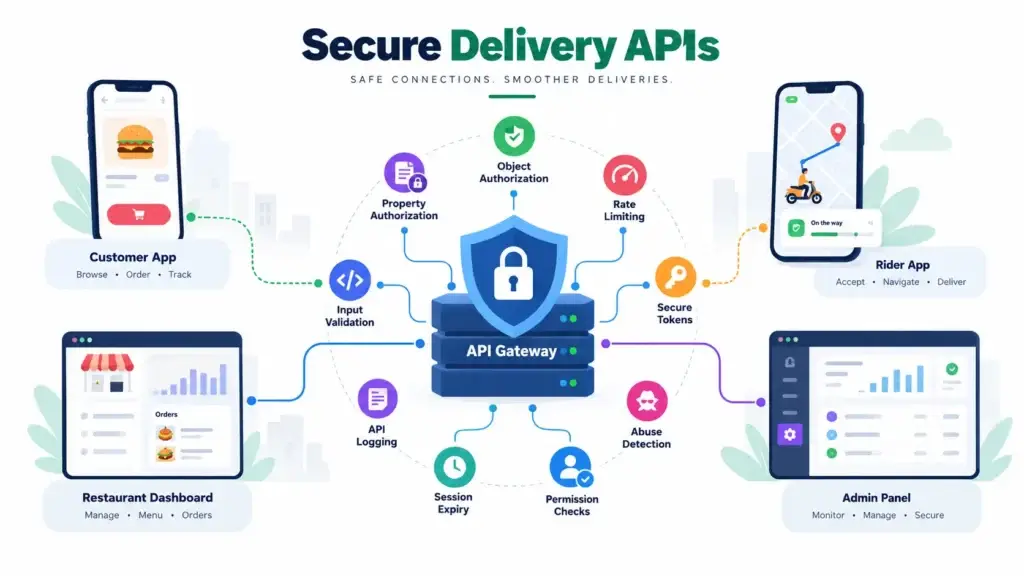
Food delivery marketplaces depend heavily on APIs. Customer apps, restaurant dashboards, rider apps, admin panels, payment systems, maps, notifications, and analytics tools all exchange data through APIs.
Because of this, API security should be treated as a core architecture layer, not a final testing step.
Important API controls include:
- Object-level authorization
- Property-level authorization
- Rate limiting
- Input validation
- Secure authentication tokens
- API logging
- Abuse detection
- Session expiry
- Permission checks across every role
- Separate access rules for customers, restaurants, riders, and admins
For example, a rider should not be able to fetch unrelated customer order histories. A restaurant should not be able to view another restaurant’s sales data. A customer should not be able to manipulate order status through an API request.
This is where technical security directly protects business operations.
Mobile App Security Controls for Customer and Rider Apps
Food delivery marketplaces usually depend on mobile apps for customers and riders. These apps often manage login sessions, device permissions, notifications, payment redirects, GPS, camera uploads, and delivery status updates.
Mobile app security should include:
- Secure data storage
- Encrypted data transfer
- Safe session handling
- Protection against exposed tokens
- Device permission control
- Secure API communication
- App update management
- Error handling without exposing sensitive data
- Protection against tampered app versions where relevant
Customer apps should be optimized for privacy and trust. Rider apps should be optimized for identity, delivery proof, location accuracy, and operational accountability.
Payment, Refund, and Payout Controls
Food delivery marketplaces have money moving in multiple directions. Customers pay for orders. Restaurants receive settlements. Riders may receive delivery earnings. The platform earns commissions, delivery fees, promotion fees, subscriptions, or service charges.
That creates a financial control layer.
A secure marketplace should include:
| Financial Area | Control Needed | Why It Matters |
|---|---|---|
| Customer payment | Tokenized payment gateway flow | Reduces exposure of sensitive payment data |
| Refunds | Role-based approval and logs | Prevents refund abuse and protects margins |
| Restaurant payout | Verified payout details and settlement history | Builds restaurant trust |
| Rider earnings | Delivery-linked earning records | Reduces payout disputes |
| Platform commission | Transparent commission calculation | Supports financial reporting |
| Cash orders | Rider collection and reconciliation | Prevents revenue leakage |
Payment security should be handled carefully because final compliance depends on the selected payment provider, operating country, storage practices, and legal review.
These controls become even more important when the platform uses multiple revenue streams such as restaurant commissions, delivery fees, subscriptions, featured listings, promotions, and payout adjustments. Founders can review Miracuves’ food delivery marketplace business model to understand how monetization and operational control work together.
Fraud and Abuse Controls for Marketplace Health
Security is not only about hackers. Food delivery platforms also face operational abuse.
Common abuse patterns include:
- Fake customer accounts
- Promo code misuse
- Repeated refund claims
- Restaurant-side order manipulation
- Rider fake delivery completion
- Location spoofing
- Support-ticket misuse
- Payment disputes
- Fake ratings and reviews
- Duplicate accounts
Fraud controls should combine automation and manual review. A practical delivery marketplace can flag unusual patterns, but admins should still have review tools to make fair decisions.
Examples of useful fraud signals include:
- Too many refunds from one account
- Multiple accounts using the same device
- Repeated failed delivery attempts by one rider
- High cancellation rates from a restaurant
- Unusual payout changes
- Abnormal order spikes from promotion abuse
- Mismatched GPS and delivery status
Founders should not wait until fraud becomes visible. These controls should be part of the platform design early.
Marketplace Trust Controls: Reviews, Ratings, and Complaints
Reviews and ratings shape marketplace trust. But if they are not moderated properly, they can become a source of abuse.
A food delivery marketplace should support:
- Customer reviews linked to real orders
- Restaurant rating controls
- Rider feedback workflows
- Abuse reporting
- Review moderation
- Complaint categorization
- Dispute history
- Admin decision logs
This protects genuine customer feedback while reducing fake, abusive, or irrelevant reviews.
Founder Decision Signals: What to Check Before Launch
Speed
A launch-ready platform can help founders move faster, but only if the core security controls are already built into customer, restaurant, rider, and admin workflows.
Control
The admin panel should give the business clear control over users, orders, refunds, payouts, commissions, zones, and disputes without exposing unnecessary permissions.
Scalability
Security should scale with order volume. Audit logs, API permissions, payment records, and rider tracking should remain reliable as the marketplace grows.
Market Fit
The right controls depend on local payment habits, restaurant operations, delivery behavior, customer support needs, and whether cash orders are part of the model.
Security planning also affects food delivery marketplace development cost because role-based access, payment workflows, delivery proof, rider verification, audit logs, refund controls, and admin permissions all influence the final build scope.
What Security Questions Should Founders Ask Before Choosing a Food Delivery Platform?
Before choosing a ready-made or custom food delivery marketplace, founders should ask practical security questions.
1. Does the platform separate customer, restaurant, rider, and admin permissions?
This is the foundation. If all roles share loose access rules, the platform may become difficult to control as it grows.
2. Are admin actions logged?
Refunds, payouts, restaurant approvals, rider approvals, commission changes, and account suspensions should be traceable.
3. Can restaurants manage staff access safely?
A restaurant owner should not need to share one login with every staff member. Staff-level permissions reduce operational risk.
4. How is rider delivery proof handled?
The platform should support a clear delivery completion workflow using OTP, photo proof, GPS validation, or another suitable method.
5. Does the app protect customer address and location data?
Customer location should be used for order fulfilment, not exposed beyond the delivery workflow.
6. How are refunds and disputes controlled?
Refunds should not be uncontrolled support actions. They should follow role permissions, order records, and approval rules.
7. Does the platform support secure payment gateway integration?
The platform should rely on secure payment integrations and avoid unnecessary storage of sensitive payment data.
8. Is source code included?
Source-code ownership matters because it gives founders long-term flexibility to audit, customize, integrate, and improve the platform as the business grows.
How Miracuves Helps Founders Launch With a Stronger Control Layer
Miracuves offers a ready-made food delivery marketplace foundation that includes customer, restaurant, rider, and admin workflows. For founders who want to move faster, this can reduce development effort because the core ordering, delivery, restaurant management, and backend control layers are already available.
The key advantage is not only faster deployment. It is the ability to start with an existing product foundation, customize the brand experience, configure the business model, and maintain control through the admin dashboard.
Where relevant, Miracuves can support a 6-day delivery path for ready-made solutions, subject to final scope, branding, integrations, and customization requirements. This helps founders validate their food delivery model faster without starting every module from zero.
Mistakes Founders Should Avoid
Treating security as a post-launch task
Security controls should be part of the marketplace foundation. Adding access rules, audit logs, payment controls, and dispute workflows later can create avoidable operational risk.
Giving every admin user full access
Full admin access should be limited. Support, finance, operations, restaurant onboarding, and marketing roles should have separate permissions based on actual responsibility.
Ignoring restaurant staff roles
Restaurants often have multiple people handling orders, menus, and accounts. Without staff-level access, one shared login can create pricing, payout, and order management problems.
Using weak delivery proof
If the platform cannot prove pickup and delivery clearly, disputes become harder to resolve and refund decisions become less reliable.
Security Control Checklist for a Food Delivery Marketplace
| Control Area | Customer App | Restaurant Panel | Rider App | Admin Panel |
|---|---|---|---|---|
| Login security | OTP, secure sessions | Staff login roles | Rider verification | MFA for sensitive users |
| Access control | Own orders only | Own menu and orders only | Assigned orders only | Role-based permissions |
| Data privacy | Address and payment protection | Limited customer visibility | Limited address visibility | Masked data where possible |
| Payment safety | Tokenized gateway flow | Settlement visibility | Earnings records | Refund and payout approvals |
| Location security | Active order tracking only | Pickup timing visibility | GPS during delivery | Operational monitoring |
| Audit logs | Order and refund history | Menu and payout changes | Delivery status history | Admin action logs |
| Dispute control | Complaint submission | Order issue records | Delivery proof | Review and resolution tools |
This checklist should be used before launch, during platform testing, and whenever new features are added.
Final Thoughts: Security Is a Marketplace Operating System
A food delivery marketplace succeeds when customers trust the order experience, restaurants trust the payout system, riders trust the delivery workflow, and admins can control the platform without confusion.
Security is not only about stopping attacks. It is about protecting the operating system of the marketplace.
As the market evolves, founders should also track modern food delivery app development trends because security, automation, delivery speed, restaurant operations, customer trust, and platform scalability are becoming connected product decisions.
The right controls help founders manage identity, payments, orders, locations, disputes, refunds, commissions, restaurants, riders, and support workflows with clarity. That clarity becomes more valuable as order volume grows.
For founders planning to launch faster, Miracuves provides a ready-made, white-label food delivery platform foundation with source-code ownership, admin control, branding flexibility, and 6-day solution delivery where the scope fits.
Once the security and control foundation is clear, the next step is growth planning. This food delivery app growth strategy explains how founders can think about acquisition, retention, repeat orders, customer trust, and marketplace visibility after launch.
FAQs
What are food delivery marketplace security controls?
Food delivery marketplace security controls are the safeguards used to protect customers, restaurants, riders, admins, payments, locations, orders, refunds, and payouts. They include secure login, role-based access, audit logs, payment protection, identity verification, API permissions, and dispute workflows.
Why does a food delivery platform need different controls for customers, restaurants, and riders?
Each role handles different data and actions. Customers manage addresses and payments. Restaurants manage menus, orders, and payouts. Riders manage pickup, delivery status, and live location. Separate controls prevent unnecessary access and reduce operational risk.
What is the most important admin security control in a food delivery marketplace?
Role-based admin access is one of the most important controls. It ensures that support, finance, operations, and platform managers only access the tools they need. This reduces the risk of accidental changes, misuse, and unauthorized access to sensitive settings.
How can a food delivery app protect customer location data?
A food delivery app can protect customer location data by limiting live tracking to active orders, restricting address visibility after delivery, controlling rider access, securing API communication, and allowing users to manage saved addresses.
What payment security controls should a food delivery marketplace use?
The platform should use secure payment gateway integration, tokenized payment flows, transaction logs, refund approval rules, payout records, and reconciliation controls. It should avoid unnecessary storage of sensitive card data.
How can restaurants be protected inside a delivery marketplace?
Restaurants can be protected through owner verification, staff-level permissions, menu change logs, payout account approval, order status controls, and settlement reports. These controls help reduce payout disputes, unauthorized edits, and operational confusion.
How can rider fraud be reduced in a food delivery marketplace?
Rider fraud can be reduced through identity verification, document checks, device/session monitoring, GPS validation, pickup confirmation, delivery proof, cash collection tracking, and abnormal activity alerts.
Can Miracuves help launch a secure food delivery marketplace faster?
Yes. Miracuves helps founders launch ready-made and white-label food delivery marketplace solutions with source code, branding, admin dashboard, and faster deployment. A 6-day delivery path may apply to ready-made solutions depending on the final scope and customization needs.
Miracuves is an independent software development company. We are not affiliated with, connected to, sponsored by, or endorsed by any company or product named in this article.
Terms such as “X Clone” are used descriptively. It is how the software industry refers to building a platform with functionality comparable to a known service, and how clients search for it.
The entire design and codebase of our products is built by our own team. Our products contain no code, design, graphics, or content originating from any third-party website or applications.
All third-party names and marks referenced in this article are the property of their respective owners, referenced solely to identify the services discussed.