


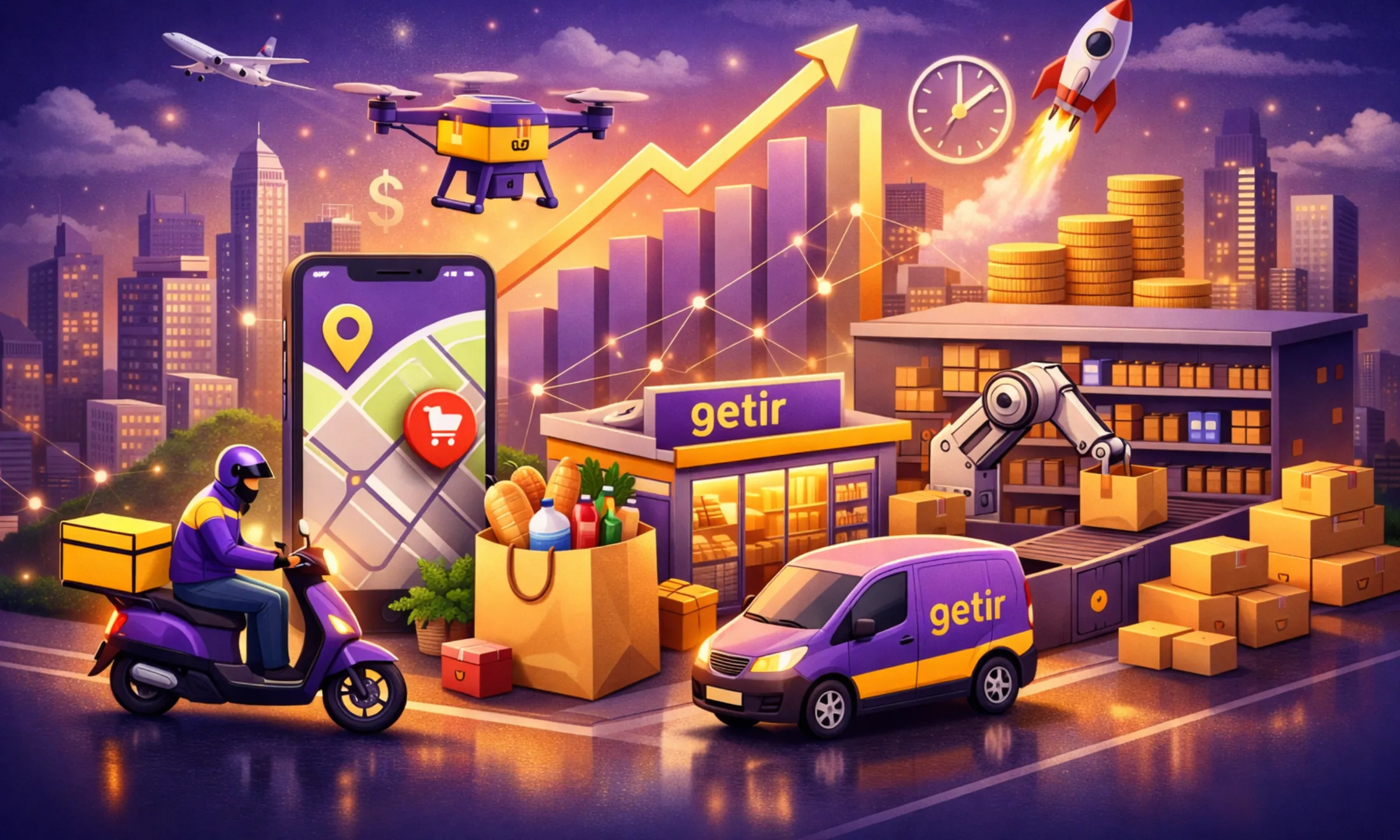
In less than a decade, the Business Model of Getir transformed grocery shopping from a planned activity into an impulse-driven habit. What started in Turkey as a bold experiment in 10-minute grocery delivery scaled into a global quick-commerce platform valued in the billions, reshaping urban consumption patterns.
By 2024, Getir had served millions of users across Europe and the US, operated thousands of dark stores, and handled millions of ultra-fast deliveries every month—all while controlling inventory, pricing, and fulfillment end-to-end.
Getir’s success wasn’t just about speed. It was about owning the entire value chain—from procurement to last-mile delivery—and designing a business model optimized for high-frequency usage, dense urban demand, and behavioral convenience.
At Miracuves, we closely analyze models like Business Model of Getir because they demonstrate how technology, operations, and monetization must be designed together to build defensible, scalable platforms in real-world markets.
How the Getir Business Model Works
Getir operates a vertically integrated quick-commerce business model designed around one core promise: ultra-fast delivery of everyday essentials. Unlike traditional marketplaces that connect buyers and sellers, Getir owns and controls nearly every layer of the transaction—inventory, storage, pricing, delivery workforce, and customer experience.
This structural choice defines how the entire business works and why Getir can consistently deliver in under 10 minutes.
Type of Business Model
Getir follows a Hybrid Vertical Commerce + On-Demand Delivery model:
- Not a pure marketplace
- Not a simple delivery aggregator
- A full-stack commerce platform optimized for speed and frequency
Core Value Proposition
Getir creates value for each side of its ecosystem by removing friction and time cost:
- Consumers
- Instant access to groceries and essentials
- No planning, no queues, no minimum wait times
- Predictable pricing and reliable availability
- Brands & Suppliers
- Guaranteed shelf placement inside dark stores
- High-velocity inventory turnover
- Access to hyperlocal demand data
- Delivery Partners (Riders)
- Stable shift-based work
- Optimized routes with short delivery radii
- Lower idle time compared to food delivery apps
Key Stakeholders & Their Roles
- Customers drive high-frequency demand
- Dark stores act as micro-fulfillment hubs
- Riders execute last-mile delivery
- Suppliers & FMCG brands feed inventory
- Technology platform orchestrates demand prediction, routing, and inventory control
Maintaining balance between these stakeholders is critical to unit economics and service reliability.
Business Model Evolution
Getir’s model evolved in clear phases:
- Phase 1: Ultra-fast grocery delivery in dense urban zones
- Phase 2: Expansion into new verticals (snacks, beverages, household essentials)
- Phase 3: International expansion and brand acquisitions
- Phase 4: Focus on unit economics, SKU optimization, and operational efficiency
Each evolution improved order density, basket predictability, and cost control.
Why the Model Works in 2025
Getir’s business model aligns perfectly with current market behavior:
- Urban consumers value time over price
- Mobile-first ordering enables impulse consumption
- Dark stores reduce last-mile complexity
- Data-driven demand forecasting lowers wastage
- High order frequency offsets thinner margins
Speed is not a feature for Getir—it is the product itself.
Read more : What is Getir and How Does It Work?
Target Market & Customer Segmentation Strategy
Getir’s growth is powered by a deep understanding of urban behavior, not mass-market e-commerce logic. Instead of chasing every customer, Getir focuses on dense, time-sensitive segments where speed delivers disproportionate value.
Primary Customer Segments
Urban Professionals (Core Segment)
- Age: 22–45
- Location: High-density city centers
- Behavior: Time-poor, convenience-driven, mobile-native
- Use cases: Last-minute groceries, late-night needs, impulse purchases
These users generate high order frequency, making them the backbone of Getir’s unit economics.
Young Singles & Couples
- Smaller basket sizes
- High snack and beverage consumption
- Peak usage during evenings and weekends
- Strong habit formation over time
Secondary Customer Segments
Families in Urban Apartments
- Predictable recurring needs
- Slightly larger basket sizes
- Use Getir as a supplement, not a replacement, for weekly shopping
Students & Night Economy Users
- Late-night orders
- High-margin SKUs (snacks, drinks, instant meals)
- Strong response to promotions and bundles
Customer Journey: From Discovery to Retention
- Discovery
- App store visibility
- Outdoor and transit advertising
- Referral incentives in dense neighborhoods
- Conversion
- First-order discounts
- Ultra-fast delivery promise
- Clean, simple app experience
- Retention
- Habit-driven repeat usage
- Personalized reordering
- Predictable delivery times and availability
Getir optimizes lifetime value by increasing order frequency rather than average order size.
Acquisition Channels by Segment
- Urban professionals: Paid mobile ads, influencer-led city campaigns
- Students: Referral loops and promo codes
- Families: Reliability and consistent service messaging
Market Positioning & Competitive Edge
Getir positions itself as:
- Faster than supermarkets
- More reliable than food delivery apps
- More predictable than marketplaces
Its brand voice emphasizes speed, simplicity, and trust, not discounts.
By focusing on micro-markets with high demand density, Getir avoids the dilution that hurt many quick-commerce competitors.
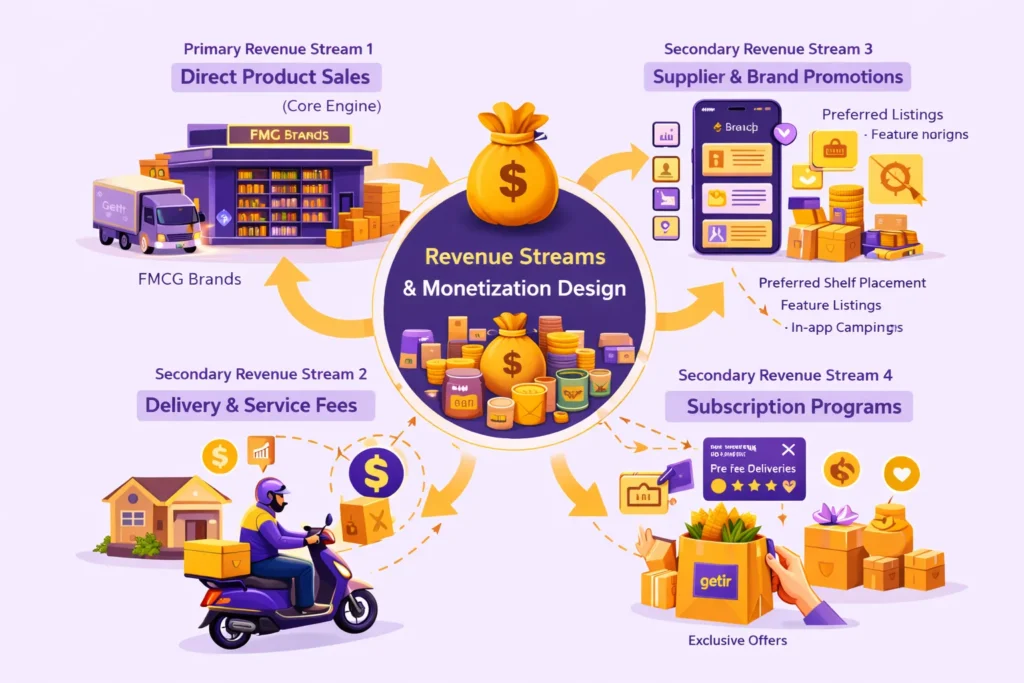
Revenue Streams and Monetization Design
Getir’s monetization strategy is built around volume, velocity, and control, not commissions. Unlike marketplace apps that earn a percentage per transaction, Getir captures value by owning the transaction end-to-end—from buying inventory to delivering it to the customer’s door.
This makes its revenue model more operationally complex, but also far more defensible.
Primary Revenue Stream 1: Direct Product Sales (Core Engine)
Mechanism
Getir purchases products directly from FMCG brands and distributors, stores them in dark stores, and sells them to consumers at retail prices.
Pricing Model
- Wholesale procurement → retail markup
- Category-based margin control
- Dynamic pricing based on demand and time of day
Revenue Contribution
- Largest share of total revenue
- Margins vary by category (snacks and beverages outperform staples)
Growth Trajectory
- Focus on high-turnover SKUs
- Reduction of long-tail inventory
- Improved demand forecasting to reduce waste
Owning inventory allows Getir to capture full retail margin, not just a platform fee.
Secondary Revenue Stream 2: Delivery & Service Fees
Mechanism
Customers pay a small delivery or service fee per order.
Role in Monetization
- Offsets last-mile costs
- Encourages basket optimization
- Can be adjusted dynamically by zone and demand
Secondary Revenue Stream 3: Supplier & Brand Promotions
Mechanism
Brands pay for:
- Preferred shelf placement inside the app
- Feature listings and in-app promotions
- Campaigns targeting high-frequency users
This functions as retail media, similar to in-store promotions in physical supermarkets.
Secondary Revenue Stream 4: Subscription Programs (Selective Markets)
Mechanism
Monthly or annual plans offering:
- Free or discounted deliveries
- Exclusive offers
Strategic Value
- Locks in repeat usage
- Improves demand predictability
- Increases customer lifetime value
How the Monetization System Works Together
Getir’s revenue streams reinforce each other:
- High-frequency orders justify lower margins per order
- Retail media boosts brand profitability without raising prices
- Subscriptions smooth demand volatility
- Delivery fees protect unit economics during peak demand
The pricing psychology is simple: small, frequent, painless payments feel invisible to users—but compound at scale.
Read more : Getir Revenue Model: How Getir Makes Money in 2025
Operational Model & Key Activities
Getir’s competitive advantage is not marketing—it is operations engineered for speed. The company runs a tightly synchronized machine where technology, logistics, and workforce management operate in real time.
This operational excellence is what allows Getir to consistently deliver within minutes while keeping costs under control.
Core Operations
Dark Store Network Management
- Small-format warehouses placed within 1–2 km of customers
- Limited SKU count optimized for fast picking
- High order density per zone
Inventory & Demand Forecasting
- AI-driven demand prediction by location and time
- Automated replenishment cycles
- SKU pruning to reduce waste and idle inventory
Last-Mile Delivery Execution
- Shift-based rider model
- Short delivery radii for predictable timing
- Route optimization to reduce idle time
Platform & Technology
- Real-time order orchestration
- Rider dispatch and tracking systems
- Inventory sync across all dark stores
Customer Support & Quality Control
- In-app issue resolution
- Replacement and refund workflows
- Performance monitoring by zone
Resource Allocation Strategy
Getir allocates resources based on operational leverage:
- Technology & Platform Development
- Heavy investment in logistics software
- Routing, forecasting, and warehouse optimization
- Operations & Workforce
- Riders, warehouse staff, and regional managers
- Training focused on speed and accuracy
- Marketing
- Targeted, city-level campaigns
- Reduced mass marketing once habits form
- Expansion & Optimization
- New dark stores only after density thresholds are met
- Underperforming zones are quickly optimized or exited
The key insight: Getir spends less on growth hype and more on execution discipline.
Growth Strategy & Scaling Mechanisms
Getir’s growth strategy is a lesson in precision scaling. Rather than expanding everywhere at once, the company scales city by city, zone by zone, only when unit economics prove sustainable.
Growth is treated as an operational milestone—not a marketing goal.
Primary Growth Engines
Organic Habit Formation
- Ultra-fast delivery creates repeat behavior
- Grocery becomes a “reflex action,” not a planned task
- High weekly order frequency compounds growth
Referral & Local Virality
- Neighborhood-based referral loops
- Riders act as moving brand assets
- High visibility in dense urban areas
Paid Acquisition (Selective)
- Performance marketing during city launches
- Reduced spend once retention stabilizes
- Focus on payback period, not top-line GMV
Product & Category Expansion
- Gradual SKU diversification
- Focus on high-margin, fast-moving categories
- Private-label experiments in select markets
Geographic Expansion Model
- Launch in dense metros first
- Deploy dark stores only after demand validation
- Exit or consolidate underperforming regions quickly
Scaling Challenges & How Getir Responded
Challenge: High Fixed Costs
- Dark stores and riders require capital
- Solution: Density-first expansion and SKU optimization
Challenge: Operational Complexity
- Multiple cities, SKUs, and rider pools
- Solution: Centralized tech platform with local execution
Challenge: Competitive Pressure
- Intense price wars in quick commerce
- Solution: Service reliability over discount dependency
Challenge: Regulatory & Labor Issues
- Rider classification and city regulations
- Solution: Local compliance models and partnerships
Getir’s most important scaling insight: Speed without density destroys economics.
Competitive Strategy & Market Defense
In quick commerce, speed alone is easy to copy. Sustainable advantage comes from systems, data, and density. Getir defends its position by turning operational excellence into structural barriers that competitors struggle to cross.
Core Competitive Advantages
Operational Density as a Moat
- High order volume per dark store
- Short delivery radii
- Lower cost per order over time
Vertical Integration
- Full control over inventory, pricing, and fulfillment
- No dependency on third-party merchants
- Faster experimentation and execution
Network Effects (Demand-Side)
- More users → higher delivery efficiency
- Higher efficiency → better pricing and reliability
- Better service → stronger retention
Brand Trust & Habit Formation
- Consistent delivery promise
- Predictable availability
- Emotional association with speed and reliability
Data-Driven Intelligence
- SKU-level demand forecasting
- Personalized reorder nudges
- Zone-based pricing and promotion strategies
Market Defense Tactics
Handling New Entrants
- Competes on reliability, not price wars
- Maintains delivery time guarantees
- Focuses on customer lifetime value
Feature Rollout Strategy
- Tests features in micro-markets
- Scales only after operational validation
- Avoids overloading the app experience
Strategic Consolidation
- Acquisitions to gain market access
- Exit from unprofitable geographies
- Consolidation of dark stores to improve margins
Regulatory & Compliance Readiness
- Local labor models
- City-level regulatory engagement
- Compliance as a trust signal
Getir doesn’t aim to be the cheapest.
It aims to be the most reliable instant commerce platform.
Read more : Best Getir Clone Scripts 2025: Launch Your Quick-Commerce App in Days
Lessons for Entrepreneurs & Implementation
Getir’s journey offers one of the clearest playbooks for founders building on-demand, logistics-heavy, or vertically integrated platforms. Its success didn’t come from chasing scale blindly—but from designing a model where operations, technology, and behavior reinforce each other.
Key Factors Behind Getir’s Success
- Speed as the core product, not a feature
- Density-first expansion before geographic scale
- Full-stack control over inventory and fulfillment
- High-frequency use cases instead of large basket sizes
- Operational discipline over aggressive discounting
Replicable Principles for Startups
Founders can adapt Getir’s model by:
- Starting with one city or micro-market
- Designing for repeat usage, not occasional transactions
- Building logistics and tech together, not sequentially
- Using data early to guide SKU and pricing decisions
Common Mistakes to Avoid
- Expanding to multiple cities without unit economics proof
- Overloading inventory with low-turnover SKUs
- Relying on discounts instead of habit formation
- Underestimating last-mile operational complexity
Adapting the Model to Local or Niche Markets
Getir’s framework works beyond groceries:
- Pharmacy and health essentials
- Pet supplies
- Convenience retail
- Hyperlocal B2B delivery
The key is density + urgency.
Ready to implement Getir’s proven business model for your market?
Miracuves builds scalable on-demand platforms with tested business models, logistics workflows, and monetization engines. We’ve helped entrepreneurs launch profitable apps across food, grocery, logistics, and hyperlocal commerce.
Get your free business model consultation today.
Conclusion
Getir’s business model proves a critical truth about modern digital platforms: innovation without execution does not scale. While many companies attempted quick commerce, only a few understood that speed must be engineered through infrastructure, data, and discipline—not marketing slogans.
By owning its supply chain, focusing on dense urban demand, and designing for behavioral convenience, Getir turned grocery delivery into a daily habit, not an occasional service. Its journey highlights how vertical integration and operational mastery can outperform asset-light marketplace models in time-sensitive categories.
For founders in 2025 and beyond, Getir’s lesson is clear:
The future of platform economies will belong to businesses that combine technology with real-world execution, build for frequency over volume, and scale only when economics are proven.
FAQs
What type of business model does Getir use?
Getir operates a vertically integrated quick-commerce model. It owns inventory, dark stores, delivery operations, and the technology platform to control speed and service quality.
How does Getir’s business model create value?
Getir removes time friction by delivering daily essentials within minutes. High-frequency usage, predictable availability, and fast fulfillment create strong customer habits and loyalty.
What are Getir’s key success factors?
Dense urban coverage, ultra-fast delivery, operational discipline, and data-driven inventory management are the core drivers of Getir’s success.
How scalable is Getir’s business model?
The model is scalable but density-dependent. Getir expands city by city only after achieving strong order volume and unit economics.
What are the biggest challenges Getir faces?
High operational costs, inventory risk, labor regulations, and intense competition are major challenges. Getir manages these through SKU optimization and demand forecasting.
How can entrepreneurs adapt Getir’s model to their region?
Start with one dense city, focus on urgent daily-use products, limit SKUs, and prioritize operational efficiency before expanding.
What are alternatives to Getir’s business model?
Marketplace-based grocery delivery, subscription convenience apps, and hybrid retail models offer lower capital intensity but slower fulfillment.
How has Getir’s business model evolved over time?
Getir shifted from aggressive expansion to unit economics optimization. The focus is now on profitability, operational efficiency, and sustainable growth.
Related Article :