



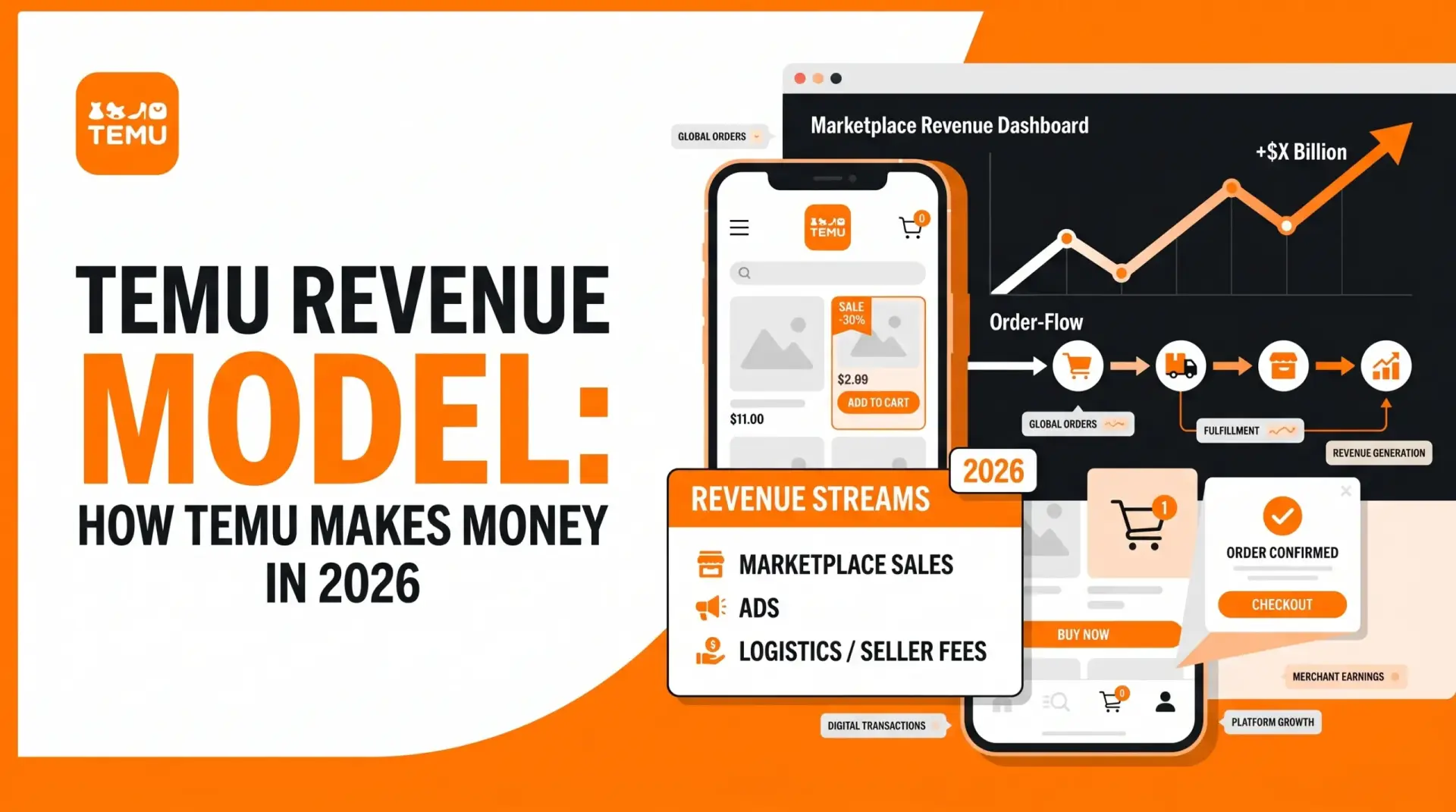
Key Takeaways
- Temu’s revenue model is built around low-cost ecommerce, supplier partnerships, marketplace scale, and high-volume orders.
- The platform connects customers, sellers, manufacturers, logistics partners, and admins through one digital commerce ecosystem.
- Product sales, seller services, promotions, advertising, and cross-border fulfillment are key revenue drivers.
- Its success depends on competitive pricing, product variety, fast discovery, and strong supply chain control.
- A Temu-like marketplace can help startups build a value-focused ecommerce platform with scalable monetization channels.
Revenue Signals
- Customers need product discovery, smart filters, flash deals, coupons, secure checkout, and order tracking.
- Sellers need product listing tools, pricing control, campaign management, inventory updates, and payout visibility.
- Admins need control over users, sellers, products, promotions, payments, refunds, logistics, and analytics.
- Sponsored listings, featured products, and seller campaigns help increase marketplace revenue.
- Low pricing, social sharing, and personalized recommendations help improve repeat purchases and customer retention.
Real Insights
- Temu shows that ecommerce growth depends on pricing, supplier depth, product discovery, and logistics efficiency.
- Weak seller control can reduce product quality, delivery trust, and long-term customer confidence.
- Clear discounts, delivery timelines, refund rules, and product details help customers buy faster.
- Advertising tools and promotional campaigns create revenue beyond direct product transactions.
- Miracuves builds Temu Clone apps with ecommerce marketplace, seller management, promotions, payments, logistics, and admin workflows.
Temu crossed $50 billion in GMV in 2026, becoming one of the fastest-scaling global eCommerce platforms ever. This growth was driven by rapid international expansion, aggressive user acquisition, and a marketplace structure built for high-frequency, low-value transactions. By prioritizing volume and reach over early margins, Temu achieved scale at a pace few global platforms have matched.
What’s surprising is not just the growth, but how Temu sustains ultra-low prices while still building a profitable long-term model. The platform controls pricing through direct supplier relationships, consolidated logistics, and data-driven demand forecasting. These mechanisms reduce supply-chain inefficiencies and allow Temu to pass savings to consumers while protecting platform-level margins.
For founders, Temu offers a masterclass in scale economics, supplier leverage, and platform-first monetization. It demonstrates how owning supply-side dynamics and monetization levers—rather than relying solely on consumer pricing—can unlock sustainable profitability. At Miracuves, this model is often studied as a strong example of how large-scale marketplaces can grow through supplier control, logistics efficiency, and infrastructure-first platform design.
Temu Revenue Overview – The Big Picture
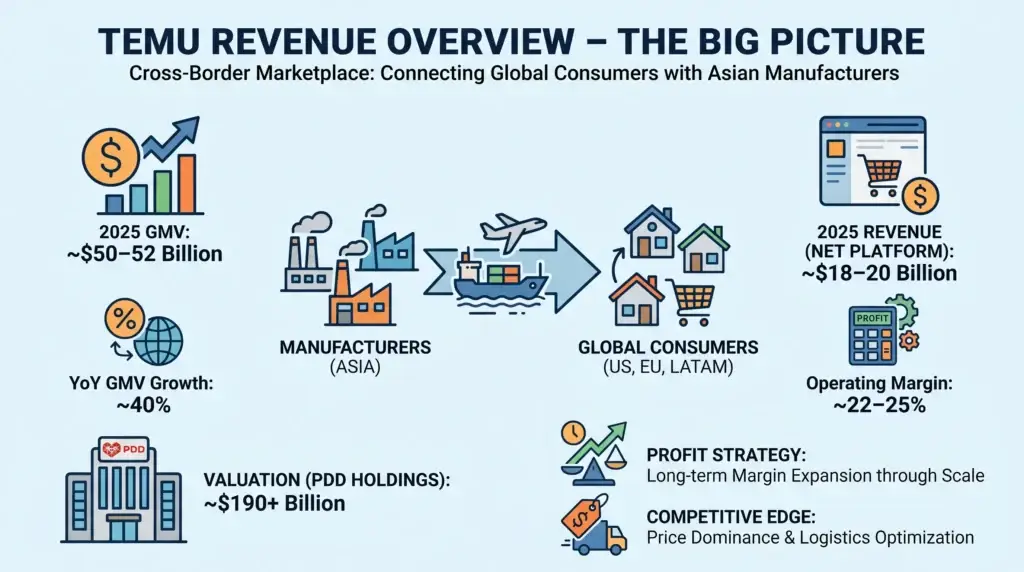
Temu operates as a cross-border marketplace connecting global consumers directly with manufacturers, primarily from Asia. Its model prioritizes volume, supply-side efficiency, and platform control.
- 2026 GMV: ~$50–52 billion
- 2026 Revenue (Net Platform Revenue): ~$18–20 billion
- Valuation (Parent – PDD Holdings): ~$190+ billion
- YoY GMV Growth: ~40%
- Primary Markets: US, Europe, LATAM
- Operating Margin (Platform-level): ~22–25%
- Profit Strategy: Long-term margin expansion through scale
Temu competes not on branding, but on price dominance and logistics optimization, forcing traditional marketplaces into margin pressure.
Read More: What Is Temu and How Does It Work?
Primary Revenue Streams Deep Dive
Revenue Stream #1: Seller Commissions
Temu earns a commission on every completed order. While rates are lower than traditional marketplaces, massive order volume compensates.
- Share of revenue: ~38%
- Average commission: 8–12%
- Focus: High frequency, low margin, high scale
Revenue Stream #2: Supplier Price Arbitrage
Unlike open marketplaces, Temu negotiates supplier pricing directly, earning margin between factory cost and consumer price.
- Share of revenue: ~27%
- High control over pricing and promotions
- Strong leverage due to bulk demand
Revenue Stream #3: Logistics & Fulfillment Margins
Temu manages cross-border logistics at scale, earning margin through consolidated shipping, routing optimization, and volume contracts.
- Share of revenue: ~15%
- Cost advantage improves with scale
Revenue Stream #4: Promotional Placement Fees
Suppliers pay for boosted visibility during flash sales, seasonal events, and demand surges.
- Share of revenue: ~12%
- Performance-based pricing model
Revenue Stream #5: Data & Demand Intelligence
Temu monetizes demand forecasting, pricing insights, and inventory signals for large suppliers.
- Share of revenue: ~8%
- Extremely high margin
Revenue Streams Percentage Breakdown
| Revenue Stream | % Share (2026) |
|---|---|
| Seller Commissions | 38% |
| Supplier Price Arbitrage | 27% |
| Logistics & Fulfillment Margins | 15% |
| Promotional Placement Fees | 12% |
| Data & Demand Intelligence | 8% |
The Fee Structure Explained
Temu’s fee system is intentionally buyer-friendly and supplier-heavy.
User-Side Fees
- No platform fees
- No subscriptions
- Free app usage
- Aggressive free-shipping thresholds
Supplier-Side Fees
- Transaction commission
- Logistics handling margin
- Promotional exposure fees
- Volume-based pricing adjustments
Hidden Revenue Layers
- Algorithmic exposure ranking
- Inventory priority access
- Demand surge pricing control
Regional Pricing Variation
Pricing dynamically adjusts based on logistics cost, import duties, and regional demand elasticity.
Complete Fee Structure by User Type
| User Type | Fee Type | Typical Range |
|---|---|---|
| Buyers | Platform usage | Free |
| Suppliers | Commission | 8–12% |
| Suppliers | Logistics margin | Variable |
| Suppliers | Promotional visibility | Performance-based |
How Temu Maximizes Revenue Per User
Temu focuses on basket expansion, not high ticket value.
- Segmentation: New users vs repeat bargain buyers
- Upselling: Bundled add-on products
- Cross-selling: “Frequently bought together” pricing
- Dynamic Pricing: Real-time factory cost adjustment
- Retention Monetization: Daily deals and gamified discounts
- LTV Optimization: Repeat purchase loops
- Psychological Pricing: Extreme anchoring and scarcity timers
In 2026, average user order frequency exceeded 9 orders per year, up from 6 in 2023.
Cost Structure & Profit Margins
Temu’s profitability improves with volume concentration.
- Infrastructure: Cloud, AI, platform systems (~11%)
- Logistics & Fulfillment: Shipping, customs (~28%)
- Customer Acquisition: Heavy but declining (~20%)
- Operations: Support, compliance (~6%)
- R&D: Pricing, demand prediction (~9%)
Unit Economics:
Low gross margin per order, but strong contribution margin at scale.
Profitability Path:
Loss-leading markets → volume dominance → margin expansion.
Read More: Best Temu Clone Scripts 2025 – Social Commerce Marketplace
Miracuves Temu-Like Platform Solution Cost and Tech Stack
Miracuves Pricing for a Temu-Like Global eCommerce Marketplace Platform developed using JavaScript architecture is available on request. Final pricing depends on marketplace modules, supplier workflows, product catalog complexity, logistics integrations, pricing automation, scalability requirements, and deployment scope. Estimated delivery timeline: 30 to 90 days.
Get a fully developed, custom global marketplace platform modeled after Temu. Built on a modern JavaScript foundation, this solution can be customized for discount commerce startups, multi-vendor marketplaces, cross-border eCommerce platforms, supplier-driven retail businesses, direct-from-manufacturer marketplaces, and large-scale shopping apps.
- Core Workflows: Customer registration, supplier onboarding, product listing, category management, product search, cart checkout, order placement, shipment tracking, returns, refunds, reviews, and customer notifications.
- Built-in Revenue Logic: Seller commissions, promoted listings, advertising placements, transaction fees, service charges, supplier subscriptions, discount campaign monetization, logistics-linked revenue, and marketplace growth incentives.
- Management Hub: Centralized admin dashboard, supplier management, customer management, product approval, inventory monitoring, order tracking, payment records, refund handling, dispute workflows, campaign controls, and marketplace analytics.
- Global Marketplace-Ready Architecture: Prepared for high-volume product catalogs, supplier-side operations, personalized recommendations, flash deals, multi-region commerce, payment gateway integration, logistics workflows, and long-term marketplace growth.
Why Does a Temu-Like Platform Require JavaScript Architecture?
A Temu-like platform needs more than a basic online store. It handles massive product catalogs, supplier operations, low-price deal campaigns, cross-border ordering, personalized discovery, payment workflows, logistics coordination, returns, refunds, reviews, and high-volume marketplace activity. A modern JavaScript architecture helps manage these commerce workflows smoothly across customers, suppliers, admins, and operations teams.
We recommend JavaScript architecture for this type of platform because:
- Built for High-Volume Marketplace Workflows: JavaScript-based backend systems can manage supplier activity, product catalogs, order processing, inventory updates, payment records, and large-scale shopping traffic.
- Advanced Frontend Experience: React.js or other JavaScript frameworks can power smooth product feeds, deal pages, personalized recommendations, cart flows, supplier dashboards, customer accounts, and admin panels.
- Scalable eCommerce Logic: JavaScript architecture supports multi-vendor operations, discount campaigns, flash sales, coupon rules, logistics tracking, return workflows, advertising modules, and marketplace expansion.
- Flexible Integration Layer: The platform can connect with payment gateways, shipping APIs, warehouse systems, supplier tools, CRM platforms, email/SMS tools, push notifications, analytics systems, recommendation engines, and customer support tools.
You get a scalable Temu-like marketplace platform designed for supplier-driven commerce, low-price product discovery, seller monetization, smooth checkout, and long-term global eCommerce growth.
Note: Final pricing depends on selected marketplace modules, supplier workflows, product catalog size, recommendation logic, logistics integrations, payment setup, deployment infrastructure, and custom feature development.
Future Revenue Opportunities & Innovations
- AI-driven supplier bidding engines
- Private-label marketplace brands
- Regional micro-fulfillment hubs
- Faster delivery monetization tiers
Predicted Trends (2026–2027)
- Reduced customer acquisition costs
- Higher supplier take rates
- Regulatory pressure on cross-border pricing
For founders, vertical-focused or regional versions of this model remain largely untapped.
Lessons for Entrepreneurs & Your Opportunity
What Works
- Factory-direct sourcing
- Platform-controlled pricing
- Volume-first economics
What to Replicate
- Supplier aggregation
- Centralized logistics
- Data-driven pricing
Market Gaps
- Category-specific Temu-style platforms
- Regional manufacturing marketplaces
- B2B bulk cross-border platforms
Final Thought
Temu proves that extreme affordability and profitability are not opposites. By designing its marketplace around high-volume, low-margin transactions, the platform achieves profitability through sheer scale rather than premium pricing. This approach allows Temu to attract price-sensitive users globally while still building a strong revenue base.
By controlling supply, logistics, and pricing, the platform turns scale into leverage. Direct access to manufacturers, centralized logistics optimization, and data-driven pricing enable Temu to reduce inefficiencies that typically erode margins in cross-border commerce. As volume increases, these controls compound, further strengthening unit economics.
For founders, this model offers one of the most aggressive yet replicable marketplace blueprints today. It shows that owning the supply chain logic and pricing intelligence can unlock sustainable growth even in highly competitive markets. With the right infrastructure and data systems, similar models can be adapted for niche categories or regional marketplaces. Let’s build together.
FAQs
1. How much does Temu make per transaction?
Low per order, but high aggregate due to massive volume.
2. What’s Temu’s most profitable revenue stream?
Supplier price arbitrage and promotional placements.
3. How does Temu’s pricing compare to competitors?
Significantly lower, driven by factory-direct sourcing.
4. What percentage does Temu take from suppliers?
Effective take rate ranges from 15–25% including logistics and promotions.
5. How has Temu’s revenue model evolved?
From subsidy-heavy growth to scale-driven efficiency.
6. Can small platforms use similar models?
Yes, especially in niche or regional markets.
7. What’s the minimum scale for profitability?
Typically 100k+ monthly active buyers.
8. How to implement similar revenue models?
Centralize supply, own logistics logic, optimize pricing with data.
9. What are alternatives to Temu’s model?
Subscription commerce or premium vertical marketplaces.