


Key Takeaways
- A luxury fashion marketplace business model connects boutiques, premium brands, and shoppers through a centralized digital platform for product discovery, transactions, and fulfillment.
- Boutiques and brands contribute curated inventory, while shoppers gain access to designer products, personalized discovery, secure checkout, delivery tracking, and returns.
- The marketplace creates value by coordinating product catalogs, inventory, orders, payments, commissions, logistics, authentication, and customer experience across multiple sellers.
Marketplace Connection Signals
- Boutiques need seller onboarding, catalog uploads, inventory synchronization, pricing controls, order processing, fulfillment updates, payouts, and performance analytics.
- Luxury brands benefit from controlled product presentation, premium storefronts, merchandising tools, campaign visibility, customer insights, and access to wider digital audiences.
- Shoppers rely on designer search, filters, recommendations, wishlists, product authenticity signals, secure payments, shipping visibility, reviews, and simplified returns.
Business Model Insights
- Luxury marketplaces can generate revenue through sales commissions, seller services, premium placements, advertising, fulfillment support, subscriptions, and strategic brand partnerships.
- Marketplace growth depends on balancing premium inventory, boutique participation, shopper demand, product authenticity, conversion rates, repeat purchases, and reliable fulfillment.
- Miracuves develops customizable luxury fashion marketplaces with boutique and brand onboarding, product catalogs, commissions, payments, inventory management, order workflows, analytics, and admin controls.
Luxury fashion marketplaces have changed how premium products move from boutiques and brands to global shoppers. Instead of relying only on one store, one inventory source, or one brand website, this model brings multiple sellers into one curated digital platform.
For shoppers, it creates access. For boutiques, it creates reach. For brands, it creates visibility. For the marketplace operator, it creates a scalable business model built around commissions, seller tools, product discovery, trust, and transaction control.
The important point for founders is this: a luxury fashion marketplace is not just an online catalog. It is a connected business system where boutiques, brands, shoppers, payments, inventory, returns, and platform rules work together.
This guide explains how the luxury fashion marketplace business model works, where revenue comes from, what each participant needs, and what founders should understand before building this type of platform.
What Is a Luxury Fashion Marketplace Business Model?
A luxury fashion marketplace business model is a digital commerce model where multiple boutiques, sellers, designers, or brands list premium fashion products on one platform.
The marketplace operator does not always need to own every product. Instead, the platform provides the technology, trust layer, customer experience, seller tools, payment flow, and operational control needed to complete transactions.
The model usually includes three main sides:
| Participant | What They Need | What the Marketplace Provides |
|---|---|---|
| Shoppers | Premium products, trust, easy discovery, secure checkout | Curated catalog, product filters, payment options, delivery tracking, returns |
| Boutiques and sellers | More reach, online selling tools, order management | Seller dashboard, product listing tools, payout records, marketplace traffic |
| Brands | Visibility, controlled presentation, premium positioning | Brand pages, campaign placements, curated collections, performance insights |
| Marketplace operator | Revenue, supply, retention, control | Commission rules, admin dashboard, seller management, analytics, settlement logic |
The value of the model comes from connecting these sides efficiently. When shoppers trust the catalog and sellers get real demand, the platform becomes more than a store. It becomes a marketplace ecosystem.
Why This Model Works in Luxury Fashion
Luxury fashion has a different buying psychology compared with normal ecommerce. Customers care about authenticity, product condition, boutique reputation, limited availability, styling, packaging, and return confidence.
A luxury marketplace works because it solves a discovery problem.
Shoppers may want access to designer items, rare collections, boutique inventory, or premium products that are not easily available in one local store. A marketplace brings this supply together and makes it easier to browse, compare, and buy.
Boutiques also benefit because they may have strong inventory but limited digital reach. By joining a marketplace, they can sell to a wider audience without building a full commerce platform from zero.
Brands benefit when the marketplace gives them visibility in the right environment. A curated platform can protect brand perception better than a crowded discount marketplace.
For the operator, the model creates revenue without depending only on owned inventory. This makes the business more scalable if seller quality, catalog control, and customer trust are managed well.
How Boutiques, Brands, and Shoppers Connect
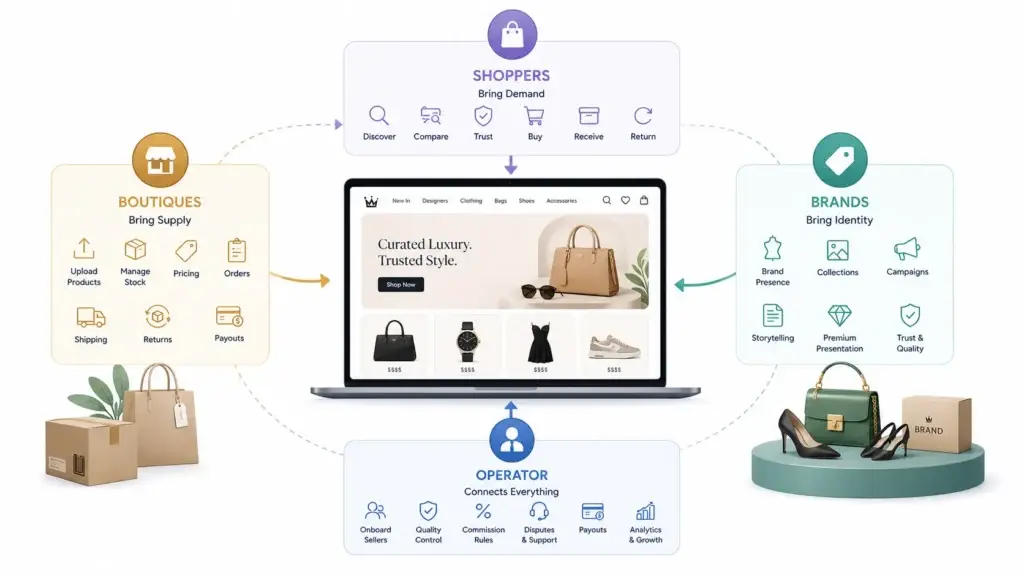
The marketplace works because each side gives and receives value.
Shoppers Bring Demand
Shoppers come to the platform looking for premium fashion, designer products, curated collections, trusted sellers, and a smooth buying experience.
They expect:
- Clear product details
- High-quality images
- Size and fit information
- Seller credibility
- Secure checkout
- Delivery tracking
- Easy returns
- Responsive support
In luxury commerce, trust is part of the product experience. A shopper is not only buying a bag, watch, dress, shoe, or accessory. They are buying confidence.
Boutiques Bring Supply
Boutiques and sellers bring inventory to the marketplace. They may list new arrivals, seasonal collections, rare products, resale items, designer pieces, or location-specific stock.
They need tools to manage:
- Product uploads
- Stock updates
- Size and variant details
- Pricing
- Orders
- Shipping status
- Returns
- Payouts
A strong boutique marketplace model gives sellers control without allowing the marketplace to lose quality standards.
Brands Bring Identity
Brands care about how their products appear. In luxury commerce, presentation matters. Product pages, collection pages, editorial sections, campaigns, and brand storytelling can influence conversion.
A marketplace that supports brand identity can attract better sellers and stronger partnerships.
This is why luxury marketplaces often need curated product pages, controlled content formats, seller approval workflows, and premium visual design.
The Operator Connects Everything
The marketplace operator manages the full system. This includes customer experience, seller onboarding, product quality, commission rules, dispute handling, payouts, analytics, and platform growth.
The operator earns revenue by making the connection between supply and demand more efficient.
Main Revenue Streams in a Luxury Fashion Marketplace
A luxury fashion marketplace can earn from several revenue streams. The strongest model usually combines transaction revenue with seller services and promotional tools. Founders who want a deeper implementation view can also explore this implementation-focused luxury marketplace revenue model to understand how commissions, seller tiers, promotional placements, and payout logic can work inside a platform.
| Revenue Stream | How It Works | Why It Matters |
| Sales commission | The platform takes a percentage from each completed order | Creates revenue directly from transactions |
| Seller subscription | Boutiques pay monthly or yearly for access, tools, or premium seller features | Adds recurring revenue |
| Featured placement | Sellers pay for better visibility on category pages, homepage sections, or curated edits | Monetizes product discovery |
| Brand campaigns | Brands pay for campaign pages, editorial placements, or promotional collections | Supports premium advertising revenue |
| Service fees | The platform adds a buyer or seller service fee where appropriate | Improves margin per order |
| Fulfillment support | The platform charges for logistics coordination, packaging support, or delivery assistance | Turns operations into a revenue layer |
| Analytics tools | Sellers pay for performance insights, demand trends, or inventory intelligence | Adds value for serious sellers |
| Loyalty programs | Shoppers pay or participate in premium membership benefits | Improves retention and repeat purchases |
A deeper implementation-focused breakdown of commissions, seller tiers, premium placements, and payout logic can be explored through the luxury marketplace revenue model.
How the Customer Journey Creates Revenue
The customer journey begins with discovery. Shoppers may enter through search, social media, ads, email campaigns, designer pages, category pages, or curated product edits.
Once they enter the marketplace, revenue depends on how easily they can move from browsing to buying.
Product Discovery
Luxury shoppers often browse by designer, category, occasion, trend, color, size, seller location, condition, or price range.
The better the discovery experience, the higher the chance of conversion. This is why filters, search, recommendations, wishlists, and curated collections matter.
Product Confidence
A product page should answer the shopper’s doubts before checkout. The page should clearly show images, product condition, seller details, delivery estimates, return policy, and authenticity signals.
In luxury marketplaces, weak product pages can reduce trust quickly.
Checkout
The checkout flow should feel simple even if the backend is complex. A shopper may buy products from more than one boutique in a single cart. The platform may need to split that order in the backend while keeping the customer experience smooth.
Delivery and Returns
Luxury buyers expect reliable delivery, tracking, careful packaging, and clear return steps.
A poor return experience can reduce repeat purchases. A smooth return process can increase trust even when the first order does not go perfectly.
How the Boutique Side Creates Revenue
The boutique side is where marketplace supply grows. If sellers find the platform useful, they will list more products, maintain inventory, and participate in campaigns.
A good seller experience includes:
- Easy onboarding
- Seller verification
- Product upload tools
- Bulk import support
- Inventory management
- Order notifications
- Return handling
- Payout visibility
- Performance reports
Boutiques are more likely to stay active when they can clearly see orders, revenue, fees, and customer demand.
This is why a luxury marketplace should not only focus on the customer app. The seller dashboard is equally important.
Why Trust Is Central to the Business Model
Trust directly affects revenue in luxury marketplaces. If shoppers doubt the product, seller, payment, or return process, they may abandon the purchase.
Trust comes from several layers:
- Verified sellers
- Clear product information
- Authenticity checks
- Secure payment flow
- Transparent return policy
- Seller ratings or approval status
- Strong customer support
- Admin review controls
Founders should treat security and trust as part of the business model, not only as technical features. For a deeper view of secure checkout, seller approval, admin controls, and platform protection, read this guide on security controls for luxury marketplaces.
Platform Features That Support the Business Model
The business model works only when the platform has the right operating features. Without seller tools, admin control, catalog rules, payment logic, and settlement workflows, the marketplace becomes difficult to scale. Readers exploring similar platform models can also browse Miracuves’ online marketplace guides for related marketplace concepts and business-model examples.
Important platform features include:
| Feature Area | Why It Matters |
| Seller onboarding | Helps verify boutiques and maintain marketplace quality |
| Product catalog management | Keeps listings organized, searchable, and consistent |
| Advanced search and filters | Improves discovery and conversion |
| Multi-seller cart | Allows shoppers to buy from multiple boutiques in one journey |
| Order splitting | Helps the backend assign items to the correct seller |
| Commission management | Allows the operator to control revenue rules |
| Payout tracking | Helps sellers understand earnings and settlement status |
| Admin dashboard | Gives the operator control over sellers, products, orders, disputes, and reports |
| Return management | Protects customer trust and seller accountability |
| Analytics | Helps the operator and sellers understand performance |
If you want to understand which modules matter before development, the multi-seller marketplace features page explains the feature layer behind catalog control, multi-seller orders, commissions, and settlement.
Founder Lessons From This Business Model
Founders should not look at a luxury fashion marketplace as only a design project. It is a business system with many moving parts.
The most important lessons are simple.
First, seller quality matters more than seller quantity. A marketplace with fewer trusted boutiques can perform better than a crowded platform with weak catalog standards.
Second, catalog structure should be planned early. Categories, product attributes, size systems, condition fields, brand pages, and filters affect the entire shopping experience.
Third, commission logic should be flexible. Different categories, sellers, regions, or campaigns may need different revenue rules.
Fourth, the admin dashboard should give the operator real control. The team should be able to approve sellers, moderate products, adjust commissions, track disputes, manage orders, and review payouts without depending on developers for every small change.
Fifth, trust should be built into the platform from the beginning. Luxury shoppers need confidence before they buy.
Common Mistakes Founders Should Avoid
Treating the Marketplace Like a Normal Online Store
A normal ecommerce store usually has one seller. A marketplace has many sellers. That means the platform needs seller workflows, commission logic, order splitting, payout tracking, and dispute management.
Letting Sellers Upload Without Quality Control
Luxury marketplaces need catalog discipline. Poor images, unclear descriptions, fake listings, or inconsistent product data can damage trust.
Ignoring the Payout System
Sellers care about payment clarity. If commissions, refunds, deductions, and payout timelines are unclear, seller relationships become difficult.
Focusing Only on Customer Design
Premium design is important, but seller operations, admin control, and backend logic decide whether the marketplace can scale.
Adding Too Many Revenue Streams Too Early
A new marketplace should start with a simple revenue model. Commission and selected seller services may be enough at the beginning. More advanced revenue streams can be added as seller demand grows.
When Should Founders Consider a Ready-Made Marketplace Foundation?
A ready-made marketplace foundation can be useful when the founder already understands the business model and wants to move faster into execution.
This approach is especially useful when the platform needs common marketplace workflows such as seller onboarding, product listings, customer checkout, admin control, commissions, order management, and payout tracking.
For founders planning a premium fashion commerce business, Miracuves offers a ready-made luxury marketplace solution that supports seller workflows, customer journeys, marketplace control, and branded deployment.
The goal is not to copy another platform blindly. The better approach is to understand the marketplace model, define your niche, and launch with the right foundation for your sellers, shoppers, and revenue strategy.
Final Thoughts
A luxury fashion marketplace business model works because it connects premium supply with high-intent shoppers through one trusted digital experience.
But the real value is not only in showing products online. It is in managing boutiques, protecting catalog quality, supporting brand presentation, handling multi-seller checkout, calculating commissions, and keeping the marketplace operator in control.
For founders, this model is worth studying before development begins. The better you understand the business logic, the easier it becomes to choose the right platform foundation, revenue model, and launch strategy.
Miracuves helps founders move from this planning stage to execution with marketplace solutions built around seller workflows, admin control, branded experiences, and scalable marketplace operations.
A strong luxury marketplace is not built around products alone. It is built around trust, curation, operations, and control.
FAQs
What is a luxury fashion marketplace business model?
A luxury fashion marketplace business model connects shoppers with boutiques, brands, and sellers through one digital platform. The platform earns revenue through commissions, seller services, featured placements, brand campaigns, and marketplace operations.
How do luxury fashion marketplaces make money?
They usually make money through sales commissions, seller subscriptions, featured product placements, brand campaigns, service fees, fulfillment support, and analytics tools for sellers.
Why do boutiques join luxury marketplaces?
Boutiques join because marketplaces help them reach more shoppers, manage online orders, improve visibility, and sell products without building a full digital commerce system alone.
What do shoppers expect from luxury fashion marketplaces?
Shoppers expect curated products, trusted sellers, high-quality images, clear product details, secure checkout, reliable delivery, and simple return workflows.
Why is trust important in luxury marketplace revenue?
Trust affects conversion. If shoppers are unsure about authenticity, seller quality, payments, or returns, they may not buy. Strong trust signals help improve purchase confidence.
What features are important for this business model?
Important features include seller onboarding, product catalog management, advanced search, multi-seller cart, order splitting, commission rules, payout tracking, admin dashboard, return management, and analytics.
Is a luxury fashion marketplace different from a normal ecommerce store?
Yes. A normal ecommerce store usually sells products from one business. A marketplace connects multiple sellers, so it needs seller dashboards, commission management, payout workflows, and marketplace-level admin control.
How can founders start a luxury fashion marketplace faster?
Founders can start faster by using a ready-made marketplace foundation that already includes core workflows such as customer shopping, seller management, admin control, order handling, commissions, and branded deployment.
Miracuves is an independent software development company. We are not affiliated with, connected to, sponsored by, or endorsed by any company or product named in this article.
Terms such as “X Clone” are used descriptively. It is how the software industry refers to building a platform with functionality comparable to a known service, and how clients search for it.
The entire design and codebase of our products is built by our own team. Our products contain no code, design, graphics, or content originating from any third-party website or applications.
All third-party names and marks referenced in this article are the property of their respective owners, referenced solely to identify the services discussed.