


Key Takeaways
What You’ll Learn
- An X-like social platform handles massive volumes of real-time user activity including posts, direct messages, media uploads, account data, and live engagement interactions.
- Security in social networking platforms goes beyond account protection because moderation systems, API security, spam prevention, and data privacy are equally critical.
- Real-time monitoring improves platform trust and safety by detecting suspicious activity, fake engagement, spam networks, and malicious behavior patterns.
- User authentication and access controls are essential security layers helping prevent account hijacking, impersonation, unauthorized access, and bot-driven abuse.
- The biggest takeaway for founders is that an X-style social platform must combine scalable infrastructure, moderation systems, user privacy, and real-time security monitoring.
Stats That Matter
- The article positions X-like platform security as a critical requirement for large-scale social ecosystems supporting real-time conversations, media sharing, and global user engagement.
- Core security features include encrypted communication, secure login systems, multi-factor authentication, moderation tools, spam detection, and API protection layers.
- Advanced security systems may include AI-powered moderation, bot detection, rate limiting, fraud monitoring, and compliance management infrastructure.
- Social networking platforms face multiple security risks including phishing attacks, fake accounts, data leaks, misinformation campaigns, API abuse, and automated spam systems.
- Miracuves positions scalable security architecture as essential for X-style platforms handling large-scale social interactions, live engagement, and high-concurrency activity.
Real Insights
- The real challenge in social platform security is balancing openness with moderation because users expect free interaction while platforms must prevent abuse and harmful behavior.
- Real-time moderation directly affects platform reputation since spam, fake engagement, and abusive content can quickly damage user trust and community quality.
- API security becomes critical as platforms scale because third-party integrations, automation tools, and bots can create performance and security vulnerabilities.
- Scalable infrastructure improves both reliability and security since high-concurrency social platforms must handle millions of interactions without compromising user protection.
- For entrepreneurs, the biggest lesson is to build an X-style social platform around account protection, moderation automation, privacy controls, scalable APIs, and reliable real-time infrastructure.
You’ve probably heard the horror stories—social platforms leaking private messages, user data being sold, or entire apps getting shut down after a breach. In 2026, when platforms like X handle real-time conversations, personal opinions, media uploads, and sometimes payments, security is no longer optional—it’s foundational.
A white-label X app gives businesses speed and scalability, but it also raises one critical question: is it actually safe? Many founders worry whether white-label apps can truly match enterprise-level security or if they come with hidden risks under the hood.
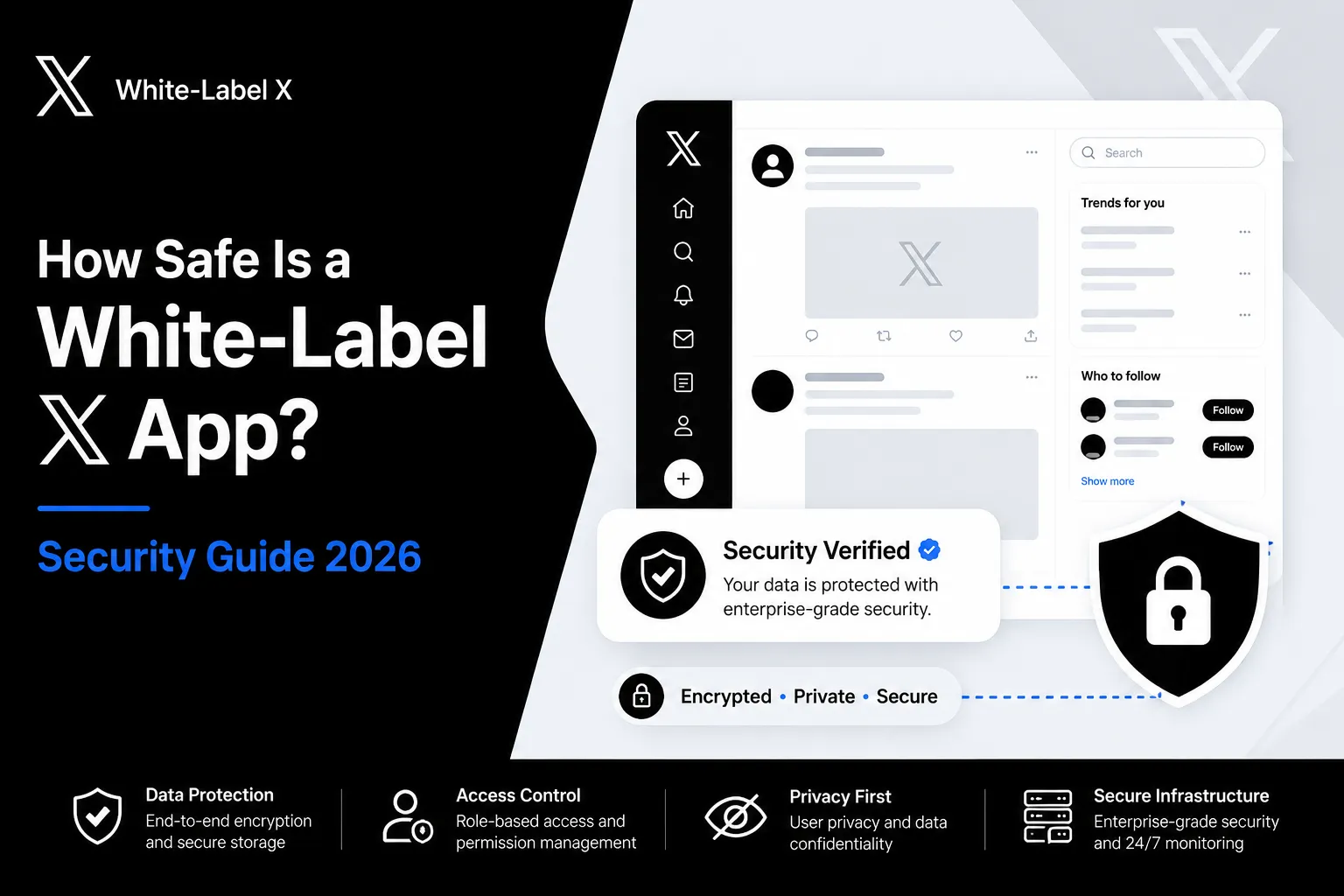
In this guide, we’ll break down the real security landscape of a white-label X app in 2026—no fear-mongering, no false promises. You’ll understand what risks exist, what standards matter, and how a security-first provider like Miracuves approaches safety, compliance, and long-term protection.
Understanding White-Label X App Security Landscape
What White-Label X App Security Really Means in 2026
White-label X app security refers to the protection measures built into a ready-made social networking platform that is rebranded and deployed for your business. In 2026, this goes far beyond simple login protection. It includes how user conversations are stored, how media is processed, how APIs communicate, and how data flows across servers, devices, and third-party services.
A secure white-label X app is not just about code ownership. It’s about who controls the infrastructure, how updates are handled, and whether security is treated as a system-level responsibility rather than an afterthought.
Common Security Myths vs Reality
One of the biggest myths is that white-label apps are automatically less secure than custom-built platforms. In reality, many security breaches in 2026 occur in poorly maintained custom apps with no structured audits or compliance roadmap.
Another misconception is that rebranded apps reuse unsafe or shared databases. Modern white-label X apps built correctly use isolated environments, encrypted storage, and role-based access—often stronger than early-stage custom builds.
Why Businesses Worry About White-Label X Apps
Concerns usually come from lack of transparency. Founders fear:
- Losing control over user data
- Being exposed to legal liability
- Depending on a third-party provider for security updates
These fears are valid in 2026, especially for platforms handling public discourse, private messages, and user-generated content at scale.
Current Threat Landscape for X-Type Platforms in 2026
Social platforms similar to X are prime targets for:
- Account takeover attacks
- API abuse and bot manipulation
- Data scraping and profile harvesting
- Media upload vulnerabilities
- DDoS attacks during viral activity
According to global cybersecurity reports in 2026, social networking apps account for a significant share of large-scale credential leaks and privacy complaints due to weak authentication and poor rate limiting.
Security Standards That Matter in 2026
In 2026, a white-label X app is expected to align with:
- Zero-trust security models
- Privacy-by-design principles
- Continuous vulnerability monitoring
- Region-specific data protection laws
Security is no longer measured by features alone but by processes, documentation, and response readiness.
Real-World App Security Statistics (2026)
Industry data in 2026 shows:
- Over 60% of social app breaches originate from insecure APIs
- Nearly 1 in 3 incidents involve third-party integrations
- Platforms with regular penetration testing reduce breach risk by more than half
These numbers highlight why provider-level security maturity is critical when choosing a white-label X app.
Key Security Risks & How to Identify Them
High-Risk Area 1: Data Protection & Privacy
User Personal Information
A white-label X app processes sensitive user data such as names, email addresses, phone numbers, profile details, and private messages. In 2026, improper access controls or weak encryption can expose this data to internal misuse or external breaches.
Payment Data Security
If your X app includes subscriptions, tipping, or promoted content, payment data becomes a high-risk asset. Storing card details without tokenization or relying on non-compliant gateways creates serious exposure under PCI DSS rules in 2026.
Location Tracking Concerns
Many social apps collect location data for personalization or analytics. Without explicit user consent, anonymization, and regional storage controls, this can violate data protection laws in multiple countries.
GDPR and CCPA Compliance
In 2026, non-compliance is no longer a warning-level issue. Regulators actively fine platforms that fail to:
- Obtain clear user consent
- Offer data deletion and export options
- Disclose how data is processed and shared
High-Risk Area 2: Technical Vulnerabilities
Code Quality Issues
Poorly written or reused code increases exposure to SQL injection, cross-site scripting, and privilege escalation attacks. Many unsafe white-label X apps fail here due to rushed development.
Server Security Gaps
Unsecured cloud configurations, exposed admin panels, and outdated server software remain top breach causes in 2026. A secure app must use hardened infrastructure and restricted access policies.
API Vulnerabilities
X-style platforms rely heavily on APIs. Weak authentication, missing rate limits, or open endpoints allow data scraping, bot abuse, and account hijacking.
Third-Party Integrations
Analytics tools, push notification services, and media processing APIs can become indirect attack vectors if not properly vetted and isolated.
High-Risk Area 3: Business & Operational Risks
Legal Liability
If a breach occurs, the app owner—not just the provider—can be held accountable under regional data laws in 2026.
Reputation Damage
Trust is fragile on social platforms. A single security incident can permanently damage user confidence and growth.
Financial Losses
Costs include regulatory fines, legal fees, compensation claims, and emergency infrastructure upgrades.
Regulatory Penalties
Fines under GDPR and similar laws in 2026 can reach millions, even for mid-sized platforms.
White-Label X App Risk Assessment Checklist
- Is all user data encrypted at rest and in transit?
- Are APIs protected with authentication and rate limiting?
- Are admin roles strictly separated and logged?
- Is payment processing PCI DSS compliant?
- Are regular security audits documented?
- Is there a defined incident response plan?
This checklist helps identify whether a white-label X app is built for long-term security or short-term launch.
Security Standards Your White-Label X App Must Meet
Essential Compliance Certifications in 2026
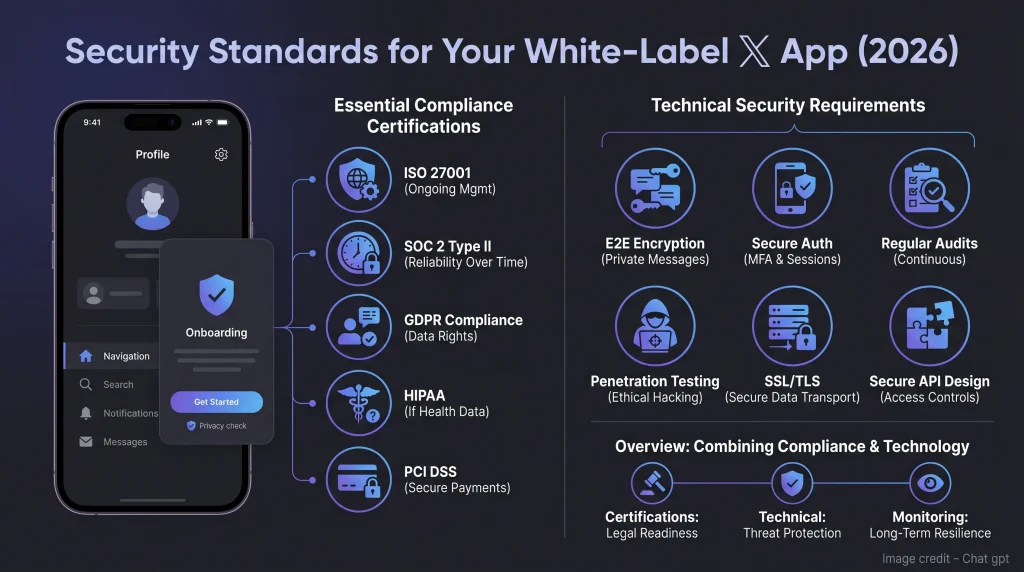
ISO 27001
ISO 27001 ensures that the white-label X app follows a structured information security management system. In 2026, this certification proves that security is managed as an ongoing process, not a one-time setup.
SOC 2 Type II
SOC 2 Type II focuses on how security controls perform over time. For social platforms like an X app, this certification validates data handling, access control, and system reliability under real usage conditions.
GDPR Compliance
GDPR remains one of the strictest data protection frameworks in 2026. A compliant white-label X app must support user consent management, data portability, right-to-erasure, and transparent privacy disclosures.
HIPAA (If Applicable)
If your X app supports health-related discussions or professional communities, HIPAA compliance may be required in 2026 to protect sensitive health data.
PCI DSS for Payments
Any white-label X app handling subscriptions, tips, or promoted posts must comply with PCI DSS standards in 2026 to securely process payment information.
Technical Security Requirements in 2026
End-to-End Encryption
Private messages and sensitive communications should be encrypted so that only intended users can access them, reducing internal and external exposure.
Secure Authentication
Strong authentication methods such as OAuth, multi-factor authentication, and session management are essential to prevent account takeover attacks.
Regular Security Audits
Security audits identify vulnerabilities before attackers do. In 2026, quarterly or continuous audits are considered best practice for social platforms.
Penetration Testing
Ethical hacking exercises simulate real-world attacks, helping uncover weaknesses in APIs, media uploads, and authentication flows.
SSL and Transport Security
All data exchanged between users, servers, and third-party services must be protected using modern SSL and TLS standards.
Secure API Design
APIs should enforce strict access controls, validation, throttling, and logging to prevent abuse and data leakage.
Security Standards Comparison Overview
A secure white-label X app in 2026 combines compliance and technology:
- Certifications ensure legal and procedural readiness
- Technical controls protect against real-time threats
- Continuous monitoring ensures long-term resilience
Meeting these standards is the difference between a platform that survives growth and one that collapses under pressure.
Red Flags: How to Spot Unsafe White-Label Providers
Warning Signs You Should Not Ignore in 2026
No Security Documentation
If a provider cannot share security architecture details, audit reports, or compliance documentation, it usually means security was never prioritized during development.
Unrealistically Cheap Pricing
In 2026, enterprise-grade security has real infrastructure, audit, and compliance costs. Extremely low pricing without explanation often signals shared servers, outdated code, or missing protections.
No Compliance Certifications
A white-label X app provider without GDPR, SOC 2, or ISO alignment exposes you to legal and regulatory risk from day one.
Outdated Technology Stack
Legacy frameworks, unsupported libraries, and old server environments increase vulnerability to known exploits that attackers actively target.
Poor Code Quality
Hardcoded credentials, lack of modularity, and missing input validation are common in unsafe white-label apps and difficult to fix later.
No Defined Security Update Policy
Security threats evolve constantly in 2026. Providers who do not offer regular patches and updates leave your platform exposed over time.
No Data Backup or Recovery Systems
Without automated backups and tested recovery plans, a single incident can result in permanent data loss.
Lack of Cyber Insurance
Serious providers carry insurance to cover breach-related liabilities. Its absence shifts all risk directly onto your business.
Evaluation Checklist Before Choosing a Provider
Questions to Ask
- How is user data encrypted and stored?
- How often are security audits conducted?
- Who is responsible for applying security updates?
- How is API access protected and monitored?
Documents to Request
- Security audit summaries
- Compliance certificates
- Data processing agreements
- Incident response policy
Testing Procedures
- Pre-launch vulnerability assessment
- API penetration testing
- Role-based access testing
Due Diligence Steps
- Review past security incidents
- Verify infrastructure ownership
- Confirm long-term support commitments
Spotting these red flags early in 2026 can save months of recovery effort and significant financial loss.
Best Practices for Secure White-Label X App Implementation
Pre-Launch Security Practices in 2026
Security Audit Process
Before launch, a white-label X app should undergo a full security audit covering code, infrastructure, APIs, and data flows. This helps identify vulnerabilities that are cheaper to fix before users join the platform.
Code Review Requirements
Independent code reviews ensure that authentication logic, data handling, and permission systems are implemented correctly and follow modern security standards.
Infrastructure Hardening
Servers must be configured using least-privilege access, firewall rules, DDoS protection, and isolated environments to reduce attack surfaces in 2026.
Compliance Verification
Before going live, confirm GDPR, CCPA, and payment compliance requirements are met and properly documented.
Staff Security Training
Human error remains a major breach cause in 2026. Teams managing the X app should be trained on access control, phishing risks, and incident reporting.
Post-Launch Security Monitoring
Continuous Security Monitoring
Real-time monitoring tools help detect unusual behavior such as bot attacks, credential stuffing, or API abuse before damage escalates.
Regular Updates and Patches
Security updates should be deployed on a defined schedule to address new vulnerabilities discovered in libraries, frameworks, or integrations.
Incident Response Planning
A documented response plan ensures faster containment, communication, and recovery if a security issue occurs.
User Data Management
Clear rules must exist for data retention, deletion, and access requests, especially under evolving regulations in 2026.
Backup and Recovery Systems
Automated backups and tested recovery procedures ensure business continuity even during infrastructure failures or cyber incidents.
Security Implementation Timeline Overview
A secure white-label X app implementation in 2026 typically follows:
- Pre-launch audit and compliance checks
- Controlled production launch
- Continuous monitoring and updates
- Quarterly security reviews
This structured approach reduces risk while supporting long-term platform growth.
Legal & Compliance Considerations
Regulatory Requirements by Region in 2026
Global Data Protection Laws
In 2026, a white-label X app operating across regions must align with multiple data protection frameworks. GDPR governs user data in the EU, while similar laws apply in the UK, India, the US, and other markets. These laws regulate how personal data is collected, processed, stored, and shared.
Industry-Specific Regulations
If the X app supports verified accounts, paid content, or professional communities, additional regulations may apply depending on the industry and region.
User Consent Management
Platforms must clearly explain data usage and obtain explicit user consent. Consent records must be stored and auditable in 2026.
Privacy Policy Requirements
A legally compliant privacy policy must disclose:
- Types of data collected
- Purpose of data processing
- Third-party data sharing
- User rights and contact information
Terms of Service Essentials
Terms of service should define acceptable use, content responsibilities, platform rights, and limitations of liability.
Liability Protection Strategies
Insurance Requirements
Cyber liability insurance is increasingly standard in 2026. It helps cover breach response costs, legal fees, and regulatory fines.
Legal Disclaimers
Proper disclaimers reduce exposure by clearly defining platform responsibilities and user obligations.
User Agreements
Clear agreements help protect the app owner in disputes related to content misuse, impersonation, or data access.
Incident Reporting Protocols
Regulations in 2026 require timely disclosure of breaches to authorities and affected users within defined timeframes.
Ongoing Compliance Monitoring
Laws evolve constantly. Regular legal reviews ensure the white-label X app remains compliant as regulations change.
Compliance Checklist by Region
- GDPR compliance for EU users
- CCPA and state-level compliance for US users
- Local data protection laws in India and APAC
- Cross-border data transfer safeguards
Managing these legal and compliance factors properly is essential to operating a secure and trusted X app in 2026.
Read more : –How to Hire the Best Wix Clone Developer
Why Miracuves White-Label X App Is Your Safest Choice
Miracuves Security-First Approach in 2026
In 2026, security is not something Miracuves adds later—it is built into the foundation of every white-label X app from day one. The platform architecture is designed with privacy-by-design and zero-trust principles, ensuring that user data, conversations, and media remain protected at every layer.
Enterprise-Grade Security Architecture
Miracuves white-label X apps are developed using hardened infrastructure, isolated environments, and role-based access control. This prevents unauthorized access and limits exposure even if one component is compromised.
Regular Security Audits and Certifications
Security audits are conducted on a scheduled basis to identify vulnerabilities early. Compliance alignment with GDPR, CCPA, and global data protection standards is maintained continuously in 2026, not just at launch.
Built-In Compliance by Default
Every Miracuves white-label X app supports:
- GDPR and CCPA-ready data handling
- User consent management
- Data deletion and export requests
- Transparent privacy controls
This reduces legal risk for businesses operating across regions.
Encrypted Data and Secure Communication
All data transmission uses modern encryption standards. Private messages, authentication tokens, and sensitive user information are protected both in transit and at rest.
Secure Payment Processing
If monetization features are enabled, Miracuves integrates PCI DSS–compliant payment gateways to ensure safe subscription and transaction handling in 2026.
Continuous Monitoring and Updates
Security does not stop after launch. Miracuves provides continuous monitoring, regular updates, and proactive patching to defend against evolving threats.
Enterprise-level risk management practices and insurance coverage help protect businesses from financial and legal exposure in case of incidents.
Risk Protection and Insurance Coverage
Final Thought
Don’t compromise on security in 2026. Miracuves white-label X app solutions are built with enterprise-grade protection, compliance readiness, and long-term reliability. With 9k+ successfully delivered projects and a strong security track record, Miracuves helps businesses launch social platforms they can trust.
In 2026, the safety of a white-label X app depends less on the concept and more on the execution. Security risks are real, but they are manageable when the right standards, processes, and provider are in place. Choosing a security-first platform protects not just your users, but your brand, revenue, and long-term vision.
FAQs
1. How secure is a white-label X app compared to custom development in 2026?
A white-label X app can be equally or more secure than custom development in 2026 if it follows enterprise security standards, regular audits, and compliance frameworks. Risk usually comes from poor providers, not the white-label model itself.
2. What happens if there is a security breach?
In 2026, a proper incident response plan ensures immediate containment, user notification, regulatory reporting, and recovery. Responsibility is shared between the app owner and the provider based on contracts.
3. Who is responsible for security updates?
The white-label app provider is responsible for core security updates, while the business owner must follow recommended operational and access-control practices.
4. How is user data protected in a white-label X app?
User data is protected through encryption, access controls, secure APIs, and compliance with data protection laws like GDPR and CCPA in 2026.
5. What compliance certifications should I look for?
Key certifications in 2026 include ISO 27001, SOC 2 Type II, GDPR compliance, and PCI DSS if payments are involved.
6. Can a white-label X app meet enterprise security standards?
Yes. When built with proper architecture, audits, and monitoring, a white-label X app can meet and maintain enterprise-grade security standards in 2026.
7. How often should security audits be conducted?
In 2026, audits should be conducted at least quarterly, with continuous monitoring for high-risk components like APIs and authentication.
8. What is included in the Miracuves security package?
Miracuves provides encrypted data handling, compliance-ready architecture, regular security audits, monitoring, and ongoing updates in 2026.
9. How is security handled across different countries?
Regional compliance frameworks are implemented based on user location, with data handling aligned to local laws in 2026.
10. What insurance is needed for app security?
Cyber liability insurance is recommended in 2026 to cover breach response costs, legal claims, and regulatory penalties.
Related Articles :