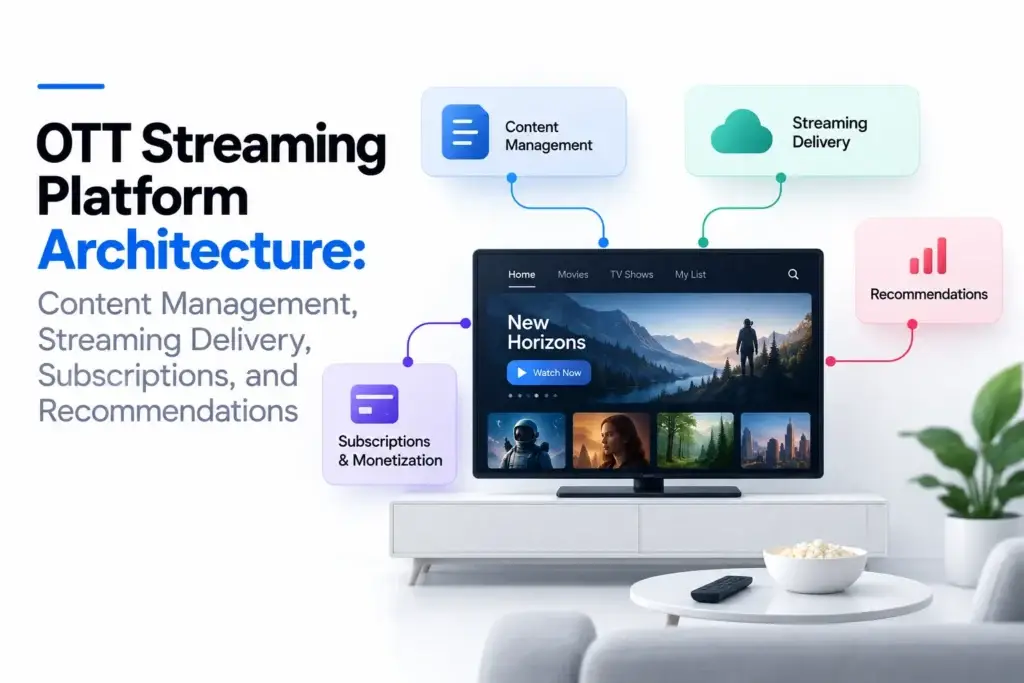

Key Takeaways
- An OTT Streaming Platform Security should protect premium content, viewer accounts, subscription payments, personal data, and playback access through multiple security layers.
- Core protections include DRM, encrypted streaming, secure authentication, entitlement checks, payment tokenization, account controls, fraud monitoring, and role-based admin permissions.
- OTT security should be integrated across content ingestion, storage, video delivery, subscriptions, payments, user sessions, device access, and administrative workflows.
Security & Content Protection Signals
- Premium video protection can use DRM, encrypted media delivery, signed playback URLs, entitlement validation, watermarking, download controls, and geo-restrictions.
- Viewer account security should include strong passwords, multi-factor authentication, session management, device limits, suspicious-login alerts, account recovery, and access history.
- Admin security should control content publishing, user permissions, subscription changes, refunds, reports, moderation, audit logs, and access to sensitive operational data.
Viewer & Payment Risk Insights
- Payment protection should cover secure gateways, recurring billing, transaction verification, failed payments, refunds, chargebacks, fraud detection, and subscription status synchronization.
- Operators should monitor unusual logins, excessive device sharing, payment failures, account abuse, playback anomalies, unauthorized access attempts, and suspicious subscription activity.
- Miracuves develops customizable OTT streaming platforms with DRM, secure playback, viewer account protection, subscription billing, payment controls, analytics, content management, and admin security tools.
OTT streaming platform security is not only about stopping hackers. It is about protecting the three things that keep the business alive: premium content, viewer accounts, and payments.
A streaming platform handles more sensitive activity than many founders realize. Users create accounts, save profiles, watch content, make payments, renew subscriptions, rent videos, access premium titles, and sometimes use multiple devices under the same plan. Behind that experience, admins manage content access, payment status, user support, moderation, refunds, analytics, and platform settings.
If security is weak, the damage is not only technical. Premium content can be misused, viewer trust can drop, payments can fail, and the brand can lose credibility. That is why security should be planned as part of the OTT platform foundation, not added after launch.
This guide explains how founders can think about OTT streaming platform security across content protection, account safety, payment workflows, admin control, APIs, compliance-ready operations, and long-term monitoring.
Why OTT Platform Security Matters Before Launch
Security decisions shape the platform long before the first user signs up. A founder may think about design, content, and pricing first, but the product also needs secure access rules, payment validation, content protection, admin permissions, and privacy-conscious data handling.
A weak security foundation can create problems such as:
- Paid users losing access after renewal
- Unpaid users accessing premium titles
- Shared accounts spreading beyond plan limits
- Admin users seeing data they should not access
- Content files being exposed through insecure links
- Payment events not updating subscription status
- APIs being abused for scraping or automated attacks
- User data being stored without clear retention rules
Security is therefore not only a development task. It is a business protection layer.
If you are still exploring the basics of how major streaming products operate, this guide on how streaming platforms work can help before going deeper into OTT security planning.
For founders planning a branded streaming product, security should be connected to content strategy, subscription design, payment workflows, user support, and admin operations from the beginning.
The Three Assets Every OTT Platform Must Protect
Most OTT security planning can be simplified into three business-critical assets: content, accounts, and payments.
| Security Area | What Needs Protection | Business Risk if Ignored |
|---|---|---|
| Premium Content | Movies, series, trailers, live streams, downloads, subtitles, playback links, and content rights | Unauthorized access, piracy, rights disputes, content leakage, and revenue loss |
| Viewer Accounts | Login credentials, profiles, watch history, devices, sessions, preferences, and personal data | Account takeover, privacy issues, user distrust, support overload, and churn |
| Payments | Subscriptions, renewals, rentals, pay-per-view, invoices, refunds, payment status, and access rules | Billing disputes, failed access, unpaid premium usage, fraud exposure, and revenue leakage |
Protecting Premium Content in an OTT Streaming Platform
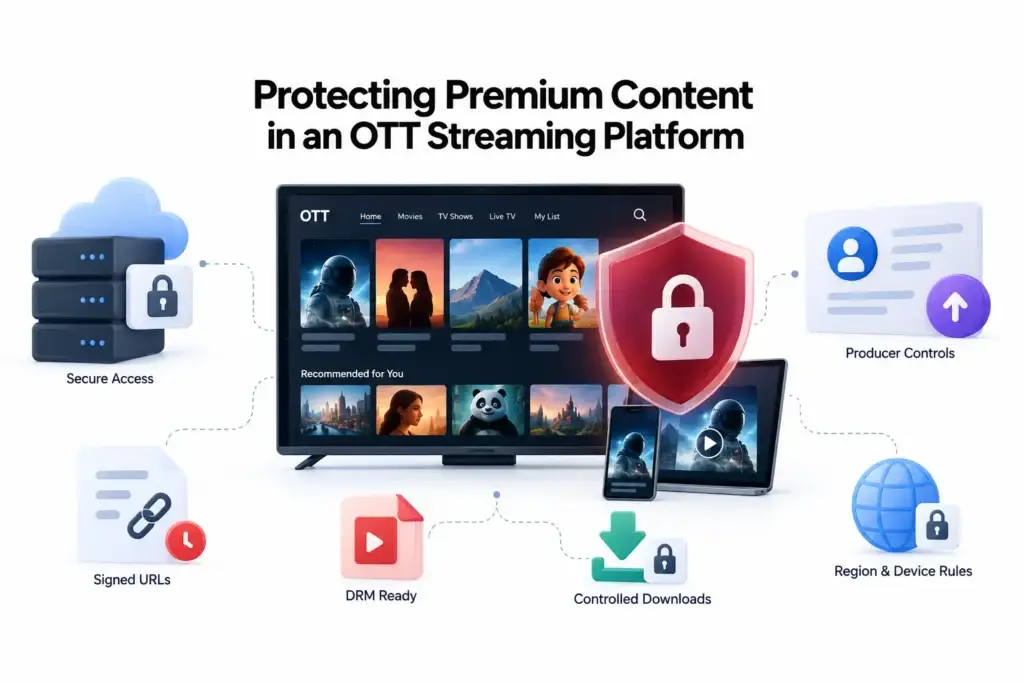
Premium content is the main asset of a streaming business. Whether the platform offers original shows, regional films, education videos, live events, sports clips, creator content, or licensed media, the platform must control who can access each title and under what conditions.
Content protection should begin at the architecture level.
Secure Content Access Rules
The platform should not expose video files directly. Users should only receive playback access after the backend checks their account, subscription status, rental validity, pay-per-view purchase, region rules, and device permissions.
For example, a premium title may be available only to annual subscribers in selected countries. Another title may be available for 48-hour rental access. A live event may allow only one active session per user. These rules need to be handled through secure entitlement checks.
Signed Playback URLs
Signed playback URLs help reduce unauthorized sharing by creating time-limited links for video access. Instead of exposing permanent video URLs, the platform generates controlled access that expires after a defined period.
This helps protect premium streams from being copied and circulated outside the app.
DRM-Ready Workflows
DRM-ready workflows help protect licensed or high-value video assets. Not every early-stage OTT platform needs advanced DRM from day one, but founders working with studios, distributors, sports rights, or premium content partners should plan for it early.
DRM planning may affect:
- Player selection
- Video packaging
- Device support
- Download rules
- Content provider requirements
- Streaming infrastructure
- Smart TV expansion
Download and Offline Viewing Controls
Offline viewing is convenient for users, but it also increases security complexity. If downloads are offered, the platform should define expiry rules, device limits, encryption, and whether downloaded videos can be played outside the app environment.
A download feature without control can create content leakage risk.
Producer and Content Partner Controls
If the platform allows studios, producers, or creators to submit content, security must also protect upload workflows. Producer dashboards should have limited permissions, secure file handling, approval workflows, payout controls, and activity logs.
This is where content protection becomes operational, not just technical.
Protecting Viewer Accounts and Personal Data
Viewer accounts store more than login details. They may contain profiles, devices, watch history, subscriptions, invoices, preferences, parental controls, and support records.
If an attacker gains account access, the platform may face privacy issues, payment disputes, support load, and user distrust.
Secure Login and Authentication
A streaming platform should support secure authentication practices such as strong password rules, secure password storage, optional two-factor authentication, session expiry, suspicious login detection, and account recovery controls.
Founders should also plan for social login carefully. It can reduce signup friction, but it still needs secure token handling and privacy-conscious data collection.
Device and Session Management
OTT users often watch on multiple devices. That makes session management important.
The platform should allow operators to define:
- Number of allowed devices
- Number of active streams
- Device removal rules
- Session expiry
- Suspicious device alerts
- Logout from all devices
- Region-specific access controls
This protects account value without making the viewer experience unnecessarily difficult.
Watch History and Viewing Data Protection
Watch history may look harmless, but it can reveal user preferences, habits, location patterns, family usage, language choices, and sensitive interests. This data should be handled carefully.
The platform should collect only what it needs, explain why data is used, limit internal access, and give users appropriate privacy controls based on the target market.
Profile and Family Account Controls
Many streaming platforms support multiple profiles under one account. This improves user experience, but it also creates privacy and access-control questions.
Profile-level controls can include kid profiles, maturity filters, profile lock, viewing restrictions, and personalized recommendations. These features support both safety and retention.
Protecting Payments, Subscriptions, Rentals, and Pay-Per-View Access
Payment security is not only about the checkout page. It also includes subscription status, renewal logic, rental expiry, invoices, failed payment handling, refunds, coupons, and entitlement rules.
A user should receive access only when the payment event is valid. A user should not lose access when a successful renewal has already been confirmed. These details require secure backend coordination.
Tokenized Payment Workflows
OTT platforms should avoid storing raw card details directly unless the business has the required infrastructure, controls, and compliance scope. A safer route is to use trusted payment gateways and tokenized payment flows.
The platform should store payment references, subscription status, invoice records, and access rules, while sensitive card handling remains with the payment provider where appropriate.
Payment Webhooks and Access Updates
Payment gateways communicate events through webhooks. These events may confirm a successful payment, failed renewal, refund, chargeback, cancellation, or subscription update.
The backend must validate these events securely before changing user access.
Weak webhook handling can create serious issues:
- Users may access paid content without valid payment
- Paid users may lose access after renewal
- Refunds may not revoke premium access
- Expired rentals may remain active
- Failed payments may go unnoticed
Entitlement Checks for Paid Content
Entitlement means the user has the right to access a specific piece of content under specific business rules.
An OTT entitlement system should check:
- Subscription plan
- Payment status
- Rental expiry
- Pay-per-view purchase
- Content category access
- Region availability
- Device rules
- Account status
- Coupon or promotional access
- Admin overrides where necessary
For deeper monetization planning, founders can review the OTT streaming business model guide and connect revenue logic with secure content access.
Secure APIs, Admin Permissions, and Infrastructure Controls
OTT platforms rely heavily on APIs. APIs connect mobile apps, web apps, video playback, subscriptions, user profiles, search, recommendations, admin dashboards, and payment systems.
If API security is weak, attackers may scrape content metadata, test login credentials, abuse payments, access private records, or overload backend systems.
API Security Controls
Important API controls include authentication, authorization, input validation, rate limiting, token expiry, request logging, and abuse detection.
APIs should answer two questions before returning sensitive data:
- Who is making this request?
- Is this user or system allowed to perform this action?
Without these checks, the platform becomes easier to abuse.
Admin Role-Based Access
The admin dashboard is one of the most sensitive areas of an OTT platform. It may control users, payments, content, banners, subscriptions, coupons, reports, producer workflows, and support actions.
Not every team member should have access to every function. A support executive may need to view account status but should not change payment rules. A content reviewer may approve titles but should not access revenue reports. A finance user may view payouts but should not edit app settings.
Role-based access control protects internal operations from mistakes and misuse.
Activity Logs and Audit Trails
Activity logs help platform owners understand who changed what and when. They are useful for debugging, dispute management, internal accountability, and incident investigation.
An OTT platform should log important events such as:
- Admin login
- Content approval
- Subscription plan change
- Payment status update
- Refund action
- User account suspension
- Coupon creation
- Producer payout update
- Permission changes
- Security setting updates
Backup and Recovery Planning
Security also includes recovery. If data is lost, corrupted, or affected by an incident, the platform should have tested backup and restoration procedures.
Backups should be encrypted, access-controlled, and tested periodically. A backup that has never been restored is only an assumption.
OTT Security Controls by Platform Area
| Platform Area | Security Controls | Founder Impact |
|---|---|---|
| Content Delivery | Signed URLs, DRM-ready workflows, CDN protection, download limits, secure playback authorization | Reduces unauthorized access and protects premium media value |
| Viewer Accounts | Secure login, session expiry, suspicious login alerts, device controls, profile privacy | Improves account trust and reduces support risk |
| Payments | Tokenized payment flows, secure gateway integration, webhook validation, refund controls | Protects revenue and reduces billing disputes |
| Subscriptions | Entitlement checks, plan mapping, renewal validation, rental expiry, PPV access control | Ensures paid users get access and unpaid users do not |
| Admin Dashboard | Role-based access, activity logs, limited permissions, approval workflows | Reduces internal misuse and operational mistakes |
| APIs and Backend | Authentication, authorization, rate limiting, input validation, monitoring, logging | Protects app data, platform performance, and sensitive workflows |
Compliance-Ready OTT Security Workflows
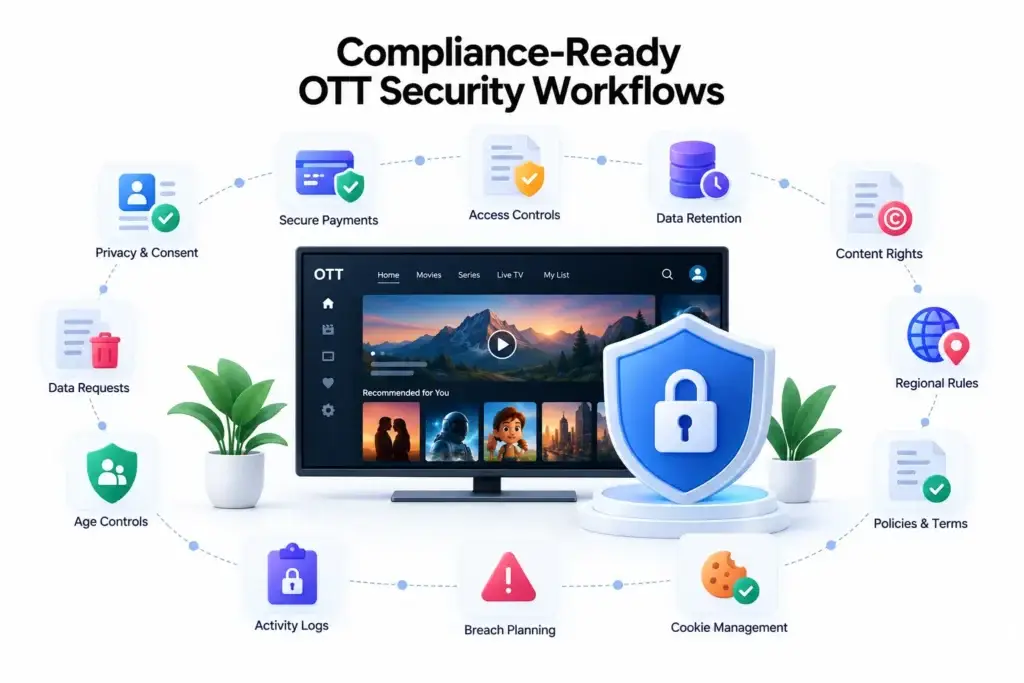
Compliance should be treated carefully. A software platform can support compliance workflows, but no blog or vendor claim should be treated as legal approval.
Depending on the market, an OTT streaming platform may need to consider privacy rules, consumer protection requirements, payment security standards, child safety controls, cookie consent, data deletion requests, breach notification processes, and content licensing obligations.
A compliance-ready OTT foundation may include:
- Privacy-conscious data collection
- Consent management workflows
- User data access and deletion request support
- Secure payment gateway integration
- Payment records and invoices
- Role-based admin access
- Data retention controls
- Activity logs
- Breach response planning
- Regional content availability rules
- Content rights and licensing records
- Age-gating where relevant
- Terms, privacy policy, and refund policy alignment
Final compliance depends on jurisdiction, legal review, hosting setup, payment providers, analytics tools, operating model, and the type of content being distributed.
Founder Decision Signals Before Securing an OTT Platform
Premium Content Value
If your platform carries licensed, paid, original, or exclusive content, prioritize secure playback URLs, entitlement checks, DRM-ready workflows, download controls, and content rights governance.
Account Abuse Risk
If users can access multiple profiles or devices, plan secure login, session expiry, device limits, suspicious login alerts, and account recovery controls before launch.
Payment Complexity
If your platform supports subscriptions, rentals, pay-per-view, coupons, or refunds, payment status must connect correctly with access rules and entitlement logic.
Admin Control
If multiple teams manage content, payments, support, banners, reports, or producer workflows, role-based access and activity logs should be built into the dashboard.
Compliance Exposure
If you serve users across regions, plan privacy notices, consent handling, data requests, payment security, breach response, and legal review based on your target markets.
Launch Speed
If you need to launch quickly, start with a secure ready-made foundation and customize the sensitive layers around content rights, payments, user data, and admin operations.
Secure OTT Launch Checklist
Before launching a paid streaming platform, founders should review security across product, backend, content, payment, and admin operations.
A practical pre-launch checklist includes:
- Confirm video files are not exposed through public permanent URLs
- Validate subscription and payment webhooks
- Test rental expiry and pay-per-view access rules
- Review user login and account recovery flows
- Add device and session controls
- Limit admin permissions by role
- Enable activity logs for sensitive admin actions
- Review payment gateway setup
- Test refunds, failed payments, and subscription cancellation flows
- Secure API endpoints with authentication and authorization
- Add rate limiting for sensitive APIs
- Review third-party SDKs and analytics tools
- Test backup and restoration procedures
- Prepare incident response steps
- Review privacy policy, terms, refund rules, and data handling notices
If you want to connect security planning with the actual product modules, this OTT platform feature planning page explains how viewer, content, and admin-side features work together.
This checklist helps founders avoid launching with hidden security gaps.
You can also review the OTT Streaming Platform Feature Planning Guide to decide which features should be secured before launch and which can be improved later.
Common OTT Security Mistakes Founders Should Avoid
1. Treating Content Protection as Only a Player Feature
A secure video player is not enough. Premium content protection also needs entitlement checks, secure playback links, DRM-ready workflows, download limits, and content rights rules.
2. Adding Payments Without Secure Access Logic
Subscriptions, rentals, refunds, and pay-per-view purchases must update user access correctly. A payment gateway alone does not protect premium content.
3. Giving Too Much Admin Access
If every admin can edit users, payments, content, plans, reports, and settings, internal mistakes become more likely. Role-based access should limit sensitive controls.
4. Ignoring Account Sharing and Session Abuse
OTT platforms should define device limits, concurrent stream rules, session expiry, suspicious login alerts, and logout controls before account abuse becomes a support problem.
5. Leaving Compliance Until After Launch
Privacy, payment records, user consent, data deletion, breach response, and content rights should be reviewed before public launch. Late fixes are harder and riskier.
Custom OTT Security vs Ready-Made Secure Foundation
A custom OTT build gives founders deep flexibility, but every security layer must be planned, built, tested, documented, and monitored. That includes authentication, payment validation, content access, video protection, admin permissions, API hardening, backups, privacy workflows, and incident response.
Founders comparing build partners should review this guide on choosing the right OTT development partner before deciding between custom development, ready-made deployment, or a hybrid approach.
A ready-made platform foundation can reduce time when core workflows already exist. The important decision is not whether the platform is custom or ready-made. The important decision is whether the security model fits your content, payment, admin, and compliance needs.
If pricing and launch scope are also part of the planning process, the OTT platform development cost guide can help connect security requirements with budget planning.
How Miracuves Helps Founders Launch Secure OTT Platforms Faster
Miracuves helps founders build ready-made and white-label OTT streaming platforms with branded apps, source-code ownership, admin control, content workflows, subscription logic, and monetization-ready foundations.
For OTT businesses, security planning should connect with the actual platform model. A founder launching paid movies needs secure rental expiry and content access rules. A producer-led platform needs content approvals and payout controls. A subscription platform needs payment validation, entitlement checks, and account protection. A regional platform may need language, country, and content-availability rules.
The Miracuves Netflix clone solution can support founders who want a launch-ready OTT foundation with platform control, monetization workflows, and customization options. Where the ready-made scope fits the business requirement, Miracuves can also support 6-day solution delivery.
Founders exploring broader video-first products can also review Miracuves’ video content platform solutions for OTT, creator, and entertainment-focused app models.
Final Thoughts: Security Protects the OTT Business Model
OTT security is not a single feature. It is the connection between content protection, account safety, payment validation, subscription access, admin control, APIs, data privacy, and operational monitoring.
Founders should not wait until after launch to secure premium content, viewer accounts, and payment workflows. By then, the platform may already have exposed content, confused users, created billing disputes, or built admin habits that are difficult to correct.
The smarter approach is to plan security as part of the platform foundation. Protect the content. Protect the viewer. Protect the payment flow. Protect the admin layer. Then scale with more confidence.
After the security foundation is clear, founders should also plan their OTT streaming platform go-to-market strategy so content, subscriptions, retention, and acquisition work together.
FAQs
What is OTT streaming platform security?
OTT streaming platform security is the set of controls used to protect premium content, viewer accounts, payments, subscriptions, APIs, admin dashboards, user data, and streaming workflows.
How can an OTT platform protect premium content?
An OTT platform can protect premium content with secure entitlement checks, signed playback URLs, DRM-ready workflows, device limits, download controls, regional access rules, and secure content approval workflows.
Why are viewer accounts at risk in streaming platforms?
Viewer accounts are valuable because they may contain personal data, watch history, active subscriptions, invoices, device access, and premium content rights. Weak login or session controls can lead to account takeover and misuse.
How should payment security work in an OTT platform?
Payment security should use trusted payment gateways, tokenized payment handling, secure webhook validation, subscription status updates, refund controls, invoices, and access rules that match the user’s payment state.
What is entitlement management in OTT security?
Entitlement management decides whether a viewer is allowed to access a specific title. It checks plan status, rental expiry, pay-per-view purchase, payment confirmation, region rules, device rules, and account status.
Do OTT platforms need DRM from day one?
Not always. Early platforms may start with secure playback and access controls. However, platforms distributing licensed, premium, sports, studio, or high-value content should plan DRM-ready workflows early.
Do OTT platforms need DRM from day one?
Not always. Early platforms may start with secure playback and access controls. However, platforms distributing licensed, premium, sports, studio, or high-value content should plan DRM-ready workflows early.
What admin security controls should an OTT platform include?
An OTT admin dashboard should include role-based access, permission limits, activity logs, content approval workflows, payment visibility controls, support access limits, and secure account management.
Can Miracuves help launch a secure OTT streaming platform?
Yes. Miracuves helps founders launch ready-made and white-label OTT streaming platforms with branding, source-code ownership, admin control, content workflows, monetization logic, and faster deployment. A 6-day launch may apply where the ready-made scope fits the business requirement.
Miracuves is an independent software development company. We are not affiliated with, connected to, sponsored by, or endorsed by any company or product named in this article.
Terms such as “X Clone” are used descriptively. It is how the software industry refers to building a platform with functionality comparable to a known service, and how clients search for it.
The entire design and codebase of our products is built by our own team. Our products contain no code, design, graphics, or content originating from any third-party website or applications.
All third-party names and marks referenced in this article are the property of their respective owners, referenced solely to identify the services discussed.