



Key Takeaways
What You’ll Learn
- Zerodha’s revenue model is built around low-cost digital brokerage services helping retail investors trade stocks, derivatives, commodities, mutual funds, and ETFs through a technology-first platform.
- The company earns mainly through brokerage and trading-related fees generated from futures & options trading, intraday activity, commodities, and advanced trading services.
- Its biggest advantage is cost disruption because Zerodha reduced traditional brokerage pricing and made investing more accessible to retail users in India.
- Ecosystem products strengthen long-term growth through tools like Coin, Varsity, Kite, Rainmatter, and partner-led fintech services.
- The biggest takeaway for founders is that fintech platforms scale effectively when low pricing, strong UX, financial education, and scalable infrastructure work together.
Stats That Matter
- The article positions Zerodha as India’s leading discount brokerage platform focused on retail investing, low-cost trading, and fintech-driven financial access.
- Core revenue comes from trading activity particularly futures & options, commodities, intraday trading, and brokerage-related transaction charges.
- Additional monetization comes from ecosystem services including partner products, premium APIs, educational tools, fintech investments, and financial integrations.
- Zerodha benefits from increasing retail investor participation in India as younger users continue adopting app-based investing and self-directed trading platforms.
- The platform’s low-cost structure improves customer acquisition because transparent pricing and digital onboarding reduce friction for first-time investors.
Real Insights
- Zerodha succeeds because it changed brokerage economics by making stock market access simpler and more affordable for retail investors.
- The strongest long-term advantage is user trust because transparent pricing and clean product experiences improve customer retention in financial services.
- Educational content strengthens platform adoption since beginner investors often need guidance before actively trading or investing consistently.
- Technology infrastructure directly impacts growth because trading apps require stability, execution speed, analytics, and scalable transaction handling.
- For entrepreneurs, the biggest lesson is to build a Zerodha-style fintech platform around low-cost brokerage, strong trading infrastructure, financial education, scalable UX, and ecosystem-led fintech expansion.
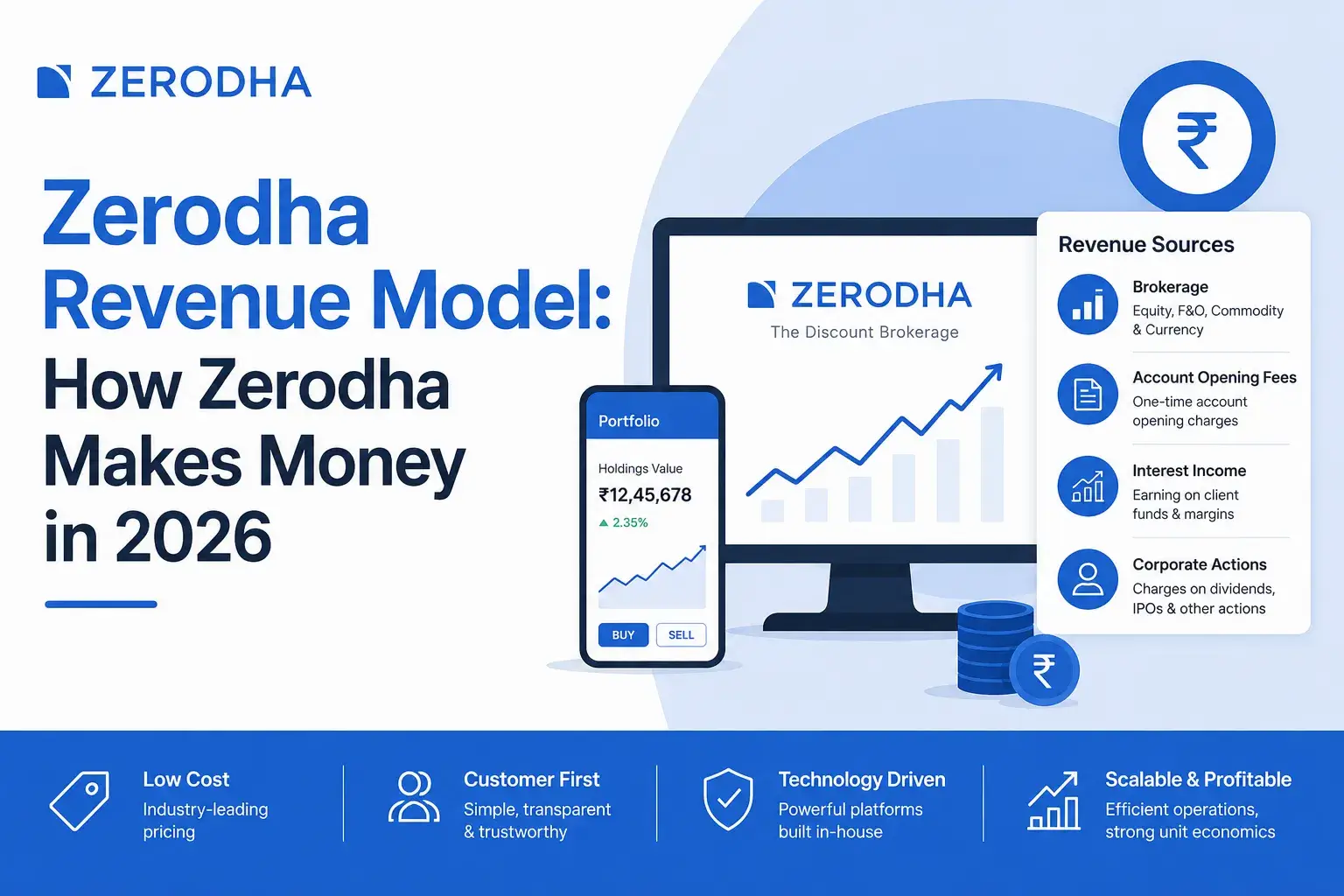
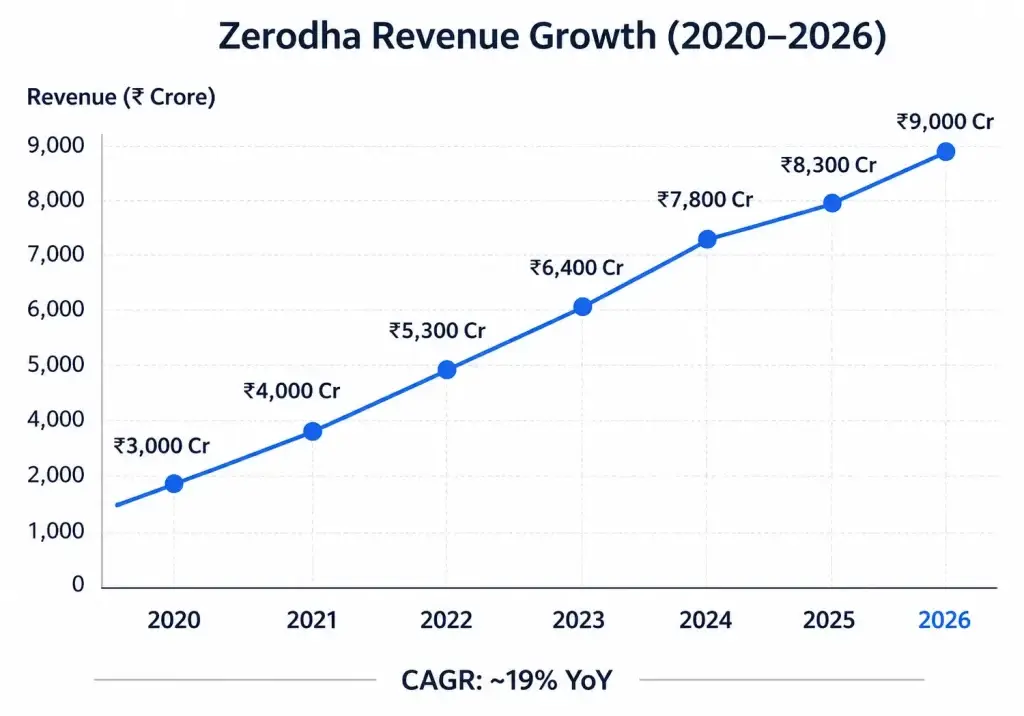
₹8,300+ crore in revenue with industry-leading profit margins. That single number explains why Zerodha is studied globally by founders, operators, and regulators alike. Unlike most fintech platforms, Zerodha converts a large portion of its revenue directly into profit through low overheads, predictable pricing, and massive transaction volume, making it an outlier in a margin-thin industry.
Zerodha didn’t win by outspending competitors on marketing or incentives. It won by redesigning brokerage economics from the ground up—eliminating percentage-based commissions, introducing flat fees, and automating operations end-to-end. This structural shift aligned user behavior with platform profitability, allowing growth without ballooning costs.
For fintech founders, Zerodha is the clearest proof that simplicity, scale, and discipline can outperform aggressive growth models. When pricing is transparent and operations are lean, scale becomes a compounding advantage rather than a liability. The real takeaway is that sustainable fintech businesses are built by engineering economics first, and growth second.
Zerodha Revenue Overview – The Big Picture
- 2026 Revenue: ~₹8,300–8,500 crore (~$1.0B)
- Valuation (implied): $6–7 billion (bootstrapped, no VC dilution)
- YoY Growth: ~18–22%
- Revenue by Region:
- India: ~99%
- International/NRI: ~1%
- Profit Margins: ~45–50% net margin (exceptional for fintech)
- Competition Benchmark:
- Groww: faster growth, lower margins
- Angel One: higher marketing, lower profitability
- Upstox: VC-backed, margin pressure
Read More: What is Zerodha and How Does It Work? – Miracuves Solutions
Primary Revenue Streams Deep Dive
Revenue Stream #1: Trading Brokerage (≈70%)
Zerodha charges a flat ₹20 per executed order for intraday, F&O, and commodities.
- No percentage-based commissions
- Massive volumes from active traders
- Predictable, scalable income
Revenue Stream #2: Interest on Margins & Collateral (≈12%)
Interest earned on margin funding, pledged securities, and idle balances.
Revenue Stream #3: Subscription Products (≈8%)
- Kite Connect API for algo traders
- Advanced analytics tools
- Professional trading add-ons
Revenue Stream #4: Ancillary Charges (≈7%)
- Call & trade fees
- Account services
- Compliance-related charges
Revenue Stream #5: Ecosystem Products (≈3%)
Includes Coin, Console, Varsity integrations and partner tools.
Revenue Streams Percentage Breakdown
| Revenue Stream | % Share (2026) |
|---|---|
| Trading Brokerage | 70% |
| Margin & Interest Income | 12% |
| Subscriptions & APIs | 8% |
| Ancillary Charges | 7% |
| Ecosystem Products | 3% |
The Fee Structure Explained
Zerodha’s pricing is designed to remove friction and maximize volume.
User-Side Fees
- Equity delivery: ₹0 brokerage
- Intraday / F&O: ₹20 per order
- Account opening & AMC: Minimal
Provider-Side Fees
- Exchange incentives (limited)
- Partner ecosystem revenue
Hidden Revenue Layers
- Margin interest spread
- Platform usage subscriptions
- Operational service charges
Regional Pricing Variation
- Uniform pricing across India
- Slightly higher compliance cost for NRIs
Complete Fee Structure by User Type
| User Type | Fees Paid | Zerodha Earnings Source |
|---|---|---|
| Long-Term Investor | Very Low | Ancillary + ecosystem |
| Active Trader | ₹20/order | High-volume brokerage |
| Algo Trader | Subscription fees | API & platform access |
| Margin Trader | Interest | Funding spreads |
How Zerodha Maximizes Revenue Per User
Zerodha focuses on cost efficiency over upselling.
- Segmentation: Investors vs high-frequency traders
- Upselling: APIs, advanced tools (not products)
- Cross-selling: Minimal by design
- Dynamic pricing: Flat fees encourage activity
- Retention monetization: Stable, long-term accounts
- LTV optimization: Decades-long trading relationships
- Psychological pricing: Flat ₹20 beats percentage fear
- Real example: One active trader can generate thousands of orders annually
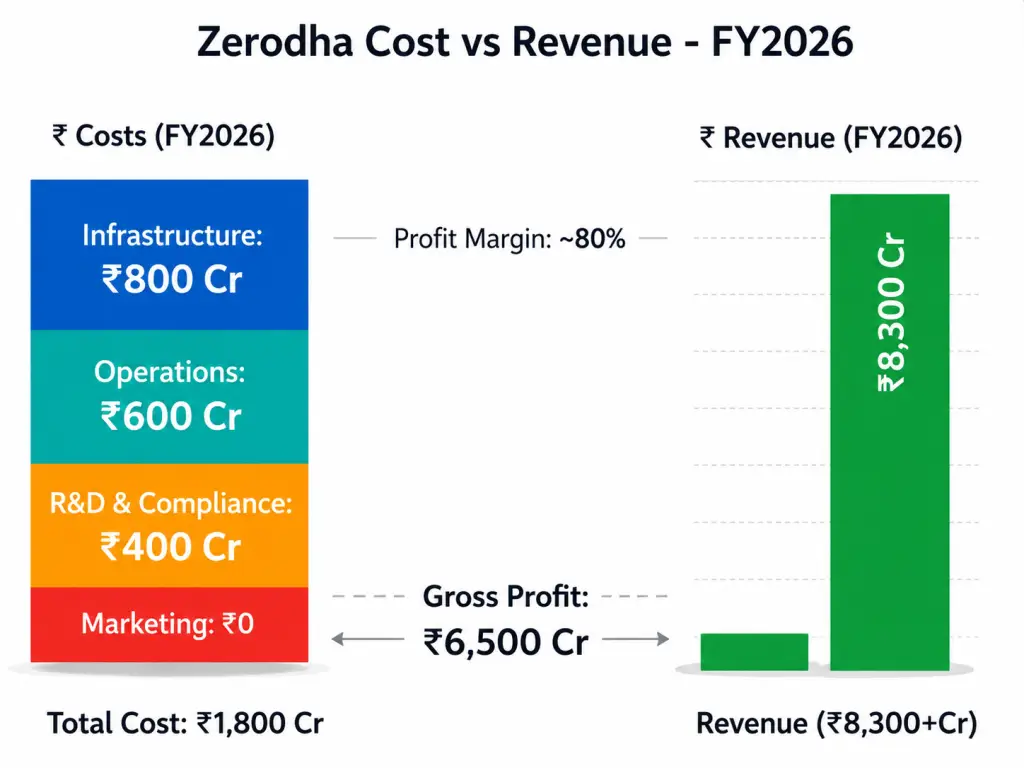
Cost Structure & Profit Margins
- Infrastructure: Trading systems, data feeds, cloud
- CAC & Marketing: Near zero (no paid advertising)
- Operations: Lean teams, automation-heavy
- R&D: Platform stability, performance, security
- Unit Economics: Profitable from early user lifecycle
- Margin Optimization: Flat pricing + low overhead
- Profitability Path: Achieved and sustained since early years
Read More: Best Zerodha Clone Scripts 2026 – High-Speed Trading Platform
Future Revenue Opportunities & Innovations
- Premium analytics subscriptions
- Institutional-grade APIs
- Deeper derivatives tooling
- AI-based trading insights (non-advisory)
- Trends 2026–2027: Self-directed trading growth
- Risks: Regulatory fee caps, market downturns
- Founder Opportunity: High-margin, low-burn fintech platforms
Lessons for Entrepreneurs & Your Opportunity
What Works
- Radical pricing simplicity
- Operational discipline
- Trust through transparency
What to Replicate
- Flat-fee models
- Automation-first operations
- Product-led growth
Market Gaps
- Regional-language trading platforms
- SME-focused trading tools
- AI-assisted non-advisory analytics
Miracuves Zerodha-Like Trading Platform Solution Cost and Tech Stack
Miracuves Pricing for a Zerodha-Like Trading and Investment Platform developed using JavaScript architecture is available on request. Final pricing depends on trading engine complexity, stock market API integrations, real-time analytics, portfolio management workflows, security requirements, scalability needs, and deployment scope. Estimated delivery timeline: 30 to 90 days.
Get a fully developed, custom fintech platform modeled around Zerodha-style online trading and investment capabilities. Built on a modern JavaScript foundation, this solution can be customized for stock brokers, fintech startups, investment firms, wealth management companies, trading communities, and digital finance platforms.
- Core Workflows: Stock trading, portfolio tracking, watchlists, real-time market updates, order placement, investment analytics, trading history, fund management, IPO investments, and user-based trading dashboards.
- Built-in Revenue Logic: Brokerage fees, premium subscriptions, API access pricing, margin trading services, partner commissions, investment advisory plans, premium analytics tools, and SaaS monetization models.
- Management Hub: Admin dashboard, trader management, transaction monitoring, portfolio analytics, compliance tracking, user verification, subscription controls, reporting systems, and investment management tools.
- Fintech-Ready Architecture: Prepared for trading APIs, live market data integration, secure payment processing, scalable transaction handling, investment analytics, AI-based recommendations, and enterprise-grade financial infrastructure.
Why Does a Zerodha-Like Platform Require JavaScript Architecture?
A Zerodha-like trading platform requires more than a simple finance dashboard. It manages live stock market data, user investments, trading workflows, portfolio calculations, transaction security, analytics systems, subscription services, and high-frequency financial interactions. A modern JavaScript architecture helps manage these complex fintech operations smoothly across users, admins, investors, and trading systems.
We recommend JavaScript architecture for this type of platform because:
- Built for Real-Time Trading Workflows: JavaScript supports fast order execution, live stock updates, instant portfolio refresh, real-time notifications, and interactive trading dashboards.
- Advanced Frontend Experience: React.js or similar JavaScript frameworks can power smooth trading interfaces, investment charts, watchlists, analytics dashboards, portfolio panels, and admin systems.
- Scalable Backend Logic: JavaScript-based backend systems can efficiently manage trading APIs, transaction processing, portfolio calculations, subscription logic, market feeds, and high-volume financial operations.
- Flexible Integration Layer: The platform can connect with stock exchanges, payment gateways, banking systems, trading APIs, KYC verification services, analytics tools, cloud infrastructure, and enterprise fintech solutions.
You get a scalable trading and investment platform designed for digital finance growth, intelligent investing experiences, recurring revenue generation, and long-term fintech scalability.
Note: Final pricing depends on selected trading APIs, live market integrations, compliance requirements, portfolio management modules, AI-based analytics, infrastructure scale, security layers, and custom feature development.
Final Thought
Zerodha proves that fintech success doesn’t require heavy spending on marketing or incentives. By relying on product-led growth, transparent pricing, and community-driven education, Zerodha keeps customer acquisition costs exceptionally low. This disciplined approach allows the company to grow sustainably while avoiding the margin pressure that affects heavily funded competitors.
Its revenue strength comes from clarity, scale, and operational excellence. A flat-fee pricing model removes complexity, encourages high trading volumes, and makes revenue predictable. Combined with lean operations, automation-first systems, and minimal overhead, this structure enables Zerodha to convert scale directly into profitability.
For founders, it’s a reminder that profitability is a strategy, not an outcome. Designing the business model for efficiency from day one—pricing, costs, and operations—creates resilience across market cycles. Platforms that treat profitability as a core principle, rather than a future milestone, are far more likely to survive, scale, and dominate their niche.
FAQs
1. How much does Zerodha make per transaction?
₹20 per executed order for most trading segments.
2. What’s Zerodha’s most profitable revenue stream?
High-volume trading brokerage.
3. How does Zerodha’s pricing compare to competitors?
Lower and simpler, with no percentage-based commissions.
4. What percentage does Zerodha take from providers?
Minimal; most revenue comes directly from users.
5. How has Zerodha’s revenue model evolved?
From brokerage-only to platform subscriptions and APIs.
6. Can small platforms use similar models?
Yes, especially in niche or regional markets.
7. What’s the minimum scale for profitability?
~50K–100K active traders with consistent volume.
8. How to implement similar revenue models?
Use flat pricing, automate operations, and scale volume.
9. What are alternatives to Zerodha’s model?
Subscription-only or advisory-based platforms.