


Key Takeaways
- A modern trading platform combines user onboarding, KYC verification, real-time market data, watchlists, order management, portfolio tracking, and secure fund workflows.
- Core trading platform features include live charts, buy and sell orders, portfolio dashboards, price alerts, transaction history, risk controls, reporting, and admin management.
- Trading platform development requires reliable broker APIs, scalable infrastructure, strong security, compliance-ready workflows, and a technology stack built for real-time financial operations.
Pricing & Tech Stack Signals
- Trading platform pricing depends on web and mobile scope, advanced charting, market data integrations, broker connectivity, KYC workflows, admin modules, and customization requirements.
- A scalable trading platform tech stack may use modern web frameworks, mobile technologies, backend APIs, databases, caching, WebSockets, and cloud infrastructure for real-time updates.
- Broker API integrations, market data licensing, security requirements, order management complexity, risk controls, and reporting depth can significantly influence development effort and platform cost.
Platform Insights
- Fast market data, accurate portfolio information, reliable order execution, and clear trading dashboards are essential for creating a trustworthy user experience.
- KYC, encryption, role-based access, audit logs, secure APIs, fraud monitoring, and compliance workflows should be planned as core parts of the trading platform architecture.
- Miracuves develops customizable modern trading platforms with market data, order management, portfolio tools, broker integrations, KYC, risk controls, analytics, security, and admin dashboards.
A modern trading platform in 2026 is no longer just a digital screen where users place buy and sell orders. It is a complete fintech system that connects market data, user onboarding, KYC workflows, portfolio tracking, broker connectivity, payment flows, risk controls, notifications, analytics, and admin operations.
For founders, fintech startups, brokers, and investment-focused businesses, the opportunity is strong. Retail investors expect fast access, clean dashboards, mobile-first trading, transparent portfolio views, and secure account management. At the same time, platform operators need backend control, audit logs, user management, reporting, and scalable infrastructure.
This is why trading platform development should not be planned only around UI screens. The real product value comes from how smoothly the trading experience, backend architecture, security controls, and operational workflows work together.
In this guide, we will explain what a modern trading platform includes, which features matter most, what affects pricing, and what tech stack decisions founders should consider before development.
What Is a Modern Trading Platform?
A modern trading platform is a web or mobile fintech system that allows users to discover financial instruments, view market data, place orders, monitor portfolios, manage funds, analyze charts, and track investment performance.
Depending on the business model, the platform may support:
- Equity trading
- ETFs
- Mutual funds
- Derivatives
- Commodities
- Currency segments
- Watchlists
- Portfolio analytics
- Broker account connections
- Paper trading
- Strategy testing
- Trading APIs
- Admin and compliance dashboards
The user-facing app is only one part of the system. Behind it, the platform needs order management, risk checks, broker integrations, payment workflows, user verification, audit logs, notifications, reporting, and system monitoring.
A broader finance and investment solutions category can help founders understand how trading platforms connect with portfolio management, investment tools, market data, secure transactions, and financial planning workflows.
Why Trading Platforms Need a Different Approach in 2026
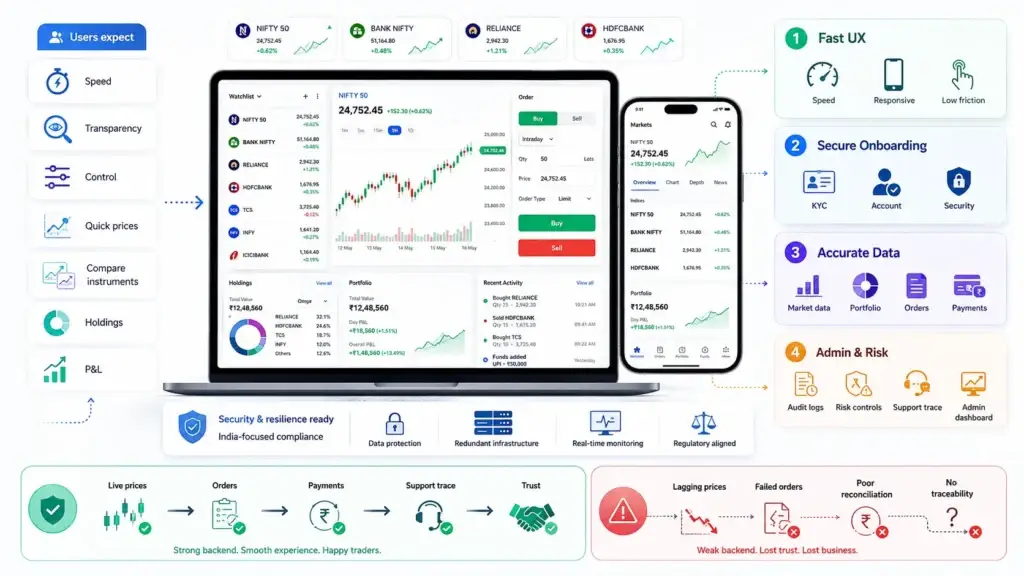
Trading users in 2026 expect speed, transparency, and control. They want to check prices quickly, compare instruments, review holdings, track profit and loss, and act without friction.
If an app feels slow, confusing, or unreliable during active market hours, users lose confidence quickly. This is especially important because trading platforms are trust-based products. A poor experience can affect user retention, transaction confidence, support load, and brand credibility.
SEBI introduced its Cybersecurity and Cyber Resilience Framework for regulated entities in August 2024 and issued implementation-related updates in 2025, which makes security and resilience planning especially important for India-focused financial platforms.
A modern trading platform should be designed around four priorities:
- Fast and reliable user experience
- Secure onboarding and account management
- Accurate market, portfolio, and order data
- Strong admin, risk, and audit controls
Because trading products sit inside a regulated and trust-sensitive fintech industry, founders should plan security, data handling, API integrations, compliance-ready workflows, and operational support before scaling the platform.
Founders who ignore the backend layer often end up with a product that looks good in a demo but struggles during real usage. If prices lag, orders fail, payments do not reconcile, or support teams cannot trace user activity, the business risk becomes serious.
Core Features Every Modern Trading Platform Should Include
A modern trading platform should be planned feature by feature, but also workflow by workflow. Every feature should support user confidence, trading efficiency, operational control, or revenue growth.
User Onboarding and KYC Workflow
User onboarding is the first trust layer of a trading platform. The platform should make registration simple while still collecting the details required for account verification, identity checks, document review, and risk controls.
A strong onboarding workflow may include:
- Mobile number and email verification
- Profile creation
- PAN or identity document workflow where applicable
- Bank account verification
- Address details
- Document upload
- KYC status tracking
- Rejection and resubmission flow
- Admin-side review dashboard
Why This Matters for Founders
KYC should not be treated as a static form. It needs a complete workflow where users can submit information, admins can review it, status can be updated, and every important action can be logged.
If onboarding is confusing, users drop off early. If the review workflow is weak, the operations team struggles to manage verification at scale.
Market Data and Watchlists
Market data is one of the most important engagement layers in a trading platform. Users need to view prices, charts, market depth, changes, and instrument details with minimal delay.
A practical market data experience can include:
- Live or delayed price feed
- Search by symbol or instrument name
- Watchlists
- Market depth
- Candlestick charts
- Timeframe selection
- Index views
- Price alerts
- Top gainers and losers
- Instrument details
Why This Matters for Founders
The technical challenge is not only showing data. The platform must deliver data efficiently, especially during peak market hours. WebSocket delivery, caching, rate limits, fallback sources, and market data provider rules can all affect performance.
If the data layer is unstable, even a well-designed trading app can feel unreliable.
Order Placement and Order Management
The trading flow must be clear, fast, and reliable. Users should understand what they are placing, what quantity they entered, which order type they selected, and whether the order was executed, pending, rejected, or cancelled.
Common order-related features include:
- Buy and sell order screens
- Market and limit order options
- Order confirmation
- Open orders
- Order history
- Trade book
- Position tracking
- Holdings view
- Margin or balance visibility
- Rejection reason display
- Order status notifications
Order Status Clarity
Every order state should be easy to understand. A user should know whether an order is:
- Submitted
- Pending
- Executed
- Partially filled
- Cancelled
- Rejected
- Failed
This area must be designed carefully because order confusion can damage user trust. A strong order management system reduces support tickets and improves confidence during active trading sessions.
Portfolio, Holdings, and P&L Dashboard
A trading app becomes useful when users can understand their portfolio without switching between spreadsheets, broker portals, or manual notes.
Portfolio features may include:
- Holdings summary
- Investment value
- Current value
- Realized and unrealized P&L
- Day gain or loss
- Asset allocation
- Segment-wise breakup
- Transaction history
- Report export options where applicable
Why This Matters for Retention
Many users open trading apps even when they are not placing trades. They check holdings, watch profit and loss, review positions, and track market movement.
A clean portfolio dashboard improves repeat usage because it gives users a reason to return daily.
Charts, Indicators, and Analysis Tools
Charts help users make decisions. The depth of charting features depends on the target audience.
A beginner-focused investing platform may need clean price charts, basic timeframes, and simple instrument data. An active trading platform may require advanced charts, multiple indicators, drawing tools, order overlays, and deeper market analysis.
Useful charting features include:
- Candlestick and line charts
- Multiple timeframes
- Moving averages
- RSI, MACD, Bollinger Bands, or other indicators
- Volume chart
- Price alerts
- Chart comparison
- Saved chart preferences
Founder Decision Point
Not every platform needs every indicator from day one. The better question is: what does your target user need to make faster and more confident decisions?
Adding too many tools too early can increase cost and complexity without improving adoption.
Alerts, Notifications, and User Engagement
Trading platforms need timely communication. Users should know when orders are placed, executed, rejected, or cancelled. They should also receive useful alerts for price movement, portfolio changes, deposits, withdrawals, and system updates.
Notification channels can include:
- Push notifications
- Email alerts
- SMS alerts
- In-app alerts
- Price alerts
- Order alerts
- KYC status alerts
- Fund transfer alerts
- Security alerts
Notification Control
A good notification system should be configurable. Too many alerts can annoy users. Too few can create confusion.
Users should be able to manage the alerts they receive, while the platform should still send important security and account-related messages.
Admin Dashboard and Operations Console
The admin dashboard is where the business actually runs. A trading platform needs a strong backend console so the operator can manage users, KYC, broker connections, risk controls, finance workflows, audit logs, and system health.
A useful admin console can include:
- User management
- KYC review
- Broker configuration
- Order monitoring
- Risk rule settings
- Payment reconciliation
- Ticket or support management
- Audit logs
- Role-based staff access
- Reports and analytics
- System health monitoring
Why Admin Control Is Critical
Trading platforms are operationally sensitive. Support teams need visibility. Compliance teams need records. Product teams need analytics. Founders need business reporting.
A stock trading platform solution can be useful when founders want a ready-made foundation that already considers trader apps, admin controls, broker workflows, security, and scalable product architecture. Miracuves describes its trading platform foundation around onboarding, portfolio and order management, real-time market data integration, trade execution workflows, risk-ready architecture, compliance-oriented controls, and a centralized admin dashboard.
Important Features and Their Business Value
| Feature | Why It Matters | Founder Impact |
|---|---|---|
| User onboarding | Helps users enter the platform with verified details | Reduces friction and improves trust |
| KYC workflow | Supports identity verification and operational review | Makes compliance workflows easier to manage |
| Market data | Keeps users informed before placing trades | Improves daily engagement |
| Watchlists | Lets users track selected instruments | Encourages repeat app usage |
| Order management | Handles order placement and order status visibility | Builds confidence in the trading experience |
| Portfolio dashboard | Shows holdings, P&L, and account value | Helps users understand performance |
| Risk controls | Helps manage exposure and trading limits | Reduces operational risk |
| Admin console | Gives the operator backend control | Reduces dependency on developers for daily tasks |
| Audit logs | Tracks sensitive actions and platform activity | Supports dispute resolution and compliance review |
| Notifications | Keeps users updated on key events | Improves clarity and engagement |
Pricing Factors for Building a Modern Trading Platform
The cost of building a modern trading platform depends on scope. A simple investing dashboard will cost less than a full trading ecosystem with broker APIs, real-time market data, advanced charts, KYC workflows, admin modules, risk controls, and mobile apps.
The same planning logic applies to monetization. A trading platform business model should define how the operator earns from brokerage slabs, subscription tiers, API access, referral arrangements, payment gateway margins, or white-label licensing before the product scope is finalized.
Platform Scope
Cost changes based on whether you need:
- Web app only
- Android app
- iOS app
- Admin dashboard
- API backend
- Broker integration layer
- Data analytics dashboard
- Trading API access
- Multi-segment support
A web-only dashboard can be simpler. A full mobile-first trading ecosystem with admin and backend modules requires more design, engineering, testing, and security review.
Market Data Integration
Market data can affect both cost and complexity. The platform may need real-time feeds, delayed feeds, charting data, market depth, historical candles, or multiple data providers.
Cost factors include:
- Type of market data
- Data provider licensing
- API limits
- Real-time delivery needs
- WebSocket infrastructure
- Caching layer
- Historical data storage
- Chart rendering requirements
If your platform targets active traders, market data performance becomes a core product requirement, not an optional feature.
Broker or Exchange Connectivity
Broker integration is one of the biggest pricing factors. Each broker API may have different authentication, order placement, account data, portfolio, and error-handling requirements.
Integration complexity depends on:
- Number of broker connections
- Order placement APIs
- Account linking flow
- Portfolio sync
- Margin and fund data
- Order status updates
- Error handling
- Failover logic
- API documentation quality
The more integrations you add, the more testing and maintenance the platform needs.
Compliance and Security Workflows
For founders planning secure trading workflows, Miracuves’ guide on fintech platform security and audit readiness explains why encryption, authorization, role-based access, audit logs, KYC workflows, secure integrations, and operational governance should be planned as part of the product foundation.
Important security and compliance-ready workflows include:
- Encrypted data transfer
- Encrypted data storage
- Role-based access control
- Audit logs
- Secure API integration
- Admin access controls
- KYC workflow support
- Activity logs
- Suspicious activity alerts
- Secure payment gateway integration
- Data retention controls
- Vulnerability testing
Final compliance depends on jurisdiction, legal review, licensed partnerships, integrations, operating model, and regulatory requirements. The product can support compliance workflows, but it should not be positioned as automatically approved or compliant in every market.
Mobile App Experience
Mobile trading apps require special attention because users expect speed, clean navigation, secure login, fast search, watchlists, charts, and reliable notifications.
Mobile cost factors include:
- Native or cross-platform development
- Biometric login
- Push notifications
- Real-time chart updates
- Offline handling
- App performance optimization
- Device testing
- App Store and Play Store release support
Cross-platform development can be cost-efficient for many founders, but high-performance trading interfaces still need careful testing on real devices.
Admin and Reporting Depth
Admin functionality can significantly affect cost because it controls the operating layer of the business.
A basic admin panel may only manage users and content. A serious trading platform admin console may need:
- KYC workflow
- Broker health monitoring
- Order oversight
- Risk controls
- Staff roles
- Finance reports
- User support tools
- Audit logs
- System alerts
- Exportable reports
- Compliance dashboards
For a deeper budget view, founders can review the main trading platform development cost factors before locking the build scope. Broker integrations, real-time market data, order management, risk workflows, compliance-ready audit trails, latency-grade infrastructure, and team expertise can all change the final development effort.
Miracuves Modern Trading Platform Solution Cost and Tech Stack
Miracuves Pricing for a Modern Trading Platform developed in JavaScript For $15,999 USD (One-Time Price) in just 6 days
Get a fully developed, deployment-ready modern trading platform built for brokerage businesses, fintech startups, investment platforms, wealthtech companies, and digital trading ventures. Built on a modern JavaScript foundation, this complete package includes everything you need to launch and scale:
Core Workflows: User onboarding, KYC verification, trading account setup, market watchlists, instrument discovery, buy/sell order flows, portfolio management, transaction history, deposits, withdrawals, and real-time trading activity.
Built-in Revenue Logic: Brokerage fees, spread-based earnings, premium subscriptions, margin-related charges, advanced analytics plans, API access fees, referral programs, and financial product cross-selling.
Management Hub: Centralized admin dashboard, trader management, KYC review, account controls, order monitoring, transaction records, deposit and withdrawal management, risk controls, compliance logs, and trading analytics.
Launch-Ready: Fully prepared for your custom branding, configuration, payment gateway setup, market data integrations, brokerage API connections, KYC workflows, trading module configuration, and immediate market entry.
Why Is Modern Trading Platform Development More Affordable?
Most modern trading platforms become expensive when businesses choose fully custom development from scratch. Building separate systems for traders, administrators, KYC verification, market data, order execution, portfolio management, deposits, withdrawals, compliance, reporting, and risk controls can significantly increase cost, timeline, and technical complexity.
We took a smarter, more practical approach:
You Aren’t Paying for Ground-Up Development: Our trading platform engine is already developed, tested, and ready to deploy. You skip the inflated cost and long development cycles normally associated with building a complete trading ecosystem from scratch.
The Power of JavaScript: We built this solution on a modern JavaScript architecture that supports interactive trading dashboards, real-time data experiences, scalable financial workflows, API-driven integrations, and smooth administrative operations.
You get a launch-ready modern trading platform with practical trading, portfolio, compliance, monetization, and management features, source code access, and faster deployment without the high custom development price tag.
Note: This cost is for the solution, re-branding, deployment, and source code only.
Architecture Layers Founders Should Plan Early
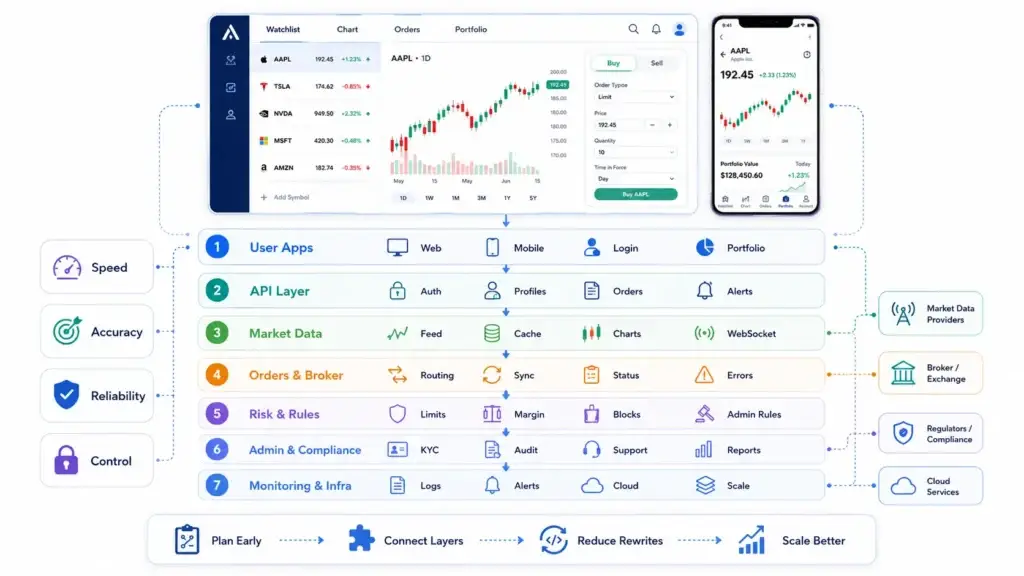
A trading platform usually needs several technical layers working together. Planning these layers early helps avoid expensive rewrites later.
User Application Layer
This includes the web app and mobile apps where users log in, view markets, place orders, track portfolios, and manage account settings.
API Layer
This layer connects the user interface to backend services. It handles authentication, profile data, portfolio requests, order actions, alerts, and reports.
Market Data Layer
This manages incoming market data, formatting, caching, WebSocket delivery, chart data, and fallback handling.
Order and Broker Layer
This layer manages broker connections, order submission, order updates, account sync, and error handling.
Risk and Rules Layer
This layer applies limits, margin checks, trading restrictions, admin rules, and user-specific controls where applicable.
Admin and Compliance Layer
This supports user review, KYC status, audit logs, support operations, reporting, staff roles, and system controls.
Monitoring and Infrastructure Layer
This tracks uptime, API latency, errors, traffic spikes, market-hour load, queue health, and system performance.
Common Mistakes Founders Should Avoid
A trading platform is a sensitive product category. Small mistakes in planning can become expensive after launch.
Building Only the User App
A trading app without a strong admin dashboard becomes difficult to operate. Support, KYC, broker health, risk controls, and audit logs need backend visibility from the beginning.
Ignoring Market-Hour Load
Trading platforms may see concentrated activity during market open, major news events, or high-volatility periods. Infrastructure should be tested for peak usage, not just normal browsing.
Underestimating Broker API Complexity
Broker APIs can behave differently across order types, account states, failure cases, and response delays. Proper testing is essential.
Treating Security as a Final Checklist
Security should be part of the architecture from day one. Access control, encryption, audit logs, admin permissions, and secure API handling should be built into the platform foundation.
Adding Too Many Advanced Features Too Early
Not every platform needs advanced strategy builders, social trading, copy trading, or algorithmic tools in the first release. Start with the features that support your target user and business model.
How Miracuves Helps Founders Build Trading Platforms
Miracuves helps founders and fintech businesses build source-code-owned, white-label, and customisable trading platform foundations with user apps, backend workflows, admin dashboards, integrations, security controls, and scalable architecture.
Once the product foundation is ready, founders also need a clear trading platform growth strategy that focuses on trust, education, onboarding, activation, retention, and user confidence rather than relying only on paid ads or discounts.
Miracuves can help with:
- Trading web app development
- Android and iOS app workflows
- Admin dashboard setup
- User and KYC management
- Market data integration
- Broker API planning
- Portfolio and P&L dashboards
- Risk control workflows
- Payment and reporting modules
- Security-focused architecture
- Source-code ownership
- Custom branding and feature expansion
Final Thoughts: Build a Trading Platform Around Trust, Speed, and Control
A modern trading platform in 2026 needs more than clean screens and basic order placement. It needs reliable market data, smooth onboarding, secure account workflows, portfolio visibility, broker connectivity, admin control, audit logs, and scalable infrastructure working together.
If the goal is to test demand before committing to a long custom build, Miracuves’ guide on using ready-made app foundations for market validation explains how founders can validate user demand, monetization workflows, admin control, payments, and scalability before investing heavily in a fully custom platform.
The strongest trading platforms are built around trust. Users need confidence that their data is secure, their portfolio is accurate, their orders are clear, and their app performs well during active market hours.
Miracuves helps founders build modern trading platforms with user apps, admin dashboards, trading workflows, security-focused architecture, and source-code ownership so businesses can launch with more control and scale with better clarity.
FAQs
What is a modern trading platform?
A modern trading platform is a web or mobile fintech system that allows users to view market data, place orders, track portfolios, manage funds, receive alerts, and access investment tools through a secure digital interface.
What features should a trading platform include in 2026?
A trading platform should include user onboarding, KYC workflows, market data, watchlists, order management, portfolio tracking, charts, alerts, payment workflows, admin controls, audit logs, risk settings, and reporting dashboards.
What affects the cost of trading platform development?
The cost depends on platform scope, mobile app requirements, market data integration, broker API connectivity, admin dashboard depth, security controls, compliance workflows, charting features, infrastructure, and customization needs.
Which tech stack is suitable for a trading platform?
A practical tech stack may include React or Next.js for web, Flutter or native mobile for apps, Node.js, Java, Go, or Python for backend services, PostgreSQL or MySQL for data, Redis for caching, WebSockets for live updates, and cloud infrastructure for scaling.
Why is the admin dashboard important in a trading platform?
The admin dashboard helps the operator manage users, KYC, broker connections, order oversight, risk rules, finance reports, support workflows, audit logs, and system health. Without a strong admin layer, daily operations become difficult after launch.
Is security important for trading platforms?
Yes. Trading platforms handle sensitive user data, account details, KYC documents, financial records, and order activity. Security planning should include encryption, access control, audit logs, secure APIs, monitoring, and compliance-ready workflows.
Can Miracuves help build a trading platform?
Yes. Miracuves helps founders build white-label and custom trading platform foundations with user apps, admin dashboards, market data workflows, broker integration planning, security controls, and source-code ownership.
Miracuves is an independent software development company. We are not affiliated with, connected to, sponsored by, or endorsed by any company or product named in this article.
Terms such as “X Clone” are used descriptively. It is how the software industry refers to building a platform with functionality comparable to a known service, and how clients search for it.
The entire design and codebase of our products is built by our own team. Our products contain no code, design, graphics, or content originating from any third-party website or applications.
All third-party names and marks referenced in this article are the property of their respective owners, referenced solely to identify the services discussed.