Key Takeaways
What You’ll Learn
- Starling Bank operates as a digital-first neobank focused on convenience, speed, and modern banking experiences.
- Mobile banking features help users manage spending, savings, and payments in real time.
- Starling generates revenue through interchange fees, subscriptions, lending, and business banking services.
- Customer experience and transparency are key reasons behind Starling Bank’s rapid growth.
- Digital banking platforms are reshaping how users interact with financial services globally.
Stats That Matter
- Starling Bank has served millions of personal and business banking customers across the UK.
- The global digital banking market continues to grow rapidly as users shift toward mobile-first financial platforms.
- Business banking and SME services remain important revenue drivers for modern neobanks.
- Cashless transactions and digital payments continue to increase across global markets.
- Neobanks are becoming a major alternative to traditional banking systems.
Real Insights
- User trust grows faster when banking experiences feel transparent and simple.
- Modern fintech platforms combine payments, savings, analytics, and security inside one ecosystem.
- Real-time notifications and spending insights help improve daily financial engagement.
- Digital convenience is now a major competitive advantage in banking.
- Long-term fintech growth depends on customer retention, trust, and seamless user experiences.
Starling Bank grew from a UK challenger bank startup founded in 2014 into a multi-billion-pound fintech leader, serving millions of retail and SME customers without relying on traditional branch networks. By 2026, the bank reported deposits exceeding £10 billion and consistent profitability in its core retail operations This success highlights the strength and resilience of the business model of Starling Bank built for scale, trust, and efficiency.
In a world where customers demand faster, smarter, and more personalized financial experiences, Starling Bank didn’t just launch a mobile app — it reimagined how modern banking works. Its cloud-native architecture, open APIs, and modular product design allow it to deliver seamless services while continuously expanding into new revenue streams beyond legacy banking fees.
For entrepreneurs and fintech founders, studying how Starling Bank works offers valuable lessons in platform strategy, monetization design, and sustainable growth. Its blend of technology, regulation, and ecosystem thinking makes the Starling Bank revenue model a benchmark for building scalable digital platforms in 2026 and beyond.
How the Starling Bank Business Model Works
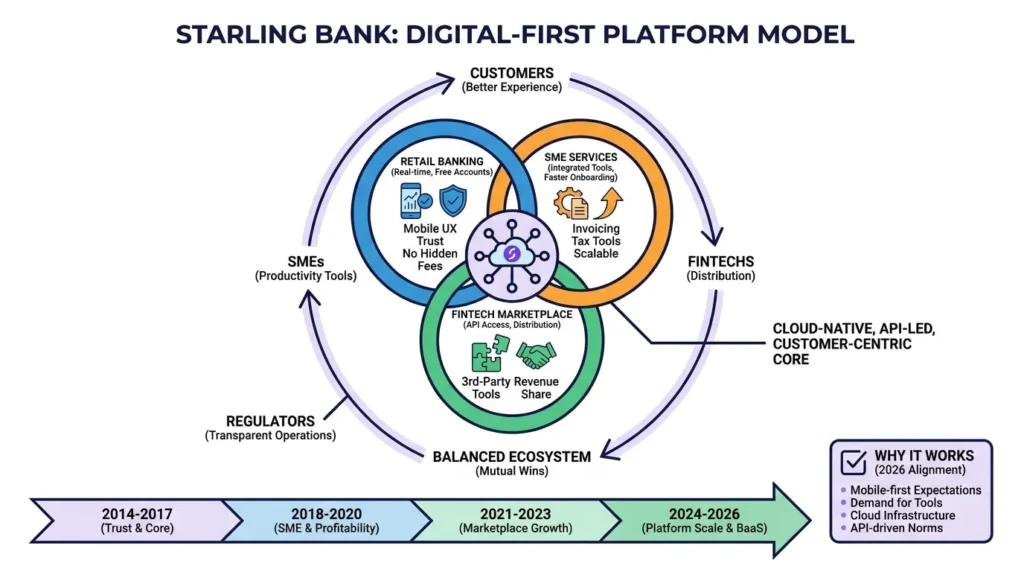
Starling Bank operates on a digital-first, platform-based banking model designed to scale efficiently while staying compliant in one of the world’s most regulated industries. Instead of copying traditional banks and “putting them on mobile,” Starling rebuilt banking from the ground up — cloud-native, API-led, and customer-centric.
At its core, Starling blends retail banking, SME services, and a fintech marketplace into one integrated ecosystem.
Core Business Model Overview
Starling’s model works because it treats banking as a technology platform, not just a financial service.
Here’s how the structure comes together
Type of Business Model
Starling uses a Hybrid Digital Banking Platform Model, combining:
- Digital-first retail and business banking
- Banking-as-a-Service (BaaS) capabilities
- Marketplace-led ecosystem expansion
- Fee-light, volume-driven monetization
Unlike neobanks that rely heavily on interchange fees alone, Starling diversified early.
Value Proposition by User Segment
For Retail Customers
- Free current accounts with real-time insights
- Seamless mobile UX (payments, budgeting, savings)
- Trust and security of a fully licensed bank
- No hidden fees or branch dependency
For SME & Business Customers
- Integrated invoicing, tax tools, and expense tracking
- Faster onboarding than legacy banks
- Scalable services as businesses grow
- Access to third-party tools via Starling Marketplace
For Partners & Developers
- API access to banking infrastructure
- Distribution to a trusted customer base
- Revenue-sharing opportunities through integrations
Key Stakeholders in the Ecosystem
Starling’s ecosystem stays balanced because each stakeholder wins:
- Customers → Better banking experience at lower cost
- SMEs → Productivity tools + financial control
- Third-party fintechs → Distribution and credibility
- Starling → Platform fees, engagement, data insights
- Regulators → Transparent, compliant operations
Business Model Evolution
Starling’s model has evolved in clear phases:
- 2014–2017: Core retail banking & trust-building
- 2018–2020: SME banking and profitability focus
- 2021–2023: Marketplace and embedded finance growth
- 2024–2026: Platform scale, automation, and BaaS-style economics
Each phase layered new revenue without bloating costs — a critical fintech lesson.
Why the Model Works in 2026
Starling thrives today because it aligns perfectly with modern banking behavior:
- Customers expect mobile-first, instant services
- SMEs demand financial tools, not just accounts
- Regulators favor transparent, tech-enabled banks
- Cloud infrastructure enables low marginal cost per user
- Open Banking norms normalize API-driven ecosystems
This is exactly the kind of scalable platform architecture Miracuves specializes in — building modular systems that can grow into ecosystems rather than single-feature apps.
Read more : How Digital Neobanks Make Money in 2026
Target Market & Customer Segmentation Strategy
Starling Bank’s growth isn’t accidental — it’s the result of laser-focused segmentation paired with a product experience that scales naturally across life stages and business maturity. Instead of chasing “everyone,” Starling identified high-friction banking segments and systematically removed pain points.
Primary & Secondary Customer Segments
Primary Segment: Digital-First Consumers
- Age: 18–45
- Urban, mobile-native users
- Comfortable managing finances via apps
- Value transparency, speed, and UX over branch access
Secondary Segment: SMEs & Sole Traders
- Freelancers, startups, small businesses
- Need fast onboarding and simple compliance
- Seek integrated tools (tax, invoicing, expenses)
- Often underserved by legacy banks
Emerging Segment: Platform & Embedded Finance Users
- Customers using third-party apps via Starling Marketplace
- Businesses leveraging Starling’s infrastructure indirectly
- Users drawn in through partnerships rather than ads
Customer Journey: From Discovery to Retention
1. Discovery
- App store visibility and strong reviews
- Word-of-mouth referrals (especially among freelancers)
- Media coverage as a “trusted challenger bank”
2. Conversion
- Frictionless digital onboarding (minutes, not days)
- Clear value messaging: “No fees. No branches. Full control.”
- Early “aha moment” via real-time notifications and budgeting tools
3. Retention
- Habit formation through daily financial touchpoints
- Feature layering (savings, business tools, marketplace apps)
- High switching costs once accounts become central to financial life
Acquisition Channels & LTV Optimization
Starling keeps acquisition costs low by leaning into:
- Organic referrals and social proof
- App store optimization
- Strategic partnerships (accountants, fintech tools)
- Content-led trust building rather than aggressive ads
Lifetime value is maximized through:
- Multi-product adoption (current account → savings → SME tools)
- Marketplace usage that increases engagement frequency
- Low churn due to operational reliability and trust
Market Positioning & Competitive Edge
Starling positions itself as:
- “A real bank, built for smartphones”
- More credible than prepaid neobanks
- More agile than legacy institutions
Differentiation Strategies
- Full UK banking license = higher trust
- Profitability focus instead of growth-at-all-costs
- Superior UX + operational discipline
- Strong brand voice around fairness and simplicity
By 2026, this positioning allows Starling to defend its market share even as Big Tech and legacy banks improve their digital offerings.
Read More: Best Starling Bank Clone Scripts 2026
Revenue Streams and Monetization Design
Starling Bank’s monetization strategy is deliberately quiet, diversified, and defensible. Unlike many neobanks that rely almost entirely on interchange fees, Starling engineered a multi-engine revenue architecture that scales with usage, not user frustration.
The result? Strong unit economics without nickel-and-diming customers.
Primary Revenue Stream: Net Interest Income
How it works
Starling earns interest on:
- Customer deposits
- SME balances
- Government-backed lending programs
Why it matters
- This is Starling’s largest and most stable revenue source
- Rising interest rates (2023–2026) significantly strengthened margins
- Digital operations keep cost-to-income ratios low
Key insight
Starling proved that “free banking” can still be profitable if deposits scale efficiently.
Secondary Revenue Streams
1. Interchange Fees
- Earned from card transactions
- Small per-transaction margins, but high volume
- Acts as a baseline revenue layer, not the core engine
2. SME Banking Fees
- Monthly fees for business accounts
- Paid add-ons: bulk payments, extra cards, advanced tools
- Higher ARPU than retail users
3. Marketplace & Partner Revenue
- Revenue share from third-party apps
- Tools like accounting, insurance, lending, and payroll
- Increases engagement and monetization simultaneously
4. Lending & Financial Products
- Business loans and overdrafts
- Carefully risk-managed, data-driven underwriting
- Focus on sustainable growth over aggressive expansion
How the Monetization Strategy Fits Together
Starling’s revenue model works because:
- No single stream carries all the risk
- Retail users drive deposits and engagement
- SMEs drive predictable recurring revenue
- Marketplace partners expand value without expanding headcount
Pricing Psychology
- Free core product builds trust
- Paid features appear after value is established
- Transparent fees reduce churn and backlash
This layered monetization approach is a classic Miracuves-style platform play — build usage first, then monetize through services that feel helpful, not extractive.
Operational Model & Key Activities
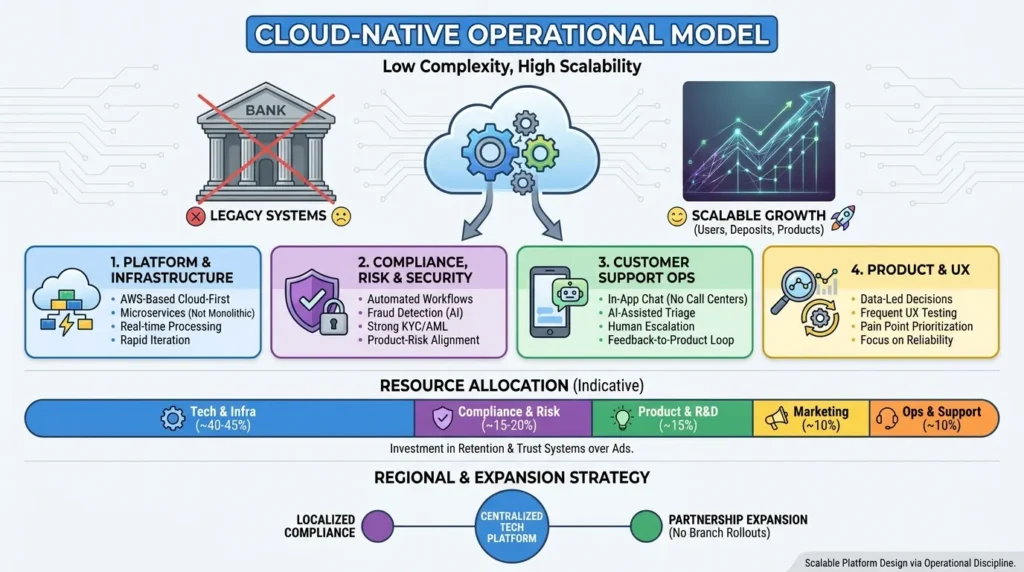
Starling Bank’s operational model is where its biggest competitive advantage lives. While traditional banks are weighed down by legacy systems and physical branches, Starling operates as a cloud-native, software-driven organization with radically lower operational complexity.
This allows the company to scale users, deposits, and products without scaling costs linearly.
Core Operations
1. Platform & Infrastructure Management
- Cloud-first architecture (AWS-based)
- Modular microservices instead of monolithic systems
- High availability, real-time processing
- Continuous deployment and rapid feature iteration
2. Compliance, Risk & Security
- Built-in regulatory compliance workflows
- Automated fraud detection and transaction monitoring
- Strong KYC/AML systems
- Close alignment between product, legal, and risk teams
3. Customer Support Operations
- In-app chat-based support (no call-center dependence)
- AI-assisted triage and issue resolution
- Human escalation for complex cases
- Feedback loops feeding directly into product improvements
4. Product Development & UX
- Data-led product decisions
- Frequent UX testing and iteration
- Feature prioritization driven by customer pain points
- Strong focus on reliability over flashy releases
Resource Allocation Strategy (Indicative)
Starling’s spending reflects its tech-first DNA:
- Technology & Infrastructure: ~40–45%
- Compliance & Risk: ~15–20%
- Product & R&D: ~15%
- Marketing & Growth: ~10%
- Operations & Support: ~10%
Instead of heavy ad spend, resources flow into systems that improve retention and trust.
Regional & Expansion Operations
- Centralized tech platform
- Localized compliance and regulatory handling
- Gradual international exploration via partnerships rather than branch rollouts
This operational discipline is exactly how Miracuves designs scalable platforms — in
Strategic Partnerships & Ecosystem Development
Starling Bank understands a powerful truth of modern platforms: you don’t need to build everything yourself — you need to orchestrate value. Instead of bloating its product roadmap, Starling built an ecosystem where partners extend functionality while Starling remains the trusted core.
This partnership-first mindset is central to its long-term defensibility.
Starling’s Collaboration Philosophy
Starling partners only where:
- A third party can deliver faster or better
- The integration increases customer value
- The experience remains seamless and secure
- Monetization aligns with long-term trust
This ensures partnerships enhance the platform rather than fragment it.
Key Partnership Types
1. Technology & API Partners
- Accounting software providers
- Expense management tools
- Lending and cash-flow apps
- Open Banking integrations
These plug directly into Starling Marketplace, turning the app into a financial operating system.
2. Payment & Financial Infrastructure Alliances
- Card networks (Visa)
- Faster Payments & international transfer partners
- Embedded lending and insurance providers
These partnerships enable global-grade functionality without owning the entire stack.
3. Marketing & Distribution Partners
- Accounting firms and SME advisors
- Startup accelerators and coworking spaces
- Freelancer and creator platforms
These channels bring in high-intent users at lower CAC.
4. Regulatory & Expansion Alliances
- Government-backed loan schemes
- Industry bodies and regulators
- Strategic advisors for international exploration
Ecosystem Strategy: Why It Works
Starling’s ecosystem creates compound advantages:
- Network effects: More partners → more value → more users
- Stickiness: Integrated tools raise switching costs
- Revenue leverage: Earns without building or staffing every feature
- Competitive moat: Harder to replicate than standalone apps
This is a textbook example of platform-led growth, the same approach Miracuves uses when helping founders design app ecosystems that scale revenue through partnerships rather than payroll
Growth Strategy & Scaling Mechanisms
Starling Bank’s growth story is not a hype-driven blitz — it’s a disciplined, compounding growth model built on trust, product depth, and operational readiness. Instead of chasing vanity metrics, Starling focused on sustainable scale.
Core Growth Engines
1. Organic Virality & Referral Loops
- Delight-driven word of mouth
- Strong app store ratings and reviews
- Customers acting as brand advocates
- SMEs recommending Starling within business communities
Trust in banking spreads socially — Starling leaned into that psychology.
2. Product-Led Growth
- Free, high-quality core product
- Feature discovery inside the app
- Natural upsell into savings, business tools, and marketplace apps
- No aggressive sales funnels
This keeps CAC low and retention high.
3. SME-Led Expansion
- SMEs bring higher balances and recurring revenue
- Business accounts scale faster through professional networks
- Accountants and advisors become indirect growth partners
Starling smartly used SMEs as both revenue drivers and growth multipliers.
4. Selective Geographic & Market Expansion
- Focused first on dominating the UK market
- Avoided premature global expansion
- Explored international opportunities through partnerships and infrastructure licensing
This avoided the regulatory and capital drain that hurt many fintech peers.
Scaling Challenges — and How Starling Solved Them
Challenge 1: Regulatory Complexity
- Solution: Built compliance into product architecture from day one
- Result: Faster approvals, fewer retrofits
Challenge 2: Infrastructure Load at Scale
- Solution: Cloud-native systems with elastic scaling
- Result: Stable performance even during usage spikes
Challenge 3: Monetization Pressure
- Solution: Diversified revenue early (SME + lending + marketplace)
- Result: Profitability without customer backlash
Why This Growth Model Is Replicable
Starling’s playbook proves that:
- Growth doesn’t need to be expensive
- Trust compounds faster than ads
- Infrastructure decisions determine scaling ceilings
This is precisely how Miracuves approaches growth for founders — designing scaling mechanisms before launch, not after traction.
Miracuves Starling Bank-Like Platform Solution Cost and Tech Stack
Miracuves Pricing for a Starling Bank-Like Digital Banking Platform developed using JavaScript architecture is available on request. Final pricing depends on banking modules, account workflows, wallet features, payment systems, compliance requirements, security layers, scalability needs, and deployment scope. Estimated delivery timeline: 30 to 90 days.
Get a fully developed, custom digital banking platform modeled around Starling Bank-style mobile banking experiences. Built on a modern JavaScript foundation, this solution can be customized for fintech startups, neobank founders, digital wallet businesses, SME banking platforms, personal finance apps, and modern financial service providers.
Core Workflows: User onboarding, account creation, KYC verification, digital wallet access, deposits, withdrawals, card management, payment transfers, spending insights, transaction history, notifications, and user profile management.
- Built-in Revenue Logic: Account subscription plans, interchange revenue, business banking fees, payment processing fees, foreign exchange margins, premium account features, lending add-ons, savings products, and partner-based financial services.
- Management Hub: Centralized admin dashboard, user management, KYC review, account monitoring, transaction records, wallet controls, card controls, compliance logs, payment tracking, support handling, and banking analytics.
- Digital Banking-Ready Architecture: Prepared for secure account workflows, real-time payment processing, banking API integrations, card issuing systems, transaction monitoring, fraud checks, compliance operations, and long-term fintech scalability.
Why Does a Starling Bank-Like Platform Require JavaScript Architecture?
A Starling Bank-like platform needs more than a simple wallet or payment app. It handles user onboarding, identity verification, bank accounts, card controls, payment transfers, transaction histories, spending analytics, business banking tools, security checks, and real-time financial activity. A modern JavaScript architecture helps manage these digital banking workflows smoothly across users, admins, banking partners, and connected financial services.
We recommend JavaScript architecture for this type of platform because:
- Built for Real-Time Banking Workflows: JavaScript-based backend systems can manage account activity, payment requests, wallet updates, card actions, transaction alerts, and high-volume user interactions.
- Advanced Frontend Experience: React.js or other JavaScript frameworks can power smooth mobile banking dashboards, spending insights, account screens, card controls, transfer flows, business banking panels, and admin views.
- Scalable Fintech Logic: JavaScript architecture supports user verification, account rules, transaction tracking, wallet records, subscription plans, compliance logs, risk checks, analytics, and growing banking activity.
- Flexible Integration Layer: The platform can connect with banking APIs, payment gateways, card issuing providers, KYC tools, fraud detection systems, accounting platforms, CRM tools, notification systems, and enterprise authentication systems.
- You get a scalable Starling Bank-like digital banking platform designed for secure account management, smooth payments, user trust, fintech monetization, and long-term business growth.
Note: Final pricing depends on selected banking modules, payment workflows, KYC requirements, card features, wallet logic, compliance needs, security layers, deployment infrastructure, and custom feature development.
Competitive Strategy & Market Defense
In a crowded fintech landscape filled with neobanks, legacy giants, and Big Tech experiments, Starling Bank stays ahead by building defensive depth, not just surface-level differentiation. Its strategy focuses on making the business hard to displace, not merely popular.
Core Competitive Advantages
1. Network Effects & Switching Barriers
- Primary bank account = deep behavioral lock-in
- Salary deposits, bills, savings, and SME operations tied to Starling
- Marketplace integrations increase dependency over time
Once Starling becomes the financial hub, switching costs rise dramatically.
2. Brand Trust & Regulatory Credibility
- Full UK banking license (not an EMI workaround)
- Strong public stance on transparency and fairness
- Consistent uptime and reliability
- Profitability reinforces long-term confidence
In banking, trust beats features — and Starling understands this deeply.
3. Technology & Product Innovation
- Cloud-native core banking stack
- Rapid feature iteration without system risk
- API-first design enabling ecosystem expansion
- Real-time data visibility for users
This tech edge allows Starling to respond faster than legacy banks and operate cheaper at scale.
4. Data-Driven Personalization
- Smart spending insights
- Context-aware nudges and alerts
- SME analytics for cash-flow forecasting
- Responsible use of data aligned with compliance standards
Personalization improves retention without crossing privacy boundaries.
Market Defense Tactics
Handling New Entrants
- Continuous UX refinement keeps the bar high
- Early adoption of regulatory changes
- Feature parity achieved quickly through modular tech
Managing Pricing Pressure
- Free core offering neutralizes price wars
- Monetization focused on value-added services
- No race to the bottom on fees
Strategic Feature Timing
- Rolls out features when operationally ready
- Avoids rushed launches that damage trust
- Focuses on reliability over buzz
Acquisitions & Strategic Moves
- Preference for partnerships over heavy acquisitions
- Internal builds where long-term control matters
- Defensive moves guided by ecosystem value, not headlines
Lessons for Entrepreneurs & Implementation
Starling Bank’s journey offers a masterclass in building a regulated, scalable, and profitable digital platform without burning trust or capital. For entrepreneurs, the value isn’t in copying features — it’s in understanding why the model works and how to adapt it intelligently.
Key Factors Behind Starling’s Success
- Built infrastructure before growth
Cloud-native systems and automation came before mass user acquisition. - Trust-first product design
Transparent pricing, reliability, and regulatory compliance were non-negotiable. - Diversified monetization early
Starling avoided dependency on interchange fees alone. - Platform thinking, not feature thinking
The marketplace turned Starling into a financial operating system. - Disciplined expansion
Focused on one core market before scaling outward.
Replicable Principles for Startups
You don’t need to be a bank to apply these lessons:
- Start with a core problem for a specific segment
- Build a modular platform, not a rigid product
- Delay monetization until trust and usage are established
- Design for ecosystem expansion, even if you launch small
- Invest early in compliance, reliability, and automation
These principles are universal across fintech, marketplaces, SaaS, and on-demand platforms.
Common Mistakes to Avoid
- Scaling users before stabilizing infrastructure
- Over-monetizing early and eroding trust
- Treating compliance as an afterthought
- Expanding geographically without product-market fit
- Building every feature in-house instead of partnering
Adapting the Model for Local or Niche Markets
Entrepreneurs can adapt Starling’s approach by:
- Targeting underserved niches (local SMEs, creators, gig workers)
- Using partnerships instead of building everything
- Localizing compliance and financial behaviors
- Starting with one revenue stream, then layering others
Implementation & Investment Priorities
Phase 1 :
- Core platform build
- Compliance and security foundations
- MVP with one clear value proposition
Phase 2 :
- Product refinement and retention focus
- Data and analytics integration
- Early partnerships
Phase 3 :
- Monetization expansion
- Ecosystem development
- Scalable growth mechanisms
Ready to implement Starling Bank’s proven business model for your market?
Miracuves builds scalable platforms with tested business models and growth mechanisms. We’ve helped entrepreneurs launch profitable apps across fintech, marketplaces, and on-demand ecosystems.
Conclusion
Starling Bank’s business model proves a powerful truth about modern platform companies: innovation alone isn’t enough — disciplined execution is what creates durable value. By combining cloud-native technology, regulatory credibility, customer trust, and ecosystem thinking, Starling transformed banking from a static service into a living digital platform.
In 2026 and beyond, the winners in fintech — and across the platform economy — won’t be those who move fastest, but those who build foundations that can scale without breaking. Starling shows that when trust, technology, and timing align, even the most regulated industries can be reimagined.
The future of platform economies belongs to builders who think like architects, not just disruptors. At Miracuves, this mindset guides how scalable fintech and platform-based products are planned, built, and prepared for long-term growth.
Get your free business model consultation today.
FAQs
What type of business model does Starling Bank use?
Starling Bank operates a hybrid digital banking platform model. It combines retail and SME banking with marketplace partnerships and embedded finance services on a cloud-native infrastructure.
How does Starling Bank’s model create value?
It delivers free, intuitive banking to customers, productivity tools to SMEs, and distribution opportunities to partners. Value is created through trust, usability, and ecosystem integration.
What are Starling Bank’s key success factors?
Key factors include a full UK banking license, strong customer trust, cloud-native technology, diversified revenue streams, and a scalable platform-first strategy.
How scalable is Starling Bank’s business model?
The model is highly scalable due to modular architecture and automation. New users, products, and partners can be added with low marginal cost.
What are the biggest challenges in this model?
Major challenges include regulatory compliance, fraud prevention, data security, and balancing innovation with reliability at scale.
How can entrepreneurs adapt this model to their region?
Founders can adapt it by focusing on local compliance, targeting underserved niches, using partnerships instead of building everything, and scaling infrastructure early.
What are alternatives to this business model?
Alternatives include EMI-based fintech models, subscription-only finance apps, vertical-specific financial platforms, and white-label BaaS solutions.
How has Starling Bank’s model evolved over time?
It evolved from a retail challenger bank into a profitable, multi-segment platform with strong SME focus and ecosystem-driven monetization.
Related Article :