


Key Takeaways
What You’ll Learn
- A Careem or Gojek-like super app helps businesses launch faster with a ready-made multi-service platform.
- Core features include booking, live tracking, payments, and service management for smooth operations.
- Multi-service support improves platform value by combining ride, delivery, and wallet convenience.
- Admin controls help manage users, drivers, orders, and operations from one place.
- White-label customization makes market entry easier under your own brand.
Stats That Matter
- The solution is positioned as a ready-to-deploy business platform.
- It fits the Super App model built around multiple daily-use services.
- The platform focuses on fast execution and launch readiness.
- It is designed for brand-ready deployment with operational simplicity.
- Readymade architecture helps reduce launch complexity for new businesses.
Real Insights
- Fast launch matters in super app markets where speed creates early traction.
- A unified user experience improves adoption across services.
- Operational visibility is essential for managing users, drivers, and transactions.
- Payments and tracking build trust across the user journey.
- Long-term growth depends on service quality, branding, and scalable operations.
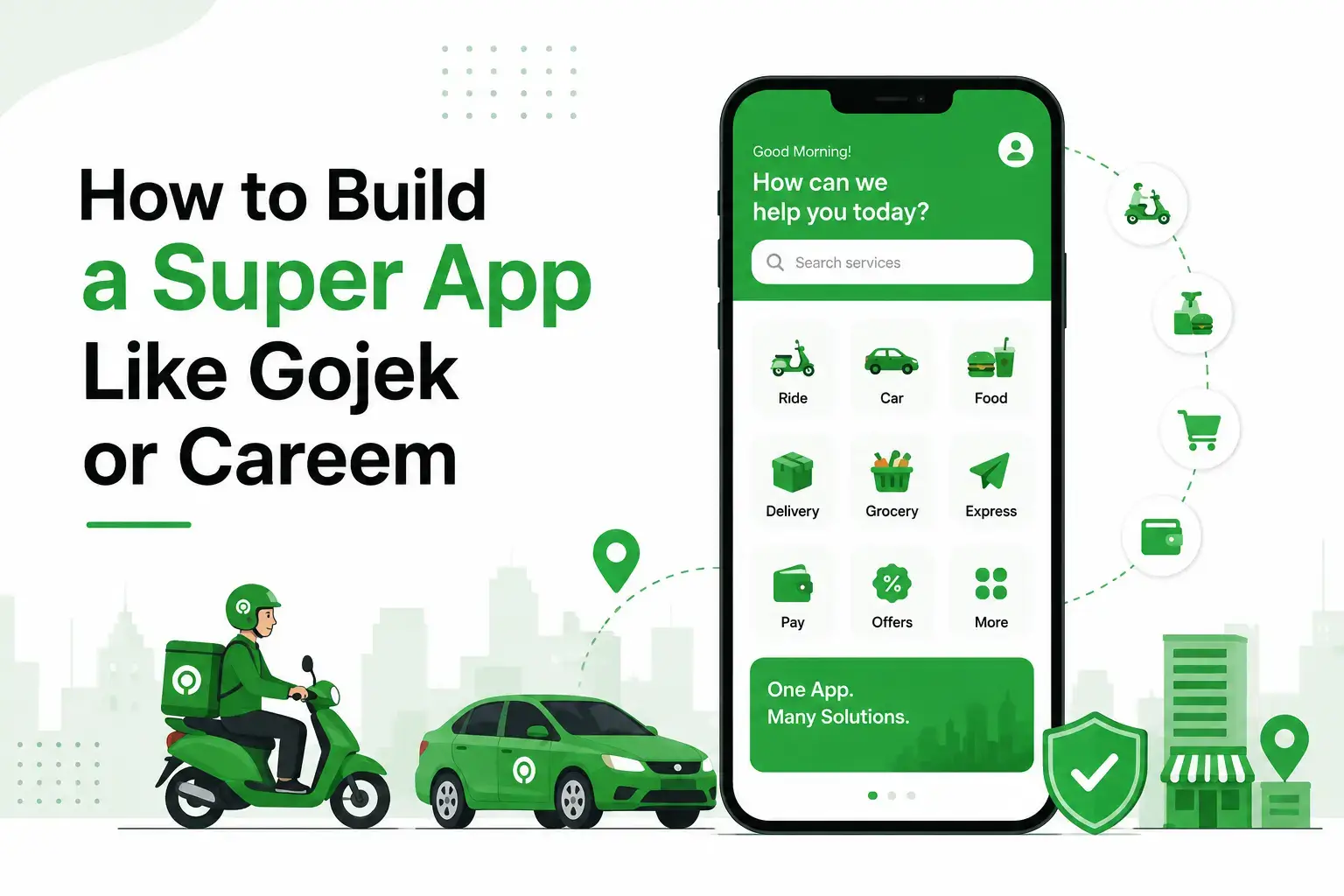
Super apps have changed how people use digital services by bringing multiple everyday needs into one platform. Instead of downloading separate apps for ride booking, food delivery, payments, grocery orders, courier services, and other on-demand solutions, users can access everything through one app. That convenience is one of the biggest reasons why businesses want to build a super app like Careem or Gojek.
If you are planning to create a super app, the goal should not be to copy every feature from day one. The smarter approach is to understand the core model, choose the right services, build a scalable platform, and launch in phases. That makes development more practical, reduces risk, and helps the product grow based on real user demand. This structure follows the Miracuves writing brief you shared earlier.
What Is a Super App?
A super app is a digital platform that combines multiple services inside one mobile ecosystem. Instead of focusing on only one function, it allows users to access different services from a single account and interface.
Apps like Gojek and Careem became popular because they made daily tasks simpler. A user could book a ride, order food, send a package, make a payment, or schedule a service without switching between multiple apps.
Why Super Apps Are Growing in Demand
Businesses are interested in super app development because this model improves user retention and opens more revenue opportunities. When users depend on one app for multiple services, engagement tends to increase over time.
Some of the biggest reasons this model is attractive include:
- Better customer convenience
- Higher user retention
- Multiple revenue streams
- Strong cross-selling opportunities
- A more connected digital ecosystem
How a Super App Differs from a Regular App
| App Type | Main Purpose |
|---|---|
| Single-purpose app | Focuses on one main service only |
| Super app | Combines multiple services in one platform |
A single-purpose app may do one thing very well, but a super app creates more value by connecting services around the user’s daily needs.
Why Building a Super App Like Gojek or Careem Is a Smart Business Move
The super app model has become one of the most attractive digital business strategies because it connects multiple services inside one ecosystem. Instead of depending on a single revenue source or one user activity, a super app creates more opportunities by serving users across different daily needs. That is why many startups and enterprises are exploring how to build a super app like Gojek or Careem.
A user who opens one app for ride booking can also use the same platform for food delivery, grocery orders, courier services, bill payments, or home services. This increases engagement and keeps users inside the platform longer. For businesses, that means more transactions, better retention, and stronger brand value over time.
One Platform, Multiple Revenue Streams
A super app is not limited to one service category. That makes it more flexible than a traditional single-purpose app. Instead of earning from only one service, the platform can generate income from several channels.
Common revenue streams in a super app include:
- Ride booking commissions
- Food delivery fees
- Merchant commissions
- Subscription plans
- In-app promotions
- Service booking fees
- Payment transaction charges
- Partner advertising
This gives the business more stability and more space to grow.
Better User Retention
One of the biggest strengths of a super app is retention. If users rely on the same app for transportation, shopping, payments, and deliveries, they are less likely to switch to another platform. This makes customer retention much stronger compared to apps that solve only one problem.
The more useful services you offer in one place, the more reasons users have to keep returning to the app.
Easier Cross-Selling Opportunities
Super apps create natural opportunities to promote one service through another. A user booking a ride may also be shown food delivery offers. A customer using digital payments may receive discounts on grocery delivery or courier bookings.
This connected structure helps businesses increase order volume without always depending on new customer acquisition.
Stronger Market Positioning
A super app can become a part of daily life if it is built around real convenience. That gives the brand a stronger position in the market. Instead of being known for just one service, the business becomes a broader digital ecosystem.
This is especially useful in urban markets where users prefer convenience, speed, and fewer app downloads.
| Advantage | Business Impact |
|---|---|
| Multiple services in one app | Higher engagement and broader usage |
| More revenue channels | Better monetization potential |
| Stronger retention | More repeat activity from users |
| Cross-selling opportunities | Increased transaction value |
| Better market presence | Stronger long-term brand positioning |
Why Start With a Focused Super App Strategy
Even though super apps offer major growth opportunities, they should not be overloaded from the start. The best strategy is to begin with a few high-demand services and expand gradually. This helps businesses control development cost, test real demand, and improve operations before scaling further.
That is how many successful super apps build momentum. They begin with core services, earn user trust, and then grow into a larger ecosystem over time.
Read More :- Best Gojek Clone Script in 2026: Features & Pricing Compared
Key Steps to Build a Super App Like Gojek or Careem
Building a super app like Gojek or Careem requires more than combining multiple services into one interface. The platform needs a clear business model, strong technical planning, smooth user experience, and scalable operations. Since a super app serves different needs within one ecosystem, each step must be planned carefully to avoid creating a product that feels confusing or difficult to manage.
Define the Core Services First
The first step is deciding which services your super app will offer in the beginning. A common mistake is trying to launch too many services at once. That often increases development cost, slows operations, and makes the user experience harder to manage.
Most super apps begin with a few high-demand services such as:
- Ride booking
- Food delivery
- Grocery delivery
- Courier service
- Digital payments
- Home services
The best starting point depends on your target market, user behavior, and local demand. It is better to start with the most practical services and expand once the platform gains traction.
Choose Your Business Model
Before development begins, you need to define how the super app will generate revenue. A super app usually operates through several business models at the same time because each service category may have a different earning structure.
Common monetization models include:
- Commission on bookings or orders
- Delivery fees
- Merchant subscription plans
- Featured listings and promotions
- Payment transaction fees
- Service partner commissions
- In-app advertising
A strong revenue plan helps shape the app’s features, workflows, and long-term scalability.
Understand the User Ecosystem
A super app is usually built around multiple user roles. These roles need different interfaces and different operational logic.
The main user groups often include:
- Customers
- Service providers or drivers
- Merchants or vendors
- Admins
For example, a food delivery module may require merchant dashboards, delivery agent management, and customer order tracking. A ride-hailing service may require driver onboarding, real-time location tracking, and fare calculation. Each service layer adds more complexity, so the ecosystem must be designed clearly from the start.
Build an MVP Instead of a Full-Scale Platform
A super app should not begin as a giant product with every feature possible. The smartest approach is to build an MVP with the most important services and features needed for launch.
A basic super app MVP may include:
- User registration and login
- Service selection dashboard
- Booking or ordering flow
- Payment integration
- Real-time tracking
- Notifications
- Basic admin panel
- Service provider or merchant management
Launching with an MVP gives you the chance to test the market, understand user behavior, and improve the platform before investing in advanced expansion.
Design a Smooth Multi-Service Experience
One of the biggest challenges in super app development is keeping the platform easy to use. Even though the app offers multiple services, users should still feel that navigation is simple and intuitive.
The app experience should focus on:
- Easy service switching
- Clear homepage layout
- Fast booking or ordering flow
- Unified wallet or payment system
- Consistent design across services
- Personalized suggestions where relevant
The goal is to make multiple services feel connected, not crowded.
Plan Operations Before Scaling
A super app does not work on software alone. It also depends on real-world operations such as partner onboarding, order management, tracking, payments, support, and dispute handling.
Important questions to answer early include:
- How will drivers or service providers be onboarded?
- How will merchants manage orders?
- How will customer complaints be handled?
- How will pricing and commissions be controlled?
- How will support work across multiple services?
Operational planning is essential because the app experience depends heavily on what happens behind the scenes.
| Step | Why It Matters |
|---|---|
| Define core services | Keeps the platform focused and practical |
| Choose business model | Creates a clear monetization strategy |
| Understand user roles | Helps build the right workflows |
| Launch an MVP | Reduces risk and improves speed to market |
| Design for simplicity | Improves usability across services |
| Plan operations early | Supports smoother long-term growth |
Build for Future Expansion
A super app should be created with future growth in mind. Even if you launch with only two or three services, the platform should be flexible enough to support more services later without major rebuilding.
That means planning for:
- Modular service architecture
- Scalable backend systems
- Flexible payment integration
- Expandable admin controls
- Multi-location support if needed
A super app grows successfully when the early foundation is strong enough to support new services over time, rather than forcing the business to rebuild the platform every time it wants to expand.
Essential Features of a Super App Like Gojek or Careem
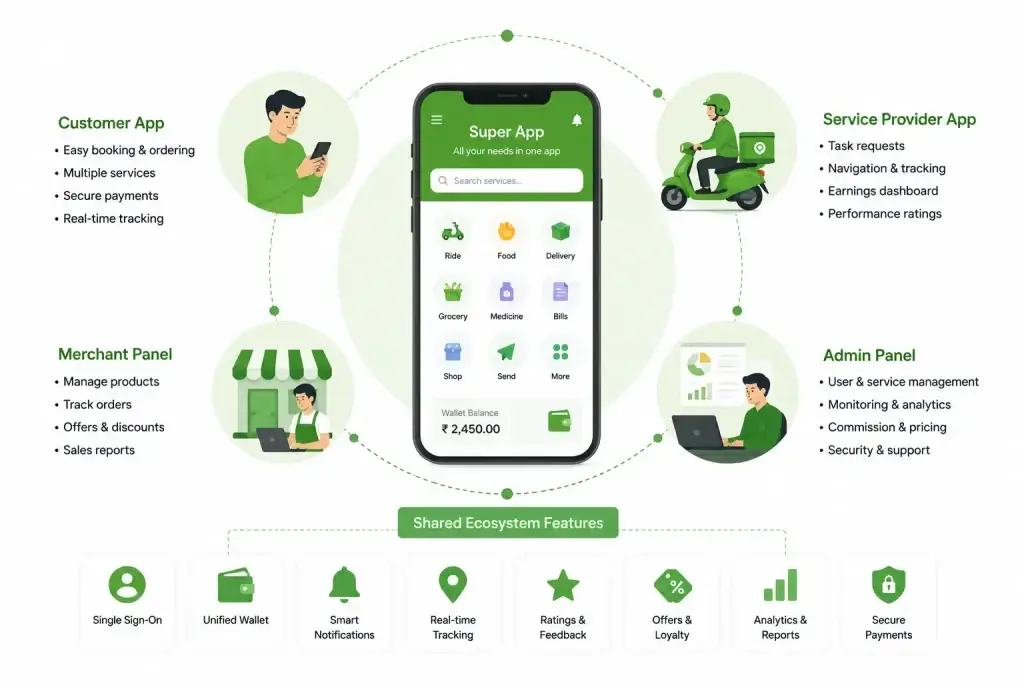
To build a super app like Gojek or Careem, the feature set must support multiple services without making the platform feel confusing. A super app is not just a collection of mini apps placed together. It needs a connected experience where users can move smoothly between services, payments, and support functions from one account and one interface.
The best way to plan features is to divide them according to user roles and platform needs. This keeps development practical and helps ensure that both the customer side and the operational side work together properly.
Customer App Features
The customer-facing side of a super app should make it easy for users to discover services, place bookings or orders, make payments, and track progress in real time.
Important customer features include:
- User registration and login
- Profile management
- Homepage with multiple service categories
- Real-time booking or ordering flow
- Live GPS tracking
- In-app wallet or payment integration
- Saved addresses and locations
- Push notifications
- Ratings and reviews
- Order history
- Promo codes and offers
- Customer support access
These features create the core user journey and make the app useful for daily activity.
Service Provider or Driver App Features
If your super app includes transportation, delivery, or on-demand services, you also need a separate experience for drivers, delivery agents, or service providers. Their app should help them accept tasks, navigate locations, and manage earnings.
Important service provider features include:
- Registration and verification
- Availability toggle
- Booking or task requests
- Real-time navigation
- Earnings dashboard
- Trip or delivery history
- In-app chat or call support
- Performance ratings
- Withdrawal or payout tracking
This part of the platform is very important because poor provider experience can directly affect service quality.
Merchant Panel Features
If the super app includes food delivery, grocery ordering, pharmacy, or local store services, merchants need a separate dashboard to manage their business inside the app.
Important merchant features include:
- Merchant registration and approval
- Product or menu management
- Order management
- Inventory updates
- Offer and discount creation
- Sales reports
- Customer feedback visibility
- Settlement and payout tracking
A good merchant panel makes it easier to onboard more vendors and keep operations active.
Admin Panel Features
The admin panel is where the business controls the entire super app ecosystem. Since multiple services are connected in one platform, the admin side needs strong visibility and control over all operations.
Essential admin features include:
- User management
- Driver or provider verification
- Merchant management
- Order and booking monitoring
- Commission control
- Pricing management
- Promo and campaign controls
- Dispute and refund handling
- Analytics and reports
- Content and banner management
- Notifications management
- Fraud and security monitoring
The admin system should help manage the platform efficiently without becoming overly complex.
Cross-Platform Features That Matter Most
Some features are important across all modules of the super app because they connect the ecosystem together.
These include:
- Single sign-on across all services
- Unified wallet or payment system
- Multi-service notification engine
- Real-time tracking
- Ratings and feedback system
- Offer and loyalty program support
- Data analytics and reporting
- Secure payment processing
These shared features are what make a super app feel like one connected product instead of separate tools.
| Feature Area | Why It Matters |
|---|---|
| Customer app features | Creates a smooth user experience |
| Driver or provider features | Supports service delivery and fulfillment |
| Merchant panel | Helps vendors manage products and orders |
| Admin panel | Keeps the platform organized and controlled |
| Shared ecosystem features | Connects all services into one app |
Why Scalability Matters From Day One
Even if you begin with only a few services, the app should be designed to handle future growth. That means the architecture should be modular enough to support additional services, higher user activity, and stronger operational complexity without forcing a complete rebuild.
A scalable super app usually needs:
- Modular service architecture
- API-based integrations
- Strong database management
- Real-time processing support
- Secure payment infrastructure
- Flexible admin controls
Choosing the right technology stack early makes future expansion much easier and helps avoid performance problems as the platform grows.
Also Read :- Why Founders Choose Miracuves to Build Their Gojek Clone In Few Days
Common Challenges in Building a Super App Like Gojek or Careem
Building a super app like Gojek or Careem can create strong business opportunities, but it also comes with serious operational and technical challenges. A super app is much more complex than a regular mobile app because it connects multiple services, multiple user roles, and real-time workflows in one platform. If these challenges are not planned properly, they can affect user experience, increase costs, and slow long-term growth.
Managing Multiple Services in One Ecosystem
One of the biggest challenges in super app development is handling multiple services without making the platform feel overloaded. Ride booking, food delivery, wallet payments, courier services, and home services may all have different workflows, but they still need to feel connected inside one app.
This becomes difficult when businesses try to launch too many services too early. The product may become harder to use, harder to maintain, and more expensive to operate. That is why most successful super apps expand gradually instead of adding every possible module in the first version.
Maintaining a Simple User Experience
A super app should offer many services, but it should still feel easy to use. This is one of the hardest design challenges. If the interface becomes crowded, users may feel confused about where to go, how to switch services, or how to complete actions quickly.
To avoid that, the platform needs:
- Clear navigation
- Consistent interface design
- Easy service discovery
- Smooth booking and payment flow
- Simple switching between modules
The goal is to make complexity invisible to the user.
Handling Real-Time Operations
Many super app services rely on live activity. Ride-hailing needs real-time driver matching. Delivery services need live order tracking. Courier modules need route visibility. These real-time functions are technically demanding and require strong backend support.
Challenges often appear in areas such as:
- Live location tracking
- Instant booking updates
- Provider availability management
- Notification delays
- Dynamic order status changes
If these systems do not work smoothly, users lose trust in the platform quickly.
Managing Different User Roles
A super app usually serves several different user groups at the same time. These may include customers, drivers, delivery partners, merchants, service providers, and admins. Each role needs its own dashboard, permissions, workflows, and support system.
That creates added complexity because the platform must work well for everyone, not just the end customer. Poor experience on the provider or merchant side can damage the entire service quality.
Building Trust Across All Services
Trust becomes even more important in a super app because users are not relying on the platform for just one service. They may be using it for transportation, deliveries, payments, or local bookings. That means any service failure can affect the overall brand image.
Trust-related challenges often include:
- Inconsistent provider quality
- Delayed deliveries or ride issues
- Payment concerns
- Refund and cancellation disputes
- Weak support response
- Merchant reliability problems
Strong verification systems, clear policies, secure transactions, and responsive support are essential to maintain confidence.
| Challenge | Why It Matters |
|---|---|
| Managing multiple services | Prevents the app from becoming too complex |
| Simple user experience | Helps users engage smoothly across modules |
| Real-time operations | Supports bookings, tracking, and service flow |
| Multiple user roles | Keeps customers, providers, and merchants aligned |
| Trust and reliability | Protects retention and brand reputation |
Controlling Operational Complexity
A super app is not only about software. It also depends on real-world coordination. Drivers need onboarding, merchants need support, orders need tracking, payments need settlements, and customer issues need fast resolution. As the number of services grows, operational management becomes much more difficult.
Without proper planning, businesses may struggle with:
- Partner onboarding
- Merchant support
- Commission calculations
- Service quality monitoring
- Customer complaint handling
- Refund or dispute management
This is why operational systems must be designed alongside the app itself.
Scaling Without Losing Performance
As more services, users, and cities are added, the platform must continue performing well. A slow or unstable super app can damage user trust even if the business idea is strong.
Scaling challenges usually appear in:
- Server performance
- Database handling
- Search and booking speed
- Live tracking accuracy
- Payment stability
- Admin visibility across services
This makes scalable architecture a key part of long-term success.
Why These Challenges Can Still Be Managed
These challenges are real, but they do not make super app development impossible. They simply mean the platform should be built in phases, with the right technical planning and a strong focus on operations. Businesses that start with a few valuable services, solve the core experience well, and expand gradually usually have a much better chance of building a stable and scalable super app.
Read More :- How to Build a Gojek-Like Platform: Multi-Services App Development Explained
Conclusion
Building a super app like Gojek or Careem is not about launching every possible service at once. It is about creating a connected platform that solves everyday user needs in a practical, scalable, and user-friendly way. The strongest super apps usually begin with a few high-demand services, build trust through reliable operations, and then expand based on real market demand.
From defining the right business model to selecting core services, planning features, choosing the technology stack, estimating development cost, and preparing for operational challenges, every step plays an important role in the long-term success of the platform. A super app works best when it is designed as a growing ecosystem rather than a one-time app launch.
For businesses entering the on-demand and multi-service app market, the smartest path is to start with a solid foundation and scale carefully over time. A well-built super app can improve customer retention, open multiple revenue opportunities, and create a stronger digital presence in competitive markets. Miracuves helps businesses turn super app ideas into scalable digital products with the right development strategy, user-focused design, and future-ready architecture.
Start with Miracuves and go live in just 6 days.
FAQs :-
How long does it take to build a super app like Gojek or Careem?
The timeline depends on the number of services, user roles, and customization needed. While building from scratch can take much longer, Miracuves helps businesses go live in as little as 6 days with its ready-made super app solution.
How much does it cost to build a super app like Gojek or Careem?
The cost depends on the number of services, real-time features, payment flows, dashboards, admin controls, and overall platform complexity. With Miracuves, a Gojek-like super app starts at $3,699, while a Careem-like app starts at Original price was: $3,699.$2,899Current price is: $2,899., built on PHP for a reliable, scalable, and cost-effective foundation.
What services should be included in the first version of a super app?
The first version should include only the most in-demand services for your target market. Common choices include ride booking, food delivery, grocery delivery, courier service, and digital payments. Starting with a few strong services is usually more effective than launching too many at once.
Is it better to build a custom super app or start with a ready-made solution?
That depends on your business goals. A ready-made solution can help launch faster and reduce initial cost, while custom development gives better flexibility, scalability, and control for long-term growth.
What are the most important features in a super app?
The most important features usually include user registration, service selection dashboard, booking or ordering flow, payment integration, real-time tracking, notifications, provider or merchant management, and a strong admin panel.
Can a super app support multiple user roles at the same time?
Yes. A super app is designed to support different user roles such as customers, drivers, merchants, service providers, and admins. Each role usually has a separate interface and workflow inside the same ecosystem.
Why is scalability important in super app development?
Scalability matters because a super app is built to grow over time. As more users, services, and locations are added, the platform must still perform smoothly without major rebuilding or performance issues.
How do super apps make money?
Super apps can earn through multiple revenue streams such as service commissions, delivery fees, partner subscriptions, promotional listings, payment transaction charges, and in-app advertising.
What is the biggest challenge in building a super app?
One of the biggest challenges is managing multiple services in one platform without making the app confusing, slow, or difficult to operate. That is why phased development and strong technical planning are important.
Should a super app launch in one city first or multiple cities?
Launching in one city or one focused market first is often the better strategy. It helps test demand, improve operations, and fix early issues before expanding to more locations.