Key Takeaways
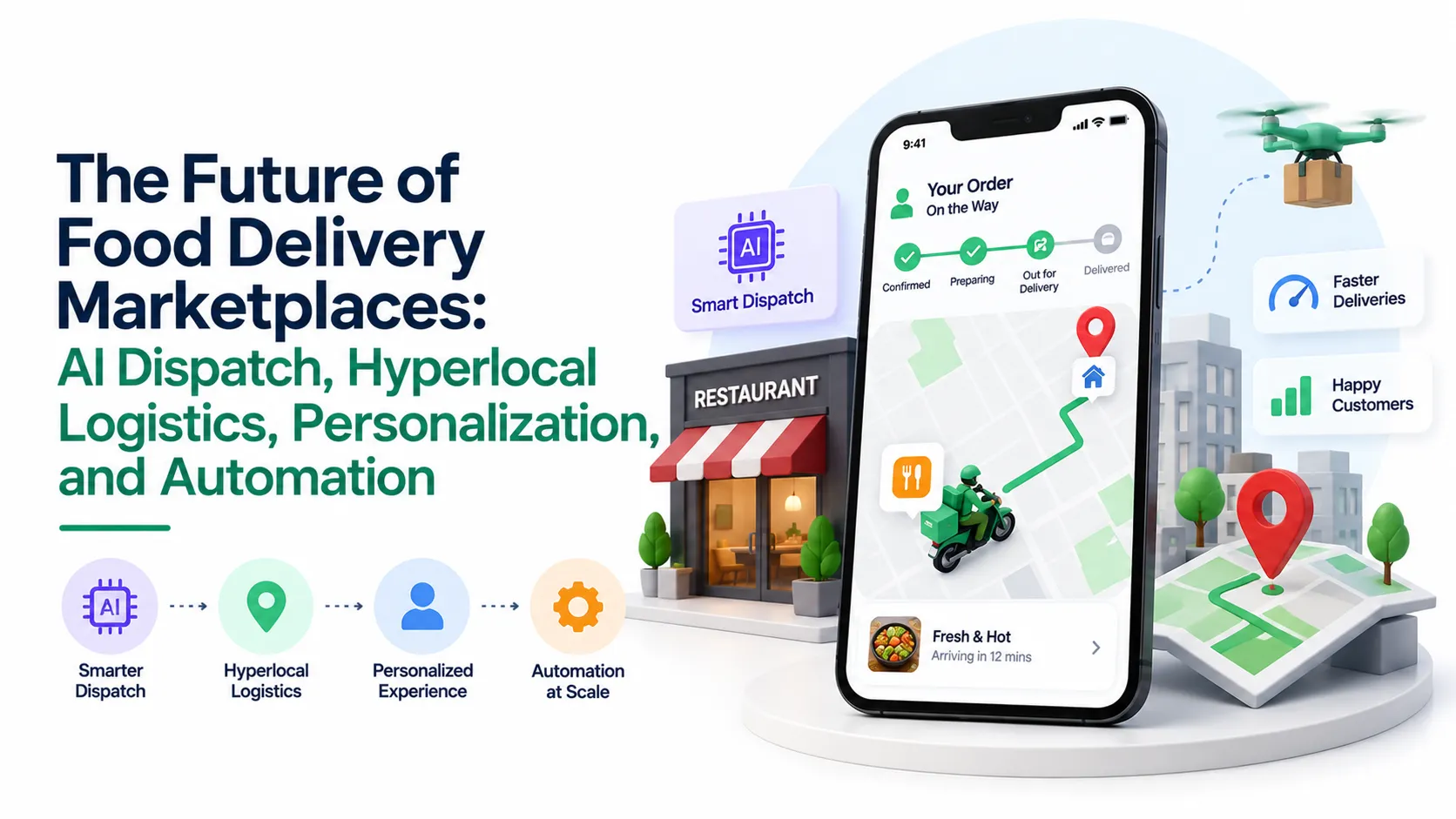
- The future of food delivery marketplaces will increasingly depend on AI dispatch, hyperlocal logistics, personalization, automation, and real-time operational intelligence.
- Smarter platforms can connect restaurant capacity, rider availability, order demand, delivery zones, traffic conditions, customer preferences, and estimated preparation times.
- Competitive advantage will come from reducing delivery friction while improving order accuracy, ETA reliability, restaurant efficiency, rider utilization, customer retention, and marketplace margins.
AI & Logistics Signals
- AI dispatch can match orders with riders using distance, preparation time, delivery zones, active workloads, route conditions, batching opportunities, and expected delivery windows.
- Hyperlocal logistics can use micro-zones, demand forecasting, dynamic rider allocation, route optimization, geofencing, order batching, and location-aware delivery rules.
- Operators should monitor acceptance time, preparation delay, pickup wait time, delivery duration, rider utilization, late orders, cancellations, batching efficiency, and cost per delivery.
Automation & Personalization Insights
- Personalized discovery can use order history, cuisine preferences, location, price sensitivity, dietary interests, time of day, promotions, and browsing behavior to improve restaurant and meal recommendations.
- Automation can support order routing, status updates, refunds, restaurant alerts, rider assignment, promotional campaigns, customer support workflows, payout processing, and operational reporting.
- Miracuves develops customizable food delivery marketplaces with AI-assisted dispatch, restaurant and rider modules, live tracking, delivery zones, personalization, automation, analytics, payments, and admin controls.
Food delivery marketplaces are no longer simple ordering apps. They are becoming real-time operating systems for restaurants, customers, delivery partners, support teams, and platform owners.
Earlier, the core question was simple: can users open an app, choose a restaurant, place an order, and receive food at the doorstep? Today, that is only the foundation. Founders now need a complete food delivery marketplace feature stack that connects dispatch accuracy, delivery density, kitchen readiness, personalized discovery, automated support, payment reliability, loyalty intelligence, and admin control.
For founders, this shift matters because the future of food delivery will not be won only by adding more restaurants or offering deeper discounts. It will be shaped by how intelligently the platform moves every order from search to checkout, kitchen to courier, and first purchase to repeat order.
Artificial intelligence, automation, and hyperlocal logistics are now becoming core parts of the food delivery marketplace stack. Industry research shows that AI-enabled forecasting can help platforms anticipate order spikes by location, cuisine, weather, time of day, local events, and user history, while dispatch algorithms improve courier batching and route planning.
For founders planning to launch a delivery business, this means the app is not just a customer-facing product. It is a logistics, commerce, data, and retention system working together in real time.
Why Food Delivery Marketplaces Are Moving Beyond Basic Ordering
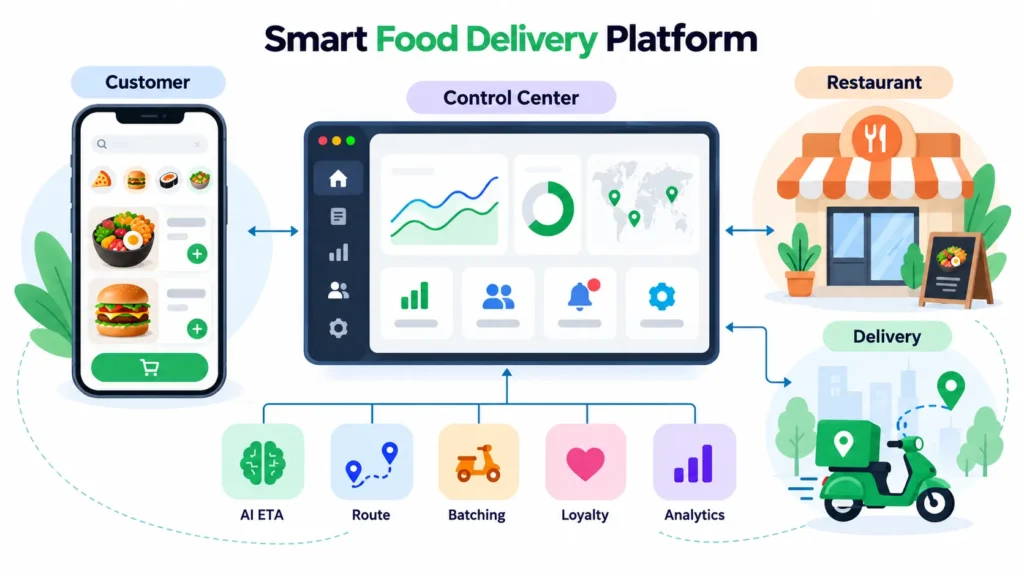
A food delivery marketplace has many moving parts. Customers want fast discovery and reliable delivery. Restaurants want manageable order flow, fair visibility, and predictable payouts. Delivery partners want clear tasks, better route planning, and transparent earnings. Platform owners want margin control, operational visibility, and repeatable growth.
When these layers are managed manually, the platform becomes fragile. A restaurant may accept more orders than it can prepare. A delivery partner may reach too early and wait outside the outlet. A customer may receive inaccurate ETA updates. A support team may spend hours solving issues that automation could have prevented.
That is why the next generation of food delivery platforms is becoming more operationally intelligent. Research on restaurant delivery management software shows rising demand for unified order aggregation, kitchen capacity management, AI-driven ETAs, batching, route optimization, CRM integration, loyalty systems, privacy controls, and margin analytics.
For founders, the lesson is clear: the future is not only about launching an app. It is about launching a marketplace that can coordinate demand, supply, payments, logistics, and customer engagement from one control layer.
AI Dispatch Will Become the Brain of Food Delivery Operations
Dispatch is one of the most important parts of a food delivery marketplace. It decides which delivery partner gets which order, when they should reach the pickup point, how the route should be managed, and whether batching makes sense.
Basic dispatch systems assign orders based mostly on distance and availability. AI dispatch goes further. It can consider restaurant preparation time, delivery partner movement, traffic signals, order value, customer location, weather, historical delay patterns, cancellation risk, and real-time platform load.
A smarter dispatch engine can help answer questions such as:
Is this delivery partner likely to reach before the food is ready?
Can two nearby orders be grouped without hurting food quality?
Should the platform delay assignment until the kitchen confirms preparation?
Which delivery partner has the best chance of completing this order on time?
Should the order be routed through a nearby high-density zone?
This is why AI dispatch is not just a technical feature. It directly affects customer satisfaction, restaurant efficiency, delivery partner productivity, and platform economics.
Research on delivery trends also points to AI and automation changing how logistics decisions are made, especially as customers expect more choice, reliability, and transparency.
For a founder, AI dispatch should not be treated as a future luxury. It should be part of the roadmap from the beginning, even if the first market version starts with rule-based dispatch and grows into predictive allocation later.
Hyperlocal Logistics Will Define Marketplace Efficiency
Food delivery is deeply local. A strategy that works in one neighborhood may fail in another because road density, restaurant supply, customer demand, parking access, weather, delivery partner availability, and order timing can be completely different.
Hyperlocal logistics helps platform owners understand delivery at a neighborhood level instead of treating an entire city as one operating zone.
A strong hyperlocal delivery model may include:
- Zone-based restaurant discovery
- Delivery radius controls
- Local delivery fee rules
- Peak-hour delivery partner planning
- Area-wise demand forecasting
- Neighborhood-specific offers
- Cloud kitchen and outlet mapping
- Local customer retention campaigns
This matters because delivery marketplaces operate on thin margins. If delivery partners spend too much time traveling across low-density routes, the platform pays more for every completed order. If the platform builds strong demand concentration in specific zones, delivery partners can complete more orders with less idle time.
Hyperlocal logistics also helps smaller and regional players compete more intelligently. Instead of trying to dominate an entire country or metro market at once, founders can focus on a specific locality, cuisine segment, business district, university area, residential cluster, or cloud kitchen network.
That focused approach can make growth more practical. The goal is not to be everywhere on day one. The goal is to build high order density where the business has a real chance to win.
Founders who want to build stronger local supply can also study a closed-loop ghost kitchen delivery strategy, where kitchen control, delivery density, menu planning, and neighborhood-level fulfillment work together to improve operational efficiency.
Personalization Will Decide Repeat Orders
In food delivery, repeat orders are more valuable than one-time discounts. A customer who returns every week gives the platform more predictable revenue, better data, and stronger retention potential.
Personalization helps create that repeat behavior.
A personalized food delivery marketplace can recommend restaurants, dishes, combos, offers, and reorder options based on user behavior. It can understand dietary preferences, cuisine patterns, time-based habits, budget range, location, previous ratings, and payment behavior.
For example, a customer who orders healthy meals during lunch hours should not see the same homepage as someone who orders late-night snacks. A family ordering weekend meals should not receive the same offer flow as a student placing small weekday orders. A high-frequency user may respond better to loyalty points, while a dormant user may need a win-back coupon.
Personalization can also support restaurants. The platform can help restaurants understand which menu items convert better, which offers improve basket size, and which customer segments are most likely to reorder.
Generative AI and machine learning are also influencing food discovery, chat-based ordering, menu translation, dietary preference matching, automated support, and personalized meal recommendations.
For founders, personalization should be connected to monetization and retention. Better recommendations can increase order frequency, better offers can reduce wasted discounts, and better segmentation can improve customer lifetime value. This is where a focused delivery marketplace growth strategy helps turn personalization into repeat orders instead of one-time discount usage.
Automation Will Reduce Manual Operational Load
Food delivery marketplaces can quickly become support-heavy if every issue requires human intervention.
Orders get delayed. Restaurants mark items unavailable. Delivery partners reject assignments. Customers ask for refunds. Payments fail. Coupons are misused. Payout disputes appear. Delivery zones need changes. Peak-hour demand creates overload.
Automation helps platform owners reduce repetitive work across these areas.
A strong food delivery automation layer can support:
- Automated order assignment
- Auto-cancellation rules for inactive restaurants
- Smart refund workflows
- Restaurant availability toggles
- Scheduled notifications
- Customer support routing
- Loyalty campaigns
- Payout calculations
- Delivery partner incentive rules
- Fraud and abuse flags
- Admin alerts for operational risks
As automation expands across refunds, payouts, payment failures, fraud flags, abuse reporting, and support workflows, founders should also review delivery app security and operational controls before scaling order volume.
Automation should not remove human control completely. It should reduce manual work while allowing the admin team to override decisions when needed.
This is especially important for founders because early teams are usually small. They cannot afford a large support team, logistics team, and operations team from day one. A well-built platform should give them enough automation to run lean while still maintaining control.
Kitchen-Aware Dispatch Will Become More Important Than Map-Only Routing
Many delivery delays do not happen on the road. They happen before pickup.
If the delivery partner reaches too early, they wait. If the restaurant is overloaded, the customer receives a delayed order. If the platform promises an unrealistic ETA, support tickets increase. If batching ignores preparation time, food quality suffers.
Kitchen-aware dispatch solves this by connecting restaurant preparation signals with delivery partner assignment.
Instead of assigning delivery only based on map distance, the system can factor in:
- Restaurant preparation time
- Kitchen load
- Order size
- Item complexity
- Historical delay patterns
- Pickup readiness
- Peak-hour congestion
- Delivery partner proximity
- Customer ETA expectations
Research on restaurant delivery software highlights that kitchen-aware dispatch, prep-ready windows, courier speed, and proximity-based auto-stacking can improve driver utilization and protect food quality.
For founders, this is a powerful operating insight. Delivery efficiency is not just about faster riders. It is about better coordination between kitchen readiness and courier movement.
Predictive Demand Planning Will Help Platforms Prepare Before Orders Arrive
Most food delivery problems become expensive when the platform reacts too late.
If demand spikes unexpectedly, restaurants get overloaded. Delivery partners become unavailable. Customers see longer ETAs. Support tickets rise. Refunds increase. Ratings drop.
Predictive demand planning helps platforms prepare before the rush.
A predictive food delivery system can use historical order data, time of day, day of week, festivals, weather, local events, cuisine popularity, and customer behavior to estimate demand. This can help the platform plan delivery partner availability, restaurant visibility, push notifications, offers, and delivery fee adjustments.
For example, if a platform knows that a certain zone usually sees high dinner demand on weekends, it can prepare delivery partner incentives earlier. It can also encourage restaurants to update inventory, adjust preparation times, or pause items that are likely to run out.
Predictive planning helps move the marketplace from reactive operations to proactive control.
Admin Dashboards Will Become the Founder’s Control Room
A food delivery marketplace is only as strong as its admin dashboard.
The customer app may look simple, but the real business runs behind the scenes. The admin dashboard controls users, restaurants, delivery partners, orders, payments, refunds, coupons, zones, commissions, reports, ratings, payouts, and platform rules.
A future-ready admin dashboard should give founders visibility into:
Live orders
Delayed orders
Cancelled orders
Restaurant performance
Delivery partner acceptance rate
Zone-wise demand
Customer retention
Average order value
Coupon performance
Commission earnings
Refund reasons
Payment failures
Support issues
High-risk activity
Popular cuisines and menu items
This is where many founders underestimate complexity. They focus heavily on the app interface but do not give enough attention to the control layer.
Without strong admin control, every operational change becomes dependent on developers. With the right dashboard, the platform owner can manage pricing, availability, delivery zones, promotions, restaurants, delivery partners, and customer engagement without rebuilding the product every time.
Miracuves focuses on this control layer through ready-made, white-label delivery marketplace solutions that include admin visibility, app panels, branding support, and faster launch paths where the selected product scope fits.
Marketplace Economics Will Depend on Smarter Monetization
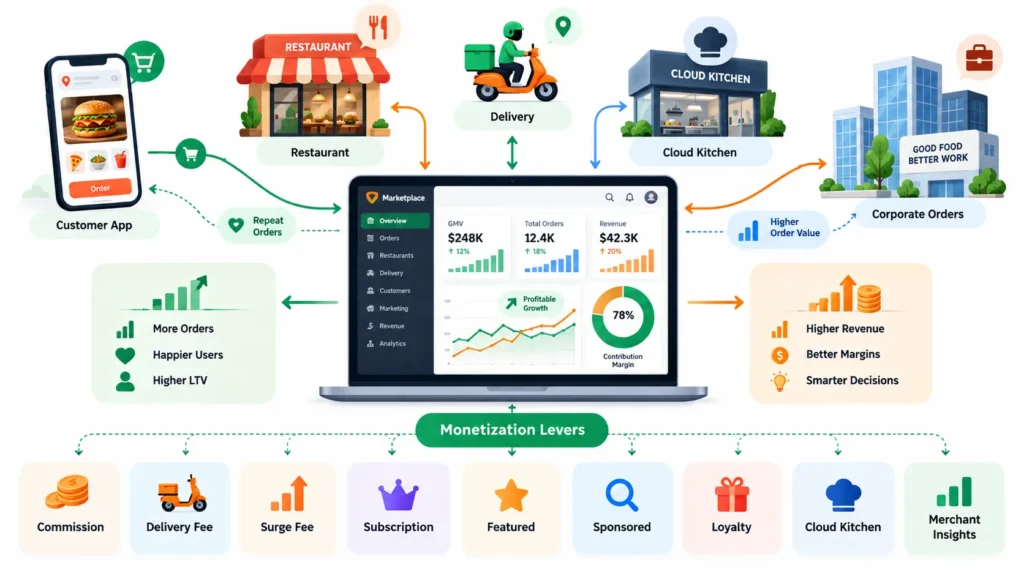
The future of food delivery marketplaces will not depend only on commission. Commission is important, but relying on one revenue stream can make the business fragile.
Modern platforms need multiple monetization options, such as:
- Restaurant commission
- Delivery fees
- Surge or peak-hour fees
- Subscription delivery passes
- Restaurant promotion packages
- Featured listings
- Sponsored search placement
- Loyalty memberships
- Cloud kitchen partnerships
- Packaging fees where applicable
- Corporate meal programs
- Data-backed merchant insights
The key is balance. If commissions are too high, restaurants may resist the platform. If delivery fees are too high, customers may reduce order frequency. If discounts are too aggressive, growth becomes expensive. Before scaling these revenue layers, founders should map the complete food delivery marketplace business model so commissions, delivery fees, subscriptions, promotions, and restaurant partnerships support long-term growth instead of creating friction.
That is why automation and analytics matter. The platform should show which monetization levers are working, which restaurants drive profitable volume, which zones need incentives, and which campaigns attract repeat users instead of one-time bargain hunters.
This is where a ready-made delivery marketplace foundation can help founders move faster. Instead of spending months rebuilding basic order, payment, restaurant, delivery, and admin workflows, they can focus earlier on local supply, pricing, retention, and monetization strategy.
What Features Matter Most in the Future Food Delivery Marketplace Stack?
A future-ready food delivery platform should bring customer experience, restaurant operations, logistics, and admin intelligence into one ecosystem.
| Platform Layer | Future-Ready Capability | Business Value |
|---|---|---|
| Customer app | Personalized discovery, reorder flows, real-time tracking, loyalty rewards | Improves repeat orders and customer retention |
| Restaurant panel | Menu control, order status, preparation time, inventory updates, offer management | Reduces operational friction and improves fulfillment |
| Delivery partner app | Smart task assignment, route guidance, earnings view, proof of delivery | Improves delivery reliability and partner productivity |
| Admin dashboard | Zones, commissions, payouts, analytics, support controls, fraud flags | Gives the platform owner business control |
| Dispatch engine | AI-assisted allocation, batching, kitchen-aware routing, ETA logic | Reduces delays and improves delivery efficiency |
| Automation layer | Notifications, refund flows, campaign triggers, payout rules | Reduces manual work and support pressure |
| Analytics layer | Demand forecasting, customer segments, restaurant performance, zone insights | Supports better growth and monetization decisions |
The main point is simple: founders should not think only in terms of app screens. They should think in terms of workflows. Every screen should connect to a business process.
Founder Decision Signals
Speed
If the market opportunity is active now, rebuilding basic delivery workflows from zero can delay validation. A ready-made foundation helps founders move faster when the scope fits.
Control
The admin dashboard should let the operator manage zones, restaurants, orders, commissions, delivery partners, offers, and payouts without depending on developers for every small change.
Scalability
Food delivery platforms need stable handling for live orders, real-time tracking, payments, notifications, and peak-hour activity. Scalability should be planned before volume grows.
Market Fit
The strongest launch strategy is usually focused. Start with a clear geography, restaurant category, customer segment, or delivery niche before expanding into wider markets.
Ready-Made Platforms Will Help Founders Test the Market Faster
Custom development can make sense when the business model is unusual, the workflows are highly specific, or the platform needs deep custom architecture from the first day. But before choosing between custom development and a ready-made platform, founders should review their modules, integrations, launch scope, and food delivery app cost planning so the build route matches both budget and business goals.
But many food delivery businesses need a proven foundation first: customer ordering, restaurant management, delivery partner workflows, live tracking, payments, admin control, offers, ratings, reporting, and payout logic.
This is where ready-made food delivery marketplace solutions become useful. They reduce the time spent rebuilding common workflows and allow founders to focus on the parts that actually create differentiation:
- Local restaurant onboarding
- Delivery partner supply
- Neighborhood-level launch strategy
- Customer acquisition
- Menu quality
- Delivery reliability
- Retention campaigns
- Pricing and commission logic
- Partnerships and regional growth
Miracuves’ ready-made delivery solutions are designed for founders who want a faster launch path with branding, source-code ownership, app panels, admin control, and 6-day delivery where the selected scope fits. The official Miracuves platform page states that its ready-made solution includes ordering, live tracking, dispatch, payment gateways, wallets, loyalty, coupons, ratings, payouts, and reporting.
Mistakes Founders Should Avoid
Treating the App as Only a Customer Interface
A polished customer app is important, but food delivery success depends on what happens after checkout. Restaurant operations, delivery assignment, payment flow, support handling, and admin control matter just as much.
Ignoring Delivery Density
Expanding too widely too early can increase delivery time and reduce operational efficiency. A focused hyperlocal launch often gives founders better control over supply, demand, and service quality.
Depending Only on Discounts
Discounts may bring first-time orders, but they do not automatically create loyalty. Better personalization, reliable delivery, restaurant quality, and rewards can do more for long-term retention.
Building Without Admin Flexibility
If the admin panel cannot manage zones, commissions, campaigns, restaurants, delivery partners, refunds, and reports, the founder may struggle to operate the business efficiently.
Leaving Automation for Later
Automation should not be an afterthought. Even simple workflows like order alerts, refund approvals, restaurant availability, delivery assignment, and customer notifications can reduce operational pressure from the beginning.
The Future Food Delivery Marketplace Will Be More Intelligent, Local, and Automated
The next phase of food delivery will not be defined by one single feature. It will be shaped by how well the platform connects intelligence across the full order journey.
AI dispatch will improve allocation and routing. Hyperlocal logistics will make operations more zone-specific. Personalization will improve retention. Automation will reduce repetitive work. Admin dashboards will give founders clearer control. Predictive analytics will help platforms prepare before problems appear.
For founders, the opportunity is not just to launch another ordering app. The opportunity is to build a delivery marketplace that understands customers, supports restaurants, guides delivery partners, and gives the operator enough control to improve the business every week.
Miracuves helps founders move faster with ready-made and white-label food delivery marketplace platforms that can be branded, configured, and delivered in 6 days where the selected solution scope fits.
FAQs
What is the future of food delivery marketplaces?
The future of food delivery marketplaces is moving toward AI-assisted dispatch, hyperlocal logistics, predictive demand planning, personalized customer experiences, automated support, and stronger admin control. The goal is not only to accept orders but to manage the full delivery ecosystem more intelligently.
How does AI dispatch improve food delivery operations?
AI dispatch can support smarter order allocation by considering delivery partner location, restaurant preparation time, traffic, order batching, customer ETA expectations, and historical delay patterns. This helps reduce waiting time, late deliveries, and operational inefficiency.
Why is hyperlocal logistics important for food delivery startups?
Hyperlocal logistics helps startups focus on specific neighborhoods, delivery zones, restaurant clusters, and customer segments. This can improve delivery density, reduce unnecessary travel, and make operations easier to control during early growth.
How does personalization increase repeat orders?
Personalization improves repeat orders by showing users more relevant restaurants, dishes, offers, reorder prompts, and loyalty benefits. When the app understands user preferences and timing patterns, the customer journey feels faster and more useful.
What should founders look for in a modern food delivery platform?
Founders should look for customer apps, restaurant panels, delivery partner apps, admin dashboards, dispatch logic, payment workflows, tracking, offers, ratings, reporting, and scalability. The platform should support both launch and ongoing operations.
Is a ready-made food delivery marketplace better than custom development?
A ready-made platform is useful when founders want to launch faster using proven workflows. Custom development is useful when the business needs highly specific logic from the beginning. The right choice depends on budget, scope, timeline, and differentiation strategy.
How can automation reduce food delivery operating costs?
Automation can reduce repetitive manual work across dispatch, notifications, refunds, payouts, restaurant availability, customer support, fraud flags, and loyalty campaigns. This helps small teams manage more orders without increasing operational load too quickly.
How fast can Miracuves deliver a food delivery marketplace solution?
Miracuves offers 6-day delivery for ready-made solutions where the selected scope fits. Final delivery depends on branding, configuration, integrations, custom changes, and launch requirements.
Miracuves is an independent software development company. We are not affiliated with, connected to, sponsored by, or endorsed by any company or product named in this article.
Terms such as “X Clone” are used descriptively. It is how the software industry refers to building a platform with functionality comparable to a known service, and how clients search for it.
The entire design and codebase of our products is built by our own team. Our products contain no code, design, graphics, or content originating from any third-party website or applications.
All third-party names and marks referenced in this article are the property of their respective owners, referenced solely to identify the services discussed.