

Choosing between white-label solutions and custom development is one of the first serious product decisions a founder makes. It affects how fast you launch, how much you spend, how much control you keep, and how easily your product can evolve after real users start using it.
For many founders, the question is not simply, “Which option is better?” The better question is, “Which option gives my business the right balance of speed, cost, ownership, and customization at this stage?”
A fully custom product can give deep flexibility, but it also demands more time, more budget, more planning, and more technical responsibility. A white-label solution gives you a ready-made product foundation that can be branded, customized, and launched faster. The smarter path depends on your business model, urgency, budget, technical complexity, and growth plan.
This guide compares white-label solutions and custom development from a founder’s point of view so you can choose the right development path before investing months into the wrong one.
What Are White-Label Solutions?
White-label solutions are ready-made software or app products that can be rebranded and customized for a business. Instead of developing the entire product from zero, the founder starts with an existing foundation that already includes core workflows, user roles, admin controls, and essential product modules.
For example, a founder planning to launch a delivery app, fintech app, marketplace, ride-hailing app, or short video platform may not need to build login, payments, dashboards, notifications, listings, user management, and admin workflows from scratch. A white-label app solution can provide these core layers, allowing the founder to focus on branding, business model, market launch, and customization.
A strong white-label solution usually includes:
- Branded mobile apps or web apps
- Admin dashboard
- User, vendor, provider, creator, driver, merchant, or partner panels depending on the business model
- Core transaction or booking workflows
- Payment gateway integration options
- Push notifications
- Reporting and basic analytics
- Custom branding
- Source-code ownership where provided
- Post-launch customization support
For founders, the biggest advantage is speed. A white-label foundation reduces development uncertainty because the product structure already exists. Instead of waiting for every module to be designed, developed, tested, and integrated from zero, the business can move faster toward launch and market validation.
Miracuves offers ready-made and white-label app solutions for founders who want a faster product foundation without losing control over branding, admin workflows, and customization direction.
What Is Custom Development?
Custom development means building software or an app from the ground up based on your specific requirements. Every major workflow, interface, backend process, database structure, integration, and user experience is planned and developed for your business.
This route is useful when your product needs something highly specific that cannot be handled by an existing white-label foundation. For example, you may need a proprietary recommendation engine, a complex enterprise workflow, a specialized compliance process, or a product experience that does not follow an existing market pattern.
Custom development gives more freedom, but it also increases responsibility. You need stronger planning, clearer documentation, deeper testing, higher budget control, and a longer development runway.
Custom development often works best when:
- The business model is highly unique
- Existing product patterns do not fit the workflow
- The company needs proprietary technology
- The product requires deep third-party integrations
- User experience must be built around a very specific journey
- The company has enough budget and time for a longer build cycle
- Internal teams can support product planning and post-launch iteration
For early-stage founders, the risk is overbuilding before the market has validated demand. A custom product may be powerful, but if the business has not proven its pricing, audience, acquisition channel, or operational model, a long custom build can create unnecessary delay.
White-Label Solutions vs Custom Development: Quick Comparison
White-Label Solutions vs Custom Development
| Decision Factor | White-Label Solutions | Custom Development | Founder Impact |
|---|---|---|---|
| Launch Speed | Faster because the core foundation is already built. | Slower because the product is planned, designed, developed, and tested from zero. | White-label is stronger when speed to market matters. |
| Cost | Usually more cost-efficient because core modules already exist. | Usually higher because every feature requires custom planning and development. | White-label helps reduce early financial risk. |
| Customization | Flexible for branding, workflows, modules, and selected feature changes depending on the provider. | Deeply flexible because everything can be built around the business requirement. | Custom wins when the product model is highly unique. |
| Ownership | Depends on the provider. Source-code-owned white-label solutions offer stronger control. | Usually full ownership if the agreement clearly transfers IP and source code. | Founders must check source code, licensing, and long-term access. |
| Scalability | Scalable if the foundation is built with growth-ready architecture. | Scalable if planned properly from the start. | Architecture matters more than the label. |
| Maintenance | Can be easier if the provider offers support and updates. | Requires dedicated technical planning, maintenance, and upgrades. | Founders should calculate post-launch responsibility. |
| Business Risk | Lower early-stage risk because the founder can validate faster. | Higher early-stage risk if the business model is untested. | White-label is often smarter for first market entry. |
Why White-Label Solutions Help Founders Launch Faster
The biggest advantage of white-label solutions is not just lower development effort. It is reduced decision drag.
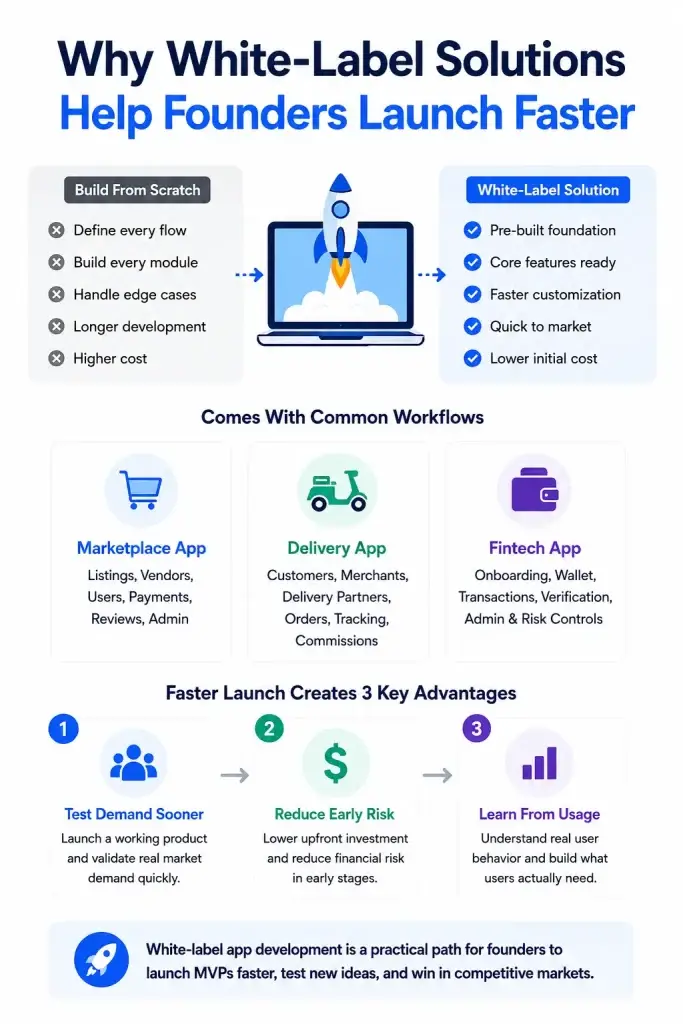
When building from zero, founders need to define every user flow, every backend function, every dashboard screen, every edge case, and every integration before launch. That sounds ideal in theory, but in practice it can slow down execution, especially when the business is still validating demand.
White-label solutions help founders launch faster because the product foundation already includes the common workflows expected in that app category. A marketplace app already understands listings, vendors, users, payments, reviews, and admin controls. A delivery app already understands customers, merchants, delivery partners, orders, tracking, and commissions. A fintech app already needs onboarding, wallet logic, transactions, verification workflows, and admin risk controls.
This does not mean every white-label product is automatically the right choice. The quality of the foundation matters. A strong white-label solution should be customizable, scalable, secure, and aligned with your business model.
For founders, faster launch creates three important advantages:
First, you can test real market demand sooner. Instead of spending months debating product assumptions, you can put a working product in front of users.
Second, you can reduce early capital risk. A ready-made foundation usually requires less upfront investment than building every module from scratch.
Third, you can learn from actual usage. Early user behavior often reveals what the product really needs, which is usually different from what the founder imagined at the planning stage.
This is why white-label app development is often a practical path for founders launching a first market version, testing a new vertical, or entering a competitive category where speed matters.
Where Custom Development Still Makes Sense
Custom development is not the wrong path. It is simply the wrong path for some stages and the right path for others.
A custom build makes sense when the product cannot be properly supported by an existing foundation. If your business depends on a unique algorithm, specialized workflow, unusual compliance logic, or proprietary operational model, a white-label solution may need too many changes to remain efficient.
Custom development may be the smarter path when:
- Your business model is new and does not follow a known app pattern
- Your product experience is the main competitive advantage
- You need deep integrations with internal enterprise systems
- Your workflows require custom automation logic
- Your data model is unique
- You need complete technical architecture control from day one
- You already have validated demand and funding for a longer build
The founder should ask one simple question:
“Is my product differentiated by the core software architecture, or by the market, brand, operations, pricing, and execution?”
If the core software itself is the differentiation, custom development may be worth it. If the business mainly needs to launch a proven model with brand, market, and operational customization, a white-label solution can be the smarter route.
Cost Comparison: Paying for Speed vs Paying for Original Build
Cost is one of the main reasons founders compare white-label solutions and custom development.
White-label solutions are usually more cost-efficient because the core product modules already exist. The founder is not paying for every screen, backend flow, database structure, and app panel to be built from zero. Instead, the investment goes into branding, configuration, customization, integrations, testing, deployment, and support.
Custom development costs more because the product is original. You are paying for research, planning, UX design, UI design, frontend development, backend development, API development, database architecture, quality assurance, deployment, project management, and post-launch fixes.
The real difference is not only development cost. It is opportunity cost.
A founder who spends six months building from zero may miss the chance to validate demand earlier. A founder who launches faster with a white-label solution can start learning from real users, acquiring customers, testing pricing, building partnerships, and improving operations.
That said, cost should not be judged only by the first invoice. Founders should also compare:
- Customization cost
- Maintenance cost
- Hosting and infrastructure cost
- Integration cost
- Feature expansion cost
- Support cost
- Future migration cost
- Source-code ownership terms
Miracuves’ ready-made approach is designed for founders who want a cost-efficient launch foundation with branding, admin control, source-code ownership, and faster deployment. Final pricing depends on selected modules, integrations, branding, and customization requirements.
Ownership and Control: What Founders Should Check Before Choosing
Ownership is where many founders make mistakes.
A white-label solution can be powerful, but only if the ownership model is clear. Some providers offer limited access, subscription-only usage, or restricted customization. Others provide source-code ownership, which gives the business more control over future changes, hosting decisions, integrations, and long-term product direction.
Before choosing a white-label solution, ask:
- Do I get source code?
- Can I customize features after launch?
- Who controls the admin dashboard?
- Who owns user and transaction data?
- Can I change hosting or infrastructure later?
- Can the product support new integrations?
- What happens if I stop working with the provider?
- Are there recurring license restrictions?
- Is support included after deployment?
Custom development usually offers stronger ownership if the agreement is written correctly. But founders should not assume ownership automatically. The contract must clearly state source-code transfer, intellectual property rights, hosting access, repository access, documentation, and post-launch responsibilities.
For white-label solutions, the strongest model is a source-code-owned foundation. This gives founders the speed of a ready-made product with stronger long-term control than a closed subscription platform.
Customization: The Middle Ground Most Founders Actually Need
Many founders assume white-label means “generic” and custom means “unique.” That is not always true.
A weak white-label product may feel generic if it only allows logo and color changes. A strong white-label solution can support meaningful customization across branding, user flows, feature modules, admin controls, monetization rules, and integrations.
Most founders do not need every line of code to be original. They need the right parts to be customizable.
Useful customization usually includes:
- Brand identity
- App colors and visual style
- Home screen layout
- User onboarding flow
- Business rules
- Commission settings
- Payment gateway choices
- Notification logic
- Service categories
- Vendor or provider workflows
- Admin permissions
- Reports and dashboards
- Monetization modules
- Language and region settings
For example, a food delivery app does not need a completely original login system. But it may need custom delivery zones, restaurant commission settings, promotional campaigns, subscription logic, and admin controls. A fintech app may not need a custom profile page from zero, but it does need careful wallet logic, verification workflows, transaction monitoring, and secure admin access.
The smartest approach is not always full custom development. Often, it is a white-label foundation with strategic customization around the parts that affect business differentiation.
Founder Decision Signals: When to Choose White-Label or Custom
Founder Decision Signals
Speed
Choose white-label solutions when you need to launch quickly, test demand, enter a competitive market, or avoid a long development cycle before learning from real users.
Cost
Choose white-label when you need a cost-efficient foundation. Choose custom development when you have the budget to build and maintain a product from zero.
Scalability
Do not judge scalability only by whether the product is white-label or custom. Check backend architecture, hosting flexibility, database design, admin control, and future feature expansion.
Market Fit
Choose white-label when the business model follows a proven app pattern. Choose custom when your product experience or technology is highly unique.
Choose White-Label Solutions When Speed and Validation Matter Most
White-label solutions are often the smarter path when the founder needs to move quickly without taking on the full cost and complexity of a custom build.
This is especially true for app categories with proven product patterns, such as:
- Delivery apps
- Grocery and quick commerce apps
- Taxi and ride-hailing apps
- Service marketplaces
- Rental marketplaces
- Fintech and remittance apps
- Short video and creator platforms
- Ecommerce marketplaces
- Healthcare appointment apps
- Education platforms
- Travel and booking apps
In these categories, many core workflows are already known. Users expect certain features. Admin teams need certain controls. Payments, listings, bookings, notifications, user roles, and dashboards follow recognizable patterns.
A founder does not need to reinvent every module. The smarter move may be to start with a ready-made foundation and customize the business-critical layers.
For example, if you are building a short video product, you may start with a TikTok clone app foundation and customize creator features, moderation workflows, monetization rules, and content discovery logic. If you are entering fintech, you may explore a Revolut clone app or Wise clone solution depending on your remittance, banking, wallet, and financial workflow needs.
White-label is not about copying another business blindly. It is about using a proven product structure to reduce avoidable development risk.
Choose Custom Development When Your Product Needs Deep Originality
Custom development becomes the better path when your product cannot succeed using a standard foundation.
This may happen when the software itself is your competitive moat. For example, a logistics company may need a highly specific routing engine. A fintech company may need unusual transaction logic. An enterprise SaaS platform may need workflow automation that is deeply tied to internal operations. A marketplace may need a completely new matching model.
Custom development gives your team the freedom to design every layer around your exact product strategy.
But that freedom comes with added responsibility. Custom products need more discovery, documentation, testing, infrastructure planning, and technical management. Founders must be ready to invest not only in development, but also in maintenance, support, security, and future iteration.
The custom path is strongest when you already have:
- Validated demand
- Clear workflows
- Documented requirements
- Budget for full-cycle development
- Technical leadership
- Long-term product roadmap
- Strong reason to build something that existing foundations cannot support
If those pieces are missing, starting with custom development can create delays and cost overruns before the business has even tested its core assumptions.
The Smarter Path Is Often Hybrid: White-Label Foundation + Customization
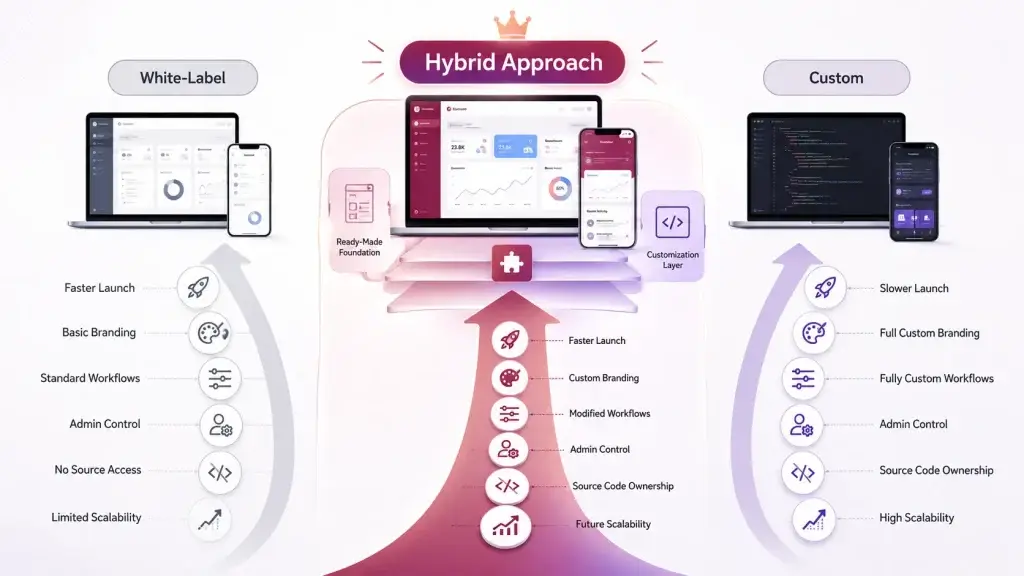
For many founders, the best answer is not pure white-label or pure custom. It is a hybrid approach.
A hybrid approach starts with a white-label or ready-made foundation and then customizes the areas that matter most to the business. This gives the founder faster launch speed while still allowing the product to feel aligned with the market, brand, and revenue model.
This approach works well when:
- The app category follows a proven model
- The founder wants faster deployment
- The business needs custom branding
- Some workflows need modification
- The platform needs admin control
- The founder wants source-code ownership
- The product may evolve after launch
For example, a marketplace founder may use a ready-made marketplace foundation but customize commission rules, listing categories, vendor verification, featured listings, dispute management, and analytics. A delivery app founder may customize delivery fees, service radius, merchant workflows, driver incentives, and promotional logic.
This is where Miracuves’ white-label approach fits many founder scenarios. It helps businesses start with a launch-ready product foundation while still allowing strategic customization around branding, operations, monetization, and admin control.
Security and Compliance Should Not Be an Afterthought
Whether you choose white-label or custom development, security should be part of the product foundation.
For marketplaces, this may include user verification, provider verification, secure payments, dispute workflows, admin approvals, and review moderation. For fintech apps, founders need to think about KYC workflows, AML workflow support, transaction monitoring, audit logs, encrypted data transfer, role-based access control, and suspicious activity flags. For creator platforms, content moderation, abuse reporting, creator verification, and payout monitoring become important.
A white-label solution should not be selected only because it looks good on the front end. Founders should ask how the backend handles permissions, data, payments, logs, and admin controls.
A custom build also does not automatically mean better security. Security depends on the team, architecture, coding practices, integrations, testing, and maintenance plan.
For regulated or sensitive industries, use careful language: the product can support compliance workflows or provide a compliance-ready foundation, but final compliance depends on jurisdiction, legal review, integrations, and operating model.
Mistakes Founders Should Avoid
Mistakes Founders Should Avoid
Choosing only based on the lowest price
A low-cost product can become expensive if it lacks source-code access, scalability, support, or customization flexibility. Compare total ownership value, not only the first invoice.
Assuming white-label means no customization
Some white-label products are rigid, but stronger solutions allow branding, module changes, workflow adjustments, integrations, and admin-level configuration.
Building custom before validating demand
A fully custom product can be powerful, but overbuilding too early can delay market learning. Founders should validate demand before investing heavily in original architecture.
Ignoring source-code ownership
Without clear source-code and IP terms, founders may face vendor dependency later. Ownership should be reviewed before signing the project agreement.
Forgetting post-launch changes
The first launch is not the final product. Founders should check whether the solution supports future feature expansion, integrations, admin changes, and scaling needs.
How Miracuves Helps Founders Choose the Smarter Path
Miracuves helps founders, startups, agencies, and businesses launch digital products faster using ready-made, white-label, and source-code-owned app solutions. The focus is not just on launching an app, but on helping the founder start with a practical product foundation that supports branding, admin control, monetization, and future customization.
If your business model follows a proven app category, Miracuves can help you explore a launch-ready solution through the Miracuves solutions hub If your product needs deeper flexibility, Miracuves can also help evaluate what should be customized and what can be built on top of an existing foundation.
This matters because founders do not always need the longest route. They need the route that gives them the right product at the right stage.
A white-label solution can be the smarter path when you need speed, cost efficiency, and a working foundation. Custom development can be the smarter path when the product itself needs deep originality. The right development partner should help you make that decision clearly instead of pushing one model for every business.
Final Thoughts: Choose the Path That Matches Your Stage, Not Just Your Ambition
White-label solutions and custom development both have a place. The mistake is choosing based on assumptions instead of business stage.
If you need to launch faster, control costs, test demand, and start with a proven app foundation, white-label solutions are often the smarter path. If your product requires deep originality, proprietary workflows, or architecture that cannot be supported by an existing foundation, custom development may be worth the longer timeline and higher investment.
The strongest founder decision is not always the most complex build. It is the build that helps you move with clarity, control, and the right level of risk.
For many businesses, that means starting with a ready-made, white-label, source-code-owned foundation and customizing the parts that truly define the business.
FAQs
What are white-label solutions?
White-label solutions are ready-made software or app products that can be rebranded and customized for another business. They help founders launch faster because the core product foundation, user flows, admin dashboard, and essential modules are already developed.
Are white-label solutions better than custom development?
White-label solutions are better when speed, cost efficiency, and market validation matter most. Custom development is better when the product requires deep originality, proprietary workflows, or highly specific technical architecture.
Do white-label apps allow customization?
Yes, strong white-label apps allow customization across branding, colors, workflows, modules, integrations, admin controls, and business rules. The level of customization depends on the provider and whether source-code access is included.
Is custom development more expensive than white-label development?
Custom development is usually more expensive because every feature, interface, backend workflow, and integration is built from zero. White-label solutions are generally more cost-efficient because the core product foundation already exists.
Who should choose white-label app development?
Founders, startups, agencies, and businesses should consider white-label app development when they want to launch quickly, reduce early-stage risk, validate demand, and customize a proven product model for their market.
Who should choose custom app development?
Custom app development is suitable for businesses with highly unique workflows, proprietary technology, complex integrations, or validated product requirements that cannot be handled by a ready-made foundation.
Miracuves is an independent software development company. We are not affiliated with, connected to, sponsored by, or endorsed by any company or product named in this article.
Terms such as “X Clone” are used descriptively. It is how the software industry refers to building a platform with functionality comparable to a known service, and how clients search for it.
The entire design and codebase of our products is built by our own team. Our products contain no code, design, graphics, or content originating from any third-party website or applications.
All third-party names and marks referenced in this article are the property of their respective owners, referenced solely to identify the services discussed.