


Key Takeaways
What You’ll Learn
- On-demand startups solve daily needs with faster service access.
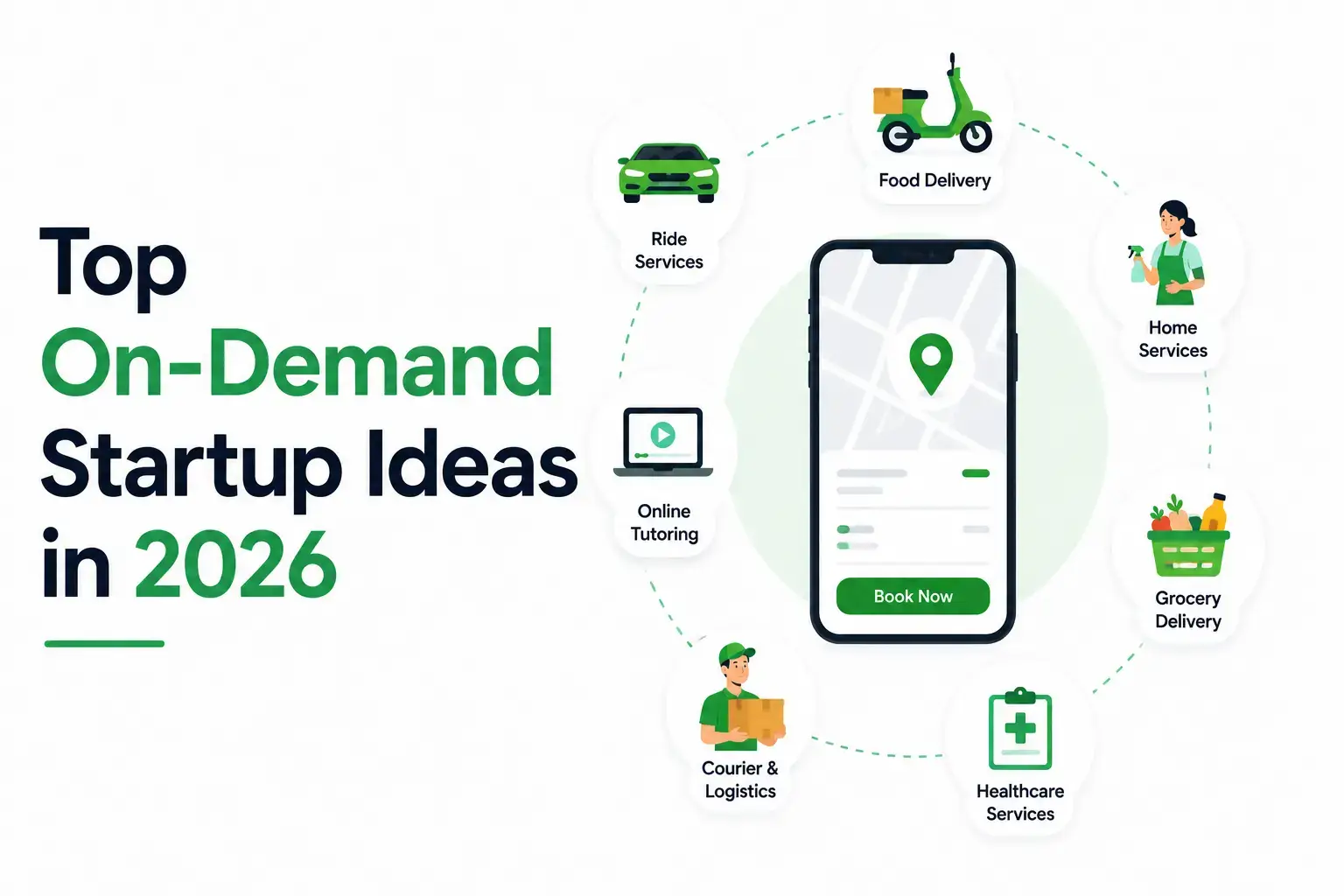
- Popular ideas include food, taxi, home services, grocery, and delivery apps.
- User convenience drives demand across on-demand business models.
- Real-time tracking improves service visibility and trust.
- Scalable apps help founders expand into new services and locations.
Stats That Matter
- Fast booking flow increases user activation and repeat use.
- Provider management helps maintain service quality.
- Secure payments support smooth transactions and user confidence.
- Admin dashboards control users, providers, orders, commissions, and reports.
- Multi-service models create more revenue opportunities for startups.
Real Insights
- On-demand success depends on speed, trust, and service quality.
- Founders should choose ideas based on local demand and execution ability.
- Simple UX improves booking completion and retention.
- Operations matter as much as app features.
- The best startup idea combines market need, reliable delivery, payments, and scalable technology.
The on-demand economy in 2026 is no longer just about food delivery and ride-hailing. Stronger domestic demand, AI-led digital ecosystems, value-conscious consumers, and growing demand for reliable local services are creating better opportunities for startups that solve urgent, repeat-use problems. Deloitte notes that retail leaders in 2026 expect growth while adapting to value-focused consumers and AI-driven commerce, and McKinsey points to heavy investment in AI software and digital ecosystems heading into 2026.
That shift matters for founders because the best on-demand startup ideas in 2026 are not simply “fast delivery” businesses. The stronger ideas combine convenience, recurring demand, operational clarity, and room for AI, automation, or local-service aggregation. Consumer behavior also supports this more practical direction: McKinsey found that many shoppers care deeply about delivery cost and reliability, not just maximum speed.
Why On-Demand Startups Still Have Strong Potential in 2026
On-demand startups remain attractive because they solve real, frequent problems. But the strongest opportunities now tend to fall into categories where customers need trust, convenience, repeat usage, and clear service coordination.
What makes an on-demand idea strong in 2026
- High repeat demand
- Clear local or regional need
- Manageable operations
- Room for AI-enabled efficiency
- Strong retention potential
- Multiple revenue streams
A strong on-demand startup in 2026 should not only deliver speed. It should also deliver consistency, affordability, and a better user experience than traditional offline alternatives. That matters even more now because consumers are increasingly selective about value and service reliability.
Best On-Demand Startup Ideas to Watch in 2026
Home Services Marketplace
Home services is one of the strongest on-demand startup categories for 2026. McKinsey says the US home services market could reach about $802 billion by 2030, with steady forecast growth from 2024 to 2030, and notes that some categories such as HVAC and electrical are relatively resilient because they are nondiscretionary or emergency-related.
This makes on-demand home services a strong idea for startups offering:
- Cleaning
- Plumbing
- Electrical repair
- AC servicing
- Pest control
- Handyman bookings
On-Demand Healthcare and Home Care Support
Healthcare convenience remains a major opportunity. McKinsey estimated that up to $265 billion worth of care services for Medicare beneficiaries could shift from traditional facilities to the home, showing the long-term strength of home-based care delivery models.
Startup ideas in this area include:
- At-home nurse booking
- Diagnostic sample collection
- Medicine delivery
- Elder care support coordination
- Post-hospital recovery assistance
Hyperlocal Grocery and Essentials Delivery
Grocery and essentials remain one of the most practical on-demand categories because they serve repeat household demand. Retail and grocery sectors continue adapting to cautious consumers, margin pressure, and AI-led operating changes, which opens room for startups that improve local convenience and smarter delivery models.
A strong startup angle here is not only speed, but:
- Better inventory visibility
- Subscription-based repeat ordering
- Neighborhood-level fulfillment
- Reliable scheduled delivery
On-Demand Logistics and Last-Mile Services
Delivery expectations are evolving. McKinsey found that many consumers are willing to wait a bit longer if shipping costs are lower, and that reliability matters heavily. That creates room for startups focused on predictable last-mile logistics instead of only instant delivery.
Promising ideas include:
- Same-day local courier services
- SME delivery networks
- Pharmacy and clinic logistics
- B2B neighborhood distribution
- Return pickup services
AI-Powered Personal Shopping and Concierge Services
McKinsey’s 2025 work on agentic commerce suggests AI agents are starting to reshape how consumers discover and buy products. That creates room for startups that combine on-demand fulfillment with AI-led shopping assistance.
This could include:
- AI shopping assistants with local delivery
- Smart gifting services
- Event-based purchase planning
- Personal errand and procurement services
On-Demand Beauty and Wellness at Home
Beauty, grooming, and wellness continue to fit the on-demand model well because customers value convenience, scheduling flexibility, and repeat service. This works especially well in urban markets where time-saving services are easier to monetize.
Examples include:
- At-home salon services
- Massage and wellness bookings
- Fitness trainer visits
- Skincare consultations
- Bridal and event beauty services
B2B On-Demand Procurement and Replenishment
B2B on-demand services are often less crowded than consumer apps and can build stronger recurring revenue. McKinsey has noted the usefulness of online marketplaces for indirect procurement, especially for long-tail purchases and auto-replenishment.
That creates startup space for:
- Office and facility supplies delivery
- Restaurant replenishment services
- Medical consumables delivery
- Retail stock refill networks
What Makes an On-Demand Startup Idea Profitable in 2026
Not every on-demand idea will perform well in 2026. The strongest opportunities usually sit at the intersection of repeat demand, reliable service delivery, and healthy unit economics. Founders who focus only on a trendy category often miss the bigger question: can this service retain users, operate efficiently, and scale without becoming too expensive to manage?
In 2026, that matters even more because consumers continue to prioritize value, convenience, and reliability. Deloitte’s 2026 consumer products outlook points to continued pressure on companies to respond to value-seeking behavior and changing digital expectations, while McKinsey’s consumer research shows that convenience alone is not enough if service quality or affordability falls short.
Repeat Usage Is More Important Than Novelty
A profitable on-demand startup usually solves a need that appears again and again, not just once in a while. That is why categories like home services, healthcare support, grocery delivery, and B2B replenishment often look stronger than ideas built only around occasional convenience.
The more often customers need the service, the better the startup can improve retention, reduce acquisition waste, and build recurring revenue over time. McKinsey’s recent work on home services highlights the appeal of categories that combine reliability with recurring or nondiscretionary demand.
Local Operational Simplicity Matters
Many on-demand startups fail not because the idea is weak, but because operations become too complicated too early. A good idea for 2026 should be launchable in one city, one region, or one niche without requiring an extremely heavy supply chain or a huge partner network from day one.
This is why focused service models often outperform broad “do everything” launches in the early stage.
AI and Automation Can Improve Margins
One of the biggest advantages in 2026 is that startups can use AI and automation to improve service quality, booking flow, support, route planning, and recommendation systems. Deloitte’s 2026 health care outlook and McKinsey’s broader 2026 healthcare and AI commentary both point to AI, automation, and new service models as central themes, while CB Insights highlights strong momentum around AI agents heading into 2026.
For on-demand founders, that can mean:
- Smarter scheduling
- Better demand forecasting
- Faster customer support
- Improved service matching
- More personalized upsells
Trust-Heavy Categories Often Create Better Retention
In 2026, many of the strongest on-demand opportunities are in trust-driven categories. When users rely on a service for essential needs such as healthcare support, repairs, delivery coordination, or recurring household services, they are more likely to return if the experience is good.
That creates stronger long-term value than categories where users switch providers constantly based only on discounts.
B2B On-Demand Models Can Be Stronger Than Consumer-Only Models
A lot of founders automatically think about consumer apps first, but B2B on-demand services can often offer better repeat order behavior and more predictable margins. McKinsey has noted that B2B online marketplace models can be especially effective for indirect procurement, long-tail purchasing, and auto-replenishment workflows.
That creates room for ideas such as:
- Office supplies replenishment
- Restaurant inventory restocking
- Clinic and pharmacy supply delivery
- Local business maintenance dispatch
- Retail stock refill services
Reliability Beats “Instant Everything”
One of the biggest shifts in the on-demand market is that “faster” is not always the winning message anymore. In many categories, users care more about dependable service, transparent pricing, and fewer failed deliveries or delays. Deloitte’s 2026 consumer outlook emphasizes long-term value-seeking behavior, which means startups that combine convenience with cost control and service consistency may be better positioned than those built only around speed.
The Best 2026 On-Demand Ideas Usually Share These Traits
| Trait | Why It Matters |
|---|---|
| Repeat demand | Helps retention and recurring revenue |
| Simple local launch model | Reduces operational complexity |
| Strong trust factor | Improves repeat usage |
| AI or automation potential | Can improve margins and service quality |
| Multi-revenue opportunity | Creates stronger business stability |
| Expansion flexibility | Makes scaling easier over time |
Best On-Demand Startup Ideas for Different Founder Types
Not every founder should start with the same model. The best startup idea depends on budget, operational strength, market access, and whether the founder wants to build for consumers, businesses, or both.
Best for Low-to-Mid Budget Startups
These ideas are often easier to validate locally and do not always require massive infrastructure at the start:
- Home cleaning and repair marketplace
- Beauty and wellness at home
- Local courier and pickup app
- Medicine delivery coordination
- Laundry and ironing pickup service
Best for Tech-Enabled Founders
These ideas become stronger when the product includes automation, AI support, scheduling intelligence, or data-driven personalization:
- AI-powered shopping assistant with fulfillment
- Smart home services dispatch platform
- Predictive grocery replenishment app
- On-demand business procurement software
- Personalized healthcare coordination app
CB Insights’ 2026 AI agent predictions suggest AI agents are moving into real customer-facing roles, especially in service and workflow automation, which supports this kind of startup direction.
Best for B2B-Focused Founders
B2B models may grow more slowly at first, but they can become more stable because order frequency and contract value are often stronger:
- Restaurant supply restocking platform
- Office and facility replenishment network
- SME logistics dispatch platform
- Medical consumables ordering platform
- Local maintenance and repair dispatch software
Also Read :- How startups are cutting cloud costs, renegotiating deals with service providers
Which On-Demand Startup Ideas Are Easiest to Launch in 2026
Not every on-demand startup idea requires heavy infrastructure, large funding, or a complex partner network. Some categories are much easier to test because they can begin in one city, one niche, or one tightly defined audience segment. In 2026, that kind of focused launch strategy matters even more because consumers are increasingly value-conscious, and operational discipline matters as much as growth. Deloitte’s 2026 outlook says value-seeking behavior is now mainstream across income levels, which means startups need ideas that are useful, efficient, and clearly worth paying for.
Home Services Are Among the Easiest to Validate
Home services remain one of the easiest on-demand categories to launch because they solve frequent real-world needs and can start with a simple aggregator model. Services such as cleaning, plumbing, electrical repair, AC servicing, and handyman work do not always require deep inventory systems or complex fulfillment networks. McKinsey’s home services analysis also highlights the resilience of nondiscretionary and emergency-driven categories, which makes this segment especially attractive for focused startups.
Local Courier and Pickup Services Can Start Lean
A local courier, parcel pickup, or SME delivery service can often be tested with a smaller operational setup than grocery or food delivery. This works especially well for startups targeting pharmacies, boutique retailers, local sellers, and business document delivery. Since McKinsey found that consumers care strongly about shipping cost and delivery reliability, a lean local service with clear communication can be more attractive than a speed-only promise.
Beauty, Wellness, and Home Appointment Models Are Practical
Beauty and wellness services are often easier to launch because they can operate through appointment-based logistics rather than dense real-time delivery systems. A startup can begin with a focused service set such as at-home salon visits, massage sessions, or fitness instruction, then expand later based on repeat demand and local partner supply.
B2B Replenishment Models Can Be Surprisingly Strong
A lot of founders overlook B2B on-demand ideas because they seem less exciting than consumer apps. But they are often easier to monetize because customers reorder more predictably and often care more about reliability than branding. McKinsey specifically points to online marketplace models for indirect procurement and auto-replenishment as a meaningful area of opportunity.
| Easiest Launch Category | Why It Works |
|---|---|
| Home services | High local demand, simpler operations |
| Courier and pickup | Lean local launch model |
| Beauty and wellness | Appointment-based, repeat-friendly |
| Medicine coordination | Clear utility and repeat potential |
| B2B replenishment | Predictable repeat ordering |
Common Mistakes Founders Should Avoid
A lot of on-demand startups fail not because the category is weak, but because the launch strategy is unrealistic. In 2026, the biggest mistakes usually come from overbuilding, poor local execution, or choosing ideas based only on hype.
Launching Too Broad Too Early
Trying to start with too many services, too many neighborhoods, or too many user segments usually creates operational confusion. A focused launch is often much stronger than a broad launch because it helps refine service quality, reduce waste, and build local trust.
Building for Speed Instead of Reliability
Fast delivery sounds attractive in marketing, but reliability often matters more in retention. McKinsey found that many consumers are willing to wait longer to avoid high delivery costs and that dependable delivery windows matter strongly. Startups that build around reliability, transparency, and cost control may perform better than those built only around urgency.
Ignoring Unit Economics
A startup may show growth early but still struggle if commissions, delivery costs, promotions, and support expenses are not sustainable. Founders should validate not just demand, but whether the business can survive after discounts and launch incentives decrease.
Copying Big Players Too Literally
A common mistake is trying to imitate mature platforms like Gojek, Uber, or Instacart feature by feature. In most cases, early-stage startups should begin with a narrower use case, better local execution, and a simpler user promise.
Missing the AI and Automation Opportunity
CB Insights’ 2026 AI agent research suggests AI agents are moving into more practical service and customer-facing roles. For on-demand startups, that means founders should seriously consider AI for support, scheduling, routing, recommendations, and service coordination instead of treating it as optional future add-on.
Which On-Demand Startup Ideas Are Easiest to Launch in 2026
Not every on-demand startup idea requires heavy infrastructure, large funding, or a complex partner network. Some categories are much easier to test because they can begin in one city, one niche, or one tightly defined audience segment. In 2026, that kind of focused launch strategy matters even more because consumers are increasingly value-conscious, and operational discipline matters as much as growth. Deloitte’s 2026 outlook says value-seeking behavior is now mainstream across income levels, which means startups need ideas that are useful, efficient, and clearly worth paying for.
Home Services Are Among the Easiest to Validate
Home services remain one of the easiest on-demand categories to launch because they solve frequent real-world needs and can start with a simple aggregator model. Services such as cleaning, plumbing, electrical repair, AC servicing, and handyman work do not always require deep inventory systems or complex fulfillment networks. McKinsey’s home services analysis also highlights the resilience of nondiscretionary and emergency-driven categories, which makes this segment especially attractive for focused startups.
Local Courier and Pickup Services Can Start Lean
A local courier, parcel pickup, or SME delivery service can often be tested with a smaller operational setup than grocery or food delivery. This works especially well for startups targeting pharmacies, boutique retailers, local sellers, and business document delivery. Since McKinsey found that consumers care strongly about shipping cost and delivery reliability, a lean local service with clear communication can be more attractive than a speed-only promise.
Beauty, Wellness, and Home Appointment Models Are Practical
Beauty and wellness services are often easier to launch because they can operate through appointment-based logistics rather than dense real-time delivery systems. A startup can begin with a focused service set such as at-home salon visits, massage sessions, or fitness instruction, then expand later based on repeat demand and local partner supply.
B2B Replenishment Models Can Be Surprisingly Strong
A lot of founders overlook B2B on-demand ideas because they seem less exciting than consumer apps. But they are often easier to monetize because customers reorder more predictably and often care more about reliability than branding. McKinsey specifically points to online marketplace models for indirect procurement and auto-replenishment as a meaningful area of opportunity.
| Easiest Launch Category | Why It Works |
|---|---|
| Home services | High local demand, simpler operations |
| Courier and pickup | Lean local launch model |
| Beauty and wellness | Appointment-based, repeat-friendly |
| Medicine coordination | Clear utility and repeat potential |
| B2B replenishment | Predictable repeat ordering |
Common Mistakes Founders Should Avoid
A lot of on-demand startups fail not because the category is weak, but because the launch strategy is unrealistic. In 2026, the biggest mistakes usually come from overbuilding, poor local execution, or choosing ideas based only on hype.
Launching Too Broad Too Early
Trying to start with too many services, too many neighborhoods, or too many user segments usually creates operational confusion. A focused launch is often much stronger than a broad launch because it helps refine service quality, reduce waste, and build local trust.
Building for Speed Instead of Reliability
Fast delivery sounds attractive in marketing, but reliability often matters more in retention. McKinsey found that many consumers are willing to wait longer to avoid high delivery costs and that dependable delivery windows matter strongly. Startups that build around reliability, transparency, and cost control may perform better than those built only around urgency.
Ignoring Unit Economics
A startup may show growth early but still struggle if commissions, delivery costs, promotions, and support expenses are not sustainable. Founders should validate not just demand, but whether the business can survive after discounts and launch incentives decrease.
Copying Big Players Too Literally
A common mistake is trying to imitate mature platforms like Gojek, Uber, or Instacart feature by feature. In most cases, early-stage startups should begin with a narrower use case, better local execution, and a simpler user promise.
Missing the AI and Automation Opportunity
CB Insights’ 2026 AI agent research suggests AI agents are moving into more practical service and customer-facing roles. For on-demand startups, that means founders should seriously consider AI for support, scheduling, routing, recommendations, and service coordination instead of treating it as optional future add-on.
Read More :- The Ultimate Guide to Custom Software Development for Startups and Enterprises
Conclusion
The best on-demand startup ideas in 2026 are not necessarily the loudest or the most complicated. The strongest opportunities usually solve repeat local problems, offer dependable service, and leave room for smarter operations through AI and automation. Current industry outlooks from Deloitte and McKinsey point in the same direction: consumers remain value-conscious, digital expectations are rising, and businesses that combine convenience with efficiency are better positioned for growth.
For founders, that means the smartest path is often to start focused. Home services, healthcare support, hyperlocal essentials, courier logistics, beauty and wellness, AI-powered concierge services, and B2B replenishment all stand out because they can be launched in a controlled way and expanded over time. Instead of trying to build a giant platform from day one, it is usually better to validate one strong use case, build trust locally, and scale only after the operating model starts working consistently.
In 2026, success in the on-demand space is less about promising instant everything and more about building a service people actually return to. Startups that focus on reliability, repeat demand, sustainable unit economics, and technology-led efficiency have a much better chance of building something durable. If you are planning to launch an on-demand platform, Miracuves can help turn the right idea into a scalable digital product built for real market demand.
FAQs :-
Which on-demand startup idea is best in 2026?
There is no single best idea for every founder, but some of the strongest categories in 2026 include home services, healthcare support, hyperlocal grocery delivery, local logistics, beauty and wellness, and B2B replenishment. These stand out because they solve repeat-use problems and can often be launched in focused local markets.
Are on-demand startups still profitable in 2026?
Yes, but profitability depends more on repeat demand, operational simplicity, and retention than on hype. Deloitte’s 2026 outlooks show continued value-seeking behavior, and McKinsey’s logistics research suggests consumers care strongly about reliability and cost, which favors well-run on-demand models over overly aggressive convenience plays.
What is the easiest on-demand startup to launch?
Home services, local courier services, and beauty or wellness appointment platforms are often among the easiest to launch because they can start with a lean local model and do not always require heavy inventory or a complex fulfillment system.
Is B2B better than B2C for an on-demand startup?
Not always, but B2B can be very strong because order patterns are often more predictable and repeat-driven. McKinsey has highlighted online marketplace and replenishment opportunities in B2B procurement, which supports the case for B2B-focused on-demand ideas.
How important is AI in on-demand startups in 2026?
AI is becoming more important because it can improve scheduling, customer support, route planning, recommendations, and operational efficiency. Recent 2026-focused industry analysis suggests AI agents and automation are becoming more practical in real service workflows.
Should I launch with multiple services at once?
Usually no. A focused launch with one strong service or one tight category is often safer and easier to manage. Expanding too early can create operational problems and weaken service quality.
What makes an on-demand startup fail?
Common reasons include launching too broad, ignoring unit economics, building for speed instead of reliability, copying big players too literally, and failing to create repeat user value. These risks are especially important in today’s value-conscious market.
Which on-demand startup ideas work well in small cities?
Ideas that solve practical local needs usually work best, such as home cleaning, handyman services, medicine delivery coordination, beauty appointments, and local pickup and courier services. These can be easier to validate in smaller, community-driven markets.
Can I start an on-demand business with a small budget?
Yes. Some categories such as home services, courier coordination, beauty booking, and local service aggregation can be launched with a smaller budget if the model stays focused and the MVP is kept simple.
What should I validate before building an on-demand app?
You should validate local demand, repeat usage potential, partner availability, pricing expectations, and whether the service can operate efficiently enough to support long-term growth.