

Key Takeaways
- WebRTC and HLS solve different streaming needs inside short video apps, so the right choice depends on latency, scale, cost, and user experience.
- WebRTC is better for real-time interaction such as live calls, creator sessions, auctions, gaming streams, and low-latency communication.
- HLS is better for scalable video playback, recorded content, short-video feeds, large audiences, and stable streaming across devices.
- A TikTok-like app may use HLS for regular video feeds and WebRTC for live interaction features where instant response matters.
- The smartest architecture is not always WebRTC vs HLS; many modern video platforms use both depending on the feature, audience size, and monetization model.
Streaming Decision Signals
- Choose WebRTC when the platform needs ultra-low latency, real-time creator-user interaction, live conversations, or instant two-way communication.
- Choose HLS when the platform needs reliable playback, CDN scalability, adaptive bitrate streaming, and smooth delivery to large viewer groups.
- WebRTC can become complex at scale because it needs stronger infrastructure for routing, media servers, bandwidth control, and session management.
- HLS is easier to distribute widely because it works well with CDNs, mobile browsers, smart TVs, and standard video delivery systems.
- Development cost changes based on streaming type, live features, CDN setup, media servers, transcoding, recording, latency goals, and backend architecture.
Real Insights
- A short video app does not need one streaming technology for every feature; the video feed, live stream, and real-time interaction layer can use different systems.
- HLS supports growth better for feed-based viewing because it delivers stable playback to many users without requiring real-time connection handling.
- WebRTC creates stronger engagement when users expect instant interaction, such as live Q&A, creator calls, co-hosting, and interactive events.
- Founders should avoid choosing streaming technology only by trend; the decision should match product goals, audience behavior, and monetization plans.
- The strongest TikTok-like platforms combine smooth playback, low-latency interaction, scalable infrastructure, smart compression, and reliable video delivery.
Short video apps are no longer simple platforms where users upload clips and scroll through a feed. Modern short-video platforms need fast playback, smooth content delivery, creator live streaming, real-time engagement, scalable infrastructure, and monetization-ready streaming features.
For founders building a TikTok-like app or short-video platform, choosing the right streaming technology is an important product decision. The wrong setup can create buffering issues, high latency, expensive infrastructure, poor live streaming quality, and weak user experience.
This is where the WebRTC vs HLS short video app comparison becomes important.
HLS and WebRTC are both video streaming technologies, but they solve different problems. HLS is mainly used for scalable video playback and content delivery. WebRTC is built for real-time communication and low-latency live interaction.
In simple terms, HLS is better when users are watching uploaded videos, recorded clips, creator profiles, and replay content. WebRTC is better when users are joining live streams, interacting with creators, sending live gifts, joining co-host sessions, or participating in real-time video communication.
For most short-video platforms, the best decision is not choosing only one. A strong platform often needs both HLS and WebRTC depending on the feature, audience size, and monetization model.
Why Streaming Tech Matters in Short Video App Development
Streaming technology directly affects how users experience a short-video app. If videos take too long to load, users leave. If live streams lag, engagement drops. If the app cannot handle traffic spikes, creators lose trust. If infrastructure costs are not planned properly, the platform becomes expensive to operate.
Short-video apps depend heavily on fast content delivery. Users expect every video to start quickly, play smoothly, and move to the next clip without interruption. This is especially important in vertical video feeds where users swipe quickly and judge the app within seconds.
A short-video platform must manage several streaming needs, such as:
- uploaded video playback
- vertical feed delivery
- creator profile videos
- video replays
- live streaming
- real-time chat
- creator co-hosting
- virtual gifting
- social commerce streams
- video calls or private live sessions
Each of these use cases does not require the same technology. A recorded video feed does not need the same low-latency setup as a live creator session. Similarly, a live stream with audience interaction cannot depend only on a slow playback system.
That is why founders should understand the difference between HLS and WebRTC before building a TikTok-like app.
What Is HLS and Why It Works for Video Playback Delivery
HLS stands for HTTP Live Streaming. It is a video streaming protocol commonly used to deliver video content across web, mobile, and connected devices.
HLS works by breaking a video into small segments. These segments are delivered over standard HTTP servers or content delivery networks. The player downloads and plays these chunks one after another, creating a smooth playback experience.
One major advantage of HLS is scalability. It works well with CDN infrastructure, which helps platforms deliver videos to a large number of users across different regions.
For short-video apps, HLS is useful because most users spend their time watching recorded videos in the feed. These videos need to load quickly, play reliably, and adapt to different network conditions.
HLS also supports adaptive bitrate streaming. This means the video quality can change based on the user’s internet speed. If the connection is strong, the user may see higher-quality video. If the connection is weak, the platform can reduce quality to prevent buffering.
This makes HLS highly practical for short-video playback.
Where HLS Fits Inside a TikTok-Like Short Video App
HLS is best suited for the parts of a short-video app where users watch pre-recorded or uploaded content.
For example, HLS can support:
- For You-style video feed
- creator profile videos
- saved videos
- trending video sections
- replay content
- educational short videos
- product demo clips
- branded video campaigns
- video discovery pages
In a TikTok-like app, users usually consume a large amount of recorded content. The platform must serve these videos to many users at the same time without overloading the system.
This is where HLS becomes valuable. It allows the platform to deliver video content at scale without requiring every viewer to maintain a real-time connection.
For founders, HLS is usually the better choice for feed-based video delivery because it is stable, scalable, and more cost-efficient for large playback volumes.
What Is WebRTC and Why It Matters for Real-Time Streaming
WebRTC is a real-time communication technology used when video or audio must move between users with very little delay. In a short video app, it is mainly useful for features where users are not just watching content, but interacting with creators live.
This makes WebRTC important for experiences like creator live rooms, co-host sessions, fan video calls, live Q&A, paid private sessions, and live shopping events.
The main advantage of WebRTC is low latency. When a creator speaks, reacts to comments, accepts a gift, or invites another user to join, the audience expects the action to happen almost instantly. A long delay can make the live experience feel disconnected.
For short video platforms, WebRTC is not always needed for normal video feed playback. Its real value appears when the app wants to support live creator engagement, two-way communication, or real-time monetization.
How WebRTC Fits Into Short Video App Features
In a TikTok-like app, WebRTC can support live features that make the platform more interactive and revenue-focused. Instead of only scrolling through recorded videos, users can join live rooms, interact with creators, send gifts, ask questions, or participate in real-time events.
This is useful for platforms that want to build around:
- creator live streaming
- live gifts and reactions
- co-hosting and interviews
- fan-to-creator video sessions
- live shopping or product demos
- paid private live rooms
- real-time community events
However, WebRTC should be used carefully. It usually needs stronger real-time infrastructure, media servers, signaling, and better scaling planning. That is why founders should not use WebRTC for every video feature. It should be reserved for places where instant interaction actually improves the product experience.
A strong short video app uses WebRTC for live engagement and uses HLS for scalable video playback. This keeps the app practical, cost-aware, and easier to scale.
WebRTC vs HLS for Short Video Apps: Key Differences Founders Should Know
The WebRTC vs HLS short video app decision becomes easier when founders understand the role of each technology.
HLS is designed for reliable video playback at scale. WebRTC is designed for real-time interaction.
Here is a simple comparison:
| Factor | HLS | WebRTC |
|---|---|---|
| Best for | Recorded videos and playback delivery | Real-time live streaming and interaction |
| Latency | Higher | Very low |
| Scalability | Easier with CDN | More complex at scale |
| Cost | More efficient for large playback volume | Can be higher for real-time sessions |
| Short-video use case | Feed videos, profile videos, replays | Live rooms, co-hosting, live gifts |
| User experience | Smooth playback | Instant interaction |
| Infrastructure need | CDN-based delivery | Real-time media servers/signaling |
| Best founder use | Scalable video consumption | Interactive creator monetization |
This comparison shows why both technologies matter in different ways.
If your short-video app is mainly focused on uploaded videos and feed-based discovery, HLS may be the primary streaming technology. If your app includes live streaming, video interaction, creator sessions, or paid live experiences, WebRTC becomes more important.
Why HLS Struggles With Live Interaction in Short Video Apps
Many founders assume that one streaming technology can manage every video feature inside a short video app. This usually creates problems when the platform starts adding live creator features. A system that works well for recorded video playback may not feel fast enough for real-time engagement.
HLS can support live streaming, but it is mainly built for scalable video delivery. It usually delivers video in small chunks, which creates delay between the creator’s action and the viewer’s screen. This delay may be acceptable for passive viewing, but it can weaken interactive live experiences.
For example, if a creator is hosting a live Q&A session, users expect quick replies. If a user sends a comment, reaction, or gift, the creator should be able to respond almost instantly. When the response is delayed, the session feels less personal and less engaging.
HLS may work well for:
- One-way live broadcasts where the audience mainly watches and does not need instant interaction with the creator.
- Event replays and recorded live sessions where real-time response is no longer important.
- Large audience playback where the main priority is stable viewing for many users at the same time.
- Passive live streaming experiences where viewers are watching content like a digital broadcast.
- Webinar-style sessions where a small delay does not damage the overall experience.
However, HLS may not be the best fit for:
- Instant creator replies where users expect comments, questions, and reactions to be noticed quickly.
- Live co-hosting where two or more creators need to speak and respond in real time.
- Two-way video communication where delay can make conversations feel broken or unnatural.
- Real-time fan interaction where users expect fast responses during live communities or creator rooms.
- Fast live gifting experiences where creators should be able to acknowledge gifts immediately.
- Live commerce events where product questions, offers, and purchase decisions happen quickly.
This is why WebRTC is often preferred for interactive live streaming features. It is designed for low-latency communication, which makes live creator experiences feel faster, more natural, and more engaging.
Why WebRTC Is Too Heavy for Everyday Feed Playback
WebRTC is powerful for real-time video communication, but it is not the most practical choice for every video experience inside a short video app. A normal short video feed works very differently from a live creator session.
When users scroll through uploaded clips, trending videos, replay content, or discovery pages, they are mostly watching pre-recorded videos. They are not speaking to creators, joining a live room, or interacting through real-time video. In this case, the priority is simple: videos should load quickly, play smoothly, and continue without buffering.
Using WebRTC for every feed video can make the platform unnecessarily complex. WebRTC usually needs real-time media servers, signaling systems, continuous session handling, and more backend resources. If the platform is serving thousands or millions of recorded video views every day, this can increase operating costs without adding real value to normal feed playback.
For everyday feed playback, users usually expect:
- Fast video start time so the next clip begins quickly after every swipe.
- Smooth scrolling experience so users can move through multiple videos without interruption.
- Adaptive video quality so playback adjusts according to network speed.
- Stable delivery across devices so videos work well on mobile, web, and different networks.
- Scalable playback support so the app can handle large traffic without heavy real-time infrastructure.
HLS handles these needs more efficiently because it is designed for large-scale video distribution. It works well with CDN delivery and adaptive bitrate streaming, making it better suited for feeds, creator profiles, replays, and discovery pages.
This is why WebRTC should not replace HLS for normal short-video playback. WebRTC should power real-time features like live rooms, co-hosting, video calls, and interactive creator sessions. HLS should power recorded video delivery where users mainly watch content at scale.
Read More : Why Niche Creator Platforms Are Becoming the Next Big Growth Opportunity
Why Short Video Platforms Often Need Both HLS and WebRTC
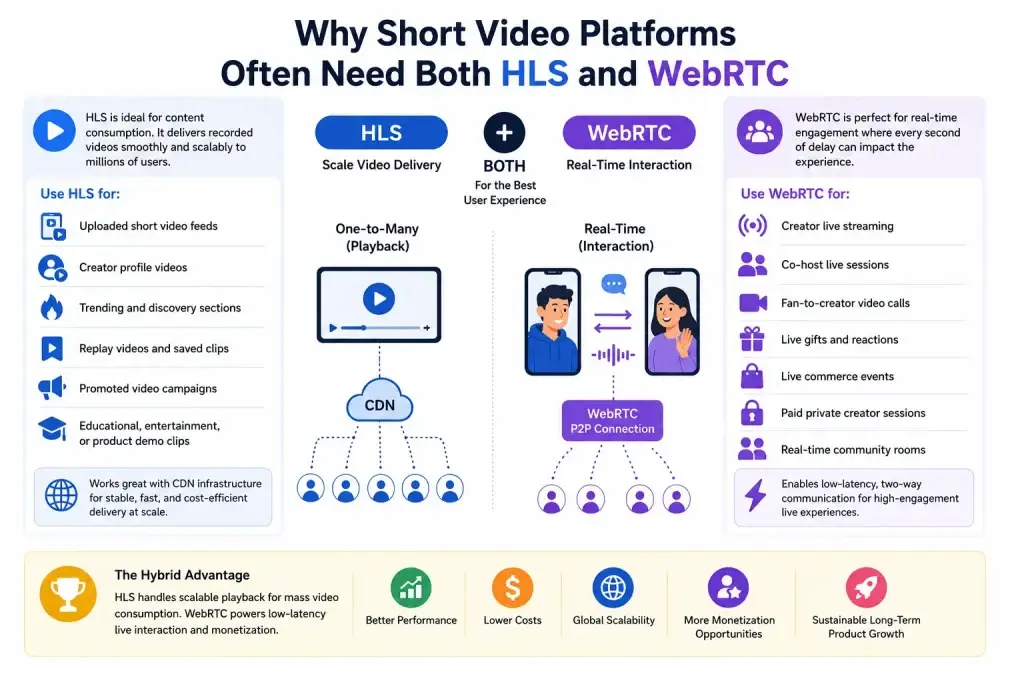
A strong short video platform usually needs both HLS and WebRTC because every video experience inside the app has a different purpose. Some features are built for large-scale video consumption, while others are built for live interaction between creators and users. If a founder uses only one streaming approach for the entire platform, the app may either become too slow for live engagement or too expensive for normal video playback.
HLS is more suitable for the content consumption side of a short video app. This includes the parts of the platform where users are mainly watching recorded videos, scrolling through feeds, discovering creators, or replaying saved content. In these cases, the goal is not instant two-way communication. The goal is smooth playback, stable quality, and scalable delivery across many users.
A TikTok-like app can use HLS for:
- uploaded short video feeds
- creator profile videos
- trending and discovery sections
- replay videos and saved clips
- promoted video campaigns
- educational, entertainment, or product demo clips
These areas need reliable video delivery because users expect videos to start quickly and play without buffering. Since HLS works well with CDN infrastructure, it is practical for serving recorded videos to a large audience across different regions and devices.
WebRTC is more useful for the interactive side of the platform. It becomes important when users expect live responses from creators or when the experience depends on real-time communication. This includes features where even a few seconds of delay can affect engagement.
A short video app can use WebRTC for:
- creator live streaming
- co-host live sessions
- fan-to-creator video calls
- live gifts and reactions
- live commerce events
- paid private creator sessions
- real-time community rooms
This hybrid setup gives founders a more balanced architecture. HLS handles scalable playback for mass video consumption, while WebRTC supports low-latency live engagement. Together, they help the platform manage performance, cost, scalability, creator monetization, and long-term product growth more effectively.
How Streaming Protocol Choice Affects Cost, Scalability, and User Experience
For a short video app, streaming technology is not only a backend decision. It directly affects how much the platform costs to run, how smoothly users watch videos, how creators interact with audiences, and how well the app scales as traffic grows.
HLS is usually more practical for large-scale video playback because it works well with CDN-based delivery. This means recorded videos can be distributed from servers closer to the user, reducing pressure on the main backend. When thousands of users are watching uploaded clips, trending videos, creator profiles, or replay content, HLS helps keep playback stable and more cost-efficient.
WebRTC works differently. It is better for real-time interaction, but it needs stronger infrastructure planning. Live rooms, co-host sessions, video calls, and private creator streams require low-latency media handling. As more users join live sessions, the platform must manage server load, connection quality, bandwidth usage, and session stability carefully.
The impact can be seen in three areas:
- Cost: HLS is usually more efficient for mass playback, while WebRTC can cost more when many real-time sessions are active.
- Scalability: HLS is easier to scale for recorded content, while WebRTC needs a stronger backend for live interaction.
- User experience: HLS supports smooth video viewing, while WebRTC supports faster creator-user engagement.
For founders, the main question is not which protocol is cheaper. The better question is: where does the app need scalable playback, and where does it need real-time interaction? A balanced short video platform should use the right protocol for the right feature.
Read More : How to Launch a TikTok Clone Startup With the Right Product Strategy
WebRTC vs HLS Short Video App Decision Framework
Founders should not choose a streaming protocol only by comparing technical terms. The better approach is to map each app feature to the user experience it needs. Some areas need reliable video delivery at scale, while others need instant communication between creators and users.
| App Area | Recommended Streaming Choice | Practical Reason for Founders |
|---|---|---|
| Main short video feed | HLS | The feed needs fast loading and stable playback as users swipe through multiple recorded videos. |
| Creator profile gallery | HLS | Profile videos are usually pre-uploaded, so smooth replay matters more than real-time response. |
| Trending and viral videos | HLS | High-view content needs efficient distribution because traffic can rise suddenly. |
| Saved videos and watch history | HLS | These are repeat-viewing experiences, so the platform should keep playback simple and cost-efficient. |
| Discovery and category pages | HLS | Users may browse many videos quickly, so adaptive playback helps maintain a smoother experience. |
| Creator live rooms | WebRTC | Live rooms need low delay so creators can respond to comments and audience activity naturally. |
| Co-host sessions | WebRTC | Multiple participants need real-time audio and video sync, otherwise the conversation feels broken. |
| Live gifts and reactions | WebRTC | Faster delivery helps creators acknowledge gifts, reactions, and fan activity at the right moment. |
| Paid private video calls | WebRTC | Two-way communication needs a real-time connection to feel personal and professional. |
| Live shopping events | WebRTC or hybrid | WebRTC helps with instant product interaction, while HLS can support larger passive audiences. |
This decision framework makes the streaming choice more practical. HLS should support the parts of the app where users mainly watch recorded content. WebRTC should support the moments where users and creators interact live.
Common Mistakes Founders Make When Choosing Streaming Technology
Many founders make the mistake of treating every video feature inside a short video app as the same. A short video feed, replay section, creator live room, co-host stream, and private video call all involve video, but they do not need the same streaming setup. Each feature has a different purpose, user expectation, and technical requirement.
Some common mistakes include:
- Using only HLS for every feature can create delays in live interaction, especially during live gifts, comments, creator replies, and co-host sessions.
- Using WebRTC for normal feed playback can make the platform more complex and expensive, even when real-time communication is not needed.
- Ignoring future traffic growth can create problems when video uploads, live sessions, creator activity, and user traffic increase.
- Choosing technology without mapping features can lead to poor performance because recorded videos and live interactions need different delivery methods.
The smarter approach is to plan streaming architecture by feature and growth stage. Use HLS for scalable playback, WebRTC for live interaction, and keep the system flexible enough to support advanced creator features later.
Best Streaming Setup for a TikTok Clone or Short Video Platform
For most TikTok-like apps, a hybrid streaming model is the strongest setup.
HLS can be used for the main video consumption experience. This includes uploaded videos, For You-style feeds, profile clips, replay content, and discovery pages. It helps the platform deliver videos smoothly to a large audience.
WebRTC can be used for real-time creator features. This includes live streaming, co-hosting, paid private rooms, fan interaction, virtual gifting, and live commerce.
This setup gives the platform both stability and engagement. Users can scroll through videos smoothly, while creators can also run live interactive sessions when needed.
A strong architecture may include:
- HLS for feed-based video playback
- CDN support for scalable delivery
- adaptive bitrate streaming for network flexibility
- WebRTC for low-latency live features
- media server support for real-time sessions
- moderation tools for live and recorded content
- analytics to track watch time, skips, replays, and live engagement
This type of setup is more practical than depending on one protocol for every use case.
Read More : White-Label TikTok Clone vs Custom Development : Which Saves More Time and Cost?
How Miracuves Helps Build Scalable Short Video Apps
Miracuves helps founders build short video apps with a practical streaming architecture that matches the platform’s business model, audience size, monetization plan, and future growth stage. Instead of treating a TikTok clone as only a video upload app, Miracuves focuses on the complete product ecosystem.
A scalable short video platform needs more than basic upload and playback. It should support smooth feed performance, creator profiles, live streaming, engagement tools, monetization modules, admin control, content moderation, and backend scalability.
Miracuves can help founders build platforms with:
- Video feed delivery for uploaded clips, trending videos, creator content, and discovery pages.
- Creator engagement tools such as likes, comments, shares, follows, live interaction, and community features.
- Live streaming support for creator sessions, real-time interaction, virtual gifts, and audience engagement.
- Monetization modules including ads, paid promotions, creator earnings, subscriptions, and gifting models.
- Admin dashboards to manage users, creators, videos, reports, payments, and platform activity.
- White-label customization so founders can launch the platform with their own branding, design, and business model.
This approach helps founders launch faster while keeping the platform ready for future upgrades. A startup can begin with core short video features and later expand into live commerce, paid creator sessions, advanced monetization, or real-time engagement as the business grows.
Final Thoughts
The WebRTC vs HLS short video app decision is not about choosing one technology over the other. Both play different roles in building a modern short-video platform.
HLS is better for scalable video playback. It works well for uploaded videos, vertical feeds, creator profiles, trending clips, and replay content because it can deliver videos smoothly to a large audience with stable performance.
WebRTC is better for real-time interaction. It supports live streaming, co-hosting, video calls, live gifts, private creator sessions, and interactive audience engagement where low latency is important.
For most TikTok-like platforms, the strongest approach is a hybrid setup. HLS can manage large-scale video delivery, while WebRTC can power real-time creator experiences and live monetization features.
Founders who understand this balance can build a short-video app that is faster, more scalable, creator-friendly, and ready for long-term growth.
If you are planning to launch a TikTok-like platform, Miracuves can help you build a scalable short video app with live streaming support, creator engagement tools, monetization modules, admin dashboards, and white-label customization designed for future growth.
FAQs
What is the main difference between WebRTC and HLS for short video apps?
The biggest difference is latency and use case. HLS is designed for scalable video playback, which makes it ideal for short video feeds, uploaded clips, trending videos, and replay content. WebRTC is designed for real-time communication, making it better for live streaming, co-hosting, creator interaction, and instant audience engagement.
Which streaming technology is better for TikTok-like video feeds?
HLS is usually the better choice for TikTok-style feeds because it supports adaptive streaming, smoother playback, and large-scale content delivery through CDN infrastructure. This helps short video apps handle thousands or millions of video views more efficiently.
Why do live creator features often need WebRTC?
Live creator experiences depend heavily on low latency. Features like live gifts, co-host sessions, fan interaction, video calls, and live shopping feel more natural when users receive responses instantly. WebRTC helps reduce delay, which improves engagement and creator-user interaction.
Should founders choose only one streaming protocol for a short video platform?
In most cases, no. Modern short video platforms often perform better with a hybrid setup. HLS can manage recorded video playback and feed delivery, while WebRTC can support real-time live experiences. Using both allows the platform to balance scalability, interaction quality, and infrastructure efficiency.
How does Miracuves help founders build scalable short video apps?
Miracuves helps founders build TikTok-like short video platforms with scalable video architecture, creator engagement features, live streaming support, monetization modules, admin dashboards, and white-label customization. The focus is not only on launching a video app quickly, but also on building a platform that can support future growth, creator interaction, and real-time engagement features.
Miracuves is an independent software development company. We are not affiliated with, connected to, sponsored by, or endorsed by any company or product named in this article.
Terms such as “X Clone” are used descriptively. It is how the software industry refers to building a platform with functionality comparable to a known service, and how clients search for it.
The entire design and codebase of our products is built by our own team. Our products contain no code, design, graphics, or content originating from any third-party website or applications.
All third-party names and marks referenced in this article are the property of their respective owners, referenced solely to identify the services discussed.