


Key Takeaways
- AI-powered content moderation is becoming essential for user-generated video apps because manual review alone cannot handle high upload volumes.
- Short video platforms need moderation systems that can detect harmful content, spam, nudity, violence, hate speech, and policy violations faster.
- Strong moderation improves user safety, creator trust, advertiser confidence, and long-term platform credibility.
- AI moderation works best when combined with human review, reporting tools, escalation workflows, and clear community guidelines.
- For TikTok-like apps, moderation is not just a safety feature; it directly affects retention, monetization, recommendation quality, and brand reputation.
Moderation Decision Signals
- Use AI moderation when the platform depends on large-scale video uploads, comments, live interactions, creator content, and community engagement.
- Add automated detection for videos, thumbnails, captions, hashtags, comments, profile images, and live-stream activity.
- Human review is still important for sensitive cases where context, culture, language, or intent cannot be judged accurately by AI alone.
- Moderation systems should support user reporting, appeal handling, admin review queues, violation history, and repeat-offender tracking.
- Development cost depends on AI detection models, review workflows, language coverage, live moderation needs, admin dashboards, and platform scale.
Real Insights
- A video app can grow quickly, but without moderation, harmful content can damage trust before the platform reaches scale.
- AI moderation helps platforms respond faster by filtering risky content before it spreads across feeds, shares, and recommendations.
- The strongest moderation systems do not block everything automatically; they balance automation with human judgment and clear policy control.
- Founders should plan moderation early instead of adding it later, because safety workflows become harder to fix after user growth begins.
- Successful TikTok-like platforms combine AI detection, human review, reporting tools, creator controls, policy enforcement, and scalable admin management.
User-generated video platforms have become one of the most influential digital products in today’s internet economy. Short-video apps, creator-led communities, livestream ecosystems, and entertainment-driven social platforms now shape how audiences consume content, discover trends, and interact online. But while recommendation algorithms and creator engagement systems receive most of the attention publicly, another infrastructure layer quietly determines whether these platforms scale successfully or collapse under their own growth — content moderation.
Modern video ecosystems operate at enormous speed. Thousands of uploads, comments, captions, audio clips, and livestream interactions may enter the platform every hour. In recommendation-driven environments, even a single harmful upload can spread rapidly across feeds before manual review teams are able to respond. Spam networks, fake engagement, explicit content, hate speech, manipulated trends, and copyright abuse can slowly damage user trust if moderation systems are unable to react quickly and consistently.
This is why AI-powered content moderation has become essential for modern user-generated video apps.
Today’s platforms cannot rely only on community reporting or manual moderation workflows anymore. AI moderation systems now help platforms analyze content behavior continuously, identify suspicious activity patterns, reduce unsafe exposure, and maintain healthier recommendation ecosystems at scale.
For businesses building TikTok-like platforms, moderation is no longer just a backend safety feature. Modern platforms also need scalable creator ecosystems, recommendation-ready infrastructure, and operational systems capable of supporting long-term growth. Businesses exploring a TikTok Clone Solution must now treat moderation as a core operational layer directly connected to platform trust, creator retention, advertiser confidence, feed quality, and long-term scalability.
Why Moderation Has Become a Growth Problem Not Just a Safety Problem
Many startups initially treat moderation as a policy requirement rather than a product infrastructure challenge. That approach usually works only during the earliest growth stage when content volume remains manageable. But recommendation-driven video ecosystems behave very differently once user activity begins scaling aggressively.
The problem is not simply that harmful content exists. The real problem is distribution speed.
Recommendation engines continuously amplify videos based on watch time, shares, comments, replay behavior, and interaction velocity. If unsafe or manipulative content enters this cycle unchecked, algorithms may unintentionally increase its visibility before moderators even review the upload.
Over time, this begins affecting the entire platform ecosystem.
Spam-heavy creator accounts start exploiting engagement systems. Fake viral trends distort recommendation quality. Toxic comment environments reduce creator trust. Copyright abuse spreads through repost networks. Eventually, users stop trusting the feed itself because content quality becomes inconsistent.
This is why moderation is now directly connected to platform growth.
Healthy recommendation systems depend on healthy engagement signals. Once manipulated activity starts influencing the algorithm regularly, recommendation quality weakens across the platform. Retention, creator confidence, advertiser trust, and monetization stability all begin declining gradually.
For modern video platforms, moderation is no longer isolated from product strategy. It has become part of the recommendation infrastructure itself.
What AI-Powered Moderation Actually Does Inside a Video Platform
AI moderation works as a continuous monitoring layer operating across the entire ecosystem instead of reacting only after user complaints appear.
Traditional moderation workflows were mostly reactive. Harmful content would spread first, users would report it later, and review teams would manually evaluate the issue afterward. That process becomes too slow inside high-speed recommendation ecosystems.
Modern moderation systems operate differently.
Instead of focusing on one type of violation alone, AI systems evaluate multiple signals simultaneously across uploads, engagement behavior, communication patterns, and account activity.
| Platform Signal | Moderation Purpose |
|---|---|
| Video visuals | Detect explicit or dangerous material |
| Spoken audio | Identify threats, abuse, or harmful speech |
| Captions and comments | Monitor scams, harassment, and toxic behavior |
| User activity patterns | Detect bots, fake accounts, or manipulation |
| Media reuse behavior | Identify stolen or duplicated content |
| Engagement anomalies | Detect artificial growth or spam activity |
The important difference is that modern moderation systems analyze relationships between signals rather than depending only on isolated keyword rules or static filters.
This allows platforms to identify harmful behavior patterns much earlier.
Why Short-Video Platforms Face More Complex Moderation Challenges
Video apps operate differently from traditional social platforms because multiple forms of communication exist inside one upload simultaneously.
A single short-form video may contain:
- Visual content designed to bypass moderation filters through edits, overlays, or altered formatting techniques.
- Spoken communication that may contain threats, abuse, misinformation, or harmful instructions hidden within audio.
- Captions, hashtags, and comments that manipulate trends, spread scams, or coordinate spam behavior.
- Artificial engagement activity intended to influence recommendation visibility unfairly.
This complexity makes moderation far more difficult than filtering text posts or comment sections alone.
The challenge becomes even harder because harmful behavior constantly evolves. Spam networks adapt quickly. Manipulative creators experiment with coded language. Fake engagement systems become more sophisticated. Harmful content creators continuously search for ways to bypass moderation rules while still benefiting from recommendation algorithms.
Static moderation systems struggle badly in these environments because modern platform abuse evolves faster than traditional filtering methods.
How AI Detects Unsafe Content Before It Spreads Widely
Modern moderation systems combine several technologies together to identify suspicious behavior before large-scale distribution occurs. Instead of depending on one detection layer, scalable video platforms use multiple systems operating simultaneously across uploads and engagement activity.
Visual Analysis Through Computer Vision
Computer vision models help moderation systems interpret what appears inside uploaded videos. These systems analyze frame patterns, object relationships, motion behavior, and contextual visual signals rather than relying only on isolated screenshots.
This helps platforms identify:
- Explicit or adult material that violates platform safety standards while reducing inconsistent moderation decisions across uploads.
- Graphic violence, dangerous behavior, or harmful visual activity that may create user safety or advertiser suitability risks.
- Manipulated visuals designed to bypass moderation filters through cropping, overlays, or editing techniques.
Modern moderation systems increasingly focus on contextual interpretation because harmful creators regularly adapt visual formats to avoid detection.
Language and Communication Analysis
Earlier moderation systems mostly depended on blocked keywords and static phrase matching. That approach struggles badly inside modern creator ecosystems where users constantly change slang, coded language, and communication patterns to bypass filters.
Newer moderation systems evaluate conversational structure, repeated behavior patterns, intent signals, and contextual relationships between interactions.
This helps platforms detect:
- Coordinated harassment or toxic behavior targeting specific creators or communities repeatedly over time.
- Scam promotion and manipulative messaging spreading through comments, captions, or creator interactions.
- Hate speech patterns hidden behind evolving slang, indirect phrasing, or coded communication styles.
The goal is no longer simply detecting restricted words. The goal is understanding harmful behavior patterns more accurately across evolving conversations.
Speech Recognition and Audio Monitoring
Audio moderation has become increasingly important because creators now communicate heavily through spoken content instead of visible text alone.
Many harmful users intentionally avoid captions or on-screen language while communicating verbally inside videos. Without audio moderation, large portions of unsafe content remain invisible to traditional detection systems.
Speech recognition infrastructure now helps platforms evaluate:
- Threatening or abusive communication hidden within spoken conversations.
- Explicit discussions or harmful instructions delivered verbally inside creator videos.
- Scam promotion, manipulated narratives, or coordinated misinformation campaigns spreading through audio content.
As short-video ecosystems become more voice-driven, audio analysis is becoming a critical moderation layer instead of an optional enhancement.
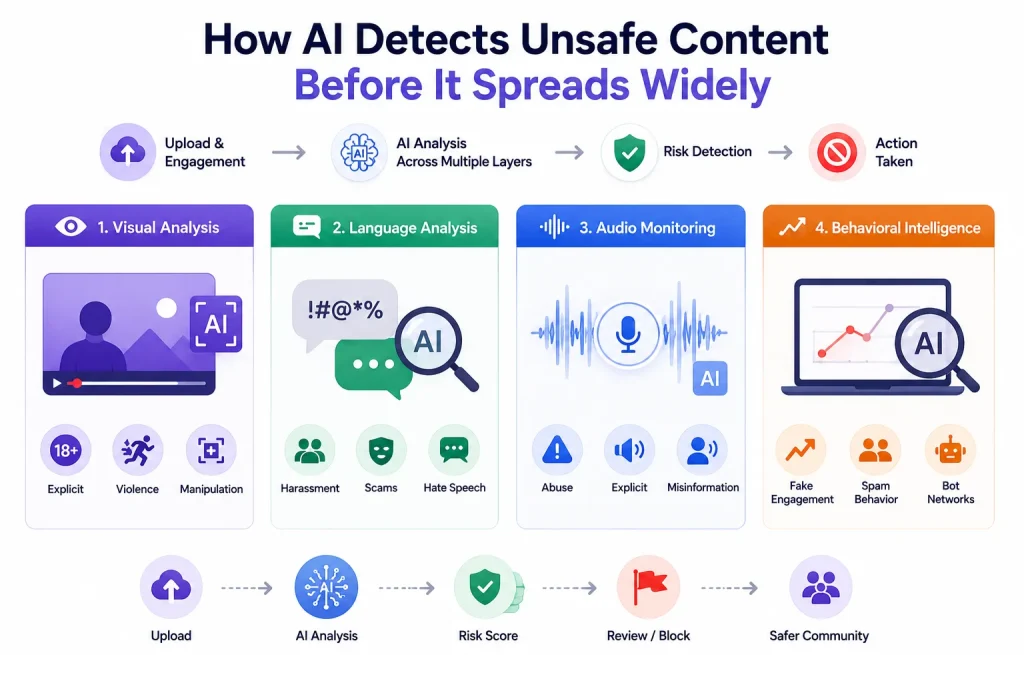
Behavioral Intelligence and Fake Engagement Detection
Some of the most damaging moderation threats do not come from content itself. They come from artificial behavior designed to manipulate recommendation systems.
Behavioral intelligence systems monitor abnormal platform activity continuously.
| Behavioral Pattern | Possible Ecosystem Risk |
|---|---|
| Sudden interaction spikes | Artificial engagement inflation |
| Repeated automated commenting | Spam distribution behavior |
| Coordinated account creation | Fake profile ecosystems |
| Repetitive device activity | Manipulation networks |
| Aggressive upload frequency | Automated spam campaigns |
This matters because recommendation engines depend heavily on engagement signals. If fake interactions distort the ecosystem consistently, algorithm quality eventually becomes unreliable for real users.
Recommendation pollution is one of the biggest long-term risks for growing short-video platforms.
The Relationship Between Recommendation Quality and Moderation Quality
Recommendation systems and moderation systems are now deeply connected operationally.
A recommendation engine can only produce healthy feeds when the underlying engagement environment remains trustworthy. If spam behavior, manipulated interactions, fake virality, or unsafe content begin influencing engagement patterns regularly, recommendation quality starts degrading slowly across the platform.
This creates a dangerous feedback loop.
Low-quality content often generates strong short-term engagement because outrage, controversy, and manipulation attract rapid interaction. Algorithms may initially interpret those signals as positive performance indicators.
Without strong moderation systems:
- Harmful trends may spread faster than legitimate creator content.
- Spam creators may dominate visibility through manipulated engagement tactics.
- Fake virality may distort recommendation accuracy for genuine users.
- Toxic environments may reduce long-term creator participation across the platform.
Platforms like TikTok invest heavily in moderation infrastructure because recommendation quality cannot remain stable inside unhealthy ecosystems.
For businesses building video apps today, moderation is no longer separate from feed engineering. Both systems influence each other continuously.
Why Large Platforms No Longer Depend on Human Moderation Alone
Manual moderation still plays an important role in appeals, nuanced policy decisions, and context-sensitive cases where automated systems may struggle. However, modern video ecosystems generate far more activity than human review teams can realistically process alone.
The strongest platforms no longer choose between AI and human moderation. They divide responsibilities strategically.
Automation handles scale and speed. Human reviewers handle judgment and nuance.
| Operational Challenge Inside Video Apps | Automated Moderation Advantage |
|---|---|
| Harmful content spreads faster than review teams react | AI systems analyze activity during distribution itself |
| Spam behavior distorts recommendation signals | Behavioral models identify suspicious activity patterns early |
| Large upload volumes overwhelm review operations | Automated systems scale continuously across ecosystems |
| Moderation delays weaken creator trust | Faster detection reduces harmful exposure windows |
This layered moderation structure allows platforms to react faster without removing human oversight entirely.
The goal is not replacing moderation teams. The goal is preventing unsafe content from spreading faster than platforms can control it.
Copyright Abuse Is Becoming Harder to Control
Copyright moderation is becoming increasingly difficult as creator economies grow larger and more competitive. Reuploaded edits, unauthorized music usage, stolen clips, livestream recordings, and copied creator content can spread quickly through recommendation systems before original owners even notice the issue.
This creates both legal and platform trust problems.
Modern moderation infrastructure now helps platforms:
- Compare upload similarity patterns to identify suspicious repost behavior across creator ecosystems.
- Detect reused media fragments and repeated unauthorized distribution activity.
- Reduce monetization abuse involving stolen or duplicated creator content.
- Protect creator confidence by supporting stronger ownership enforcement systems.
For businesses launching TikTok-like platforms, copyright moderation is becoming as important as engagement management and recommendation infrastructure.
What Happens When Moderation Systems Fail
Weak moderation systems damage much more than community safety alone. They gradually weaken the entire operational quality of the platform.
Advertisers become cautious when unsafe content appears beside sponsored campaigns. Professional creators lose confidence when spam networks and abusive interactions dominate engagement spaces. Users also begin distrusting recommendation quality once feeds become overloaded with manipulative or low-value content.
Over time, moderation failures can create:
- Platform-wide trust decline as recommendation feeds become increasingly inconsistent and spam-heavy.
- Creator retention problems caused by toxic interaction environments and repeated abuse exposure.
- Monetization instability as advertisers avoid unpredictable or unsafe content ecosystems.
- Regulatory pressure from governments demanding stronger digital safety enforcement standards.
The biggest long-term risk is ecosystem instability. Once users stop trusting feed quality, recommendation systems become significantly harder to recover.
This is why successful video platforms increasingly treat moderation as foundational infrastructure rather than only a policy department.
How Modern Moderation Pipelines Usually Operate
Large-scale moderation systems typically operate through layered review pipelines instead of isolated moderation checkpoints.
A modern moderation workflow often includes:
- Upload-stage analysis that evaluates videos, speech, captions, and behavioral signals before content distribution expands.
- Automated risk scoring systems that prioritize suspicious uploads for deeper moderation review.
- Continuous monitoring across recommendation feeds, trending systems, and engagement activity after publication.
- Human escalation processes for appeals, policy-sensitive cases, and contextual moderation decisions.
- Community reporting systems that help improve moderation accuracy and identify emerging harmful behavior patterns.
This layered structure helps platforms balance scalability, moderation speed, and decision quality more effectively.
AI Moderation Still Has Important Limitations
Although moderation technology continues improving rapidly, AI systems still struggle with context interpretation in certain situations.
Satirical content, educational discussions, cultural references, documentary footage, or nuanced creator conversations may sometimes confuse automated systems. Harmful users also continuously evolve their tactics using synthetic media, coded language, manipulated visuals, and increasingly sophisticated spam strategies.
This is why successful moderation ecosystems still require:
- Continuous policy refinement as harmful behavior patterns evolve over time.
- Human oversight for nuanced moderation decisions involving context-sensitive content.
- Ongoing model training to improve accuracy across changing platform behavior.
- Operational adaptability instead of depending on static moderation rules.
The objective is not simply removing more content. The real objective is maintaining healthier ecosystems without damaging legitimate creator experiences.
How Miracuves Helps Businesses Build Moderation-Ready Video Platforms
Building a successful short-video platform today requires much more than video uploads, creator profiles, and recommendation feeds. As user-generated ecosystems grow, platforms also need operational systems capable of controlling spam activity, unsafe content, fake engagement, copyright misuse, and community-level trust challenges at scale.
This is where moderation-ready infrastructure becomes critical.
Miracuves helps businesses launch TikTok-like platforms designed for scalable creator ecosystems rather than basic video-sharing apps alone. The platform architecture is structured to support long-term operational growth across content management, creator workflows, engagement systems, reporting controls, and moderation governance.
Instead of treating moderation as a separate afterthought, modern video platforms increasingly integrate safety and trust systems directly into platform operations.
Miracuves platform solutions support areas such as:
- Creator and user management systems that help platforms monitor account activity, engagement behavior, and community interactions more effectively.
- Reporting and moderation workflows designed to support content review, unsafe activity monitoring, spam control, and scalable platform governance.
- Engagement infrastructure connected to recommendation-driven ecosystems where feed quality, trust signals, and user retention remain closely linked.
- Backend architecture capable of supporting future scalability as upload volumes, creator activity, and platform interactions continue growing.
For startups entering the short-video market, moderation infrastructure is no longer only about policy enforcement. It directly affects recommendation stability, advertiser confidence, creator retention, and overall platform credibility.
As user-generated video ecosystems become larger and more competitive, platforms that invest early in moderation-ready operational systems are often better positioned to scale sustainably over the long term. Businesses planning to launch scalable TikTok-like platforms can also contact the Miracuves team to discuss platform architecture, moderation workflows, creator ecosystem features, and long-term scalability requirements.
Conclusion
AI-powered content moderation is becoming one of the foundational systems behind modern user-generated video apps. As recommendation-driven platforms continue growing, harmful content, fake engagement, spam networks, copyright abuse, and toxic interactions can spread far faster than traditional moderation teams are able to respond manually.
Modern moderation infrastructure helps platforms detect unsafe activity patterns continuously across uploads, communication systems, recommendation environments, and behavioral ecosystems. More importantly, these systems help maintain healthier engagement signals, stronger creator trust, safer monetization environments, and more stable recommendation quality over time.
The future of short-video platforms will not be shaped only by how effectively recommendation algorithms distribute content. It will also depend on how intelligently moderation systems control the ecosystems those algorithms amplify.
FAQs
Why is AI moderation important for short-video apps?
AI moderation helps platforms detect harmful content, spam activity, fake engagement, and unsafe behavior before it spreads widely across recommendation feeds.
Can AI moderation detect hate speech and abusive language?
Yes, modern moderation systems can analyze captions, comments, and spoken audio to identify harassment, hate speech, threats, and toxic interactions.
How do video platforms detect fake accounts and bots?
Platforms use behavioral analysis systems to monitor suspicious engagement patterns, repetitive activity, mass account creation, and automated spam behavior.
Does AI moderation help recommendation algorithms?
Yes, moderation systems help reduce spam and manipulated engagement, which improves recommendation quality and keeps feeds more trustworthy for users.
Can AI moderation detect copyrighted content?
Modern moderation systems can identify reused media, duplicated uploads, unauthorized music usage, and suspicious repost activity across creator ecosystems.
Why can’t video platforms rely only on human moderators?
Manual moderation becomes difficult at large scale because short-video platforms process massive upload volumes every day. AI helps platforms respond faster while human reviewers handle complex decisions.
Miracuves is an independent software development company. We are not affiliated with, connected to, sponsored by, or endorsed by any company or product named in this article.
Terms such as “X Clone” are used descriptively. It is how the software industry refers to building a platform with functionality comparable to a known service, and how clients search for it.
The entire design and codebase of our products is built by our own team. Our products contain no code, design, graphics, or content originating from any third-party website or applications.
All third-party names and marks referenced in this article are the property of their respective owners, referenced solely to identify the services discussed.