


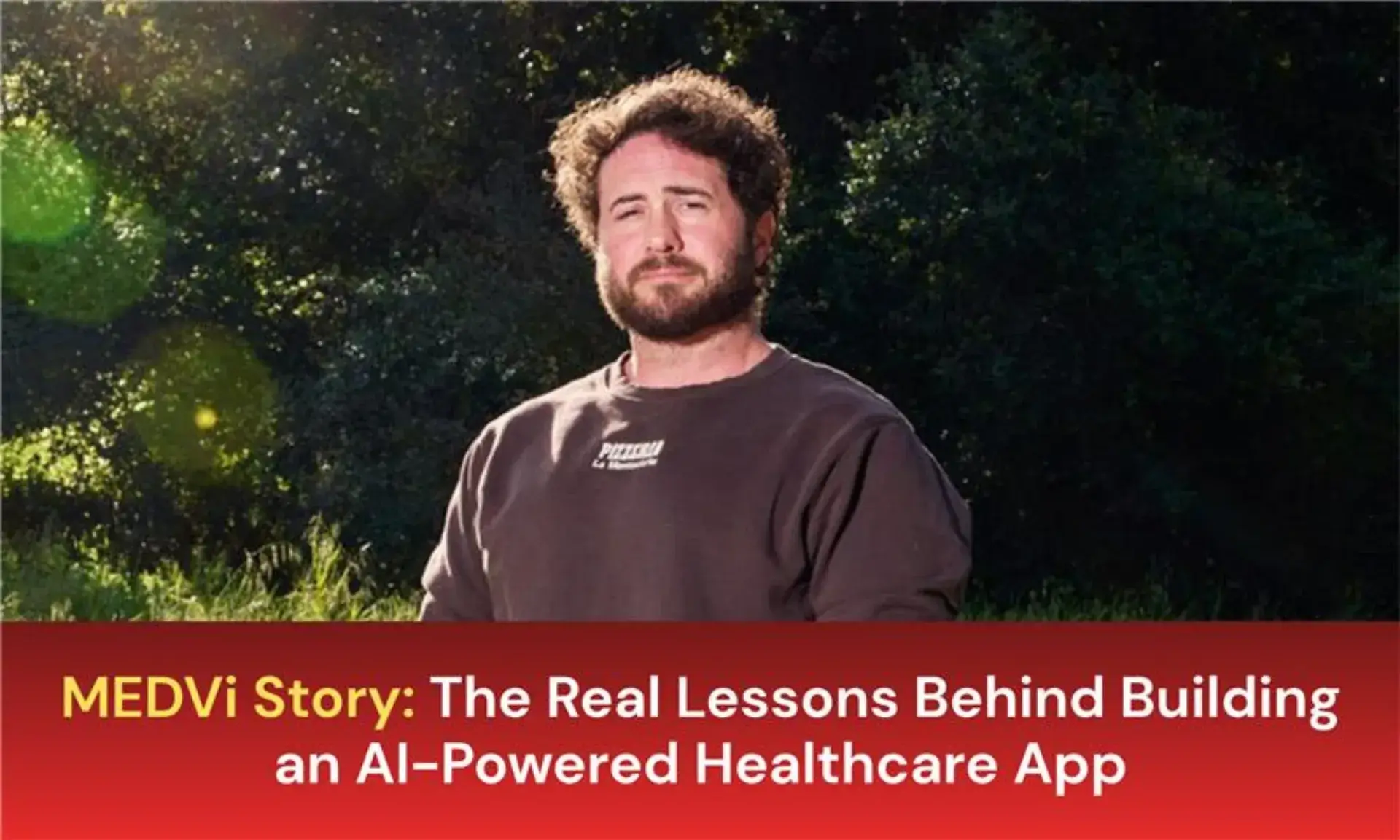
The recent MEDVi story has caught the attention of founders, marketers, and product teams because it combines two things that every startup wants: rapid growth and lean execution. Recent reporting described MEDVi as an AI-powered telehealth startup that reportedly generated $401 million in revenue and $65 million in profit in 2025, with projections pointing to a much larger 2026 sales run rate. At the same time, the company has also faced scrutiny around misleading claims, affiliate advertising practices, and regulatory risk. (Forbes)
That combination makes MEDVi more than just a news story. It turns into a case study for startup founders who want to build an AI-powered healthcare app. The lesson is not simply that AI can help a small team scale faster. The deeper lesson is that healthcare products do not succeed on speed alone. In this market, growth, trust, compliance, and product architecture have to move together. (Forbes)
Why the MEDVi story matters to startup founders
Many startup founders look at healthtech and see a huge opportunity. Demand for online consultations, personalized treatment journeys, recurring subscriptions, digital prescriptions, and chronic care support has created a strong market for telehealth innovation. When a company appears to grow quickly with AI, it naturally creates curiosity among entrepreneurs who want to build similar products. MEDVi’s recent coverage amplified exactly that kind of interest. (Forbes)
But healthcare is not a standard SaaS category. A founder can build a travel app, marketplace, or social product and fix some issues later. In healthcare, weak oversight can create legal, ethical, and trust problems very early. That is why MEDVi’s story should be studied carefully. It shows the upside of AI-led operations, but it also highlights what can happen when marketing, product claims, and governance do not stay tightly controlled. (Business Insider)
Lesson 1: AI can accelerate growth, but it cannot replace accountability
One of the biggest reasons MEDVi drew attention was the idea that a very small operation could use AI tools to move quickly across content, customer interaction, and marketing execution. For founders, this is an attractive concept. AI can absolutely reduce early operational friction. It can help teams generate first-draft content, improve support workflows, structure intake forms, summarize patient questions, assist internal operations, and speed up product planning. (Forbes)
However, healthcare is a category where “fast” is only valuable when the system remains accountable. Founders should treat AI as an accelerator, not as a substitute for clinical review, legal review, human oversight, or factual accuracy. If an app is using AI in patient communication, treatment education, or onboarding flows, there must be clear boundaries around what the system can say, what it cannot say, and when a licensed human must step in.
The main takeaway here is simple: AI can improve execution, but responsibility still belongs to the company.
Lesson 2: Healthcare app growth depends on trust, not just conversion
A lot of startup teams focus first on CAC, ad creatives, landing page performance, and conversion rates. Those things matter. But in healthcare, trust is not a soft brand concept. It is part of the product itself.
The FDA’s February 2026 warning letter to MEDVi stated that website content reviewed by the agency included false or misleading claims about compounded semaglutide and tirzepatide products. The letter specifically objected to claims such as “same active ingredient as Wegovy and Ozempic” and “same active ingredient as Mounjaro and Zepbound,” saying those claims could mislead consumers into believing the products had been FDA-approved or evaluated for safety and effectiveness when they had not. The letter also said website labeling suggested MEDVi was the compounder when it was not. (U.S. Food and Drug Administration)
For founders, this is a critical lesson. In healthcare, trust is shaped by every product and marketing layer:
- the wording on landing pages
- the claims in ads
- the treatment explanations inside the app
- the identity and credibility of medical professionals
- the clarity of consent and disclosure flows
- the reliability of follow-up communication
A healthcare app may look polished and convert well, but if users start questioning claims, provider legitimacy, or data handling, growth becomes fragile very quickly.
Lesson 3: Affiliate and acquisition channels need strong oversight
According to Business Insider’s reporting, some MEDVi affiliates appeared to use AI-generated or misleading doctor-style personas in Meta ads, and the company’s affiliate marketing became a major point of scrutiny. The report also noted concerns from watchdog groups and mentioned that the FTC expects advertisers to maintain reasonable oversight programs for affiliates, especially in high-risk areas like health marketing. (Business Insider)
This is one of the most practical founder lessons from the entire story.
Many digital health startups focus heavily on product design but underestimate acquisition governance. In healthcare, growth channels themselves need system design. That means a serious healthtech company should have:
- approved claim libraries
- ad review processes
- affiliate policies
- disclosure requirements
- escalation rules for non-compliant campaigns
- audit logs for marketing edits and approvals
In other words, compliance cannot sit outside the product. It needs operational infrastructure.
Lesson 4: A healthcare app is not just a front-end experience
Many founders imagine a healthcare app as a simple combination of user onboarding, appointment booking, payments, and chat. In reality, a scalable telehealth product is much deeper than that.
A strong AI-powered healthcare app usually needs multiple connected layers:
Patient onboarding
This includes intake forms, eligibility questions, medical history capture, consent collection, and identity verification. These flows must be structured carefully because they influence both safety and operational decisions.
Clinical workflow
This includes provider review, consultation logic, treatment pathways, escalation conditions, and follow-up protocols. A health app should make it easy for clinicians to act safely and consistently.
Prescription or treatment operations
If the business model involves prescriptions, compounded products, or treatment fulfillment, the backend must handle documentation, partner workflows, status tracking, and audit-ready recordkeeping.
Subscription and retention engine
Healthcare businesses often rely on recurring care journeys. That means subscription logic, refill management, reminders, adherence messaging, and support handoffs become central parts of the product.
Admin and compliance controls
Role-based access, claim approval workflows, marketing review logs, consent records, and event tracking should be part of the system architecture from the beginning.
Founders often lose time by thinking only about the user interface. The real strength of a healthcare platform comes from how the workflows are designed behind the interface.
Lesson 5: Brand credibility in healthtech is built through precision
A founder may think the biggest differentiator is AI, personalization, or speed to market. Those things matter, but in healthcare, credibility often comes from precision.
Precision means the product says exactly what it should say.
Precision means the system shows users what is approved, reviewed, and documented.
Precision means the company does not blur the line between education, promotion, and medical guidance.
The MEDVi situation shows how quickly credibility risk can grow when the market starts asking hard questions about representations, claims, or oversight. That is why founders should treat medical content, provider identity, treatment descriptions, and ad messaging as strategic infrastructure rather than simple content tasks. (Business Insider)
What founders should do before building an AI healthcare app
If a founder wants to build in this category, the right question is not, “How do we launch fast like MEDVi?” The better question is, “How do we design a product that can scale without breaking trust?”
A good starting framework looks like this:
Define the care model clearly.
Know whether the product is consultation-led, subscription-based, treatment-focused, diagnostic-supportive, or marketplace-driven.
Map every regulated touchpoint.
Identify where claims are made, where consent is required, where provider review happens, and where records need to be maintained.
Use AI selectively.
Apply AI where it improves internal speed or user experience, but keep clinical, legal, and safety boundaries explicit.
Build governance into the product.
Do not leave compliance as a spreadsheet or policy PDF. Put approvals, logs, permissions, and review systems into the platform itself.
Design for trust from day one.
Clear language, authentic provider representation, transparent disclosures, and reliable workflows matter as much as UI quality.
The bigger founder takeaway
The MEDVi story is compelling because it shows both sides of modern startup ambition. On one side, AI can dramatically increase speed, output, and operating leverage. On the other side, healthcare remains one of the most sensitive categories a founder can enter. Recent reporting and the FDA warning letter suggest that aggressive execution without enough control can expose a company to major trust and compliance issues. (Forbes)
For founders, the real lesson is not to fear AI. It is to build with maturity. The winners in digital health will not just be the fastest teams. They will be the teams that combine AI efficiency with strong product design, clear workflows, compliant communication, and long-term trust.
That is what building an AI-powered healthcare app really requires.
FAQ
What is MEDVi and why is it in the news?
MEDVi is a telehealth startup that has recently gained major attention because of its reported rapid growth, AI-led operations, and the wider discussions around healthcare marketing, compliance, and trust. For founders, it has become an important case study in how modern healthcare startups scale and where risks can appear.
What can founders learn from the MEDVi story?
The biggest lesson is that building an AI-powered healthcare app is not only about speed, automation, or fast growth. Founders also need to think about compliance, user trust, provider credibility, workflow design, and clear communication from the start.
Why is trust so important in a healthcare app?
Trust matters because healthcare users are sharing personal information, relying on treatment guidance, and making important decisions through the platform. If claims, communication, or provider representation feel unclear, users may lose confidence quickly.
Can AI help in healthcare app development?
Yes, AI can improve healthcare app development in many areas, such as onboarding support, internal automation, patient communication workflows, analytics, and operational efficiency. But AI should support the system, not replace human review, compliance checks, or responsible decision-making.
What features should an AI-powered healthcare app include?
A strong AI-powered healthcare app usually includes patient onboarding, consultation workflows, appointment or treatment tracking, subscriptions, secure payments, admin controls, consent collection, and compliance-focused data handling. The exact feature set depends on the care model and business goal.
Is building a telehealth app only about design and development?
No. A telehealth app also needs strong backend workflows, user trust systems, data privacy measures, provider-side operations, and compliance-aware communication. Good design is important, but healthcare products need a much deeper operational foundation.
Why should founders be careful with healthcare app marketing?
Healthcare marketing needs extra care because medical-related claims can affect user decisions in a highly sensitive category. Founders should make sure that landing pages, ad messages, and promotional content stay accurate, clear, and aligned with regulations.
How can startups build a better healthcare app from the beginning?
Startups should begin with a clear care model, define every regulated workflow, build trust-focused user journeys, use AI carefully, and include governance features such as approvals, logs, and role-based controls early in the product.