

Key Takeaways
- A short-form video platform backend should support feed growth, video uploads, media processing, live streaming, recommendations, engagement events, and sudden traffic spikes without slowing the user experience.
- Core backend components include scalable APIs, databases, caching, message queues, object storage, transcoding pipelines, CDN delivery, real-time services, and monitoring systems.
- Reliable architecture separates high-volume workloads so feed requests, video processing, live sessions, notifications, and analytics can scale independently as platform usage grows.
Backend Scaling Signals
- Feed services can use caching, candidate generation, ranking APIs, pagination, event streams, and distributed data stores to handle increasing users, videos, and personalization requests.
- Video upload pipelines should manage file validation, object storage, transcoding queues, compression, thumbnails, moderation, metadata processing, CDN publishing, and failed-job recovery.
- Live streaming requires real-time ingestion, stream processing, adaptive bitrate delivery, chat and engagement services, viewer concurrency management, and automatic scaling during high-demand broadcasts.
Performance & Reliability Insights
- Load balancing, autoscaling, CDN caching, database replication, rate limiting, queue-based processing, and graceful degradation help absorb sudden traffic spikes without overwhelming core services.
- Operators should monitor API latency, feed response time, upload failures, transcoding queues, stream health, concurrency, database load, cache hit rate, and infrastructure errors to detect bottlenecks early.
- Miracuves develops customizable short-form video platforms with scalable backend architecture, feed services, video processing, live streaming, CDN delivery, recommendations, analytics, monitoring, and admin controls.
Short-form video platforms look simple from the outside. A user opens the app, scrolls through a feed, watches videos, likes content, follows creators, joins live sessions, and uploads clips in a few taps.
Behind that smooth experience is a backend system doing heavy work every second.
A short-form video platform backend must handle video uploads, encoding, storage, feed ranking, playback delivery, live streaming, analytics, moderation, notifications, and admin controls at the same time. When the platform starts growing, this backend becomes the difference between smooth user retention and frustrating delays.
For founders, this matters because video platforms do not fail only because of weak design. They often fail because the infrastructure cannot keep up with creator activity, audience growth, or sudden traffic spikes.
Miracuves helps founders build a launch-ready short-form video platform with white-label branding, source code ownership, admin control, and scalable backend workflows. For founders who want to move faster, Miracuves’ ready-made delivery model can help launch a short-video solution in 6 days, while still keeping room for future customization and infrastructure upgrades.
Why Backend Planning Matters More in Short-Form Video Platforms
A normal social app may handle text posts, images, comments, likes, and notifications. A short-form video platform has a much heavier workload because almost every interaction involves media, behavior data, and real-time engagement.
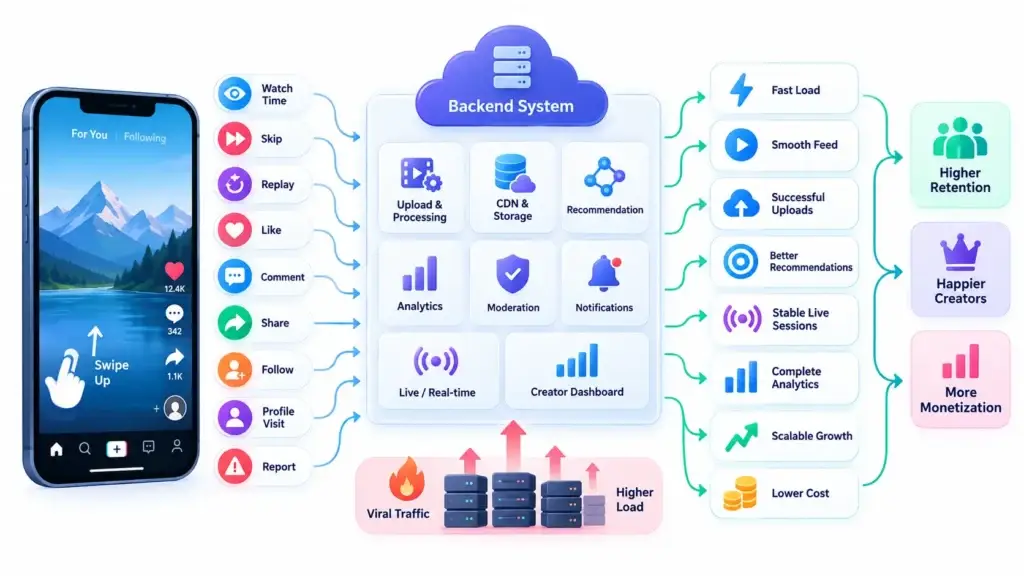
Every swipe can create multiple backend events. The system may need to record watch time, skip behavior, replay activity, likes, comments, shares, profile visits, follow actions, and content reports. These signals then feed into discovery, recommendation, analytics, moderation, and creator performance dashboards.
That means backend planning is not just a technical decision. It directly affects retention, creator satisfaction, infrastructure cost, and monetization potential.
If the backend is weak, users may experience:
- Slow video loading
- Feed lag
- Upload failures
- Delayed publishing
- Poor content recommendations
- Live session interruptions
- Missed notifications
- Incomplete analytics
- Higher infrastructure costs
A strong backend helps the platform stay responsive even when creator uploads increase, videos go viral, or thousands of users join at the same time.
The Core Backend Layers Behind a Growing Short-Form Video Platform
A scalable short-form video backend usually works through several connected layers. Each layer has a specific responsibility, and each one should be designed so it can scale independently as the platform grows.
| Backend Layer | What It Handles | Why It Matters for Growth |
|---|---|---|
| API gateway | App requests, authentication, routing, rate limits | Keeps traffic organized and protects backend services |
| User service | Profiles, accounts, follows, preferences | Supports personalization and identity control |
| Upload service | Video intake, file validation, upload sessions | Helps creators publish smoothly |
| Processing service | Compression, transcoding, thumbnails, moderation tasks | Keeps heavy work away from the main app experience |
| Feed service | Content ranking, recommendations, caching | Controls discovery and retention |
| Engagement service | Likes, comments, shares, saves, views | Captures signals for analytics and recommendations |
| Live stream service | Real-time video sessions, chat, gifts, moderation | Supports interactive creator experiences |
| Notification service | Push alerts, creator updates, engagement triggers | Brings users back into the app |
| Admin system | Users, content, reports, analytics, platform controls | Gives operators control over growth and safety |
Founders who want to understand how these backend layers connect with user-facing modules can explore the full list of short-video app features, including creator profiles, video uploads, engagement tools, admin controls, live streaming, and monetization workflows.
The key point is separation. Uploads, feeds, live sessions, notifications, analytics, and moderation should not all depend on one overloaded system. If one area becomes busy, the rest of the platform should continue working.
How the Backend Handles Feed Growth
The feed is the heart of a short-form video platform. It is where users discover creators, where videos gain traction, and where the platform learns what people want to watch.
As traffic grows, the backend cannot generate every feed from scratch in real time. That would become slow and expensive. Instead, a scalable feed system usually combines cached recommendations, user behavior signals, trending content, freshness logic, and personalized ranking.
A strong feed backend should consider:
- Watch duration
- Replays
- Skips
- Likes and comments
- Shares and saves
- Follow relationships
- Creator consistency
- Content freshness
- Location or language preferences
- Reported or restricted content
- Device and network performance
For early-stage platforms, the feed may begin with simple ranking rules. As the platform grows, the backend can evolve into more advanced recommendation workflows using behavioral signals, machine learning models, and a scalable video feed architecture that keeps discovery fast as content volume increases.
The goal is not just to show videos. The goal is to keep each scroll fast, relevant, and stable.
Poor recommendation logic can damage retention even when the app design looks polished. That is why founders should understand how AI-powered feed personalization affects discovery quality, user trust, watch time, and long-term engagement.
For founders exploring a launch-ready platform foundation, a natural next step is to review Miracuves’ <a href=”https://miracuves.com/tikok-clone/”>short-video app solution for creators and communities</a>. The blog should educate the reader first, while the money page explains the product path when they are ready to act.
How Video Uploads Move Through the Backend
Video uploads are one of the heaviest backend workflows in any creator platform. A user may upload a file in seconds, but the backend still needs to complete multiple steps before that video is fully ready for the feed.
Because video uploads involve storage, compression, transcoding, thumbnails, moderation, and delivery, founders should also understand how video hosting and infrastructure costs increase as creator activity grows.
A typical upload pipeline includes:
- The creator selects or records a video.
- The app validates file size, format, and duration.
- The upload service receives the file.
- The raw video is stored securely.
- A background job starts processing.
- The system compresses and transcodes the video.
- Thumbnails and preview assets are generated.
- Moderation checks are triggered.
- Metadata is stored.
- The video is prepared for CDN delivery.
- The content becomes eligible for feed distribution.
This process should not block the app. Creators should be able to continue using the platform while the backend processes their video in the background.
That is why queues and background workers are important. Instead of making the main app server handle video processing directly, the backend sends heavy tasks into a queue. Worker systems then process those tasks separately.
This improves upload reliability and protects the app from slowing down during high publishing activity.
Why Background Processing Is Critical for Upload Spikes
Upload spikes can happen for many reasons. A creator challenge may go viral. A campaign may encourage thousands of users to post. A regional event may trigger sudden content activity. Without background processing, the platform may struggle to keep up.
A queue-based backend helps by organizing heavy tasks such as:
- Video compression
- Multi-resolution transcoding
- Thumbnail generation
- Audio extraction
- Caption processing
- Content moderation checks
- CDN preparation
- Creator notifications
- Analytics updates
If upload volume increases, the platform can add more workers instead of overloading the main app server. This gives founders more control over performance and cost.
The backend should also include retry logic. If video processing fails because of a temporary issue, the system should retry safely rather than losing the upload or forcing the creator to start again.
How Live Streams Change Backend Requirements
Live streaming adds another layer of complexity because it is real-time. Uploaded videos can be processed in the background, but live sessions must work immediately.
A live streaming backend needs to manage:
- Stream creation
- Host authentication
- Viewer joining
- Real-time chat
- Reactions and gifts
- Moderation actions
- Stream quality monitoring
- Session recording if enabled
- Abuse reporting
- Network disruption handling
- Viewer count updates
- Creator earnings if monetization is active
Live streams also require stronger concurrency planning. A single creator session may suddenly attract many viewers. The backend must handle those viewers without breaking the stream, delaying chat, or losing engagement events.
For monetized platforms, live sessions may also include wallet deductions, virtual gifting, paid access, or creator payout records. These events must be processed carefully because they affect user trust and revenue accuracy.
If live streaming is part of the revenue plan, founders should connect backend decisions with the larger creator platform business model, including ads, subscriptions, virtual gifts, paid access, creator commissions, and payout workflows.
How Traffic Spikes Affect Short-Form Video Infrastructure
Traffic spikes are different from normal growth. Normal growth is gradual. Spikes happen suddenly.
A spike may occur when a video goes viral, an influencer joins the platform, a paid campaign starts, or a live event attracts many users at once. During these moments, the backend must absorb increased traffic without damaging the user experience.
The most common pressure points include:
- Feed requests
- Video playback requests
- Login and session activity
- Comments and likes
- Push notifications
- Live stream joins
- Search and profile visits
- Upload attempts
- Admin moderation queues
Traffic spike planning should include CDN delivery, caching, autoscaling, load balancing, database optimization, queue-based jobs, and rate limits.
This is where technical decisions become business decisions. If the platform cannot handle a viral moment, it may lose users at the exact time growth opportunity is highest.
The Role of CDN Delivery in Smooth Playback
Video playback should not depend only on the main server. If every user pulls video files directly from the origin server, infrastructure cost and latency can rise quickly.
A CDN helps deliver video from edge locations closer to users. This improves playback speed, reduces server load, and supports smoother viewing during high-traffic periods.
For a short-form video platform, CDN planning should consider playback quality, startup delay, and measurable performance signals. Founders can also review video platform performance benchmarks to understand why time to first frame, buffering, and first-load speed matter.
For a short-form video platform, CDN planning should consider:
- First-frame loading speed
- Cache hit ratio
- Regional latency
- Adaptive bitrate streaming
- Playback failure rate
- Rebuffering frequency
- Popular video caching
- Traffic routing during spikes
Feed experience depends heavily on playback performance. Even if the recommendation system is strong, users may leave if videos buffer too often or take too long to start.
How Caching Keeps the Feed Fast
Caching helps the backend avoid repeating the same expensive work again and again.
In a short-form video platform, caching can be used for:
- Trending feeds
- Popular creator profiles
- Frequently watched videos
- Hashtag pages
- Comment counts
- Like counts
- Viewer counts
- Recommendation batches
- Session data
- Regional content lists
Caching should be planned carefully. Some data can stay cached longer, while fast-changing data needs shorter cache rules.
For example, a trending feed can be cached briefly and refreshed often. A creator profile may be cached differently from real-time live viewer counts. The backend should balance speed with freshness.
How Databases Support Feed, Creator, and Engagement Growth
A video platform backend usually needs more than one type of data storage.
User profiles, account settings, reports, and payments may live in structured databases. Video files are usually stored in object storage. Engagement events may move through event streams or analytics pipelines. Search data may need a separate index. Cache data may sit in an in-memory system.
The database layer should support:
- Fast user profile lookup
- Feed metadata retrieval
- Engagement tracking
- Creator dashboards
- Comment storage
- Report and moderation history
- Payment or wallet records if monetization exists
- Analytics aggregation
- Admin search and filters
As the platform grows, database planning becomes more important. Indexing, read replicas, partitioning, and event-based data processing can help prevent slow queries and overloaded systems.
How Moderation Fits Into Backend Growth
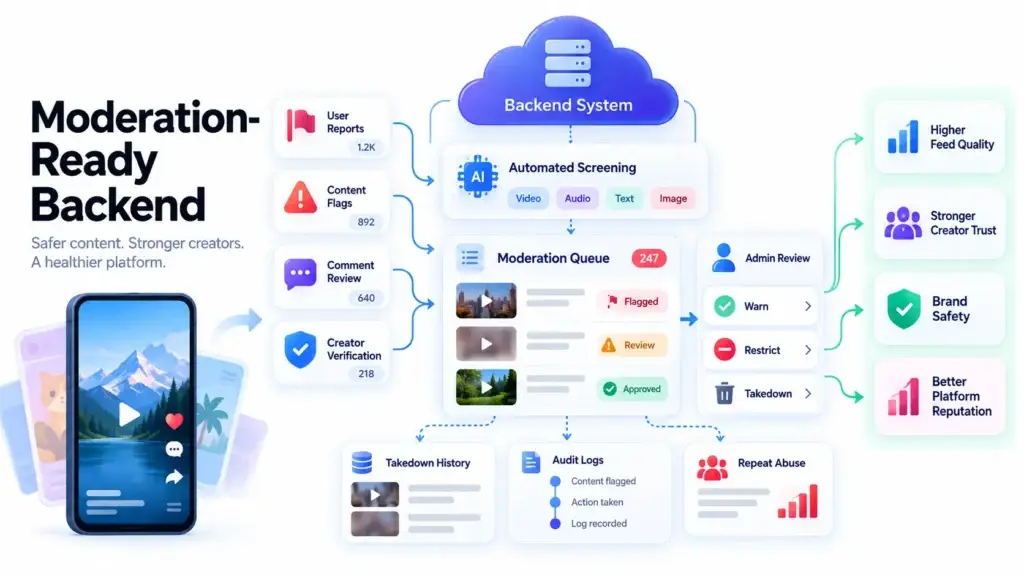
User-generated video platforms need moderation from the beginning. As upload volume increases, manual review alone becomes difficult.
A moderation-ready backend should support strong platform safety workflows. For deeper planning, founders can also review short-video app security practices around reports, access control, moderation, data protection, and admin permissions.
A moderation-ready backend should support:
- User reports
- Content flags
- Comment review
- Creator verification
- Admin review queues
- Automated screening workflows
- Warning and restriction actions
- Takedown history
- Audit logs
- Repeat abuse tracking
Moderation affects more than safety. It also affects feed quality, advertiser confidence, creator trust, and long-term platform reputation.
A founder should not treat moderation as a later feature. It should be part of the backend control layer from the first serious launch.
How Admin Controls Help Operators Manage Growth
A short-form video platform needs an admin dashboard that gives operators visibility and control.
The admin layer should help manage:
- Users and creators
- Uploaded videos
- Reported content
- Live sessions
- Hashtags and categories
- Monetization settings
- Featured content
- Push notifications
- App banners
- User restrictions
- Platform analytics
- Payment or payout workflows
- System health indicators
Without admin control, founders become dependent on developers for routine platform operations. That slows down decision-making and makes it harder to respond to abuse, growth, creator issues, or campaign opportunities.
Miracuves focuses on admin-ready platform foundations so founders can manage users, content, monetization, and operational workflows with more control after launch.
Founder Decision Signals for Backend Scalability
Feed Load
If feed requests are increasing faster than user registrations, the backend needs stronger caching, recommendation batching, and CDN-supported playback.
Creator Uploads
If creators upload frequently, video processing should move through queues, background workers, retry systems, and moderation workflows.
Live Activity
If live sessions are part of the business model, the backend must support real-time chat, reactions, viewer joins, gifting events, and moderation controls.
Traffic Spikes
If campaigns, influencers, or viral content are expected, the backend should include autoscaling, rate limits, monitoring, and fallback planning.
Ready-Made Foundation vs Building Every Backend Module From Zero
Founders usually have two paths.
They can build every backend module from zero, which gives complete flexibility but requires more planning, development, QA, and infrastructure decisions. Or they can start with a ready-made foundation and customize it around their audience, branding, monetization model, and growth roadmap.
| Build Approach | Best For | Backend Advantage | Business Tradeoff |
|---|---|---|---|
| Custom build from zero | Highly unique product logic | Maximum control from the first line of code | Longer planning and development cycle |
| Ready-made foundation | Faster market validation | Core workflows already exist and can be customized | Needs careful customization to match the business model |
| Hybrid approach | Founders who want speed and flexibility | Launch faster, then extend infrastructure over time | Requires clear upgrade roadmap |
A ready-made platform foundation is useful when the founder wants to validate the market quickly without waiting for every module to be built from scratch. Founders who want implementation support can also work with a short-video app development partner instead of managing every backend, frontend, and infrastructure decision alone.
For founders comparing both routes, Miracuves offers a ready-made video-sharing platform that can be customized around branding, creator features, monetization, admin workflows, and backend growth needs.
Mistakes Founders Should Avoid
Treating the Backend as a Later Upgrade
Many founders focus first on UI and launch screens. That is understandable, but short-form video products become infrastructure-heavy quickly. If upload processing, CDN delivery, feed logic, and monitoring are weak, the app may struggle as soon as users become active.
Building a Feed Without Behavior Signals
A feed should not be a random list of videos. Even a simple early version should collect useful behavior signals such as views, skips, replays, likes, shares, and completion rates. These signals help the platform improve discovery over time.
Ignoring Upload Failure Recovery
Creators lose trust when uploads fail. A strong backend should include retry logic, processing status, error handling, and background jobs so uploads do not break during high activity.
Adding Live Streaming Without Moderation
Live sessions need moderation controls, reporting, session logs, and admin visibility. Without these systems, live content can become difficult to manage as the community grows.
Scaling Only After Performance Problems Appear
Waiting until users complain about buffering, lag, or failed uploads can damage retention. Scalability should be planned before traffic spikes happen, not after.
How Miracuves Helps Founders Launch Faster
Miracuves helps founders build short-form video platforms with a ready-made, white-label foundation that can support creator profiles, video uploads, feeds, engagement tools, live streaming, monetization workflows, admin control, and source code ownership.
The advantage is speed with control. Instead of starting every module from zero, founders can begin with a launch-ready base and customize it for their audience, brand, and business model.
Where relevant, Miracuves can help deliver a ready-made short-video solution in 6 days. This is especially useful for founders who want to validate demand faster, show investors a working product, or enter a market before spending months on initial development.
Final Thoughts
A short-form video platform backend is not just a technical layer hidden behind the app. It is the growth engine that keeps feeds fast, uploads reliable, live streams stable, and traffic spikes manageable.
For founders, the real question is not only whether the app can launch. The stronger question is whether it can keep working when creators publish more content, users scroll longer, live sessions become active, and viral traffic arrives without warning.
The right backend foundation should support feed growth, background video processing, CDN delivery, live streaming workflows, analytics, moderation, admin control, and future scalability.
Miracuves helps founders move from idea to launch faster with ready-made, white-label, source-code-owned app foundations designed for branding, admin control, monetization, and scalable platform growth.
FAQs
What is a short-form video platform backend?
A short-form video platform backend is the system that manages user accounts, video uploads, processing, feeds, engagement, live streams, notifications, storage, analytics, moderation, and admin controls behind the app.
Why do short-form video platforms need scalable backend infrastructure?
They need scalable infrastructure because video apps process heavy media files, frequent feed requests, real-time engagement, creator activity, and traffic spikes. Without scalable backend planning, users may face buffering, slow uploads, feed lag, or unstable live sessions.
How does a backend handle video uploads?
The backend receives the video file, stores the raw upload, sends processing tasks into a queue, compresses and transcodes the video, generates thumbnails, triggers moderation checks, prepares CDN delivery, and then makes the video ready for feed distribution.
Why are queues important in video platform backends?
Queues help move heavy tasks away from the main app server. This allows video encoding, thumbnail generation, moderation checks, notifications, and analytics updates to run in the background without slowing the user experience.
How does CDN delivery help short-video platforms?
A CDN delivers video content from edge locations closer to users. This helps reduce latency, improve playback speed, reduce server pressure, and support smoother performance during high-traffic periods.
What backend systems are needed for live streaming?
Live streaming needs stream management, real-time chat, viewer handling, reactions, gifting logic if monetized, moderation controls, abuse reporting, session monitoring, and scalable infrastructure for sudden viewer growth.
How can founders reduce backend development time?
Founders can reduce development time by starting with a ready-made platform foundation instead of building every backend module from zero. This allows faster launch, while still keeping room for customization, branding, monetization, and future scaling.
How does Miracuves support short-video platform development?
Miracuves helps founders launch short-video platforms with ready-made and white-label foundations that can include video uploads, creator profiles, feeds, live streaming, monetization workflows, admin control, source code ownership, and faster deployment.
Miracuves is an independent software development company. We are not affiliated with, connected to, sponsored by, or endorsed by any company or product named in this article.
Terms such as “X Clone” are used descriptively. It is how the software industry refers to building a platform with functionality comparable to a known service, and how clients search for it.
The entire design and codebase of our products is built by our own team. Our products contain no code, design, graphics, or content originating from any third-party website or applications.
All third-party names and marks referenced in this article are the property of their respective owners, referenced solely to identify the services discussed.