



In 2026, BigCommerce stands as one of the most respected open SaaS ecommerce platforms worldwide, supporting tens of thousands of online businesses across B2B and B2C markets. Founded in 2009 as a bootstrapped ecommerce solution, the company evolved into a publicly listed platform (NASDAQ: BIGC) by building the business model of BigCommerce around merchant flexibility, API-first architecture, and partner-led growth. Instead of locking sellers into a closed ecosystem, BigCommerce positioned itself as scalable commerce infrastructure.
This approach matters because modern founders are no longer just building online stores—they are building integrated commerce systems. The BigCommerce business model supports seamless connections with ERPs, CRMs, marketplaces, headless frontends, and cross-border payment solutions. By enabling ecosystems rather than controlling them, BigCommerce shows how platforms can scale while preserving customization, performance, and operational control.
For entrepreneurs exploring SaaS platforms, B2B marketplaces, or composable commerce products, studying the business model of BigCommerce offers a proven blueprint. At Miracuves, we often see founders struggle to balance flexibility with scale, and BigCommerce’s strategy provides clear, practical answers to that challenge.
How the BigCommerce Business Model Works
BigCommerce operates on a SaaS-first, API-driven commerce platform model designed to serve both fast-growing D2C brands and complex enterprise merchants. Unlike closed ecommerce systems, BigCommerce positions itself as a commerce operating system—handling core transaction logic while allowing merchants to customize everything around it.
At its core, the BigCommerce business model succeeds because it separates commerce functionality from experience design, enabling flexibility without sacrificing stability.
Core Business Model Framework
Type of Business Model
- SaaS subscription platform
- Open, composable commerce architecture
- Hybrid B2C + B2B commerce enablement
BigCommerce earns predictable recurring revenue while supporting a wide range of merchant use cases—from solo entrepreneurs to enterprise brands.
Value Proposition by User Segment
For Merchants
- Fully hosted ecommerce backend (catalog, checkout, payments, taxes)
- No transaction fees on standard plans
- Native support for headless commerce and multi-channel selling
- Strong B2B features (custom pricing, purchase orders, account hierarchies)
For Developers & Agencies
- Open APIs and SDKs
- Freedom to build custom frontends (React, Next.js, Vue)
- Deep integrations with ERP, CRM, PIM, and CMS tools
For Partners & App Providers
- Large merchant base to distribute apps and services
- Revenue sharing via BigCommerce App Marketplace
- Co-marketing and solution partnerships
Key Stakeholders & Their Roles
- Merchants: Generate subscription revenue and platform usage
- Developers & Agencies: Drive adoption through custom builds
- Technology Partners: Extend platform functionality
- BigCommerce: Maintains core infrastructure, compliance, and scalability
This multi-sided ecosystem creates reinforcing network effects—more merchants attract more partners, which increases platform value.
Evolution of the Model
- Early phase: SMB-focused hosted ecommerce platform
- Mid-stage: API-first transformation to support headless commerce
- Current (2026): Enterprise and B2B-led growth with composable commerce positioning
BigCommerce deliberately avoided becoming a closed marketplace, choosing flexibility over control.
Why the Model Works in 2026
- Merchants demand ownership over data and experience
- Composable commerce is now mainstream among mid-market and enterprise brands
- B2B ecommerce growth outpaces B2C in many regions
- Businesses want to avoid vendor lock-in while scaling globally
BigCommerce aligns with these realities by acting as infrastructure, not just software.
Read more : What is BigCommerce and How Does It Work?
Target Market & Customer Segmentation Strategy
BigCommerce’s growth is driven not by mass-market dominance, but by precision segmentation. Instead of competing head-on with beginner-focused platforms, BigCommerce targets merchants who have outgrown basic ecommerce tools and now need scale, flexibility, and integration depth.
This positioning shapes everything—from product features to pricing tiers and partner strategy.
Primary & Secondary Customer Segments
Primary Segment 1: Mid-Market & Enterprise Brands
- Annual online revenue: $1M–$100M+
- Industries: D2C retail, manufacturing, wholesale, SaaS-enabled commerce
- Needs: Custom checkout, ERP integration, multi-storefront management, global compliance
- Why they stay: Stability, extensibility, and long-term scalability
Primary Segment 2: B2B Commerce Businesses
- Manufacturers, distributors, wholesalers
- Complex pricing rules, bulk ordering, account-based access
- Fastest-growing segment for BigCommerce in 2025–2026
Secondary Segment: High-Growth SMBs
- Brands planning to scale internationally
- Merchants migrating from Shopify, WooCommerce, or Magento
- Often adopt BigCommerce during re-platforming phases
Customer Journey: From Discovery to Retention
Discovery
- Partner agencies and system integrators
- Content marketing around headless and B2B commerce
- Platform comparisons during re-platforming decisions
Conversion
- Free trials and sandbox demos
- Proof-of-concept builds with agencies
- Enterprise sales-assisted onboarding
Retention & Expansion
- Annual subscription renewals
- Upgrades to enterprise plans
- App marketplace adoption increases switching costs
BigCommerce optimizes lifetime value by embedding itself into a merchant’s tech stack rather than upselling aggressively.
Acquisition Channels by Segment
- SMBs: SEO, comparison content, app marketplace referrals
- Mid-Market: Agency partnerships, solution pages, webinars
- Enterprise & B2B: Direct sales, co-selling with tech partners, industry events
This channel diversification reduces dependency on paid acquisition.
Market Positioning & Competitive Edge
BigCommerce positions itself as:
- More flexible than Shopify
- Easier to manage than Magento
- More open than Salesforce Commerce Cloud
Its brand voice emphasizes freedom, performance, and extensibility—appealing to technical decision-makers rather than hobby sellers.
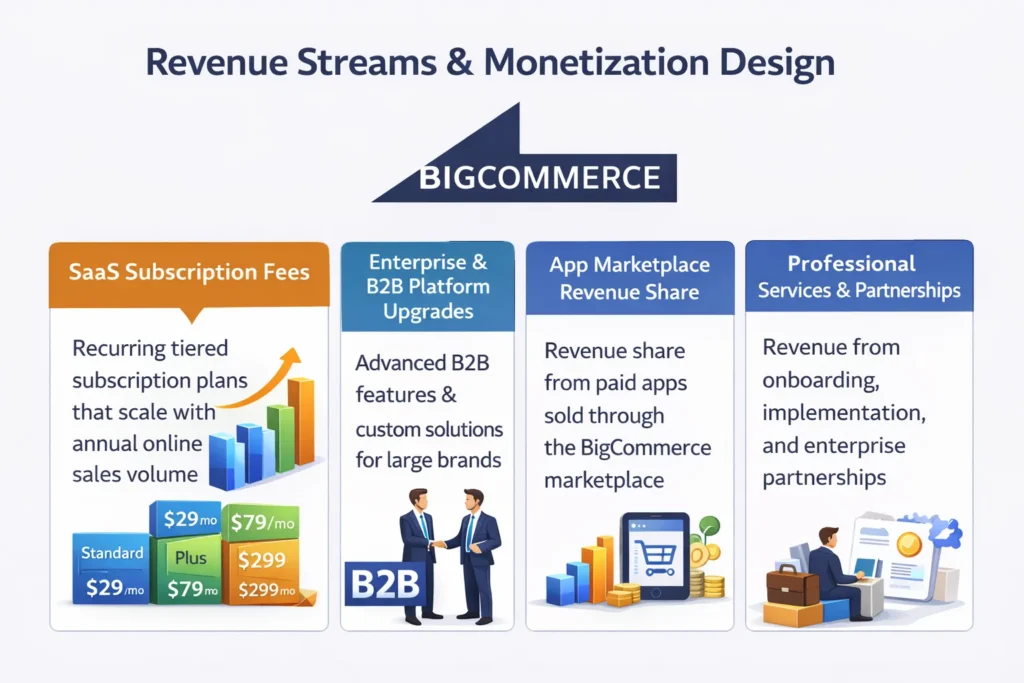
Revenue Streams and Monetization Design
Once BigCommerce solved merchant adoption and platform trust, monetization followed a predictable, SaaS-led revenue architecture. Unlike marketplaces that monetize transactions, BigCommerce earns primarily from access, scale, and infrastructure value—keeping merchant incentives aligned with growth.
This is a critical reason why larger brands adopt the platform long term.
Primary Revenue Stream 1: SaaS Subscription Fees (Core Engine)
Mechanism
Merchants pay a recurring subscription fee to access the BigCommerce platform. Pricing scales based on annual online sales volume, feature access, and support level.
Pricing Model (2026)
- Tiered monthly and annual plans
- Automatic plan upgrades triggered by revenue thresholds
- Custom enterprise pricing for large brands
Revenue Contribution
- Largest share of total revenue (majority of ARR)
- Highly predictable and renewal-driven
- Strong gross margins typical of SaaS platforms
Growth Trajectory
- Expansion into B2B commerce increases average contract value
- Enterprise migrations drive multi-year commitments
- Headless commerce adoption increases platform stickiness
This stream works because BigCommerce captures value before transactions scale, not after.
Secondary Revenue Stream 2: Enterprise & B2B Platform Upgrades
Mechanism
- Advanced B2B features
- Priority support and SLAs
- Dedicated account management
Revenue Impact
- Smaller in volume but higher in margin
- Strengthens retention among large clients
Secondary Revenue Stream 3: App Marketplace Revenue Share
Mechanism
- BigCommerce takes a percentage from paid apps sold via its marketplace
- Revenue shared with developers and technology partners
Strategic Value
- Expands platform functionality without internal development cost
- Increases switching costs for merchants
Secondary Revenue Stream 4: Professional Services & Partnerships
Mechanism
- Revenue from onboarding support and implementation partners
- Co-selling and referral-based enterprise deals
This stream reinforces ecosystem adoption rather than acting as a standalone profit center.
Overall Monetization Strategy
BigCommerce intentionally avoids:
- Transaction fees
- Ad-based monetization
- Data resale models
Instead, it focuses on:
- Long-term subscription value
- Ecosystem-driven expansion
- Predictable ARR growth
Pricing psychology emphasizes fairness and transparency, which resonates strongly with mid-market and enterprise buyers.
Read more : BigCommerce Revenue Model: How BigCommerce Makes Money in 2026
Operational Model & Key Activities
Behind BigCommerce’s clean merchant experience sits a highly disciplined operational engine. The company operates like a modern cloud infrastructure provider—prioritizing reliability, scalability, and compliance while continuously shipping platform improvements.
Unlike consumer apps, BigCommerce’s operations are optimized for uptime, security, and long-term merchant success, not short-term engagement metrics.
Core Operational Functions
Platform & Infrastructure Management
- Cloud-native, multi-tenant SaaS architecture
- High-availability hosting with global CDN support
- Continuous performance optimization for peak traffic events
Product Development & Engineering
- API-first development model
- Rapid iteration on B2B and headless commerce features
- Backward compatibility to protect merchant builds
Security, Compliance & Trust
- PCI DSS compliance for payments
- GDPR and regional data regulations
- Ongoing fraud prevention and platform monitoring
Merchant Support & Success
- Tiered customer support (self-serve → enterprise)
- Onboarding, documentation, and training resources
- Dedicated success managers for high-value accounts
Marketing & Growth Operations
- Content-led inbound marketing
- Partner co-marketing with agencies and tech vendors
- Enterprise sales enablement programs
Resource Allocation Strategy (2026 Estimates)
- Technology & Engineering: ~45–50%
- Sales & Marketing: ~30–35%
- Customer Success & Support: ~10–15%
- Operations, Legal & Compliance: ~5–10%
This allocation reflects BigCommerce’s belief that platform quality drives retention more than aggressive sales pressure.
Operational Advantage
By keeping its internal focus on infrastructure and ecosystem enablement, BigCommerce avoids the operational drag of:
- Logistics ownership
- Payment processing risk
- Inventory management
This allows the company to scale globally without exponential cost increases.
Strategic Partnerships & Ecosystem Development
BigCommerce’s long-term advantage is not just its software—it’s the ecosystem wrapped around it. Rather than building everything in-house, BigCommerce follows a deliberate partner-first strategy, allowing specialists to create value on top of its core platform.
This approach turns BigCommerce from a product into a commerce ecosystem.
Partnership Philosophy
BigCommerce believes its role is to be the best commerce engine, not the best at everything. By staying open and interoperable, it attracts partners that want freedom—not competition—from the core platform.
This philosophy accelerates innovation while keeping internal complexity under control.
Key Partnership Categories
Technology & API Partners
- CMS platforms (WordPress, Contentful, Bloomreach)
- Frontend frameworks (Next.js, React-based solutions)
- ERP, CRM, and PIM systems
Payment & Financial Partners
- Global payment gateways
- Buy-now-pay-later providers
- Tax and compliance solutions
Logistics & Fulfillment Alliances
- Shipping and order management platforms
- Inventory and warehouse systems
Agency & System Integrator Partners
- Certified development agencies
- B2B commerce consultants
- Regional implementation partners
Marketplace & Channel Integrations
- Amazon, eBay, social commerce channels
- Omnichannel retail connectors
Ecosystem Strategy & Competitive Moat
- More partners → more merchant value
- More merchants → stronger partner incentives
- High integration depth → high switching costs
BigCommerce monetizes this ecosystem indirectly through subscription retention, upsells, and marketplace revenue sharing, without damaging trust.
This ecosystem-led strategy creates durable network effects without the risks of a closed marketplace.
Read more : Best BigCommerce Clone Scripts 2025: Build a Scalable SaaS Ecommerce Platform
Growth Strategy & Scaling Mechanisms
BigCommerce’s growth story is not driven by viral consumer adoption. Instead, it scales through enterprise credibility, partner leverage, and platform depth. This makes its growth slower than consumer apps—but far more durable.
Primary Growth Engines
1. Partner-Led Expansion
- Agencies and system integrators bring high-intent merchants
- Partners act as sales, implementation, and retention channels
- Reduces customer acquisition cost while increasing deal size
2. B2B Commerce Acceleration
- Rising demand for digital wholesale platforms
- Strong adoption among manufacturers and distributors
- B2B contracts are typically larger and longer-term
3. Headless & Composable Commerce
- Adoption of modern frontend frameworks
- Decoupled architecture appeals to enterprise CTOs
- Drives platform stickiness and migration from legacy systems
4. Geographic Market Expansion
- Focus on North America, Europe, and APAC
- Localized compliance, tax, and payment support
- Regional partner enablement over direct offices
Scaling Challenges & Solutions
Challenge: Enterprise Sales Complexity
- Solution: Co-selling with agencies and solution partners
Challenge: Platform Performance at Scale
- Solution: Cloud-native architecture and continuous optimization
Challenge: Competitive Pressure from Larger Platforms
- Solution: Differentiation via openness, not price wars
Challenge: Regulatory and Data Compliance
- Solution: Proactive investment in global compliance frameworks
BigCommerce scales by deepening value per merchant, not by chasing volume alone.
Competitive Strategy & Market Defense
BigCommerce operates in one of the most competitive SaaS markets in the world. Its survival and growth depend on strategic differentiation, not scale dominance. Rather than fighting price wars, BigCommerce competes on architecture, flexibility, and long-term merchant value.
Core Competitive Advantages
Open & Composable Architecture
- Merchants are not locked into proprietary tools
- Easy integration with best-in-class third-party systems
- Strong appeal to CTOs and enterprise architects
Enterprise-Grade Performance & Reliability
- High uptime during traffic spikes
- Scalable checkout and catalog performance
- Trusted by high-revenue merchants
B2B Commerce Leadership
- Native B2B features that many competitors bolt on
- Designed for complex pricing, workflows, and approvals
Brand Trust & Platform Neutrality
- No competition with merchants
- No private-label products
- No ad-driven conflicts of interest
Market Defense Tactics
Handling New Entrants
- Focus on high-complexity use cases new players avoid
- Continuous investment in platform depth
Responding to Pricing Pressure
- Avoids undercutting; emphasizes ROI and TCO
- Targets merchants where switching cost is justified
Feature Rollout & Timing
- Releases based on enterprise demand, not trends
- Maintains backward compatibility to protect partners
Partnership & Acquisition Strategy
- Selective acquisitions that enhance core commerce capabilities
- Strategic integrations rather than ecosystem replacement
BigCommerce defends its position by being indispensable infrastructure, not a flashy tool.
Lessons for Entrepreneurs & Implementation
This is where BigCommerce’s story becomes most valuable for founders. Its success was not driven by hype, virality, or aggressive discounting—but by disciplined platform thinking. For entrepreneurs building SaaS apps, marketplaces, or infrastructure products, BigCommerce offers several replicable lessons.
Key Factors Behind BigCommerce’s Success
1. Solve for Scale Early
BigCommerce was architected to support complexity from the beginning—multi-storefronts, APIs, and enterprise workflows. This avoided painful rewrites later.
2. Monetize Access, Not Transactions
By charging subscriptions instead of transaction fees, BigCommerce aligned incentives with merchant growth rather than taxing success.
3. Build an Ecosystem, Not Just a Product
Partners, developers, and agencies became growth multipliers—not cost centers.
4. Focus on High-Value Customers
Instead of chasing millions of small sellers, BigCommerce concentrated on merchants with long lifecycles and higher retention.
Replicable Principles for Startups
- Design your app as infrastructure, not a feature bundle
- Keep the core product focused; extend via integrations
- Choose predictable revenue models early
- Let partners handle customization and regionalization
These principles apply equally to B2B SaaS, vertical marketplaces, and platform-based apps.
Common Mistakes to Avoid
- Locking users into rigid systems
- Over-monetizing too early
- Building features that partners could build better
- Ignoring enterprise or B2B needs until late-stage
BigCommerce avoided these traps by thinking long-term.
Adapting the Model for Local or Niche Markets
Founders can adapt this model by:
- Targeting a specific industry (healthcare, logistics, education)
- Offering modular pricing instead of flat plans
- Building API-first from day one
- Prioritizing compliance and trust in regulated markets
This is especially relevant in emerging markets where businesses leapfrog directly to modern platforms.
Implementation Timeline & Investment Priorities
Phase 1 :
- Core platform development
- Basic integrations
- MVP customer onboarding
Phase 2 :
- Partner ecosystem launch
- Advanced features for power users
- Monetization optimization
Phase 3 :
- Enterprise expansion
- Geographic scaling
- Ecosystem-led growth
Ready to implement BigCommerce’s proven business model for your market?
Miracuves builds scalable platforms with tested business models and growth mechanisms. We’ve helped 200+ entrepreneurs launch profitable apps. Get your free business model consultation today.
Conclusion
BigCommerce’s journey proves an important truth about platform businesses in 2026: sustainable growth comes from enabling others, not controlling them. By positioning itself as open commerce infrastructure rather than a closed ecosystem, BigCommerce built long-term trust with merchants, developers, and partners alike.
Its business model shows that predictability (subscriptions), flexibility (APIs), and ecosystem leverage (partners) can outperform flashy growth tactics over time. While competitors raced to own every layer of commerce, BigCommerce chose to own the core and empower the edges—a strategy that continues to compound value.
For founders, the bigger lesson is clear. The future of digital platforms is not about who controls the most users, but who enables the most sustainable businesses to grow on top of them.
As platform economies mature in 2026 and beyond, the winners will be those who design for scalability, trust, and collaboration from day one.
FAQs
What type of business model does BigCommerce use?
BigCommerce uses a SaaS-based ecommerce platform model where merchants pay recurring subscription fees. It focuses on open, API-first commerce rather than transaction-based monetization.
How does the BigCommerce business model create value?
It provides scalable commerce infrastructure while allowing merchants full flexibility over design and integrations. This reduces vendor lock-in and supports long-term business growth.
What are BigCommerce’s key success factors?
Open architecture, strong B2B capabilities, and predictable subscription revenue drive stability. A partner-led ecosystem further increases adoption and retention.
How scalable is the BigCommerce business model?
The SaaS infrastructure allows growth without proportional cost increases. Partners and integrations handle customization at scale.
What are the biggest challenges in this model?
Enterprise sales cycles are longer and competition is intense. Continuous investment in performance, security, and compliance is required.
How can entrepreneurs adapt this model to their region?
By focusing on a niche industry, offering modular pricing, and building API-first platforms. Local partnerships help with compliance and market adoption.
What are alternatives to the BigCommerce business model?
Transaction-fee marketplaces, closed ecommerce platforms, or open-source systems. Each trades flexibility for either control or faster early monetization.
How has BigCommerce’s business model evolved over time?
It evolved from an SMB store builder into an enterprise-grade composable commerce platform. B2B and headless commerce now drive its growth in 2026.
Related Article :