Key Takeaways
- Handmade marketplace platform features and cost factors should be evaluated around complete buyer, seller, payment, and operator workflows.
- Core features include seller onboarding, storefronts, product listings, search, checkout, orders, commissions, payouts, and admin controls.
- Development cost depends on platform coverage, design complexity, integrations, marketplace rules, customization, security, and scalability.
- Personalized, made-to-order, digital, and one-of-a-kind products require flexible catalogue and inventory management.
- Founders should compare operational completeness, ownership terms, and future flexibility—not only the initial price.
Founder Evaluation Signals
- Confirm whether buyer interfaces, seller dashboards, mobile apps, backend services, and admin controls are included.
- Test seller verification, storefront setup, listing approval, product variants, inventory, customization, and order management.
- Review multi-seller checkout, payment confirmation, commissions, refunds, seller balances, withdrawals, and payout reconciliation.
- Clarify costs for payment gateways, shipping providers, tax tools, notifications, analytics, localization, and custom integrations.
- Check source-code ownership, hosting control, documentation, deployment assistance, updates, and post-launch support.
Real Insights
- A polished storefront has limited value when seller approvals, refunds, commissions, and payouts still require manual work.
- Adding more features increases cost without improving the business when the core seller-to-payout journey remains unreliable.
- Low initial pricing can create higher long-term costs when customization rights, documentation, or source-code access are restricted.
- The right platform should support current launch needs while allowing future changes to categories, revenue rules, and seller operations.
- Miracuves develops white-label handmade marketplaces with buyer and seller workflows, multi-vendor commerce, admin controls, integrations, and source-code ownership.
Launching a marketplace for handmade products involves a different set of decisions from opening a conventional online store.
Instead of managing one catalog and one merchant account, the platform may need to support hundreds or thousands of independent makers. Each seller can have different products, inventory levels, processing times, shipping requirements, commissions, customer conversations, refunds, and payout balances.
That changes what founders should evaluate before choosing a marketplace platform.
A polished storefront matters, but it is only one layer. Seller onboarding, catalog control, search and discovery, payments, payouts, moderation, administration, and operational visibility can have a much greater impact on whether the marketplace remains manageable as it grows.
Cost works the same way. The number on an initial development quote rarely tells the whole story. Platform coverage, seller workflows, integrations, customization, mobile applications, payment complexity, admin requirements, infrastructure, and ownership can all affect the final scope.
This guide focuses on the questions founders should ask before launch: which marketplace capabilities actually matter, which ones can wait, and which decisions are likely to increase development cost.
Why Handmade Marketplaces Need Different Evaluation Criteria
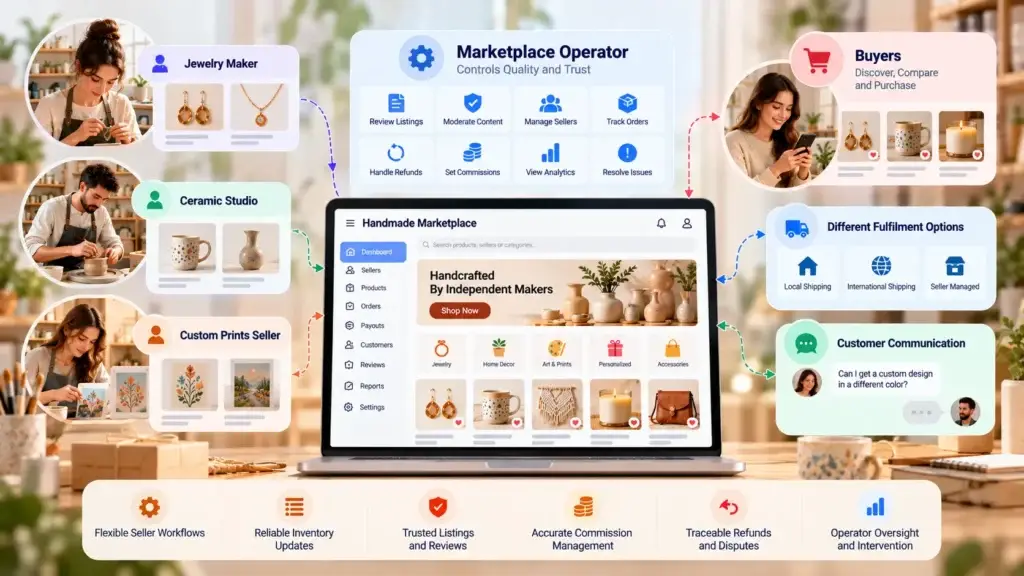
A standard ecommerce store normally has one business controlling the catalog, pricing, inventory, customer experience, and fulfillment rules.
A handmade marketplace distributes those responsibilities.
A jewelry maker may process an order differently from a ceramic studio. A custom-print seller may need customer communication before production. A local craft seller may offer different shipping options from an international artisan. Some sellers may maintain ten products while others maintain hundreds.
The platform therefore needs to create enough independence for sellers while giving the marketplace operator enough control to maintain quality and trust.
This is why founders should evaluate marketplace software around business workflows, not simply screens.
A product-upload page may look complete in a demo. The more important questions are whether listings can be reviewed, inventory can be updated reliably, sellers can manage orders independently, refunds remain traceable, commissions are calculated correctly, and the operator can intervene when something goes wrong.
1. Seller Onboarding Should Work Without Creating an Operations Bottleneck
Seller acquisition is one side of marketplace growth. Seller administration is the other.
If every new maker requires manual database changes, long email conversations, or developer intervention, operational cost rises as the seller base expands.
A stronger onboarding process should allow founders to think through:
- seller registration;
- identity or business verification where required;
- shop profile creation;
- seller approval;
- marketplace policies;
- category permissions;
- payout information;
- shipping settings;
- seller status and suspension;
- document management where relevant.
The exact workflow depends on the marketplace model. A curated marketplace may intentionally approve every maker manually, while a broader platform may automate more of the process.
The important point is control.
Founders should know what happens between “a seller wants to join” and “their products become available to buyers.”
Founder evaluation question
Can the marketplace onboard substantially more sellers without requiring the operations team to grow at the same rate?
That question is more valuable than simply asking whether the platform has a “seller registration” feature.
2. Product Listings Need to Reflect How Handmade Goods Are Actually Sold
Handmade catalogs are rarely uniform.
Products may have variations in material, color, dimensions, quantity, finish, production time, or personalization. Some items are stocked; others are produced after the buyer places an order.
Before launch, founders should determine how much catalog flexibility their sellers genuinely require.
Important considerations include product images, descriptions, categories, attributes, variants, stock, pricing, availability, processing time, shipping information, product status, reviews, and listing moderation.
For highly customized products, buyer-to-seller communication may also be important before or after checkout.
But founders should resist the temptation to build every imaginable product configuration into the first release.
If most sellers offer straightforward products, a highly complex configuration engine may add development and testing cost without materially improving the launch.
The feature decision should follow the merchandise model-not the other way around.
3. Search and Discovery Directly Affect Marketplace Liquidity
A marketplace creates value when buyers can find relevant sellers and products.
That becomes harder as the catalog grows.
Basic keyword search may be sufficient for a narrowly focused launch. A larger marketplace may need categories, filters, sorting, price ranges, seller discovery, autocomplete, availability filters, ratings, location signals, or other discovery tools.
Founders should decide which product attributes buyers actually use to make purchasing decisions.
For example, a marketplace focused on handcrafted furniture may need different discovery logic from one focused on jewelry, printable artwork, wedding products, or personalized gifts.
Search requirements can also affect cost. More sophisticated filtering, indexing, recommendation logic, personalization, or external search infrastructure introduces additional technical scope.
Start with the discovery experience buyers genuinely need, then expand as real search behavior becomes visible.
4. Marketplace Checkout Is More Complex Than Store Checkout
A buyer may add products from several independent sellers to one cart.
That creates operational questions immediately.
Who fulfills each part of the purchase? How is shipping calculated? What happens if one seller cancels? Can one item be refunded while the others continue? When does each seller become eligible for payment?
These decisions influence checkout, orders, payments, refunds, commissions, seller balances, and customer support.
For founders, this means “payment gateway integration” should never be treated as the complete payment requirement.
The business must define what happens to money throughout the transaction lifecycle.
Before launch, document at least:
buyer payment → order confirmation → seller fulfillment → marketplace fee → refund or adjustment → seller settlement
The implementation can then be evaluated against the actual business rule instead of a generic checkout checklist.
5. Seller Payouts and Commission Controls Need Operational Clarity
Marketplaces need a reliable way to distinguish platform revenue from seller earnings.
A simple model may use one marketplace commission percentage. A more developed business may eventually need different rates by category, seller agreement, subscription level, promotion, or product type.
The question is not whether founders need every pricing rule on day one.
It is whether the platform can support the commercial model without creating accounting confusion.
Seller dashboards should make earnings understandable. Operators should be able to trace transactions, adjustments, refunds, fees, and withdrawal activity.
This becomes particularly important when a marketplace begins processing meaningful order volume.
A payout workflow that is manageable with ten sellers can become an operational burden with hundreds.
6. Marketplace Trust Features Protect Both Growth and Operations
Handmade marketplaces depend heavily on trust.
Buyers need confidence that products are represented accurately. Sellers need confidence that orders and payments are handled fairly. Operators need ways to respond when either side violates marketplace rules.
Depending on the business model, useful trust capabilities may include:
- seller verification;
- listing moderation;
- ratings and reviews;
- buyer-seller communication;
- abuse or product reporting;
- refund workflows;
- dispute management;
- seller suspension;
- activity history;
- role-based administrative access.
Not every marketplace needs the same controls.
However, founders should decide how problems will be handled before problems begin occurring at scale.
Manual intervention is normal during an early launch. The risk appears when the platform provides no structured record of what happened or what the operator changed.
7. The Admin Dashboard Is a Business Operating System, Not a Back-Office Extra
Founders often spend more time evaluating buyer-facing interfaces than the operator dashboard.
That priority can become expensive after launch.
The admin layer determines how easily the business can manage sellers, products, categories, orders, payments, commissions, refunds, promotions, content, reports, and platform settings.
Ask a practical question:
Which everyday business decisions would require a developer if the admin dashboard could not handle them?
Every routine configuration that requires a code change adds operational friction.
A capable operator dashboard can therefore reduce more than administrative effort. It can shorten the time between identifying a marketplace problem and fixing it.
8. Mobile Apps Should Be a Business Decision, Not an Automatic Requirement
Launching web, Android, and iOS experiences simultaneously increases scope.
That investment may be justified when the target audience strongly depends on mobile usage or when sellers need to manage orders away from a computer.
But founders should determine which interfaces are truly required for the launch.
For example, the business might need a mobile-first buyer experience while sellers initially operate through a responsive web dashboard. Another marketplace may benefit significantly from a seller application because makers constantly manage inventory, messages, and order updates from their phones.
There is no universal answer.
Platform coverage should follow user behavior.
Adding applications increases not only initial development scope but also testing, deployment, store publishing, updates, device compatibility work, and ongoing maintenance.
9. Integrations Can Change Marketplace Cost Faster Than Visible Features
Third-party integrations are one of the easiest development-cost factors to underestimate.
A marketplace may connect to payment gateways, maps, shipping providers, email services, SMS platforms, analytics tools, identity verification services, accounting software, CRM systems, customer-support tools, cloud storage, or marketing platforms.
Each integration introduces its own API behavior, authentication, errors, usage fees, testing requirements, and future maintenance.
Founders should therefore separate integrations into three groups:
- Required for launch: the marketplace cannot operate properly without them.
- Useful soon after launch: valuable, but the business can initially operate without them.
- Future optimization: appropriate once volume or operational data justifies the investment.
This prioritization protects the launch budget from expanding because of integrations that solve problems the business does not yet have.
What Actually Determines Handmade Marketplace Development Cost?
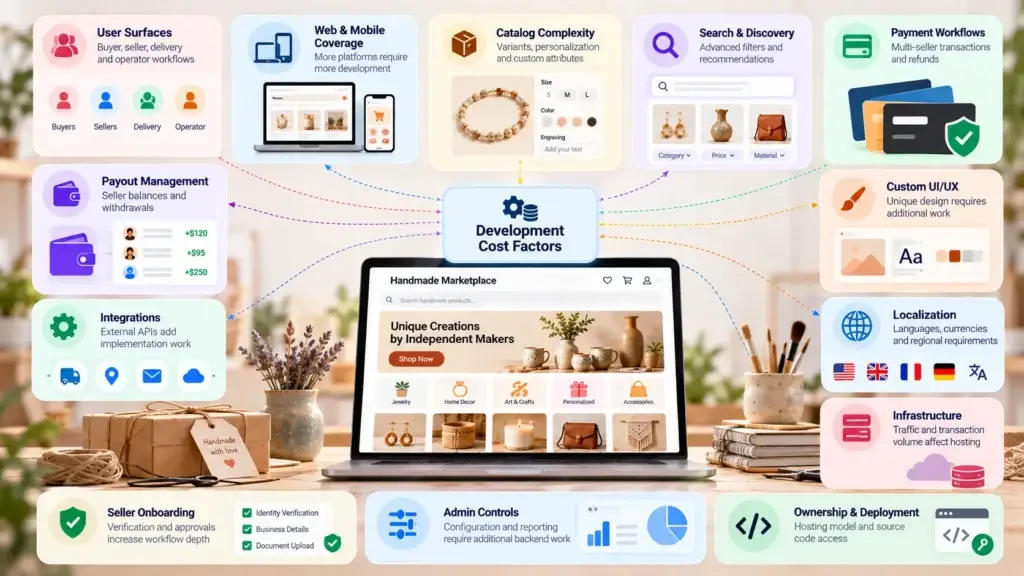
There is no useful universal price for every handmade marketplace because two platforms with similar storefronts can have completely different operational requirements.
The better approach is to understand the variables that change scope.
| Cost Factor | Why It Changes Scope | Founder Decision |
|---|---|---|
| User surfaces | Buyer, seller, delivery and operator experiences require separate workflows | Decide which roles are essential at launch |
| Web and mobile coverage | More platforms require more implementation, QA and deployment work | Match platforms to real user behavior |
| Seller onboarding | Verification, approvals and documents increase workflow depth | Define how controlled seller entry should be |
| Catalog complexity | Variants, personalization and advanced attributes require more product logic | Build around actual merchandise requirements |
| Search and discovery | Advanced filtering, recommendations and indexing increase technical requirements | Prioritize the discovery tools buyers need |
| Payment workflows | Multi-seller transactions, refunds and settlements add financial logic | Map the full transaction lifecycle |
| Payout management | Seller balances, withdrawals and reconciliation require operator controls | Decide how and when sellers get paid |
| Integrations | External APIs introduce implementation and maintenance requirements | Separate essential from optional integrations |
| Custom UI/UX | Significant design changes require additional design and front-end work | Customize where differentiation matters |
| Localization | Languages, currencies, tax logic and regional requirements add configuration | Define launch geography early |
| Admin controls | Deeper configuration and reporting require additional backend work | Identify everyday operator decisions |
| Infrastructure | Traffic, images, search and transaction volume affect hosting architecture | Plan for realistic launch and growth volumes |
| Ownership and deployment | Hosting model and source-code access affect long-term flexibility | Evaluate total control, not only initial price |
The most useful cost conversation is therefore not:
“How much does a marketplace cost?”
It is:
“What does my marketplace need to do at launch, and which requirements are actually driving the quote?”
Launch-Critical Features vs. Features That Can Often Wait
One of the strongest ways to control marketplace development cost is to distinguish operational necessities from future enhancements.
Usually launch-critical
Seller onboarding, catalog management, buyer discovery, checkout, payment processing, order management, commission logic, basic seller earnings, moderation, notifications, and operator controls normally form the operational foundation.
Often phase-dependent
Advanced recommendations, extensive automation, sophisticated loyalty systems, complex promotional engines, deeply customized analytics, unusual product configurators, and non-essential integrations may be introduced when there is evidence that they solve a meaningful user or operational problem.
This does not mean advanced functionality lacks value.
It means sequencing matters.
A founder who knows which capability validates demand can allocate capital more deliberately than one trying to reproduce every feature associated with a mature marketplace before acquiring the first sellers.
Ready-Made Foundation or Custom Development: What Should Founders Evaluate?
The decision should depend on how unusual the required workflows are.
A custom build provides maximum architectural freedom but requires the business to design and implement the standard marketplace foundation as well as its differentiating features.
A ready-made foundation can shorten that path when the core buyer, seller, catalog, order, payment, and operator workflows already match the business model.
The evaluation should focus on:
- how much of the required workflow already exists;
- what needs customization;
- whether the source code is available;
- whether branding can be changed;
- whether integrations can be added;
- how deployment works;
- what administrative control is included;
- whether future developers can extend the platform;
- which requirements fall outside the existing scope.
The goal is not simply to launch as quickly as possible.
It is to avoid spending custom-development time rebuilding standard marketplace infrastructure when that infrastructure does not differentiate the business.
Founder Decision Signals Before Choosing a Platform
Speed
If market timing matters, determine how much of the marketplace is already functional and how much requires new development.
Operational Control
Inspect the seller and operator workflows as closely as the storefront. The business must be able to manage the marketplace after developers finish deploying it.
Customization
Separate branding changes from workflow changes. Changing colors and logos is very different from changing how orders, commissions, payouts, or product configuration work.
Ownership
Understand who controls the source code, hosting environment, data, third-party accounts, and future development decisions.
Scalability
Do not interpret scalability as “supports millions of users” without evidence. Instead, examine how seller growth, catalog growth, transaction volume, images, search activity, and operational queues are handled.
Business Fit
The platform should fit the marketplace you plan to operate-not merely resemble a familiar marketplace interface.
Read More: What Features Should a Handmade Marketplace Platform Include for Independent Makers and Buyers?
Common Mistakes That Increase Cost Without Improving Launch Readiness
Choosing by Feature Count
A long feature list can hide weak workflows. Evaluate how critical actions connect from beginning to end.
Building for Hypothetical Scale Too Early
Founders should plan for growth without paying to solve every theoretical future requirement before validating demand.
Ignoring Seller Operations
The buyer experience may attract attention, but poor seller tools can reduce catalog quality and increase support workload.
Underestimating Refunds and Exceptions
Real marketplaces include cancellations, failed payments, stock problems, disputes, delayed orders, and refund requests. These should be considered normal operating scenarios.
Treating Every Integration as Essential
Integrations create implementation and maintenance obligations. Add them because they solve a defined requirement, not because they appear impressive in a scope document.
Comparing Only the Initial Quote
A lower initial quote may exclude mobile applications, deployment, source code, customization, integrations, maintenance, or essential administrative workflows.
Compare scope and ownership before comparing numbers.
How Miracuves Can Support the Next Step
Once founders have defined their seller model, catalog requirements, transaction flow, operational controls, and launch priorities, they are in a much stronger position to evaluate an implementation.
Miracuves offers a ready-made Etsy clone product foundation for businesses building seller-led and handmade marketplaces. The commercial solution includes buyer, seller and operator workflows and is designed to be customized under the business’s own branding.
Where the existing ready-made scope matches the requirements, Miracuves offers a 6-day solution delivery path. Requirements outside that foundation should be scoped separately rather than assumed to be included.
For founders, that distinction matters. Faster deployment is useful when the existing product foundation matches the business. Unique workflows still deserve proper product planning and development.
Final Thoughts: Evaluate the Marketplace You Need to Operate
The strongest handmade marketplace is not necessarily the platform with the largest feature list.
It is the one whose capabilities match how sellers join, how products are managed, how buyers discover them, how orders move, how money is reconciled, and how the operator handles exceptions.
The same principle should guide development cost.
Instead of starting with a target number and forcing the product into it, define the workflows required to operate the marketplace successfully. Separate launch-critical requirements from future enhancements. Identify expensive integrations and custom logic early. Confirm what is included in the platform foundation and what requires additional work.
That gives founders something far more useful than a feature comparison.
It gives them a clear launch scope.
FAQs
What features should a handmade marketplace platform include?
A handmade marketplace generally needs seller onboarding, product and catalog management, search and discovery, buyer checkout, order management, payment processing, commission handling, seller earnings or payouts, reviews, moderation, notifications, and operator controls. The exact requirements depend on the marketplace’s products, geography, seller model, and fulfillment process.
What factors affect handmade marketplace development cost?
Major cost factors include the number of user roles, web and mobile platforms, seller workflows, catalog complexity, payment and payout requirements, third-party integrations, customization, localization, administrative controls, infrastructure, deployment, and ownership requirements.
Does a handmade marketplace need separate seller software?
Sellers need a dedicated way to manage their shops, products, inventory, orders, customer communication, earnings, and other marketplace activities. Whether that experience should be a web dashboard, mobile app, or both depends on seller behavior and launch priorities.
Why is seller onboarding important for marketplace scalability?
Manual onboarding can become increasingly expensive as seller volume grows. Structured registration, verification, approval, shop setup, and status management help the operator maintain control without handling every seller through disconnected manual processes.
Should a marketplace launch with Android and iOS apps?
Not automatically. Founders should evaluate how buyers and sellers will use the platform. Additional applications increase implementation, testing, publishing, and maintenance scope, so they should solve a genuine user requirement.
How can founders control marketplace development costs?
Start by separating essential launch workflows from enhancements. Define user roles, payment logic, seller requirements, integrations, geographic scope, and administrative needs before requesting development estimates. This makes quotes easier to compare and reduces unnecessary scope.
Is a ready-made marketplace platform suitable for a new business?
It can be when the existing buyer, seller, catalog, transaction, and operator workflows closely match the planned business. Founders should still verify customization flexibility, source-code ownership, deployment, integrations, admin controls, and any requirements outside the existing scope.
What should founders ask before choosing marketplace software?
Ask what is included at launch, which user interfaces are provided, how sellers are onboarded, how commissions and payouts work, what administrators can configure, which integrations are included, who owns the source code, where the platform is deployed, and how custom requirements are handled.
Miracuves is an independent software development company. We are not affiliated with, connected to, sponsored by, or endorsed by any company or product named in this article.
Terms such as “X Clone” are used descriptively. It is how the software industry refers to building a platform with functionality comparable to a known service, and how clients search for it.
The entire design and codebase of our products is built by our own team. Our products contain no code, design, graphics, or content originating from any third-party website or applications.
All third-party names and marks referenced in this article are the property of their respective owners, referenced solely to identify the services discussed.