



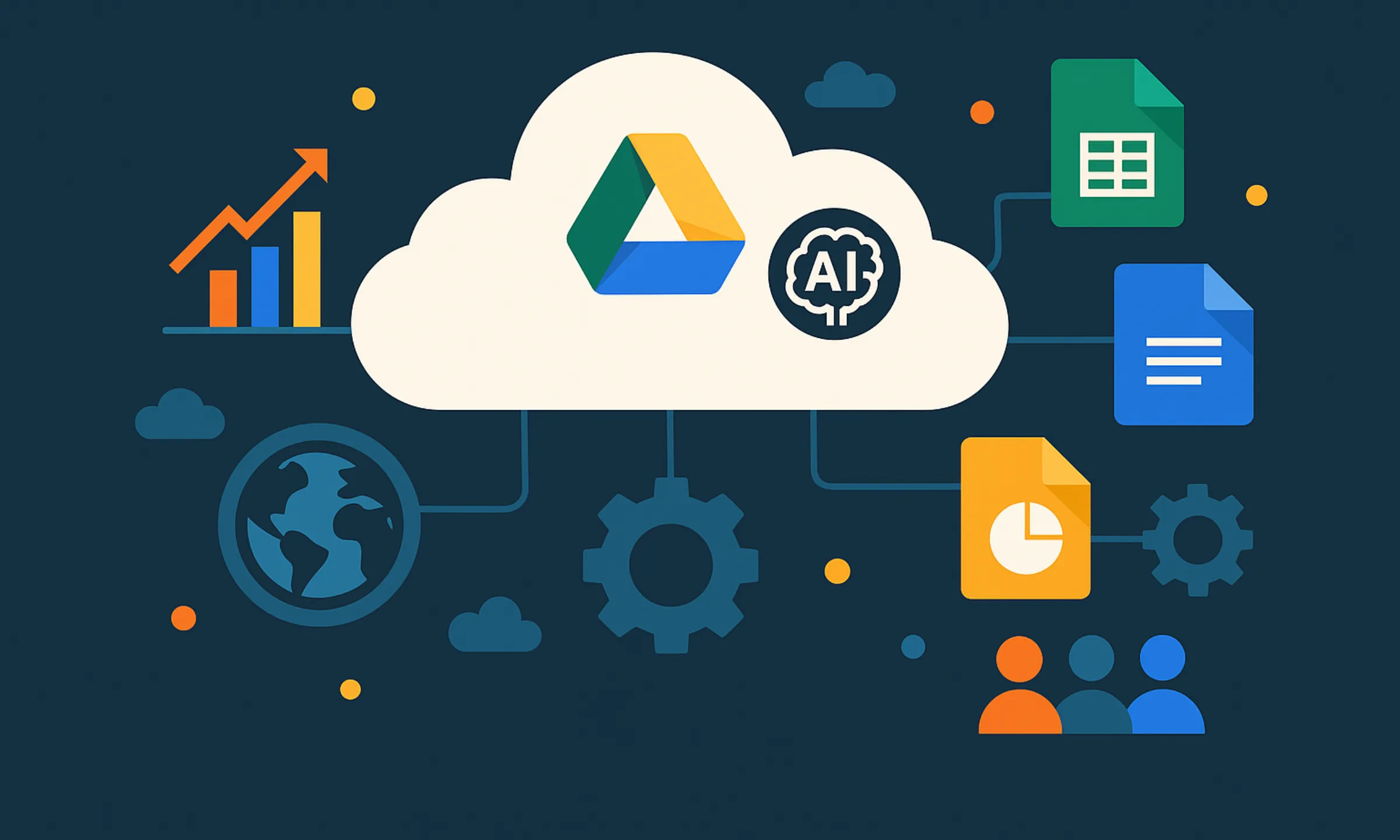
In 2025, Google Drive commands over 2 billion active users and contributes significantly to Google Cloud’s $40+ billion annual revenue. What began as a simple file storage service in 2012 has evolved into a global productivity backbone for individuals, startups, and enterprises alike.
The Business Model of Google Drive reflects one of the most powerful digital transformations of the last decade — turning digital storage into a full-scale collaboration economy. Its model fuses freemium adoption, enterprise cloud integration, and ecosystem lock-in to create compounding network effects.
For entrepreneurs, the Business Model of Google Drive offers a masterclass in scalable user acquisition, product-led growth, and ecosystem monetization — lessons directly applicable to startups building SaaS, marketplace, or productivity platforms today.
How the Google Drive Business Model Works
Google Drive operates at the intersection of cloud storage, collaboration, and ecosystem lock-in — a hybrid model that balances freemium adoption for individuals with enterprise-grade monetization through Google Workspace.
Core Framework Overview
At its foundation, Google Drive is a freemium SaaS platform integrated within the broader Google Workspace ecosystem. It allows users to store, share, and collaborate on documents, images, and data seamlessly across devices — with revenue scaling through paid upgrades, enterprise subscriptions, and cloud API integrations.
Key Insights
1. Type of Model: Hybrid (Freemium + Subscription + Platform)
- Freemium Base: 15 GB free storage attracts mass adoption and habitual use.
- Subscription Upsell: Premium tiers (Google One & Workspace) monetize power users and enterprises.
- Platform Model: Drive integrates APIs and apps (Docs, Sheets, Slides, Meet, etc.) forming a mini productivity ecosystem.
2. Value Proposition
- For Individuals: Secure cloud storage, seamless sync, and file access anywhere.
- For Businesses: Scalable document management, advanced collaboration, and admin-level control.
- For Developers/Partners: APIs enabling integration with third-party apps, automations, and workflows.
3. Stakeholders
- Users: Upload, store, and collaborate on files.
- Businesses: Use Drive as part of Workspace for productivity and compliance.
- Partners & Developers: Extend functionality through integrations and add-ons.
- Google Cloud Infrastructure: Provides backend storage, security, and AI features (e.g., smart search, labeling).
4. Evolution Timeline
- 2012–2015: Core file storage service competes with Dropbox and OneDrive.
- 2016–2019: Integration into Google Suite; pivot from storage to collaboration.
- 2020–2023: Unified under Google Workspace; growth in enterprise adoption and education sector.
- 2024–2025: AI-powered file organization, smart search, and real-time insights integrated via Gemini and Duet AI.
5. Why It Works in 2025
- Increasing demand for remote collaboration and cross-device accessibility.
- Data growth from hybrid work and AI tools.
- User retention driven by Google ecosystem integration (Gmail, Meet, Docs).
- Enterprise-grade compliance (ISO 27001, SOC 2 Type II, GDPR, CCPA) builds trust at scale.
Read more : What is Google Drive App and How Does It Work?
Target Market & Customer Segmentation Strategy
Google Drive’s success is rooted in its ability to serve multiple audience tiers simultaneously — from individual users seeking free storage to global corporations managing petabytes of data. Its market segmentation strategy is a masterclass in balancing mass adoption with enterprise monetization.
1. Primary Customer Segments
a. Individual Users (Freemium Tier)
- Demographics: Students, freelancers, professionals, and everyday users.
- Motivation: Free, secure cloud storage integrated with Gmail and Android.
- Behavior: Primarily use Drive for file backup, personal documents, and sharing.
- Retention Trigger: Seamless integration across Google ecosystem (e.g., Photos, Docs, Gmail).
b. SMBs & Enterprises (Paid Workspace Users)
- Demographics: Startups, SMEs, large enterprises, educational and government institutions.
- Motivation: Collaboration, security, compliance, and scalability.
- Behavior: Adopt Drive within Workspace for document management, team sharing, and secure workflows.
- Retention Trigger: Admin control, shared drives, and productivity suite integration.
c. Developers & Integration Partners
- Demographics: SaaS startups, workflow automation tools, and cloud-based applications.
- Motivation: API access for storage, sharing, and embedding Drive features into their products.
- Retention Trigger: Low-cost scalability and stable Google Cloud API ecosystem.
2. Secondary Segments
- Education Sector: Schools and universities using Google Workspace for Education — benefiting from collaboration and reduced infrastructure costs.
- Creative Professionals: Designers and video editors leveraging Drive for remote collaboration and large file sharing.
- Mobile-Centric Users: Drive pre-installed on Android creates automatic acquisition loops.
3. Customer Journey Mapping
| Stage | Touchpoints | Conversion Triggers | Retention Factors |
| Discovery | Gmail / Android pre-installation, Search ads | Free 15GB offer | Device sync & file backup |
| Conversion | Usage exceeds free limit | Google One upgrade prompt | Unified billing, AI-driven suggestions |
| Retention | Daily collaboration via Docs, Sheets, Meet | Workspace integration | Habitual productivity reliance |
4. Market Positioning & Competitive Edge
Google Drive competes in a crowded but expanding cloud productivity market, yet its advantage lies in ecosystem integration and trust.
- Brand Voice: Reliable, accessible, and collaborative.
- Competitive Edge: Cross-platform synergy (Docs + Gmail + Android).
- Market Share (2025): Estimated 35–40% of global consumer cloud storage, and 22% of enterprise productivity suites, ahead of Dropbox but trailing Microsoft 365 in enterprise penetration.
- Differentiation: Freemium scaling → AI-enhanced enterprise productivity → Cloud-native collaboration.
Read more : How to Build an App Like Google Drive — A Developer’s Guide
Revenue Streams and Monetization Design
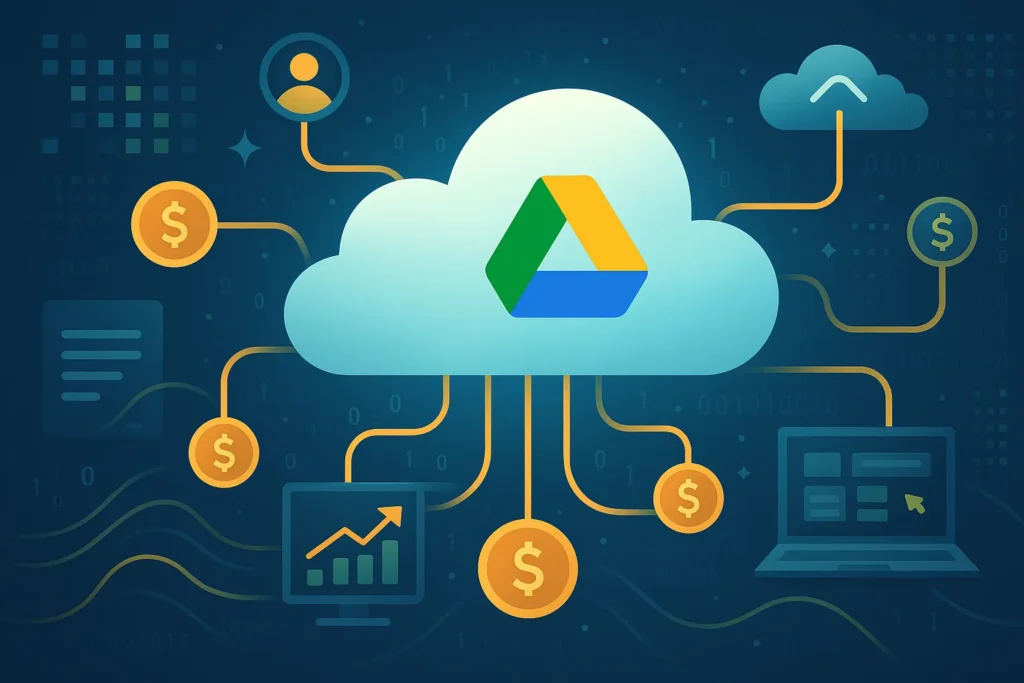
Google Drive’s monetization architecture is a sophisticated mix of freemium scaling, subscription upgrades, and ecosystem-driven enterprise revenue. What began as free cloud storage has matured into a cornerstone of Google’s SaaS and cloud business strategy — generating billions through tiered pricing and integrated value creation.
Primary Revenue Stream 1: Google One & Workspace Subscriptions (~80% of Drive Revenue)
Mechanism:
- Individuals who exceed their free 15 GB quota are funneled into Google One, while businesses adopt Google Workspace (formerly G Suite).
- Plans range from personal $1.99/month tiers to enterprise-level subscriptions exceeding $25/user/month.
Pricing Model:
- Google One (Consumers):
- 100 GB – $1.99/month
- 200 GB – $2.99/month
- 2 TB – $9.99/month
- Family sharing boosts perceived value.
- Google Workspace (Business):
- Business Starter: $6/user/month
- Business Standard: $12/user/month
- Business Plus: $18/user/month
- Enterprise: Custom pricing (advanced security, AI tools, analytics).
Growth Trajectory:
In 2024, Workspace surpassed 10 million paying businesses, and the segment’s ARR exceeded $12 billion, with consistent double-digit growth driven by AI integration (Gemini for Workspace).
Secondary Revenue Stream 2: Google Cloud Storage & API Integrations (~10%)
- Developers and SaaS companies integrate Drive storage and file-sharing APIs.
- Monetized through Google Cloud usage billing, depending on API calls, storage, and data transfer.
- Acts as a backend infrastructure engine for third-party applications, deepening B2B ties.
Secondary Revenue Stream 3: Enterprise Add-Ons & Compliance Solutions (~5%)
- Add-ons for enterprise data governance, compliance (HIPAA, GDPR), and extended storage.
- Custom support tiers and SLAs increase high-value enterprise deal sizes.
- Integration with Duet AI for Workspace adds premium automation and productivity features.
Secondary Revenue Stream 4: Indirect Ecosystem Monetization (~5%)
- Retention → Ad Revenue: Drive usage enhances engagement across Gmail, YouTube, and Chrome, indirectly boosting Google Ads’ ecosystem value.
- Cross-Selling → Google Cloud: Drive often acts as an entry point for businesses to adopt full-scale Google Cloud solutions.
Monetization Strategy Overview
Google Drive’s financial design is built on network compounding:
- Freemium Onramp: Free users create habitual dependence.
- Tiered Upsell: Contextual triggers (storage limits, AI tools) convert users to paid tiers.
- Cross-Selling: Workspace users adopt other Google Cloud products.
- AI Differentiation: Gemini AI automates workflows, commanding premium pricing.
Psychology Behind Pricing
- Anchoring Effect: The free tier increases perceived value of paid upgrades.
- Family Sharing: Encourages multi-user retention.
- Enterprise Customization: Builds trust through flexibility and compliance assurance.
Operational Model & Key Activities
Behind Google Drive’s sleek user experience lies a massively engineered operational infrastructure — one that blends global cloud infrastructure, AI-driven optimization, and continuous innovation at scale. Its operational model is designed for resilience, low latency, and infinite scalability while maintaining user privacy and compliance worldwide.
1. Core Operations
- Cloud Infrastructure Management:
Operates on Google Cloud Platform (GCP) — leveraging distributed data centers across more than 35 regions. Data is automatically replicated for redundancy, enabling 99.9% uptime and rapid failover capability. - Platform Maintenance & Version Control:
Continuous software updates through rolling releases, ensuring zero downtime for billions of users. AI tools monitor uptime, latency, and file sync performance in real time. - Product Development & Feature Innovation:
Core engineering teams iterate through sprints focused on usability, integration, and AI personalization (Smart Search, Auto Classification, Suggested Files). - Data Privacy & Security:
Encryption by default (AES-256 at rest, TLS in transit).
Zero-trust access control and compliance with ISO 27001, SOC 2 Type II, FedRAMP, GDPR, and CCPA. - Customer Support & Success:
- Self-service help center for free users.
- 24/7 dedicated enterprise support for Workspace clients.
- AI chatbots handle millions of tier-1 queries daily.
2. Resource Allocation (Estimated 2025 Breakdown)
| Area | Allocation % | Key Focus |
| R&D & Engineering | 40% | AI innovation, system scalability, integration with Workspace |
| Cloud Infrastructure | 25% | Server optimization, data center expansion, carbon-neutral initiatives |
| Marketing & Growth | 15% | Workspace promotions, YouTube/Google Ads, referral incentives |
| Customer Success & Support | 10% | Onboarding, training, and enterprise assistance |
| Administration & Compliance | 10% | Global legal, finance, and regulatory management |
3. Regional Expansion Strategy
- Localized data storage in compliance with emerging data sovereignty laws (EU, India, Brazil).
- Partnering with regional ISPs and cloud carriers for latency reduction.
- Multi-language AI support and contextualized marketing across 150+ countries.
4. Operational Efficiency Levers
- AI Operations (AIOps): Predictive maintenance detects anomalies before downtime occurs.
- Green Data Centers: Google Cloud runs on carbon-neutral energy, improving sustainability brand equity.
- Shared Infrastructure: Drive piggybacks on GCP’s infrastructure, reducing marginal costs per user.
Strategic Partnerships & Ecosystem Development
Google Drive’s long-term dominance is not just a result of superior product design — it’s powered by a deeply interconnected partnership ecosystem that strengthens its value chain across technology, enterprise, and compliance fronts. Google’s partnership philosophy centers on mutual scalability: enabling others to build on Drive while Drive becomes indispensable across industries.
1. Collaboration Philosophy
Google Drive’s partnerships follow a platform-based alliance model — prioritizing integrations, interoperability, and ecosystem synergy. Instead of competing on isolated product value, Google Drive thrives by embedding itself into tools, workflows, and enterprises globally.
The goal: Make Drive the universal storage and collaboration layer for the modern internet economy.
2. Key Partnership Types
a. Technology & API Partners
- Integrations with Slack, Trello, Notion, Zoom, Canva, and DocuSign to enhance productivity and workflow continuity.
- Drive APIs empower third-party developers to embed upload, preview, and share functions inside their own apps.
- Gemini and Duet AI extensions now connect with partner platforms for smart document summarization and meeting notes.
b. Payment & Infrastructure Alliances
- Google Cloud collaborates with global payment processors (Stripe, Adyen) to support Workspace billing and localized subscription models.
- Partnerships with telecom providers and OEMs preload Drive on Android devices — a major driver of early user acquisition in emerging markets.
c. Marketing & Distribution Partners
- Joint campaigns with hardware makers (Samsung, HP, Lenovo) offering free Drive storage trials with new devices.
- Cross-promotions within YouTube Premium and Google One bundles enhance retention and perceived ecosystem value.
d. Regulatory & Enterprise Expansion Alliances
- Strategic compliance collaborations with EU, India, and Japan regulators ensure adherence to local data residency laws.
- Partnerships with enterprise resellers and IT consultancies (e.g., Accenture, Deloitte, Wipro) for Workspace deployment.
3. Ecosystem Impact & Strategy
Google Drive’s ecosystem amplifies its network effects — every partner app, device, or integration increases the stickiness of its platform.
- Network Effects: The more tools integrate Drive, the higher its switching cost for users.
- Partner Value Creation: Partners gain cloud reliability and user reach, while Google gains user data insights and ecosystem dependence.
- Monetization Layer: Indirect revenue via increased Workspace adoption, API usage, and cross-sold Google Cloud services.
- Competitive Moat: Interoperability with thousands of tools makes it almost irreplaceable in enterprise and education environments.
Growth Strategy & Scaling Mechanisms
Google Drive’s growth strategy demonstrates how to transform a utility product into a global collaboration powerhouse. By merging freemium adoption, ecosystem expansion, and AI-led innovation, Drive has achieved sustained double-digit growth even in mature cloud markets.
1. Core Growth Engines
a. Product-Led Growth (PLG)
- The free 15GB tier serves as a massive onboarding funnel.
- User acquisition is primarily organic — embedded in Android devices, Gmail, and YouTube.
- Conversion to paid tiers occurs naturally through usage triggers (storage limits, sharing features, advanced tools).
This frictionless pathway converts users without aggressive marketing, reducing CAC (Customer Acquisition Cost).
b. Ecosystem Virality
- Every shared file, document, or collaboration request brings new non-users into the ecosystem.
- Drive’s seamless integrations with Docs, Sheets, Meet, and Calendar amplify engagement loops.
- Collaboration features (shared drives, versioning, commenting) reinforce habitual use — forming viral adoption cycles within teams.
c. AI-Powered Product Differentiation
- 2024–2025 saw the introduction of Gemini and Duet AI integration, turning Drive into a smart workspace rather than mere storage.
- AI tools summarize documents, automate file organization, and recommend content — leading to higher retention and enterprise upsells.
AI differentiation now fuels workspace premium conversions and cross-product synergy with Google Cloud.
d. Global Market Expansion
- Localization across 150+ languages and data centers in 35+ regions drives global reliability.
- Partnering with OEMs, ISPs, and education institutions fuels large-scale B2B and B2C expansion.
- The education vertical alone accounts for over 300 million active Drive users globally.
2. Scaling Challenges & Solutions
| Challenge | Impact | Google’s Solution |
| Data center scalability | Rising data volume and latency | AI-optimized routing, carbon-neutral data centers |
| Privacy regulations (GDPR, DPDPA India) | Compliance complexity | Regionalized storage & encryption layers |
| Market saturation | Slower user growth in mature regions | AI feature bundling + cross-product innovation |
| Competition (OneDrive, Dropbox, iCloud) | Price compression | Value stacking through Workspace & AI integration |
3. Key Scaling Mechanisms
- Cross-Suite Retention: Each Workspace tool strengthens others (Drive ↔ Docs ↔ Meet).
- AI Monetization: Gemini-based premium features add new revenue layers without changing core pricing.
Cloud Backbone Leverage: Shared infrastructure keeps marginal costs per GB low even as storage scales exponentially.
Read more : Best Google Drive Clone Scripts in 2025: Features & Pricing Compared
Competitive Strategy & Market Defense
In a world dominated by cloud giants like Microsoft OneDrive, Dropbox, and Apple iCloud, Google Drive’s competitive strategy revolves around three pillars: ecosystem integration, AI innovation, and platform trust. It doesn’t merely compete on storage capacity or price — it competes on how seamlessly it connects life and work.
1. Core Competitive Advantages
a. Ecosystem Integration & Network Effects
- Drive is not a standalone product — it’s the connective tissue across Gmail, Android, Docs, and YouTube.
- Every new Google service reinforces Drive usage, making it impossible to switch without losing convenience.
- Example: An Android photo backup, a Gmail attachment, and a Docs collaboration — all feed into the same storage layer.
b. AI-Driven Differentiation
- Google’s Gemini & Duet AI integrations make Drive a smart assistant — suggesting files, automating searches, and summarizing content.
- Competing services (e.g., OneDrive Copilot) lag in contextual intelligence since Google has superior access to user behavioral data.
- This personalization turns Drive from a static repository into a living productivity engine.
c. Trust, Compliance & Reliability
- ISO 27001, SOC 2, HIPAA, and GDPR compliance enhance enterprise credibility.
- Encrypted-by-default architecture with zero-trust access strengthen brand trust.
- Sustainability leadership — all Drive data centers are carbon-neutral since 2023 — adds ESG appeal.
2. Market Defense Tactics
| Threat | Response Strategy |
| Microsoft OneDrive (Enterprise integration) | Emphasize superior search, AI intelligence, and Google Meet synergy. |
| Dropbox (SMB-focused innovation) | Undercut on pricing while offering more native integrations. |
| Apple iCloud (ecosystem loyalty) | Focus on Android ubiquity and cross-platform accessibility. |
| Regulatory Scrutiny (data laws) | Adopt proactive localization and full compliance partnerships. |
3. Strategic Defense Moves
- Feature Rollouts with Precision: New AI and collaboration tools released quarterly to maintain innovation momentum.
- Smart Bundling: Workspace + YouTube Premium + Google One bundles create layered loyalty.
- M&A Defense: Acquiring startups in security, AI, and collaboration to preempt disruption (e.g., AppSheet acquisition for workflow automation).
- Enterprise Penetration: Partnering with consulting firms (Accenture, Deloitte) to drive B2B migrations.
4. Competitive Position (2025 Snapshot)
| Competitor | Key Strength | Google Drive Counterplay |
| Microsoft 365 | Enterprise dominance | Freemium funnel + AI collaboration edge |
| Dropbox | Niche innovation | Price advantage + ecosystem synergy |
| Apple iCloud | iOS ecosystem | Android + cross-device flexibility |
| Box | Security & compliance | Equivalent standards + Gemini AI overlay |
Lessons for Entrepreneurs & Implementation
The Google Drive story is far more than a tale of cloud storage — it’s a case study in platform evolution, ecosystem thinking, and scalable SaaS design. For founders and digital entrepreneurs, its growth blueprint offers a roadmap for building enduring, high-retention platforms in 2025 and beyond.
1. Key Factors Behind Google Drive’s Success
- Freemium Funnel Mastery: By offering massive free value upfront (15GB), Drive turned casual users into long-term customers.
- Ecosystem Lock-In: Tight integration with Gmail, Docs, Meet, and Android creates a self-reinforcing network of dependence.
- AI-Driven Personalization: Gemini and Duet AI differentiate Google Drive from static competitors — delivering predictive value.
- Scalable Architecture: Leveraging Google Cloud’s distributed infrastructure allows exponential growth without service degradation.
- Security as Strategy: Global compliance and zero-trust policies built long-term enterprise credibility.
2. Replicable Principles for Startups
| Principle | How Entrepreneurs Can Apply It |
| Product-led growth | Offer a freemium tier that builds habit before monetization. |
| Ecosystem integration | Build APIs and partnerships instead of isolated apps. |
| Scalable backend | Use modular cloud architecture that supports future expansion. |
| Trust and compliance | Make data privacy and transparency part of your brand identity. |
| Continuous innovation | Release small, high-impact updates regularly to sustain engagement. |
3. Common Mistakes to Avoid
- Ignoring network effects: Growth slows without community or collaboration incentives.
- Overcomplicating monetization: Too many pricing tiers confuse customers — simplicity wins.
- Underinvesting in UX: Drive’s intuitive UI reduces friction and increases retention.
- Neglecting compliance early: Retroactive fixes for data privacy are costly and reputationally risky.
4. Adaptation Strategies for Local or Niche Markets
- Target industry-specific collaboration needs — e.g., healthcare (HIPAA-compliant storage) or education (shared coursework tools).
- Localize AI and language support for emerging markets.
- Integrate with regional payment systems and CRMs to boost adoption.
- Offer white-label collaboration suites powered by existing frameworks (like Miracuves’ multi-tenant cloud platform).
5. The Miracuves Advantage
At Miracuves, we specialize in helping founders replicate proven business models — faster and smarter.
With our white-label cloud collaboration platform, you can build your own Drive-like solution in 3-9 days, featuring:
- Encrypted storage & user management
- Admin panel, API integrations, and payment gateways
- Multi-device sync and custom branding
- Compliance-ready backend with enterprise-grade security
Ready to implement Google Drive’s proven business model for your market?
Miracuves builds scalable platforms with tested monetization and growth frameworks Join 200+ global entrepreneurs who’ve launched successful digital ventures.
Get your free business model consultation today.
Conclusion :
Google Drive’s journey from a simple cloud storage tool to a global collaboration ecosystem underscores a timeless truth in digital strategy: innovation scales, but integration sustains. Its evolution was never just about saving files — it was about connecting people, productivity, and possibilities in one seamless platform.
In 2025 and beyond, as AI-driven workspaces become the new norm, Google Drive’s model shows how trust, usability, and intelligence can coexist to create enduring network effects. The company’s ability to adapt — from freemium adoption to enterprise-grade AI workflows — demonstrates that scalability isn’t just about growth; it’s about alignment between user value and technological evolution.
For modern entrepreneurs, the takeaway is clear: build ecosystems, not products. The future belongs to platforms that make themselves indispensable — through collaboration, context, and continuous innovation.
FAQs :
1. What type of business model does Google Drive use?
Google Drive operates on a freemium SaaS model supported by subscription revenue through Google One (for consumers) and Google Workspace (for enterprises). It also earns from cloud API usage, enterprise integrations, and indirect ecosystem monetization.
2. How does Google Drive’s model create value?
It creates value by offering secure cloud storage, real-time collaboration, and cross-device access — simplifying file management for individuals and enterprises. AI-driven recommendations and integration across Google services multiply its daily utility.
3. What are Google Drive’s key success factors?
Google Drive succeeds through seamless integration across Gmail, Android, and Workspace, a powerful freemium funnel that converts users naturally, and enterprise-level reliability backed by global compliance. Its AI-powered search and deep ecosystem partnerships further enhance engagement and scalability.
4. How scalable is Google Drive’s business model?
Highly scalable — built on Google Cloud Platform, Drive efficiently supports billions of users worldwide with minimal incremental cost through shared infrastructure and automated scaling.
5. What are the biggest challenges Google Drive faces?
Google Drive faces tough competition from OneDrive, iCloud, and Dropbox, increasing privacy regulations, exponential data storage demands, and the complexity of maintaining performance amid AI expansion.
6. How can entrepreneurs adapt Google Drive’s model?
Entrepreneurs can replicate Drive’s model by launching freemium collaboration platforms with integrated APIs and cloud storage, using Miracuves’ ready-to-deploy solutions for rapid scalability and branding.
7. What resources and timeframe are needed to launch such a platform?
With Miracuves’ white-label architecture, a Drive-like platform can launch in 3–9 days, and price start at $2,499 requiring only branding, hosting, and integration setup — with optional AI or payment modules.
8. What are alternatives to Google Drive’s model?
Alternatives include Microsoft OneDrive for enterprises, Dropbox for SMBs, Box for secure corporate use, and Apple iCloud for ecosystem-based personal storage.
9. How has Google Drive’s model evolved over time?
Google Drive evolved from a basic storage tool (2012) into an AI-driven productivity hub (2025) — integrating Docs, Sheets, and Gmail, unifying under Workspace, and adding Gemini-powered intelligence for next-gen collaboration.
Related Article :