


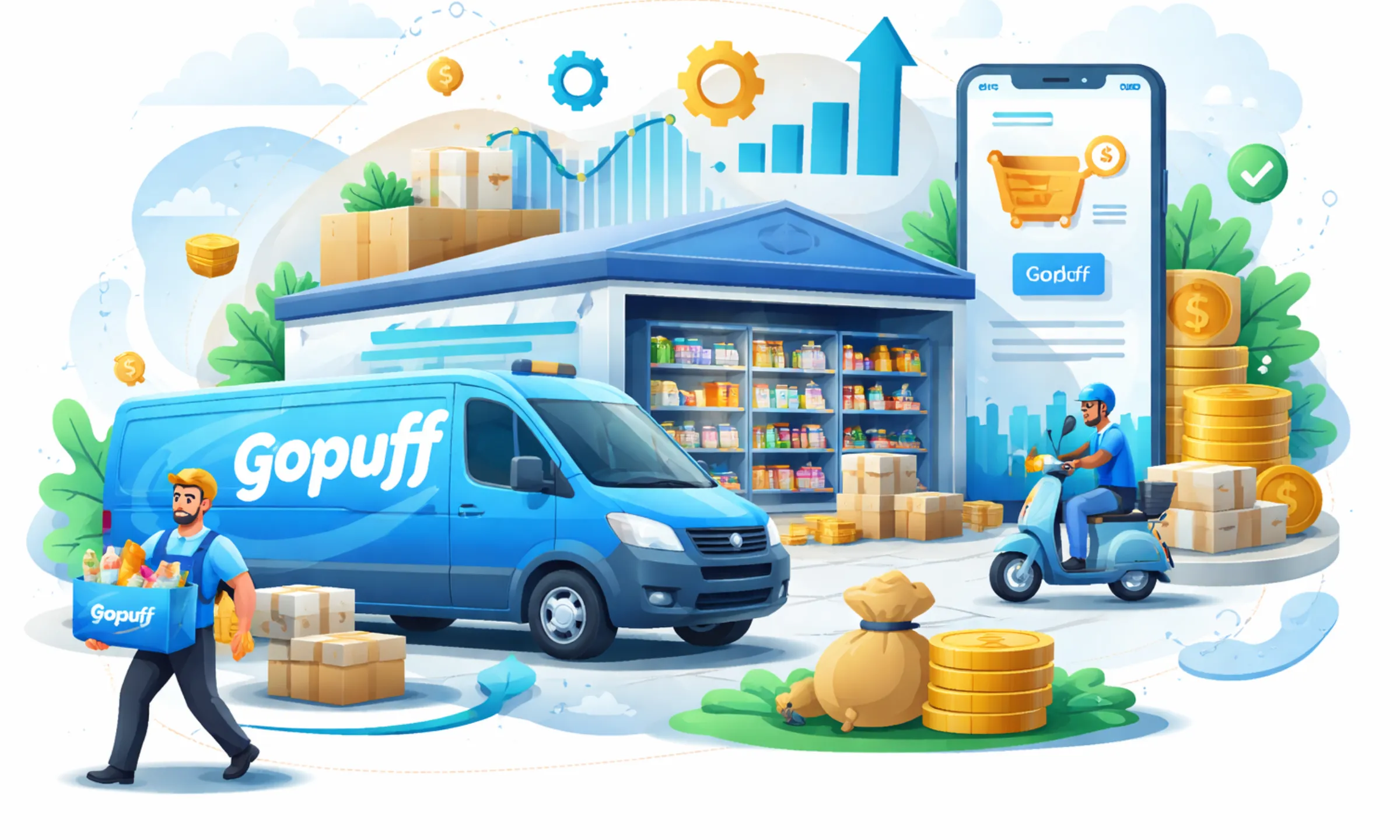
In a world where “now” beats “tomorrow,” the Business Model of GoPuff didn’t just compete with grocery stores or delivery apps—it redefined the supply chain itself. Founded in 2013, GoPuff recognized early that convenience wasn’t about listing more stores, but about controlling speed, availability, and fulfillment at the infrastructure level.
Unlike Uber Eats or Instacart, GoPuff chose a vertically integrated quick-commerce model. Instead of operating as a pure marketplace, it owns inventory, dark stores, pricing, and last-mile delivery. This structure gives GoPuff tighter control over delivery times, margins, and customer experience the Business Model of GoPuff offers critical lessons for founders building on-demand platforms, inventory-led marketplaces, private-label consumer apps.
At Miracuves, we closely study models like GoPuff because they demand enterprise-grade platform architecture, logistics intelligence, and monetization discipline—the same foundations required to build scalable on-demand ecosystems across regions.
How the GoPuff Business Model Works
GoPuff operates on a vertically integrated, inventory-led quick-commerce model. Unlike traditional delivery platforms that simply connect buyers and sellers, GoPuff owns the entire value chain—from procurement and storage to pricing and last-mile delivery.
This structure allows GoPuff to deliver thousands of everyday essentials in under 30 minutes, with predictable service quality and tighter control over margins.
Type of Business Model
GoPuff uses a Hybrid Commerce Model, combining:
- Direct-to-Consumer (D2C) retail
- Inventory-led on-demand delivery
- Subscription-based loyalty
- Private-label brand ownership
This puts GoPuff closer to a digital convenience store network than a food-delivery marketplace.
Value Proposition (Multi-Sided)
For Consumers
- Instant access to essentials (snacks, beverages, alcohol, OTC meds, home items)
- Transparent pricing and no in-store shopping friction
- 24/7 availability in many markets
For Brands
- Guaranteed shelf space inside GoPuff’s dark stores
- High-frequency impulse purchase exposure
- Data-driven demand forecasting and promotions
For GoPuff (Platform Owner)
- Full pricing and inventory control
- Higher gross margins vs pure marketplace apps
- Ability to push private-label and high-margin SKUs
Key Stakeholders & Their Roles
- Customers: Drive repeat, high-frequency orders
- Dark Store Operators: Manage localized inventory hubs
- Delivery Drivers (W2/Hybrid): Enable fast, predictable delivery
- CPG Brands: Supply inventory and marketing spend
- Technology Platform: Orchestrates routing, inventory, pricing, and demand forecasting
The ecosystem stays balanced because GoPuff—not third parties—controls supply reliability and delivery standards.
Business Model Evolution
GoPuff’s model has evolved significantly:
- Phase 1: Essentials-only delivery near college campuses
- Phase 2: Expansion into alcohol, household goods, and snacks
- Phase 3: Private-label brands (higher margin control)
- Phase 4 (2024–2025): Market rationalization, automation, unit-economics optimization
Instead of expanding endlessly, GoPuff refined market density and order profitability—a major shift after the 2021–2022 quick-commerce bubble.
Why This Model Works in 2025
- Consumer demand favors speed + reliability over variety
- Fewer but denser dark stores improve unit economics
- Private-label growth offsets delivery cost pressure
- AI-driven demand forecasting reduces inventory waste
In 2025’s capital-disciplined environment, GoPuff’s model proves that owning infrastructure can outperform marketplaces—if scale and data are used correctly.
Read more : What is GoPuff and How Does It Work?
Target Market & Customer Segmentation Strategy
GoPuff doesn’t try to serve everyone. Its growth comes from deep penetration within specific high-frequency customer segments, where speed and convenience matter more than price comparison.
This sharp focus is what allows GoPuff to justify owning inventory and infrastructure.
Primary Customer Segments
1. Urban Convenience Seekers
- Age: 18–35
- Behavior: Late-night orders, impulse buying, small baskets
- Needs: Speed, availability, predictable delivery
- Use Cases: Snacks, drinks, OTC medicine, last-minute essentials
2. Students & Young Professionals
- Location: College towns and dense metro areas
- Behavior: High order frequency, low patience for physical stores
- Value Driver: 24/7 access + no minimum effort
3. Alcohol & Party Purchasers
- Behavior: Time-sensitive purchases
- Value Driver: Legal compliance + fast fulfillment
- High-margin category for GoPuff
Secondary Customer Segments
4. Subscription Users (GoPuff Fam)
- Monthly fee users seeking zero delivery fees
- Higher lifetime value and lower churn
- Predictable demand patterns
5. Value-Conscious Repeat Buyers
- Respond to bundles, private-label pricing, and promos
- Less price-sensitive than grocery shoppers, more habit-driven
Customer Journey: Discovery → Retention
Discovery
- App store presence
- Campus marketing and local promotions
- Referral incentives and first-order discounts
Conversion
- Fast onboarding
- Clear pricing
- Immediate fulfillment promise (≤30 minutes)
Retention
- Habit-forming use cases (late-night, emergencies)
- Subscription savings
- Personalized reorder suggestions
GoPuff optimizes lifetime value (LTV) by increasing order frequency rather than basket size.
Acquisition Channels by Segment
- Students: Campus ambassadors, referral loops
- Urban users: App installs, paid local search
- Subscribers: Post-purchase upsells inside the app
- Alcohol buyers: Occasion-based promotions
Market Positioning & Competitive Edge
GoPuff positions itself as a digital convenience layer, not a grocery platform.
- Faster than Instacart
- More controlled than Uber Eats
- More impulse-driven than Amazon
Its differentiation lies in speed, owned inventory, and private labels, rather than assortment breadth.
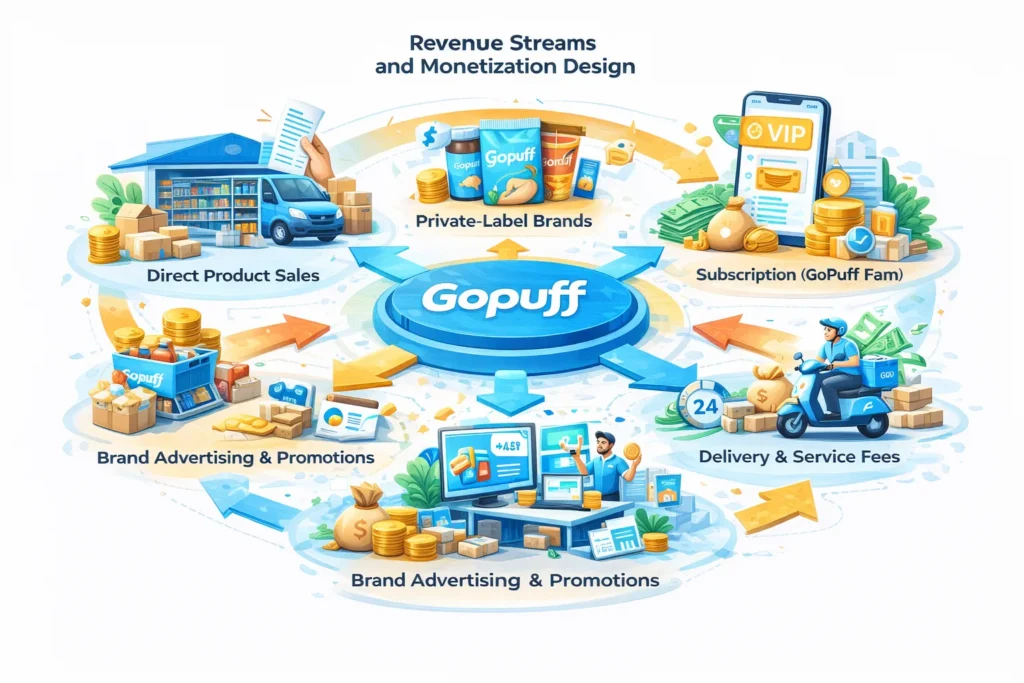
Revenue Streams and Monetization Design
Once GoPuff locked in high-frequency usage, its business model shifted from “delivery convenience” to margin engineering. Unlike marketplace apps that rely on commissions, GoPuff monetizes by owning the transaction end-to-end.
This makes its revenue model more complex—but also more defensible.
Primary Revenue Stream 1: Direct Product Sales (Core Engine)
Mechanism
GoPuff purchases inventory directly from brands and sells it to consumers at retail prices.
Pricing Model
- Wholesale procurement → retail markup
- Dynamic pricing by location and demand
- Bundling and impulse pricing for fast-moving SKUs
Revenue Contribution
- Largest share of total revenue
- Margin varies by category (snacks, beverages, alcohol, OTC meds)
Growth Trajectory
- Shift toward higher-margin categories
- Reduced SKU count to improve turnover
- Better forecasting to minimize waste
Owning inventory allows GoPuff to capture full retail margin, not just a platform fee.
Secondary Revenue Stream 2: Private-Label Brands (Margin Multiplier)
Mechanism
- GoPuff develops and sells in-house brands (snacks, beverages, essentials)
- Exclusive availability inside its app
Why It Matters
- Significantly higher gross margins
- Full control over pricing and promotions
- Reduced dependency on national brands
Private labels are critical to long-term profitability, especially as delivery costs remain structurally high.
Secondary Revenue Stream 3: Subscription (GoPuff Fam)
Mechanism
- Monthly subscription for free deliveries and exclusive deals
Pricing Psychology
- Reduces friction for repeat orders
- Locks users into habitual usage
- Smooths demand volatility
Strategic Impact
- Higher customer lifetime value
- Lower churn
- More predictable revenue base
Secondary Revenue Stream 4: Brand Advertising & Promotions
Mechanism
- Sponsored placements inside the app
- Paid promotions and featured product slots
- Data-driven targeting based on purchase behavior
Why Brands Pay
- High-intent, last-mile customers
- Immediate conversion vs traditional a
- Closed-loop performance tracking
This turns GoPuff into a retail media platform, similar to Amazon—but hyperlocal.
Secondary Revenue Stream 5: Delivery & Service Fees
Mechanism
- Per-order delivery charges
- Surge or late-night fees in select market
Strategic Role
- Covers part of last-mile costs
- Acts as demand control lever during peak hours
Overall Monetization Strategy (How It All Connects)
GoPuff’s monetization works because:
- Retail margins fund operations
- Private labels expand profitability
- Subscriptions stabilize demand
- Advertising monetizes attention
- Fees manage logistics costs
The pricing psychology is subtle: customers feel they’re paying for convenience, while GoPuff quietly compounds margin across multiple layers.
Read more : GoPuff Revenue Model: How GoPuff Makes Money in 2025
Operational Model & Key Activities
GoPuff’s real differentiation isn’t the app—it’s the operational machine behind the app. Unlike asset-light marketplaces, GoPuff runs a logistics-heavy business that demands discipline, automation, and tight execution.
This section reveals why many quick-commerce startups failed—and why GoPuff survived.
Core Operations (Day-to-Day Engine)
1. Dark Store Network Management
- Micro-fulfillment centers placed near dense demand clusters
- Limited SKU selection optimized for speed and turnover
- Localized inventory planning by neighborhood behavior
2. Inventory & Supply Chain Control
- Centralized procurement from CPG brands
- Demand forecasting using historical order data
- SKU rationalization to avoid slow-moving inventory
3. Last-Mile Delivery Operations
- In-house or hybrid driver model (not pure gig)
- Optimized batching and routing
- Time-based delivery promises (not distance-based)
4. Platform & Technology Operations
- Real-time inventory visibility
- Route optimization algorithms
- Dynamic pricing and promotion engines
5. Customer Support & Trust Systems
- Refund automation
- Alcohol compliance and ID verification
- Issue resolution within minutes, not hours
Resource Allocation Strategy (Where the Money Goes)
GoPuff’s spending priorities reflect its infrastructure-first model:
- Technology & Platform: ~25–30%
AI forecasting, routing, inventory systems - Logistics & Operations: ~35–40%
Warehouses, drivers, fulfillment - Marketing & Growth: ~15–20%
Local campaigns, retention, referrals - People & Compliance: ~10–15%
Operations managers, legal, safety - R&D & Automation: Growing focus in 2025
Robotics, demand prediction, cost optimization
Rather than expanding everywhere, GoPuff invests deeply in fewer, high-performing markets.
Why This Operational Model Is Hard to Copy
- High upfront capital requirements
- Operational complexity across cities
- Tight coordination between tech and logistics
- Margin pressure without scale and data
This is why Miracuves emphasizes enterprise-grade backend architecture when building inventory-led or on-demand platforms—weak ops kill even strong demand.
Strategic Partnerships & Ecosystem Development
GoPuff understands a critical truth of platform economics: you don’t scale alone. While it owns the core infrastructure, its growth and efficiency are amplified through carefully chosen partnerships that strengthen supply, distribution, and compliance.
Rather than chasing thousands of integrations, GoPuff focuses on high-leverage alliances.
Partnership Philosophy
GoPuff partners where it:
- Improves unit economics
- Expands assortment without operational chaos
- Reduces regulatory and logistics friction
- Increases customer trust and brand credibility
Every partnership must reinforce speed, reliability, or margin.
Key Partnership Types
1. CPG & Brand Partnerships
- Direct sourcing agreements with global and regional brands
- Exclusive product launches and bundles
- Joint promotions and data-backed merchandising
These partnerships ensure predictable supply and advertising revenue.
2. Private-Label Manufacturing Partners
- White-label and contract manufacturers
- Rapid product testing and iteration
- Margin optimization through vertical integration
This allows GoPuff to behave like a consumer brand owner, not just a retailer.
3. Payment & Financial Partners
- Digital wallets and card networks
- Fraud prevention and instant settlements
- Subscription billing infrastructure
Payments reliability is critical for high-frequency micro-orders.
4. Technology & Automation Partners
- Routing and logistics optimization tools
- Warehouse automation and inventory systems
- Data analytics and forecasting platforms
These partnerships reduce labor dependency and improve predictability.
5. Regulatory & Local Compliance Alliances
- Alcohol compliance vendors
- Age-verification technology providers
- Local authorities for licensing and zoning
These partnerships enable expansion into regulated categories without legal risk.
Ecosystem Strategy: Why It Creates a Moat
- Brands depend on GoPuff for last-mile conversion
- Customers rely on GoPuff for time-sensitive needs
- Partners benefit from predictable demand and data insights
This creates ecosystem lock-in, making GoPuff harder to replace despite competitive pressure.
At Miracuves, we help entrepreneurs design similar partner-first architectures that scale without operational overload.
Growth Strategy & Scaling Mechanisms
GoPuff’s growth story is not about hyper-expansion—it’s about controlled scaling. After the quick-commerce boom exposed the fragility of growth-at-all-costs, GoPuff recalibrated toward density, efficiency, and defensibility.
This section explains how it grows without breaking unit economics.
Core Growth Engines
1. Organic Habit Formation
- Late-night and emergency use cases
- Predictable reorder behavior
- High weekly order frequency in dense markets
Convenience—not discounts—drives repeat usage.
2. Referral & Local Virality
- First-order credits and peer referrals
- Campus and neighborhood-level adoption
- Social proof via fast delivery experiences
GoPuff grows block-by-block, not city-by-city.
3. Subscription-Led Expansion
- GoPuff Fam as a retention engine
- Reduces delivery friction
- Converts casual users into power users
Subscribers order more often and churn less.
4. Category Expansion (Not Geographic Sprawl)
- Alcohol, OTC, home essentials
- Private-label launches
- Occasion-based bundles
GoPuff expands share of wallet before expanding footprint.
5. Selective Geographic Scaling
- Focus on high-density urban clusters
- Exit from low-margin markets
- Dark store placement optimized by data
Scaling means deepening presence, not spreading thin.
Scaling Challenges & How GoPuff Addressed Them
Challenge: High Fulfillment Costs
→ Solution: SKU rationalization + automation
Challenge: Demand Volatility
→ Solution: Subscription smoothing + predictive analytics
Challenge: Capital Intensity
→ Solution: Market consolidation + operational discipline
Challenge: Regulatory Barriers (Alcohol)
→ Solution: Compliance-first partnerships
Why This Growth Model Works in 2025
- Investors reward profitability paths, not just GMV
- Consumers value reliability over novelty
- Fewer competitors remain after market correction
GoPuff’s biggest strength is knowing where not to grow.
Competitive Strategy & Market Defense
In quick commerce, speed alone is not a moat. GoPuff survives in a brutally competitive landscape because it built defensive advantages that compound over time—not features that can be copied overnight.
This section explains how GoPuff protects its position against Amazon, Instacart, Uber Eats, and emerging local players.
Core Competitive Advantages
1. Owned Infrastructure (Structural Advantage)
- Dark stores instead of third-party retailers
- Full control over inventory, pricing, and delivery windows
- Predictable service quality across locations
Most competitors rely on partners—GoPuff relies on itself.
2. Network Density Effects
- Higher order volume per dark store
- Faster delivery times with lower cost per order
- Better demand forecasting as data compounds
Density creates economic flywheels, not just convenience.
3. Private-Label Margin Control
- Exclusive products unavailable elsewhere
- Pricing power insulated from brand negotiations
- Better promotion economics than national brands
This quietly strengthens GoPuff’s gross margin defense.
4. Brand Trust in Time-Critical Moments
- Late-night, emergency, and regulated purchases
- Compliance reliability (especially alcohol)
- Consistent delivery promise fulfillment
Trust becomes a switching barrier in urgency-driven categories.
5. Data-Driven Personalization
- Reorder predictions
- Localized assortment decisions
- Dynamic promotions by time and behavior
Data advantage compounds with every order.
Market Defense Tactics
Against Price Wars
- Limited discounting
- Focus on convenience value, not lowest price
- Subscription offsets delivery friction
Against New Entrants
- High capital and operational barrier
- Difficulty matching density economics
- Regulatory learning curve
Against Platform Giants
- Narrow focus on instant essentials
- Faster fulfillment than grocery-led models
- Better impulse conversion than marketplaces
GoPuff doesn’t fight everywhere—it defends where it wins.
Strategic Moves to Protect Market Share
- Exit unprofitable regions early
- Invest in automation over expansion
- Strengthen brand + private-label ecosystem
- Prioritize operational excellence over marketing noise
This disciplined defense approach is exactly why platform architecture and backend resilience—the core of Miracuves’ expertise—matter in 2025.
Read more : Best GoPuff Clone Scripts 2025 – Build a Rapid On-Demand Delivery App
Lessons for Entrepreneurs & Implementation
GoPuff’s journey offers a powerful lesson for founders: business models don’t fail—execution does. What looks simple on the surface (fast delivery) hides one of the most operationally demanding models in tech.
Here’s how entrepreneurs can translate GoPuff’s insights into action.
Key Factors Behind GoPuff’s Success
- Chose ownership over aggregation
- Built infrastructure before chasing scale
- Designed monetization early, not as an afterthought
- Prioritized density and unit economics over vanity growth
- Used data to guide expansion and contraction
GoPuff succeeded because it treated logistics as a core competency, not a cost center.
Replicable Principles for Startups
1. Own What Defines Your Value
If speed or quality is your promise, control the supply chain.
2. Design for Frequency, Not One-Time Orders
High-frequency use cases compound faster than high-ticket purchases.
3. Monetize from Multiple Angles
Product margin + subscriptions + ads > single revenue stream dependency.
4. Build for Fewer Markets, Deeper Impact
One profitable city beats ten unprofitable ones.
Common Mistakes to Avoid
- Expanding before achieving order density
- Ignoring private-label or margin levers
- Over-discounting to fake retention
- Treating operations as secondary to marketing
Most quick-commerce failures came from premature scaling.
Adapting GoPuff’s Model to Local or Niche Markets
- Focus on specific use cases (meds, B2B supplies, campus essentials)
- Start with one high-density zone
- Use limited SKUs to test demand
- Add subscriptions early to stabilize cash flow
Localization beats replication.
Ready to implement GoPuff’s proven business model for your market?
Miracuves builds scalable on-demand and inventory-led platforms with tested monetization and growth frameworks. We’ve helped 200+ entrepreneurs launch profitable apps globally.
Get your free business model consultation today.
Conclusion
GoPuff’s business model proves a powerful truth about modern platforms: innovation isn’t just about software—it’s about systems.
By owning inventory, logistics, pricing, and delivery, GoPuff transformed convenience from a retail concept into a real-time infrastructure problem—and then solved it with discipline, data, and focus. While many quick-commerce startups chased expansion, GoPuff survived by choosing control over chaos and density over hype.
In 2025 and beyond, the winners in platform economies won’t be the loudest or fastest-growing—they’ll be the ones who understand unit economics, operational leverage, and ecosystem design at a fundamental level.
For founders building the next generation of on-demand, hyperlocal, or inventory-led apps, GoPuff is a reminder that execution is the real product.
FAQs
What type of business model does GoPuff use?
GoPuff uses a vertically integrated, inventory-led quick-commerce model. It owns inventory, dark stores, pricing, and last-mile delivery instead of acting as a pure marketplace.
How does GoPuff’s business model create value?
GoPuff creates value by delivering everyday essentials in under 30 minutes with consistent availability. Owning the supply chain ensures speed, reliability, and predictable customer experience.
What are GoPuff’s key success factors?
High order frequency, dense dark-store networks, private-label margins, and data-driven demand forecasting are GoPuff’s core success drivers.
How scalable is GoPuff’s business model?
The model is scalable in dense urban markets but capital-intensive. Profitability improves with order density, automation, and private-label expansion rather than rapid geographic spread.
What are the biggest challenges GoPuff faces?
High fulfillment costs, inventory risk, and regulatory complexity—especially alcohol compliance—are major challenges. GoPuff mitigates these through automation and market rationalization.
How can entrepreneurs adapt GoPuff’s model to their region?
Entrepreneurs should start with one high-density zone, limit SKUs, and focus on repeat-use cases. Localization and controlled expansion are critical for success.
What are alternatives to GoPuff’s business model?
Alternatives include marketplace delivery models like Instacart or Uber Eats and micro-warehouse B2B supply apps. These reduce capital needs but offer less margin control.
How has GoPuff’s business model evolved over time?
GoPuff evolved from campus-focused delivery to a nationwide quick-commerce platform. By 2025, it emphasizes profitability, automation, and fewer but denser markets.
Related Article :