Key Takeaways
What You’ll Learn
- DoorDash is an on-demand delivery platform that connects customers with restaurants, grocery stores, and local merchants through one app.
- The app works through a simple marketplace flow where users browse items, place orders, and receive deliveries through independent delivery partners.
- Its core value comes from convenience and speed, offering real-time order tracking, digital payments, and doorstep delivery.
- DoorDash is more than a food delivery app because it also supports groceries, convenience items, retail delivery, and local commerce use cases.
- The platform succeeds by combining logistics, merchant supply, and customer convenience into one smooth delivery experience.
Stats That Matter
- Food delivery apps grow by solving convenience and time-saving needs, making it easier for users to order meals and essentials without visiting stores in person.
- The DoorDash model supports multiple local delivery categories such as restaurants, groceries, convenience items, and everyday essentials in one platform.
- Real-time tracking, secure checkout, and live order updates help improve customer confidence and reduce delivery friction.
- Merchant availability and delivery partner supply directly influence order speed, fulfillment quality, and customer satisfaction.
- A strong delivery marketplace performs better when customer demand, merchant operations, and logistics efficiency stay balanced across locations.
Real Insights
- DoorDash became popular because it made local delivery simple and reliable, turning restaurant and store orders into a faster digital experience.
- The platform works best when delivery speed stays consistent, because user trust depends heavily on timing and order accuracy.
- Convenience alone is not enough, since merchant quality, driver efficiency, and support systems also shape long-term customer retention.
- For startups, this model is attractive because it is scalable and category-flexible, allowing expansion into more local delivery segments over time.
- Long-term success depends on combining strong technology, reliable delivery operations, and merchant coordination into one seamless marketplace.
Imagine it’s raining, you’re hungry, and your favorite restaurant doesn’t deliver — but within minutes, hot food shows up at your door. That’s the magic of DoorDash, one of the most powerful on-demand delivery platforms reshaping how people order food in 2026.
Founded in 2013 by Tony Xu, Stanley Tang, Andy Fang, and Evan Moore, DoorDash started with a simple mission — help local businesses deliver anything to anyone. Fast forward to 2026, and it has grown into a global leader in food delivery, serving millions of users across the U.S., Canada, Australia, and Japan. From meals to groceries to convenience store essentials, DoorDash has evolved far beyond just restaurant deliveries.
Its innovative logistics, strong network of “Dashers” (delivery partners), and seamless customer experience have made it a household name in the $350+ billion global food delivery industry.
What is DoorDash? – The Simple Explanation
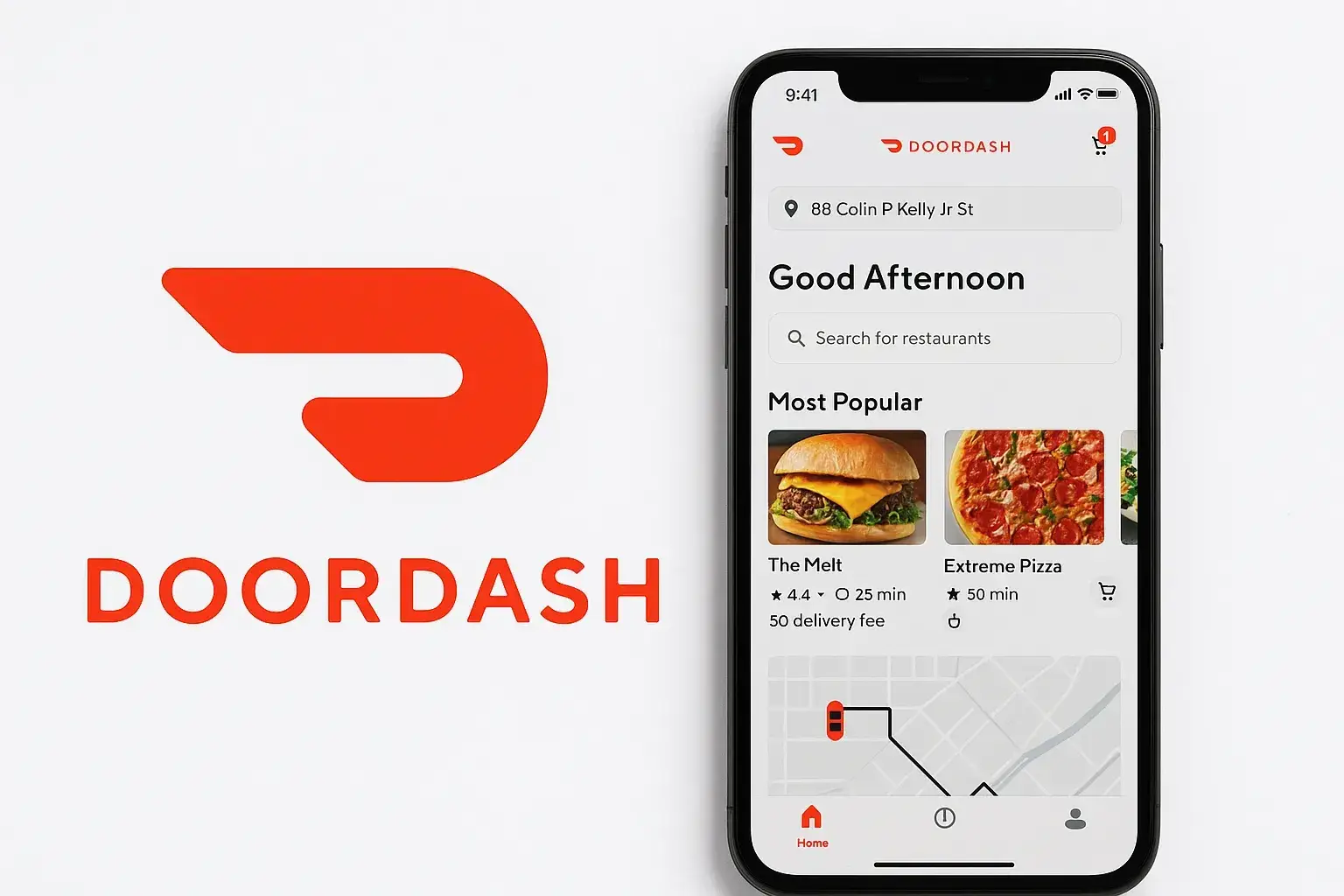
DoorDash is a popular on-demand food and goods delivery platform that connects users with local restaurants, grocery stores, and retailers. Through its mobile app or website, customers can browse menus, place orders, and get items delivered to their doorstep — often within minutes.
At its core, DoorDash solves a modern problem: the gap between customers craving convenience and local businesses needing broader reach. It empowers small restaurants and stores to serve customers beyond their physical locations — all without owning delivery infrastructure.
Target Users & Use Cases
- Customers: Busy individuals who want quick, reliable food delivery or grocery drop-offs.
- Merchants: Local restaurants, cafes, and stores seeking to increase sales through online delivery.
- Dashers (Delivery Partners): Independent contractors who earn by completing deliveries.
Current Market Position (2026 Data)
- Operates in over 7,000 cities across 4 countries
- Holds ~57% U.S. food delivery market share (as of 2026, per Statista)
- Serves 35+ million active users monthly
- Partners with over 550,000 merchants globally
- Valued at $45+ billion market cap (2026)
Read more: Build Your Own Food Delivery App Like DoorDash: Cost, Features, and Development Process
Why It Became Successful
DoorDash succeeded by focusing not just on restaurants, but on logistics optimization and hyperlocal delivery. Its AI-driven route management, partnership flexibility, and subscription program (DashPass) built strong customer loyalty — turning everyday ordering into a lifestyle habit.
How Does DoorDash Work? – Step-by-Step Breakdown
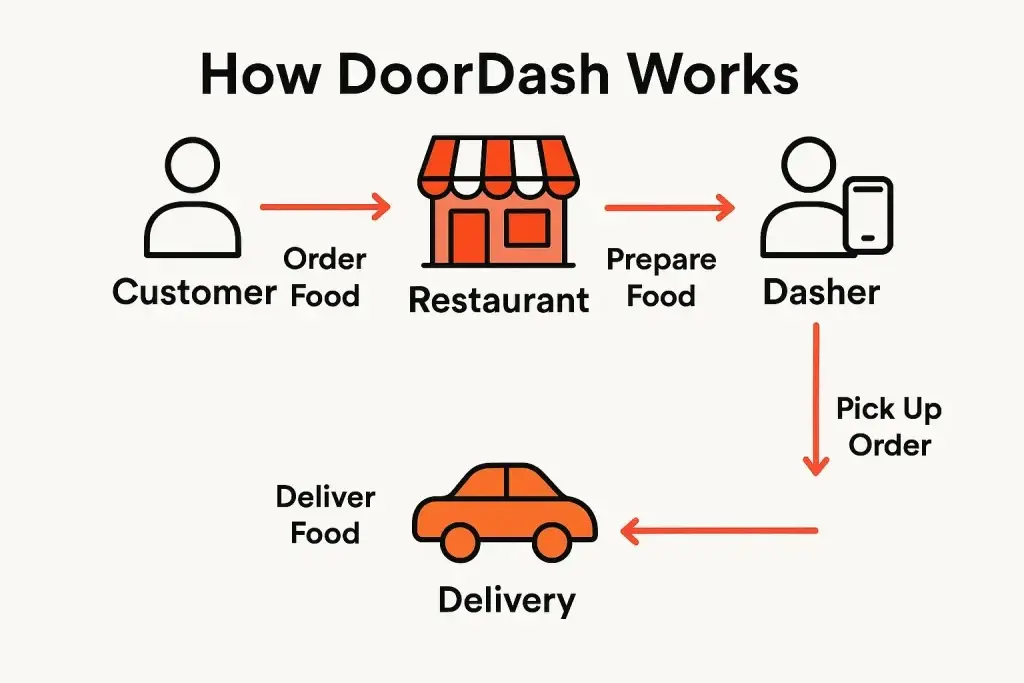
DoorDash operates as a three-sided marketplace — connecting customers, restaurants/merchants, and delivery partners (Dashers) through a unified platform that makes food delivery seamless.
For Users (Customers)
1. Account Creation:
Users sign up via the DoorDash app or website using their email, Google, or Apple account. They enter their delivery address to see available restaurants nearby.
2. Browsing & Ordering:
Customers browse menus, apply filters (cuisine, delivery time, price, ratings), and place orders. Payment options include credit/debit cards, PayPal, Apple Pay, Google Pay, and DoorDash credits.
3. Real-Time Tracking:
Once an order is placed, users can track the entire journey — from restaurant confirmation to Dasher pickup and live GPS tracking until delivery.
4. DashPass Subscription (Optional):
For $9.99/month, DashPass offers free delivery and reduced service fees on eligible orders, improving loyalty and repeat usage.
Example:
Jane orders sushi via DoorDash. She tracks the Dasher, sees ETA updates, and receives the order — all within 25 minutes — without calling the restaurant.
For Dashers (Delivery Partners)
1. Onboarding:
Dashers sign up, undergo a background check, and set their preferred working hours via the Dasher app.
2. Accepting Deliveries:
They receive delivery requests based on proximity, restaurant readiness, and customer distance.
3. Completing Orders:
Dashers pick up food, verify order details, deliver to the user, and mark completion in-app.
4. Earnings Structure:
Dashers earn based on:
- Base pay: $2–$10 per delivery
- Promotions: Peak pay or challenges during busy hours
- Tips: 100% go to Dashers
Average Dasher income in 2026: $25–$32/hour (during peak times).
For Merchants (Restaurants/Stores)
Merchants list their businesses on DoorDash through DoorDash Merchant Portal or Drive API integration. They manage menu items, prices, and availability. DoorDash handles order routing, customer support, and delivery logistics.
Technical Overview (Simple Explanation)
DoorDash relies on a three-tier architecture:
- Frontend (App/Web): Built with React Native for smooth cross-platform experience
- Backend: Powered by Python (Django/Flask) and Node.js for scalable API management
- Database: Uses PostgreSQL, Redis, and AWS infrastructure for performance and real-time order tracking
AI/ML systems optimize route planning, delivery matching, and demand prediction, ensuring shorter delivery times and better customer satisfaction.
DoorDash’s Business Model Explained
DoorDash’s success stems from a multi-revenue model that monetizes all sides of its marketplace — customers, merchants, and delivery partners — creating a balanced ecosystem that fuels rapid growth and profitability.
How DoorDash Makes Money
- Commissions from Merchants
- Restaurants and stores pay DoorDash a commission (15%–30%) per order for access to delivery, logistics, and customer base.
- Higher-tier partners get better visibility in the app through DoorDash Premier listings.
- Delivery & Service Fees (Customers)
- Customers pay a delivery fee ($1.99–$5.99) depending on distance and demand.
- A service fee (up to 10%) is added to cover platform and payment costs.
- DashPass Subscription Program
- $9.99/month plan offering free deliveries and reduced fees on eligible restaurants.
- Over 15 million active subscribers as of 2026, generating predictable recurring revenue.
- DoorDash Drive (B2B Deliveries)
- White-label logistics for brands like Walmart, Chipotle, and Sephora, allowing them to use DoorDash delivery without being listed on the consumer app.
- White-label logistics for brands like Walmart, Chipotle, and Sephora, allowing them to use DoorDash delivery without being listed on the consumer app.
- Advertising & Promotions
- Restaurants pay for sponsored placements, banner ads, and priority listings — a growing revenue stream in 2026.
- Merchants can also run in-app promotions (like “free delivery weekends”) for higher visibility.
- Partnerships & Cloud Kitchens
- DoorDash collaborates with ghost kitchens and delivery-only brands to expand reach while minimizing overhead.
- It earns through infrastructure sharing and revenue-sharing agreements.
Read more: DoorDash Business Model Explained: Key Revenue Streams
Market Size & Financials (2026 Snapshot)
| Metric | Value (2026 Estimate) |
| Global Market Share | ~57% U.S., 10% Global |
| Annual Revenue | $11.4 Billion+ |
| Net Profit Margin | 6.8% |
| Active Dashers | 3.5 Million+ |
| Partnered Merchants | 550,000+ |
| Monthly Active Users | 35 Million+ |
Pricing & Commission Breakdown
| Segment | Fee Type | Range |
| Customer | Delivery Fee | $1.99 – $5.99 |
| Customer | Service Fee | 5% – 10% |
| Merchant | Commission | 15% – 30% |
| Subscription | DashPass | $9.99/month |
| Ads | Sponsored Listings | Variable (CPC-based) |
Profitability Insight
DoorDash’s path to profitability accelerated post-2024 due to its AI-driven logistics (reducing idle time) and expanded non-food verticals like groceries, flowers, and pet supplies — giving it higher order frequency per user.
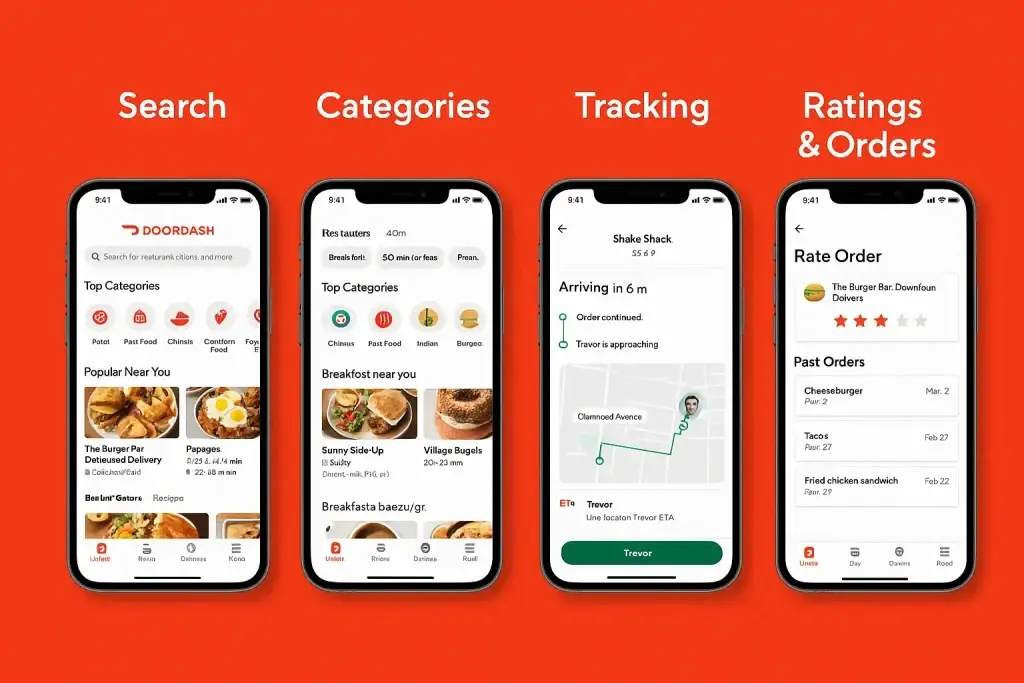
Key Features That Make DoorDash Successful
DoorDash’s dominance in the food delivery industry isn’t accidental — it’s built on a powerful mix of user-centric design, AI-driven logistics, and business flexibility. These features not only improve convenience but also create strong loyalty loops across customers, merchants, and Dashers.
Top 10 Features That Drive DoorDash’s Success (2026)
1. Smart Restaurant Discovery
Users can browse from thousands of nearby restaurants using filters like cuisine, ratings, price range, and delivery time. DoorDash’s AI algorithm personalizes suggestions based on order history and time of day — boosting engagement.
2. Real-Time Order Tracking
Live GPS tracking lets users see exactly where their Dasher is — improving transparency and reducing anxiety during delivery.
3. DashPass Subscription
For $9.99/month, users enjoy free delivery and lower service fees. This feature significantly increases customer retention and average order frequency.
4. DoorDash Drive (White-Label Delivery)
This B2B logistics solution powers delivery for brands like Walmart and Chipotle — helping businesses expand reach without building their own fleets.
5. Group Orders
Multiple users can join one order from different devices, making it ideal for offices, families, or group hangouts.
6. Advanced Scheduling
Users can schedule orders hours or days in advance, a feature widely adopted by corporate users and event planners.
7. In-App Chat & Real-Time Notifications
Users and Dashers communicate seamlessly within the app for updates, delays, or directions — improving delivery success rate and satisfaction.
8. AI Route Optimization
DoorDash’s proprietary AI system automatically assigns deliveries to the most efficient Dasher based on distance, order size, and real-time traffic — reducing average delivery time by up to 22%.
9. Ratings & Feedback Loop
Customers rate both food and delivery experience, helping maintain high service quality. Merchants use analytics dashboards to track performance and user sentiment.
10. Expanding Non-Food Categories
In 2026, DoorDash now supports groceries, flowers, alcohol, and pet supplies, increasing revenue diversity and user retention.
AI/ML Integrations (2026 Upgrades)
- Predictive Demand Forecasting: AI predicts busy hours for restaurants and Dashers.
- Dynamic Pricing: Adjusts delivery fees based on supply-demand balance.
- Personalized Recommendations: Machine learning tailors restaurant suggestions per user.
- Fraud Detection Systems: ML algorithms detect unusual transactions and fake accounts in real time.
What Sets DoorDash Apart
Unlike competitors like Uber Eats or Grubhub, DoorDash invests heavily in logistics intelligence — positioning itself as a tech-first company rather than just a delivery service. Its focus on merchant growth tools, community-based programs, and sustainability goals (carbon-neutral deliveries by 2030) further enhance its brand value.
The Technology Behind DoorDash
DoorDash’s smooth, lightning-fast experience is powered by a robust tech ecosystem built to handle millions of simultaneous users, real-time delivery updates, and dynamic route optimization — all while maintaining reliability and scalability.
Tech Stack Overview (Simplified)
| Layer | Technologies Used | Purpose |
| Frontend | React Native, React.js | Cross-platform UI for Android, iOS & Web |
| Backend | Python (Flask, Django), Node.js, Go | API management, business logic, scalability |
| Database | PostgreSQL, Redis, Cassandra | Storing user data, orders, sessions, caching |
| Cloud & Hosting | AWS, Kubernetes, Docker | Auto-scaling, deployment, and uptime |
| Payment Processing | Stripe, Braintree | Secure multi-currency transactions |
| AI/ML & Analytics | TensorFlow, PyTorch, Snowflake, Airflow | Predictive demand, route optimization, customer personalization |
| Maps & Tracking | Google Maps API, Mapbox, custom geo-routing | Real-time Dasher location & ETA tracking |
Real-Time Features
- Live Order Tracking: GPS-powered tracking updated every few seconds.
- Push Notifications: Instant order confirmation, pickup, and delivery alerts.
- Real-Time Routing: AI dynamically reassigns Dashers during high demand or delays.
- In-App Communication: Real-time chat between users, restaurants, and Dashers.
These systems rely heavily on WebSocket protocols and MQTT messaging, ensuring updates occur within milliseconds.
Data Handling & Privacy
DoorDash employs end-to-end encryption and tokenized payments to secure sensitive data. It complies with GDPR and CCPA, ensuring global data privacy standards.
Customer addresses and payment data are anonymized before sharing with merchants or Dashers, reducing exposure risks.
Scalability Approach
- Microservices architecture enables independent scaling of delivery, payments, and order modules.
- Load balancing & containerization via Kubernetes ensures stability even during traffic surges (like Super Bowl weekends).
- AI-driven infrastructure monitoring predicts outages before they occur, improving uptime to 99.98% in 2026.
API Integrations
- Merchant API: For restaurants to manage menus, inventory, and order flow.
- Delivery API (Drive): Enables third-party logistics for enterprises.
- Payments API: For secure, quick settlements across thousands of merchants.
- Analytics API: Gives merchants insight into sales trends, customer behavior, and performance KPIs.
Why This Tech Matters for Business
DoorDash’s technology foundation makes it scalable, data-smart, and globally adaptable, giving entrepreneurs confidence that a clone built on similar architecture can support massive growth — from local startups to global food delivery networks.
DoorDash’s Impact & Market Opportunity
DoorDash didn’t just change how people order food — it transformed the global delivery economy. By blending technology, convenience, and local empowerment, it created ripple effects across industries ranging from restaurants to retail logistics.
Industry Disruption
DoorDash revolutionized the on-demand delivery model by giving small restaurants and local stores access to large-scale logistics and digital visibility — something only major chains once had.
Its hyperlocal logistics algorithm became a global benchmark, influencing startups across grocery, medicine, and parcel delivery sectors.
Market Statistics (2026)
| Metric | Value (2026 Estimate) |
| Global Food Delivery Market Size | $355 Billion |
| DoorDash Market Share (U.S.) | ~57% |
| Active Monthly Users | 35+ Million |
| Orders Per Day | 8.5+ Million |
| Active Dashers | 3.5 Million+ |
| Partner Merchants | 550,000+ |
| DashPass Subscribers | 15+ Million |
DoorDash’s non-food verticals (grocery, alcohol, retail) now account for ~22% of total revenue — showing its diversification and adaptability.
User Demographics & Behavior
- Age Group: Majority of users are between 22–40 years old, tech-savvy and urban-based.
- Usage Frequency: Average of 5.4 orders per month per user.
- Device Preference: 82% of orders come from mobile devices.
- Peak Times: Lunch (12–2 PM) and Dinner (6–9 PM).
Geographic Presence
Active in 7,000+ cities across:
- North America (U.S., Canada)
- Asia-Pacific (Japan)
- Australia
- Planning European expansion in 2026
DoorDash’s flexible delivery framework allows rapid onboarding in new regions using local driver partnerships and regional language support.
Future Projections
- AI-Powered Automation: Predictive delivery routing and drone pilots in select U.S. cities.
- Sustainability Goals: Carbon-neutral deliveries by 2030.
- Expansion Plans: Focus on groceries, pharmacy deliveries, and international markets.
- Projected Market Cap (2026): Estimated to cross $55 Billion.
Opportunities for Entrepreneurs
This massive success shows one clear thing — the on-demand delivery model works when powered by data, automation, and convenience.
For startups and businesses, creating a DoorDash-like platform in 2026 presents incredible opportunities in:
- Niche markets (e.g., vegan delivery, local groceries)
- Hyperlocal logistics
- B2B delivery networks
- White-label fulfillment platforms
This massive success is why many entrepreneurs now want to create similar on-demand platforms — blending real-time delivery, local business empowerment, and AI-driven logistics.
Building Your Own DoorDash-Like Platform
The rise of DoorDash has inspired thousands of entrepreneurs to tap into the booming on-demand delivery economy. But building a platform of this scale doesn’t have to be overwhelming — with the right tech stack, business model, and execution, you can launch your own DoorDash clone quickly and efficiently.
Why Businesses Want DoorDash Clones
- Proven Market Demand: Food and goods delivery continues to grow at >10% CAGR through 2030.
- Multiple Revenue Streams: Subscriptions, delivery fees, ads, and partnerships.
- Scalability: Once your delivery infrastructure works locally, expansion to other verticals (groceries, medicines, etc.) is seamless.
- Customer Stickiness: AI personalization and loyalty programs keep users returning.
Key Considerations Before Development
- Business Model Choice:
Decide if you want a commission-based, subscription, or hybrid model. - Target Audience:
Will you serve restaurants, grocery stores, or all-in-one delivery? - Technology Stack:
Ensure your app includes real-time tracking, automated dispatch, secure payments, and merchant dashboards. - Legal & Compliance:
Verify local delivery regulations, taxation, and data privacy norms. - UI/UX Design:
Simple, responsive design is critical for customer retention.
Global Cost Factors & Pricing Breakdown for a DoorDash-Like App
The technology stack behind your platform plays a major role in determining development cost, launch speed, and long-term scalability. Some businesses aim for a faster and more affordable launch, while others require a more advanced setup to manage real-time order tracking, high traffic, and multi-location delivery operations.
Here is a simple comparison of common global development approaches for a DoorDash-like food delivery and on-demand logistics platform:
PHP / Laravel is best for quick and affordable launches, Node.js / Python for real-time delivery operations, and Go microservices for large-scale platforms.
DoorDash Clone App Development Cost & Miracuves Pricing Breakdown
Miracuves Pricing for a DoorDash-Like Food Delivery App developed in PHP/Laravel with Flutter Apps for $3,399 USD (One-Time Price) in just 6 days
Get a fully developed, deployment-ready platform modeled after DoorDash. Built on a stable PHP/MySQL backend with Flutter mobile apps, this complete package gives you everything needed to launch and scale a modern food delivery business with efficiency, flexibility, and real-time operational control.
- Core Delivery Flow: Customer ordering, restaurant onboarding, order management, and driver delivery workflows.
- Built-in Operations: Dynamic pricing logic, service fee structure, commission handling, and payout management.
- Management Hub: Centralized admin backend for restaurants, drivers, users, orders, pricing rules, and platform operations.
- Launch-Ready Setup: Fully prepared for branding, deployment, API setup, and app store launch support.
Why is it so affordable?
Most food delivery platforms like DoorDash rely on complex logistics systems, real-time tracking, and multi-layer pricing models across restaurants, customers, and delivery partners. Building this from scratch requires larger engineering teams, more development time, and significantly higher technical investment. Miracuves removes that burden by offering a ready-made DoorDash-style platform that already includes the essential delivery workflows, business logic, and admin controls required to launch faster.
We took a smarter, more practical approach:
- You Aren’t Paying for Ground-Up Development: Our DoorDash-style engine is already developed, tested, and structured for real business operations, helping you avoid months of product planning and backend setup.
- The Strength of PHP / MySQL with Flutter Apps: This stack is reliable, scalable, and cost-effective, making it easier to maintain your platform and manage future customizations without inflating your budget.
- Fast Launch Advantage: Instead of waiting months to enter the market, you can launch a fully branded food delivery solution in just 6 days with the core order, delivery, and management workflows already in place.
You get a complete, business-ready food delivery platform without the inflated cost of full custom development.
Note: This cost includes the solution, re-branding, deployment support, source code, backend/API setup, admin panel configuration, and publishing support for Google Play Store and Apple App Store.
Essential Features to Include
- User & Merchant Apps (iOS + Android)
- Real-Time Order Tracking
- Multiple Payment Options
- Ratings & Reviews
- Push Notifications
- Admin Dashboard
- AI-Powered Route Optimization
- Subscription/Rewards Programs
- Analytics & Reports
Conclusion
DoorDash has evolved from a small Silicon Valley startup into a global delivery powerhouse, redefining how people experience convenience. Its success lies in data-driven logistics, AI-powered operations, and a customer-first philosophy that makes every order fast, reliable, and satisfying.
In 2026, DoorDash isn’t just a food delivery app — it’s a technology-driven ecosystem connecting people, merchants, and drivers through efficiency and trust. It has inspired a new generation of entrepreneurs to explore the booming on-demand economy, from groceries to pharmacy deliveries and beyond.
Want to launch your delivery app fast? Talk to our experts or explore more at Miracuves.
FAQs
How does DoorDash make money?
DoorDash earns revenue through merchant commissions (15–30%), delivery and service fees, DashPass subscriptions, ads and promotions, and its B2B logistics service — DoorDash Drive.
Is DoorDash available in my country?
As of 2026, DoorDash operates in the U.S., Canada, Australia, and Japan, with expansion plans for Europe in 2026.
How much does DoorDash charge users?
Customers typically pay a delivery fee of $1.99–$5.99 plus a service fee (5–10%), depending on distance, order size, and demand.
What’s the commission for service providers (merchants)?
Restaurants and stores pay DoorDash 15–30% commission per order, depending on their plan tier and delivery support level.
How does DoorDash ensure safety?
DoorDash uses GPS tracking, two-way identity verification, contactless delivery, and real-time support systems to ensure customer and Dasher safety.
Can I build something similar to DoorDash?
Yes! You can create your own DoorDash-like app using ready-made Miracuves clone solutions. These can be fully customized and launched within 6 Days with scalable tech and branding flexibility.
What makes DoorDash different from competitors?
DoorDash stands out through its AI-powered logistics, hyperlocal delivery model, and merchant-focused growth tools, giving it stronger retention and profitability than Uber Eats or Grubhub.
How many users does DoorDash have?
In 2026, DoorDash serves 35+ million active users monthly and partners with 550,000+ merchants worldwide.
What technology does DoorDash use?
DoorDash uses React Native, Python, AWS, TensorFlow, and Google Maps APIs, while Miracuves builds similar platforms with PHP and Flutter for faster, more cost-effective deployment.
Related Articles:
Miracuves is an independent software development company. We are not affiliated with, connected to, sponsored by, or endorsed by any company or product named in this article.
Terms such as “X Clone” are used descriptively. It is how the software industry refers to building a platform with functionality comparable to a known service, and how clients search for it.
The entire design and codebase of our products is built by our own team. Our products contain no code, design, graphics, or content originating from any third-party website or applications.
All third-party names and marks referenced in this article are the property of their respective owners, referenced solely to identify the services discussed.