

In 2007, LendingClub launched with a simple but disruptive idea: connect borrowers directly with investors through a digital platform. By 2026, the company has transformed into a full-scale digital bank and fintech platform with over $80+ billion in loans originated since inception and millions of customers across the United States.
What started as a peer-to-peer lending marketplace has evolved into a hybrid fintech-bank model after LendingClub acquired Radius Bank in 2021, allowing it to control deposits, funding, and lending infrastructure.And its business model of LendingClub matters for modern founders because it demonstrates how a platform can: Build two-sided financial marketplaces, monetize data-driven lending decisions, and scale through technology-first banking infrastructure.
For entrepreneurs exploring fintech platforms, lending marketplaces, or embedded finance solutions, LendingClub provides a blueprint for building a scalable, asset-light financial ecosystem. At Miracuves, many fintech founders study LendingClub’s model to understand how digital platforms can manage risk, regulation, and revenue simultaneously while scaling financial services globally.
How the LendingClub Business Model Works
LendingClub operates on a hybrid fintech marketplace + digital banking model that connects borrowers, investors, and depositors through a technology-driven lending platform.
Originally launched as a peer-to-peer lending marketplace, LendingClub’s model evolved after acquiring Radius Bank, allowing it to fund loans directly through deposits while still maintaining its marketplace infrastructure for institutional investors.
This hybrid structure gives LendingClub a major advantage: it can both originate loans and distribute them strategically across its ecosystem, improving liquidity and profitability.
Type of Business Model
LendingClub operates a hybrid model combining multiple financial frameworks:
- Marketplace Lending Platform
- Matches borrowers with institutional investors.
- Loans can be sold into the marketplace.
- Matches borrowers with institutional investors.
- Digital Banking Model
- Deposits from customers fund loans.
- Enables LendingClub to earn net interest income.
- Deposits from customers fund loans.
- Data-Driven Fintech Platform
- Uses proprietary credit models and AI-driven risk analytics.
- Uses proprietary credit models and AI-driven risk analytics.
In essence, LendingClub blends:
Fintech + Marketplace + Digital Bank
This hybrid model allows the company to scale lending without holding all loans on its balance sheet, reducing capital risk while maximizing revenue opportunities.
Why the Model Works in 2026
Several macro trends strengthen LendingClub’s business model today.
Digital banking adoption
Consumers increasingly prefer app-based financial services.
Data-driven credit scoring
AI and machine learning improve loan risk prediction.
Investor demand for alternative credit
Institutional investors seek yield beyond traditional bonds.
Fintech-banking convergence
Platforms that combine lending, deposits, and analytics dominate modern finance.
Because of this, LendingClub’s hybrid model positions it well within the next generation of fintech banking platforms.
For founders building fintech platforms, companies like Miracuves often replicate similar marketplace architectures when designing scalable lending, payment, or financial ecosystem apps.
Read more : What is LendingClub and How Does It Work?
Target Market & Customer Segmentation Strategy
Understanding LendingClub’s success requires examining who the platform serves, how it attracts them, and why they remain loyal.
Unlike traditional banks that focus on broad demographics, LendingClub uses data-driven segmentation and digital behavior analytics to precisely target customers who benefit most from its lending ecosystem.
The company’s strategy revolves around high-intent borrowers, yield-seeking investors, and digital-first banking customers.
Primary Customer Segments
1. Consumer Borrowers (Core Segment)
The largest user group on LendingClub consists of individual consumers seeking personal loans, particularly for debt consolidation.
Typical borrower characteristics:
- Age: 30–55
- Credit score: Mid to high range (often 660–780)
- Financial goal: Reduce credit card debt or manage personal expenses
- Digital behavior: Comfortable applying for loans online
Common use cases include:
- Credit card debt consolidation
- Home improvement
- Medical expenses
- Major life events (weddings, relocation, etc.)
LendingClub’s algorithmic credit evaluation enables faster approvals and competitive interest rates, making it attractive to borrowers frustrated with traditional bank processes.
2. Institutional Investors
The second key segment consists of institutional investors who purchase LendingClub-originated loans.
Typical investor profiles:
- Hedge funds
- Asset managers
- Pension funds
- Fintech-focused investment firms
Their motivation:
- Access to diversified consumer credit portfolios
- Predictable yield compared to bonds
- Data transparency through LendingClub’s analytics
This investor base allows LendingClub to scale lending operations without holding all loans on its balance sheet.
3. Digital Banking Customers (Depositors)
After acquiring Radius Bank, LendingClub began attracting digital banking customers looking for modern savings solutions.
These users typically:
- Prefer app-first banking
- Seek higher savings interest rates
- Want integrated financial tools
Services used by this segment include:
- High-yield savings accounts
- personal finance dashboards
- automated savings tools
Deposits from these customers fund LendingClub’s lending engine, lowering capital costs.
Secondary Customer Segments
Beyond its core users, LendingClub also engages several secondary segments:
Financial advisors and fintech platforms
- Partner with LendingClub to access lending products.
Small business owners
- Some personal loans are used for business-related expenses.
Credit improvement customers
- Individuals seeking structured repayment plans to improve credit scores.
These secondary segments expand LendingClub’s addressable market without significantly increasing acquisition costs.
Revenue Streams and Monetization Design
Now that we understand who uses LendingClub, the next step is to examine how money flows through the platform.
LendingClub’s monetization structure is sophisticated because it combines fintech platform revenue with traditional banking income streams. This hybrid revenue design allows the company to generate income from both loan origination activity and long-term financial products.
In 2026, LendingClub’s revenue model revolves around three major pillars: loan origination, loan servicing, and net interest income from banking operations.
Primary Revenue Stream: Loan Origination Fees
The largest historical revenue driver for LendingClub is the origination fee charged to borrowers when a loan is issued.
How it works
When a borrower takes a personal loan through LendingClub:
- The platform charges an origination fee typically ranging from 1% to 6% of the loan amount.
- The fee is deducted from the loan before funds are disbursed.
Example:
- Borrower approved for $20,000 loan
- Origination fee 3% ($600)
- Borrower receives $19,400
Why this stream scales well
Origination fees are powerful because they:
- Generate immediate revenue
- Scale with loan volume
- Require minimal marginal cost once the platform infrastructure exists
With billions of dollars in annual loan originations, these fees represent a major share of LendingClub’s platform income.
Secondary Revenue Stream: Net Interest Income
After acquiring Radius Bank, LendingClub began earning net interest income (NII)—the difference between:
- Interest earned on loans
- Interest paid to depositors
How it works
Deposits fund a portion of the loan portfolio.
For example:
- Loan interest rate: 13%
- Savings account interest rate: 4%
The spread between these rates creates sustainable banking income.
Strategic benefit
This shift transformed LendingClub from a pure marketplace into a profitable digital bank with recurring revenue.
Net interest income now plays a growing role in the company’s financial structure.
Additional Revenue Streams
1. Loan Servicing Fees
LendingClub continues to service loans even after selling them to investors.
The platform charges servicing fees for managing repayment operations.
Services include:
- Payment processing
- Customer support
- delinquency management
- collections and reporting
These fees create predictable recurring income over the loan lifecycle.
2. Investor Platform Fees
Institutional investors using LendingClub’s marketplace may pay:
- platform access fees
- loan acquisition fees
- data analytics services
Investors benefit from LendingClub’s credit scoring algorithms and portfolio diversification tools, making these fees valuable.
3. Banking Products
With its digital banking infrastructure, LendingClub also earns revenue from:
- debit card interchange fees
- account services
- financial product cross-selling
Although smaller compared to lending income, these services help increase customer lifetime value.
4. Data & Risk Analytics
A growing opportunity for LendingClub is data monetization.
The company collects massive datasets on:
- borrower behavior
- repayment trends
- credit performance
These insights help improve lending models and may also support future financial partnerships and embedded finance solutions.
Operational Model & Key Activities
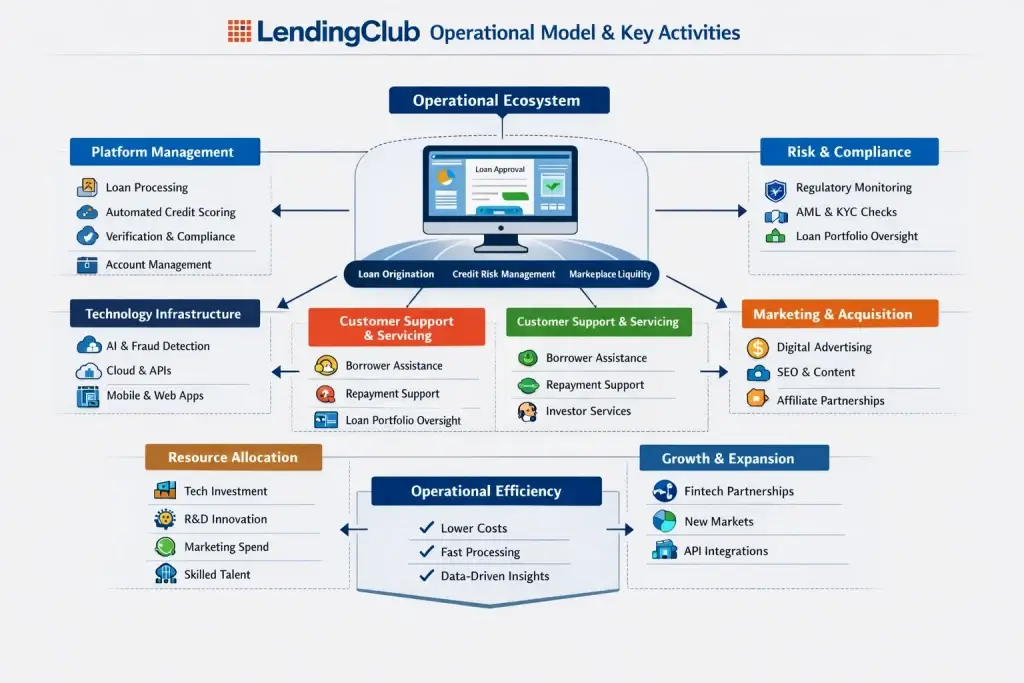
Behind LendingClub’s fintech marketplace lies a highly structured operational engine that keeps the platform running efficiently at scale.
Unlike traditional banks that rely heavily on branch infrastructure, LendingClub operates as a technology-first financial platform, where software, analytics, and automation power most daily operations.
Its operational model focuses on loan origination, credit risk management, marketplace liquidity, and digital banking services.
Core Operations
LendingClub’s daily business activities revolve around maintaining a seamless financial ecosystem.
1. Platform Management
The platform is responsible for handling millions of financial transactions and loan applications.
Key activities include:
- Loan application processing
- Credit assessment automation
- borrower verification and compliance checks
- account management for borrowers and depositors
Automation and AI-driven credit scoring allow LendingClub to process applications faster than traditional lenders.
2. Technology Infrastructure
Technology is the backbone of LendingClub’s operations.
Core components include:
- AI-powered credit decisioning models
- fraud detection systems
- cloud-based financial infrastructure
- customer-facing mobile and web applications
- API integrations with financial partners
These systems allow LendingClub to analyze thousands of borrower variables to predict repayment behavior.
Modern fintech platforms built by companies like Miracuves often deploy similar scalable cloud architectures when designing digital banking and lending ecosystems.
3. Risk & Compliance Management
Operating in the financial services industry requires strict regulatory compliance.
LendingClub maintains extensive operations around:
- regulatory compliance monitoring
- anti-money laundering (AML) processes
- identity verification
- credit risk analysis
- loan portfolio monitoring
These systems protect both investors and borrowers while maintaining regulatory approval.
4. Customer Support & Servicing
Customer experience is essential in financial services.
LendingClub provides:
- borrower support during loan applications
- repayment assistance
- financial wellness guidance
- loan servicing for investors
Strong servicing operations help maintain low default rates and high customer satisfaction.
5. Marketing & Customer Acquisition
Growth is fueled by data-driven marketing operations.
Key functions include:
- SEO and content marketing
- digital advertising campaigns
- affiliate partnerships
- fintech comparison platforms
- referral programs
These strategies target consumers actively searching for debt consolidation or personal loan solutions.
Read more : Best LendingClub Clone Scripts 2026: Build a Scalable P2P Lending Platform with Confidence
Operational Efficiency Advantage
LendingClub’s digital-first operations provide several key advantages:
- Lower overhead than traditional banks
- faster loan approval processes
- scalable infrastructure for high loan volumes
- data-driven risk management
This efficiency is one of the main reasons fintech platforms like LendingClub can compete directly with established financial institutions.
Companies like Miracuves often help fintech startups design similar operational frameworks, ensuring platforms can scale efficiently while maintaining compliance and customer trust.
Strategic Partnerships & Ecosystem Development
No fintech platform scales alone. LendingClub’s long-term success has been heavily supported by strategic partnerships that strengthen its financial ecosystem, expand market reach, and improve platform capabilities.
Rather than building every component internally, LendingClub collaborates with technology providers, payment networks, financial institutions, and regulatory partners to create a robust and scalable fintech infrastructure.
This ecosystem-driven approach enables LendingClub to accelerate innovation while maintaining compliance in a highly regulated industry.
Collaboration Philosophy
LendingClub’s partnership strategy focuses on leveraging external expertise while maintaining control over its core lending platform.
The company typically partners in areas where:
- Specialized infrastructure is required
- Market expansion opportunities exist
- Regulatory or compliance frameworks must be supported
- Customer experience can be enhanced
By doing this, LendingClub can scale faster than traditional banks while remaining asset-efficient.
Technology & API Partners
Technology partnerships play a critical role in LendingClub’s infrastructure.
These partners support:
- cloud computing and data storage
- fraud detection systems
- credit scoring and financial analytics
- identity verification tools
- fintech API integrations
Examples of technology collaboration areas include:
- cloud providers for scalable infrastructure
- AI and machine learning platforms for credit modeling
- cybersecurity solutions for financial data protection
These partnerships allow LendingClub to maintain high-performance fintech architecture without building every technology layer internally.
Platforms developed by companies like Miracuves often integrate similar API-based ecosystems, allowing fintech apps to scale rapidly while remaining flexible.
Payment & Banking Infrastructure Partnerships
Financial services require reliable transaction networks.
LendingClub collaborates with:
- payment networks
- banking infrastructure providers
- clearing and settlement systems
These partnerships enable the platform to manage:
- loan disbursements
- automated repayments
- debit card transactions
- savings account transfers
Such integrations ensure seamless financial flows between borrowers, depositors, and investors.
Growth Strategy & Scaling Mechanisms
LendingClub’s growth journey is a case study in how fintech platforms evolve from niche startups into large-scale financial ecosystems.
Instead of relying on a single growth engine, LendingClub built a multi-layered scaling strategy combining technology, marketplace liquidity, and banking infrastructure.
From 2007 to 2026, the company expanded through organic customer growth, institutional investor partnerships, strategic acquisitions, and product diversification.
Growth Engines
1. Organic Virality & Referral Loops
One of LendingClub’s earliest growth drivers was customer advocacy.
Borrowers who successfully consolidated high-interest credit card debt often shared their experience with others. This created natural word-of-mouth growth.
Referral loops were strengthened through:
- referral incentives for borrowers
- financial education resources
- transparent pricing and trust-building
Satisfied customers became organic ambassadors for the platform, reducing marketing costs.
2. Data-Driven Marketing & Customer Acquisition
As the fintech market matured, LendingClub adopted high-performance digital marketing strategies.
Key acquisition channels include:
- search engine marketing (SEM)
- SEO-driven financial content
- affiliate partnerships with personal finance websites
- comparison marketplaces
- targeted social media advertising
Because most users search for loans during high financial intent moments, these channels convert at higher rates.
The company’s analytics team continuously optimizes campaigns to maintain a healthy CAC-to-LTV ratio.
3. Product Expansion
LendingClub scaled beyond its original peer-to-peer loan marketplace by introducing additional financial products.
Key product expansion milestones include:
- personal loans for debt consolidation
- auto refinance loans
- digital banking services
- high-yield savings accounts
- financial wellness tools
Each product strengthens the company’s financial ecosystem and cross-selling opportunities.
4. Strategic Acquisition: Radius Bank
One of LendingClub’s most important scaling decisions was the acquisition of Radius Bank in 2021.
This acquisition enabled LendingClub to:
- obtain a U.S. banking license
- accept consumer deposits
- fund loans directly
- earn net interest income
This move transformed LendingClub from a pure fintech marketplace into a hybrid fintech-bank model, significantly increasing long-term profitability.
5. Geographic Strategy
Unlike many fintech companies that expand globally quickly, LendingClub adopted a focused geographic strategy.
The company prioritized:
- deep penetration of the U.S. consumer lending market
- compliance with domestic financial regulations
- scalable nationwide digital infrastructure
This focus helped LendingClub maintain strong regulatory relationships and operational stability.
Lessons for Entrepreneurs & Implementation
LendingClub’s journey offers powerful lessons for entrepreneurs building fintech platforms, digital marketplaces, or data-driven financial products.
Its success did not come from a single innovation but from combining technology, trust, and ecosystem design into a scalable financial platform.
For founders looking to launch similar platforms, LendingClub’s model reveals several replicable principles and strategic insights.
Key Factors Behind LendingClub’s Success
Several core elements enabled LendingClub to evolve from a startup marketplace into a major fintech bank.
1. Platform-Based Financial Ecosystem
Instead of operating as a traditional lender, LendingClub built a two-sided platform connecting borrowers and investors.
This ecosystem approach allowed the company to:
- scale loan originations rapidly
- diversify funding sources
- reduce capital risk
Platform models often scale faster because each new participant strengthens the network.
2. Data-Driven Lending Decisions
LendingClub invested heavily in data science and credit analytics.
Its proprietary algorithms analyze borrower risk using thousands of variables, allowing the platform to:
- approve loans faster
- price risk more accurately
- maintain healthy repayment rates
For fintech founders, data infrastructure is one of the strongest long-term competitive advantages.
3. Strategic Evolution of the Business Model
LendingClub didn’t stay fixed in its original model.
The company evolved through several phases:
- Peer-to-peer lending platform
- Institutional investor marketplace
- Hybrid fintech + digital bank
This adaptability allowed LendingClub to respond to market shifts, investor needs, and regulatory changes.
4. Trust and Regulatory Compliance
Fintech success depends heavily on consumer and regulatory trust.
LendingClub prioritized:
- transparent loan pricing
- regulatory compliance infrastructure
- strong risk management systems
These elements helped the company maintain credibility in a heavily regulated industry.
Implementation Roadmap for Founders
Entrepreneurs building fintech platforms can follow a simplified development roadmap inspired by LendingClub’s strategy.
Phase 1: Platform Foundation
- Build core marketplace infrastructure
- Design credit scoring algorithms
- establish compliance framework
Phase 2: Market Entry
- launch pilot lending marketplace
- attract early borrowers and investors
- optimize acquisition channels
Phase 3: Ecosystem Expansion
- introduce additional financial products
- expand funding sources
- strengthen partnerships
Phase 4: Financial Ecosystem Scaling
- integrate banking capabilities
- expand data-driven services
develop new financial verticals
LendingClub’s success shows that technology, data, and ecosystem design can transform traditional financial services.
For entrepreneurs looking to replicate similar platforms:
Miracuves specializes in building scalable fintech ecosystems and marketplace platforms.
We help startups:
- design proven business models
- develop secure fintech infrastructure
- integrate financial APIs and payment systems
- launch scalable lending or digital banking apps
Ready to implement LendingClub’s proven business model for your market?
Miracuves builds scalable platforms with tested business models and growth mechanisms.
We’ve served 6,000+ clients.
Get your free business model consultation today.
Conclusion
LendingClub’s evolution from a peer-to-peer lending startup in 2007 to a hybrid digital bank and fintech marketplace by 2026 demonstrates how innovation and execution together create long-term competitive advantage.
What began as a simple platform connecting borrowers and investors gradually transformed into a full financial ecosystem powered by data, digital infrastructure, and regulatory strategy. By combining technology-driven credit models, marketplace liquidity, and deposit-funded lending, LendingClub built a resilient business model capable of adapting to changing financial markets.
The bigger lesson for founders is clear:
successful fintech platforms don’t just disrupt an industry — they redesign the entire financial value chain.
For entrepreneurs exploring fintech, marketplace platforms, or digital banking solutions, LendingClub proves that scalability comes from ecosystem design, not just product innovation.
As the platform economy continues to reshape financial services in 2026 and beyond, the companies that succeed will be those that combine technology, trust, and network-driven growth models.
And just like LendingClub demonstrated, the future of finance will belong to platforms that intelligently connect users, capital, and data into seamless digital ecosystems.
FAQs
What type of business model does LendingClub use?
LendingClub operates a hybrid fintech marketplace and digital banking model. It connects borrowers with investors while also using customer deposits to fund loans, generating both platform fees and interest income.
How does LendingClub’s model create value?
LendingClub provides affordable personal loans for borrowers, investment opportunities for institutions, and high-yield savings options for depositors. Its data-driven lending platform improves efficiency and transparency.
What are LendingClub’s key success factors?
Key success factors include advanced credit algorithms, a two-sided lending marketplace, strong regulatory compliance, and diversified revenue streams. Its acquisition of Radius Bank also strengthened its funding capabilities.
How scalable is the LendingClub business model?
LendingClub’s digital platform allows it to scale efficiently without physical bank branches. Automated underwriting, cloud infrastructure, and marketplace funding enable it to handle large loan volumes with lower operational costs.
What are the biggest challenges in this model?
Major challenges include strict financial regulations, managing credit risk, maintaining investor liquidity, and intense competition from fintech lenders and digital banks.
How can entrepreneurs adapt this model in their region?
Entrepreneurs can build digital lending marketplaces or fintech platforms by partnering with local banks, using alternative credit scoring, and designing solutions tailored to regional regulations and consumer needs.
What are alternatives to LendingClub’s model?
Alternatives include direct digital lenders like SoFi, AI-based lending platforms like Upstart, buy-now-pay-later providers like Affirm, and traditional banks offering digital lending services.
How has LendingClub’s business model evolved over time?
LendingClub started as a peer-to-peer lending platform, later shifted toward institutional investors, and eventually became a hybrid digital bank after acquiring Radius Bank in 2021.
Related Articles
Miracuves is an independent software development company. We are not affiliated with, connected to, sponsored by, or endorsed by any company or product named in this article.
Terms such as “X Clone” are used descriptively. It is how the software industry refers to building a platform with functionality comparable to a known service, and how clients search for it.
The entire design and codebase of our products is built by our own team. Our products contain no code, design, graphics, or content originating from any third-party website or applications.
All third-party names and marks referenced in this article are the property of their respective owners, referenced solely to identify the services discussed.