




Overstock scaled by transforming itself from a simple closeout bargain site into a home-focused ecommerce platform, succeeding not by owning every product, but by mastering assortment depth, pricing intelligence, fulfillment partnerships, and repeat purchase behavior. The business model of Overstock shows how disciplined category focus—especially in furniture and home goods—can outperform broader, unfocused ecommerce strategies in one of the most competitive online retail segments.
What makes the business model of Overstock especially relevant for founders in 2026 is its emphasis on business-model evolution over brute-force growth. Overstock is not “just ecommerce.” It represents category domination through merchandising expertise and coordinated supply networks.
For entrepreneurs building marketplaces or D2C platforms, the Overstock business model highlights real-world platform economics. Margins are shaped by unit economics, logistics decisions, return handling, and paid traffic efficiency—not hype. This ecosystem-first approach mirrors the scalable platform architecture Miracuves helps entrepreneurs build beyond the MVP stage.
How the Overstock Business Model Works
business model of Overstock is best understood as a hybrid commerce platform rather than a pure retailer or a pure marketplace. The company combines owned-inventory retail discipline with partner-driven assortment expansion, all optimized around one high-intent category: home and furniture.
Instead of trying to be everything to everyone (like Amazon), Overstock focuses on depth over breadth—winning by curating millions of home-related SKUs while keeping operational risk under control.
Type of Business Model
Overstock operates a Hybrid Ecommerce + Marketplace Model, structured around three layers:
- First-party retail (1P)
Overstock directly sources and sells selected inventory where pricing, margin, and supply reliability matter most. - Third-party marketplace (3P)
External merchants list products on Overstock’s platform, expanding assortment without Overstock carrying inventory risk. - Platform-driven merchandising layer
Search, filters, recommendations, pricing logic, and promotions guide demand toward profitable SKUs.
This hybrid approach allows Overstock to stay competitive on price while maintaining flexibility in capital allocation.
Value Proposition by User Segment
For Customers (Buyers)
- Access to a wide home-focused catalog: furniture, décor, bedding, outdoor, lighting, and more
- Competitive pricing driven by supplier competition and closeout sourcing
- Trust signals: reviews, guarantees, delivery transparency, and returns
For Merchants (Sellers & Suppliers)
- Demand access without needing to build consumer traffic themselves
- Overstock-managed payments and visibility tools
- Logistics-friendly integration models for bulky home goods
For Overstock (Platform Owner)
- Capital-light growth via marketplace expansion
- Margin optimization through blended 1P + 3P sales
- Data-driven control over pricing, promotions, and catalog health
Key Stakeholders in the Ecosystem
- Consumers: drive repeat demand and data signals
- Suppliers & Marketplace Sellers: provide assortment and price competition
- Logistics Partners: critical for large-item delivery economics
- Payment Providers: enable smooth checkout and conversion
- Technology Teams: optimize search, pricing, fraud, and personalization
Overstock’s real leverage comes from coordinating these stakeholders so that scale improves unit economics, rather than eroding them.
Evolution of the Model
Overstock’s model did not start as it exists today:
- Phase 1: Closeout Retailer
Heavy reliance on discounted inventory and opportunistic sourcing - Phase 2: Broad Ecommerce Expansion
Increased categories, rising complexity, margin pressure - Phase 3: Home-Centric Platform Focus
Category narrowing, marketplace enablement, operational simplification - Phase 4: Efficiency & Profitability Discipline (2024–2026)
Fewer categories, tighter cost controls, improved contribution margins
This evolution shows a crucial lesson: scaling down strategically can unlock sustainable scaling up.
Why the Model Works in 2026
In today’s market, Overstock’s structure aligns well with consumer and macro realities:
- Home shoppers expect variety + fast decision support, not endless categories
- Rising logistics and ad costs favor focused platforms over generalists
- Marketplace models reduce balance-sheet risk during demand volatility
- Consumers reward trusted brands for big-ticket purchases like furniture
For founders, this reinforces an important point: business models must evolve with cost structures, not just growth ambitions.
Read more : What Is Overstock and How Does It Work?
Target Market & Customer Segmentation Strategy
Overstock’s growth is not driven by mass-market appeal alone—it is driven by precision in who the platform serves, how those users behave, and why they return. In home commerce, scale doesn’t come from impulse buying; it comes from trust, decision confidence, and repeat household needs.
Primary Customer Segments
1. Value-Conscious Home Shoppers (Core Segment)
These customers want quality home products without luxury pricing.
- Mid-income households and first-time homeowners
- Price-sensitive but not bargain-only
- Compare across platforms before purchasing
- High engagement with promotions, seasonal sales, and reviews
Why they stay:
Overstock consistently positions itself as a place where “smart buyers” find better value for the same product category.
2. Furniture & Big-Ticket Buyers
Customers making deliberate, high-consideration purchases.
- Sofas, beds, dining sets, outdoor furniture
- Longer decision cycles (days to weeks)
- Heavy reliance on images, dimensions, delivery clarity, and returns policy
Why they stay:
Clear logistics expectations, price competitiveness, and category depth reduce purchase anxiety.
Secondary Customer Segments
3. Repeat Home Upgraders
- Existing customers returning for décor refreshes, seasonal items, or home expansions
- Higher lifetime value than first-time buyers
- Strong response to email, loyalty pricing, and recommendations
4. Marketplace Sellers & Suppliers
- Manufacturers, distributors, and private-label sellers
- Often specialized in specific home subcategories
- Depend on Overstock for demand aggregation and conversion
Customer Journey: Discovery → Conversion → Retention
Discovery
- Paid search for high-intent keywords (e.g., furniture, décor, home essentials)
- Organic SEO driven by category and product depth
- Seasonal campaigns tied to home-buying cycles
Conversion
- Strong product comparison tools
- Reviews, ratings, and trust badges
- Transparent shipping timelines and pricing clarity
Retention
- Email-driven remarketing and deal alerts
- Personalized recommendations by room, category, or style
- Repeat-purchase incentives tied to household lifecycle events
The key insight: Overstock does not chase daily engagement like social apps—it optimizes for episodic but high-value purchasing behavior.
Market Positioning & Competitive Edge
Overstock’s positioning sits between mass marketplaces and premium brands:
- More curated than Amazon for home categories
- More price-accessible than luxury furniture retailers
- Broader assortment than single-brand D2C stores
Its brand voice emphasizes value, reliability, and breadth in home, not trend-chasing or exclusivity.
From a strategic lens, this creates defensibility:
- Customers return when they need home solutions, not just deals
- Sellers benefit from category-focused demand rather than generalized traffic
For entrepreneurs, this demonstrates a powerful lesson: clear category ownership beats horizontal expansion, especially when logistics and margins matter.
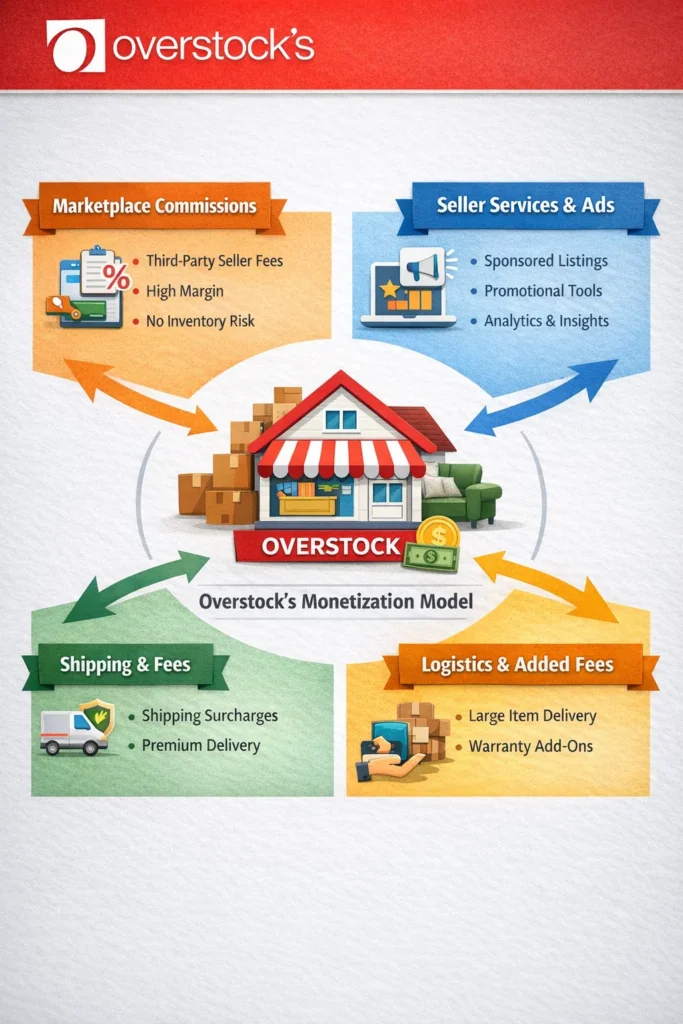
Revenue Streams and Monetization Design
Once you understand who Overstock serves, the next question is obvious: how does money actually flow through the system?
Overstock’s monetization strategy is deliberately multi-layered, designed to balance margin stability with scalable growth.
Unlike pure marketplaces that rely almost entirely on commissions, Overstock blends retail margins, marketplace fees, and performance-driven monetization—reducing dependence on any single revenue lever.
Primary Revenue Stream 1: First-Party Retail Sales (Core Engine)
Mechanism
Overstock purchases inventory directly from suppliers and sells it to consumers under its own retail model.
Pricing Model
- Wholesale procurement with negotiated discounts
- Dynamic pricing based on demand, inventory velocity, and competitor benchmarks
- Promotional pricing during seasonal demand spikes
Revenue Contribution
- Historically the largest share of total revenue
- Lower gross margin than digital-only models, but higher control over quality and delivery
Growth Trajectory
- Gradual reduction in low-margin SKUs
- Focus on categories where Overstock has pricing power
- Tighter inventory turnover to protect cash flow
This stream exists because owning select inventory gives Overstock pricing leverage and fulfillment reliability—critical for big-ticket home purchases.
Secondary Revenue Stream 2: Marketplace Seller Commissions
Mechanism
Third-party sellers list products on Overstock and pay a commission per completed sale.
Pricing Model
- Category-based commission rates
- Performance-influenced visibility and promotion opportunities
Revenue Contribution
- Smaller than retail sales, but higher margin
- Scales without Overstock carrying inventory risk
Growth Trajectory
- Expansion of long-tail assortment
- Increased seller participation in profitable subcategories
- Improved tooling to raise seller conversion rates
Marketplace commissions allow Overstock to scale assortment faster than capital, a key advantage in volatile demand cycles.
Secondary Revenue Stream 3: Seller Services & Promotional Tools
Mechanism
Sellers pay for enhanced visibility and operational support.
Includes:
- Sponsored product placements
- Merchandising boosts during peak seasons
- Data insights and performance dashboards
Revenue Contribution
- Growing but still secondary
- Highly profitable once seller competition increases
This mirrors a familiar platform pattern: as demand density grows, sellers pay to stand out.
Secondary Revenue Stream 4: Shipping, Handling & Value-Added Fees
Mechanism
- Shipping surcharges for oversized items
- Premium delivery options (room-of-choice, white-glove delivery)
- Optional protection or service add-ons
Revenue Contribution
- Not always a pure profit center
- Helps offset logistics costs and protect margins
In bulky categories like furniture, shipping economics are part of monetization, not just operations.
How the Monetization System Fits Together
Overstock’s revenue design works because the streams reinforce each other:
- Retail sales anchor trust and pricing leadership
- Marketplace sellers expand choice without balance-sheet risk
- Seller tools monetize competition within the ecosystem
- Logistics fees stabilize contribution margins on large items
Psychologically, Overstock avoids aggressive subscription or paywall tactics. Instead, it monetizes at moments of value delivery—when a product sells, ships, or gains visibility.
For founders, this highlights a critical principle: strong platforms monetize flows, not users.
Read more : Overstock Revenue Model: How Overstock Makes Money in 2026
Operational Model & Key Activities
Behind Overstock’s storefront sits a tightly controlled operational engine. In ecommerce—especially home and furniture—execution matters as much as strategy. Margins are thin, logistics are complex, and customer tolerance for errors is low.
Overstock’s operating model is designed to keep the platform capital-efficient, scalable, and resilient.
Core Operations
Platform & Technology Management
- Marketplace infrastructure for product listings, pricing, inventory sync, and order routing
- Search, filters, and recommendation systems optimized for home categories
- Fraud detection, payments, and seller compliance systems
Catalog & Merchandising Control
- Category curation to avoid low-quality or unprofitable SKUs
- Dynamic pricing rules based on demand, seasonality, and competition
- Promotion planning aligned with household buying cycles
Fulfillment & Logistics Coordination
- Mix of direct fulfillment (1P inventory) and seller-fulfilled orders
- Heavy reliance on third-party logistics partners for bulky items
- Delivery experience management: timelines, tracking, damage resolution
Customer Support & Trust Operations
- Returns and refund workflows
- Dispute resolution between buyers and sellers
- Quality enforcement to protect platform reputation
Marketing & Growth Operations
- Performance marketing (search, shopping ads)
- Email and lifecycle marketing for retention
- SEO-driven category and product discovery
Resource Allocation Strategy (Strategic Lens)
While exact percentages vary year to year, Overstock’s resource focus typically follows this logic:
- Technology & Platform Development: Core investment priority
Focus on scalability, automation, and seller tooling - Marketing Spend: Performance-heavy, ROI-driven
Reduced brand-spend dependency compared to mass retailers - Logistics & Operations: Cost control over speed-at-any-cost
Preference for predictable delivery over aggressive SLAs - People & Expertise: Merchandising, data science, operations
Fewer but more specialized teams
The strategic intent is clear: optimize contribution margin per order, not just gross revenue growth.
How Operations Enable Scale
Overstock does not scale by hiring endlessly or warehousing everything. It scales by:
- Letting partners carry inventory risk
- Using technology to enforce standards automatically
- Shifting complexity away from the balance sheet and into systems
This is where Miracuves’ experience becomes relevant. Building a similar platform requires:
- Seller onboarding workflows
- Order-splitting and fulfillment logic
- Margin-aware pricing engines
- Scalable customer support systems
These are not “features”—they are operational infrastructure.
Strategic Partnerships & Ecosystem Development
Overstock’s long-term strength doesn’t come only from what it owns—it comes from who it collaborates with. In categories like home and furniture, no single company can efficiently control manufacturing, storage, delivery, payments, and compliance at scale. Overstock’s ecosystem strategy is built around orchestration, not ownership.
Collaboration Philosophy
Overstock partners to:
- Expand assortment without capital lock-in
- Improve delivery experience without building logistics from scratch
- Enter or stabilize markets without regulatory overexposure
The platform acts as a central coordinator, aligning incentives across partners while retaining control over customer experience and monetization.
Key Partnership Types
1. Technology & API Partners
- Ecommerce infrastructure providers
- Data, analytics, and personalization tools
- Fraud prevention and security platforms
These partnerships allow Overstock to evolve its platform faster than building everything in-house.
2. Payment & Financial Service Alliances
- Payment gateways and installment providers
- Fraud monitoring and chargeback management partners
- Cross-border payment facilitators for international sellers
Payments are not just transactional—they are conversion and trust levers.
3. Logistics & Fulfillment Partners
- Third-party logistics (3PL) providers
- Last-mile delivery services specialized in large items
- White-glove and room-of-choice delivery partners
In home commerce, delivery quality directly affects brand trust and repeat purchase rates.
4. Marketing & Distribution Partners
- Performance marketing platforms
- Affiliate and comparison-shopping networks
- Content and influencer channels in home décor and lifestyle
These partners help Overstock reach high-intent shoppers efficiently.
5. Regulatory & Market Expansion Alliances
- Tax compliance providers
- Regional logistics and fulfillment operators
- Legal and compliance advisors for cross-border commerce
These alliances reduce friction as Overstock adapts to evolving regulations.
Ecosystem Strategy: Why It Creates a Moat
Overstock’s partnerships reinforce network effects:
- More sellers → better assortment → more buyers
- More buyers → higher seller competition → better pricing
- Better pricing and delivery → stronger brand trust
Monetization is layered into the ecosystem:
- Sellers pay commissions and promotional fees
- Logistics partners are integrated into value-added services
- Payment partners improve conversion, benefiting all sides
For founders, the insight is powerful: strong platforms don’t build everything—they design incentives so partners scale the business for them.
At Miracuves, this ecosystem-first thinking is core to how scalable marketplaces are architected—from API-ready platforms to partner monetization layers.
Growth Strategy & Scaling Mechanisms
Overstock’s growth story is not about hypergrowth at any cost. It is about controlled scaling in a margin-sensitive industry. The company learned—sometimes the hard way—that sustainable growth in ecommerce comes from repeat behavior, operational efficiency, and category authority, not just traffic volume.
Core Growth Engines
1. Organic Demand & Repeat Purchase Loops
- SEO-driven category and product discovery
- Email and lifecycle marketing tied to home lifecycle events
- Repeat demand from seasonal refreshes and household upgrades
Overstock optimizes for lifetime value, not daily active usage.
2. Performance Marketing with Margin Discipline
- Paid search and shopping ads for high-intent keywords
- Continuous ROI monitoring at SKU and category level
- Pullback from unprofitable traffic sources when CAC rises
This keeps growth aligned with contribution margins.
3. Assortment-Led Expansion
- Adding depth within existing home subcategories
- Expanding long-tail SKUs via marketplace sellers
- Using demand data to guide category prioritization
Instead of new verticals, Overstock focuses on horizontal depth inside home.
4. Geographic Optimization
- Concentration on markets with reliable logistics economics
- Selective international exposure through seller partnerships
- Avoidance of regions with high returns or regulatory complexity
Growth is chosen where delivery economics make sense.
Scaling Challenges & How Overstock Addressed Them
Operational Complexity
- Challenge: Managing millions of SKUs, sellers, and deliveries
- Response: Automation, seller standards, and category pruning
Logistics Costs
- Challenge: Bulky items and reverse logistics pressure margins
- Response: Shipping fee structures and delivery-tier optimization
Paid Traffic Inflation
- Challenge: Rising ad costs across ecommerce
- Response: Greater reliance on SEO, email, and repeat customers
Market Competition
- Challenge: Competing with Amazon, Wayfair, and D2C brands
- Response: Category focus and value positioning instead of breadth wars
The result is a growth model that prioritizes predictability over virality.
For entrepreneurs, this section offers a crucial reminder: scaling is not adding features—it’s removing friction and waste faster than competitors.
This is precisely where Miracuves-supported platforms gain an edge: growth systems are baked into the architecture—analytics, cohort tracking, margin-aware marketing hooks, and partner-led expansion.
Competitive Strategy & Market Defense
Overstock operates in one of the most competitive environments in digital commerce. Home retail sits at the intersection of high consumer expectations, heavy logistics costs, and aggressive pricing wars. Survival—and relevance—depends on building defenses that go beyond discounts.
Overstock’s competitive strategy focuses on structural advantages, not short-term tactics.
Core Competitive Advantages
1. Category-Focused Network Effects
- More home-specific sellers create deeper assortment
- Deeper assortment attracts high-intent home buyers
- Higher buyer density increases seller competition and pricing efficiency
These network effects are category-contained, making them harder for generalist platforms to replicate.
2. Switching Barriers Through Trust & Experience
- Furniture and home purchases involve risk and deliberation
- Reliable delivery, returns, and customer support reduce buyer anxiety
- Once trust is established, customers return for future home needs
Trust becomes a soft switching cost.
3. Brand Equity in “Value Home”
- Overstock is positioned as a smart-value destination
- Not luxury, not bargain-basement—accessible quality
- This clarity avoids direct brand conflict with premium or ultra-low-cost players
4. Data-Driven Merchandising
- Demand forecasting by category, size, and style
- SKU-level profitability insights
- Pricing optimization based on conversion and return rates
This allows Overstock to remove unprofitable products quickly—a major advantage in ecommerce.
Market Defense Tactics
Handling New Entrants
- Focus on assortment depth rather than chasing novelty
- Leverage existing supplier relationships to maintain pricing power
Responding to Pricing Wars
- Avoid blanket discounts
- Use targeted promotions where elasticity is proven
- Protect margins in categories with strong differentiation
Strategic Feature Rollouts
- Incremental UX and search improvements rather than disruptive redesigns
- Enhancements focused on reducing purchase hesitation
Partnership & Portfolio Moves
The deeper insight here is important for founders: defensibility is designed, not declared. Overstock’s defenses come from aligning brand, data, operations, and partnerships around a single category mission.
- Strengthening logistics and payment partnerships
- Exploring strategic alignments that reinforce home-category dominance
Platforms built with Miracuves follow the same philosophy—competitive moats are engineered through ecosystem design, not marketing slogans.\
Read more : Best Overstock Clone Scripts 2025: Build a Deals-Driven Marketplace That Scales Fast
Lessons for Entrepreneurs & Implementation
Overstock’s journey offers practical, sometimes uncomfortable lessons for founders building marketplaces, ecommerce platforms, or hybrid digital ecosystems. This is not a story of viral growth—it is a story of discipline, focus, and business-model realism.
Key Factors Behind Overstock’s Success
1. Category Ownership Beats Category Expansion
Overstock survived by narrowing its focus to home, not by expanding endlessly.
Depth creates efficiency. Breadth creates cost.
2. Hybrid Models Reduce Risk
Blending first-party retail with a marketplace:
- Preserves pricing and experience control
- Reduces inventory and capital risk
- Enables flexible scaling across demand cycles
3. Monetize Flows, Not Attention
Overstock earns when:
- Products sell
- Sellers compete
- Logistics value is delivered
This avoids fragile ad-only or subscription-dependent revenue models.
4. Operational Excellence Is the Product
In home commerce, the real product is:
- Delivery reliability
- Returns handling
- Customer support resolution
UI matters—but execution retains customers.
Replicable Principles for Startups
Founders can adapt Overstock’s model by:
- Starting with one defensible category
- Building seller onboarding and quality controls early
- Designing pricing and logistics logic before scaling traffic
- Using marketplace expansion to test demand without inventory risk
Common Mistakes to Avoid
- Expanding categories before unit economics are proven
- Over-investing in paid traffic without LTV clarity
- Treating logistics as a cost center instead of a revenue lever
- Copying Amazon’s breadth instead of owning a niche
Adapting the Model for Local or Niche Markets
Overstock’s approach works especially well when:
- Markets have fragmented suppliers
- Logistics partners already exist
- Consumers value price transparency and trust
Localized versions can focus on:
- Regional furniture manufacturers
- B2B home procurement
- Rental, hospitality, or office furnishing niches
Implementation Timeline & Investment Priorities
Phase 1 : Foundation
- Category validation
- Supplier and seller onboarding
- Core marketplace and checkout system
Phase 2 : Optimization
- Pricing logic and logistics integrations
- Seller performance metrics
- SEO and lifecycle marketing setup
Phase 3 : Scale
- Marketplace expansion
- Seller monetization tools
- Data-driven merchandising and automation
This is where execution partners matter.
Ready to implement Overstock’s proven business model for your market? Miracuves builds scalable platforms with tested business models and growth mechanisms. We’ve helped 200+ entrepreneurs launch profitable apps. Get your free business model consultation today.
Conclusion :
Overstock’s business model proves a quiet but powerful truth about platform economies: sustainable growth is engineered, not chased. While many digital businesses pursue scale through expansion and visibility, Overstock found resilience by refining its focus, aligning incentives, and respecting unit economics.
The company’s evolution—from a discount-led retailer to a home-centric commerce platform—shows that success in 2026 is less about being everywhere and more about being indispensable in one space. Technology enables scale, but discipline preserves it.For founders building the next generation of marketplaces and on-demand platforms, the lesson is clear: when innovation is matched with operational rigor, platforms endure. As platform ecosystems mature beyond hype, the future belongs to businesses that design for profitability from day one.
FAQs
What type of business model does Overstock use?
Overstock uses a hybrid ecommerce business model that combines first-party retail sales with a third-party marketplace, supported by platform-driven merchandising and logistics coordination.
How does Overstock’s model create value?
It creates value by offering a wide, curated home assortment at competitive prices while reducing risk through marketplace sellers and partner-led fulfillment.
What are Overstock’s key success factors?
Category focus (home), disciplined cost control, hybrid monetization, strong logistics partnerships, and data-driven merchandising.
How scalable is Overstock’s business model?
The model is highly scalable because assortment growth is driven by sellers, not inventory ownership, allowing expansion without proportional capital increases.
What are the biggest challenges in this model?
Logistics costs, returns management, paid traffic inflation, and maintaining seller quality at scale.
How can entrepreneurs adapt this model to their region?
By focusing on one category, partnering with local suppliers and logistics providers, and using a marketplace-first approach to reduce capital risk.
What are alternatives to Overstock’s model?
Pure marketplace models (commission-only), D2C vertical brands, or subscription-based home commerce platforms.
How has Overstock’s business model evolved over time?
It evolved from a closeout retailer to a focused home commerce platform with stronger marketplace integration and profitability discipline.
Related Article :
- What is Farfetch and How Does It Work?
- What is ASOS and How Does It Work?
- Best Wish Clone Scripts 2025: Build a High-Profit Social Commerce App
- Best DHgate Clone Scripts 2025: Build a Global B2B Wholesale Marketplace Faster
- Best BigCommerce Clone Scripts 2025: Build a Scalable SaaS Ecommerce Platform