


Key Takeaways
- A luxury multi-brand fashion marketplace connects premium brands, boutiques, sellers, and high-intent shoppers through one digital commerce platform.
- Core marketplace features include designer catalogs, advanced search, product discovery, inventory synchronization, secure checkout, order tracking, returns, and seller management.
- Marketplace success depends on premium brand selection, product authenticity, consistent customer experience, global fulfillment, pricing control, and strong trust signals.
Business Model & User Flow Signals
- Luxury fashion marketplaces can generate revenue through seller commissions, brand partnerships, service fees, premium placements, advertising, and value-added marketplace services.
- Shoppers move from brand and product discovery to filters, product pages, wishlists, checkout, payment, delivery tracking, returns, and repeat purchases.
- Sellers need catalog management, inventory updates, order processing, pricing controls, fulfillment visibility, payouts, returns management, and performance analytics.
Founder Insights
- Founders should define their luxury niche, brand acquisition strategy, commission structure, authentication process, fulfillment model, target geography, and customer positioning before development.
- Features such as personalized recommendations, multilingual support, multi-currency payments, international shipping, loyalty, and premium customer service can strengthen the luxury shopping experience.
- Miracuves develops customizable multi-brand fashion marketplaces with product catalogs, seller management, payments, commissions, order workflows, inventory tools, analytics, and admin controls.
Luxury ecommerce is not just about selling expensive products online. It is about trust, curation, availability, brand control, seller relationships, and a shopping experience that feels premium from discovery to delivery.
That is why luxury multi-brand fashion marketplaces have become an important model in online retail. Instead of one store owning all inventory, the platform connects shoppers with multiple boutiques, designers, brand partners, and sellers through one digital marketplace.
For founders, this model is useful to study because it solves a real supply problem. Luxury shoppers want access to rare, premium, and authentic products. Boutique sellers want global reach without losing their identity. The marketplace operator sits between both sides and creates value through technology, trust, discovery, payments, logistics, and seller operations.
This guide explains how luxury multi-brand fashion marketplaces work, how the business model earns revenue, what the user flow looks like, and what founders should understand before building a similar platform.
What Is a Luxury Multi-Brand Fashion Marketplace?
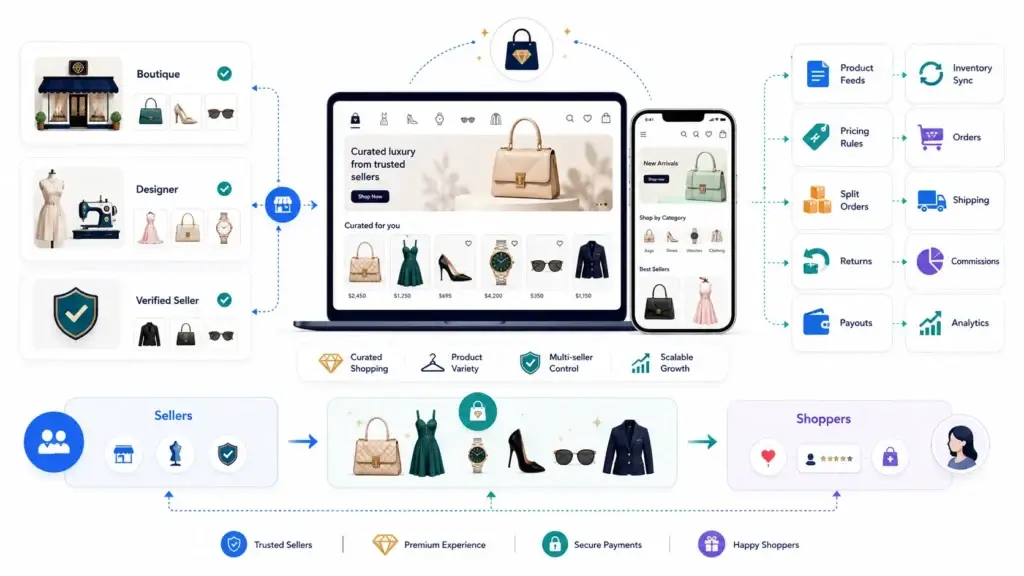
A luxury multi-brand fashion marketplace is an online platform where shoppers can browse and buy premium fashion products from multiple boutiques, designers, and verified sellers in one place.
Unlike a traditional ecommerce store, the marketplace does not always need to own every product in its catalog. Instead, it provides the digital infrastructure that allows different sellers to list products, manage stock, receive orders, ship items, and get paid through the platform.
The customer sees one curated shopping experience. Behind the scenes, the platform manages multiple seller accounts, product feeds, inventory updates, pricing rules, commissions, order splitting, return workflows, and payout records.
This is what makes the model powerful. It allows a marketplace operator to scale product variety without carrying all inventory directly.
Why This Marketplace Model Works in Luxury Fashion
Luxury shoppers do not behave like generic ecommerce shoppers. They care about authenticity, brand reputation, product condition, size accuracy, packaging, return confidence, and the overall feeling of trust.
A multi-brand marketplace works well in this category because it brings scattered luxury supply into one organized digital experience.
For shoppers, the benefit is convenience. They can discover products from multiple sellers without visiting many different boutique websites.
For boutiques and sellers, the benefit is reach. A local or regional seller can access a wider audience without building the full technology, marketing, payment, and logistics stack alone.
For the marketplace operator, the opportunity is control. The platform can create revenue through commissions, seller services, visibility tools, loyalty programs, fulfillment partnerships, and premium marketplace features.
The model works when all three sides win:
| Marketplace Side | What They Want | What the Platform Provides |
|---|---|---|
| Shoppers | Authentic products, smooth discovery, secure checkout, reliable delivery | Curated catalog, trust signals, payment options, order tracking, returns |
| Boutiques and sellers | More customers, better visibility, easier digital selling | Seller dashboard, catalog tools, order management, payout records |
| Marketplace operator | Revenue, retention, scalable supply, brand control | Admin dashboard, commission rules, seller controls, analytics, moderation |
How the Shopper Flow Works
From the outside, a luxury fashion marketplace looks simple. A shopper opens the website or app, browses products, adds items to the cart, checks out, and receives the order.
But a good marketplace experience depends on several connected steps.
1. Discovery and Browsing
The shopper usually starts with categories, designer names, product types, curated edits, search filters, or personalized recommendations.
In luxury commerce, discovery matters because many customers do not arrive with only one product in mind. They may browse by designer, occasion, trend, collection, size, availability, location, condition, or price range.
A strong marketplace makes this discovery feel curated rather than crowded.
2. Product Detail and Trust Signals
Product pages need more than images and prices. They should explain size, material, condition, seller location, return policy, delivery estimate, authenticity checks, and available offers.
For luxury products, trust signals are part of conversion. Shoppers want to know who is selling the item, how the product is verified, what happens if there is a return, and whether the checkout is secure. This is why founders should also understand the security and trust architecture for luxury marketplaces before launching a premium commerce platform.
3. Cart and Multi-Seller Checkout
A shopper may add products from more than one boutique or seller into the same cart. This creates complexity because the platform may need to split the order behind the scenes.
One customer order can become multiple seller orders. Each seller may have separate shipping timelines, return rules, and fulfillment status.
For the shopper, it should still feel like one smooth checkout. For the backend, it requires careful order logic.
4. Payment, Shipping, and Order Tracking
After payment, the platform confirms the order, notifies the sellers, updates inventory, and starts fulfillment. If items come from different sellers, tracking may happen separately while still being visible inside one customer account.
This is where marketplace operations become important. Delayed seller confirmation, inaccurate inventory, unclear shipping costs, or weak return workflows can damage the customer experience quickly.
5. Returns and After-Sales Support
Returns in luxury marketplaces must be handled carefully. The platform needs clear rules for product condition, packaging, refund approval, seller responsibility, and customer communication.
A strong after-sales flow protects both the shopper and the seller. It also protects the marketplace brand.
How the Boutique and Seller Flow Works
The seller side is just as important as the customer side. A marketplace cannot grow if boutiques, brands, or sellers find the platform difficult to use.
1. Seller Application and Verification
Before a seller can list products, the marketplace should review the business, product category, brand fit, documents, and operational capacity.
This step protects marketplace quality. If low-quality sellers enter too easily, the platform risks poor catalog standards, fake listings, bad fulfillment, and customer complaints.
2. Catalog Upload and Product Approval
Sellers need tools to upload product data, images, sizes, prices, stock, descriptions, and shipping details.
In premium fashion, catalog quality must be controlled. Product titles, images, attributes, designer names, condition notes, and pricing should follow a consistent format. Otherwise, the marketplace becomes difficult to browse and harder to trust.
3. Inventory and Price Management
Inventory accuracy is critical. If a shopper buys an item that is no longer available, the platform loses trust.
Sellers should be able to update stock manually, through bulk upload, or through integrations depending on the marketplace setup. The platform should also support price updates, discount rules, and regional settings where needed.
4. Order Management
When a customer buys from a seller, the seller should receive a clear order notification with product details, customer shipping information, fulfillment deadline, packaging instructions, and status updates.
The platform operator should be able to track seller performance through order acceptance, cancellation rate, shipping delay, return rate, and dispute history.
5. Payout and Settlement
Seller payout is one of the most important backend workflows in any marketplace.
The platform must calculate commission, deduct fees, track refunds, manage disputes, and release payouts with proper records. This is especially important when one customer order contains products from multiple sellers.
For founders, this is where a simple ecommerce setup often becomes insufficient. A luxury marketplace needs marketplace-grade settlement logic, not just a product grid.
Business Model of a Luxury Fashion Marketplace
A luxury multi-brand marketplace can earn revenue in several ways. The strongest platforms usually do not depend on only one income stream. Founders who want a deeper breakdown can also study the luxury marketplace revenue model to understand how commissions, seller plans, featured listings, and service fees work together.
| Revenue Stream | How It Works | Founder Benefit |
| Commission on sales | The marketplace takes a percentage from each completed order | Creates transaction-based revenue |
| Seller subscription plans | Sellers pay for premium tools, visibility, or account benefits | Adds predictable recurring revenue |
| Featured listings | Sellers pay to promote products or collections | Monetizes marketplace visibility |
| Brand campaigns | Designers or sellers pay for curated campaign placements | Supports premium marketing revenue |
| Logistics or fulfillment fees | The platform charges for shipping coordination or fulfillment support | Converts operational support into revenue |
| Payment or service fees | The platform adds small service charges where appropriate | Improves margin per transaction |
| Data and analytics tools | Sellers pay for advanced insights, performance reports, or demand signals | Increases value for serious sellers |
The right revenue model depends on marketplace maturity.
In the early stage, commission is usually easier to understand. As the marketplace grows, seller subscriptions, premium visibility, analytics, and brand campaigns can become stronger revenue layers.
Technology Layers Behind the Marketplace
A luxury marketplace is not only a website with designer products. It is a connected system of customer, seller, admin, payment, catalog, and logistics workflows. If you are planning this type of platform, reviewing the core multi-seller marketplace features can help you understand which modules are essential before development begins.
Customer Interface
The customer side includes browsing, search, filters, product pages, wishlist, cart, checkout, order history, returns, loyalty, and support.
The interface should feel premium, but it also needs to be fast and practical. Luxury design should not slow down the buying experience.
Seller Dashboard
The seller dashboard allows boutiques and sellers to manage listings, stock, prices, orders, documents, returns, and payout records.
This dashboard decides how scalable the supply side becomes. If sellers need to email spreadsheets for every update, operations become slow and expensive.
Admin Panel
The admin panel gives the platform operator control over users, sellers, products, commissions, disputes, payouts, categories, content, promotions, and reports.
For founders, admin control is not a small feature. It is the command center of the business.
Catalog and Search System
Luxury marketplaces need strong catalog structure. Products should be searchable by designer, category, size, color, condition, price, seller, location, and availability.
The catalog also needs quality control because duplicate or inconsistent listings can hurt both trust and conversion.
Payment and Settlement Logic
Payments should be secure, trackable, and connected to the seller payout system.
In a multi-seller order, the platform may need to calculate different commissions, taxes, shipping costs, refunds, and seller payouts. This requires clean backend logic.
Logistics and Return Workflows
Shipping, tracking, delivery updates, return requests, refund status, and customer support must connect smoothly.
Luxury buyers expect clear communication. A weak logistics workflow can damage the platform even when the product catalog is strong.
Founder Decision Signals
Supply Quality
If boutiques and sellers are not verified properly, the marketplace can lose trust before it gains traction.
Catalog Control
If product data is inconsistent, shoppers struggle to compare items and the marketplace feels less premium.
Checkout Logic
If one cart contains products from multiple sellers, the backend must split orders without confusing the customer.
Settlement Readiness
If commissions, refunds, and payouts are not handled clearly, seller relationships become difficult to manage.
What Founders Can Learn From This Marketplace Model
The biggest lesson is that marketplace success depends on operational depth, not only visual design.
A premium storefront may attract attention, but the business grows through seller trust, product availability, fulfillment reliability, payment clarity, and repeat customer experience.
Founders should think about five decisions early.
First, decide what type of sellers the marketplace will accept. A curated boutique marketplace needs stricter standards than a mass ecommerce platform.
Second, define the catalog structure before onboarding sellers. Categories, attributes, designer fields, size systems, product conditions, and image rules should be clear from the beginning.
Third, plan the revenue model before launch. Commission alone may be enough at the start, but premium seller tools and featured placements can become valuable later.
Fourth, build admin control into the foundation. The operator should not depend on developers for every seller approval, commission update, refund review, or category change.
Fifth, choose a technology path that supports marketplace complexity. A basic ecommerce theme may work for a single seller store, but it may not handle multi-seller checkout, seller payout, catalog approval, and split fulfillment properly.
Common Mistakes Founders Should Avoid
Treating the marketplace like a normal ecommerce store
A luxury marketplace needs seller onboarding, catalog approval, payout logic, returns, disputes, and multi-seller order handling. A basic store setup can become limiting quickly.
Launching without seller standards
If every seller can upload anything without review, product quality and customer trust can suffer.
Ignoring settlement workflows
Commissions, refunds, seller payouts, and disputes should be planned before orders start flowing.
Over-focusing on design before operations
Premium visuals matter, but operations decide whether shoppers and sellers return.
How a Founder Can Turn This Model Into a Launch-Ready Platform
Once the business model is clear, the next step is deciding how to build.
A founder can choose a fully custom build, a ready-made foundation, or a hybrid path where the core marketplace modules are already available and then customized for the brand, region, and seller strategy.
Choosing the right luxury marketplace development team also matters because this model needs more than frontend design. The team should understand seller workflows, catalog control, payment logic, admin dashboards, and marketplace operations.
The right choice depends on budget, timeline, product complexity, and how quickly the founder wants to test supply and demand. Founders comparing build options can review the luxury marketplace development cost to understand which factors usually affect pricing, customization, and launch scope.
For founders planning a curated luxury commerce business, Miracuves offers a ready-made luxury marketplace solution that supports the core logic behind this model, including seller workflows, customer shopping journeys, marketplace control, and branded deployment.
You can explore the implementation route here: ready-made luxury marketplace solution.
The goal is not to copy another platform blindly. The stronger approach is to understand the marketplace pattern, adapt it to a clear niche, and launch with enough backend control to manage sellers, products, orders, and revenue from day one.
Final Thoughts
Luxury multi-brand fashion marketplaces work because they connect premium supply with high-intent shoppers through one trusted digital experience.
But the real value is not only in showing products online. It is in managing sellers, protecting catalog quality, handling multi-seller checkout, supporting returns, calculating commissions, and keeping the marketplace operator in control.
For founders, this model is worth studying before development begins. The better you understand the business logic, the easier it becomes to choose the right platform foundation, revenue model, and launch strategy. Miracuves helps founders move from this planning stage to execution with marketplace solutions built around seller workflows, admin control, branded experiences, and scalable marketplace operations.
A strong luxury marketplace is not built around products alone. It is built around trust, curation, operations, and control.
FAQs
What is a luxury multi-brand fashion marketplace?
A luxury multi-brand fashion marketplace is an online platform where shoppers can buy premium fashion products from multiple boutiques, brands, or sellers through one digital experience. The platform manages discovery, checkout, seller workflows, and marketplace operations.
How does a luxury fashion marketplace make money?
It can earn through sales commissions, seller subscriptions, featured listings, brand campaigns, logistics services, service fees, and advanced seller tools. The best revenue mix depends on the marketplace stage and seller strategy.
Why do boutiques join multi-brand marketplaces?
Boutiques join because marketplaces can give them wider reach, digital selling tools, customer acquisition, order management, payment support, and visibility without requiring them to build a full ecommerce system alone.
What features are important in a premium fashion marketplace?
Important features include curated catalog management, seller onboarding, advanced search, wishlist, secure checkout, multi-seller order handling, returns, seller dashboards, payout tracking, and admin controls.
Is a luxury marketplace different from a normal ecommerce store?
Yes. A normal ecommerce store usually sells from one business. A marketplace supports multiple sellers, which means it needs seller verification, catalog approval, commission rules, split orders, dispute handling, and settlement workflows.
What should founders focus on before building this type of marketplace?
Founders should define the seller model, catalog rules, revenue streams, order flow, payout logic, return policy, and admin controls before development starts. These decisions shape the platform’s long-term scalability.
Can a ready-made marketplace foundation support this model?
Yes, if the foundation includes the right marketplace modules such as seller dashboards, catalog control, customer checkout, admin management, order workflows, and source-code ownership. Miracuves can help founders evaluate and customize this type of launch-ready foundation.
Miracuves is an independent software development company. We are not affiliated with, connected to, sponsored by, or endorsed by any company or product named in this article.
Terms such as “X Clone” are used descriptively. It is how the software industry refers to building a platform with functionality comparable to a known service, and how clients search for it.
The entire design and codebase of our products is built by our own team. Our products contain no code, design, graphics, or content originating from any third-party website or applications.
All third-party names and marks referenced in this article are the property of their respective owners, referenced solely to identify the services discussed.