



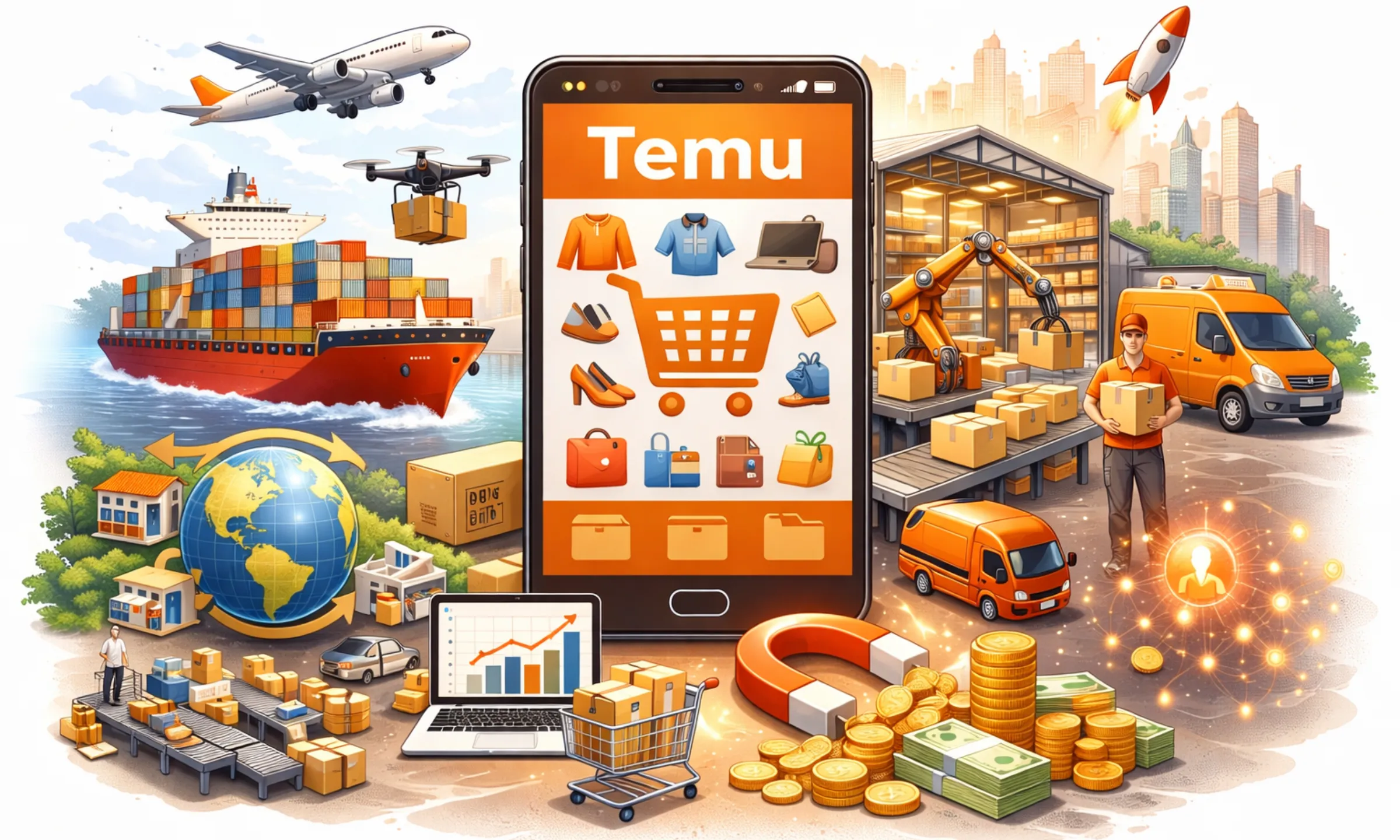
In less than four years, Temu scaled from a little-known cross-border app into one of the most downloaded shopping platforms globally, reshaping consumer expectations around price, speed, and variety. Backed by PDD Holdings, Temu leveraged China’s manufacturing ecosystem to challenge Amazon, Walmart, and Shein across the US, Europe, and emerging markets.
By 2026, Temu is no longer just a “cheap products app.” It is a supply-chain-driven commerce engine built on extreme price discovery, aggressive user acquisition, and deep supplier integration. Reports estimate Temu crossed 100+ million active users globally, with daily usage driven by gamification, flash pricing, and algorithmic merchandising.What makes business model of Temu especially important for entrepreneurs is this :
Temu did not win by out-marketing incumbents — it won by re-engineering the cost structure of ecommerce itself.
At Miracuves, we closely study platforms like Temu because they represent the next generation of high-scale, infrastructure-led marketplaces — models that can be adapted, localized, and rebuilt for niche or regional dominance.
How the Temu Business Model Works
Temu operates on a hybrid marketplace model that blends elements of cross-border ecommerce, managed marketplace control, and factory-direct sourcing. At its core, Temu is not trying to be a neutral platform like Amazon Marketplace. Instead, it acts as an active orchestrator between factories and consumers, controlling pricing, visibility, and fulfillment logic.
This structural choice explains why Temu can offer prices that often appear unsustainable to traditional retailers — yet continue scaling in 2026.
Core Business Model Framework
Type of Model
- Managed marketplace (factory-to-consumer)
- Cross-border ecommerce at scale
- Subsidy-driven growth model in expansion markets
Value Proposition by User Segment
- Consumers:
Ultra-low prices, wide product variety, frequent discounts, gamified shopping experience - Suppliers / Factories:
Guaranteed demand, global market access, data-driven production insights - Logistics & Service Partners:
High-volume, predictable shipping flows and long-term contracts
Key Stakeholders and Their Roles
- Temu (Platform Owner):
Controls pricing bands, demand forecasting, product ranking, and promotions - Factories / Manufacturers:
Produce at scale, compete on cost efficiency, comply with Temu quality and SLA rules - Logistics Partners:
Handle international shipping, customs, and last-mile delivery - Payment & Risk Partners:
Enable low-friction checkout and fraud prevention at scale
How the Model Evolved Over Time
- 2022–2023: Rapid US market entry with heavy user subsidies and free shipping
- 2024–2025: Expansion into Europe, Latin America, and parts of Asia
- 2026: Shift toward margin optimization, private labels, and logistics efficiency
Temu gradually reduced reliance on pure discounts by:
- Improving demand prediction accuracy
- Pushing higher-margin categories
- Introducing minimum order thresholds in select regions
Why This Model Works in 2026
- Global consumers remain price-sensitive amid inflation
- Cross-border logistics costs declined due to scale efficiencies
- Factories prefer demand stability over branding investment
- App-first discovery aligns with impulse buying behavior
Temu’s advantage is not marketing alone — it is structural cost dominance. This is the same principle Miracuves applies when designing scalable marketplaces: reduce friction, centralize intelligence, and let volume do the heavy lifting.
Read more : What Is Temu and How Does It Work?
Target Market & Customer Segmentation Strategy
Temu’s growth is powered by mass-market appeal, but its real strength lies in how precisely it segments behavior, not demographics. Instead of chasing premium buyers, Temu optimizes for high-frequency, low-consideration purchases — turning casual browsing into habitual buying.
Primary and Secondary Customer Segments
Primary Segment: Price-Driven Digital Shoppers
- Age: 18–45
- Behavior: Deal-seeking, impulse buying, mobile-first
- Motivations: Lowest price, free shipping, novelty products
- Regions: US, UK, EU, LATAM, Southeast Asia
Secondary Segment: Casual & Occasional Buyers
- Shop during promotions, festivals, or viral trends
- Less brand-loyal, highly price-sensitive
- Influenced by social proof, reviews, and countdown deals
Supplier-Side Segment (Indirect but Critical)
- Small to mid-sized manufacturers
- Export-ready factories seeking volume over brand control
- Willing to trade margins for stable demand
Customer Journey: Discovery to Retention
- Discovery:
Paid social ads, influencer content, referral rewards, app store rankings - Conversion:
Time-bound discounts, first-order subsidies, one-click checkout - Retention:
Gamification (spin wheels, credits), flash deals, personalized feeds
Temu increases lifetime value by:
- Encouraging daily app opens
- Cross-selling unrelated but cheap products
- Triggering urgency through limited-time pricing
Acquisition Channels by Segment
- New users: Aggressive paid ads and referral bonuses
- Repeat users: Push notifications, price alerts, gamified rewards
- Dormant users: Re-engagement discounts and seasonal campaigns
Market Positioning & Competitive Edge
Temu positions itself as “maximum value, minimum effort.”
It does not compete on trust depth or premium experience — it competes on price certainty and abundance.
Differentiation strategies include:
- Algorithm-led merchandising instead of search-led shopping
- Extreme SKU breadth across non-branded categories
- Price transparency that undercuts competitors instantly
By 2026, Temu commands significant share in the ultra-low-cost ecommerce segment, forcing incumbents to respond with their own discount layers.
Revenue Streams and Monetization Design
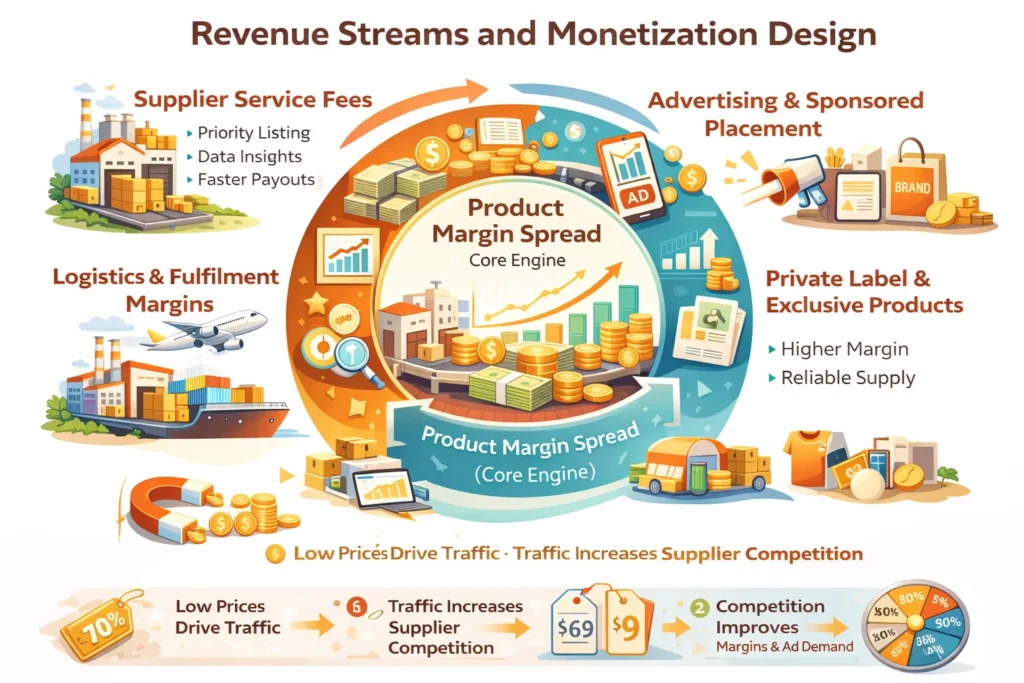
Once Temu solved traffic acquisition and supply-side scale, monetization became a layered, data-driven system rather than a single revenue lever. Unlike traditional ecommerce platforms that depend heavily on seller commissions, Temu focuses on margin orchestration across the value chain.
Primary Revenue Stream 1: Product Margin Spread (Core Engine)
Mechanism
Temu negotiates factory pricing directly and resells products to consumers at a controlled markup. Instead of open seller pricing, Temu sets target price bands and absorbs short-term losses to win demand.
Pricing Model
- Factory-direct procurement
- Dynamic pricing based on demand and inventory velocity
- Subsidies applied selectively by category and region
Revenue Contribution
- Largest long-term revenue driver
- Margins remain thin per item but scale through volume
Growth Trajectory
- Higher-margin categories promoted algorithmically
- Reduced logistics cost per order as scale increases
- Gradual reduction of subsidies in mature markets
Secondary Revenue Streams
2. Supplier Service Fees
- Factories pay for:
- Priority listing
- Data insights and demand forecasting
- Faster payout cycles
- Grows as supplier competition intensifies
3. Advertising & Sponsored Placement
- Paid visibility within the product feed
- Performance-based pricing models
- Still early-stage but expanding rapidly by 2026
4. Logistics & Fulfillment Margins
- Negotiated bulk shipping rates
- Cost advantage retained as platform margin
- Particularly strong on consolidated shipments
5. Private Label & Exclusive Products
- Temu-controlled brands
- Higher margin and supply reliability
- Reduced dependency on third-party factories
Overall Monetization Strategy
Temu’s monetization works because each stream reinforces the others:
- Low prices drive traffic
- Traffic increases supplier competition
- Competition improves margins and ad demand
- Data improves pricing accuracy and inventory flow
The psychology behind Temu’s pricing relies on:
- Perceived “too cheap to skip” value
- Anchoring through inflated original prices
- Gamified discounts that feel earned, not given
This multi-layer design mirrors how Miracuves structures marketplace monetization — start with liquidity, then extract value progressively without killing growth.
Read more : Temu Revenue Model: How Temu Makes Money in 2026
Operational Model & Key Activities
Behind Temu’s low prices and massive SKU count is a highly centralized operational engine. The platform succeeds not by decentralizing responsibility to sellers, but by controlling execution at scale — from supplier onboarding to pricing logic and logistics coordination.
Core Operations
Temu’s daily operations focus on volume efficiency and system-level optimization:
- Platform Management:
Algorithmic product ranking, pricing controls, promotion scheduling, and quality enforcement - Technology Infrastructure:
Demand forecasting systems, supplier performance analytics, fraud detection, and personalization engines - Quality Control:
Factory audits, sampling checks, return rate monitoring, and SKU-level suppression for poor performance - Customer Support:
Centralized dispute handling, refunds, and automated service flows - Marketing Operations:
Always-on paid acquisition, referral programs, and campaign-based discount orchestration
Resource Allocation Strategy (2026 Estimate)
- Technology & Data Systems: ~35%
AI pricing, recommendation engines, and logistics optimization - Marketing & User Acquisition: ~30%
Aggressive spend in new markets, tapering in mature regions - Logistics & Operations: ~20%
Warehousing partnerships, shipping contracts, returns processing - People & R&D: ~15%
Supply chain experts, data scientists, compliance and risk teams
Operational Philosophy
Temu prioritizes:
- Central decision-making over seller autonomy
- Automation over manual intervention
- Scale efficiency over short-term profitability
This approach reduces variability, which is critical when operating millions of SKUs across borders.
For entrepreneurs, this highlights an important lesson Miracuves emphasizes:
marketplaces don’t scale on freedom alone — they scale on systems, rules, and data discipline.
Strategic Partnerships & Ecosystem Development
Temu’s ecosystem strategy is built around control with collaboration. Rather than forming loose alliances, Temu forges partnerships that lock in cost advantages, scale reliability, and long-term efficiency. Every partnership exists to strengthen Temu’s core promise: lowest possible price at massive scale.
Partnership Philosophy
Temu partners where it cannot efficiently build in-house — but structures agreements to preserve platform dominance. This ensures partners grow with Temu, not at Temu’s expense.
Key Partnership Categories
Technology & Infrastructure Partners
- Cloud service providers for elastic scaling
- Data analytics and AI infrastructure partners
- Anti-fraud and risk management vendors
Payment & Financial Partners
- Global and local payment gateways
- Currency conversion and cross-border settlement providers
- Refund and chargeback management systems
Logistics & Fulfillment Alliances
- International freight carriers
- Regional last-mile delivery partners
- Customs clearance and compliance specialists
Marketing & Distribution Partners
- Influencer networks and affiliate platforms
- App store promotion partnerships
- Social media ad platforms
Regulatory & Expansion Alliances
- Local legal and compliance firms
- Trade and customs advisory partners
- Regional market-entry consultants
Ecosystem Strategy Insights
Temu’s ecosystem creates powerful network effects:
- Higher order volumes attract better logistics pricing
- Better logistics improves delivery times and retention
- Increased demand strengthens factory dependency on Temu
Monetization inside the ecosystem happens through:
- Supplier tools and premium services
- Preferred logistics routing
- Sponsored visibility and campaign participation
These partnerships form a defensive moat. Competitors can copy Temu’s interface, but replicating its deeply integrated ecosystem is far harder.
This mirrors how Miracuves approaches platform builds — design ecosystems, not just apps, so value compounds over time.
Growth Strategy & Scaling Mechanisms
Temu’s growth is not accidental or purely marketing-driven. It is the result of engineered growth loops designed to maximize user acquisition, repeat engagement, and geographic expansion — even at the cost of short-term losses.
Primary Growth Engines
Organic Virality & Referral Loops
- Cash credits and discounts for inviting friends
- Gamified sharing mechanics
- Social proof through deal screenshots and unboxing content
Paid Marketing at Scale
- Heavy spend on social platforms and search
- Aggressive app-install campaigns in new markets
- Rapid scaling followed by spend optimization
Product-Led Growth
- Daily deal refreshes encourage habitual app opens
- Personalized feeds increase session duration
- Gamification creates emotional investment
Geographic Expansion Model
- Enter market with subsidies and free shipping
- Capture top app-store rankings quickly
- Optimize logistics and pricing after scale is achieved
Scaling Challenges & How Temu Addressed Them
Operational Complexity
- Millions of SKUs and cross-border shipments
- Solved through automation and SKU-level data controls
Logistics Bottlenecks
- International shipping delays and customs friction
- Addressed via consolidated shipping and regional hubs
Regulatory Pressure
- Scrutiny around product quality and compliance
- Responded with tighter factory audits and category restrictions
Margin Pressure
- High acquisition costs in early stages
- Offset through volume-based efficiencies and supplier fees
Sustaining Momentum in 2026
Temu’s focus is shifting from “growth at all costs” to:
- Improving repeat purchase frequency
- Expanding private labels
- Increasing average order value
For founders, the key takeaway is clear:
scale first, optimize second — but only if your cost structure can survive the journey.
Read more : Best Temu Clone Scripts 2025: Launch a Next-Gen Social Commerce & Group-Buying Marketplace
Competitive Strategy & Market Defense
Temu operates in one of the most competitive environments in global ecommerce. Its survival and dominance depend on structural advantages, not short-term tactics. By 2026, Temu’s defense strategy is built around making competition economically uncomfortable for rivals.
Core Competitive Advantages
Cost Leadership at Structural Level
- Factory-direct sourcing eliminates middlemen
- Volume-based logistics contracts reduce per-order costs
- Centralized pricing prevents margin erosion
Network Effects
- More buyers attract more factories
- More factories increase price competition
- Lower prices drive more buyers back into the loop
Brand Equity Through Value
- Temu is synonymous with “cheapest online”
- High recall even without emotional branding
- Habitual use driven by deals, not loyalty programs
Data & Algorithmic Advantage
- SKU-level demand prediction
- Dynamic pricing at massive scale
- Personalized discovery instead of search dependency
Compliance & Risk Controls
- Category-level enforcement
- Supplier blacklisting for quality failures
- Increasing investment in regulatory alignment
Market Defense Tactics
Handling New Entrants
- Price wars Temu can sustain longer due to scale
- Rapid SKU expansion to crowd out competitors
Timing Feature Rollouts
- Introduce higher-margin features only after liquidity
- Delay monetization until user behavior stabilizes
Strategic Suppression
- Promote categories where Temu dominates
- Deprioritize low-margin or high-risk products
Acquisition & Imitation Shielding
- Private labels and exclusives
- Supplier dependency discourages multi-homing
Temu’s strategy forces competitors into a dilemma:
either match prices and bleed margins, or exit the segment.
This is a pattern Miracuves sees repeatedly — true market leaders win by redesigning economics, not interfaces.
Lessons for Entrepreneurs & Implementation
Temu’s success offers powerful, sometimes uncomfortable lessons for founders. It proves that business model design matters more than branding in the early stages, and that winning platforms often look unprofitable before they look unstoppable.
Key Factors Behind Temu’s Success
- End-to-end cost control instead of marketplace neutrality
- Willingness to subsidize aggressively to achieve scale
- Data-driven decision-making at SKU and user level
- Deep integration with supply-side operations
Temu did not optimize for margins first — it optimized for dominance.
Replicable Principles for Startups
Entrepreneurs can adapt Temu’s logic without copying its scale:
- Start with a narrow category and dominate pricing there
- Build direct relationships with suppliers or service providers
- Use data to control pricing and visibility, not just listings
- Design growth loops before monetization layers
Common Mistakes to Avoid
- Launching with monetization before liquidity
- Over-investing in branding without cost advantage
- Allowing uncontrolled seller behavior early
- Ignoring operational scalability
Adapting the Model for Local or Niche Markets
Temu’s model can be localized by:
- Focusing on regional suppliers
- Simplifying logistics and returns
- Targeting one user behavior loop instead of many
This is where Miracuves supports founders — translating global platform logic into region-ready, capital-efficient builds.
Implementation Timeline & Investment Priorities
- Phase 1 : Supplier onboarding, MVP, pricing logic
- Phase 2 : User acquisition, demand validation, ops automation
- Phase 3 : Monetization layering, partnerships, optimization
Ready to implement Temu’s proven business model for your market?
Miracuves builds scalable platforms with tested business models and growth mechanisms. We’ve helped entrepreneurs launch profitable apps. Get your free business model consultation today.
Conclusion :
Temu’s business model demonstrates a defining truth of modern platform economies: innovation without execution is noise, and execution without structural advantage is temporary. What Temu perfected was not just low pricing, but a repeatable system where supply, data, and demand reinforce each other at scale.
By redesigning ecommerce economics from the factory upward, Temu proved that dominance in 2026 is less about brand storytelling and more about infrastructure, discipline, and patience. The platform accepted short-term losses to earn long-term control — a tradeoff many competitors were unwilling or unable to make.
For founders and operators, the larger lesson is clear. The next generation of winning platforms will not look like lighter versions of incumbents. They will look like re-engineered systems that remove cost, friction, and guesswork from the value chain.
As platform markets mature beyond 2026, the winners will be those who understand this balance early — and build for scale before comfort.
FAQs :
What type of business model does Temu use?
Temu uses a managed marketplace model combined with factory-to-consumer cross-border ecommerce. The platform controls pricing, demand, and visibility rather than acting as a neutral intermediary.
How does Temu’s business model create value?
Temu creates value by aggregating global demand, giving factories predictable volume, and passing cost savings directly to consumers through ultra-low pricing.
What are Temu’s key success factors?
Cost leadership, supplier competition at scale, aggressive user acquisition, and data-driven pricing are the core success drivers behind Temu’s growth.
How scalable is Temu’s business model?
The model is highly scalable because margins improve with volume, logistics costs decrease at scale, and supplier competition intensifies as demand grows.
What are the biggest challenges in Temu’s model?
Quality control, regulatory compliance, logistics reliability, and sustaining margins while reducing subsidies are ongoing challenges.
How can entrepreneurs adapt Temu’s model regionally?
Founders can localize the model by focusing on regional suppliers, limiting categories, simplifying logistics, and targeting one dominant user behavior loop.
What resources and timeframe are needed to launch a Temu-like platform?
A focused version can be launched in 30 – 90 days with strong supplier relationships, robust pricing logic, and sufficient capital for user acquisition.
What are alternatives to Temu’s business model?
Alternatives include open marketplaces, subscription-based commerce, curated D2C platforms, and vertical-specific discount marketplaces.
How has Temu’s business model evolved over time?
Temu evolved from subsidy-heavy user acquisition to a more balanced model with supplier fees, advertising, and private labels improving long-term economics.
Related Article :
- What is Amazon App and How Does It Work?
- What is Myntra App and How Does It Work?
- Best Shein Clone Scripts 2025 – Build Your Global Fashion App Fast
- Best Pinduoduo Clone Scripts 2025 for Social Shopping & Group-Buying Marketplaces
- Best Newegg Clone Scripts 2025: Build a High-Performance Electronics Marketplace