
Key Takeaways
- A group-buying marketplace combines ecommerce with collaborative purchasing and shared discounts.
- Core workflows include group deals, referrals, seller onboarding, checkout, and order management.
- Pricing depends on platform scope, integrations, customization, and operational complexity.
- Seller and admin controls are essential for managing campaigns, inventory, payouts, and disputes.
- Founders should validate one category and buying community before expanding the marketplace.
Marketplace Evaluation Signals
- Test group creation, participant limits, price tiers, countdowns, and deal completion rules.
- Review seller verification, product listings, inventory updates, commissions, and settlements.
- Check referral rewards, coupons, wallets, refunds, cancellations, and failed group orders.
- Verify admin controls for vendors, campaigns, payments, reports, fraud, and customer support.
- Confirm that the architecture can handle flash-sale traffic and concurrent group purchases.
Real Insights
- Group buying works only when the discount gives users a strong reason to invite others.
- Gamification cannot compensate for weak products, unreliable sellers, or poor fulfillment.
- Marketplace development cost rises quickly when workflows are added without clear priorities.
- Seller quality and order reliability influence retention more than feature quantity.
- Miracuves develops group-buying marketplaces with buyer, seller, admin, and campaign-management workflows.
Group-buying marketplaces are becoming attractive for founders who want more than a standard ecommerce store. Instead of relying only on search, ads, and discounts, this model encourages users to invite others, unlock better prices together, and turn shopping into a shared action.
But the model is not successful just because it offers discounts. A group-buying marketplace needs the right feature architecture, pricing logic, vendor controls, inventory rules, referral workflows, admin visibility, and trust systems. Without these layers, founders may launch a platform that looks exciting on the surface but becomes difficult to operate when real users, sellers, payments, refunds, and campaigns start moving together.
This guide explains what founders should evaluate before launching a group-buying marketplace, what features matter most, what affects pricing, and how to decide whether a ready-made platform foundation or custom development route makes better business sense.
What Is a Group-Buying Marketplace?
A group-buying marketplace is an ecommerce platform where buyers can unlock better prices by purchasing together. A user may start a deal group, invite friends or community members, and receive a discounted price when enough participants join within a defined time.
Unlike a normal ecommerce marketplace, the growth loop is social. The buyer is not only a customer. The buyer can also become a promoter by sharing the deal with others.
This model usually includes:
- Product listings
- Individual purchase options
- Group purchase options
- Invite-to-buy workflows
- Deal countdown timers
- Referral rewards
- Seller dashboards
- Admin campaign controls
- Payment and refund workflows
- Order tracking
- Product reviews
- Marketplace analytics
For founders, the real value of this model is not simply “lower pricing.” The business opportunity is to reduce customer acquisition pressure by encouraging users to share products because they receive a clear benefit.
Why Founders Are Exploring Group-Buying Marketplace Models
A traditional ecommerce marketplace often depends heavily on paid ads, product discovery, SEO, influencer campaigns, and repeated promotions. These channels can work, but they can become expensive when the founder is still validating demand.
Group buying adds a different layer. It gives users a reason to invite others because the platform connects sharing with price advantage, urgency, and community participation.
This can work especially well when:
- Products have broad appeal
- Sellers can offer volume-based discounts
- Buyers are price-conscious
- Communities already exist around location, lifestyle, category, or interest
- Product discovery benefits from social sharing
- Vendors want faster movement of inventory
However, founders should be careful. Not every ecommerce category is ideal for group buying. High-consideration products, luxury items, complex B2B purchases, or products with very limited stock may need a different commerce model.
A group-buying marketplace works best when the offer is easy to understand, the discount feels meaningful, and users can quickly invite others without friction.
Core Group-Buying Marketplace Features Founders Should Evaluate
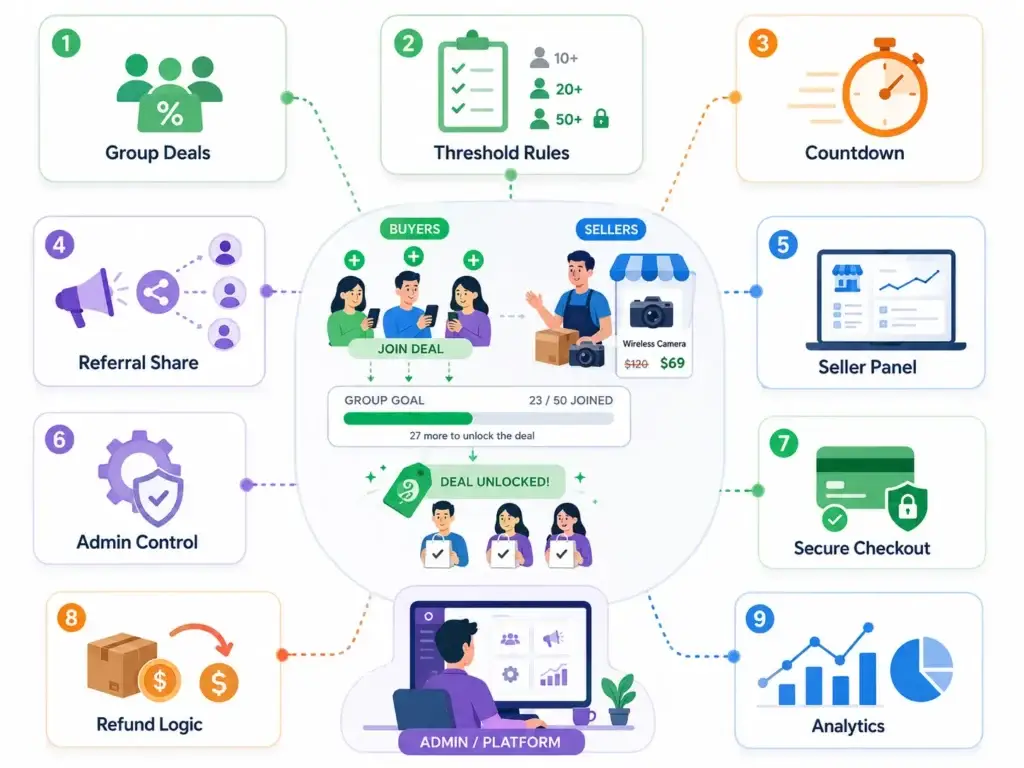
Image Source: AI-generated visual by Miracuves
A strong group-buying marketplace is built from multiple connected modules. The buyer experience, seller workflow, admin control layer, payment system, campaign engine, and trust features must work together.
Group-Buying Marketplace Feature Evaluation Table
| Feature | Business Value | Founder Impact |
|---|---|---|
| Group deal creation | Allows buyers or sellers to start group purchase campaigns. | Creates the core participation loop that separates the platform from normal ecommerce. |
| Deal threshold rules | Defines how many buyers are required to unlock the discount. | Protects seller margins and prevents uncontrolled discounting. |
| Countdown timers | Adds urgency to group participation. | Encourages faster sharing and decision-making. |
| Referral sharing | Lets users invite friends through links, messaging apps, or social channels. | Turns buyers into acquisition channels. |
| Seller dashboard | Helps vendors manage products, stock, pricing, orders, and campaigns. | Makes seller participation easier and reduces admin dependency. |
| Admin campaign control | Gives the platform owner control over approvals, commissions, refunds, and promotions. | Improves operational control as campaigns scale. |
| Secure checkout | Supports safe payment collection and order confirmation. | Builds buyer trust and reduces transaction friction. |
| Refund and failed-group logic | Handles cases where a group does not reach the required buyer count. | Prevents support confusion and improves customer confidence. |
| Analytics dashboard | Tracks campaign performance, seller activity, conversion, repeat purchase, and revenue. | Helps founders make data-backed decisions after launch. |
Buyer App Features That Make Group Shopping Easy
The buyer app must make participation simple. If users do not understand how to join a deal, invite others, track progress, or complete payment, the model loses momentum quickly.
Important buyer-side features include:
- Simple registration and login
- Product browsing by category
- Search and filter options
- Individual purchase option
- Group purchase option
- Create a group
- Join an existing group
- Deal countdown timer
- Share deal link
- Referral rewards
- Coupons and wallet credits
- Cart and checkout
- Payment options
- Order tracking
- Refund request flow
- Ratings and reviews
- Push notifications
- Wishlist or saved deals
The key founder question is: can a new user understand the value of joining a group within seconds?
If the product interface feels too complicated, users may leave before inviting others. A good buyer flow should clearly show the original price, group price, required participants, time left, invite option, and what happens if the group does not complete.
Seller Dashboard Features That Protect Marketplace Supply
A group-buying marketplace cannot work only from the buyer side. Sellers need a clean operating layer where they can list products, manage campaigns, check stock, process orders, and understand performance.
A seller dashboard should support:
- Seller onboarding
- Product listing management
- Category selection
- Product images and descriptions
- Stock and inventory control
- Group deal pricing
- Minimum buyer threshold
- Campaign start and end dates
- Order management
- Shipment updates
- Refund visibility
- Sales analytics
- Commission visibility
- Customer review tracking
Seller control is especially important because group buying often depends on volume-based pricing. Vendors must know how much inventory they are committing, how discounts affect margins, and whether campaign performance justifies participation.
If the seller dashboard is weak, the platform owner may end up manually managing vendor tasks. That creates operational pressure and makes scaling difficult.
Admin Dashboard Features That Decide Operational Control
The admin dashboard is where the founder controls the marketplace. This is one of the most important layers in any group-buying marketplace because multiple actors are moving at the same time: buyers, sellers, campaigns, payments, refunds, products, disputes, and promotions.
A strong admin dashboard should include:
- Buyer management
- Seller management
- Product approval
- Category management
- Group deal approval
- Commission settings
- Coupon and promotion control
- Payment monitoring
- Refund handling
- Order tracking
- Campaign analytics
- Dispute management
- Review moderation
- Notification management
- Revenue reporting
- Role-based access control
- Activity logs
The admin panel should not be treated as a backend afterthought. It is the control center of the marketplace. A founder who cannot monitor campaigns, seller performance, failed deals, refund requests, and revenue flow will struggle to manage the platform after launch.
Group Deal Logic: The Feature Layer Most Founders Underestimate
The group deal engine is the heart of this business model. It decides how group buying actually works inside the platform.
Founders should define:
- Who can create a group deal
- Whether buyers or sellers initiate groups
- Minimum number of participants
- Maximum number of participants
- Deal duration
- Product quantity limits
- Payment timing
- Refund rules for failed groups
- Commission logic
- Discount funding
- Referral reward rules
- Coupon stacking rules
- Campaign approval rules
This is where many early platforms make mistakes. They focus on the front-end design but do not define the business rules behind each campaign.
For example, if a deal requires five buyers but only three join, what happens to the payment? Is the amount refunded automatically? Is the order converted into a normal purchase? Is the buyer offered a wallet credit? Can the seller extend the campaign?
These details directly affect trust. Buyers need clarity, sellers need predictability, and the founder needs admin control.
Pricing Strategy for a Group-Buying Marketplace
Pricing is not only the cost of development. It is also the pricing logic inside the marketplace.
Founders need to think about two pricing layers:
- Platform build pricing — what it costs to build, customize, deploy, and maintain the marketplace.
- Marketplace deal pricing — how products are discounted, how sellers fund offers, and how the platform earns revenue.
Marketplace Deal Pricing
Group-buying campaigns usually require a clear discount logic. A seller may offer a lower price when the required number of buyers is reached. The platform may earn through commission, campaign placement, advertising, subscriptions, or transaction fees.
Common marketplace monetization models include:
| Revenue Model | How It Works | Best For |
|---|---|---|
| Seller commission | Platform takes a percentage from each completed order | Broad multi-vendor marketplaces |
| Featured deal fees | Sellers pay to promote selected group deals | Competitive product categories |
| Subscription plans | Sellers pay monthly for access to advanced tools | Repeat seller participation |
| Advertising slots | Brands pay for visibility in banners or promoted sections | High-traffic marketplaces |
| Transaction fees | Platform charges a small fee per order | Large order volume models |
| Delivery or handling fees | Platform adds fulfillment-related charges | Local commerce and grocery models |
| Buyer membership | Users pay for exclusive deals, early access, or loyalty benefits | Strong repeat-purchase communities |
The right revenue model depends on product category, seller margins, order frequency, buyer price sensitivity, and fulfillment model.
What Affects Group-Buying Marketplace Development Pricing?
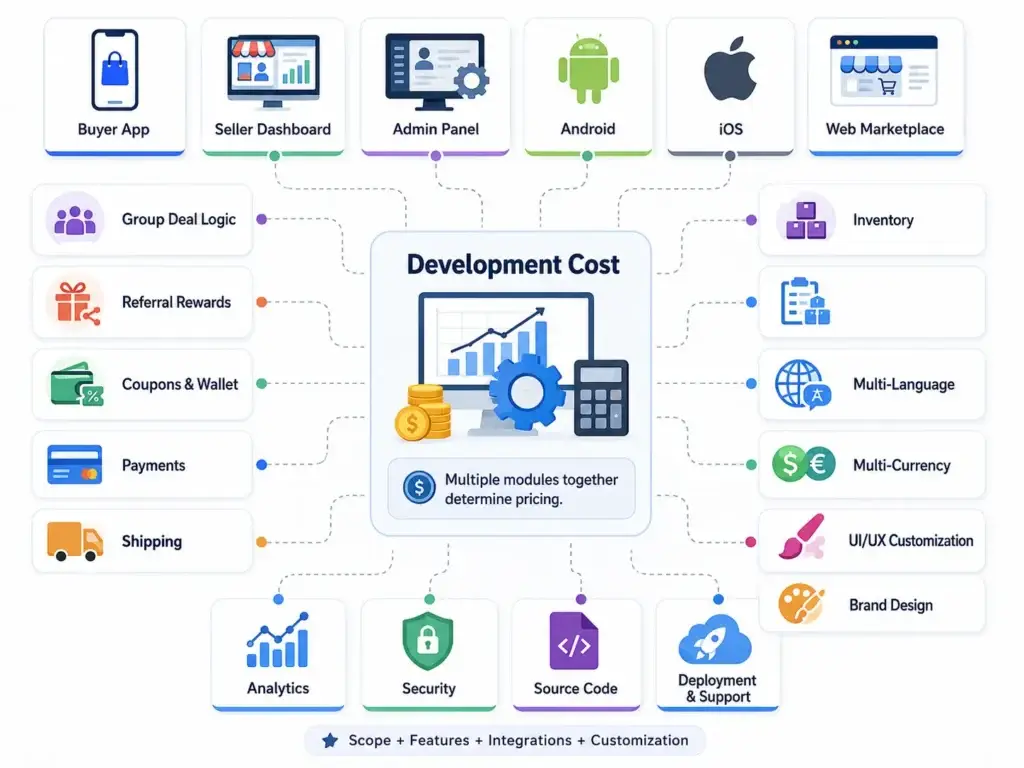
Image Source: AI-generated visual by Miracuves
Founders often ask for one fixed number, but the real answer depends on the scope. A basic marketplace with simple product listings and checkout is very different from a full group-buying platform with seller dashboards, referral logic, admin controls, campaign analytics, payment integrations, and custom branding.
Key cost factors include:
- Buyer app requirements
- Seller dashboard complexity
- Admin panel depth
- Android app requirement
- iOS app requirement
- Web marketplace requirement
- Group-buying campaign logic
- Referral and reward system
- Coupon and wallet workflows
- Payment gateway integrations
- Shipping or delivery integrations
- Inventory management
- Multi-language support
- Multi-currency support
- UI/UX customization
- Brand design
- Analytics and reporting
- Security workflows
- Source-code ownership
- Deployment and support scope
Pricing depends on features, integrations, tech stack, customization, and launch scope. Founders should request the latest quote based on the selected modules and business model.
Miracuves Group-Buying Marketplace Solution Cost and Tech Stack
Miracuves Pricing for a group-buying marketplace solution developed in JavaScript starts at $3,699 USD as a one-time price with 6-day deployment.
Miracuves offers a deployment-ready social commerce and group-buying marketplace foundation built for founders who want to launch faster without developing every buyer, seller, deal, payment, and admin workflow from zero. The solution is designed on a modern JavaScript foundation and can be configured around your branding, marketplace categories, seller onboarding flow, payment gateway, and group-buying business model.
- Core Marketplace Workflows:
User registration, product browsing, product listing, group deal creation, team purchase flow, invite-to-buy sharing, cart checkout, order management, seller onboarding, shipment tracking, customer notifications, and buyer order history. - Built-In Revenue Logic:
Seller commissions, group deal margins, promoted listings, flash sale campaigns, seller subscription plans, advertising placements, transaction fees, platform service charges, and campaign-based monetization options. - Admin and Seller Management Hub:
Centralized admin dashboard, seller management, buyer management, product approval, group deal controls, order monitoring, payment records, refund handling, dispute management, marketplace analytics, and campaign performance tracking. - Launch-Ready Setup:
The solution is prepared for custom branding, configuration, payment gateway setup, seller onboarding, category setup, group-buying workflow setup, source-code access, and faster market entry.
Why Group-Buying Marketplace Development Can Be More Cost-Efficient
Group-buying marketplace development becomes expensive when founders build everything from scratch. A complete platform usually needs separate workflows for buyers, sellers, group deals, team purchases, product catalogs, payments, refunds, order management, referrals, notifications, analytics, and admin controls. Each module adds development time, testing effort, and technical complexity.
Miracuves uses a more practical ready-made approach.
- You Are Not Paying for Ground-Up Development:
The core group-buying marketplace engine is already developed, tested, and ready for deployment. This helps reduce the cost and timeline usually required to build a social shopping marketplace from the beginning. - Built on JavaScript for Modern Marketplace Workflows:
The solution uses a JavaScript-based architecture that supports interactive buyer journeys, scalable group-buying logic, API-driven integrations, fast frontend performance, and smooth admin operations. - Designed for Faster Market Validation:
Instead of waiting months to test your idea, founders can start with a launch-ready foundation and focus on seller acquisition, product categories, group deal strategy, pricing logic, and customer growth.
With Miracuves, you get a ready-made group-buying marketplace solution with practical social commerce features, source-code access, admin control, and faster deployment without the high cost of fully custom development.
Note: This cost covers the solution, rebranding, deployment, and source code only. Final pricing may vary based on customization, integrations, payment gateway requirements, feature scope, and post-launch support needs.
Ready-Made Foundation vs Fully Custom Development
Founders usually have two routes: start with a ready-made foundation or build a fully custom platform from scratch.
| Decision Factor | Ready-Made Marketplace Foundation | Fully Custom Development |
| Launch speed | Faster because core workflows are already available | Slower because every module is planned and built from zero |
| Cost logic | More cost-efficient for early validation | Higher investment due to custom engineering |
| Customization | Can be customized on top of existing modules | Fully flexible but more time-intensive |
| Risk level | Lower early execution risk if the foundation is stable | Higher early risk if scope is not controlled |
| Best for | Founders who want faster market entry | Businesses with highly unique workflows |
| Ownership | Should be checked before purchase | Usually defined in the development contract |
| Scalability | Depends on architecture and tech stack | Can be designed from scratch for specific scale goals |
A ready-made foundation is useful when the founder wants to validate the model faster without building every common marketplace module from zero. Custom development is better when the platform requires unique logic, complex integrations, enterprise-level workflows, or a highly differentiated product experience.
Miracuves supports founders with ready-made and white-label marketplace foundations that can be customized around branding, workflows, admin controls, and monetization needs. For readers evaluating a launch-ready route, the next step is to review a dedicated white-label group-buying marketplace solution and compare it against the features listed in this guide.
Founder Decision Signals Before You Build
Speed
If your goal is to validate demand quickly, avoid spending months on basic marketplace modules that already exist in ready-made foundations.
Cost
Pricing should be evaluated by module scope, integrations, admin depth, source-code ownership, and customization requirements.
Scalability
The platform should support more vendors, more campaigns, larger product catalogs, secure payments, and clear analytics as demand grows.
Market Fit
The model works best when buyers have a strong reason to share deals and sellers can profit from volume-based pricing.
Security and Trust Features Founders Should Not Ignore
Trust is critical in a group-buying marketplace because users are paying, inviting others, waiting for deal completion, and expecting clear fulfillment. Sellers also need confidence that campaign rules, payouts, refunds, and order records are handled correctly.
Important trust and security layers include:
- Secure payment gateway integration
- Encrypted data transfer
- Role-based access control
- Admin access controls
- Seller verification
- Product approval workflows
- Refund and dispute management
- Order history
- Activity logs
- Review moderation
- Fraud monitoring signals
- Abuse reporting
- Permission-based dashboards
Security should not be positioned as an add-on. It should be part of the platform foundation. When buyers do not trust payment handling, refunds, seller quality, or order tracking, social sharing becomes harder.
Marketplace Categories Where Group Buying Can Work
Group buying can work across several categories, but founders should choose carefully. The product must have enough demand, margin flexibility, seller availability, and social-sharing potential.
Grocery and Household Essentials
Community-based grocery buying can work when users want better prices on everyday items. This model often depends on local supply, delivery coordination, pickup options, and repeat purchase behavior.
Fashion and Lifestyle Products
Fashion sellers can use group campaigns for seasonal inventory, limited offers, bundle deals, and influencer-led promotions. However, sizing, returns, and product quality control must be handled carefully.
Beauty and Personal Care
Beauty products can work well with group deals because users often share recommendations with friends. Bundles, trial packs, creator promotions, and limited-time campaigns can support discovery.
Electronics and Accessories
Accessories, gadgets, and small electronics may work when discounts are clear and product trust is strong. Founders should pay attention to warranty, seller verification, and return policies.
Local Deals and Community Commerce
Local vendors can use group buying to attract neighborhood demand. This can work for food boxes, household products, local services, and community-driven buying groups.
Mistakes Founders Should Avoid
Building only the buyer app and ignoring seller operations
A group-buying marketplace depends on seller participation. If vendors cannot manage products, inventory, pricing, orders, and campaigns easily, the platform becomes operationally heavy.
Launching discounts without margin logic
Discounts should be funded carefully. If sellers lose money or the platform overuses promotions, growth becomes unsustainable.
Not defining failed-group refund rules
Founders should clearly define what happens when a group does not reach the required buyer count. Confusing refund rules can damage buyer trust quickly.
Treating admin control as a basic backend feature
The admin panel is where the founder manages users, sellers, campaigns, payments, refunds, disputes, commissions, and analytics. Weak admin control limits scalability.
How Miracuves Helps Founders Launch Faster
Miracuves helps founders build ready-made and white-label app solutions with source-code ownership, branded design, admin control, and faster deployment for launch-ready platforms.
For a group-buying marketplace, this means founders do not need to start from a blank product scope. They can begin with core ecommerce, seller, buyer, campaign, payment, and admin workflows, then customize the product around their target market.
A Miracuves-ready approach can support:
- Buyer app workflows
- Seller dashboards
- Admin control panels
- Product catalog management
- Group-buying campaign logic
- Social sharing flows
- Secure payment gateway integration
- Order management
- Campaign and coupon systems
- Marketplace monetization models
- Custom branding
- Source-code ownership
- Faster deployment for ready-made solutions
If you are comparing build routes, you can explore Miracuves launch-ready group-buying marketplace solution to understand how a ready-made foundation can support faster market validation.
Final Thoughts: Build the Group-Buying Logic Before You Build the Marketplace
A group-buying marketplace is not just an ecommerce app with discounts. It is a social commerce system where users, sellers, campaigns, payments, inventory, referrals, and admin controls must work together.
The smartest founders evaluate the model before they build. They check whether buyers have a reason to share, whether sellers can support volume-based pricing, whether the platform can manage failed groups and refunds, and whether the admin dashboard gives enough control to scale operations.
Miracuves helps founders move from idea to launch faster with ready-made, white-label, source-code-owned marketplace foundations. For founders planning a social shopping platform, the goal is not to copy another company. The goal is to use proven group-buying mechanics, customize them for a specific market, and validate demand with the right product foundation.
FAQs
What features should a group-buying marketplace include?
A group-buying marketplace should include buyer registration, product discovery, group deal creation, join-group workflows, referral sharing, countdown timers, seller dashboards, secure checkout, order tracking, refunds, campaign management, admin controls, and analytics.
How does group-buying marketplace pricing work?
Pricing depends on two layers. First, the platform build cost depends on features, integrations, apps, dashboards, customization, and source-code requirements. Second, marketplace pricing depends on how discounts are funded, how sellers participate, and how the platform earns revenue.
What affects the cost of building a group-buying ecommerce platform?
The cost is affected by buyer app features, seller dashboard depth, admin controls, group-deal logic, payment gateways, referral rewards, wallet or coupon systems, shipping integrations, analytics, UI/UX customization, and deployment scope.
Is a ready-made marketplace foundation better than custom development?
A ready-made foundation is better when the founder wants faster launch, lower early execution risk, and faster market validation. Custom development is better when the platform requires highly unique workflows, advanced integrations, or complex enterprise-level architecture.
How does a group-buying marketplace make money?
It can make money through seller commissions, featured deals, advertising placements, seller subscriptions, transaction fees, delivery fees, campaign fees, and buyer membership plans. The right revenue model depends on the category, market, and seller strategy.
What makes group buying different from normal ecommerce?
Normal ecommerce focuses on individual purchases. Group buying encourages users to purchase together so they can unlock better prices, create urgency, and share deals with others. This adds a social growth loop to the commerce experience.
What admin features are important for a social shopping marketplace?
Important admin features include user management, seller approval, product moderation, campaign approval, commission settings, refund management, dispute handling, payment monitoring, analytics, coupon control, notification management, and role-based access.
Can Miracuves help launch a group-buying marketplace faster?
Yes. Miracuves helps founders launch ready-made and white-label marketplace solutions with source code, branded design, admin dashboards, and faster deployment for launch-ready products.
Miracuves is an independent software development company. We are not affiliated with, connected to, sponsored by, or endorsed by any company or product named in this article.
Terms such as “X Clone” are used descriptively. It is how the software industry refers to building a platform with functionality comparable to a known service, and how clients search for it.
The entire design and codebase of our products is built by our own team. Our products contain no code, design, graphics, or content originating from any third-party website or applications.
All third-party names and marks referenced in this article are the property of their respective owners, referenced solely to identify the services discussed.