

Key Takeaways
- Myntra is a fashion ecommerce app that connects shoppers with clothing, footwear, accessories, beauty products, and lifestyle brands.
- Customers, sellers, brands, delivery partners, payment teams, support teams, and admins need connected shopping workflows.
- Product discovery, category filters, wishlists, carts, secure checkout, order tracking, returns, and offers are core features.
- The app works by combining fashion browsing, personalized recommendations, brand catalogs, payments, logistics, and customer support.
- A Myntra-like fashion marketplace can help startups build a scalable shopping platform with strong product discovery and repeat purchases.
Workflow Signals
- Customers need easy signup, product search, size filters, wishlists, carts, secure payments, order updates, and return options.
- Sellers and brands need catalog uploads, inventory control, pricing tools, offer management, order handling, and sales reports.
- Delivery teams need pickup details, shipment tracking, delivery status, return handling, and proof-of-delivery workflows.
- Admins need control over users, sellers, products, commissions, discounts, payments, disputes, returns, and analytics.
- Notifications keep shoppers and sellers updated on offers, order confirmations, shipping status, refunds, returns, and wishlist activity.
Real Insights
- A fashion shopping app works best when discovery, product visuals, size clarity, and checkout are smooth.
- Weak product data, unclear size guides, or poor return workflows can reduce buyer trust quickly.
- Personalized recommendations, seasonal offers, brand collections, and wishlist reminders can improve repeat purchases.
- Founders should focus on catalog quality, seller control, payment reliability, delivery visibility, and return management before scaling.
- Miracuves builds Myntra-like fashion ecommerce platforms with product catalogs, seller tools, secure checkout, delivery tracking, returns, analytics, and admin control.
A fashion ecommerce marketplace looks simple from the outside. A shopper opens the app, searches for a dress, filters by size, adds the right color to the cart, pays, tracks the order, and returns it if the fit does not work. But behind that smooth shopping experience is a complex operating system connecting product discovery, variant-level inventory, sellers, payments, logistics, customer support, returns, refunds, and admin control.
For founders, fashion retailers, boutique aggregators, regional brands, and digital commerce startups, understanding this workflow matters before investing in a platform. Fashion is not the same as general ecommerce. One product can become dozens of sellable units because every size, color, style, material, fit, and stock location may behave differently. A marketplace also has to manage multiple sellers, product moderation, order splitting, delivery coordination, refund rules, and customer trust at the same time.
This guide explains how a fashion ecommerce marketplace works from discovery to delivery and returns. It also shows which operational layers matter most when building or choosing a platform, especially if you want to launch a scalable multi-brand fashion shopping experience with strong admin control and clear monetization logic.
What Is a Fashion Ecommerce Marketplace?
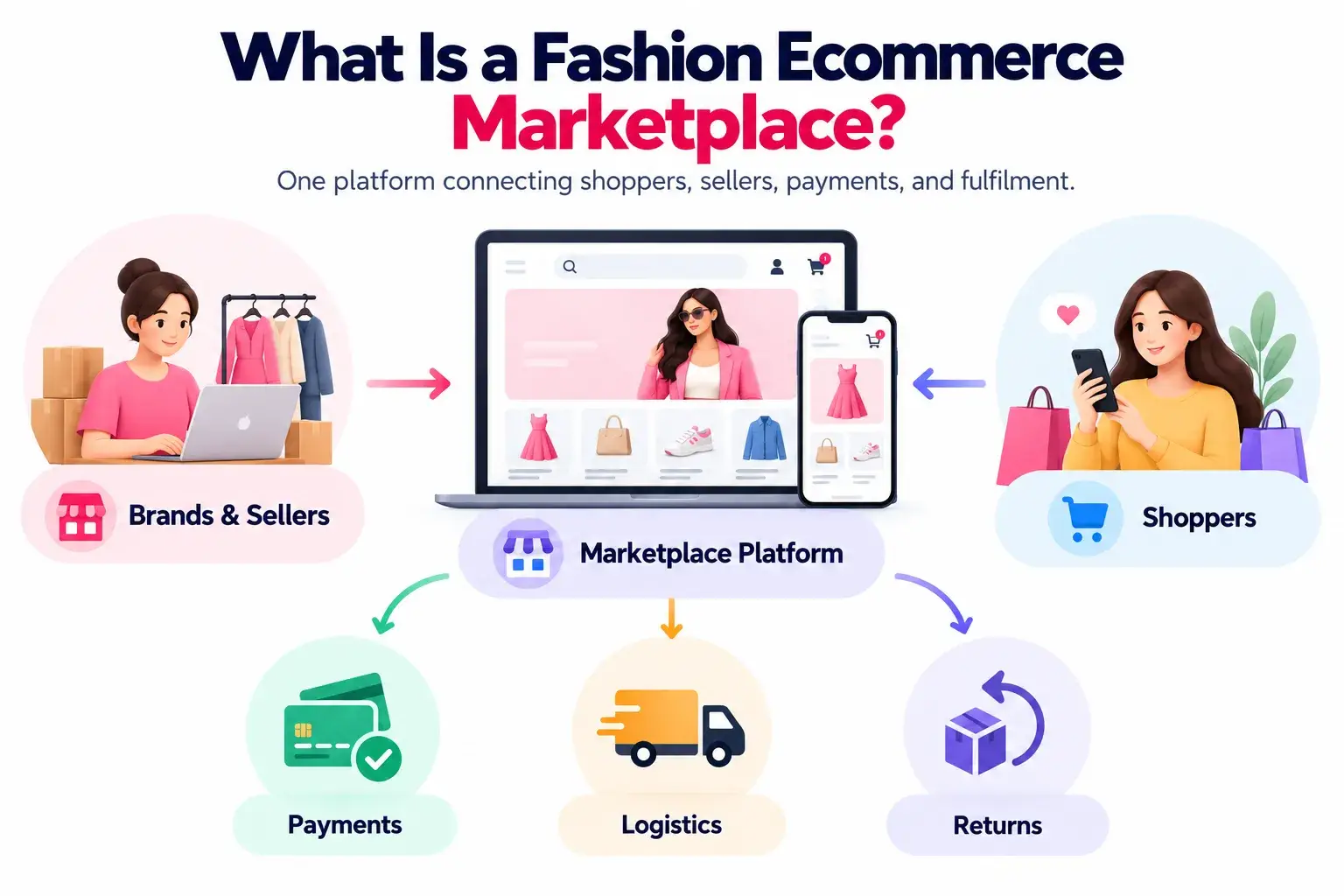
A fashion ecommerce marketplace is an online platform where multiple fashion brands, retailers, or sellers list products and sell them to customers through a shared digital storefront. Unlike a single-brand store, a marketplace gives buyers access to many sellers, categories, price points, styles, and product options in one place.
The platform operator usually controls the marketplace experience. That includes seller approval, catalog rules, product visibility, commissions, payment settlement, promotions, customer support, returns, refunds, and overall trust. Sellers manage their own products, stock, orders, and sometimes shipping responsibilities depending on the marketplace model.
In fashion, this marketplace model is especially powerful because shoppers rarely search in a straight line. They may start with a category, switch to a brand, filter by size, compare colors, save items, check delivery dates, look at reviews, and return later during a sale. The marketplace must support that browsing behavior without creating confusion.
How It Differs From a Normal Ecommerce Store
A normal ecommerce store may sell products from one business. A fashion marketplace usually has many sellers and more operational layers. It needs vendor onboarding, product approval, commission rules, order routing, seller payouts, seller analytics, return approvals, platform-level support, and marketplace-wide reporting.
| Area | Single Fashion Store | Fashion Ecommerce Marketplace |
|---|---|---|
| Seller structure | One brand or retailer | Multiple brands, boutiques, or sellers |
| Catalog control | Central team manages all listings | Sellers add products, platform reviews or moderates |
| Inventory | Usually one business-owned stock system | Stock can vary by seller, warehouse, size, color, and product line |
| Orders | One seller fulfills the order | One customer cart may split into multiple seller orders |
| Revenue | Margin on products sold | Commission, promotions, subscriptions, fulfillment fees, featured listings, or private labels |
| Returns | Handled by the brand directly | May involve seller approval, platform refund rules, logistics, wallet, payment gateway, and commission reversal |
Why Fashion Marketplaces Need a Different Operating Logic
Fashion commerce is emotional, visual, seasonal, and return-heavy. A customer is not only buying a product. They are buying fit, identity, occasion, comfort, style, and confidence. That makes the platform’s backend more important than it appears.
A marketplace can fail even with attractive screens if the product data is weak, sizes are inaccurate, stock is not updated, return rules are unclear, or sellers cannot manage orders properly. The strongest fashion marketplaces treat catalog depth, variant control, seller operations, and post-purchase experience as core business infrastructure.
The Four Operational Layers That Matter Most
- Discovery layer: Helps shoppers find products through search, filters, categories, brand pages, recommendations, banners, collections, and visual browsing.
- Catalog and variant layer: Converts products into accurate sellable units such as size, color, material, fit, stock, SKU, and price.
- Order and fulfillment layer: Manages cart, checkout, seller order routing, payment, packing, delivery, tracking, and status updates.
- Returns and settlement layer: Handles return requests, refund routes, commission reversals, wallet adjustments, inventory updates, and customer communication.
When these layers work together, the marketplace feels simple to the shopper and manageable for the operator. When they are disconnected, customers face out-of-stock items, wrong sizes, delayed orders, unclear refunds, and poor support.
How Product Discovery Works in a Fashion Ecommerce Marketplace
Product discovery is the journey from “I want something” to “I found the right item.” In fashion, discovery is rarely limited to typing a keyword in a search bar. Shoppers browse by mood, trend, occasion, size availability, brand preference, price, discount, delivery time, and social proof.
A strong discovery system helps users move naturally from broad inspiration to confident selection. For example, a shopper may start with “ethnic wear,” narrow it down to “kurta sets,” filter by size and color, sort by discount, open a product, check reviews, save it, compare another item, and finally add the right variant to the bag.
Key Discovery Features in a Fashion Marketplace
- Search with autocomplete: Helps users find categories, brands, product names, styles, and attributes faster.
- Category navigation: Organizes products into gender, clothing type, footwear, accessories, beauty, occasion, season, and trend-based groups.
- Smart filters: Allows shoppers to narrow results by size, color, price, brand, discount, rating, material, fit, sleeve length, pattern, and delivery availability.
- Brand pages: Give each seller or brand a dedicated space to showcase products, identity, collections, and trust signals.
- Personalized rails: Show recently viewed products, similar styles, bestsellers, new arrivals, seasonal picks, and wishlist-based suggestions.
- Visual merchandising: Uses banners, curated collections, look-based edits, sale sections, and campaign placements to guide demand.
Discovery also has a business role. It decides which products get visibility, which brands gain attention, how quickly seasonal inventory moves, and how efficiently shoppers convert. For the marketplace operator, discovery is not just a user experience feature. It is a revenue lever.
Founder Insight: Discovery Should Reduce Decision Friction
Many fashion apps overload users with products. More products do not automatically mean more sales. A marketplace needs the right balance between choice and clarity. Filters, collections, recommendations, and category logic should reduce the mental effort required to find a good item.
If discovery is weak, customers may still visit the app but leave without buying. If discovery is strong, the app can turn casual browsing into repeat purchase behavior.
How Product Variants Work: Size, Color, SKU, Stock, and Price
Product variants are one of the most important parts of fashion marketplace architecture. A product is not truly one item if it comes in five sizes and six colors. It may look like one product page to the shopper, but behind the scenes it may represent thirty different sellable units.
Each variant can have its own SKU, stock count, price, discount, image, availability, barcode, weight, return eligibility, and low-stock threshold. This is why fashion inventory must be managed at variant level, not only at product level.
Example: One Dress Becomes Many Sellable Units
| Product | Color | Size | SKU | Stock | Price |
|---|---|---|---|---|---|
| Printed Summer Dress | Blue | S | PSD-BLU-S | 12 | ₹1,499 |
| Printed Summer Dress | Blue | M | PSD-BLU-M | 4 | ₹1,499 |
| Printed Summer Dress | Blue | L | PSD-BLU-L | 0 | ₹1,499 |
| Printed Summer Dress | Black | S | PSD-BLK-S | 8 | ₹1,599 |
| Printed Summer Dress | Black | M | PSD-BLK-M | 2 | ₹1,599 |
To the shopper, this is one product page with color and size options. To the marketplace, it is a set of separate inventory records. If the platform does not treat each variant separately, it can create serious operational problems: overselling, wrong fulfillment, inaccurate stock alerts, broken returns, and poor seller reporting.
Why Variant-Level Stock Matters
- Accurate availability: A product may be available in one size but sold out in another.
- Better customer trust: Customers should not discover after payment that the selected size is unavailable.
- Cleaner seller operations: Sellers need to know exactly which size and color to pack.
- Smarter promotions: Operators can discount slow-moving variants without reducing the price of every option.
- Useful reporting: Brands can see which sizes, colors, and styles move fastest.
- Return accuracy: Returned inventory must go back to the correct variant, not just the parent product.
This is where many basic ecommerce builds become fragile. Fashion is not only a catalog problem. It is a data structure problem. The platform needs to understand the difference between a product, a variant, a SKU, and an order line.
How the Customer Journey Works From Browse to Checkout
A good fashion ecommerce marketplace makes the customer journey feel effortless. But every step triggers backend actions that must happen in the correct order. The customer sees a clean shopping flow. The operator sees a chain of catalog, pricing, stock, payment, seller, logistics, and notification events.
Step 1: The Shopper Discovers a Product
The journey starts when a user lands on the homepage, category page, brand page, search result, campaign banner, or personalized recommendation. The platform shows relevant products based on category mapping, product tags, filters, brand rules, promotional placement, and stock availability.
At this stage, the marketplace should avoid showing unavailable variants too aggressively. If a size is out of stock, the customer may still view the product, but the platform should make availability clear and, ideally, offer restock alerts or similar alternatives.
Step 2: The Shopper Selects a Variant
Once the shopper opens a product page, they choose color, size, quantity, and sometimes other attributes such as fit, waist size, shoe size, fabric, or pack type. This selection should map to a specific SKU. The platform should then show the correct price, discount, images, stock status, delivery estimate, return eligibility, and seller information.
This step is critical because the variant selected here is the exact item that must be reserved, packed, shipped, delivered, and possibly returned later.
Step 3: The Item Is Added to Cart or Wishlist
Fashion shoppers often browse before buying. That makes wishlist and save-for-later features important. A user may save products during the first visit and purchase later during a sale, payday, festival season, or after comparing styles.
The cart should preserve the selected variant, seller, quantity, price, and availability. If stock changes before checkout, the app should update the user instead of allowing a broken purchase flow.
Step 4: Checkout Calculates the Real Order
Checkout is where the marketplace turns browsing into a commercial transaction. The platform calculates product totals, seller-wise shipping, coupon discounts, wallet balance, loyalty points, taxes, payment method, delivery address, and estimated delivery date.
In a multi-brand marketplace, one customer cart may contain products from several sellers. The user sees one checkout experience, but the platform may create multiple seller-specific order lines in the backend. This allows each seller to accept, pack, ship, or reject only the products assigned to them.
How Multi-Seller Orders Work Behind the Scenes
Order management becomes more complex when several sellers are involved. A customer may buy shoes from one brand, a shirt from another, and accessories from a third. From the customer’s perspective, it should still feel like one order. From the platform’s perspective, each seller needs a clear fulfillment task.
This is why marketplace order systems usually split the order internally while keeping a unified customer-facing record. The buyer can track the complete purchase, while sellers see only the items they are responsible for.
Typical Marketplace Order Flow
- The customer places an order after selecting address, coupon, payment method, and delivery option.
- The platform confirms payment or marks the order as cash-on-delivery, depending on the selected method.
- The order is split into seller-specific order lines based on product ownership.
- Each seller receives the relevant order details in the seller panel or seller app.
- The seller accepts, rejects, packs, or marks the item ready for pickup.
- The platform assigns delivery or connects the order with the relevant shipping workflow.
- The customer receives tracking updates through app notifications, email, SMS, or order page updates.
- After delivery, the platform settles commissions, seller payouts, delivery fees, wallet deductions, and loyalty adjustments according to business rules.
This backend separation is what allows a marketplace to scale. Without seller-level order visibility, the operator would have to manually coordinate every product in every order, which becomes impossible as catalog size and order volume grow.
How Payments, Coupons, Wallets, and Loyalty Work Together
A fashion marketplace usually supports several payment and incentive layers. Customers expect smooth payment options, but operators also need control over discounts, seller commissions, refunds, loyalty points, and settlement records.
The challenge is that every discount or payment adjustment affects multiple parties. A coupon may reduce platform revenue, seller revenue, or both. Wallet credit may be used at checkout and later reversed during a refund. Loyalty points may be earned after order completion but cancelled if the product is returned.
Common Commercial Logic in Fashion Marketplaces
| Layer | What It Does | Why It Matters |
|---|---|---|
| Payment gateway | Processes online payments | Supports smooth checkout and payment confirmation |
| Cash on delivery | Allows payment at delivery | Important in markets where customers prefer paying after receiving goods |
| Coupons | Applies discounts by product, category, seller, order value, or campaign | Helps with conversion, seasonal sales, and inventory movement |
| Wallet | Stores credits, refunds, or promotional balance | Can improve repeat purchase and faster refund experience |
| Loyalty points | Rewards purchases or engagement | Encourages retention and repeat shopping |
| Commission | Defines the platform’s earning from seller transactions | Supports marketplace monetization |
| Seller payout | Transfers seller earnings after deductions | Builds seller trust and keeps marketplace operations transparent |
For founders, this means payment architecture should not be treated as a simple checkout integration. It is part of the marketplace’s financial backbone.
How Returns and Refunds Work in a Fashion Ecommerce Marketplace
Returns are one of the biggest operational realities in fashion ecommerce. Customers may return products because of size issues, color mismatch, quality concerns, damaged items, late delivery, incorrect products, or simple change of preference. A marketplace that treats returns as an afterthought will struggle with trust, seller disputes, and financial reconciliation.
A proper returns workflow should connect customer request, seller response, platform policy, logistics, refund method, inventory update, commission reversal, loyalty adjustment, and support communication.
Typical Return Workflow
- The customer opens the order and selects the product they want to return.
- The platform checks return eligibility based on category, delivery date, seller policy, and marketplace rules.
- The customer chooses a reason and may upload images or comments as evidence.
- The seller or operator reviews the request depending on the approval model.
- A reverse pickup or return shipping process is initiated.
- The returned item is inspected after it reaches the seller or warehouse.
- The refund is approved, rejected, or partially adjusted based on policy.
- The refund is sent to the original payment method, wallet, or another approved route.
- Inventory is updated if the item can be resold.
- Commission, seller payout, coupon impact, wallet usage, and loyalty points are adjusted.
The most important detail is that returns affect more than the customer’s money. They affect seller earnings, platform commission, inventory accuracy, reports, customer trust, and future shopping behavior.
Why Returns Should Be Built Into the Core Platform
Many early-stage platforms focus on product listing and checkout first, then add returns later when complaints start growing. That approach creates manual work. A stronger platform includes return statuses, refund rules, evidence uploads, seller responses, admin override, wallet credit, and financial reversal logic from the beginning.
For fashion commerce, return handling is not only a support feature. It is a trust feature. Customers are more likely to buy if they know returns are clear, trackable, and fair.
What Sellers Need in a Fashion Marketplace
A fashion marketplace cannot scale if sellers depend on the platform team for every product update. Sellers need tools to manage their shop, catalog, orders, stock, returns, and earnings without creating operational bottlenecks.
Important Seller Panel Features
- Shop profile management: Seller name, logo, business information, documents, policies, and support details.
- Product listing tools: Product title, description, images, categories, brand, attributes, size chart, and SEO fields.
- Variant management: Size, color, SKU, price, stock, barcode, discount, and low-stock alerts.
- Bulk upload: Faster catalog onboarding through CSV or spreadsheet import for large sellers.
- Order queue: Accept, reject, pack, prepare, and track seller-specific order lines.
- Return response: Review return requests, add comments, approve, reject, or escalate based on marketplace policy.
- Sales analytics: Product performance, revenue, returns, conversion, and inventory movement.
- Wallet and payout view: Seller earnings, commission deductions, payout requests, and settlement history.
The better the seller tools, the easier it is to onboard quality brands and keep them active. A marketplace is not only a customer product. It is also a seller operations product.
What the Admin Dashboard Must Control
The admin dashboard is where the marketplace operator manages the business. It should not be limited to user lists and product approvals. A fashion ecommerce marketplace needs operational control across catalog quality, sellers, orders, refunds, promotions, payouts, tax settings, content, and reports.
Without a strong admin layer, every business change becomes a developer dependency. The operator should be able to update commissions, approve sellers, manage banners, review returns, configure coupons, export reports, and monitor platform health without editing code.
Admin Controls That Matter Most
| Admin Area | What It Controls | Business Value |
|---|---|---|
| Seller management | Approvals, suspensions, documents, subscription plans, seller status | Keeps seller quality under control |
| Product moderation | Listing approvals, category mapping, image quality, prohibited items | Protects catalog trust and marketplace standards |
| Order management | Order statuses, seller actions, delivery flow, manual overrides | Improves operational visibility |
| Refund management | Return reasons, evidence, approval status, refund route | Reduces disputes and manual reconciliation |
| Commission settings | Platform fees, seller fees, category-wise commission | Supports monetization flexibility |
| Marketing controls | Banners, campaigns, coupons, featured products, seasonal sales | Helps move demand and manage seasonal inventory |
| Reports | Sales, refunds, sellers, products, wallets, tax, payouts | Helps founders make better business decisions |
| Role permissions | Staff access by module or responsibility | Improves security and internal accountability |
For founders planning a serious fashion commerce business, the admin dashboard is not a back-office extra. It is the control center of the marketplace.
How a Fashion Marketplace Makes Money
A fashion ecommerce marketplace can use several monetization streams. The right model depends on seller type, product category, fulfillment approach, brand relationships, and customer acquisition strategy. Some marketplaces rely mostly on commission. Others combine commission with advertising, subscriptions, fulfillment support, and promoted visibility.
Common Revenue Streams
- Seller commission: The platform earns a percentage from each successful sale.
- Featured listings: Sellers pay for better placement in search, category pages, or campaign sections.
- Brand promotion: Brands pay for banners, sponsored collections, launch placements, or seasonal visibility.
- Seller subscriptions: Sellers pay monthly or yearly for advanced tools, lower commission, more listings, or analytics access.
- Fulfillment fees: The platform charges for storage, pickup, packing, shipping, or reverse logistics support.
- Private label margin: The operator sells owned or exclusive products with higher margin control.
- Customer loyalty programs: Premium memberships, faster delivery, exclusive access, or member-only discounts can create repeat revenue.
The strongest model is usually not one revenue stream. It is a structured mix that fits the marketplace’s stage. Early platforms may focus on seller acquisition and commission. Mature platforms may add promotions, subscriptions, and fulfillment services once seller demand becomes stronger.
Build From Scratch or Use a Launch-Ready Marketplace Foundation?
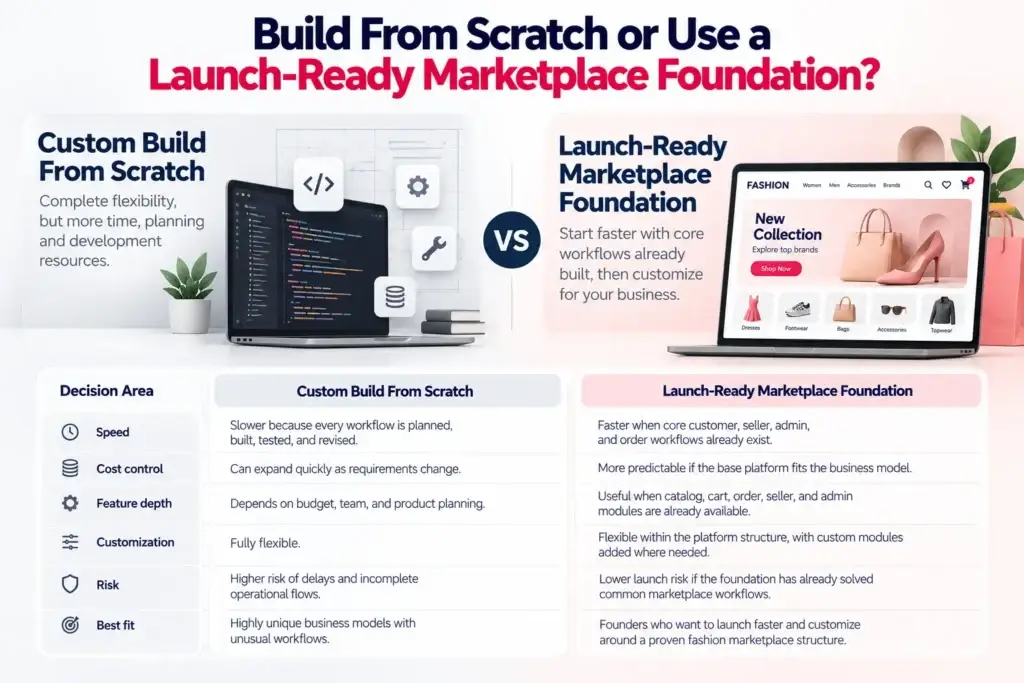
Once founders understand the operational complexity, the next question is usually practical: should the business build everything from scratch, or start with a launch-ready marketplace foundation and customize from there?
Building from scratch gives complete flexibility, but it also requires more time, technical planning, product management, QA, marketplace logic, seller tooling, payment workflows, and return systems. Starting with a ready-made foundation can help founders validate faster when the required workflows are already close to the business model.
| Decision Area | Custom Build From Scratch | Launch-Ready Marketplace Foundation |
|---|---|---|
| Speed | Slower because every workflow is planned, built, tested, and revised | Faster when core customer, seller, admin, and order workflows already exist |
| Cost control | Can expand quickly as requirements change | More predictable if the base platform fits the business model |
| Feature depth | Depends on budget, team, and product planning | Useful when catalog, cart, order, seller, and admin modules are already available |
| Customization | Fully flexible | Flexible within the platform structure, with custom modules added where needed |
| Risk | Higher risk of delays and incomplete operational flows | Lower launch risk if the foundation has already solved common marketplace workflows |
| Best fit | Highly unique business models with unusual workflows | Founders who want to launch faster and customize around a proven fashion marketplace structure |
If you are evaluating a fashion marketplace app foundation, review the multi-brand fashion marketplace solution from Miracuves. It is relevant for founders who want customer shopping flows, seller operations, admin control, variant-based catalog logic, and faster launch planning in one connected platform.
What Features Should a Fashion Ecommerce Marketplace Include?
A fashion ecommerce marketplace should include features for all major participants: customers, sellers, delivery teams, and platform operators. Focusing only on the customer app creates an incomplete product. The marketplace becomes scalable only when every participant can complete their workflow without manual dependency.
Customer-Side Features
- User registration and profile management
- Homepage banners, collections, and campaign sections
- Search, autocomplete, categories, filters, and sorting
- Product pages with images, variants, descriptions, reviews, and seller details
- Wishlist, save for later, recently viewed products, and restock alerts
- Cart, checkout, coupons, wallet, loyalty, and multiple payment options
- Order tracking, cancellation, returns, refunds, support, and notifications
Seller-Side Features
- Seller onboarding and profile setup
- Catalog creation, variant management, pricing, and inventory control
- Bulk product upload and product approval status
- Order queue, packing status, return responses, and seller notifications
- Sales reports, refund reports, wallet, payout requests, and performance analytics
Admin-Side Features
- User, seller, product, category, and brand management
- Commission, coupon, loyalty, wallet, tax, delivery, and payment settings
- Order tracking, refund management, dispute handling, and manual override tools
- Marketing banners, featured products, push notifications, and campaign management
- Reports for sales, products, sellers, refunds, payouts, wallets, and customer activity
- Role-based staff access for safer marketplace operations
For a deeper breakdown of platform capabilities, readers can review the fashion marketplace feature guide, which is a better next step after understanding the basic marketplace flow.
Common Mistakes Founders Should Avoid
Fashion marketplace execution is not only about launching an app. It is about launching an operating system for catalog, sellers, orders, returns, and revenue. Many early builds fail because they underestimate backend workflows.
1. Treating Variants as Simple Product Options
Size and color are not cosmetic filters. They are sellable units with stock, price, availability, delivery, and return impact. If the platform does not manage variants correctly, the business will face overselling and fulfillment errors.
2. Building the Storefront Before the Seller Workflow
A beautiful storefront is not enough. Sellers need tools to upload products, manage orders, respond to returns, track earnings, and update stock. If seller workflows are weak, marketplace operations become manual and slow.
3. Ignoring Returns Until After Launch
Returns affect refunds, inventory, loyalty, commission, seller payout, and customer trust. Treating returns as a support ticket instead of a platform workflow creates long-term operational debt.
4. Adding Too Many Promotions Without Rules
Coupons and discounts are useful, but they need clear conditions. Operators should define whether a coupon applies to a product, category, seller, order value, new user, repeat user, payment method, or campaign. Without rules, discounts can damage margins.
5. Choosing a Platform Without Admin Control
A marketplace changes constantly. New sellers join, products need review, categories evolve, returns rise, campaigns change, and commission rules shift. If the admin dashboard cannot support these changes, the business becomes dependent on developers for routine decisions.
When Should You Build a Fashion Ecommerce Marketplace?
A fashion ecommerce marketplace makes sense when the business opportunity depends on aggregation, choice, curation, seller participation, or regional supply. It may be suitable for founders who want to bring multiple fashion brands into one platform, digitize offline retailers, launch a niche fashion vertical, or create a curated marketplace for a specific audience.
Good use cases include regional fashion marketplaces, sustainable fashion platforms, boutique discovery apps, modest fashion marketplaces, footwear marketplaces, kidswear platforms, ethnic wear marketplaces, premium accessory platforms, and creator-led fashion commerce.
Before building, founders should answer a few practical questions:
- Who will supply the catalog?
- How will sellers be onboarded and approved?
- Will the platform manage delivery or will sellers ship directly?
- What commission model will apply?
- How will variants, size charts, and stock updates be handled?
- Who approves returns and refunds?
- Will the marketplace support wallet, loyalty, coupons, and COD?
- Which admin reports are needed from day one?
If these answers are clear, the platform build becomes much easier to scope. If they are unclear, the founder should first define the business model and operational rules before development begins. The fashion marketplace business model guide can help with that planning stage.
How Miracuves Helps Founders Launch Fashion Marketplace Platforms
Miracuves helps founders and businesses move from idea to launch with ready-made, white-label, source-code-owned app solutions. For fashion commerce, the goal is not to copy another platform blindly. The goal is to start with a proven marketplace foundation, customize it around your catalog, seller model, brand identity, payment rules, and launch market, then improve based on real usage.
If you are still evaluating the broader technical route, you can explore Miracuves’ ecommerce app development services. If you already know you want a multi-brand fashion commerce setup, the next step is to review a launch-ready marketplace foundation and compare it against custom development timelines, features, and operating control.
A ready-made solution is most useful when speed, source-code ownership, admin control, and practical validation matter. For founders who want to enter the market quickly, Miracuves’ 6-day solution delivery can help reduce the waiting period between planning and launch, while still allowing customization where the business model requires it.
Final Thoughts: A Fashion Marketplace Is a System, Not Just a Shopping App
A fashion ecommerce marketplace succeeds when discovery, catalog structure, variant management, seller operations, order routing, payment logic, returns, refunds, and admin control work together. The customer may only see a smooth shopping app, but the business depends on what happens behind the scenes.
For founders, the smartest approach is to understand the workflow before choosing the technology. A marketplace with weak variant logic, poor seller tools, unclear return rules, or limited admin control will struggle as soon as orders increase. A strong foundation gives the business room to test, learn, scale, and monetize with fewer avoidable operational problems.
If your goal is to launch a multi-brand fashion marketplace faster, start by mapping your catalog, seller model, return rules, and revenue streams. Then choose a platform foundation that supports those workflows from day one.
FAQs
What is a fashion ecommerce marketplace?
A fashion ecommerce marketplace is an online platform where multiple brands, sellers, or retailers list fashion products and sell them through one shared storefront. The platform usually manages discovery, seller onboarding, catalog rules, orders, payments, returns, refunds, and marketplace-wide admin control.
How does product discovery work in a fashion marketplace?
Product discovery works through search, categories, filters, brand pages, recommendations, curated collections, banners, and personalized shopping sections. The goal is to help shoppers move from broad browsing to the right product, size, color, and price with less friction.
Why are product variants important in fashion ecommerce?
Product variants are important because one fashion product may have several sizes, colors, prices, and stock levels. Each variant should be treated as a separate sellable unit so the platform can manage accurate availability, fulfillment, returns, and reporting.
How do multi-seller orders work in a fashion marketplace?
A customer may place one order containing products from multiple sellers. The marketplace keeps the customer experience unified but splits the order internally so each seller can manage only their assigned products, packing, delivery updates, and return responses.
Why are returns complex in fashion ecommerce?
Returns are complex because they affect refunds, seller earnings, platform commission, inventory, loyalty points, customer support, and trust. A strong marketplace should include return eligibility, reason capture, evidence upload, approval workflow, reverse logistics, refund routing, and financial reconciliation.
What features should a fashion marketplace app include?
A fashion marketplace app should include customer shopping features, seller catalog and order tools, admin controls, variant management, payments, coupons, wallet, loyalty, delivery tracking, returns, refunds, reports, and role-based access for marketplace teams.
Can Miracuves help launch a fashion ecommerce marketplace faster?
Yes. Miracuves helps founders launch ready-made, white-label, source-code-owned marketplace solutions with branding, admin control, and 6-day solution delivery where the base solution fits the business scope. Custom modules can be planned based on business requirements.
Miracuves is an independent software development company. We are not affiliated with, connected to, sponsored by, or endorsed by any company or product named in this article.
Terms such as “X Clone” are used descriptively. It is how the software industry refers to building a platform with functionality comparable to a known service, and how clients search for it.
The entire design and codebase of our products is built by our own team. Our products contain no code, design, graphics, or content originating from any third-party website or applications.
All third-party names and marks referenced in this article are the property of their respective owners, referenced solely to identify the services discussed.