



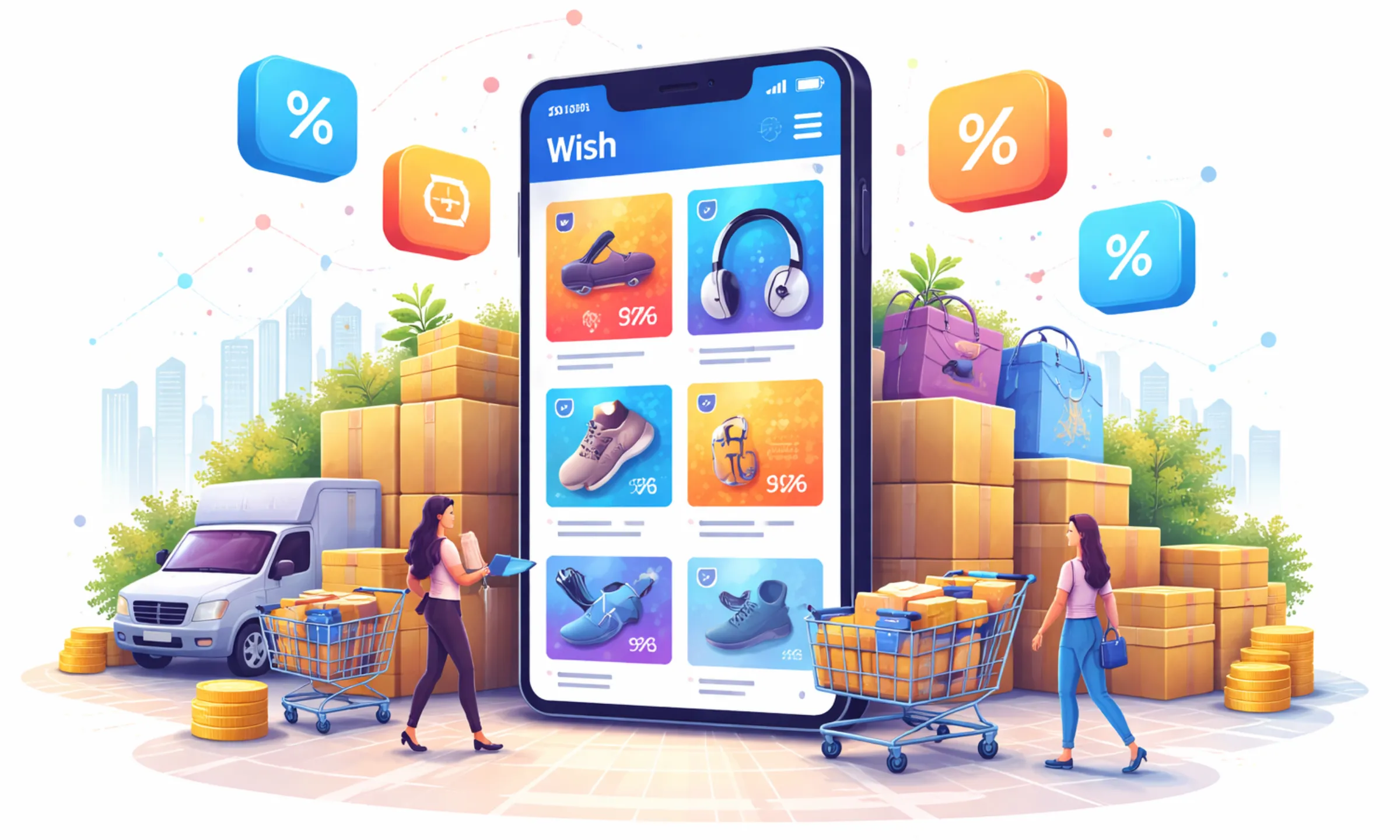
In its peak growth years, Wish evolved from a small product-discovery startup into a global ecommerce platform valued at over $14 billion, reshaping how ultra-low-price shopping could scale across borders. The business model of Wish challenged traditional ecommerce thinking by prioritizing price-sensitive demand over brand trust, speed, or premium experience
What truly set the Wish business model apart was its feed-based, impulse-driven commerce approach. Instead of relying on search, Wish transformed shopping into a scrolling experience similar to social media. Users didn’t arrive with intent; they arrived to explore. This shift redefined how traffic was generated, how pricing competition worked, and how monetization was structured behind the platform.
By 2026, the business model of Wish stands as both a growth success and a strategic lesson. It shows how discount marketplaces scale rapidly, why unit economics and logistics discipline matter, and how growth-first strategies must evolve.
How the Wish Business Model Works
Wish business model is built around a simple but unconventional idea: shopping should feel like scrolling, not searching.
Instead of users typing keywords and comparing brands, Wish turns ecommerce into a discovery-first, impulse-driven experience, powered by algorithms and extreme price competition.
At its core, Wish operates as a global cross-border marketplace connecting low-cost manufacturers—primarily from Asia—with value-focused consumers around the world.
Core Business Model Framework
Type of Model
- Marketplace-based ecommerce platform
- Algorithm-driven product discovery (feed-based)
- Cross-border, factory-to-consumer commerce
- Asset-light (no inventory ownership)
This combination allowed Wish to scale rapidly without the capital intensity of warehousing or last-mile logistics in its early years.
Value Proposition by User Segment
For Consumers
- Ultra-low prices compared to domestic ecommerce platforms
- Endless product variety across categories
- Personalized product feeds based on behavior
- Gamified browsing experience that encourages impulse purchases
For Merchants
- Access to global demand without building their own storefronts
- Performance-based exposure driven by Wish’s algorithm
- Lower upfront costs compared to running independent ecommerce sites
For Wish (Platform Owner)
- Scalable GMV growth without inventory risk
- Monetization through merchant fees and advertising
- Data-driven optimization of demand, pricing, and exposure
Key Stakeholders in the Ecosystem
- Manufacturers & Merchants: Supply products and compete for visibility
- Consumers: Drive demand through engagement and purchases
- Logistics Partners: Enable cross-border shipping at scale
- Payment Providers: Support multi-currency global transactions
- Regulators & Customs Authorities: Influence market access and compliance
The platform’s challenge has always been balancing price, quality, and delivery expectations across these stakeholders.
How the Model Evolved Over Time
Early Phase (2013–2017)
- Growth driven by Facebook and Instagram ads
- Extremely low prices used as viral hooks
- Minimal quality control and long delivery times
Hypergrowth Phase (2018–2021)
- Massive user acquisition across the US and Europe
- IPO in 2020 fueled by pandemic-era ecommerce demand
- Rising customer dissatisfaction due to inconsistent quality and shipping delays
Correction & Repositioning Phase (2022–2026)
- Reduced paid acquisition spend
- Shift toward logistics control and merchant accountability
- Focus on fewer markets with higher operational discipline
Why the Model Still Matters in 2026
Wish’s model works when:
- Consumers are highly price-sensitive
- Discovery beats intent-based search
- Supply-side competition keeps prices low
- Logistics expectations are managed realistically
In 2026, this model is no longer about “cheap products at any cost.”
It is about controlled discount ecosystems, where:
- Data replaces brute-force marketing
- Logistics is integrated earlier
- Merchant quality is algorithmically enforced
This is where modern platform builders must redesign—not replicate—the Wish approach.
Read more : What is Wish and How Does It Work?
Target Market & Customer Segmentation Strategy
Wish did not try to serve everyone.
It deliberately optimized for a specific mindset: users who value price over perfection and enjoy discovery more than efficiency.
This focus shaped every decision—from product design to marketing to monetization.
Primary Customer Segments
1. Value-Driven Consumers (Core Segment)
These users form the backbone of Wish’s demand.
- Highly price-sensitive shoppers
- Comfortable waiting longer for delivery
- Willing to trade brand trust for lower cost
- Strong impulse-buying behavior
Typical characteristics:
- Middle-income or budget-conscious users
- Students, deal hunters, emerging-market consumers
- Users influenced by visual discovery rather than search intent
Why they stay:
They are not looking for reliability—they are looking for surprise value.
2. Casual Discovery Shoppers (Secondary Segment)
These users don’t open Wish to buy something specific.
- Scroll-driven behavior similar to social media
- Low purchase frequency, but high session engagement
- Convert when prices feel “too cheap to ignore”
Wish monetizes this group through:
- Algorithmic retargeting
- Flash pricing and scarcity triggers
Supply-Side Segment: Merchants & Manufacturers
Wish’s supply side is just as important as its buyers.
Merchant Profile
- Price-competitive manufacturers (mainly Asia-based)
- Sellers with thin margins but large production capacity
- Merchants willing to compete aggressively for volume
Why merchants join Wish
- Global reach without branding investment
- Demand generation handled by the platform
- Performance-based exposure instead of fixed shelf space
Customer Journey: Discovery to Retention
Discovery
- Paid social ads (historically)
- App store browsing
- Referral incentives and viral offers
Conversion
- Ultra-low prices as friction breakers
- Visual product cards instead of detailed descriptions
- Gamified discounts and time-limited offers
Retention
- Personalized feeds based on browsing behavior
- Push notifications for price drops and deals
- Habit formation through daily scroll behavior
Wish focused less on brand loyalty and more on habitual engagement.
Market Positioning & Competitive Edge
Wish positioned itself as:
- A discount discovery engine, not a trusted retailer
- An alternative to Amazon’s efficiency model
- A playground for experimentation and impulse buying
Differentiation Strategies
- Feed-based shopping instead of search
- Extreme price transparency
- Algorithm-first merchandising
- Global supply without local inventory
By 2026, this positioning has narrowed but matured. Wish now prioritizes fewer markets, better logistics control, and tighter quality thresholds to protect long-term viability.
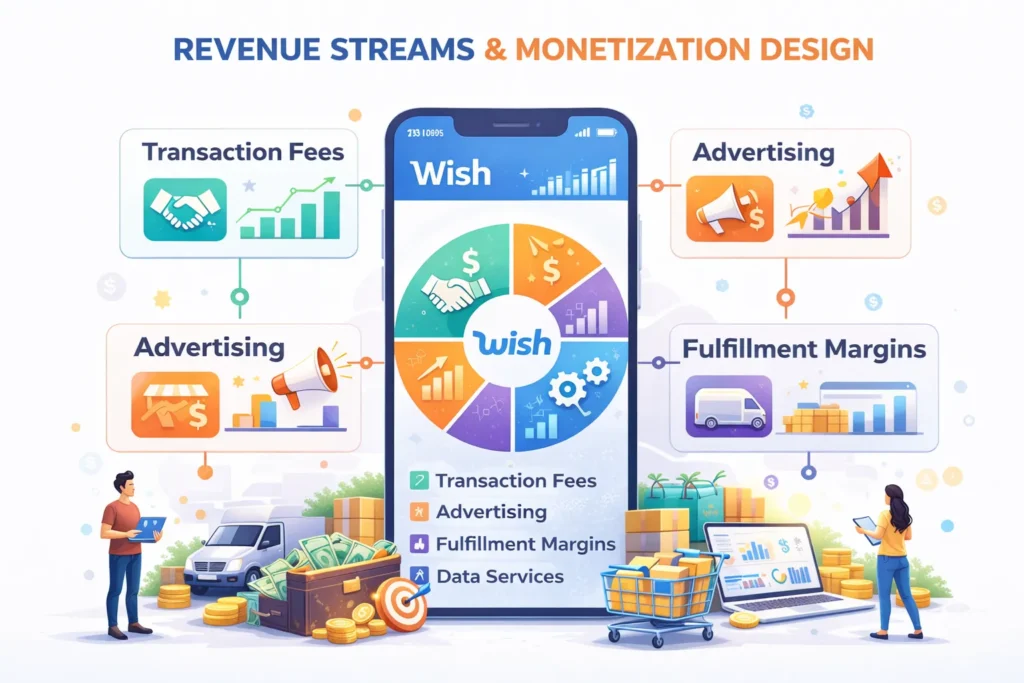
Revenue Streams and Monetization Design
Once Wish built massive traffic and habitual engagement, monetization became a merchant-funded system, not a consumer-taxed one.
The platform’s revenue model was designed to keep prices visibly low for users while extracting value behind the scenes from sellers competing for attention.
Primary Revenue Stream 1: Merchant Transaction Fees (Core Engine)
Mechanism
- Wish charges merchants a commission on every completed sale
- Fees vary by category, region, and merchant performance
Pricing Model (2025–2026)
- Percentage-based commission on order value
- Performance-adjusted fees tied to delivery speed, refunds, and ratings
Revenue Contribution
- Historically the largest and most stable revenue stream
- Directly linked to Gross Merchandise Value (GMV)
Growth Trajectory
- Higher-quality merchants improve repeat purchase rates
- Better logistics reduce refunds, protecting net revenue
- Selective merchant onboarding improves unit economics
This stream works because Wish does not own inventory—every sale scales without balance-sheet risk.
Secondary Revenue Stream 2: Merchant Advertising & Product Boosting
Mechanism
- Merchants pay to boost product visibility inside user feeds
- Exposure is auction-based and algorithmically allocated
Pricing Model
- Cost-per-click (CPC) and performance-based bidding
- Budget-based campaigns for high-volume sellers
Revenue Contribution
- High-margin revenue stream
- Scales with merchant competition, not user fees
Strategic Value
Advertising monetization transforms Wish from a marketplace into a demand-allocation engine, similar to how social platforms monetize attention.
Secondary Revenue Stream 3: Logistics & Fulfillment Margins (Evolving)
Mechanism
- Wish integrates with logistics partners and fulfillment programs
- Merchants opt into Wish-supported shipping solutions
Monetization Logic
- Margins earned on shipping coordination
- Reduced delivery time improves platform trust
This stream became more important post-2022 as Wish tried to regain customer confidence.
Secondary Revenue Stream 4: Data & Performance Services
Mechanism
- Merchants gain access to performance insights and optimization tools
- Data-driven recommendations for pricing, inventory, and promotion
Value
- Increases merchant dependence on the platform
- Improves GMV per seller
How the Monetization System Works Together
Wish’s monetization strategy is layered:
- Transactions generate baseline revenue
- Advertising amplifies margins
- Logistics improves retention and reduces churn
- Data tools increase merchant lifetime value
The psychology is subtle:
- Consumers feel they are always “getting a deal”
- Merchants pay for growth, visibility, and access—not shelf space
This keeps the user experience price-focused while allowing the platform to monetize at scale.
Read more : Wish Revenue Model: How Wish Makes Money in 2026
Operational Model & Key Activities
Wish’s operational model is where its biggest strengths—and weaknesses—were exposed.
Running a global discount marketplace is not just about demand generation. It is about controlling chaos at scale.
Behind the simple scrolling interface sits a complex operational machine designed to balance cost, quality, and speed.
Core Daily Operations
Platform & Technology Management
- Algorithm-driven product ranking and personalization
- Fraud detection and merchant quality scoring
- Pricing optimization based on conversion data
Merchant Operations
- Seller onboarding and compliance checks
- Performance monitoring (delivery times, refunds, ratings)
- Automated penalties and visibility suppression for poor performers
Customer Support & Trust
- Refund processing and dispute resolution
- Review and feedback systems
- Policy enforcement to protect marketplace credibility
Marketing Operations
- Lifecycle-based push notifications
- Retargeting and price-drop alerts
- Reduced dependence on paid acquisition post-2022
Resource Allocation Strategy (2025–2026)
Wish restructured its spending after years of aggressive growth.
Technology & Infrastructure
- Heavy investment in data science and ML systems
- Backend optimization to handle feed personalization at scale
Logistics & Quality Control
- Increased budget for delivery predictability
- Tighter merchant logistics requirements
Marketing Spend
- Shift from mass paid ads to retention-focused engagement
- Emphasis on unit economics over raw user growth
Human Resources
- Leaner teams with focus on engineering, compliance, and operations
- Reduced experimental spend compared to pre-IPO years
Why Operations Define Success for This Model
In a discount marketplace:
- Poor operations destroy trust faster than high prices
- One bad experience outweighs five cheap wins
- Logistics quality directly impacts retention
By 2026, Wish’s survival depends less on clever marketing and more on operational discipline—a lesson many founders underestimate.
For entrepreneurs building Wish-like platforms today, the real innovation is not the feed—it is the infrastructure underneath it.
Read more : Best Wish Clone Scripts 2025: Build a High-Profit Social Commerce App
Strategic Partnerships & Ecosystem Development
Wish’s ecosystem was never designed to be a closed system.
Its scale depended on external partners that could extend reach, reduce cost, and absorb operational complexity.
Over time, partnerships shifted from growth acceleration to stability and control.
Collaboration Philosophy
In its early years, Wish prioritized speed over structure:
- Onboard as many merchants as possible
- Use third-party logistics extensively
- Rely on external ad platforms for growth
By 2026, the philosophy evolved to:
- Fewer, higher-quality partners
- Deeper operational integration
- Shared accountability for customer experience
This shift marks the transition from experimentation to sustainability.
Key Partnership Categories
Technology & API Partners
- Cloud infrastructure providers for scalability
- Data and analytics tools for personalization
- Fraud detection and compliance platforms
Payment & Financial Partners
- Global payment gateways for multi-currency support
- Local payment options in emerging markets
- Risk and chargeback management partners
Logistics & Fulfillment Alliances
- Cross-border shipping providers
- Regional last-mile delivery partners
- Consolidation hubs to reduce delivery time
These partnerships directly affect customer satisfaction and repeat purchase behavior.
Marketing & Distribution Partners
- App stores and OEM partnerships
- Affiliate and referral ecosystems
- Limited influencer collaborations (post-hypergrowth)
Regulatory & Market Access Partners
- Customs and compliance consultants
- Local regulatory advisors in key regions
- Trade and import facilitation partners
Ecosystem Strategy Insights
Wish’s ecosystem strategy relies on network effects with accountability:
- Merchants gain demand but accept performance enforcement
- Partners gain volume but must meet service-level standards
- The platform monetizes coordination, not ownership
Strategic partnerships create:
- Operational moats that are hard to replicate quickly
- Cost advantages through scale negotiations
- A defensible ecosystem beyond just low prices
For founders, the takeaway is clear:
Platforms do not scale alone. They scale through systems of aligned incentives.
Growth Strategy & Scaling Mechanisms
Wish’s growth story is one of the most aggressive—and instructive—scaling experiments in consumer tech.
It shows how fast a platform can grow when demand, pricing, and algorithms align—and how fragile that growth can be without operational balance.
Primary Growth Engines
1. Paid User Acquisition (Early Hypergrowth)
- Heavy reliance on Facebook and Instagram ads
- Algorithmic creative testing at massive scale
- Ultra-low prices used as conversion hooks
This engine allowed Wish to acquire users globally at unprecedented speed—but at rising cost.
2. Algorithmic Virality & Habit Formation
- Feed-based product discovery mimicking social media
- Personalized recommendations increasing session time
- Push notifications driving repeat engagement
Wish didn’t need users to refer friends.
It needed them to open the app daily.
3. Merchant-Led Expansion
- New merchants introduced new categories
- More competition lowered prices, increasing demand
- Supply expansion fueled demand expansion
This flywheel worked until quality and logistics fell behind.
4. Geographic Expansion Model
- Rapid entry into price-sensitive markets
- Minimal localization in early phases
- Focus on volume before optimization
By 2026, Wish reversed this approach—exiting underperforming markets and concentrating on regions with sustainable unit economics.
Scaling Challenges & How Wish Responded
Challenge: Rising Customer Dissatisfaction
- Long delivery times
- Product quality inconsistency
- High refund rates
Response
- Merchant performance scoring
- Logistics partnerships and fulfillment programs
- Reduced low-quality seller exposure
Challenge: Unsustainable Marketing Costs
- Increasing ad competition
- Lower post-install engagement
Response
- Slashed paid acquisition spend
- Shifted focus to retention and profitability
- Rebuilt growth around operational efficiency
Challenge: Regulatory Pressure
- Consumer protection scrutiny
- Import and customs compliance
Response
- Stronger compliance frameworks
- Region-specific operational controls
Key Insight on Scaling
Wish proved that:
- Growth without control is temporary
- Algorithms amplify both strengths and weaknesses
- Sustainable scale requires sequencing, not speed
Founders should note: the most dangerous phase is not launch—it is hypergrowth without infrastructure.
Competitive Strategy & Market Defense
Wish operates in one of the most competitive environments in digital commerce, facing pressure from Amazon, Temu, AliExpress, Shein, and emerging regional marketplaces. Its survival has depended on choosing where to compete—and where not to.
Core Competitive Advantages
Network Effects
- More merchants increase price competition
- Lower prices attract more users
- More user data improves personalization algorithms
This loop is powerful but fragile if quality drops.
Algorithm-Driven Personalization
- Feed-based discovery replaces search dependency
- Behavioral data determines product exposure
- Faster feedback loops than traditional marketplaces
Wish competes on attention optimization, not assortment depth.
Cost Leadership Positioning
- Factory-direct supply chains
- Minimal branding and packaging overhead
- Price anchoring that reframes consumer expectations
This positions Wish as a price reference point in discount commerce.
Data & Experimentation Culture
- Continuous A/B testing on pricing, UI, and offer
- Rapid iteration across markets
- Automated enforcement of merchant performance
Market Defense Tactics
Against New Entrants
- Scale-based price compression
- Data advantages in demand prediction
- Merchant lock-in through performance history
Against Price Wars
- Algorithmic visibility control instead of blanket discounts
- Selective promotions rather than site-wide sales
Against Platform Substitution
- Focus on impulse discovery, not planned shopping
- Habit-based engagement instead of brand loyalty
Strategic Adjustments in 2026
Wish no longer tries to beat Amazon on trust or Temu on logistics speed.
Instead, it defends a narrow but defensible lane:
- Discovery-first discount shopping
- Controlled marketplace scope
- Profitability over vanity metrics
The lesson is clear:
Winning does not always mean dominating—it often means surviving intelligently.
Lessons for Entrepreneurs & Implementation
This is where Wish’s story becomes most valuable for founders.
Not as a model to copy blindly—but as a system to extract principles from
Why Wish Succeeded (and Where It Struggled)
Success Drivers
- Clear focus on price-sensitive demand
- Discovery-first UX that changed shopping behavior
- Aggressive use of data and algorithms
- Asset-light marketplace structure
Where It Broke
- Underestimating logistics and quality control
- Over-reliance on paid acquisition
- Scaling faster than operational maturity
- Delayed shift toward profitability
Replicable Principles for Startups
Entrepreneurs can adapt Wish’s ideas without inheriting its risks:
- Use feeds and personalization to drive discovery
- Compete on one core advantage (price, speed, or niche depth)
- Let merchants fund growth through performance-based fees
- Design monetization that stays invisible to users
Common Mistakes to Avoid
- Chasing scale before unit economics
- Ignoring post-purchase experience
- Assuming low price alone builds loyalty
- Expanding globally without localization
Adapting the Model for Local or Niche Markets
Modern founders should:
- Focus on regional supply chains instead of global sprawl
- Apply stricter merchant onboarding from day one
- Combine discount discovery with trust signals
- Integrate logistics earlier in the platform lifecycle
Implementation Timeline & Investment Priorities
Phase 1
- Validate demand and pricing sensitivity
- Build feed-based discovery MVP
- Onboard pilot merchants
Phase 2
- Introduce performance scoring
- Add basic logistics integration
- Launch merchant monetization
Phase 3
- Optimize retention and repeat purchases
- Expand categories selectively
- Improve automation and data depth
Ready to implement Wish’s proven business model for your market?
Miracuves builds scalable platforms with tested business models and growth mechanisms. We’ve helped 200+ entrepreneurs launch profitable apps.
Get your free business model consultation today.
Conclusion :
Wish’s journey proves a powerful truth about platform businesses in 2026:
innovation alone is not enough—execution decides survival.
The company showed the world that ecommerce does not have to start with trust, brands, or logistics dominance. It can start with attention, price discovery, and behavioral design. For a period, that insight reshaped global commerce and forced incumbents to rethink how consumers discover products.
But Wish also demonstrated the limits of growth without discipline. Algorithms can scale demand instantly, yet trust, delivery reliability, and operational excellence scale much slower. When those foundations lag, even the most creative business model begins to fracture. As platform economies evolve beyond 2026, the winners will not be those who grow the fastest—but those who sequence growth, infrastructure, and trust at the right time.
FAQs
What type of business model does Wish use?
Wish uses a marketplace-based, discovery-driven ecommerce model where users browse personalized product feeds instead of searching.
How does the Wish business model create value?
It delivers ultra-low prices to consumers while giving merchants global reach and algorithm-driven product visibility.
What are Wish’s key success factors?
Feed-based discovery, extreme price competitiveness, data-driven personalization, and an asset-light marketplace structure.
How scalable is the Wish business model?
The model scales quickly on demand but requires strong logistics and merchant controls to remain sustainable.
What are the biggest challenges in this model?
Maintaining product quality, managing delivery timelines, controlling refunds, and preserving customer trust at scale.
How can entrepreneurs adapt Wish’s model to their region?
Focus on local suppliers, stricter seller onboarding, faster logistics, and category-level specialization.
What are alternatives to the Wish business model?
Search-based marketplaces, vertical niche platforms, social commerce apps, and subscription-led ecommerce models.
How has Wish’s business model evolved over time?
Wish shifted from growth-first expansion to a controlled discount ecosystem with better logistics and merchant accountability.
Related Article :
- What Is Shopee and How Does It Work?
- What is Vinted and How Does It Work?
- Best Shein Clone Scripts 2025 – Build Your Global Fashion App Fast
- Best Pinduoduo Clone Scripts 2025 for Social Shopping & Group-Buying Marketplaces
- Best Newegg Clone Scripts 2025: Build a High-Performance Electronics Marketplace