



You’ve probably heard the horror stories—ride-hailing apps leaking location data, payment breaches exposing users, or platforms getting fined for compliance failures. In 2025, these risks aren’t rare incidents anymore—they’re business-ending mistakes.
A white-label Careem app can help you launch fast, but speed without security is dangerous. When your app handles real-time location tracking, driver identities, and payments, safety is no longer optional—it’s foundational.
In this guide, we’ll give you an honest, no-hype assessment of white-label Careem app security. You’ll learn where real risks exist, what standards actually matter in 2025, and how to build a ride-hailing app that users, regulators, and payment partners can trust.
At the end, you’ll also see how Miracuves approaches white-label app security differently—security-first, compliant by design, and enterprise-ready from day one.
Understanding White-Label Careem App Security Landscape
What White-Label Careem App Security Actually Means
White-label security is not just about adding SSL or hiding source code. In a white-label Careem app, security means protecting every layer of the system—user data, driver data, live location tracking, payment flows, and backend infrastructure—while allowing the app to be rebranded and customized safely.
A secure white-label Careem app must ensure:
- User identities cannot be exposed or misused
- Real-time location data is encrypted and access-controlled
- Payments are processed without storing sensitive card data
- Drivers and riders are authenticated properly
- APIs cannot be abused or reverse-engineered
Security is not a feature—it is the architecture
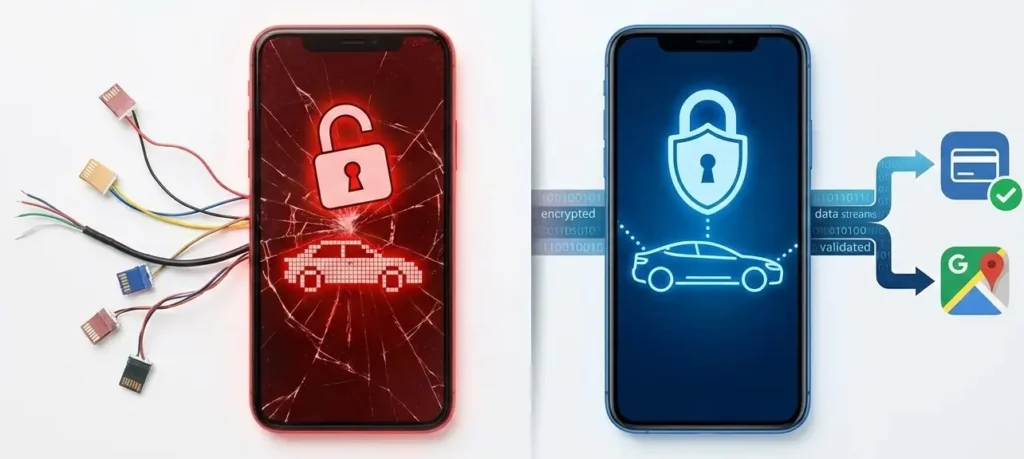
Why People Worry About White-Label Careem Apps
Concerns around white-label Careem apps are valid because these platforms handle:
- Continuous GPS location tracking
- Sensitive personal identification data
- Driver background information
- High-frequency payment transactions
Any weakness can lead to stalking risks, financial fraud, regulatory penalties, or loss of user trust.
Current Threat Landscape for Ride-Hailing Platforms
In 2025, ride-hailing apps face targeted attacks, including:
- API abuse to scrape user and driver data
- Man-in-the-middle attacks on location updates
- Payment interception attempts
- Fake driver or rider account creation
- Admin panel takeover due to weak authentication
Ride-hailing platforms are now classified as high-risk applications by many compliance and insurance providers due to real-time mobility data exposure.
Security Standards That Matter in 2025
Modern white-label Careem apps must align with:
- Zero-trust architecture principles
- Data minimization and encryption-by-default
- Role-based access control across dashboards
- Mandatory audit logging
- Region-aware data storage policies
Security is no longer about “best effort”—it’s about provable compliance.
Real-World App Security Statistics
Recent industry data shows:
- A significant share of mobility app breaches originate from insecure APIs
- Location data leaks carry higher regulatory penalties than email or profile data breaches
- Payment-related incidents cause the fastest user churn in ride-hailing apps
This is why regulators, insurers, and investors now demand documented security practices before platform approval.
Key Security Risks & How to Identify Them
Data Protection & Privacy Risks
- A white-label Careem app processes highly sensitive data every second. If data protection is weak, the consequences go far beyond technical issues.
- User personal information includes names, phone numbers, ride history, and home locations. If this data is stored without encryption or proper access control, it becomes an easy target for attackers.
- Payment data security is another critical area. Storing card details directly on servers instead of using tokenized gateways increases breach risk and violates PCI DSS requirements.
- Location tracking is the most sensitive element of a ride-hailing app. Continuous GPS data can reveal daily routines, workplaces, and private addresses. If location data is not encrypted in transit and at rest, it creates serious safety and legal risks.
- Privacy compliance failures related to GDPR and CCPA often happen due to missing consent logs, unclear data retention policies, or lack of user data deletion mechanisms.
Technical Vulnerabilities
- Code quality issues are one of the most overlooked risks. Poorly written or reused code without audits often contains hardcoded keys, weak authentication logic, or insecure data handling.
- Server security gaps arise when cloud infrastructure is misconfigured. Open ports, exposed admin panels, or weak firewall rules can allow unauthorized access.
- API vulnerabilities are a major attack vector in ride-hailing apps. APIs that do not enforce rate limiting, authentication, or request validation are easily abused to extract data.
- Third-party integrations such as maps, notifications, and analytics can introduce risks if they are not properly sandboxed or monitored.
Business & Operational Risks
- Legal liability increases when a breach exposes user or driver data. In many regions, platform owners are directly responsible, regardless of who built the app.
- Reputation damage spreads quickly in mobility platforms. One security incident can permanently reduce user trust and driver onboarding rates.
- Financial losses include regulatory fines, legal fees, compensation payouts, and loss of partnerships with payment providers.
- Regulatory penalties for location data misuse or payment non-compliance are significantly higher than general data breaches.
Risk Assessment Checklist
A white-label Careem app should be flagged as high risk if:
- Location data is not encrypted end-to-end
- Payment information is stored instead of tokenized
- APIs lack authentication or rate limits
- Admin dashboards do not use multi-factor authentication
- No audit logs are available for sensitive actions
- Data deletion and consent management are unclear
Read more : – Business Model of Careem : Complete Strategy Breakdown 2025
Security Standards Your White-Label Careem App Must Meet
Essential Security Certifications
A white-label Careem app operating in 2025 must meet globally accepted security and compliance standards. These are not optional badges—they are minimum trust requirements demanded by regulators, payment partners, and insurers.
- ISO 27001 ensures that the app follows a structured information security management system. It covers data handling, access control, risk management, and incident response.
- SOC 2 Type II focuses on how securely systems operate over time. It validates controls around security, availability, confidentiality, and data integrity, which is critical for real-time ride-hailing platforms.
- GDPR compliance is mandatory if the app serves users in the EU or processes EU citizen data. This includes consent tracking, right-to-erasure, and strict breach notification timelines.
- HIPAA becomes relevant if the app integrates medical transport, emergency services, or health-related ride programs.
- PCI DSS compliance is mandatory for handling payments. A secure Careem app should never store raw card data and must rely on certified payment gateways.
Core Technical Security Requirements
- End-to-end encryption is essential for protecting ride data, messages, and location updates. Data must be encrypted both in transit and at rest.
- Secure authentication mechanisms such as OAuth 2.0, JWT tokens, and multi-factor authentication are required for users, drivers, and administrators.
- Regular security audits help identify vulnerabilities before attackers do. These audits should be scheduled and documented.
- Penetration testing simulates real-world attacks on APIs, mobile apps, and backend systems to expose weak points.
- SSL certificates and HTTPS enforcement are mandatory across all endpoints, including admin dashboards and APIs.
- Secure API design includes authentication, request validation, rate limiting, and version control to prevent abuse.
Security Standards Comparison Overview
A compliant white-label Careem app should meet the following baseline:
- Data encryption: Mandatory for all user, driver, and location data
- Payment handling: PCI DSS-compliant gateways only
- Authentication: Multi-factor for admin, token-based for users
- Monitoring: Real-time logging and alerting
- Compliance: GDPR by default, regional extensions as needed
If any of these are missing, the app carries elevated operational and legal risk.
Read more : – Careem App Marketing Strategy: How It Grew Across the Middle East
Red Flags – How to Spot Unsafe White-Label Providers
Warning Signs You Should Never Ignore
One of the biggest mistakes founders make is assuming all white-label Careem app providers follow the same security standards. In reality, unsafe providers often reveal themselves early—if you know what to look for.
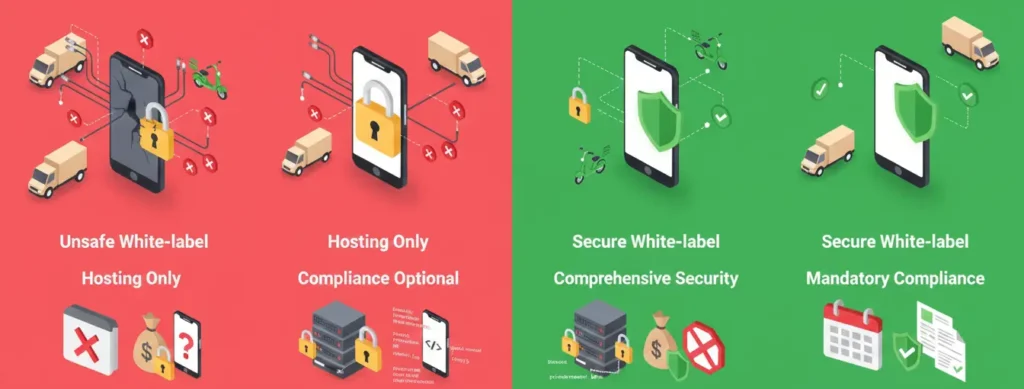
- No security documentation is a major red flag. If a provider cannot clearly explain how data is stored, encrypted, and accessed, security has not been taken seriously.
- Unrealistically cheap pricing without technical justification usually means security shortcuts. Proper encryption, audits, and compliance cost money and time.
- Lack of compliance certifications such as ISO 27001, GDPR readiness, or PCI DSS alignment indicates the app is not enterprise-ready.
- An outdated technology stack increases vulnerability exposure. Old frameworks and unpatched libraries are common entry points for attackers.
- Poor code quality often shows up as slow performance, bugs, or unstable features. These are not just usability issues—they are security risks.
- No defined security update policy means vulnerabilities may remain unpatched for months, leaving the app exposed.
- Absence of automated backups or disaster recovery planning puts the entire platform at risk in case of system failure or ransomware attacks.
- No insurance coverage for cyber incidents increases your financial exposure if a breach occurs.
Evaluation Checklist for White-Label Careem App Providers
Before selecting a provider, you should demand clear answers to these questions:
- How is user, driver, and location data encrypted?
- What authentication methods are used for users, drivers, and admins?
- How often are security audits and penetration tests conducted?
- Which compliance standards does the app currently meet?
- How are third-party integrations secured and monitored?
Documents you should request include:
- Security architecture overview
- Compliance certificates or audit reports
- Data protection and privacy policy templates
- Incident response and breach notification process
Testing and due diligence steps should include:
- API security testing
- Admin panel access review
- Payment flow validation
- Data deletion and consent workflow checks
If a provider hesitates or avoids these discussions, it is a clear sign to walk away.
Best Practices for Secure White-Label Careem App Implementation
Pre-Launch Security Foundations
- Security must be established before the app goes live. Most ride-hailing security failures happen because teams rush to launch without validating their security stack.
- A structured security audit should be conducted on the mobile apps, backend services, and admin dashboards. This helps uncover weak authentication logic, exposed APIs, and insecure data flows.
- Code review is critical in a white-label Careem app because reused modules must still be validated. Every payment, location, and identity-related function should be reviewed for secure handling.
- Infrastructure hardening includes firewall configuration, private network isolation, database access restrictions, and secure cloud permissions. Open environments are a common breach entry point.
- Compliance verification must be completed before launch. GDPR consent flows, privacy policies, and data retention rules should be tested in real user scenarios.
- Staff training is often ignored. Admins and support teams must understand access control, phishing risks, and incident escalation procedures.
Post-Launch Security Monitoring
- Launching the app is not the end of security—it is the beginning.
- Continuous security monitoring is required to detect unusual login attempts, API abuse, and abnormal ride activity. Automated alerts reduce response time during incidents.
- Regular updates and patches must be applied to both app code and infrastructure. Delayed updates are one of the leading causes of security breaches.
- An incident response plan should be documented and tested. This includes breach identification, containment steps, user notification timelines, and regulatory reporting.
- User data management must be enforced continuously. Access logs, data minimization, and retention controls protect both users and the business.
- Backup and recovery systems should be automated and tested. Encrypted backups ensure the platform can recover quickly without data loss after failures or attacks.
Security Implementation Timeline
A secure white-label Careem app implementation typically follows this sequence:
- Initial security audit and architecture review
- Infrastructure and API hardening
- Compliance validation and documentation
- Pre-launch penetration testing
- Live monitoring and alert activation
- Scheduled audits and update cycles
Security is not a one-time setup—it is an operational discipline.
Legal & Compliance Considerations
Regulatory Requirements by Region
Operating a white-label Careem app means complying with multiple legal frameworks, depending on where your users and drivers are located.
Data protection laws such as GDPR in Europe and CCPA in California require explicit user consent, transparent data usage policies, and the ability to delete user data on request. Failure to comply can result in heavy fines and forced platform shutdowns.
In regions like the Middle East and Asia, local data residency laws may require certain user data to be stored within national borders. Ignoring these rules can block app operations entirely.
Payment regulations mandate the use of PCI DSS-compliant gateways. Direct handling of card data without certification exposes the business to financial penalties and loss of payment partners.
Ride-hailing apps may also be subject to transport authority regulations, requiring secure driver verification, background checks, and audit trails.
User Consent & Privacy Management
A secure white-label Careem app must clearly explain:
- What data is collected
- Why the data is required
- How long it is retained
- Who has access to it
Users must be able to withdraw consent, request data deletion, and access their stored information. These processes must be built into the app—not handled manually.
Privacy policies and terms of service should be updated regularly to reflect regulatory changes and new features.
Liability Protection for Platform Owners
- Legal responsibility ultimately rests with the app owner, not the development provider.
- Cyber insurance coverage is strongly recommended. It helps cover breach response costs, legal fees, user compensation, and regulatory penalties.
- Clear user agreements limit liability by defining acceptable use, dispute resolution, and data responsibility boundaries.
- Incident reporting protocols must be in place to meet regulatory timelines, especially under GDPR, which requires notification within strict time limits.
- Ongoing compliance monitoring ensures the app remains aligned with changing regulations and avoids unexpected violations.
Compliance Checklist Overview
A legally compliant white-label Careem app should include:
- Region-specific data protection compliance
- Documented consent management
- Secure driver and user verification processes
- Incident response and reporting workflows
- Regular legal and security reviews
Why Miracuves White-Label Careem App Is Your Safest Choice
Miracuves Security-First Architecture
At Miracuves, security is not added after development—it is built into the foundation of every white-label Careem app we deliver.
Our architecture is designed around zero-trust principles, ensuring that every request, user, driver, and admin action is verified, logged, and controlled. Sensitive data such as location updates, ride history, and user identities are encrypted by default.
Enterprise-Grade Compliance Built In
Miracuves white-label Careem apps are engineered to meet modern compliance expectations from day one.
Our platforms align with ISO 27001 information security practices and follow SOC 2–aligned operational controls. GDPR and CCPA requirements are integrated into data flows, consent management, and user rights handling by default.
Payment processing is handled through PCI DSS-compliant gateways, ensuring that sensitive financial data never touches insecure systems.
Continuous Monitoring & Protection
Security does not stop at launch. Miracuves implements continuous monitoring across infrastructure, APIs, and admin panels to detect and respond to threats in real time.
Regular security audits, penetration testing, and patch management ensure vulnerabilities are identified and resolved before they can be exploited.
Encrypted backups and disaster recovery systems protect your business from data loss, ransomware, and operational downtime.
Proven Track Record You Can Trust
Miracuves has delivered 600+ successful white-label platforms across mobility, fintech, and marketplace industries. Our solutions have maintained a strong security record with no major publicly reported breaches across deployed platforms.
This reliability is why enterprises, startups, and regional operators trust Miracuves for mission-critical platforms.
Final Thought
Don’t compromise on security. Miracuves white-label Careem app solutions come with enterprise-grade protection built in. With a security-first approach, regulatory compliance by default, and continuous monitoring, we help you launch with confidence. Get a free security assessment today and see why businesses choose Miracuves for safe, compliant ride-hailing platforms.
The real risk is not choosing a white-label app—it’s choosing one without a security-first foundation. When security, compliance, and monitoring are treated as core infrastructure, a white-label Careem app can be just as safe, scalable, and reliable as any enterprise platform.
FAQs
1. How secure is a white-label Careem app compared to custom development?
A white-label Careem app can be equally secure or more secure than custom development when built with audited code, encryption, and compliance-ready architecture. Security depends on implementation quality, not development approach.
2. What happens if there is a security breach?
A secure app must have an incident response plan that includes immediate containment, investigation, user notification, and regulatory reporting within required timelines.
3. Who is responsible for security updates?
The platform owner is legally responsible, but a reliable white-label provider like Miracuves handles regular security patches, updates, and vulnerability fixes.
4. How is user data protected in a white-label Careem app?
User data is protected through encryption at rest and in transit, strict access control, audit logs, and data minimization policies.
5. What compliance certifications should I look for?
ISO 27001, GDPR readiness, PCI DSS compliance for payments, and SOC 2–aligned controls are essential for ride-hailing apps.
6. Can a white-label Careem app meet enterprise security standards?
Yes. With proper architecture, audits, and monitoring, a white-label Careem app can fully meet enterprise-grade security requirements.
7. How often should security audits be conducted?
Security audits and penetration testing should be conducted at least annually, with continuous monitoring in between.
8. What is included in Miracuves’ security package?
Miracuves provides encrypted infrastructure, compliance-ready architecture, regular audits, secure payments, continuous monitoring, and incident response support.
9. How is security handled across different countries?
The app follows region-specific data protection laws, data residency rules, and localized compliance requirements.
10. What insurance is needed for app security?
Cyber liability insurance is recommended to cover breach response costs, legal expenses, and regulatory