
Key Takeaways
What You’ll Learn
- Careem works as a super app by combining rides, food, groceries, delivery, and payments in one platform.
- The user flow is simple with signup, booking, tracking, payment, and review steps.
- Captains and merchants are part of the same ecosystem through onboarding and service fulfillment.
- Localization is a major reason for success through cash payments, regional language support, and market-fit services.
- Careem earns through multiple revenue streams instead of depending only on rides.
Stats That Matter
- The article describes Careem as a super app serving rides, food, groceries, courier services, and digital payments.
- It highlights 50M+ active users, 2.5M captains, 13 countries, and 100+ cities.
- The guide notes around 48% ride-hailing market share in MENA and nearly 80M monthly active transactions.
- It explains revenue through ride commissions, food commissions, delivery margins, Careem Pay fees, and business partnerships.
- Miracuves positions a Careem-style launch in 6 days with rides, food, pay, and delivery modules.
Real Insights
- Careem’s strength comes from convenience because one app solves multiple daily needs.
- Regional fit matters because Careem grew with cash options, Arabic support, and local pricing logic.
- Trust features improve adoption through OTP verification, real-time tracking, chat, ratings, and safety controls.
- Multi-service monetization makes the business stronger than a single-service transport app.
- Long-term growth depends on service variety, localization, and operational efficiency.
Imagine you’re in Dubai on a hot afternoon — you open an app, book a ride within seconds, get groceries delivered, and even send money to a friend — all in one place. That’s the power of Careem, the Middle East’s homegrown super app that inspired many entrepreneurs to build their own Careem clone platforms, offering similar multi-service convenience and digital freedom.
Careem began in 2012 as a simple ride-hailing platform co-founded by Mudassir Sheikha and Magnus Olsson, aiming to make transportation in the Middle East reliable and convenient. Over time, it evolved into a super app — offering not just rides but also food delivery, grocery shopping, bike rentals, and digital payments.
In 2020, Uber acquired Careem for $3.1 billion, yet it continues to operate independently, expanding its super-app vision across 100+ cities in 13 countries. As of 2025, Careem has over 50 million users, 2.5 million captains (drivers), and growing fintech and delivery verticals that make it one of the region’s most influential digital ecosystems.
What is Careem? The Simple Explanation
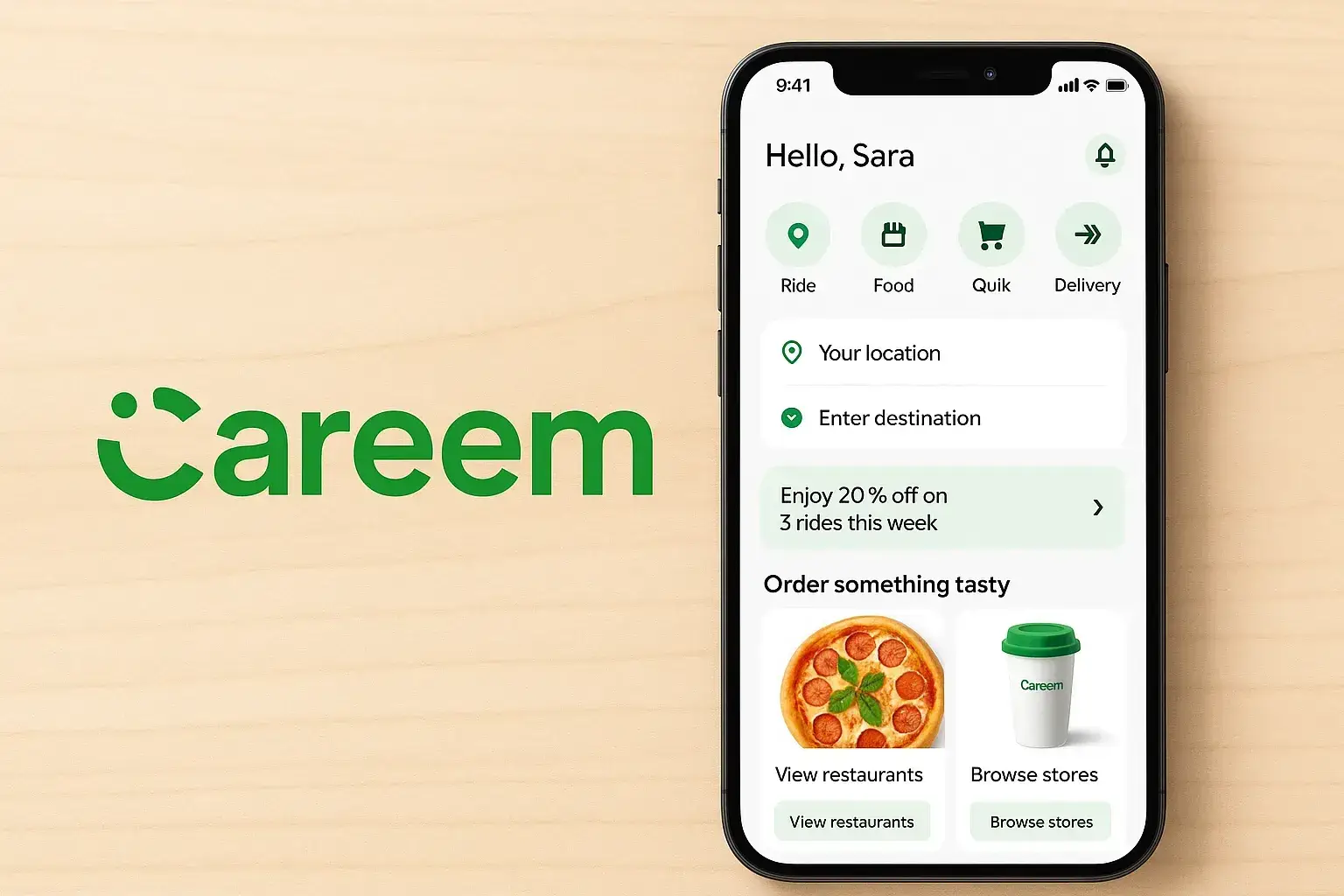
Careem is a super app that combines multiple services — ride-hailing, food delivery, grocery shopping, courier services, and digital payments — into one unified platform. Think of it as the “Middle Eastern version of Grab or Gojek,” designed to simplify everyday life in one tap.
Core Problem It Solves
Before Careem, transportation and local delivery in many MENA and South Asian cities were fragmented and unreliable. Careem solved this by offering on-demand rides and deliveries powered by GPS tracking, verified drivers (“Captains”), and real-time support — all localized for the region’s languages, payment systems, and regulations.
Target Users and Use Cases
- Commuters: Book rides (cars, bikes, or taxis) for daily travel
- Food Lovers: Order meals from nearby restaurants
- Households: Get groceries, pharmacy, and daily essentials delivered
- Businesses: Use Careem for logistics, payments, and fleet management
- Individuals: Send money or packages easily via Careem Pay and delivery options
Current Market Position (2025 Stats)
- Active Users: 50M+
- Captains (Drivers): 2.5M+
- Countries: 13
- Cities Covered: 100+
- Market Share: ~48% of ride-hailing in the MENA region
- Monthly Active Transactions (2025): 80M+
- Key Competitors: Uber (parent), Bolt, and local startups like InDrive
Why It Became Successful
Careem succeeded by deeply understanding regional needs — offering cash and wallet payments, Arabic-language support, and localized pricing. Its trust-driven ecosystem, along with features like Careem Rewards and Careem Pay, helped it scale fast and earn brand loyalty across emerging markets.
Read more: Careem App Marketing Strategy: How It Grew Across the Middle East
How Does Careem Work? Step-by-Step Breakdown
The Careem app is designed to make daily life simpler — whether you’re booking a ride, ordering food, or sending money. Here’s how it works for users, captains, and on a technical level.
For Users (Customers)
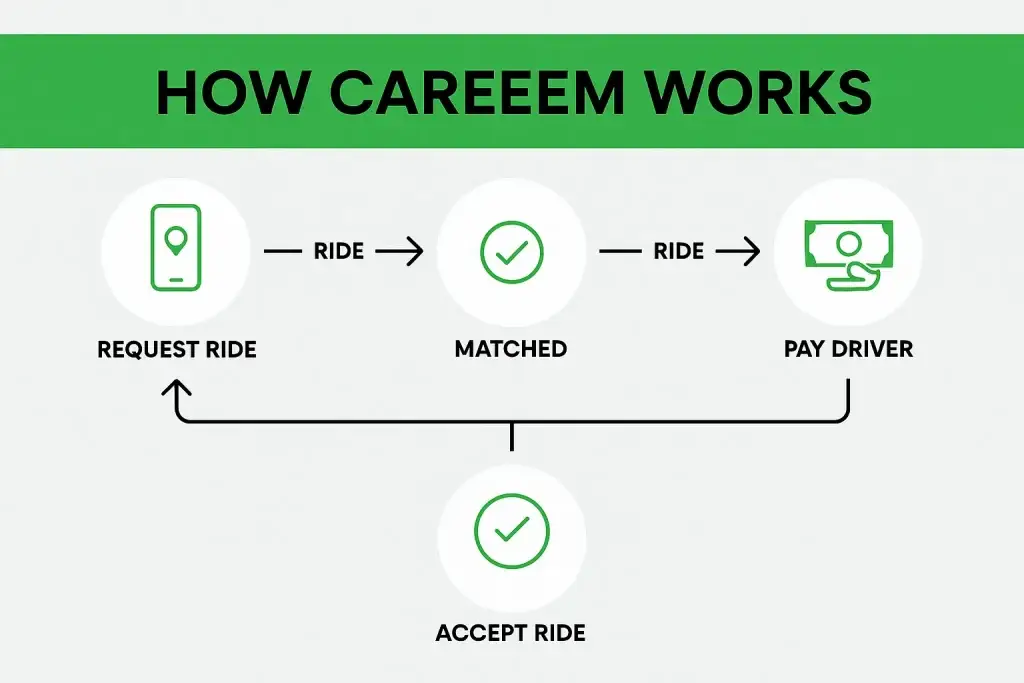
1. Account Creation
Users sign up using their mobile number or email, verify via OTP, and set up basic details like preferred payment method (cash, card, or Careem Pay wallet).
2. Booking a Ride or Service
- Open the Careem app and choose a service: Ride, Food, Quik (groceries), Delivery, or Pay.
- Set pickup and drop-off locations or delivery address.
- Choose vehicle type (Go, Business, Bike, Hala Taxi, etc.).
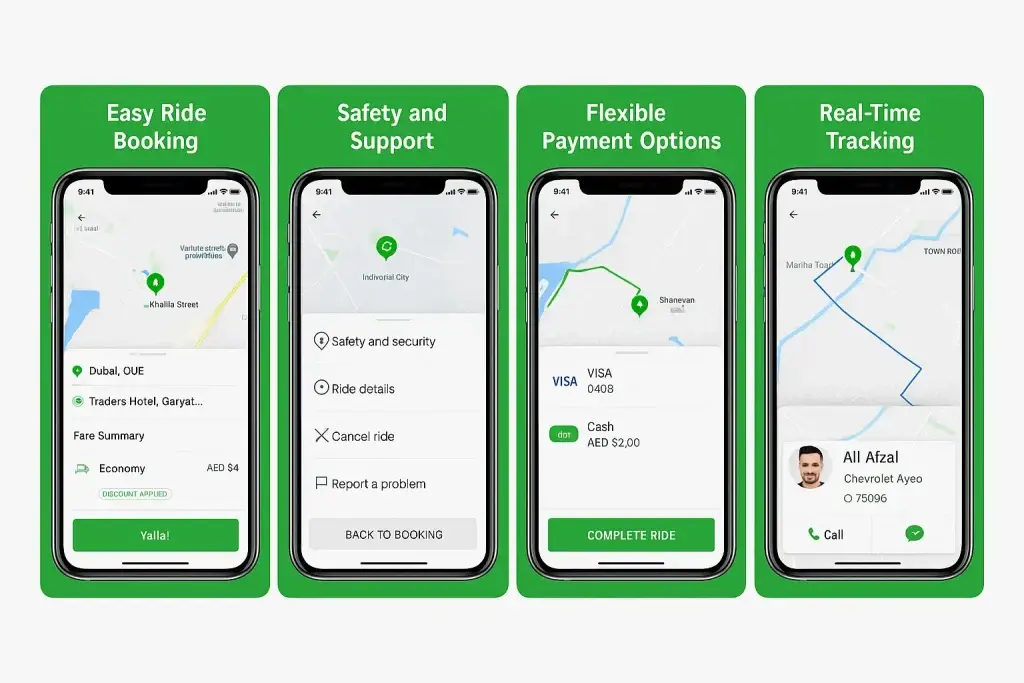
- Confirm the fare estimate and tap “Yalla!” (Let’s Go) to book.
3. Tracking and Completion
- Track your driver or order in real time.
- Communicate via in-app chat or call.
- Pay via cash, card, or wallet once the ride/delivery is completed.
- Rate and review the experience.
Sara books a “Careem Go” ride from Downtown Dubai to Dubai Mall. The app shows her fare, vehicle details, and driver ETA — all in under 30 seconds.
For Service Providers (Captains & Merchants)
1. Onboarding
Captains (drivers) register through the Careem Captain app, submitting their license, vehicle documents, and ID verification. Once approved, they can accept ride or delivery requests.
2. Operation & Earnings
- Captains earn per completed trip/delivery, with a commission (typically 20–25%) deducted by Careem.
- Earnings are tracked daily via the Captain app, with instant payout options through Careem Pay.
- Merchants (restaurants, stores) integrate via Careem Merchant Platform to manage orders, menus, and payouts.
3. Support & Training
Careem offers in-person and online training for captains, ensuring professional conduct, safety, and customer satisfaction.
Technical Overview (Simplified)
| Layer | Function | Example Tech |
| Frontend | User & Captain apps | Flutter, React Native |
| Backend | Core operations, API management | Node.js, Python |
| Database | User, trip, and order data | PostgreSQL, MongoDB |
| Maps & Routing | Real-time navigation | Google Maps API, Careem Maps |
| Payments | Wallet & transactions | Stripe, PayFort, Careem Pay |
| Cloud Infrastructure | Scalability & reliability | AWS, Kubernetes |
Careem’s Business Model Explained
Careem’s business model is a multi-vertical super-app ecosystem, generating revenue from mobility, delivery, and financial services. Each vertical contributes to its growing influence across the Middle East, North Africa, and South Asia.
1. Revenue Streams
| Revenue Source | Description | Revenue Model Type |
| Ride-Hailing | Core revenue from customers booking cars, bikes, and taxis. | Commission per ride (20–25%) |
| Food Delivery (Careem Food) | Restaurant partnerships & delivery fees. | Commission on order value (15–30%) + delivery charges |
| Careem Quik | Grocery delivery in under 30 minutes. | Margin on product prices + delivery fee |
| Careem Pay | Digital wallet, peer-to-peer payments, and bill payments. | Transaction fees + fintech services |
| Careem for Business | Corporate transport & delivery solutions. | Subscription or pay-per-use model |
| Advertising & Partnerships | In-app ads, brand tie-ups, and cross-promotions. | Sponsored placements, loyalty partnerships |
2. Pricing Structure & Commission Rates (2025 Update)
- Ride-Hailing: Careem charges riders a base fare + distance/time-based rate.
Example: AED 10 base fare + AED 2/km. - Commission: 20–25% of each trip goes to Careem.
- Food Orders: Restaurants are charged 15–30% per order, depending on exclusivity.
- Grocery Deliveries: 10–15% margin plus delivery fee (~AED 5–10).
- Wallet/Pay Services: ~1.5% transaction fee for businesses using Careem Pay.
3. Market Size & Growth (2025 Stats)
- MENA ride-hailing market: Valued at $9.2 billion (2025)
- Online food delivery market: $5.7 billion and growing at 12.5% CAGR
- Digital payments via Careem Pay: Projected to cross $2 billion in 2025
- User retention rate: 71% (super-app engagement driven by multiple verticals)
4. Profit Margins & Scalability
- Ride-hailing margins: ~15% (after costs)
- Food & grocery margins: 8–12%
- Fintech (Careem Pay): Emerging high-margin segment
- Cross-vertical engagement helps reduce CAC (Customer Acquisition Cost) and improve lifetime value.
5. Strategic Advantage
Careem’s biggest strength is its “all-in-one ecosystem”. By merging transportation, commerce, and payments, it creates a self-sustaining digital economy where users spend more time (and money) inside the app.
Read more: Business Model of Careem : Complete Strategy Breakdown 2025
Key Features That Drive Careem’s Success
Careem’s success comes from more than just ride-hailing. Its growth into a super app is built on convenience, localized service experience, flexible mobility options, and strong user trust. By combining everyday services into one platform, Careem makes daily life easier for users while increasing retention and repeat usage.
Top Features That Make Careem Stand Out
| Feature | Why It Stands Out | User Value |
|---|---|---|
| Multi-Service Platform | Combines rides, food, groceries, and payments in one app | Users can manage multiple daily needs without switching between apps |
| Careem Pay Wallet | Supports smooth digital payments and money transfers | Makes transactions faster, easier, and more convenient |
| Real-Time Tracking | Live GPS tracking for rides and deliveries | Builds trust through visibility and better service control |
| Rewards & Loyalty Program | Encourages repeat usage through points and benefits | Users get extra value from regular transactions |
| Multiple Ride Options | Offers budget, premium, and other transport choices | Gives users flexibility based on price and travel needs |
| Quick Grocery Delivery | Expands use cases beyond transport into instant commerce | Helps users order essentials quickly from the same app |
| In-App Communication | Direct chat and support within the platform | Makes coordination and issue resolution easier |
| Scheduled Bookings | Allows users to pre-book rides for planned travel | Adds convenience for airport trips, office commutes, and important schedules |
| Safety Features | Includes live tracking, driver verification, and emergency support | Increases confidence and strengthens platform trust |
| Personalized Super App Interface | Organizes services in a user-friendly and intelligent way | Creates a smoother and more relevant app experience |
Read more: Best Careem Clone Script 2025 — Build a Profitable Ride-Hailing App
Recent 2025 Updates
- Careem Pay Expansion: Integrated bill payments, mobile recharges, and international transfers.
- AI-Powered Smart Routing: Uses machine learning to predict traffic and optimize trip allocation.
- Sustainability Push: Electric vehicle pilot in UAE and Pakistan, plus carbon offset options for riders.
- Enhanced Careem Rewards 2.0: Users now earn up to 5x points during peak hours or special events.
- Voice Command Integration: Now supports Arabic voice booking and Siri/Google Assistant integration.
AI/ML Integrations
- Smart Matchmaking: Predicts the best driver or courier based on proximity, history, and ratings.
- Dynamic Pricing Engine: Adjusts fares intelligently based on demand and weather.
- Personalized Recommendations: Suggests restaurants, stores, or services based on user patterns.
What Sets Careem Apart
Unlike global competitors like Uber or Bolt, Careem’s regional localization, multi-service model, and cultural alignment give it a unique advantage. It’s not just a transport app — it’s becoming the digital infrastructure for millions of users in emerging markets.
Global Cost Factors & Pricing Breakdown
Building a Careem clone can include services like rides, taxi, bike, car rental, school rides, food delivery, grocery delivery, payments, wallet, and other daily-use services in one platform. The cost depends on the number of services, tech stack, real-time features, payment flows, dashboards, and backend scalability required.
PHP/Laravel is often the most practical option for launching a Careem clone faster and at a lower cost. Node.js/Python becomes more useful when real-time logic and data-heavy workflows become more important, while Go microservices are better suited for enterprise-scale Careem-like platforms with higher concurrency and more complex infrastructure needs.
Miracuves Careem-Like App Solution Cost and Tech Stack
Miracuves Pricing for a Careem-Like Super App developed in PHP/Laravel with Flutter Apps for $3,099 USD (One-Time Price) in just 6 days
Get a fully developed, deployment-ready platform inspired by Careem. Built on a reliable PHP/Laravel backend with Flutter apps, this package includes the core systems needed to launch and grow a multi-service platform faster:
- Core Workflows: Ride booking, food delivery, parcel delivery, and multi-service on-demand flows.
- Built-in Finance: In-app wallet logic, fare and pricing controls, commission handling, and provider payout setup.
- Management Hub: Driver and service provider management, booking control, category handling, and a centralized admin backend.
- Launch-Ready: Prepared for rebranding, deployment, configuration, and faster market entry.
Why Is Careem-Like App Development More Affordable?
Many on-demand super apps are built using expensive custom stacks that require larger engineering teams, longer timelines, and significantly higher development budgets. When businesses build from scratch, the total cost increases quickly because each booking flow, service module, and management layer must be planned, developed, and tested separately.
We took a smarter and more practical approach:
- You Aren’t Paying for Ground-Up Development: Our multi-service platform engine is already developed, refined, and ready to deploy. That helps you avoid the inflated cost and long wait that usually come with building a Careem-like app from zero.
- The Power of PHP / Laravel: We use one of the most trusted and globally adopted frameworks available. This keeps development practical, maintenance more manageable, and future customizations more cost-effective because PHP developers are widely available across global markets.
You get a strong, scalable, and business-ready foundation without taking on the oversized cost of a fully custom super app build from day one.
Note: This cost is for the solution, re-branding, deployment, and source code only.
The Technology Behind Careem
Behind Careem’s seamless experience lies a powerful, scalable, and regionally adaptive tech infrastructure designed to handle millions of real-time interactions daily — from ride bookings to payments and deliveries.
1. Tech Stack Overview (Simplified)
| Layer | Technology | Purpose |
| Frontend (App + Web) | Flutter, React Native | Unified cross-platform experience for users and captains |
| Backend Services | Node.js, Java, Python | Handles requests, routes, APIs, and service logic |
| Database Systems | PostgreSQL, MongoDB | Stores trip, order, and payment data securely |
| Cloud Infrastructure | AWS, Kubernetes, Docker | Ensures high scalability and uptime |
| Mapping & Routing | Google Maps API, Careem Maps | For GPS tracking, route optimization, and live updates |
| Payments & Wallet | Stripe, PayFort, Careem Pay APIs | Enables seamless and secure transactions |
| AI/ML Modules | TensorFlow, PyTorch | For smart matching, dynamic pricing, and fraud detection |
2. Real-Time Features
- Live Tracking: GPS and geofencing ensure accurate driver-user visibility.
- Instant Notifications: Push alerts via Firebase and WebSockets for trip status and updates.
- Dynamic Dispatch: AI instantly assigns captains based on distance, demand, and rating.
- Surge Pricing Engine: Adjusts pricing in milliseconds based on real-time traffic and user demand.
3. Data Handling & Privacy
Careem employs end-to-end encryption for transactions and communications. Sensitive user data — like payment info and trip history — is anonymized and stored in compliance with GDPR and regional laws.
They also implement multi-factor authentication (MFA) and MPC (Multi-Party Computation) in wallet transactions for advanced protection.
4. Scalability & Infrastructure
- Microservices Architecture: Allows independent scaling of ride, food, and pay modules.
- Load Balancing & Auto-Scaling: AWS Elastic Load Balancer dynamically adjusts to demand spikes.
- Caching Layers (Redis, Memcached): Optimize response times under heavy load.
- CDN Integration: Ensures low-latency content delivery across MENA and South Asia.
5. Mobile App vs Web Platform
- Mobile App: Full-featured, optimized for daily use (rides, orders, payments).
- Web Platform: Mainly used for Careem for Business, allowing bulk bookings and dashboards for corporate clients.
6. API Integrations
Careem integrates with:
- Google Maps & Firebase (for location and notifications)
- Payment Gateways: Stripe, PayFort, local banking APIs
- SMS & OTP Services: Twilio, Nexmo
- Partner APIs: Restaurants, grocery vendors, and merchants for real-time order sync
Why This Tech Matters for Business
Careem’s modular architecture enables rapid scaling, high uptime, and localized adaptability, allowing it to launch new services — like Careem Pay or Careem Quik — without rebuilding the entire system. This flexibility is key for any entrepreneur building a Careem-like super app.
Careem’s Impact & Market Opportunity
Careem has become much more than just a ride-hailing app — it’s a digital infrastructure powering transport, commerce, and payments across emerging markets. Its super-app strategy has reshaped industries and inspired a generation of tech entrepreneurs in the Middle East, Africa, and South Asia.
1. Industry Disruption
Careem revolutionized how people move and transact in regions where public transport and digital payments were underdeveloped. It:
- Created 2.5 million jobs for captains and couriers
- Digitized everyday life for 50+ million users
- Empowered local businesses through delivery and fintech integrations
- Set the stage for the super-app ecosystem in the MENA region
2. Market Statistics (2025)
| Metric | Data |
| Active Users | 50M+ |
| Monthly Transactions | 80M+ |
| Active Cities | 100+ |
| Countries Covered | 13 |
| Estimated 2025 Valuation | $3.8 Billion |
| Revenue Growth (YoY) | 18% |
| Food & Grocery Growth Rate | 25% CAGR |
| Digital Payment Volume | $2B+ annually |
3. User Demographics & Behavior
- Age Group: 20–40 years (core users are young professionals)
- Gender Split: ~62% male, 38% female
- Usage Frequency: Average user opens the app 3–5 times daily
- Top Use Cases: Daily commute, food delivery, and digital wallet use
4. Geographic Presence
- MENA: UAE, Saudi Arabia, Egypt, Jordan
- South Asia: Pakistan
- North Africa: Morocco, Sudan
- Expansion Targets (2025–2026): Iraq, Palestine, and new fintech operations in Africa
5. Future Projections
By 2026, Careem aims to:
- Reach 75 million active users
- Expand Careem Pay across 15 countries
- Launch EV-based delivery fleets
- Integrate AI-driven personalization for commerce and financial recommendations
6. Opportunities for Entrepreneurs
The success of Careem shows that super-apps thrive in fragmented service economies. Entrepreneurs can replicate this model for:
- Regional logistics platforms
- Food or grocery delivery networks
- Local payment ecosystems
- Corporate transport management tools
Its rapid scaling also highlights the value of pre-built clone solutions that reduce development time and cost — a perfect opportunity for startups to enter high-growth markets with ready-to-launch Careem-like apps.
Natural Transition
This massive success is exactly why many entrepreneurs today are looking to build Careem-like super apps — combining rides, delivery, and payments into one seamless experience.
Building Your Own Careem-Like Platform
Creating a Careem-like super app is one of the most exciting business opportunities of 2025. Entrepreneurs can enter the mobility, delivery, and fintech markets rapidly using proven technologies and clone solutions — turning an idea into a full-fledged platform in just days.
1. Why Businesses Want Careem Clones
- Proven Profit Model: Multi-service apps like Careem generate steady recurring revenue.
- Growing Demand: Emerging markets are shifting to on-demand and cashless ecosystems.
- Super-App Advantage: Combining rides, food, and payments increases retention and lifetime value.
- Faster Go-to-Market: Ready-made Careem clone scripts cut development time from months to days.
2. Key Considerations for Development
When planning a Careem-like platform, focus on:
- Scalability: Use modular microservice architecture to support future add-ons (food, pay, grocery).
- Localization: Support multiple languages, currencies, and payment methods.
- Real-Time Capabilities: GPS tracking, live notifications, and dynamic pricing are must-have features.
- Security & Compliance: Implement strong data encryption, secure APIs, and regional data compliance.
- User Experience: Keep design intuitive — quick actions, one-tap booking, and minimal screens.
Essential Features to Include
| Core Feature | Description |
| Ride-Hailing Module | Real-time trip booking, route optimization, and fare calculation |
| Delivery & Food Services | Manage restaurants, groceries, and courier orders |
| Wallet & Payments | Secure in-app transactions, top-ups, and P2P transfers |
| Captain/Driver App | Live trip requests, earnings dashboard, and route guidance |
| Admin Dashboard | Manage users, captains, and analytics across all verticals |
| AI & Analytics | Smart recommendations and route efficiency tracking |
| Multi-Language & Currency | Arabic, Urdu, English, and region-specific settings |
Conclusion
Careem’s journey from a simple ride-hailing startup in Dubai to a regional super app powerhouse is a masterclass in innovation, localization, and scalability. By combining mobility, delivery, and fintech under one digital roof, Careem has transformed the daily lives of millions — proving that technology built with local insight and global ambition can redefine entire industries.
As of 2025, Careem continues to push the boundaries with AI-driven optimization, EV integration, and Careem Pay’s fintech growth, setting the stage for the next wave of digital ecosystems in emerging markets.
For entrepreneurs, the lesson is clear — the super-app model works, especially when executed with speed, reliability, and user focus.
Ready to Launch Your Own Careem Clone?
Get started today with Miracuves — launch your ride, delivery & payment super app in just 6 Days! Contact Us Now
FAQs
Q:1 How does Careem make money?
Careem earns through commissions on rides (20–25%), food orders (15–30%), delivery margins, Careem Pay transaction fees, and corporate partnerships under its “Careem for Business” program.
Q:2 Is Careem available in my country?
As of 2025, Careem operates in 13 countries including UAE, Saudi Arabia, Egypt, Jordan, Pakistan, Morocco, and Qatar, with expansion plans for Iraq and Palestine.
Q:3 How much does Careem charge users?
Fare pricing depends on distance and location. For example, in the UAE, a Careem Go ride starts from AED 10 base fare + AED 2/km. Delivery and food services include small service and delivery fees.
Q:4 What’s the commission for service providers (Captains or Restaurants)?
Captains: 20–25% commission per ride
Restaurants: 15–30% per order depending on exclusivity and order volume
Q:5 How does Careem ensure safety?
Careem includes features like driver background verification, live ride tracking, SOS button, 24/7 customer support, and AI-based route monitoring to ensure passenger safety.
Q:6 Can I build something similar to Careem?
Yes! You can develop a Careem-like super app with Miracuves’ Careem Clone Solution — a pre-built, customizable platform deployable in just 6 Days.
Q:7 What makes Careem different from competitors like Uber or Bolt?
Careem’s strength lies in localization — multiple languages, cash payments, regional partnerships, and services beyond rides (like Careem Pay and Careem Quik) make it a true super app.
Q:8 How many users does Careem have in 2025?
Careem currently serves over 50 million active users and 2.5 million captains across more than 100 cities.
Q:9 What technology does Careem use?
Careem’s backend runs on Node.js, Java, and Python, using AWS Cloud, PostgreSQL, and Google Maps APIs, with AI/ML models handling routing and dynamic pricing.
Q:10 How can I create an app like Careem?
With Miracuves, you can launch your Careem-like platform in just 6 Days using a ready-made Careem Clone App that includes ride, food, pay, and delivery modules, full branding, and post-launch support.
Related Articles:
Miracuves is an independent software development company. We are not affiliated with, connected to, sponsored by, or endorsed by any company or product named in this article.
Terms such as “X Clone” are used descriptively. It is how the software industry refers to building a platform with functionality comparable to a known service, and how clients search for it.
The entire design and codebase of our products is built by our own team. Our products contain no code, design, graphics, or content originating from any third-party website or applications.
All third-party names and marks referenced in this article are the property of their respective owners, referenced solely to identify the services discussed.