

Key Takeaways
What You’ll Learn
- A white-label Faire app must protect buyers, sellers, payments, and marketplace data.
- Main risks include fake suppliers, payment fraud, data leaks, and API abuse.
- Secure login, encrypted payments, and seller verification help reduce major risks.
- Regular testing, updates, and monitoring keep the platform safer after launch.
- Strong security builds trust across vendors, buyers, and marketplace teams.
Stats That Matter
- Faire-style marketplace apps handle customer data, vendor details, product listings, orders, and payments.
- Common threats include account takeover, fake listings, refund abuse, bot activity, and unsecured APIs.
- Secure APIs, payment protection, fraud checks, role-based access, and cloud security reduce major risks.
- PCI DSS, GDPR, ISO 27001, and SOC 2 support safer marketplace operations.
- Audits, backups, vulnerability testing, and monitoring help protect the app long term.
Real Insights
- Security should be planned from the start, not added after launch.
- Vendor verification helps reduce fraud and fake supplier activity.
- Secure APIs and payment gateways protect key marketplace workflows.
- Monitoring helps detect suspicious orders, accounts, and transactions early.
- The strongest Faire apps combine secure code, verified vendors, safe payments, compliance, and maintenance.
You’ve heard the horror stories about data breaches, payment leaks, and marketplaces losing user trust overnight.
When it comes to launching a white-label Faire app, security is often the biggest concern for founders and businesses.
In 2026, marketplace platforms—especially those built with trusted providers like Miracuves—handle massive amounts of sensitive data such as supplier details, buyer transactions, and business analytics. Without strong security measures, even a single vulnerability can lead to financial loss, legal trouble, and serious reputation damage.
This guide gives you an honest look at how safe a white-label Faire app really is.
We’ll break down real risks, security standards, and practical steps to ensure your platform stays protected—while showing how the right development partner makes all the difference.
Understanding White-Label Faire App Security Landscape
What “White-Label Security” Actually Means
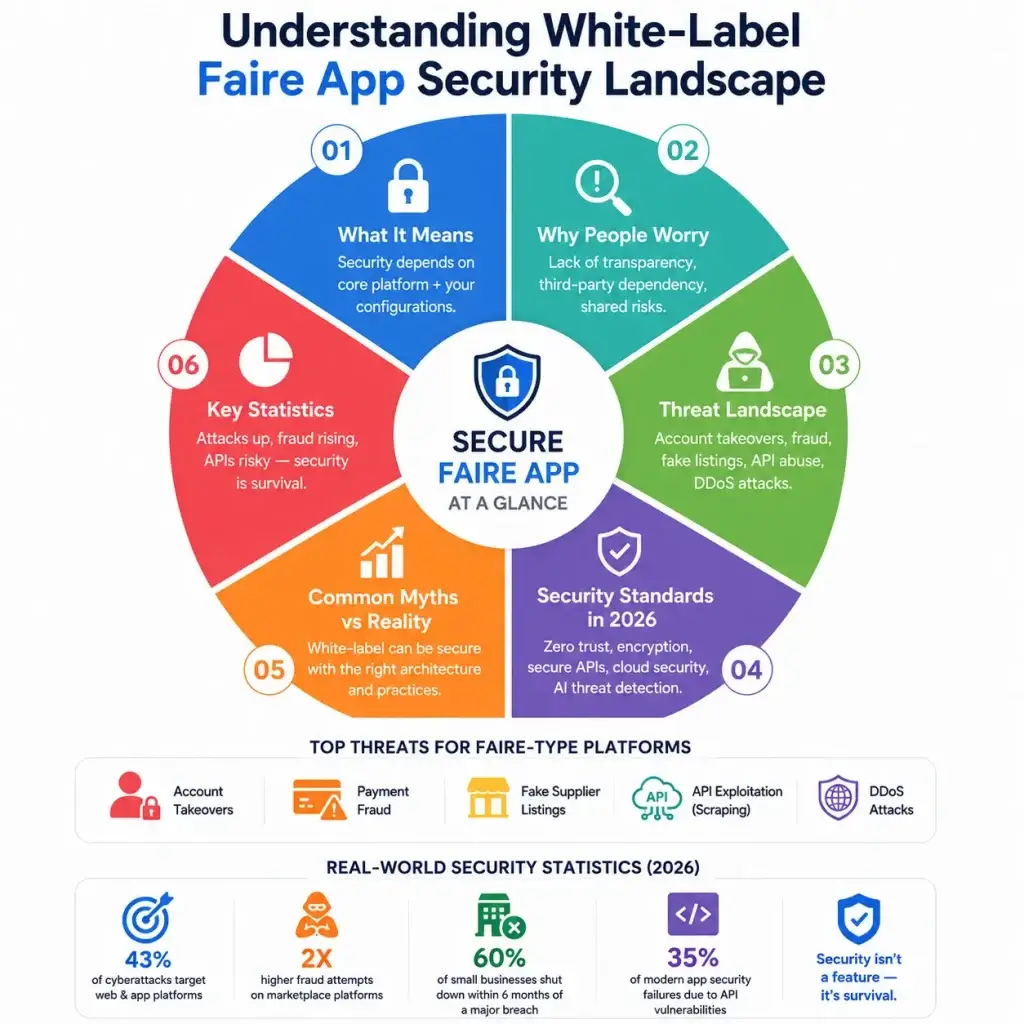
A white-label Faire app is a ready-made marketplace solution customized for your brand.
Security in this context depends on two layers:
- The core platform architecture (built by the provider)
- Your custom configurations and integrations
If the foundation is weak, no amount of customization can fully secure it.
Why People Worry About White-Label Apps
Security concerns usually come from:
- Lack of transparency in code
- Dependency on third-party infrastructure
- Fear of shared vulnerabilities across multiple apps
- Limited control over backend systems
These concerns are valid—but manageable with the right approach.
Current Threat Landscape for Faire-Type Platforms
Wholesale marketplace apps like Faire face specific threats:
- Account takeovers (vendors & buyers)
- Payment fraud and chargebacks
- Fake supplier listings
- API exploitation for pricing/data scraping
- DDoS attacks on high-traffic marketplaces
These risks have increased due to the rapid growth of B2B commerce platforms.
Security Standards in 2026
Modern white-label apps are expected to follow:
- Zero Trust Architecture
- End-to-end encryption as default
- Secure API-first design
- Cloud-native security frameworks (AWS/GCP standards)
- Continuous monitoring with AI-based threat detection
Security is no longer optional—it’s a baseline expectation.
Real-World Statistics on App Security Incidents
- Over 43% of cyberattacks in 2026 target web and app platforms
- Marketplace platforms see 2x higher fraud attempts than standard apps
- Around 60% of small businesses shut down within 6 months of a major breach
- API vulnerabilities account for nearly 35% of modern app security failures
These numbers highlight one thing: security isn’t a feature—it’s survival.
Key Security Risks & How to Identify Them
Data Protection & Privacy
White-label Faire apps handle sensitive business and personal data. Any weakness here can directly impact trust and compliance.
User Personal Information
Includes names, emails, business details, and order history.
If not encrypted properly, this data can be exposed or sold.
Payment Data Security
Payment gateways must follow strict PCI DSS standards.
Poor integration can lead to card data leaks and fraud.
Location Tracking Concerns
Many marketplace apps track location for logistics.
Improper handling can expose user movement patterns.
GDPR/CCPA Compliance
Failure to comply can result in heavy penalties.
Users must have control over their data, including access and deletion rights.
Technical Vulnerabilities
These risks usually come from poor development practices or outdated systems.
Code Quality Issues
Unoptimized or insecure code can create backdoors.
Common issues include improper validation and insecure data handling.
Server Security Gaps
Weak server configurations can expose databases.
Misconfigured cloud storage is one of the most common causes of breaches.
API Vulnerabilities
APIs are critical in marketplace apps.
If not secured, attackers can exploit endpoints to access or manipulate data.
Third-Party Integrations
Plugins and external tools can introduce hidden vulnerabilities.
Every integration increases the attack surface.
Business Risks
Security failures don’t just affect systems—they impact the entire business.
Legal Liability
Non-compliance with data laws can lead to lawsuits and penalties.
Reputation Damage
Users lose trust quickly after a breach.
Recovery can take years, if it happens at all.
Financial Losses
Includes fraud, compensation, downtime, and recovery costs.
Regulatory Penalties
Authorities impose strict fines for data mishandling, especially under GDPR and similar laws.
Risk Assessment Checklist
Use this checklist to evaluate your white-label Faire app security:
- Is all sensitive data encrypted (at rest and in transit)?
- Are secure payment gateways properly integrated?
- Does the app follow GDPR/CCPA compliance standards?
- Are APIs protected with authentication and rate limiting?
- Is the server infrastructure regularly audited?
- Are third-party integrations verified and updated?
- Is there a clear incident response plan?
- Are regular backups maintained and tested?
Security Standards Your White-Label Faire App Must Meet
Essential Certifications
To ensure your white-label Faire app is secure and trustworthy, it must align with globally recognized certifications.
ISO 27001 Compliance
This standard ensures proper information security management systems are in place.
It covers risk management, data protection, and operational security.
SOC 2 Type II
Focuses on how customer data is handled.
It evaluates security, availability, processing integrity, confidentiality, and privacy.
GDPR Compliance
Mandatory for handling data of EU users.
Requires transparency, consent management, and data protection controls.
HIPAA (if applicable)
Needed if your platform handles healthcare-related data.
Ensures strict protection of sensitive medical information.
PCI DSS for Payments
Essential for any app processing payments.
Protects cardholder data and reduces fraud risks.
Technical Requirements
Beyond certifications, your app must meet strong technical security standards.
End-to-End Encryption
All data should be encrypted during transmission and storage.
Prevents interception and unauthorized access.
Secure Authentication (2FA/OAuth)
Users should have multi-layer login protection.
OAuth allows secure third-party logins without exposing credentials.
Regular Security Audits
Periodic reviews help identify vulnerabilities early.
Audits should be both internal and third-party.
Penetration Testing
Simulates real-world attacks to test system defenses.
Should be conducted at least twice a year.
SSL Certificates
Ensures secure communication between users and servers.
HTTPS is mandatory for trust and security.
Secure API Design
APIs must include authentication, rate limiting, and encryption.
Prevents misuse and data leaks.
Security Standards Comparison Table
| Security Standard | Purpose | Mandatory For | Risk if Ignored |
|---|---|---|---|
| ISO 27001 | Information security management | All apps | Weak data protection framework |
| SOC 2 Type II | Data handling and privacy | SaaS & marketplaces | Loss of customer trust |
| GDPR | User data protection (EU) | Global apps with EU users | Heavy fines and legal action |
| PCI DSS | Payment security | Payment-enabled apps | Payment fraud and penalties |
| HIPAA | Health data protection | Healthcare-related apps | Legal and compliance violations |
Red Flags: How to Spot Unsafe White-Label Providers
Warning Signs
Choosing the wrong provider can expose your entire Faire app to serious risks. Watch out for these red flags.
No Security Documentation
If a provider cannot show clear security policies, it’s a major concern.
Transparency is a basic requirement in 2026.
Cheap Pricing Without Explanation
Unusually low pricing often means compromised quality.
Security infrastructure is expensive—cutting costs here is risky.
No Compliance Certifications
Lack of ISO, SOC 2, or GDPR compliance indicates weak security practices.
Outdated Technology Stack
Old frameworks and libraries are easier to exploit.
Modern security requires up-to-date technology.
Poor Code Quality
Messy or unstructured code increases vulnerability risks.
It also makes future updates difficult.
No Security Updates Policy
Without regular patches, even small vulnerabilities can become major threats.
Lack of Data Backup Systems
No backup means permanent data loss during attacks or failures.
No Insurance Coverage
Serious providers have cyber liability insurance.
It reflects accountability and preparedness.
Evaluation Checklist
Before selecting a white-label Faire app provider, go through this checklist.
Documents to Request
- Security compliance certificates (ISO, SOC 2, etc.)
- Data protection policies
- Audit and penetration testing reports
- Backup and disaster recovery plans
Testing Procedures
- Perform vulnerability scans
- Request a demo with security walkthrough
- Test authentication and access controls
- Evaluate API security
Due Diligence Steps
- Check past client reviews and case studies
- Analyze their update and maintenance history
- Verify third-party integrations
- Assess their incident response readiness
Best Practices for Secure White-Label Faire App Implementation
Pre-Launch Security
Security should start before your app goes live. Fixing issues later is always more expensive and risky.
Security Audit Process
Conduct a full audit of the app architecture.
Identify vulnerabilities in code, APIs, and infrastructure.
Code Review Requirements
Ensure clean, secure, and well-documented code.
Focus on input validation, authentication logic, and data handling.
Infrastructure Hardening
Secure servers, databases, and cloud environments.
Disable unnecessary services and enforce strict access controls.
Compliance Verification
Confirm alignment with GDPR, PCI DSS, and other required standards.
Missing compliance can delay launch or lead to penalties.
Staff Training Programs
Train your team on security awareness.
Human error is still one of the biggest security risks.
Post-Launch Monitoring
Security doesn’t end at launch. Continuous monitoring is critical.
Continuous Security Monitoring
Use tools to track suspicious activities in real time.
Early detection prevents major damage.
Regular Updates and Patches
Keep the app and dependencies updated.
Most breaches happen due to outdated systems.
Incident Response Planning
Have a clear plan for handling breaches.
Define roles, response time, and communication strategy.
User Data Management
Regularly review how user data is stored and accessed.
Limit access based on roles and responsibilities.
Backup and Recovery Systems
Maintain automated backups.
Test recovery processes to ensure business continuity.
Security Implementation Timeline
| Phase | Key Activities | Timeline |
|---|---|---|
| Planning | Risk assessment, compliance checks | Week 1–2 |
| Development | Secure coding, API protection | Week 3–6 |
| Testing | Security audits, penetration testing | Week 7–8 |
| Pre-Launch | Final compliance verification, fixes | Week 9 |
| Post-Launch | Monitoring, updates, incident readiness | Ongoing |
Legal & Compliance Considerations
Regulatory Requirements
Operating a white-label Faire app means dealing with multiple legal frameworks, especially if your platform serves users across regions.
Data Protection Laws by Region
- Europe: GDPR requires strict data handling, consent, and user rights
- USA: CCPA and CPRA focus on transparency and data access
- India: Digital Personal Data Protection Act (DPDP) governs user data usage
Each region has different requirements, so compliance must be location-aware.
Industry-Specific Regulations
If your app handles specific categories like payments or sensitive business data, additional rules apply.
For example, financial transactions must follow PCI DSS standards.
User Consent Management
Users must clearly agree to how their data is collected and used.
Consent should be:
- Explicit
- Trackable
- Easy to withdraw
Privacy Policy Requirements
Your app must have a clear and updated privacy policy.
It should explain:
- What data is collected
- Why it is collected
- How it is stored and protected
Terms of Service Essentials
Terms of service define user responsibilities and platform rules.
They help reduce disputes and legal risks.
Liability Protection
Legal protection is just as important as technical security.
Insurance Requirements
Cyber liability insurance helps cover:
- Data breaches
- Legal fees
- Compensation costs
It acts as a financial safety net.
Legal Disclaimers
Disclaimers limit your responsibility in certain scenarios.
They must be clearly written and legally valid.
User Agreements
Well-structured agreements protect your platform from misuse.
They also define acceptable behavior for buyers and suppliers.
Incident Reporting Protocols
In many regions, breaches must be reported within a specific timeframe.
For example, GDPR requires reporting within 72 hours.
Regulatory Compliance Monitoring
Laws change frequently.
You need continuous monitoring to stay compliant and avoid penalties.
Compliance Checklist by Region
| Region | Key Law | Requirement | Risk if Ignored |
|---|---|---|---|
| Europe | GDPR | User consent, data protection, breach reporting | Heavy fines up to millions |
| USA | CCPA/CPRA | Data transparency and user rights | Legal action and penalties |
| India | DPDP Act | Consent-based data processing | Regulatory penalties |
| Global | PCI DSS | Secure payment handling | Payment fraud and fines |
Read more : – Business Model of Faire : Complete Strategy Breakdown 2026
Why Miracuves White-Label Faire App is Your Safest Choice
Miracuves Security Advantages
Choosing the right development partner is the biggest factor in how secure your white-label Faire app will be. Miracuves is built with a security-first approach, not security as an afterthought.
Enterprise-Grade Security Architecture
Miracuves uses scalable and secure architecture designed for high-traffic marketplace platforms.
This ensures stability, data protection, and resilience against attacks.
Regular Security Audits and Certifications
All systems undergo routine security audits and compliance checks.
This helps identify and fix vulnerabilities before they become threats.
GDPR/CCPA Compliant by Default
Compliance is built into the core system.
You don’t have to worry about setting up data protection frameworks from scratch.
24/7 Security Monitoring
Continuous monitoring helps detect suspicious activities in real time.
This reduces response time and minimizes potential damage.
Encrypted Data Transmission
All data is encrypted both in transit and at rest.
This protects sensitive business and user information from interception.
Secure Payment Processing
Integrated payment systems follow PCI DSS standards.
This ensures safe and reliable transactions.
Regular Security Updates
Frequent updates keep the platform protected against new threats.
Security evolves constantly, and so does the system.
Insurance Coverage Included
Miracuves-backed solutions include risk coverage support.
This adds an extra layer of business protection.
Final Thought
Launching a white-label Faire app is not risky if security is handled correctly.
The real risk comes from ignoring standards, choosing the wrong provider, or treating security as optional. Talk to our team and see why businesses trust Miracuves for safe, compliant platforms. In 2026, users expect safe platforms by default. If you prioritize security from day one, your app won’t just survive—it will earn long-term trust.
FAQs
1. How secure is white-label vs custom development?
White-label apps can be equally or more secure if built by experienced providers. They often follow tested frameworks, unlike rushed custom builds.
2. What happens if there’s a security breach?
You may face data loss, legal penalties, and reputation damage. A strong incident response plan helps minimize impact.
3. Who is responsible for security updates?
It is a shared responsibility. The provider handles core updates, while you manage configurations and usage practices.
4. How is user data protected in white-label apps?
Through encryption, secure servers, access controls, and compliance with laws like GDPR and CCPA.
5. What compliance certifications should I look for?
ISO 27001, SOC 2 Type II, GDPR, and PCI DSS are essential for most marketplace apps.
6. Can white-label apps meet enterprise security standards?
Yes, if they follow modern architecture, regular audits, and strict compliance requirements.
7. How often should security audits be conducted?
At least twice a year, along with continuous monitoring.
8. What’s included in Miracuves security package?
End-to-end encryption, compliance readiness, regular audits, monitoring, secure payments, and ongoing updates.
9. How to handle security in different countries?
Follow region-specific laws like GDPR (EU), CCPA (USA), and DPDP (India). Use adaptable compliance frameworks.
10. What insurance is needed for app security?
Cyber liability insurance is recommended to cover breach-related losses and legal costs.
Related Articles
Miracuves is an independent software development company. We are not affiliated with, connected to, sponsored by, or endorsed by any company or product named in this article.
Terms such as “X Clone” are used descriptively. It is how the software industry refers to building a platform with functionality comparable to a known service, and how clients search for it.
The entire design and codebase of our products is built by our own team. Our products contain no code, design, graphics, or content originating from any third-party website or applications.
All third-party names and marks referenced in this article are the property of their respective owners, referenced solely to identify the services discussed.