


Key Takeaways
- Fast app development helps founders launch quicker, test market demand earlier, and reduce the opportunity cost of waiting.
- Long development timelines often increase cost, delay revenue, slow user feedback, and create higher risk before the product reaches the market.
- A 6-days app launch works best when businesses use ready-made technology, proven app flows, pre-built modules, and focused customization.
- Traditional 3 to 6 month development may still fit highly complex custom projects, but it is not always ideal for founders who need faster validation.
- The real comparison is not just speed versus quality; it is speed, cost control, market timing, learning, and revenue opportunity together.
Growth Signals
- Every delayed launch can mean missed customers, slower brand visibility, delayed partnerships, and lost first-mover advantage.
- Ready-made app solutions reduce development effort by using pre-built user apps, admin panels, dashboards, payment flows, and core business logic.
- Faster launches help founders collect real user feedback before spending heavily on unnecessary features or long custom development cycles.
- Shorter timelines can improve cash flow because businesses can start testing acquisition, bookings, transactions, or subscriptions sooner.
- Development cost changes based on app type, customization level, tech stack, integrations, design changes, scalability needs, and post-launch support.
Real Insights
- Fast app development is not about skipping quality; it is about using proven systems instead of building every feature from zero.
- The biggest hidden cost of long timelines is often not development cost, but delayed learning, delayed revenue, and delayed market entry.
- Founders should choose long custom development only when the product needs deeply unique architecture, complex workflows, or heavy enterprise customization.
- For most launch-stage businesses, speed matters because real users reveal what the product actually needs after going live.
- The strongest launch strategy combines fast deployment, clean customization, scalable architecture, user feedback, and continuous improvement after launch.
Launching an app is not just a technical milestone; it is a business timing decision. In this blog, we will explain why Fast App Development matters for founders, startups, agencies, and business owners, especially when delays can directly affect revenue, market entry, customer feedback, investor confidence, and competitive advantage.
A traditional app development timeline often takes 3 to 6 months or more when everything is built from scratch. During this period, founders are not only waiting for code; they are also waiting for users, payments, feedback, validation, and growth signals. Meanwhile, competitors may launch first, customer demand may shift, marketing plans may pause, and development costs may increase.
This blog also explains why Fast App Development is becoming a smarter choice for many founders. Instead of spending months building every feature from zero, businesses can start with a ready-made, scalable, and customizable app foundation. Miracuves helps reduce this waiting period with ready-made app solutions that can be launched in 6 days with source code, branding, deployment support, and scalable architecture.
Understanding the Real Cost of Long App Development Timelines
A long app development timeline may feel normal at first. Many founders accept 3 to 6 months of development as part of building a serious app. But the longer an app stays under development, the more business opportunities remain locked.
The real cost is not only development cost. It is also the revenue you do not earn, the users you do not acquire, the feedback you do not collect, and the market advantage competitors may gain while your product is still unfinished.
Fast App Development helps reduce this waiting gap by giving founders a faster path from idea to launch, especially when the goal is to validate demand, enter the market quickly, and start building traction.
Key hidden costs of long app development timelines include:
- Lost revenue before launch: The business cannot earn from bookings, subscriptions, commissions, transactions, or service fees until the app is live.
- Delayed user acquisition: Marketing and onboarding become harder when there is no working product for users to try.
- Missed market timing: A fresh idea can lose its advantage if competitors launch first or customer demand changes.
- Higher project costs: Longer timelines often create more revisions, testing cycles, team hours, and technical rework.
- Founder fatigue: Months of approvals, bugs, features, and delays can reduce focus before the business even starts.
- Competitor advantage: Early competitors can build users, reviews, partnerships, SEO visibility, and brand recall faster.
Lost Revenue Before Launch
Every delayed week pushes revenue further away. For marketplace, fintech, delivery, rental, creator, ecommerce, and on-demand apps, income starts only after users begin using the platform.
| App Type | Revenue That Gets Delayed |
|---|---|
| Marketplace App | Vendor commissions, listing fees, service fees |
| Fintech App | Transaction fees, wallet fees, subscriptions |
| Delivery App | Delivery charges, merchant commissions, surge fees |
| Taxi App | Ride commissions, driver plans, booking fees |
| Rental App | Booking commissions, service charges, insurance fees |
| Creator Platform | Subscriptions, creator commissions, premium content sales |
| Ecommerce App | Product sales, seller commissions, advertising revenue |
A 6-month development cycle does not only delay the app. It delays the first customer, first payment, first review, first feedback, and first revenue signal.
Missed Market Opportunities
Markets do not wait for perfect products. A business idea that looks fresh today can become crowded within months.
Many founders delay launch because they want every feature ready before going live. But a competitor with a simpler, functional app can enter the market first, attract users, test pricing, and start building trust.
This is especially risky in fast-moving categories such as:
- Food delivery apps: Early platforms can onboard restaurants and repeat customers before others enter.
- Taxi platforms: Faster launch helps secure drivers, riders, and popular local routes early.
- Fintech apps: Early validation helps test trust, payment behavior, and transaction demand faster.
- Short-video apps: Creators and viewers often join platforms that offer early visibility and engagement.
- Rental marketplaces: Early entry helps capture listings, hosts, inventory, and seasonal demand.
- Creator platforms: Creators may choose platforms that help them monetize and engage fans sooner.
Fast App Development helps founders enter the market while demand is active, instead of launching after competitors have already built traction.
Higher Development and Management Costs
Longer timelines often increase project costs because requirements change, new features get added, integrations take longer, and more testing is needed.
Traditional development may start with a fixed estimate, but the final cost can rise when the project keeps expanding.
Common cost risks include:
- New feature requests: Extra features increase design, development, testing, and approval time.
- UI and UX changes: Revised screens and flows can extend both design and frontend work.
- Third-party integrations: Payments, maps, SMS, analytics, and APIs may take longer than planned.
- Extra testing cycles: More custom code usually means more bugs, fixes, and quality checks.
- Deployment issues: Server setup, app store approval, and live testing can delay release.
| Cost Area | Why It Becomes Expensive |
|---|---|
| Feature Development | New ideas keep getting added before launch |
| Project Management | Longer coordination increases team hours |
| Testing | More custom code creates more bug-fixing cycles |
| Integrations | Third-party tools may need extra setup and fixes |
| Deployment | Server, app store, and configuration issues can delay launch |
Fast App Development gives founders better cost control because the core modules are already built. Instead of paying to rebuild common workflows from scratch, they can focus on branding, setup, deployment, and future improvements.
Founder Fatigue and Decision Pressure
Long development cycles can exhaust founders before the app reaches the market. They spend months reviewing designs, approving features, managing developers, checking bugs, tracking deadlines, and handling budget changes.
This often leads to overthinking. Founders keep adding features because they are trying to predict what users want without real user data.
A founder should not spend six months only waiting for development. That time is better spent acquiring users, building partnerships, testing offers, improving positioning, and preparing for revenue.
Fast App Development helps founders shift from endless planning to real market action faster.
Competitor Advantage
A delayed app gives competitors more time to capture attention, build trust, and learn from real users.
Competitors who launch earlier can:
- Build an early user base: Real users create activity, retention data, and stronger market presence.
- Collect customer reviews: Reviews build trust and make new users more likely to choose them.
- Test marketing channels: Early campaigns reveal which keywords, ads, and audiences convert.
- Build partnerships: Vendors, drivers, creators, merchants, and service providers may join them first.
- Rank on search engines: Earlier content and landing pages can gain SEO visibility before your launch.
- Improve pricing: Real customer behavior helps refine commissions, subscriptions, discounts, and fees.
In many markets, the first functional product gains more advantage than the perfect product launched too late.
Fast App Development reduces this risk by helping founders launch sooner, collect feedback earlier, and compete before the market becomes harder to enter.
Why Traditional App Development Often Takes 3 to 6 Months
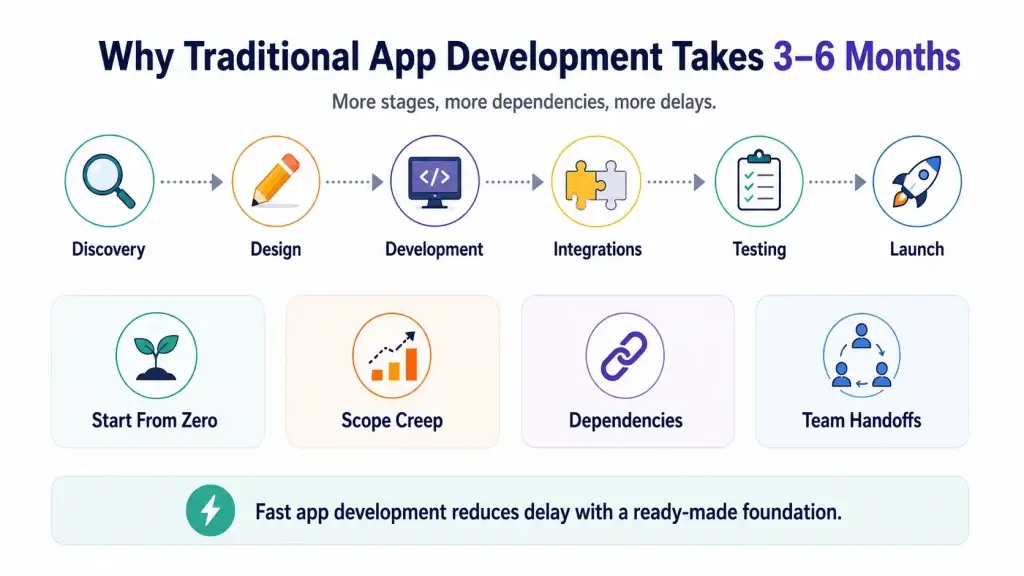
Traditional app development takes time because every part of the product is usually planned, designed, developed, tested, and deployed from the beginning. This approach can work for enterprise projects with highly unique requirements, but it often becomes slow for founders who need to validate quickly and enter the market faster.
A long app development timeline usually does not happen because of one single delay. It happens because multiple stages, teams, features, integrations, and approval cycles depend on each other. When one part slows down, the entire launch timeline gets pushed forward.
Starting From Zero Makes Every Feature Take Longer
In traditional development, the team usually starts from zero. Every screen, backend module, API, database structure, admin panel, and user flow must be planned and built manually.
| Stage | What Happens |
|---|---|
| Discovery | Business goals, features, user roles, app flow, and requirements are discussed. |
| Wireframing | Basic screen structure and user journey are planned before design starts. |
| UI/UX Design | Visual design, branding, layouts, and interface elements are created. |
| Backend Development | Server, database, APIs, admin logic, and business rules are built. |
| Mobile App Development | Android and iOS apps are developed and connected with backend systems. |
| Admin Panel Development | Dashboards, controls, reports, user management, and revenue settings are created. |
| Integrations | Payment gateways, maps, notifications, analytics, and third-party tools are added. |
| Testing | Bugs, performance issues, API errors, and app crashes are identified and fixed. |
| Deployment | Server setup, Play Store, App Store, and live configuration are completed. |
Each stage takes time, especially when every module is custom-built.
For example, a marketplace app may need user accounts, vendor dashboards, product listings, payments, commissions, reviews, notifications, and admin controls. A taxi app may need booking flows, driver tracking, fare logic, map integration, payment gateway, and trip management. A fintech app may require wallets, KYC, transaction history, admin approval workflows, payment flows, and compliance-related controls.
Fast App Development reduces this delay because the core product foundation is already built. Instead of starting from zero, founders can begin with a tested structure and move toward launch faster.
Scope Creep Turns a Simple App Into a Longer Project
Many app projects begin with a simple feature list but slowly expand during development. This is called scope creep.
At first, the founder may want a basic launch version. But during development, new ideas, competitor comparisons, investor suggestions, and internal feedback can keep adding more features to the product.
Common examples of scope creep include:
- New payment options: Additional gateways or wallet options increase integration and testing work.
- Extra user roles: More roles require separate permissions, dashboards, and access controls.
- Advanced admin controls: Extra backend settings can increase dashboard complexity and development time.
- Referral systems: Referral tracking, reward rules, and user credits require extra logic.
- Loyalty programs: Points, coupons, memberships, and rewards add more business rules.
- Multi-language support: Each language needs content setup, layout checks, and user experience testing.
- Analytics dashboards: Advanced reports require accurate data tracking, filters, and visual summaries.
- Region-specific workflows: Different markets may need local payment, tax, compliance, or operational rules.
Each new feature adds more design, development, testing, and approval time. What started as a simple launch plan can slowly become a long and expensive custom build.
Fast App Development helps founders launch the core platform first and add advanced features later based on real user feedback.
UI, Backend, and API Dependencies Slow the Launch
App development requires multiple systems to work together. Even if the design is ready, backend delays can stop progress. Even if the backend is complete, API issues can delay the mobile apps. Even if the apps are ready, testing or deployment problems can still push the launch date.
Delays usually happen because of small dependencies across different modules.
| Module | Why It Can Delay Launch |
|---|---|
| Map Integration | Driver tracking, location search, and route accuracy must work properly. |
| Payment Gateway | Failed payments, callbacks, refunds, or transaction errors can block live usage. |
| Booking Flow | Requests, acceptance, cancellation, and completion must sync correctly. |
| Driver or Vendor App | Availability, order status, earnings, and notifications must update in real time. |
| Admin Dashboard | Users, orders, trips, commissions, reports, and disputes must be managed correctly. |
| Notifications | Users, vendors, drivers, or admins must receive timely app, SMS, or email alerts. |
| Commission Logic | Platform earnings, vendor payouts, and service fees must calculate accurately. |
If one part is delayed, the entire launch can get delayed. This is one major reason traditional app development timelines often stretch beyond the original plan.
Late Testing Can Add Weeks Before Launch
Testing is important, but custom-built apps often need longer testing cycles because the product has not been used in real workflows before.
The more custom the app is, the more areas must be checked before launch.
Common testing and deployment issues include:
- Login errors: Users may face problems with signup, OTP, password reset, or social login.
- Payment failures: Transactions may fail because of gateway, callback, refund, or configuration issues.
- App crashes: Mobile apps may crash on specific devices, operating systems, or user actions.
- Slow loading: Poor performance can affect user experience and app store quality checks.
- Incorrect admin data: Reports, orders, payments, or user details may not display correctly.
- Notification delays: Push notifications, SMS, or emails may not reach users on time.
- API errors: Mobile apps may not sync properly with backend data or third-party services.
- App store rejection: Play Store or App Store review issues can force last-minute fixes.
- Server configuration problems: Hosting, SSL, database setup, and live environment issues can delay release.
Fixing these problems can extend the launch by days or weeks. In some cases, one fix can create another issue, increasing testing time again.
With ready-made app solutions, many common workflows are already developed and tested, which can reduce the time needed to prepare the platform for launch.
Too Many Team Handovers Create Timeline Gaps
Traditional development often involves multiple people working across different parts of the product. This may include designers, frontend developers, backend developers, mobile app developers, testers, project managers, deployment teams, business owners, and client-side decision makers.
When communication is slow or unclear, the project timeline expands.
Small delays in design approval, feature clarification, API updates, bug feedback, payment setup, or deployment decisions can create major timeline gaps over several months.
Longer communication chains often create longer app development timelines. Fast App Development reduces this complexity because the core structure is already prepared, making the launch process more focused, predictable, and faster.
How a 6-Month App Development Timeline Increases Business Risk
The cost of waiting grows with every month. A founder may think they are only waiting for development, but they are also delaying market learning, revenue validation, customer acquisition, and competitive positioning.
Fast App Development reduces this risk by helping founders launch earlier, test faster, and make decisions based on real market activity.
Competitors Learn From Real Users First
A competitor that launches earlier can test features, improve pricing, collect feedback, and build trust while your app is still under development.
| Earlier Launcher | Delayed Founder |
|---|---|
| Tests real users | Tests assumptions |
| Collects feedback | Waits for launch |
| Improves pricing | Finalizes features |
| Builds reviews | Has no traction |
| Tests revenue | Delays validation |
| Builds brand recall | Prepares launch assets |
Speed becomes a business advantage because the earlier product reaches users, the faster the founder understands what actually works.
Marketing Starts Late When Launch Is Delayed
Founders often wait until the app is ready before running serious marketing campaigns. This means SEO, paid ads, influencer outreach, partnerships, and app store optimization also start late.
Long development delays can affect:
- SEO content: Organic visibility takes time, so late publishing delays traffic growth.
- Paid ads: Founders lose time testing audiences, keywords, offers, and creatives.
- Influencer campaigns: Promotions cannot drive installs before the app is live.
- Vendor onboarding: Marketplaces and service apps cannot build supply early.
- App store optimization: Rankings, reviews, and install momentum cannot start before launch.
Fast App Development allows marketing, onboarding, and traction-building to begin earlier.
User Feedback Comes Too Late
No app idea can be fully validated inside meetings or design approvals. Real validation starts when users interact with the product.
Real users help validate:
- Onboarding: Whether users can sign up and understand the app easily.
- Transactions: Whether users complete bookings, payments, orders, or subscriptions.
- Feature demand: Which features matter and which ones are ignored.
- Drop-off points: Where users leave before completing an action.
- Improvement priority: What should be fixed or upgraded first.
A 6-day launch gives founders faster learning. A 6-month timeline delays learning.
Revenue Validation Gets Delayed
Investors, partners, and founders care about traction, but traction cannot begin until the app is live.
Long development delays important business signals such as:
- First transaction: The business cannot prove payment activity before live usage.
- First subscription: Subscription demand remains untested until users start paying.
- First booking: Service, rental, taxi, and delivery demand cannot be validated early.
- First user review: Trust signals cannot build before customers use the app.
- First retention data: Repeat usage cannot be measured until users return.
Early revenue data is often more useful than a perfect first version because it proves whether the market wants the product.
Market Timing Gets Weaker
Some app ideas perform best when launched at the right time. Seasonal demand, local gaps, trends, and early-mover advantage can strongly influence success.
| App Idea | Why Timing Matters |
|---|---|
| Rental App | Seasonal travel and local events create strong launch windows. |
| Delivery App | Local demand can rise quickly in specific service areas. |
| Fintech App | New payment habits can create market openings. |
| AI App | Trend cycles move fast, so early visibility matters. |
| Creator Platform | Niche creator demand can grow before larger platforms react. |
| Marketplace App | Early vendor onboarding can create a supply advantage. |
Fast App Development helps founders act while the opportunity is still strong, instead of launching after competitors have captured users and attention.
6-Days App Launch vs 6-Month Development Cycle
This is where the difference becomes clear.
A 6-days app launch is not about avoiding quality. It is about using a ready-made foundation to reduce unnecessary waiting time.
A 6-month custom development cycle may be useful for highly complex enterprise products, but many founders do not need to wait that long to test a business idea.
| Factor | 6-Days App Launch With Miracuves | Traditional 6-Month Development |
|---|---|---|
| Launch Speed | App can go live quickly with a ready-made foundation | Requires full planning, design, development, testing, and deployment |
| Cost Control | More predictable because core modules are already built | Costs may increase due to scope creep and delays |
| Market Entry | Faster entry into the target market | Delayed market testing |
| User Feedback | Real feedback starts earlier | Feedback comes after months of development |
| Revenue Testing | Monetization can be tested sooner | Revenue starts only after full development |
| Founder Risk | Lower waiting risk | Higher delay and uncertainty risk |
| Customization | Branding, features, and workflows can be adapted | Full customization but slower execution |
| Marketing Start | Campaigns can begin earlier | Marketing often starts after development |
| Investor Readiness | Early traction can support better conversations | Investor proof is delayed |
| Product Learning | Market learning begins quickly | Learning is based on assumptions for months |
| Best For | Founders who want speed, validation, and faster launch | Businesses with very unique enterprise requirements |
Why Fast App Development Does Not Mean Low-Quality Development
Some founders assume Fast App Development means poor quality, limited features, or weak scalability. But fast does not mean rushed. It means using a ready-made product foundation, tested workflows, reusable architecture, and deployment-ready modules instead of building everything from zero.
Traditional development starts from scratch, which makes every feature take longer. Fast App Development starts with a working foundation and customizes it for the founder’s business model, brand, and target market.
A Ready-Made Foundation Reduces Build Time
Miracuves does not need to rebuild every basic feature from zero. Core modules such as the user app, provider or vendor app, admin dashboard, payment flow, booking system, notifications, reports, and revenue controls are already prepared.
This saves time on basic development and helps founders focus on what matters more before launch: branding, market entry, customer acquisition, and business validation.
Source Code Ownership Gives Long-Term Control
A fast launch should not create vendor lock-in. Miracuves provides source code access so founders can customize, scale, and extend the platform after launch.
Source code ownership helps founders:
- Add new features as the business grows
- Scale the platform for more users, transactions, and regions
- Maintain stronger product control for investors and future teams
This makes the platform useful not only for fast launch but also for long-term growth.
Custom Branding Makes the App Market-Ready
A ready-made solution does not have to look generic. It can be branded with the founder’s logo, app name, color theme, app icon, splash screen, business details, domain, and basic content.
This helps founders enter the market faster with a platform that feels aligned with their own business identity, instead of waiting months for a fully custom design and setup process.
Post-Launch Improvements Can Continue
Founders do not need every advanced feature before going live. They can launch the core platform first, collect real feedback, and improve based on actual user behavior.
After launch, the app can be upgraded with advanced analytics, AI recommendations, loyalty systems, referral programs, subscription plans, multi-language support, regional payment gateways, or custom integrations.
Fast App Development gives founders a practical path: launch first, learn faster, and improve smarter.
How Miracuves Helps Founders Launch Faster Without Starting From Zero
Miracuves helps founders reduce the traditional app development timeline with ready-made, customizable, and scalable app solutions that can be launched in 6 days. This model is built for founders who want to move fast, test demand, reduce waiting risk, and enter the market with a working platform instead of starting from zero.
Ready-Made App Architecture Saves Development Time
Miracuves solutions come with pre-built architecture for common business models, including marketplace apps, fintech apps, delivery apps, taxi apps, rental apps, creator platforms, ecommerce apps, grocery delivery apps, logistics platforms, service booking apps, and social or video platforms.
This ready-made architecture helps founders avoid the slowest part of development: building every core module from scratch. Instead, they can start with a functional foundation and adapt it to their business model.
6-Days Launch Timeline Helps Founders Enter the Market Faster
The 6-days launch timeline is one of the biggest advantages of Miracuves’ Fast App Development model. Instead of waiting months for basic development, founders can use a deployment-ready solution and move toward launch faster.
This helps founders:
- Test demand faster: Founders can see how users respond before investing months in custom development.
- Onboard early users: The business can start building its first customer base sooner.
- Start operations sooner: Founders can begin real platform activity instead of waiting for completion.
- Begin marketing earlier: SEO, paid ads, partnerships, and app promotion can start faster.
- Validate revenue quickly: The business can test bookings, payments, subscriptions, or commissions earlier.
- Reduce waiting risk: Shorter timelines reduce the chance of losing momentum before launch.
- Enter before competitors: Faster market entry helps founders compete while the opportunity is still fresh.
For founders, this speed can make a major difference because it allows them to act while demand is still active.
Source Code Access Gives Founders Full Product Control
Miracuves provides complete source code access with ready-made app solutions. This gives founders flexibility, ownership, and long-term control over the platform.
| Benefit | Why It Matters |
|---|---|
| Future Customization | Founders can add new features as the business grows. |
| Scaling | The platform can be improved for more users, regions, and transactions. |
| Investor Confidence | Source code ownership shows stronger product control. |
| Internal Tech Control | Businesses are not fully dependent on one vendor forever. |
| Reduced Dependency | The product can be managed or extended by future teams. |
| Long-Term Ownership | The founder owns the foundation of the platform. |
This means founders are not just buying a temporary app setup. They are getting a product foundation they can continue improving after launch.
Custom Branding and Deployment Support Make Launch Easier
Miracuves supports launch preparation through branding, deployment, configuration, and basic platform setup. This helps founders move from idea to market faster without getting stuck in technical delays.
Launch support may include:
- Branding setup: The platform can be aligned with the founder’s business identity.
- Logo and color integration: The app can reflect the brand’s visual style.
- App name configuration: The solution can be launched under the founder’s own app name.
- Domain setup: The platform can be connected with the business domain.
- Server deployment: The app can be configured for live usage.
- App configuration: Core settings can be adjusted for the founder’s market.
- Basic content updates: Key text, business details, and platform information can be updated.
- Admin setup: Business owners can access and manage the backend dashboard.
- Payment flow configuration: Payment-related workflows can be prepared for transactions.
- Pre-launch testing: The platform can be checked before going live.
Custom branding and deployment support make the app more market-ready, allowing businesses to focus on user acquisition, partnerships, and revenue testing.
Scalable Platform Supports Future Growth
A fast launch should not block future growth. Miracuves builds platforms that can be improved with advanced features, integrations, automation, analytics, AI modules, and region-specific workflows after launch.
This gives founders a practical path:
- Launch quickly: Enter the market with a working app foundation.
- Validate demand: Test whether users, vendors, or customers respond positively.
- Collect feedback: Understand what users actually need from the platform.
- Improve features: Upgrade the app based on real market behavior.
- Scale operations: Expand users, services, transactions, and locations.
- Enter new markets: Adapt the platform for new regions, niches, or business models.
This model is useful for founders who want to avoid overbuilding before they know what the market actually wants.
Founder Scenarios Where Fast App Development Wins
Fast App Development works best when speed, validation, and market entry matter more than waiting for a fully custom product from day one. For many founders, the first goal is to launch, test demand, collect feedback, and understand what the market actually wants.
| Founder Type | Why Fast App Development Helps |
|---|---|
| Marketplace founders | Tests vendors, categories, cities, commissions, and user demand faster. |
| Fintech startups | Validates wallet, payment, KYC, and transaction flows before heavy custom investment. |
| On-demand businesses | Helps launch before competitors capture users, vendors, drivers, or local partners. |
| Agencies and consultants | Delivers client apps faster with clearer timelines and lower production risk. |
Marketplace Founders Can Test Demand Faster
A marketplace founder may not know which category, city, audience, or vendor segment will perform best. A faster launch helps them test real demand instead of building assumptions for months.
They can test:
- Vendor onboarding: Which sellers, partners, or providers are easiest to onboard.
- Category demand: Which product or service category gets the strongest response.
- City-level traction: Which location shows better user and vendor activity.
- Commission model: Whether vendors prefer fixed fees, commissions, or subscriptions.
- Marketing channel: Whether SEO, ads, referrals, or local outreach performs better.
This helps founders make decisions based on market behavior, not guesswork.
Fintech Startups Can Reduce Build Risk
Fintech founders often need to test trust, onboarding, payment flows, and transaction behavior before investing in deeper custom development.
| Validation Area | What Founders Can Learn |
|---|---|
| Wallet usage | Whether users are comfortable managing money digitally. |
| Transaction flow | Whether payments, transfers, or wallet actions work smoothly. |
| KYC completion | Whether users complete verification without major drop-offs. |
| Fee acceptance | Whether users accept charges, commissions, or subscription pricing. |
| Trust signals | What makes users feel safe using the platform. |
Early validation is important in fintech because users need confidence before they adopt financial products.
On-Demand Businesses Can Launch Before Local Competitors
Taxi, delivery, grocery, handyman, rental, and logistics businesses often compete in local markets where speed matters. A faster launch helps founders onboard users, vendors, drivers, and partners before competitors dominate the area.
Fast launch helps them:
- Build early supply: Onboard drivers, vendors, stores, or service providers sooner.
- Acquire first users: Start attracting customers while demand is still open.
- Test local pricing: Check which fees, commissions, or discounts work best.
- Improve operations: Learn from real orders, rides, bookings, or service requests.
- Build reviews: Create early trust through ratings and customer feedback.
In on-demand businesses, the platform that builds supply and demand first often gains a stronger local advantage.
Agencies Can Deliver Client Apps Faster
Agencies and consultants can use Fast App Development to deliver client projects faster, reduce production delays, and improve profitability.
| Agency Benefit | Business Impact |
|---|---|
| Faster delivery | Clients move from idea to launch sooner. |
| Better margins | Less time is spent rebuilding basic modules. |
| Lower risk | Tested foundations reduce development uncertainty. |
| Predictable timelines | Agencies can plan delivery more confidently. |
| Quicker demos | Clients can review a working product faster. |
| Higher satisfaction | Faster launch helps clients begin marketing and testing sooner. |
For agencies, speed is not only a technical advantage. It can also improve the delivery model.
When Should You Choose Fast App Development?
Fast App Development is suitable when your priority is launch speed, business validation, and market entry.
You should consider it when:
- You want to launch quickly: Enter the market without waiting months for basic development.
- You need to validate demand: Let real users confirm whether the app idea works.
- You want predictable pricing: Reduce uncertainty compared to open-ended custom development.
- You need source code ownership: Keep control over future customization and scaling.
- You want to beat competitors: Capture users, vendors, and attention earlier.
- You plan to improve after launch: Add advanced features based on real user behavior.
- You are an agency: Deliver client apps faster with lower production risk.
| Your Priority | Is Fast App Development Suitable? |
|---|---|
| Launch quickly | Yes |
| Validate demand early | Yes |
| Test revenue first | Yes |
| Own source code | Yes, with the right provider |
| Build everything from scratch | Not always |
| Need deep enterprise customization | Longer custom development may be better |
When a Longer Custom Development Timeline Makes More Sense?
A longer custom app development timeline may be better when the product has deep technical complexity, unique workflows, or enterprise-level requirements.
Custom development may be better when:
- The product has unique technical logic: The app cannot use a ready-made foundation.
- The business needs enterprise integrations: CRMs, ERPs, internal systems, or legacy tools must connect deeply.
- The platform needs complex compliance: Strict approval, audit, or regulatory workflows are required from day one.
- The business model is experimental: The product needs custom architecture and testing from scratch.
- The app depends on proprietary algorithms: Unique matching, pricing, ranking, or recommendation logic is required.
- The product uses hardware or IoT: Specialized integrations need longer testing and development.
Custom development has its place for complex products. But for many founders, starting with a ready-made solution is a smarter way to enter the market faster and improve based on real feedback.
Fast App Development vs Custom Development Decision Guide
| Business Situation | Better Option |
|---|---|
| Need to test demand quickly | Fast App Development |
| Want to launch before competitors | Fast App Development |
| Need predictable cost and faster launch | Fast App Development |
| Need source code and future control | Fast App Development with source code |
| Need full enterprise custom logic | Longer custom development |
| Have a completely experimental model | Longer custom development |
| Need heavy compliance from day one | Longer custom development or hybrid approach |
| Want every feature custom-built before launch | Longer custom development |
Final Takeaway: Fast App Development Is a Business Advantage
Fast App Development is not just about saving time; it is about reducing the cost of waiting. Every month spent in development can delay revenue, user feedback, market entry, investor confidence, and competitive positioning. For some businesses, a 6-month app development timeline may make sense, especially when the product needs deep custom logic. But for founders who need speed, validation, and early traction, waiting too long can become a business risk.
The real danger is not only that development takes longer. The bigger danger is that competitors may launch first, users may move elsewhere, marketing costs may rise, and the market opportunity may become weaker before your app is ready.
This is where Miracuves helps founders move faster. With ready-made, scalable app solutions, source code ownership, custom branding, deployment support, and post-launch flexibility, founders can reduce waiting time and move toward launch in 6 days.
If your app idea is ready, your market should not have to wait. Launch faster, test demand earlier, collect real feedback, and start building traction before competitors take the lead.
Ready to launch your app in 6 days instead of waiting 6 months? Build faster, reduce waiting cost, and move forward with Miracuves.
FAQs
What is fast app development?
Fast app development means launching an app quickly using ready-made architecture, pre-built modules, reusable features, and faster deployment workflows instead of building every part from scratch.
How long does traditional app development usually take?
A traditional app development timeline usually takes 3 to 6 months or more, depending on the app features, backend complexity, UI/UX design, integrations, testing, and deployment requirements.
Is fast app development good for startups?
Yes. Fast app development is useful for startups because it helps founders launch quickly, test market demand, collect user feedback, validate revenue, and reduce the risk of spending months on untested assumptions.
What is the biggest cost of waiting too long to launch an app?
The biggest cost is opportunity loss. A delayed app can mean lost revenue, missed users, slower feedback, higher marketing costs, weaker market timing, and more time for competitors to capture the audience first.
Why choose Miracuves for fast app development?
Miracuves helps founders launch ready-made, scalable app platforms in 6 days with source code, custom branding, deployment support, and post-launch flexibility, making it easier to enter the market faster without starting from zero.
Miracuves is an independent software development company. We are not affiliated with, connected to, sponsored by, or endorsed by any company or product named in this article.
Terms such as “X Clone” are used descriptively. It is how the software industry refers to building a platform with functionality comparable to a known service, and how clients search for it.
The entire design and codebase of our products is built by our own team. Our products contain no code, design, graphics, or content originating from any third-party website or applications.
All third-party names and marks referenced in this article are the property of their respective owners, referenced solely to identify the services discussed.