

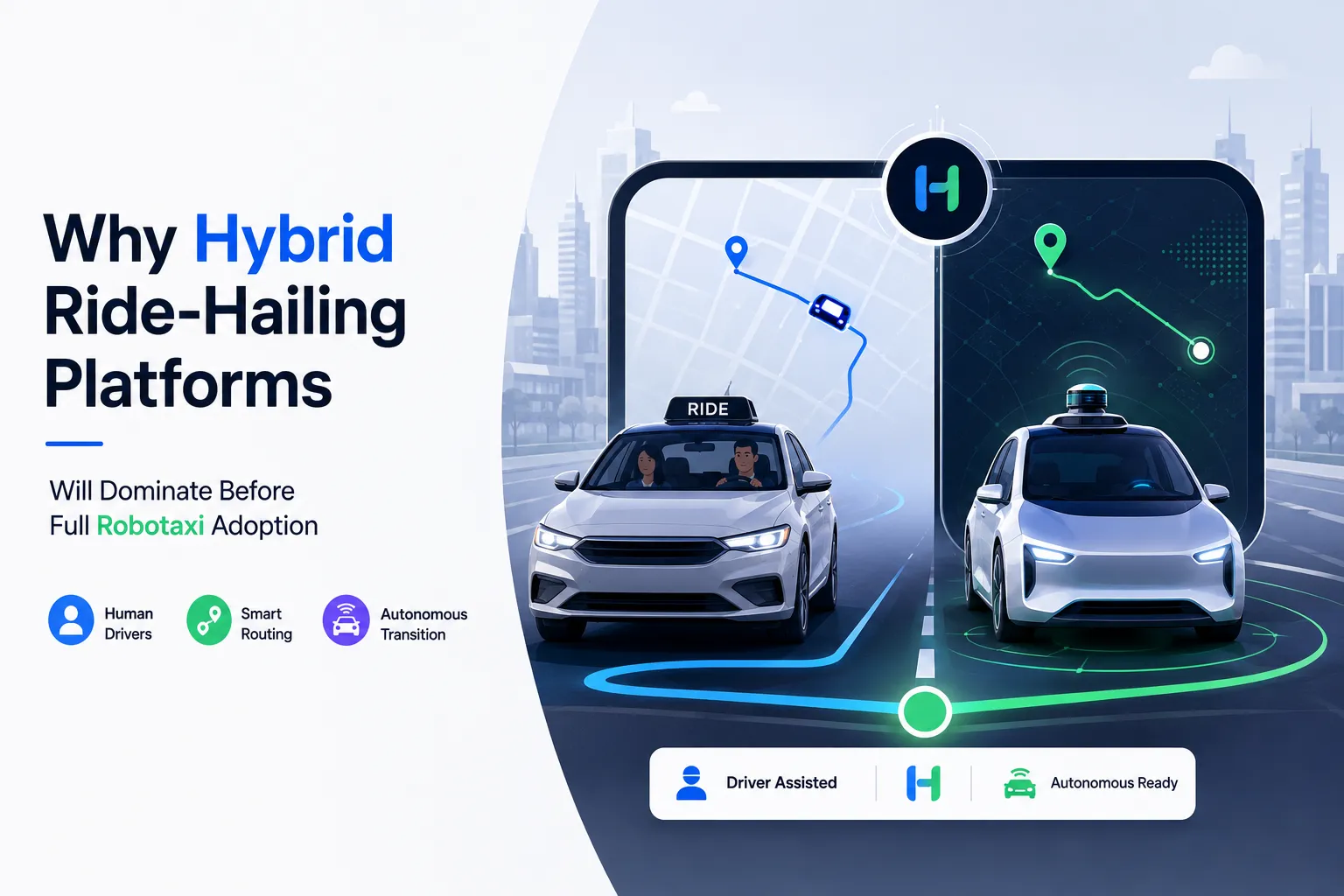
The future of ride-hailing is evolving differently from what the mobility industry once expected. Instead of a rapid transition toward fully autonomous robotaxi fleets, the market is moving toward hybrid ride-hailing platforms where human drivers and autonomous vehicles operate together within one coordinated mobility ecosystem.
This shift is happening because real-world transportation is far more complex than simple automation narratives suggest. Urban congestion, unpredictable traffic patterns, infrastructure limitations, weather disruptions, regional regulations, and passenger-support requirements still make complete robotaxi replacement difficult across many cities and transportation environments.
As a result, major ride-hailing companies are investing not only in autonomous vehicle technology, but also in AI dispatch systems, EV infrastructure, fleet intelligence, and scalable ride-sharing platform ecosystems capable of balancing both human-operated and autonomous transportation networks together.
Between 2026 and 2031, the companies likely to dominate ride-hailing will not simply focus on replacing drivers. They will build scalable mobility platforms capable of intelligently coordinating robotaxis, human drivers, electric fleets, routing systems, and real-time transportation demand within one operational ecosystem.
The future of ride-hailing is no longer just about automation alone. It is about orchestrating mobility infrastructure at scale.
Why the Robotaxi Revolution Will Take Longer Than Expected
Autonomous vehicle technology is advancing rapidly, but full robotaxi adoption is still moving much slower than many early predictions suggested. While AI-powered vehicles perform well in controlled environments, real-world transportation remains highly unpredictable and difficult to automate at scale.
Modern cities still face infrastructure limitations, inconsistent regulations, weather disruptions, complex traffic behavior, and operational edge cases that autonomous systems alone cannot fully handle. Human drivers continue providing flexibility in situations where real-time judgment, passenger support, and route adaptability are critical.
- Construction zones, emergency diversions, unpredictable pedestrian movement, and severe weather conditions still create major operational challenges for autonomous ride-hailing systems.
- Many suburban, rural, and developing regions also lack the infrastructure needed for large-scale robotaxi deployment, making human-operated mobility networks essential for broader transportation coverage.
Economics slow adoption further. Autonomous fleets require significant investment in vehicle hardware, AI systems, fleet monitoring, maintenance operations, and EV charging infrastructure. For most ride-hailing companies, replacing human drivers entirely is neither financially practical nor operationally stable in the near future.
This is why the next phase of ride-hailing will likely evolve through hybrid mobility systems where autonomous fleets and human drivers operate together rather than through immediate full automation.
Read More : How to Build a Ride-Hailing App like Uber : A Complete Guide
How Hybrid Ride-Hailing Systems Actually Work
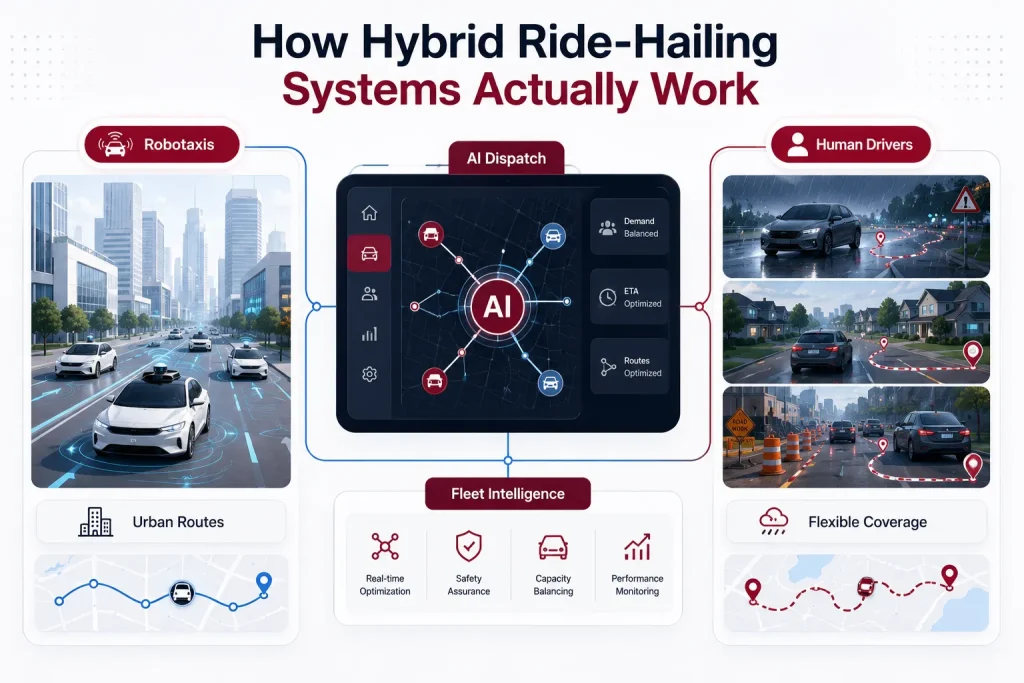
Hybrid ride-hailing systems combine autonomous fleets and human-driver networks within one coordinated mobility platform. Instead of relying entirely on robotaxis, these systems intelligently distribute transportation demand depending on traffic conditions, route complexity, passenger needs, and operational efficiency.
Autonomous vehicles are expected to dominate highly predictable environments such as airport routes, business districts, university zones, and dense city corridors where routing patterns remain structured and mapping accuracy is stronger. Human drivers continue handling routes where flexibility, customer interaction, and real-time adaptability remain critical.
This operational balance allows ride-hailing companies to expand autonomous mobility gradually without disrupting transportation reliability.
| Mobility Scenario | Robotaxi Advantage | Human Driver Advantage |
|---|---|---|
| Dense Urban Corridors | Structured routes and predictable traffic improve AV efficiency. | Useful during traffic disruptions or unexpected rerouting. |
| Airport Transfers | High-frequency repetitive routes suit autonomous systems. | Better for luggage assistance and customer interaction. |
| Construction-Heavy Areas | Limited performance in unstable routing conditions. | Human adaptability improves navigation reliability. |
| Suburban & Rural Routes | Less economically efficient due to lower demand density. | Flexible coverage without large infrastructure costs. |
| Late-Night Transportation | Efficient in mapped operational zones. | Passenger trust and flexibility remain important. |
As hybrid mobility expands, ride-hailing platforms are evolving beyond simple rider-driver marketplaces into intelligent transportation coordination systems capable of balancing autonomous fleets, EV operations, and human-driver networks together in real time.
Why Human Drivers Still Matter in Autonomous Ride-Hailing
One of the biggest misconceptions about autonomous transportation is that driving is fully predictable. In reality, urban mobility involves thousands of constantly changing situations that remain difficult for autonomous systems to handle consistently across every environment.
Human drivers continue to provide flexibility that robotaxi networks still struggle to replicate at scale.
Weather remains one of the biggest challenges. Heavy rain, fog, flooding, poor visibility, and rapidly changing road conditions can reduce the accuracy of sensors, cameras, and mapping systems used by autonomous vehicles. Human drivers are often better at adapting quickly in uncertain driving environments where conditions change in real time.
Construction-heavy areas create similar problems. Temporary lane changes, incomplete road markings, manual traffic control, and sudden route diversions can make autonomous navigation significantly more difficult, while human drivers can improvise more naturally.
Passenger interaction also continues to matter across many ride-hailing scenarios. Elderly passengers, tourists, children, disabled riders, and users requiring assistance often prefer human support, especially in situations where communication and situational judgment are important.
- In many cities, local navigation still depends heavily on human familiarity with temporary closures, pickup-point confusion, gated communities, and unstructured road systems that GPS alone may not handle accurately.
- Rural and low-density routes may also remain economically inefficient for robotaxi fleets for years, making human-operated transportation networks essential for broader mobility coverage.
This is why hybrid ride-hailing systems are currently more practical than fully autonomous fleets. Human drivers are no longer just a temporary workforce layer — they remain a critical operational component within modern mobility ecosystems.
As transportation becomes more complex, the strongest ride-hailing platforms will be the ones capable of coordinating both autonomous efficiency and human adaptability together.
Human Flexibility Still Solves the Problems Robotaxis Cannot
Autonomous transportation performs best in structured and predictable environments, but real-world mobility rarely operates under perfect conditions. Urban transportation constantly changes through weather disruptions, construction zones, traffic irregularities, route diversions, and passenger-specific situations that still require human adaptability.
This is where human drivers continue playing a critical role within modern ride-hailing ecosystems.
Severe weather remains one of the biggest operational challenges for autonomous systems. Heavy rain, fog, flooding, poor visibility, and unstable road conditions can reduce the reliability of sensors, cameras, and mapping systems that robotaxis depend on for navigation.
Construction-heavy areas create similar complexity. Temporary lane shifts, incomplete road markings, manual traffic control, and sudden diversions often require quick situational judgment that autonomous systems still struggle to manage consistently at scale.
Passenger experience also remains an important factor. Elderly riders, tourists, disabled passengers, children, and users requiring assistance frequently depend on human interaction in situations where communication and flexibility matter as much as transportation itself.
- In many cities, local navigation still depends heavily on driver familiarity with temporary closures, confusing pickup points, gated communities, and unstructured road systems that GPS data alone may not interpret accurately.
- Low-density suburban and rural routes may also remain economically impractical for robotaxi fleets for years, making human-operated transportation networks essential for broader mobility coverage.
As a result, hybrid ride-hailing systems are becoming more operationally realistic than fully autonomous networks. Human drivers are no longer just a temporary layer within mobility platforms — they remain a critical part of how large-scale transportation ecosystems function efficiently.
The strongest ride-hailing platforms over the next decade will not rely only on automation. They will combine autonomous efficiency with human adaptability to create more flexible and scalable mobility systems.
Fleet Orchestration Is Becoming More Important Than Driver Matching
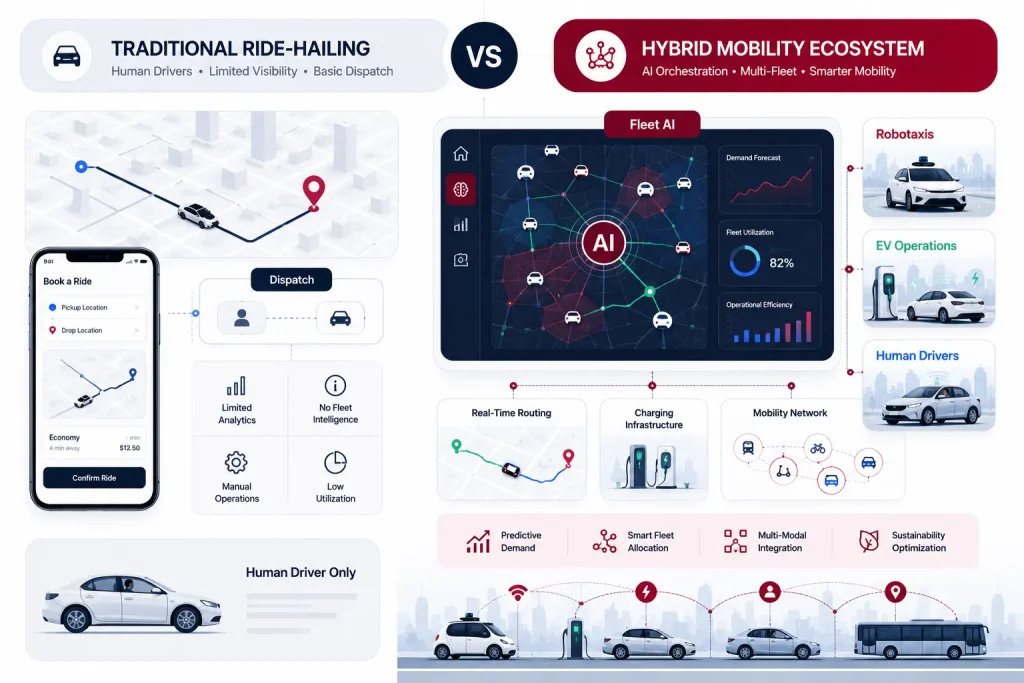
Traditional ride-hailing platforms were designed around one primary objective: connecting passengers with the nearest available driver. But hybrid mobility systems are changing that operational model completely.
Modern ride-hailing platforms must now coordinate autonomous fleets, EV operations, charging infrastructure, traffic intelligence, demand forecasting, and human-driver ecosystems simultaneously. This transition is shifting ride-hailing away from simple marketplace logic toward intelligent fleet orchestration infrastructure.
Instead of only asking “Which driver is closest?”, future mobility systems increasingly evaluate:
- route predictability
- battery availability
- operational zones
- traffic conditions
- transportation demand
- autonomous driving eligibility
- passenger preferences
This operational intelligence is becoming one of the most valuable components in future mobility ecosystems.
| Traditional Ride-Hailing | Hybrid Mobility Platforms |
|---|---|
| Driver-passenger matching focused | Real-time fleet orchestration across multiple mobility layers |
| Human-driver dependent | Balances robotaxis, EV fleets, and human drivers together |
| Basic dispatch systems | AI-powered predictive dispatch and routing intelligence |
| Limited operational analytics | Demand forecasting and transportation optimization systems |
| Simple transportation marketplace | Infrastructure-driven mobility ecosystem |
As hybrid transportation networks scale, the platforms likely to dominate ride-hailing will not simply own more vehicles. They will operate smarter mobility systems capable of coordinating transportation infrastructure dynamically across entire urban environments.
Ride-Hailing Platforms Are Evolving Into Mobility Infrastructure Systems
Ride-hailing companies are no longer operating as simple transportation marketplaces. As hybrid mobility expands, these platforms are gradually transforming into infrastructure-driven systems responsible for coordinating vehicles, routing intelligence, energy operations, and real-time urban transportation demand together.
This shift is happening because future mobility depends on much more than booking rides alone. Modern ride-hailing ecosystems increasingly manage operational layers that resemble transportation infrastructure rather than traditional app workflows.
Today’s platforms are beginning to coordinate:
- autonomous fleets
- EV charging operations
- predictive routing systems
- traffic intelligence
- fleet balancing
- multimodal transportation
- mobility APIs
- urban transportation analytics
The rise of electric mobility accelerates this transformation even further. EV fleets require platforms to manage charging availability, battery optimization, downtime scheduling, and route efficiency simultaneously. These operational responsibilities look far closer to infrastructure coordination than standard ride-booking management.
Autonomous vehicle integration adds another layer of complexity. Robotaxi systems depend heavily on:
- high-precision mapping
- remote fleet monitoring
- predictive maintenance
- operational zoning
- AI dispatch coordination
- safety redundancy systems
As these technologies scale, ride-hailing companies increasingly operate like mobility networks rather than software marketplaces.
This is also driving stronger partnerships between mobility platforms, automakers, charging providers, mapping companies, and AI infrastructure firms. The future of transportation depends on connected mobility ecosystems where infrastructure, intelligence, and operations work together seamlessly.
Over the next decade, the companies leading ride-hailing will not simply provide transportation convenience. They will manage intelligent mobility systems capable of coordinating vehicles, passengers, infrastructure, and urban movement in real time.
The Technologies Powering Hybrid Ride-Hailing Platforms
Hybrid ride-hailing platforms depend on multiple technologies working together.
AI-Based Dispatch Systems
AI dispatch helps platforms assign rides based on more than distance. It can consider traffic, demand, route difficulty, vehicle type, driver availability, and autonomous zone coverage.
Predictive Demand Forecasting
Predictive analytics helps platforms understand when and where ride demand will increase. This allows vehicles and drivers to be positioned before demand spikes.
Fleet Telematics
Fleet telematics helps track vehicle location, battery health, maintenance needs, usage patterns, and performance.
EV Charging Optimization
As electric fleets grow, platforms need charging-aware routing to reduce downtime and keep vehicles available during peak demand.
Real-Time Route Intelligence
Modern platforms need routing systems that can respond to closures, congestion, accidents, diversions, and changing city conditions.
Admin and Control Dashboards
Businesses need centralized dashboards to manage drivers, vehicles, payments, customers, service zones, analytics, and operational performance.
What This Means for Ride-Hailing Startups
For startups, the next opportunity is not just launching another taxi booking app. The better opportunity is building a platform that can support human drivers today, EV fleets tomorrow, and autonomous mobility when the market becomes ready.
A future-ready ride-hailing platform should include:
- Rider app
- Driver app
- Admin dashboard
- Fleet management system
- Real-time tracking
- Smart dispatch engine
- Payment integration
- Driver verification
- Fare management
- Analytics dashboard
- Zone-based operations
- EV-ready workflows
- Scalable backend architecture
Startups that build only for today’s ride-booking market may struggle later. But startups that build flexible mobility infrastructure can adapt as the industry moves toward hybrid and autonomous transportation.
Building Future-Ready Ride-Hailing Platforms
A future-ready ride-hailing platform must be designed for scalability from the beginning.
Businesses entering the mobility market are increasingly exploring scalable ride-hailing app platforms that can support hybrid transportation models, fleet coordination, EV operations, and future mobility expansion without building core infrastructure entirely from scratch.
It should support standard taxi booking operations, but also remain flexible enough for future business models such as:
- EV ride-hailing
- Corporate mobility
- Airport transfer platforms
- Fleet-based taxi businesses
- Subscription mobility
- Multimodal transportation
- Hybrid human-autonomous networks
- City-level mobility services
The backend architecture matters because future ride-hailing businesses will depend heavily on dispatch performance, analytics, fleet visibility, and operational control.
A weak platform may work for basic bookings, but it will struggle when the business expands into fleet management, EV operations, or multi-city mobility.t simply operate ride-booking apps. They will build scalable transportation ecosystems capable of coordinating infrastructure, intelligence, fleets, and real-time mobility operations together.
How Miracuves Helps Businesses Build Future-Ready Mobility Platforms
As the ride-hailing industry evolves beyond traditional taxi-booking applications, businesses increasingly need scalable mobility infrastructure capable of supporting long-term transportation transformation.
This is where Miracuves helps businesses launch future-ready ride-hailing platforms designed for modern mobility ecosystems.
Instead of focusing only on rider-driver matching workflows, scalable mobility platforms now require:
- intelligent dispatch systems
- fleet coordination infrastructure
- driver and rider management
- EV-ready operational workflows
- analytics dashboards
- payment ecosystems
- real-time operational intelligence
- centralized admin controls
Miracuves helps businesses reduce the complexity of building these foundational systems from scratch while supporting scalable transportation operations that can evolve alongside future mobility trends.
For startups exploring hybrid ride-hailing systems, EV-based transportation, or next-generation mobility infrastructure, the goal is no longer simply to launch another taxi app. The market is moving toward intelligent mobility coordination platforms capable of balancing autonomous fleets, human drivers, transportation analytics, and operational scalability together within one ecosystem. Businesses looking to build scalable hybrid mobility systems can connect with ride-sharing platform experts to explore future-ready transportation infrastructure and mobility platform development strategies.
Miracuves delivers ready-to-launch solutions in 6 days, helping businesses enter the mobility market faster with scalable ride-hailing infrastructure built for long-term growth.
Conclusion
The future of ride-hailing will not be shaped by fully autonomous transportation alone. Over the next decade, the industry will likely evolve through hybrid mobility ecosystems where robotaxis and human drivers operate together within intelligent platform networks.
Autonomous fleets will continue expanding across structured urban environments where routing conditions and infrastructure support automation efficiently. But human drivers will remain essential across many transportation scenarios involving flexibility, passenger interaction, unpredictable routing, and operational edge cases.
This transition is fundamentally changing the role of ride-hailing platforms themselves.
What began as simple ride-booking applications is evolving into large-scale mobility infrastructure capable of coordinating vehicles, routing intelligence, EV operations, transportation analytics, and real-time urban movement together.
The companies that dominate the next phase of mobility will not simply own the largest fleets or deploy the fastest robotaxis. They will build the most intelligent hybrid transportation ecosystems capable of balancing automation, operational efficiency, and human adaptability at scale.
FAQs
What is a hybrid ride-hailing platform?
A hybrid ride-hailing platform combines autonomous vehicles and human drivers within one mobility system to improve operational flexibility and transportation coverage.
Will robotaxis completely replace human drivers?
Not anytime soon. Human drivers still handle unpredictable traffic conditions, customer interaction, rural coverage, and operational edge cases that autonomous systems struggle with.
Why are hybrid mobility systems becoming more popular?
They allow ride-hailing companies to expand autonomous transportation gradually while maintaining reliability through human-driver networks.
What technologies power hybrid ride-hailing platforms?
AI dispatch systems, fleet analytics, predictive routing, EV infrastructure, telematics, and real-time traffic intelligence are some of the core technologies behind hybrid mobility platforms.
How are ride-hailing platforms evolving beyond taxi apps?
Modern platforms are becoming mobility infrastructure systems that coordinate fleets, EV operations, routing intelligence, analytics, and multimodal transportation ecosystems.
How can startups build future-ready ride-hailing platforms?
Startups should focus on scalable dispatch architecture, fleet management systems, EV-ready workflows, operational analytics, and hybrid mobility coordination capabilities.
Miracuves is an independent software development company. We are not affiliated with, connected to, sponsored by, or endorsed by any company or product named in this article.
Terms such as “X Clone” are used descriptively. It is how the software industry refers to building a platform with functionality comparable to a known service, and how clients search for it.
The entire design and codebase of our products is built by our own team. Our products contain no code, design, graphics, or content originating from any third-party website or applications.
All third-party names and marks referenced in this article are the property of their respective owners, referenced solely to identify the services discussed.