

Key Takeaways
What You’ll Learn
- GrabMart works as a hyperlocal grocery delivery platform connecting local stores, dark stores, and delivery partners in one fast-commerce ecosystem.
- Merchant commissions form the largest revenue layer, making store-side monetization central to the business model.
- Delivery fees, platform fees, and small-basket charges add important customer-side revenue on every order.
- Subscriptions, sponsored listings, and brand partnerships help increase retention while expanding revenue beyond basic order commissions.
- The model depends on frequency, logistics efficiency, and order density to scale profitably across urban grocery markets.
Stats That Matter
- The article estimates 2025 GMV at around $1.4–1.6 billion for GrabMart alone.
- Estimated net revenue contribution is roughly $380–450 million, with year-over-year growth of about 25–30%.
- Merchant commissions contribute about 45% of revenue, while delivery and service fees contribute about 25%.
- Subscriptions account for about 10%, while sponsored listings and ads contribute about 12% of total revenue.
- Average order value is estimated at $18–25, and the article places mature-city profit margins around 8–12%.
Real Insights
- Commission + fee hybrid monetization makes the model more resilient than depending on only one revenue source.
- Subscription-led retention helps increase repeat orders and improves customer lifetime value.
- Merchant advertising and sponsored placements create high-margin upside inside the grocery app itself.
- Hyperlocal logistics and data-driven pricing are critical because grocery delivery success depends on speed, density, and smart fulfillment economics.
- Long-term growth depends on high order frequency, strong merchant supply, and efficient last-mile delivery operations.
GrabMart is Grab’s on-demand grocery delivery platform across Southeast Asia, connecting local stores, dark warehouses, and delivery partners through a single ecosystem focused on speed and convenience.
By 2026, grocery has become one of Grab’s fastest-growing verticals as consumers shift from occasional food orders to frequent purchases of daily essentials, driving higher order frequency and repeat usage.
For founders building hyperlocal or instant-commerce platforms, GrabMart’s revenue model offers practical insights into monetizing frequency, optimizing logistics, and scaling profitably across dense urban markets.
GrabMart Revenue Overview – The Big Picture
GrabMart operates under Grab Holdings Ltd, whose Deliveries segment (food + grocery) is the company’s largest revenue contributor.
2026 Key Metrics (Estimated):
- 2026 GMV (GrabMart only): ~$1.4–1.6 billion
- 2026 Net Revenue Contribution: ~$380–450 million
- Grab Holdings Valuation: ~$18–20 billion
- YoY Growth (GrabMart): ~25–30%
- Primary Markets: Singapore, Indonesia, Malaysia, Vietnam, Thailand, Philippines
- Average Order Value: $18–25
- Profit Margin (mature cities): 8–12%
- Main Competitors: GoMart, ShopeeMart, Lazada, Amazon Fresh (select markets)
Read More: What is GrabMart and How Does It Work?
Primary Revenue Streams Deep Dive
Revenue Stream #1: Merchant Commission Fees
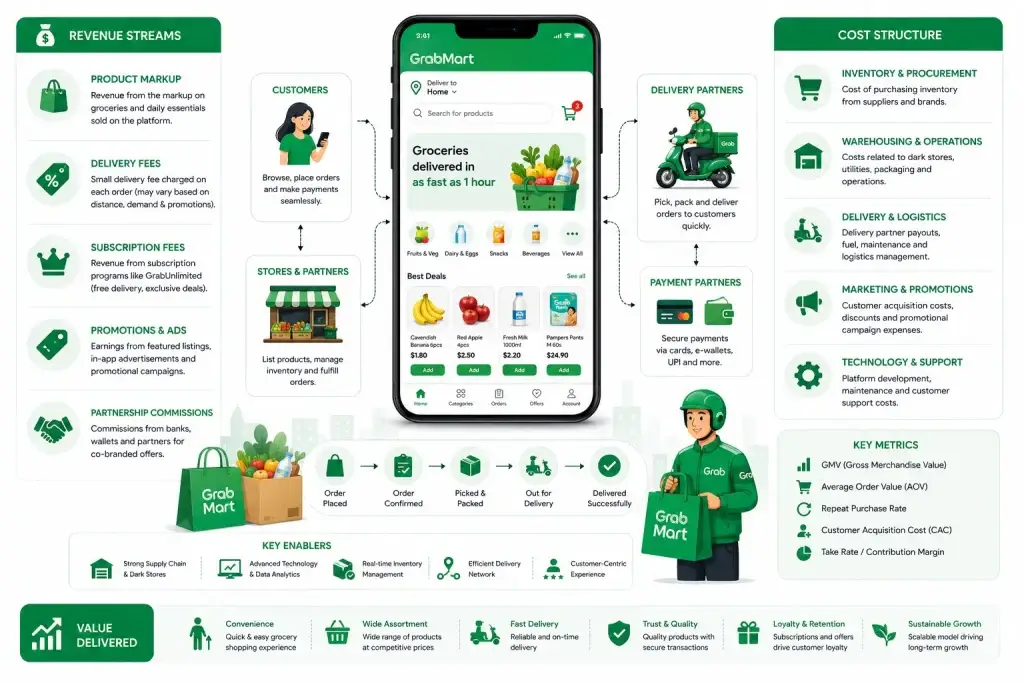
GrabMart earns a commission from grocery stores, supermarkets, and dark stores.
- Commission Range: 10–25% per order
- Revenue Share: ~45%
- Pricing Logic: Higher commission for high-demand or fast-delivery merchants
Revenue Stream #2: Delivery & Service Fees
Paid by customers per order.
- Delivery Fee: $1–4 (dynamic)
- Platform Fee: $0.50–1.50
- Revenue Share: ~25%
Revenue Stream #3: GrabUnlimited Subscriptions
Subscription model driving retention and frequency.
- Monthly Price: ~$3–5
- Benefits: Free deliveries, discounts
- Revenue Share: ~10%
Revenue Stream #4: Sponsored Listings & Ads
Merchants pay to boost visibility inside the app.
- CPC / CPA based ads
- Revenue Share: ~12%
- High-margin revenue
Revenue Stream #5: Data & Partner Promotions
Brand promotions, FMCG partnerships, analytics insights.
- Revenue Share: ~8%
Revenue streams percentage breakdown
| Revenue Stream | Description | % of Total Revenue (2026) |
|---|---|---|
| Merchant Commission Fees | Percentage charged to grocery stores & dark stores | 45% |
| Delivery & Service Fees | Customer-paid delivery, platform, and small-order fees | 25% |
| Subscriptions (GrabUnlimited) | Monthly plans offering free deliveries & discounts | 10% |
| Sponsored Listings & In-App Ads | Paid merchant promotions and featured placements | 12% |
| Data Partnerships & Brand Deals | FMCG promotions, analytics, co-marketing campaigns | 8% |
| Total | 100% |
The Fee Structure Explained
User-Side Fees
- Delivery fee
- Small basket fee
- Surge pricing during peak hours
- Subscription upsell
Provider-Side Fees
- Commission on orders
- Sponsored placement fees
- Promotional campaign fees
Hidden Revenue Layers
- Supplier-funded discounts
- Margin on private-label products
Regional Pricing Variation
Urban markets see higher AOV and lower delivery fees; tier-2 cities rely more on commissions.
Complete fee structure by user type
| User Type | Fee Category | What It Covers | Typical Pricing (2026) | When It Applies |
|---|---|---|---|---|
| Customer (Buyer) | Delivery Fee | Last-mile delivery cost (distance/time based) | $1.00–$4.00 per order | Every order; varies by distance, demand, weather |
| Customer (Buyer) | Platform / Service Fee | App convenience + operations support | $0.50–$1.50 per order | Most orders (can vary by market/promotions) |
| Customer (Buyer) | Small Basket Fee | Extra charge for low AOV orders to protect margins | $0.50–$2.00 | If cart value is below a threshold (e.g., <$10–$15) |
| Customer (Buyer) | Surge / Peak Pricing | Dynamic uplift to manage demand & rider supply | +10%–40% on delivery fee | Peak hours, heavy rain, holidays, shortages |
| Customer (Buyer) | Priority / Express Add-On | Faster delivery slot / instant dispatch | $0.50–$2.50 | Optional upgrade (availability varies) |
| Customer (Buyer) | Tip (Optional) | Customer-paid gratuity to delivery partner | 100% optional | Optional; passed to rider/driver (platform may not take a cut) |
| Customer (Buyer) | Subscription (GrabUnlimited) | Free/discounted deliveries + exclusive deals | $3–$5/month | Optional; reduces per-order fees for frequent users |
| Customer (Buyer) | Cancellation / No-Show Fee | Compensation for wasted rider time/merchant prep | $1–$5 | If late cancellation after dispatch or no-show cases |
How GrabMart Maximizes Revenue Per User
GrabMart focuses heavily on frequency-based monetization.
- Smart customer segmentation
- Subscription-driven upselling
- Cross-selling food + grocery orders
- AI-based dynamic pricing
- Reorder reminders & cart nudges
- Retention rewards via GrabRewards
- Optimized LTV through weekly usage
Example:
A subscribed household ordering twice weekly generates 3× more lifetime revenue than a casual user.
Cost Structure & Profit Margins
Major Costs
- Delivery partner incentives
- Cloud infrastructure & mapping APIs
- Customer acquisition (discounts, vouchers)
- Operations & merchant onboarding
- Product & AI development
Unit Economics
- Contribution margin positive in core cities
- Break-even achieved after ~15–18 orders per user
Profitability Path
- Higher subscription penetration
- Reduced incentives
- Private-label expansion
Future Revenue Opportunities & Innovations
New Revenue Streams
- Private-label groceries
- B2B bulk grocery delivery
- Dark store franchising
AI/ML Monetization
- Predictive demand pricing
- Smart inventory partnerships
Market Expansion
- Tier-2 cities
- Rural fulfillment hubs
Risks & Threats
- Thin margins
- High logistics costs
- Regulatory pressure
Founder Opportunities
Lessons for Entrepreneurs & Your Opportunity
What Works:
- Commission + fee hybrid model
- Subscription-led retention
- Merchant advertising monetization
What to Replicate:
- Hyperlocal logistics
- Data-driven pricing
- Frequency-first design
Market Gaps:
- Regional grocery brands
- Faster rural fulfillment
- B2B grocery supply
Founder Improvements:
- Lower-cost delivery models
- Community-driven sourcing
Miracuves GrabMart-Like Grocery Delivery Platform Solution Cost and Tech Stack
Miracuves Pricing for a GrabMart-Like Grocery Delivery Platform developed using Node.js / React.js Architecture starts at $3,999. Contact Miracuves for custom pricing based on platform features, scalability requirements, integrations, and deployment scope. Estimated delivery timeline: 15-30 days, extending to 45-60 days for larger scope.
Build a powerful grocery delivery and quick commerce platform designed for startups, supermarkets, grocery chains, delivery businesses, and enterprise retail operations.
Core Workflows: Grocery product listings, online ordering systems, inventory management, delivery tracking, customer shopping workflows, payment processing, and quick commerce operations.
Built-in Commerce Operations: Real-time inventory synchronization, delivery partner management, dynamic pricing systems, order tracking, transaction monitoring, customer notifications, loyalty systems, and retail analytics reporting.
Management Hub: Admin dashboards, store management systems, delivery partner controls, inventory analytics, reporting dashboards, customer support workflows, audit logs, and centralized grocery operations management.
Enterprise-Ready: Fully customizable architecture prepared for secure scaling, multi-store operations, high-volume order management, cloud infrastructure expansion, enterprise retail ecosystems, and long-term platform growth.
Why does a GrabMart-Like Platform require Node.js / React.js architecture?
Grocery delivery platforms process real-time orders, inventory updates, delivery operations, payment workflows, and concurrent customer-delivery interactions. These platforms require scalable infrastructure, low-latency processing, and highly responsive interfaces across web and mobile ecosystems.
We recommend a modern JavaScript-based architecture for this type of platform because:
Built for Real-Time Operations: Node.js enables scalable backend operations for live order processing, inventory synchronization, delivery tracking, payment workflows, and concurrent retail activities.
Advanced Dashboard Experience: React.js supports highly interactive interfaces for grocery browsing, order tracking, delivery management, analytics reporting, and seamless customer shopping experiences.
Enterprise Scalability: This architecture is well-suited for handling high order volumes, multi-store retail ecosystems, delivery fleet operations, and rapidly growing quick commerce platforms.
Flexible Integration Layer: Easily integrates with payment gateways, POS systems, GPS tracking tools, CRM platforms, analytics systems, inventory management software, and third-party delivery services.
You get a scalable, enterprise-grade grocery delivery platform designed for long-term operational growth.
Note: Final pricing depends on platform modules, delivery workflows, third-party integrations, deployment infrastructure, payment systems, and custom workflow development.
If you want to launch sooner, our ready-made quick-commerce delivery app starts at $2,499 and is delivered in 6 days. It is not a copy of GrabMart. Dark-store inventory tools and multi-warehouse routing are scoped as custom work.
Conclusion
GrabMart demonstrates that grocery delivery can evolve into a scalable, profitable business when built around daily-use behavior.
Its success comes from high-order frequency, data-led pricing, and strong merchant monetization—not one-off transactions.
For founders, the key takeaway is simple: repeat usage, tight unit economics, and subscriptions drive sustainable growth.
FAQs
How much does GrabMart make per transaction?
Typically $2–5 per order after commissions and fees.
What’s GrabMart’s most profitable revenue stream?
Merchant commissions and sponsored listings.
What percentage does GrabMart take from providers?
Around 10–25% depending on merchant category.
How has GrabMart’s revenue model evolved?
Shifted from discounts to subscriptions and ads.
Can small platforms use similar models?
Yes, at a regional or city scale.
What’s the minimum scale for profitability?
Roughly 10,000+ monthly active users per city.
How to implement similar revenue models?
Combine commissions, delivery fees, and ads.
What are alternatives to GrabMart’s model?
Inventory-led or B2B grocery platforms.
Miracuves is an independent software development company. We are not affiliated with, connected to, sponsored by, or endorsed by any company or product named in this article.
Terms such as “X Clone” are used descriptively. It is how the software industry refers to building a platform with functionality comparable to a known service, and how clients search for it.
The entire design and codebase of our products is built by our own team. Our products contain no code, design, graphics, or content originating from any third-party website or applications.
All third-party names and marks referenced in this article are the property of their respective owners, referenced solely to identify the services discussed.