
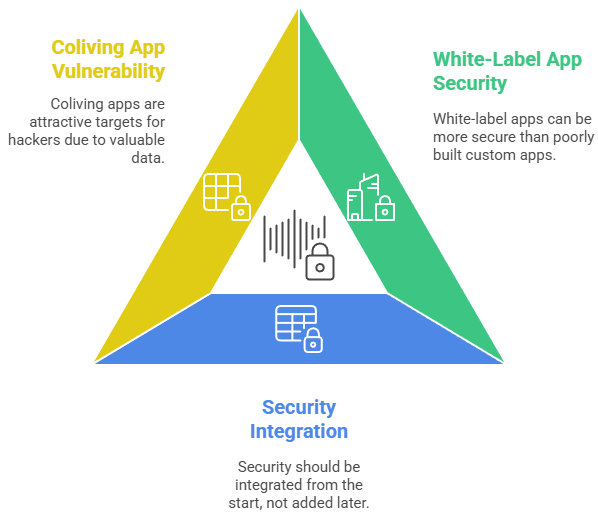
You’ve probably heard the horror stories—user data leaks, payment fraud, or apps getting shut down due to compliance failures. When you’re planning a white-label Habyt-style app, the biggest question isn’t features or design. It’s safety.
In 2025, coliving and rental apps handle sensitive data every day—identity proofs, payment details, location data, and lease documents. One security mistake can damage trust, invite legal penalties, and permanently hurt your brand.
This guide gives you an honest, no-hype assessment of white-label Habyt app security—what risks actually exist, what standards truly matter, and how to build a platform that users and regulators trust.
I’ll also show how security-first providers like Miracuves approach white-label app safety differently—by designing protection into the architecture, not adding it later.
Understanding White-Label Habyt App Security Landscape
What “White-Label Habyt App Security” Really Means
When people hear “white-label,” they often assume security is weaker or generic. In reality, white-label Habyt app security depends entirely on how the app is built, deployed, and maintained.
A secure white-label Habyt-style app means:
- Pre-built architecture designed with security controls
- Configurable access rules for tenants, landlords, and admins
- Compliance-ready data handling from day one
- Continuous monitoring after launch
Security is not about whether the app is white-label—it’s about how seriously the provider treats risk and compliance.
Why People Worry About White-Label Habyt Apps
The concern is not imaginary. Founders worry because:
- Apps store government IDs and contracts
- Monthly rent and deposits involve recurring payments
- Location tracking exposes resident movement data
- Multiple stakeholders access the same platform
If security roles are unclear, misuse and breaches become easy.
Current Threat Landscape for Habyt-Style Apps
In 2025, the most common threats for coliving and rental apps include:
- Account takeovers through weak authentication
- Data scraping of tenant profiles
- Payment fraud via insecure APIs
- Admin panel exploitation
- Insider misuse due to poor access control
According to global app security reports, over 62% of real estate and rental apps faced at least one critical vulnerability in the last two years, mostly related to authentication and API security.
Security Standards That Matter in 2025
Modern white-label Habyt-style apps are expected to follow:
- Zero-trust access principles
- Encrypted data at rest and in transit
- Role-based access control (RBAC)
- Continuous vulnerability scanning
- Region-specific data protection compliance
Security today is no longer optional—it’s a baseline requirement for app survival.
Key Security Risks & How to Identify Them
Data Protection & Privacy Risks
Habyt-style apps process extremely sensitive resident data. This makes data protection the highest-risk area.
User Personal Information
- Government ID proofs
- Contact details
- Employment and income information
- Lease agreements and documents
If this data is stored without encryption or proper access control, a single breach can expose thousands of users.
Payment Data Security
- Monthly rent payments
- Security deposits
- Refund processing
Apps that don’t follow PCI DSS standards risk card data leaks and payment fraud. Tokenization and secure payment gateways are mandatory, not optional.
Location Tracking Concerns
- Property location mapping
- Resident check-ins
- Maintenance visit tracking
Without strict permissions, location data can be abused internally or leaked externally.
GDPR / CCPA Compliance Gaps
Common mistakes include:
- No explicit user consent tracking
- Poor data deletion workflows
- Lack of data access logs
These gaps directly lead to regulatory penalties.
Technical Vulnerabilities
Code Quality Issues
- Hardcoded credentials
- Poor input validation
- Insecure file uploads
Low-quality code is the root cause of most app breaches.
Server Security Gaps
- Misconfigured cloud storage
- Open admin ports
- Weak firewall rules
Even a secure app becomes vulnerable if the infrastructure is poorly managed.
API Vulnerabilities
Habyt-style apps rely heavily on APIs for:
- Property listings
- Payments
- Booking management
Unsecured APIs are the #1 attack vector in modern apps.
Third-Party Integrations
- Payment gateways
- KYC services
- Mapping tools
If third-party vendors are not vetted, your app inherits their risks.
Business-Level Security Risks
Legal Liability
A breach can make you legally responsible for:
- Data misuse
- Regulatory violations
- Financial damages
Reputation Damage
Trust is everything in coliving platforms. One security incident can permanently reduce bookings.
Financial Losses
- Chargebacks
- Legal fees
- Recovery costs
- Customer churn
Regulatory Penalties
Non-compliance with GDPR or local data laws can result in heavy fines.
White-Label Habyt App Risk Assessment Checklist
- Is all user data encrypted?
- Are payment flows PCI DSS compliant?
- Are APIs authenticated and rate-limited?
- Is access role-based and logged?
- Are regular security audits conducted?
- Is there an incident response plan?
If you answer “no” to even one of these, your app carries high risk.
Security Standards Your White-Label Habyt App Must Meet
In 2025, security is no longer about best effort. A white-label Habyt-style app must meet recognized global standards to be considered safe, scalable, and legally compliant.
Essential Security Certifications
ISO 27001 Compliance
ISO 27001 ensures that the provider follows a structured Information Security Management System (ISMS).
It covers:
- Data access control
- Risk management processes
- Incident response frameworks
- Continuous security improvement
For a Habyt-style app handling tenant identities and contracts, ISO 27001 is a foundational requirement.
SOC 2 Type II
SOC 2 Type II focuses on how security controls perform over time, not just on paper.
It validates:
- Data confidentiality
- System availability
- Processing integrity
- Ongoing monitoring
This certification is critical for investor trust and enterprise partnerships.
GDPR Compliance
If your app serves users in Europe—or stores EU citizen data—GDPR compliance is mandatory.
Key requirements include:
- Explicit user consent
- Right to access and delete data
- Data minimization
- Breach notification protocols
HIPAA (If Applicable)
If your Habyt-style app includes:
- Health-related accommodations
- Assisted living features
HIPAA compliance becomes relevant for protecting sensitive medical data.
PCI DSS for Payments
Any app handling rent, deposits, or subscriptions must comply with PCI DSS standards.
This ensures:
- Secure card processing
- Tokenized payment storage
- Reduced fraud exposure
Technical Security Requirements
End-to-End Encryption
All data must be encrypted:
- In transit using TLS/SSL
- At rest using industry-standard encryption algorithms
Secure Authentication
Strong authentication mechanisms include:
- Two-factor authentication
- OAuth-based login systems
- Role-based access control for admins, landlords, and tenants
Regular Security Audits
Annual or quarterly audits help identify:
- New vulnerabilities
- Configuration drift
- Compliance gaps
Penetration Testing
Ethical hacking simulates real-world attacks to expose weaknesses before criminals do.
Secure API Design
APIs must include:
- Authentication tokens
- Rate limiting
- Input validation
- Access logging
Security Standards Comparison Table
| Security Area | Minimum Requirement | Enterprise-Grade Standard |
|---|---|---|
| Data Storage | Basic encryption | Encrypted + access logs |
| Payments | Gateway integration | PCI DSS + tokenization |
| Authentication | Password-based | 2FA + OAuth |
| Compliance | Privacy policy | GDPR + ISO 27001 |
| Monitoring | Manual checks | 24/7 automated alerts |
A truly secure white-label Habyt app meets enterprise-grade standards across all layers, not just at the surface.
Read more : – Business Model of Habyt : Complete Strategy Breakdown 2025
Red Flags – How to Spot Unsafe White-Label Providers
Choosing the wrong white-label app provider is the fastest way to introduce security risk into your business. Many breaches don’t happen because apps are attacked—they happen because warning signs were ignored early.
Major Warning Signs You Should Never Ignore
No Security Documentation
If a provider cannot clearly explain:
- How data is stored
- How access is controlled
- How breaches are handled
It usually means security was never designed properly.
Unusually Cheap Pricing Without Explanation
Security has real costs—audits, monitoring, compliance, and infrastructure.
Extremely low pricing often means:
- No penetration testing
- No regular updates
- No dedicated security team
No Compliance Certifications
If a provider claims “we follow best practices” but has:
- No ISO 27001
- No SOC 2
- No GDPR framework
You are accepting unverified risk.
Outdated Technology Stack
Old frameworks and unsupported libraries are common attack targets.
A modern Habyt-style app must run on actively maintained technology.
Poor Code Quality
Signs include:
- Frequent bugs
- Slow performance
- Inconsistent behavior across devices
These often indicate deeper security flaws.
No Security Update Policy
Security is not a one-time setup.
If updates are not scheduled and documented, vulnerabilities will accumulate.
Lack of Data Backup Systems
Without secure backups:
- Ransomware attacks can destroy data
- Recovery becomes slow and expensive
No Insurance Coverage
Professional providers carry:
- Cyber liability insurance
- Errors and omissions coverage
Lack of insurance shifts all risk to you.
White-Label Habyt App Provider Evaluation Checklist
Questions to Ask Before Signing
- How is user data encrypted?
- Who has access to production systems?
- How often are security audits conducted?
- What is the incident response timeline?
- How are third-party vendors vetted?
Documents You Should Request
- Security architecture overview
- Compliance certificates
- Data processing agreements
- Penetration test reports
- Backup and recovery policy
Testing Procedures to Verify Claims
- Request demo access to admin panels
- Review API authentication flows
- Test role-based access controls
- Verify payment security flows
Due Diligence Steps
- Independent security review
- Legal compliance validation
- Infrastructure assessment
- Contractual security clauses
If a provider hesitates on any of these points, it’s a clear signal to walk away.
Best Practices for Secure White-Label Habyt App Implementation
Security only works when it is applied systematically, not in isolation. A white-label Habyt-style app must follow a clear security lifecycle—from planning to post-launch operations.
Pre-Launch Security Practices
Security Audit Process
Before launch, the app should undergo:
- Architecture-level security review
- Data flow analysis
- Threat modeling for user, admin, and payment systems
This ensures risks are identified before real users are involved.
Code Review Requirements
Every critical module must be reviewed for:
- Secure coding standards
- Input validation
- Authentication handling
- Error exposure
Unchecked code is the most common entry point for attackers.
Infrastructure Hardening
Secure deployment includes:
- Private cloud networking
- Firewall and WAF configuration
- Secure storage buckets
- Restricted admin access
Infrastructure security is as important as app security.
Compliance Verification
Before onboarding users:
- GDPR consent flows must be tested
- Payment compliance validated
- Data retention policies enforced
Compliance gaps discovered after launch are costly to fix.
Staff Training Programs
Internal teams must understand:
- Secure access practices
- Phishing and social engineering risks
- Incident escalation procedures
Human error remains a top security risk.
Post-Launch Security Monitoring
Continuous Security Monitoring
Real-time monitoring helps detect:
- Unauthorized access attempts
- Suspicious payment activity
- API abuse
- Data exfiltration attempts
Regular Updates and Patches
Security vulnerabilities evolve constantly.
Updates must be:
- Scheduled
- Tested
- Documented
- Deployed without downtime
Incident Response Planning
A clear plan should define:
- Detection timelines
- User notification process
- Regulatory reporting steps
- Recovery actions
User Data Management
Best practices include:
- Minimal data collection
- Automated data deletion
- Secure data exports
- Access logging
Backup and Recovery Systems
A secure Habyt-style app must have:
- Encrypted backups
- Geo-redundant storage
- Regular recovery testing
Security Implementation Timeline
| Phase | Key Security Activities |
|---|---|
| Planning | Risk assessment, architecture design |
| Development | Secure coding, internal reviews |
| Pre-Launch | Audits, penetration testing |
| Launch | Monitoring activation |
| Post-Launch | Updates, compliance checks |
Security is not a milestone—it’s an ongoing responsibility.
Legal & Compliance Considerations
Security is not only a technical responsibility—it’s a legal obligation. A white-label Habyt-style app operates across contracts, payments, and personal data, which places it directly under multiple regulatory frameworks.
Regulatory Requirements by Region
Data Protection Laws
Depending on where your users are located, your app must comply with:
- GDPR (Europe):
Requires lawful data processing, explicit consent, data portability, and breach reporting within strict timelines. - CCPA / CPRA (United States):
Gives users the right to know, delete, and opt out of data sharing. - DPDP Act (India):
Mandates purpose limitation, consent-based data usage, and secure storage of personal data.
Failure to comply can result in heavy penalties and operational restrictions.
Industry-Specific Regulations
Habyt-style apps may also fall under:
- Rental and housing regulations
- Consumer protection laws
- Digital payment regulations
- Electronic contract validity rules
Ignoring these can invalidate agreements stored within the app.
User Consent Management
Legally compliant apps must:
- Capture explicit consent
- Allow consent withdrawal
- Log consent history
- Update users on policy changes
Consent cannot be assumed or hidden in fine print.
Privacy Policy Requirements
Your privacy policy must clearly state:
- What data is collected
- Why it is collected
- How long it is retained
- Who it is shared with
- How users can request deletion
Terms of Service Essentials
Strong terms of service protect your business by defining:
- User responsibilities
- Acceptable use
- Liability limitations
- Dispute resolution mechanisms
Liability Protection Measures
Insurance Requirements
A secure white-label Habyt app business should carry:
- Cyber liability insurance
- Data breach insurance
- Professional indemnity coverage
Insurance does not replace security, but it limits financial damage.
Legal Disclaimers
Clear disclaimers help manage expectations around:
- Service availability
- Data accuracy
- Third-party integrations
User Agreements
Well-drafted agreements define:
- Data ownership
- Usage rights
- Termination conditions
- Breach response responsibilities
Incident Reporting Protocols
In case of a breach:
- Users must be notified within legal timelines
- Regulators may need formal reports
- Internal logs must be preserved for investigation
Ongoing Compliance Monitoring
Compliance is not static. Laws change, and apps must adapt through:
- Regular legal reviews
- Policy updates
- Internal audits
Compliance Checklist by Region
| Region | Key Compliance Requirements |
|---|---|
| Europe | GDPR, data residency, breach reporting |
| USA | CCPA/CPRA, consumer data rights |
| India | DPDP Act, consent-based processing |
| Global | Secure contracts, payment compliance |
Legal compliance is not optional—it defines whether your app can legally operate.
Why Miracuves White-Label Habyt App Is Your Safest Choice
When it comes to coliving and rental platforms, security cannot be an afterthought. At Miracuves, security is treated as a core product feature, not an optional add-on. This approach is what separates a risky white-label app from an enterprise-ready Habyt-style platform.
Miracuves Security-First Architecture
Enterprise-Grade Security by Design
Miracuves white-label Habyt apps are built with:
- Secure-by-default architecture
- Role-based access control across all modules
- Encrypted data storage and transmission
- Isolated tenant environments for data safety
Security decisions are made at the architecture level, not patched later.
Regular Audits and Compliance Validation
Miracuves follows a continuous compliance model:
- ISO 27001-aligned security processes
- SOC 2 Type II-ready infrastructure
- GDPR and CCPA compliance built into user flows
- PCI DSS-compliant payment handling
This ensures your app stays compliant as regulations evolve.
Always-On Security Monitoring
Your platform benefits from:
- 24/7 security monitoring
- Automated threat detection
- Real-time alerting for suspicious activity
- Proactive vulnerability remediation
Problems are detected early—before they become public incidents.
Secure Payment and Financial Data Handling
All financial transactions follow:
- Tokenized payment processing
- Secure gateway integrations
- No direct card data storage
- Fraud prevention controls
This significantly reduces financial and legal exposure.
Continuous Updates and Patch Management
Miracuves maintains:
- Regular security updates
- Framework and dependency upgrades
- API security enhancements
- Ongoing performance hardening
Your app does not age into vulnerability.
Insurance and Risk Coverage
Miracuves-backed projects include:
- Professional security practices
- Risk mitigation frameworks
- Coverage alignment for cyber liability
This adds an extra layer of business protection.
Why Businesses Trust Miracuves
With 600+ successful deployments across multiple industries, Miracuves white-label apps have maintained zero major security breach incidents—because safety is engineered, not assumed.
Final Thought
Don’t compromise on security. Miracuves white-label Habyt app solutions come with enterprise-grade protection built in from day one. Get a free security assessment and see why businesses trust Miracuves for safe, compliant platforms.
A white-label app can be just as secure as a custom-built platform when it is designed with the right architecture, standards, and ongoing monitoring. Choosing a security-first provider like Miracuves ensures your app is built to protect users, comply with regulations, and scale safely without hidden risks.
FAQs
1. How secure is a white-label Habyt app compared to custom development?
A professionally built white-label Habyt app can be as secure as, or even more secure than, custom development when it follows certified security standards and regular audits.
2. What happens if there is a security breach?
A secure app must have an incident response plan that includes rapid containment, user notification, regulatory reporting, and data recovery procedures.
3. Who is responsible for security updates in a white-label app?
The provider is responsible for core security updates, while the business owner ensures policies, access control, and compliance are followed correctly.
4. How is user data protected in a Habyt-style app?
User data is protected through encryption, role-based access control, secure servers, and strict data retention policies.
5. What compliance certifications should I look for?
At minimum, ISO 27001, GDPR compliance, and PCI DSS for payments. SOC 2 Type II is recommended for enterprise readiness.
6. Can white-label Habyt apps meet enterprise security standards?
Yes, when built with secure architecture, audited infrastructure, and continuous monitoring, they fully meet enterprise-grade requirements.
7. How often should security audits be conducted?
Security audits should be conducted annually at minimum, with vulnerability scans and monitoring running continuously.
8. What is included in Miracuves’ security package?
Miracuves includes secure architecture, encrypted data handling, compliance-ready workflows, monitoring, and regular security updates.
9. How is security handled across different countries?
Security is adapted through region-specific compliance frameworks such as GDPR, CCPA, and India’s DPDP Act.
10. What insurance is needed for app security?
Cyber liability and data breach insurance are essential to reduce financial risk in case of security incidents.
Related Articles: