Key Takeaways
What You’ll Learn
- A white-label BigCommerce app can be safe when built with secure code, APIs, and hosting.
- Main risks include payment fraud, data leaks, unsafe integrations, and weak access control.
- Encryption, secure checkout, and strong authentication help protect customers and store owners.
- Security needs regular updates, testing, monitoring, and compliance checks.
- Strong security helps build trust and safer ecommerce operations.
Stats That Matter
- BigCommerce apps handle customer data, product details, orders, payments, and store integrations.
- Common threats include unsafe APIs, fake orders, payment abuse, bot activity, and account takeover.
- Secure payments, API protection, fraud checks, and safe hosting reduce major risks.
- PCI DSS, GDPR, ISO 27001, and SOC 2 support safer ecommerce operations.
- Audits, backups, updates, and monitoring help protect the app after launch.
Real Insights
- Security should be planned from the start, not added after launch.
- App permissions should stay limited to only what the store needs.
- Secure APIs and payment gateways protect key ecommerce workflows.
- Monitoring helps detect fraud, attacks, and suspicious activity early.
- The strongest BigCommerce apps combine secure code, compliance, safe integrations, and maintenance.
You’ve heard the horror stories about data breaches, stolen customer data, and hacked eCommerce platforms. And if you’re planning to launch a white-label BigCommerce app, one question keeps coming up — is it actually safe?
In 2026, eCommerce security is no longer optional. With rising cyberattacks, stricter data laws, and customer trust at stake, even a small vulnerability can cost millions. That’s why businesses are turning to Miracuves, a security-first solution provider that ensures your platform is built with enterprise-grade protection from day one.
The truth is, white-label apps can be extremely secure — but only if built and managed correctly.
In this guide, you’ll get an honest breakdown of white-label BigCommerce app security, real risks, and practical steps to protect your platform.
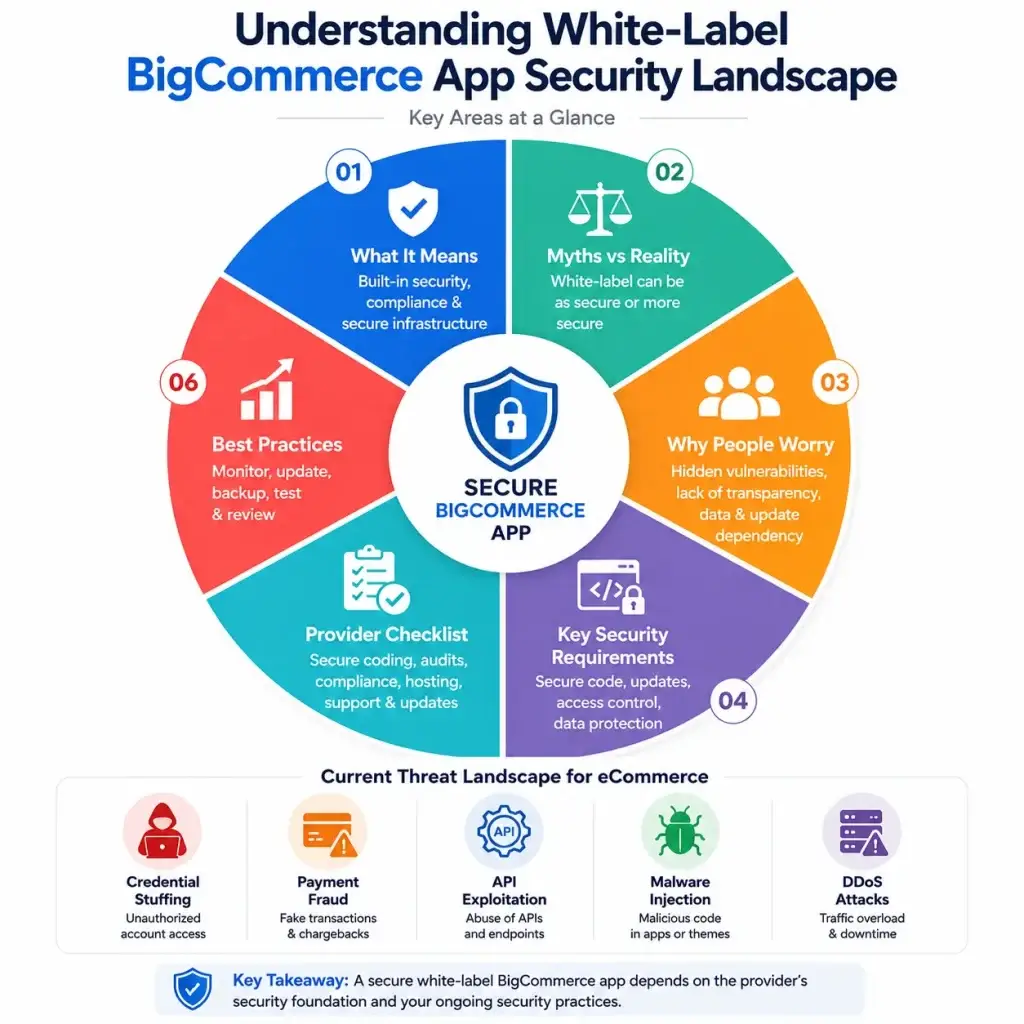
Understanding White-Label BigCommerce App Security Landscape
What “White-Label Security” Actually Means
White-label security refers to how the underlying app is built, protected, and maintained before you brand it as your own.
Unlike custom development, you’re relying on a pre-built system. This means your security depends heavily on the provider’s architecture, coding standards, and compliance practices.
A secure white-label BigCommerce app should include:
- Pre-tested secure codebase
- Built-in compliance frameworks
- Scalable and protected infrastructure
- Ongoing security updates
If these are missing, risks increase significantly.
Common Security Myths vs Reality
| Myth | Reality |
|---|---|
| White-label apps are less secure than custom apps | A well-built white-label app can be more secure due to standardized security practices |
| BigCommerce platform handles all security | BigCommerce secures infrastructure, but your app layer is your responsibility |
| Cheap solutions are “good enough” | Low-cost apps often cut corners on security |
| Once built, security is done | Security requires continuous monitoring and updates |
Why People Worry About White-Label Apps
Businesses hesitate because they don’t control the original codebase.
Key concerns include:
- Hidden vulnerabilities in reused code
- Lack of transparency from providers
- Data ownership and privacy risks
- Dependency on third-party updates
These concerns are valid — but manageable with the right partner.
Current Threat Landscape for eCommerce Platforms
White-label BigCommerce apps face the same threats as any major eCommerce platform.
Common attack vectors include:
In 2026, attackers are using AI-driven tools, making threats faster and harder to detect.
Security Standards in 2026
Security expectations have evolved significantly.
Modern white-label apps must align with:
- Zero Trust Architecture
- AI-based threat detection systems
- Continuous compliance monitoring
- Secure DevOps (DevSecOps) practices
Static security is outdated. Dynamic, real-time protection is now the standard.
Real-World Statistics on App Security Incidents
- Over 43% of cyberattacks target eCommerce platforms
- 60% of small businesses shut down within 6 months of a major breach
- Payment-related attacks increased by 30% in 2025–2026
- API vulnerabilities account for over 50% of modern breaches
These numbers highlight one thing — security is a business survival factor.
Key Security Risks & How to Identify Them
Data Protection & Privacy Risks
Handling user data is one of the biggest responsibilities of any BigCommerce app.
User Personal Information
Customer data like names, emails, and addresses are prime targets.
Risks include:
- Unauthorized access due to weak authentication
- Data leaks from insecure databases
- Insider threats from poor access control
A secure app must use strict role-based access and encrypted storage.
Payment Data Security
eCommerce apps process sensitive financial data daily.
Key risks:
- Card skimming attacks
- Weak payment gateway integrations
- Lack of PCI DSS compliance
Always ensure tokenization and secure payment processing are in place.
Location Tracking Concerns
Many apps track user behavior and location.
Potential issues:
- Excessive data collection
- Lack of user consent
- Improper data storage
Transparency and minimal data collection are critical.
GDPR/CCPA Compliance
Non-compliance can lead to heavy penalties.
Common gaps:
- Missing consent mechanisms
- No data deletion options
- Poor privacy policies
Your app must allow users to control their data.
Technical Vulnerabilities
Code Quality Issues
Poorly written code creates hidden security gaps.
Watch for:
- Hardcoded credentials
- Lack of input validation
- Unpatched libraries
Secure coding practices are non-negotiable.
Server Security Gaps
Your backend infrastructure must be hardened.
Risks include:
- Misconfigured servers
- Open ports and weak firewalls
- Lack of intrusion detection
Cloud security must follow strict standards.
API Vulnerabilities
APIs are one of the biggest attack surfaces.
Common threats:
- Broken authentication
- Data exposure via endpoints
- Rate limiting issues
Secure API design is essential for protection.
Third-Party Integrations
Plugins and integrations can introduce risks.
Problems arise when:
- Third-party tools lack security audits
- Dependencies are outdated
- External services mishandle data
Always verify integration security.
Business Risks
Legal Liability
A breach can lead to lawsuits and regulatory action.
You may face:
- GDPR fines
- Customer compensation claims
- Contract violations
Reputation Damage
Trust is everything in eCommerce.
One breach can:
- Destroy brand credibility
- Reduce customer retention
- Impact long-term growth
Financial Losses
Security failures are expensive.
Costs include:
- Incident recovery
- Legal fees
- Lost revenue
Regulatory Penalties
Authorities are stricter in 2026.
Non-compliance can result in:
- Heavy fines
- Business restrictions
- Mandatory audits
Risk Assessment Checklist
Use this checklist before choosing or launching a white-label BigCommerce app:
- Is all sensitive data encrypted (at rest and in transit)?
- Does the app support secure authentication (2FA/OAuth)?
- Are regular security updates provided?
- Is the app compliant with GDPR, CCPA, and PCI DSS?
- Are APIs protected with authentication and rate limiting?
- Are third-party integrations audited?
- Is there a clear incident response plan?
- Does the provider offer transparency in security practices?
If you can’t confidently answer these, your app may be at risk.
Security Standards Your White-Label BigCommerce App Must Meet
Essential Certifications
A secure white-label BigCommerce app must comply with globally recognized security standards. These are not optional in 2026 — they are baseline requirements.
ISO 27001 Compliance
This ensures your app follows a structured information security management system.
It covers:
- Risk assessment processes
- Data protection policies
- Continuous security improvements
SOC 2 Type II
Focuses on how customer data is handled over time.
It validates:
- Security controls
- System availability
- Data confidentiality
This is critical for building trust with enterprise clients.
GDPR Compliance
Mandatory for handling EU user data.
Requirements include:
- Explicit user consent
- Data access and deletion rights
- Transparent data usage policies
HIPAA (If Applicable)
If your app handles health-related data, HIPAA compliance is required.
It ensures:
- Secure storage of medical data
- Controlled access to sensitive information
PCI DSS for Payments
This is essential for any eCommerce app.
It protects:
- Credit card data
- Payment processing systems
- Transaction security
Without PCI DSS, your app is highly vulnerable to fraud.
Technical Requirements
Beyond certifications, your app must meet strict technical security standards.
End-to-End Encryption
All data must be encrypted during transmission and storage.
This prevents:
- Data interception
- Unauthorized access
Secure Authentication (2FA/OAuth)
Basic passwords are no longer enough.
Modern apps must include:
- Two-factor authentication
- OAuth-based login systems
Regular Security Audits
Security should be tested frequently.
This includes:
- Internal audits
- Third-party security reviews
Penetration Testing
Simulated attacks help identify weaknesses.
It ensures:
- Vulnerabilities are detected early
- Fixes are implemented before real attacks
SSL Certificates
Every data exchange must be secured via HTTPS.
This protects:
- User sessions
- Data transmission
Secure API Design
APIs must be built with security-first principles.
Best practices include:
- Authentication tokens
- Rate limiting
- Data validation
Security Standards Comparison Table
| Security Standard | Purpose | Mandatory for BigCommerce App | Risk if Missing |
|---|---|---|---|
| ISO 27001 | Information security management | Recommended | Poor security governance |
| SOC 2 Type II | Data handling and trust | Highly recommended | Loss of enterprise trust |
| GDPR | Data privacy (EU users) | Mandatory (if EU users) | Heavy legal penalties |
| HIPAA | Health data protection | Conditional | Legal violations |
| PCI DSS | Payment security | Mandatory | Payment fraud & breaches |
| SSL/TLS | Secure communication | Mandatory | Data interception risks |
| 2FA/OAuth | User authentication | Mandatory | Account takeover risks |
Security is not about one certification — it’s about combining multiple layers of protection.
If your white-label BigCommerce app doesn’t meet these standards, it’s not ready for real-world use.
Red Flags: How to Spot Unsafe White-Label Providers
Choosing the wrong provider is the fastest way to compromise your app’s security. Many risks don’t come from the app itself, but from who builds and maintains it.
Warning Signs
No Security Documentation
If a provider cannot clearly explain their security practices, that’s a major risk.
Look for:
- Security architecture details
- Compliance reports
- Data protection policies
No documentation usually means weak or non-existent security.
Cheap Pricing Without Explanation
Extremely low pricing often indicates shortcuts.
Hidden issues may include:
- Poor code quality
- No security testing
- Lack of updates
Security is an investment, not a cost to cut.
No Compliance Certifications
A serious provider should meet at least basic standards.
Missing certifications like:
- PCI DSS
- GDPR
- SOC 2
This is a strong indicator of unsafe systems.
Outdated Technology Stack
Old frameworks and libraries are easier to exploit.
Risks include:
- Known vulnerabilities
- Lack of support
- Compatibility issues
Modern security requires modern technology.
Poor Code Quality
You may not see the code, but signs are visible.
Indicators:
- Frequent bugs
- Slow performance
- Unstable features
These often point to deeper security flaws.
No Security Updates Policy
Security is ongoing, not one-time.
If the provider doesn’t offer:
- Regular patches
- Version updates
- Threat monitoring
Your app will become vulnerable over time.
Lack of Data Backup Systems
Without backups, recovery becomes impossible after an attack.
Essential features:
- Automated backups
- Disaster recovery plans
- Data redundancy
No Insurance Coverage
Serious providers protect against risk.
Cyber insurance shows:
- Accountability
- Preparedness
- Professional maturity
Evaluation Checklist
Before selecting a white-label BigCommerce app provider, follow this checklist.
Questions to Ask Providers
- What security certifications do you hold?
- How often do you conduct security audits?
- Do you provide penetration testing reports?
- How do you handle data encryption?
- What is your incident response plan?
Documents to Request
- Compliance certificates (ISO, SOC 2, PCI DSS)
- Security audit reports
- Data processing agreements (DPA)
- Privacy policy and terms
Testing Procedures
- Perform vulnerability scans
- Test authentication systems
- Review API security
- Simulate user flows for weaknesses
Due Diligence Steps
- Check client reviews and case studies
- Verify past security incidents
- Evaluate support responsiveness
- Assess long-term update commitments
A secure app starts with a secure provider. If any of these red flags appear, it’s better to step back before risking your business.
Read more : – Business Model of BigCommerce : Complete Strategy Breakdown 2026
Best Practices for Secure White-Label BigCommerce App Implementation
Security doesn’t start after launch. It begins from day one and continues throughout the app lifecycle.
Pre-Launch Security
Before going live, a full security audit is essential.
Third-party audits add extra credibility.
Code Review Requirements
Every line of code should be reviewed for security.
Focus on:
- Removing hardcoded credentials
- Validating inputs
- Securing authentication flows
Clean code directly impacts security strength.
Infrastructure Hardening
Your hosting environment must be secure.
Key steps:
- Configure firewalls properly
- Close unused ports
- Use secure cloud configurations
A weak server can compromise even the best app.
Compliance Verification
Ensure all required standards are met before launch.
Verify:
- GDPR and CCPA readiness
- PCI DSS compliance for payments
- Data handling policies
Compliance failures can lead to legal issues.
Staff Training Programs
Human error is a major risk factor.
Train your team on:
- Secure data handling
- Phishing awareness
- Access control practices
Security is not just technical — it’s operational.
Post-Launch Monitoring
Continuous Security Monitoring
Threats evolve constantly.
You need:
- Real-time monitoring tools
- Intrusion detection systems
- Log analysis
Early detection prevents major damage.
Regular Updates and Patches
Outdated systems are easy targets.
Maintain:
- Frequent security patches
- Dependency updates
- Platform upgrades
Delays in updates increase risk exposure.
Incident Response Planning
No system is 100% immune.
Prepare for:
- Data breach scenarios
- Communication protocols
- Recovery procedures
A fast response reduces impact.
User Data Management
Handle user data responsibly.
Best practices:
- Minimize data collection
- Encrypt sensitive information
- Provide user control over data
Trust depends on how you manage data.
Backup and Recovery Systems
Always be prepared for worst-case scenarios.
Ensure:
- Daily automated backups
- Secure storage of backups
- Quick restoration capability
Downtime can be costly without backups.
Security Implementation Timeline
| Phase | Timeline | Key Actions |
|---|---|---|
| Planning | Week 1–2 | Security requirements, compliance mapping |
| Development | Week 3–6 | Secure coding, API protection, encryption setup |
| Testing | Week 7–8 | Security audits, penetration testing |
| Pre-Launch | Week 9 | Final compliance checks, infrastructure hardening |
| Post-Launch | Ongoing | Monitoring, updates, incident response |
Security is not a one-time setup. It’s a continuous process that evolves with new threats.
Legal & Compliance Considerations
Legal compliance is a critical part of white-label BigCommerce app security. Ignoring regulations in 2026 can lead to heavy penalties and business shutdowns.
Regulatory Requirements
Data Protection Laws by Region
Different regions have strict rules for handling user data.
Key regulations include:
- GDPR (Europe): Requires user consent, data access, and deletion rights
- CCPA (California): Gives users control over personal data usage
- DPDP Act (India): Focuses on consent-based data processing
- PIPEDA (Canada): Governs how businesses collect and use data
Your app must adapt based on where your users are located.
Industry-Specific Regulations
Some industries have additional compliance needs.
Examples:
- Fintech apps must follow financial regulations
- Health-related apps require HIPAA compliance
- eCommerce apps must follow PCI DSS
Ignoring industry rules increases legal risk.
User Consent Management
Users must know how their data is used.
Your app should include:
- Clear consent forms
- Cookie management systems
- Opt-in and opt-out options
Consent must be explicit, not assumed.
Privacy Policy Requirements
A strong privacy policy builds trust and ensures compliance.
It must clearly explain:
- What data is collected
- How it is used
- Who it is shared with
- How users can control it
Transparency is legally required.
Terms of Service Essentials
Terms of service protect your business legally.
They should define:
- User responsibilities
- Platform limitations
- Dispute resolution terms
- Liability boundaries
Well-written terms reduce legal exposure.
Liability Protection
Insurance Requirements
Cybersecurity insurance is becoming standard in 2026.
Coverage should include:
- Data breach costs
- Legal expenses
- Business interruption losses
Insurance adds a financial safety net.
Legal Disclaimers
Disclaimers help limit liability.
They should clarify:
- Service limitations
- Third-party risks
- Data usage responsibilities
User Agreements
Every user must agree to clear terms.
Include:
- Data usage consent
- Acceptable use policies
- Account responsibility clauses
Incident Reporting Protocols
In case of a breach, reporting is mandatory in many regions.
Requirements include:
- Notifying users within defined timelines
- Informing regulatory authorities
- Documenting the incident
Delayed reporting can increase penalties.
Regulatory Compliance Monitoring
Compliance is not static.
You must:
- Track regulation updates
- Conduct regular compliance audits
- Update policies accordingly
Staying compliant is an ongoing process.
Compliance Checklist by Region
| Region | Key Law | Mandatory Actions | Risk if Non-Compliant |
|---|---|---|---|
| Europe | GDPR | Consent, data rights, breach reporting | Heavy fines up to 4% revenue |
| USA (California) | CCPA | Data transparency, opt-out options | Legal penalties, lawsuits |
| India | DPDP Act | Consent-based data processing | Regulatory action |
| Canada | PIPEDA | Data protection policies | Fines and restrictions |
| Global | PCI DSS | Secure payment handling | Payment fraud risk |
Legal compliance is directly tied to your app’s security. A secure app that is not compliant is still a liability.
Why Miracuves White-Label BigCommerce App is Your Safest Choice
When it comes to security, not all providers operate at the same level. Miracuves is built with a security-first approach, ensuring your BigCommerce app is protected from day one.
Miracuves Security Advantages
Enterprise-Grade Security Architecture
Miracuves uses robust, scalable architecture designed to handle real-world threats.
This includes:
- Multi-layered security systems
- Secure cloud infrastructure
- Isolation of sensitive data
Regular Security Audits and Certifications
Security is continuously validated.
Miracuves ensures:
- Periodic third-party audits
- Compliance with global standards
- Updated certifications
GDPR/CCPA Compliant by Default
Compliance is built into the system.
You don’t need extra effort to meet:
- Data privacy requirements
- User consent management
- Legal documentation standards
24/7 Security Monitoring
Threats don’t follow business hours.
Miracuves provides:
- Real-time monitoring
- Instant threat detection
- Rapid response systems
Encrypted Data Transmission
All data is protected during transfer and storage.
This prevents:
- Data interception
- Unauthorized access
Secure Payment Processing
Payment security is handled with strict standards.
Features include:
- PCI DSS-compliant integrations
- Tokenized transactions
- Fraud prevention systems
Regular Security Updates
Your app stays protected against evolving threats.
Miracuves delivers:
- Frequent patches
- System upgrades
- Vulnerability fixes
Insurance Coverage Included
Risk is managed professionally.
Miracuves offers:
- Cybersecurity insurance support
- Risk mitigation strategies
- Business protection assurance
Final Thought
Security in a white-label BigCommerce app is not about choosing between safe or unsafe. It’s about choosing the right provider and processes.
In 2026, risks are real, but so are the solutions. With proper standards, continuous monitoring, and compliance, a white-label app can be as secure as any enterprise platform. Talk to our security experts and see why businesses trust Miracuves for safe, compliant platforms. The key is simple — don’t compromise on security at any stage.
If you build it right, you don’t just protect your app. You protect your business, your customers, and your future.
FAQs
1. How secure is a white-label BigCommerce app compared to custom development?
A well-built white-label app can be equally or more secure than custom apps because it follows standardized and tested security practices.
2. What happens if there’s a security breach?
You must activate your incident response plan, notify users, fix vulnerabilities, and comply with legal reporting requirements.
3. Who is responsible for security updates?
The provider handles core updates, but you are responsible for configurations, usage, and third-party integrations.
4. How is user data protected in white-label apps?
Through encryption, secure servers, access controls, and compliance with laws like GDPR and CCPA.
5. What compliance certifications should I look for?
Look for ISO 27001, SOC 2 Type II, GDPR, and PCI DSS as essential standards.
6. Can white-label apps meet enterprise security standards?
Yes, if built with proper architecture, certifications, and continuous monitoring systems.
7. How often should security audits be conducted?
At least annually, with continuous monitoring and periodic vulnerability assessments.
8. What’s included in Miracuves security package?
It includes encryption, compliance readiness, monitoring, secure payments, and regular updates.
9. How to handle security in different countries?
Follow region-specific laws like GDPR, CCPA, and DPDP, and implement flexible compliance systems.
10. What insurance is needed for app security?
Cybersecurity insurance covering data breaches, legal costs, and business interruptions is recommended.
Related Articles
Miracuves is an independent software development company. We are not affiliated with, connected to, sponsored by, or endorsed by any company or product named in this article.
Terms such as “X Clone” are used descriptively. It is how the software industry refers to building a platform with functionality comparable to a known service, and how clients search for it.
The entire design and codebase of our products is built by our own team. Our products contain no code, design, graphics, or content originating from any third-party website or applications.
All third-party names and marks referenced in this article are the property of their respective owners, referenced solely to identify the services discussed.