

Key Takeaways
- Microservices architecture helps fintech apps scale by separating key business functions into independent services.
- A Wise clone app needs clear service boundaries for users, KYC, wallets, transfers, FX rates, payments, and compliance.
- Database-per-service design reduces dependency and improves system reliability.
- Event-driven communication helps manage transfers, notifications, audits, and transaction updates smoothly.
- Scaling to 10K+ concurrent users requires Kubernetes, observability, security, and fault-tolerant backend planning.
What You’ll Learn
- How microservices architecture supports fintech app scalability.
- Service boundaries help separate wallet, transfer, compliance, and user modules.
- Events and queues reduce pressure on core transaction workflows.
- Kubernetes and autoscaling help handle traffic spikes and high user activity.
- Growth depends on backend design, monitoring, security, databases, and deployment strategy.
Real Insights
- Fintech apps cannot scale safely with weak backend structure or tightly coupled systems.
- Payment and wallet services need isolation to reduce risk during failures.
- Observability is essential for tracking errors, latency, transactions, and service health.
- Security must be built into every service, not added only at the application layer.
- The best strategy is to build a modular, secure, and scalable fintech architecture from day one.
Building a Wise clone app is not only about creating wallet screens, exchange rate pages, transfer forms, and user dashboards. The real challenge begins when thousands of users start checking balances, requesting FX quotes, uploading KYC documents, initiating remittances, receiving status updates, and contacting support at the same time.
That is where microservices architecture fintech app development becomes a serious business decision.
For an early-stage fintech product, a simple backend may seem enough. But for a remittance platform handling 10K+ concurrent users, one overloaded database, one slow payment workflow, or one failed notification queue can damage trust quickly. In fintech, users do not tolerate uncertainty around money movement.
A Wise-style remittance platform needs architecture that can scale individual business capabilities independently. KYC should not slow down wallet balance checks. FX quote requests should not block transfer processing. Notification spikes should not affect ledger accuracy. Admin reporting should not overload transaction services.
This guide explains how founders, CTOs, and fintech product teams can design a scalable Wise clone app using microservices, service boundaries, database-per-service architecture, event-driven workflows, Kubernetes, observability, and compliance-ready controls.
Miracuves helps founders build ready-made and white-label fintech app foundations with source-code ownership, admin control, and scalable backend planning, making it easier to move from idea to market without starting every technical layer from zero.
Why Wise Clone Apps Need Scalability Planning Before Growth
A Wise clone app is different from a simple marketplace or content app because every action is connected to financial trust. A user may forgive a slow social feed. They are much less forgiving when a transfer status is unclear, a wallet balance does not refresh, or a payout confirmation is delayed.
At 10K+ concurrent users, the system may need to handle:
- Login and identity verification requests
- FX quote generation
- Wallet balance checks
- Money transfer initiation
- Payment gateway callbacks
- Transaction status updates
- KYC document uploads
- Compliance review queues
- Push notifications and email alerts
- Admin dashboard queries
- Fraud monitoring signals
- Customer support ticket updates
If all these workloads sit inside one monolithic backend, scaling becomes difficult. You may add more servers, but the same shared database, shared codebase, and shared deployment cycle can continue to create bottlenecks.
For fintech founders, this matters because scalability is not just an engineering issue. It affects user trust, transaction reliability, support workload, regulatory preparedness, and long-term platform valuation.
Read more: Top UI/UX Mistakes in Digital Banking & Fintech Apps
What Microservices Architecture Means in a Fintech App
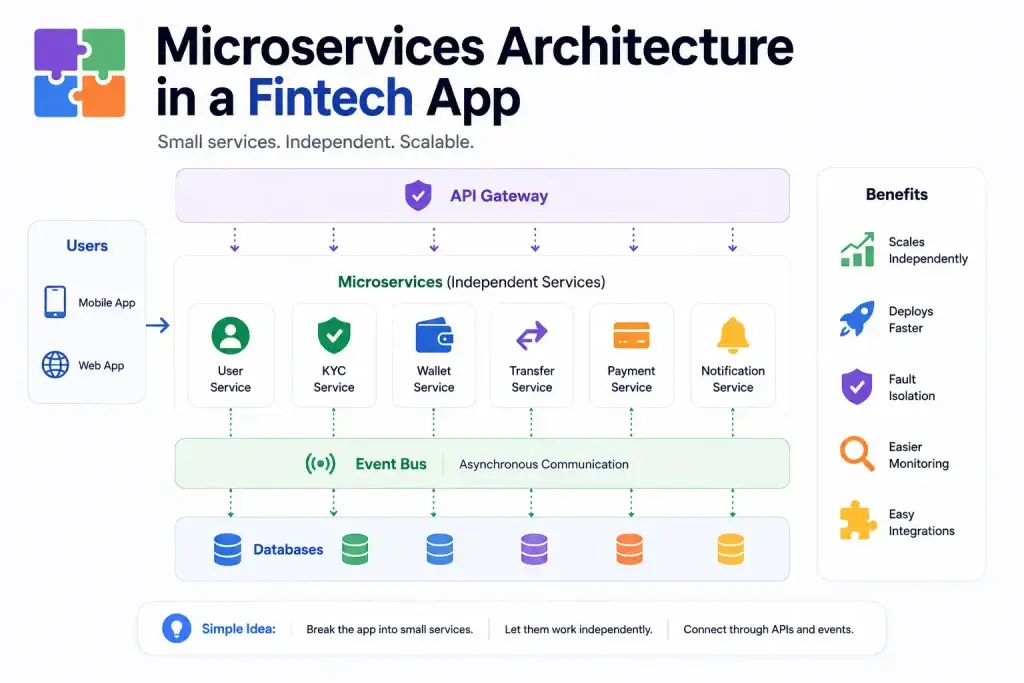
Microservices architecture breaks a large application into smaller, independently deployable services. Each service owns a specific business capability and communicates with other services through APIs, events, or messaging systems.
In a fintech app, microservices should not be divided randomly by technical layers such as “frontend,” “backend,” and “database.” They should be designed around business domains.
For a Wise clone app, those domains may include:
- User identity
- KYC verification
- Wallet and balances
- FX rates
- Transfers
- Payments
- Beneficiaries
- Notifications
- Compliance monitoring
- Admin operations
- Reporting
- Support and disputes
The goal is not to create as many services as possible. The goal is to create clear boundaries so that each service can scale, deploy, fail, recover, and evolve without breaking the entire platform.
A well-designed fintech microservices architecture supports:
- Independent scaling of high-traffic services
- Faster deployment of isolated modules
- Better fault isolation
- Cleaner ownership of financial logic
- Easier audit and monitoring
- More flexible integration with banks, payment gateways, KYC providers, and FX providers
Core Service Boundaries for a Wise Clone App
Service boundaries decide whether your microservices architecture becomes scalable or chaotic. Poor boundaries create distributed complexity without real business benefit.
A Wise clone app can start with these service boundaries:
| Service | Responsibility | Scaling Priority |
|---|---|---|
| Identity Service | User registration, login, authentication, device sessions | High |
| KYC Service | Document upload, provider integration, verification status | Medium to High |
| Wallet Service | Balances, wallet states, wallet restrictions | Very High |
| Ledger Service | Immutable transaction entries, debit-credit records | Very High |
| FX Service | Exchange rates, quote generation, quote expiry | High |
| Transfer Service | Transfer creation, transfer status, recipient flow | Very High |
| Payment Service | Payment gateway, bank rails, card or wallet top-up | High |
| Beneficiary Service | Recipient profiles, bank details, saved accounts | Medium |
| Notification Service | Email, SMS, push, in-app alerts | High during spikes |
| Compliance Service | Risk flags, AML workflow support, suspicious activity checks | High |
| Admin Service | Platform controls, user management, operational dashboards | Medium |
| Reporting Service | Analytics, transaction reports, reconciliation exports | Medium |
The wallet and ledger services deserve special care. Wallet data shows current value, while the ledger should preserve the historical record of how that value changed. Mixing these responsibilities can make reconciliation and dispute handling more difficult later.
For founders, the practical decision is simple: design around money movement first. Attractive screens matter, but transaction correctness is what keeps a remittance platform alive.
Database Per Service: Why Shared Databases Become a Scaling Risk
One of the most important principles in microservices architecture is the database-per-service pattern. Instead of every module reading and writing to one shared database, each service owns its own data store and exposes data through APIs or events.
The database-per-service pattern keeps each microservice’s data private and accessible only through that service’s API. This prevents other services from directly modifying data they do not own.
For a Wise clone app, this means:
- The KYC service owns KYC records.
- The wallet service owns wallet state.
- The ledger service owns ledger entries.
- The transfer service owns transfer lifecycle data.
- The notification service owns message delivery records.
- The compliance service owns risk review data.
This architecture reduces the risk of hidden dependencies. If the notification service needs to send a transfer success alert, it should not directly query the transfer database. It should receive a “transfer completed” event or call a controlled API.
Example Database Ownership Model
| Service | Suggested Data Store | Why |
|---|---|---|
| Identity Service | PostgreSQL / MySQL | Structured user and auth records |
| KYC Service | PostgreSQL + object storage | Verification status plus document files |
| Wallet Service | PostgreSQL | Strong consistency for wallet state |
| Ledger Service | PostgreSQL / append-only store | Accurate financial record keeping |
| FX Service | Redis + PostgreSQL | Fast quote lookup with persistent history |
| Transfer Service | PostgreSQL | Transfer lifecycle and status |
| Notification Service | MongoDB / PostgreSQL | Message logs and delivery attempts |
| Reporting Service | Data warehouse / read replica | Analytics without overloading core services |
The founder-level benefit is control. When each service owns its data, you can scale the high-load parts of the fintech platform without constantly rewriting the entire backend.
Event-Driven Architecture for Transfers, KYC, FX, and Notifications
A fintech app cannot rely only on synchronous API calls. Some workflows need immediate response, while others should happen asynchronously in the background.
Event-driven architecture helps services communicate through events such as:
- UserRegistered
- KYCSubmitted
- KYCApproved
- FXQuoteGenerated
- TransferCreated
- TransferFunded
- TransferProcessing
- TransferCompleted
- TransferFailed
- WalletDebited
- WalletCredited
- SuspiciousActivityFlagged
- NotificationSent
Event-driven architecture allows systems to detect, process, and react to events as they happen. This makes it useful for fintech workflows where multiple services need to respond to a single business action.
Example: Transfer Event Flow
- User creates a transfer.
- Transfer Service validates the request.
- FX Service locks or confirms the exchange quote.
- Wallet Service checks available balance.
- Ledger Service records pending debit.
- Payment Service initiates payout or bank rail flow.
- Compliance Service checks risk signals.
- Notification Service sends user updates.
- Reporting Service updates operational dashboards.
Without events, each service may call another service directly in a long chain. That creates latency and failure risk. With events, services can react independently.
Recommended Messaging Tools
Common event infrastructure options include:
- Apache Kafka
- RabbitMQ
- AWS EventBridge
- Google Pub/Sub
- Azure Service Bus
The right choice depends on expected transaction volume, cloud provider, engineering maturity, and reporting needs.
For 10K+ concurrent users, the priority is not simply choosing Kafka because it sounds scalable. The priority is designing reliable event contracts, retry logic, dead-letter queues, idempotency, and monitoring.
Kubernetes Deployment Model for 10K+ Concurrent Users
Kubernetes is often used to deploy and manage containerized microservices. For a Wise clone app, Kubernetes can help teams scale high-demand services independently, restart failed containers, manage service discovery, and support rolling deployments. Google’s Kubernetes materials describe building distributed, scalable applications using a microservices model.
A Kubernetes-based fintech deployment may include:
- API Gateway
- Identity Service pods
- KYC Service pods
- Wallet Service pods
- Ledger Service pods
- FX Service pods
- Transfer Service pods
- Notification Service pods
- Compliance Service pods
- Admin Service pods
- Message broker cluster
- Redis cache
- Database clusters or managed databases
- Observability stack
Kubernetes Scaling Logic
| Component | Scaling Trigger | Why It Matters |
|---|---|---|
| API Gateway | Request per second | Handles traffic spikes |
| FX Service | Quote request volume | Users often check rates repeatedly |
| Transfer Service | Transfer creation volume | Core transaction flow |
| Notification Service | Message queue depth | Prevents delayed alerts |
| KYC Service | Upload and verification queue | Handles onboarding spikes |
| Reporting Service | Query load | Protects core transaction services |
| Admin Service | Operator usage | Keeps support workflows stable |
Horizontal Pod Autoscaling can increase the number of pods when CPU, memory, or custom metrics cross thresholds. For fintech platforms, queue depth, latency, error rates, and transaction throughput are often more useful than CPU alone.
Transaction Consistency, Sagas, and Ledger Safety
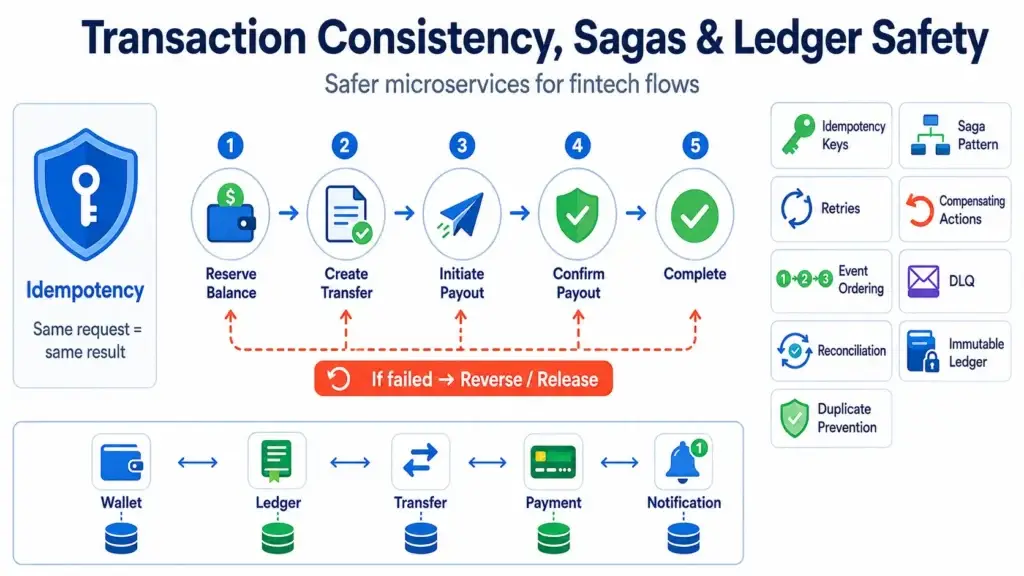
The hardest part of microservices in fintech is not deployment. It is consistency.
In a monolith, a single database transaction may update multiple tables. In microservices, wallet, ledger, transfer, payment, and notification services may all own separate databases. That means you need a reliable way to manage distributed workflows.
For Wise clone apps, the system should be designed around:
- Idempotency keys
- Saga pattern
- Retry policies
- Compensating actions
- Event ordering rules
- Dead-letter queues
- Reconciliation jobs
- Immutable ledger entries
- Duplicate transaction prevention
Why Idempotency Matters
If a payment gateway sends the same callback twice, your system should not credit or debit the user twice. Idempotency ensures that repeated requests with the same key produce the same result instead of duplicating financial actions.
Why Sagas Matter
A saga breaks a long transaction into smaller steps. If one step fails, the system triggers compensating actions.
Example:
- Reserve wallet balance.
- Create transfer.
- Initiate payout.
- Confirm payout.
- Mark transfer completed.
- Release or reverse reserved balance if payout fails.
This is safer than pretending every distributed action can happen inside one perfect transaction.
Observability, Audit Logs, and Failure Recovery
A fintech platform cannot scale safely without observability. At 10K+ concurrent users, the team must know what is happening across services before users start raising tickets.
A production-grade Wise clone app should monitor:
- API latency
- Transfer success rate
- Payment failure rate
- FX quote response time
- Wallet debit and credit delays
- Queue depth
- Event processing lag
- KYC processing time
- Database connection usage
- Error rates by service
- Suspicious activity signals
- Admin actions
- Reconciliation mismatches
Recommended Observability Stack
| Need | Tools or Approach |
|---|---|
| Metrics | Prometheus, Grafana, cloud monitoring |
| Logs | ELK, OpenSearch, Loki |
| Tracing | OpenTelemetry, Jaeger, Tempo |
| Alerts | PagerDuty, Opsgenie, Slack alerts |
| Audit Logs | Internal audit log service |
| Error Tracking | Sentry or similar tools |
Audit logs are especially important in fintech. They help track who changed a user status, who approved a KYC review, who modified a transaction state, and which system action triggered a financial event.
Read more: How Safe Is a White-Label Wise App? Security Guide 2026
Security and Compliance-Ready Architecture for Fintech Platforms
Security should be part of the platform foundation, not a late-stage add-on.
For a Wise clone app, security and compliance-ready workflows should include:
- Encrypted data transfer
- Encrypted data storage
- Role-based access control
- KYC workflow support
- AML workflow support
- Transaction monitoring
- Suspicious activity flags
- Audit logs
- Admin access controls
- Secure API integration
- Payment gateway security
- User identity checks
- Permission-based dashboards
- Activity logs
- Compliance reporting support
A fintech app can be built with a compliance-ready foundation, but final compliance depends on jurisdiction, legal review, operating model, banking partners, payment providers, and regulatory requirements.
This is where architecture and business planning meet. A founder building for one local market may not need the same KYC, AML, reporting, and payout integrations as a founder planning cross-border remittance across multiple regions.
Monolith vs Microservices for Wise Clone Apps
Microservices are powerful, but they are not always the right starting point for every founder. The decision depends on expected traffic, budget, launch urgency, engineering team, compliance needs, and long-term roadmap.
| Factor | Monolith | Microservices |
|---|---|---|
| Initial build speed | Faster | Slower |
| Operational complexity | Lower | Higher |
| Scaling flexibility | Limited | Strong |
| Deployment independence | Low | High |
| Fault isolation | Weak | Strong |
| Fintech compliance workflows | Possible but harder at scale | Easier to separate and audit |
| Best for | Early validation | Growth-stage or high-scale fintech |
| 10K+ concurrent users | Risky if not carefully optimized | Better suited with strong DevOps |
A practical approach is to start with a modular architecture that can evolve into microservices. For founders, this reduces early complexity while avoiding a backend structure that becomes impossible to scale later.
Miracuves can help founders choose between a ready-made fintech foundation, custom modules, or a phased microservices roadmap depending on launch goals, market risk, and expected traffic.
Founder Decision Signals: When Your Wise Clone App Needs Microservices
You should seriously consider microservices architecture when:
- You expect high transfer volume across regions.
- Wallet, FX, KYC, and notification workloads scale differently.
- You need independent deployment of financial modules.
- Your admin team needs strong audit and permission controls.
- You plan to integrate multiple payment providers or banking partners.
- You need separate compliance review workflows.
- Your reporting workload should not affect live transaction performance.
- You expect 10K+ concurrent users within a realistic growth window.
- You want source-code ownership and long-term architecture flexibility.
You may not need full microservices immediately when:
- You are validating a small single-market product.
- Your team cannot manage DevOps complexity.
- Your transaction volume is low.
- Your app does not yet require multiple integrations.
- You need the fastest possible first launch.
The smarter decision is not “monolith or microservices” in isolation. The smarter decision is choosing an architecture path that supports your first launch and does not block your second stage of growth.
Read More: Revenue Model of Wise: How Wise Makes Money and What Startups Can Learn
Common Mistakes Founders Make When Scaling Fintech Apps
1. Treating Wallet and Ledger as the Same Thing
Wallet balance and ledger history are related, but they should not be treated casually as one simple table. The ledger must provide a reliable record of financial movement.
2. Using One Shared Database for Every Service
A shared database may feel easy early, but it creates tight coupling. Over time, every service depends on every table, and scaling becomes harder.
3. Ignoring Idempotency
Duplicate requests, gateway retries, and repeated callbacks are normal in fintech. Without idempotency, duplicate financial actions can create serious reconciliation issues.
4. Scaling Only the App Servers
Many teams add more servers but ignore database locks, queue lag, API rate limits, payment provider latency, and slow reporting queries.
5. Building Compliance Workflows Too Late
KYC, AML, transaction monitoring, audit logs, and admin permissions should be designed early. Retrofitting them after launch is usually harder.
6. Overengineering Too Early
Microservices without DevOps maturity can create more problems than they solve. Founders should choose a phased architecture instead of copying enterprise patterns blindly.
Read more: Understanding the Revolut vs Wise Business Model for Fintech Startups
How Miracuves Helps Build Scalable Wise Clone App Foundations
Miracuves helps founders launch fintech and remittance app solutions with ready-made, white-label, source-code-owned foundations that can be customized around business goals.
For Wise-style platforms, Miracuves can support:
- User onboarding flows
- KYC workflow planning
- Wallet and transaction modules
- Remittance workflows
- Admin dashboard controls
- Role-based access
- Notification workflows
- Payment gateway integration planning
- Compliance-ready architecture
- Source-code ownership
- Scalable backend planning
- Custom branding
- Faster launch using ready-made foundations where applicable
For founders planning a high-scale remittance platform, the goal is not just to build a Wise clone app. The goal is to build a fintech product foundation that can handle traffic, trust, transaction complexity, and operational growth.
Explore Miracuves’ Wise clone solution or the broader fintech app development ecosystem to plan your launch path.
Conclusion
Microservices architecture is not automatically better because it sounds modern. It becomes valuable when your fintech app has multiple high-value workflows that need to scale, fail, recover, and evolve independently.
For a Wise clone app, the most important services are not just user-facing features. The real foundation sits behind wallet accuracy, ledger safety, transfer orchestration, KYC status, FX quotes, compliance review, notifications, and admin visibility.
If your goal is to support 10K+ concurrent users, architecture planning should start before the growth spike arrives. A scalable fintech platform is built by separating responsibilities clearly, protecting financial data, designing event-driven workflows, monitoring every critical path, and giving operators the control they need to manage risk.
Miracuves helps founders move faster with white-label fintech app foundations, source-code ownership, admin control, and scalable architecture planning so they can launch smarter without building every layer from zero.
Planning to build a scalable Wise clone or fintech app with microservices architecture? Contact Us to discuss your fintech app requirements and launch strategy.
FAQs
What is microservices architecture in a fintech app?
Microservices architecture in a fintech app means separating the platform into independent services such as wallet, KYC, FX, transfer, payment, notification, compliance, and admin services. Each service owns a specific business capability and can be scaled or deployed independently.
Why does a Wise clone app need microservices architecture?
A Wise clone app may need microservices architecture when it handles high transaction volume, multiple payment integrations, KYC workflows, FX quotes, wallet balances, compliance checks, and user notifications at scale. Microservices help isolate these workloads so one overloaded module does not affect the entire platform.
Can a Wise clone app support 10K+ concurrent users?
Yes, but the architecture must be planned carefully. The platform should include scalable APIs, database-per-service design, event-driven workflows, caching, Kubernetes-based deployment, monitoring, queue management, and strong transaction controls.
What is database per service in fintech microservices?
Database per service means each microservice owns its own database and does not allow other services to directly access or modify its data. In fintech, this improves data ownership, reduces hidden dependencies, and helps protect sensitive workflows such as wallet, ledger, KYC, and transaction records.
Why is event-driven architecture useful for fintech apps?
Event-driven architecture is useful because fintech workflows often trigger multiple follow-up actions. For example, when a transfer is completed, the platform may need to update the ledger, notify the user, update reporting, and check compliance records. Events allow these actions to happen asynchronously and reliably.
Is Kubernetes required for a fintech microservices app?
Kubernetes is not mandatory for every fintech app, but it is useful for managing containerized microservices at scale. It helps with deployment, service discovery, autoscaling, recovery, and rolling updates.
How should wallet and ledger services be designed in a Wise clone app?
Wallet and ledger services should be separated carefully. The wallet service can manage current balance states, while the ledger service should preserve accurate debit-credit records. This separation helps with reconciliation, audit trails, and dispute resolution.
Can Miracuves help build a scalable Wise clone app?
Yes. Miracuves helps founders build ready-made and white-label Wise-style fintech app solutions with source-code ownership, admin dashboards, KYC workflow planning, wallet modules, remittance flows, and scalable backend architecture.
Miracuves is an independent software development company. We are not affiliated with, connected to, sponsored by, or endorsed by any company or product named in this article.
Terms such as “X Clone” are used descriptively. It is how the software industry refers to building a platform with functionality comparable to a known service, and how clients search for it.
The entire design and codebase of our products is built by our own team. Our products contain no code, design, graphics, or content originating from any third-party website or applications.
All third-party names and marks referenced in this article are the property of their respective owners, referenced solely to identify the services discussed.