
Key Takeaways
What You’ll Learn
- White-label remittance platforms allow agencies and fintech businesses to launch payment services faster.
- Recurring revenue models can be built through transaction fees, subscriptions, FX margins, and platform services.
- Modern remittance systems support multi-currency transfers, compliance workflows, and global payout infrastructure.
- Agencies increasingly use white-label fintech products to create scalable long-term business models.
- The goal is to build sustainable recurring revenue through scalable remittance infrastructure and fintech services.
Stats That Matter
- Cross-border payments and digital remittance services continue expanding across global fintech markets.
- Recurring revenue models provide more predictable growth than one-time development projects alone.
- White-label fintech systems reduce launch timelines compared to building remittance infrastructure from scratch.
- Modern remittance platforms rely on APIs, compliance systems, FX management, and payout integrations.
- Scalable payment infrastructure becomes increasingly valuable as businesses expand internationally.
Real Insights
- Many agencies are shifting from service-only revenue to platform-based recurring income models.
- White-label remittance systems help businesses focus on customer acquisition instead of rebuilding payment infrastructure.
- Long-term profitability often depends on transaction volume, operational automation, and customer retention.
- Flexible fintech architecture allows businesses to expand services, regions, currencies, and integrations over time.
- Successful remittance businesses balance compliance, scalability, user trust, infrastructure reliability, and recurring revenue growth.
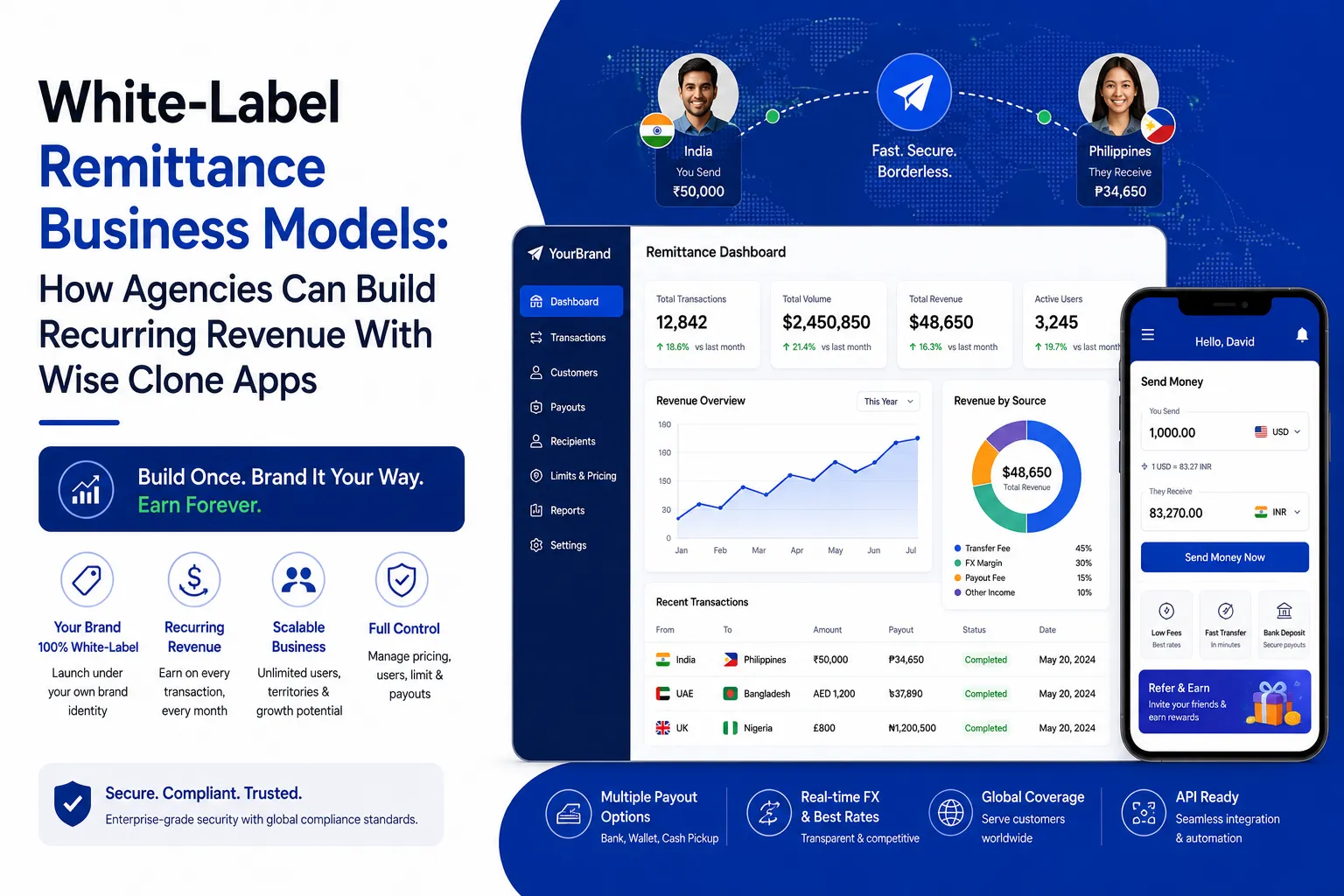
Agencies are under pressure to move beyond one-time website projects, short-term campaigns, and custom development work that ends after delivery. The stronger agency model is recurring revenue: implementation fees, monthly support, product upgrades, technical retainers, compliance workflow support, and long-term client relationships.
That is why the white-label remittance business model is becoming attractive for agencies that serve fintech startups, money transfer operators, payroll platforms, migrant communities, cross-border marketplaces, and financial service businesses.
A Wise clone app or white-label remittance platform gives agencies a ready-made foundation to help clients launch branded money transfer experiences faster. Instead of building every transfer flow, wallet module, FX workflow, KYC screen, admin dashboard, and transaction history from zero, agencies can package a launch-ready product foundation and monetize the surrounding services.
But there is a serious caveat.
Remittance is a regulated fintech category. Agencies should not sell compliance as a guarantee. They should sell a compliance-ready product foundation that supports KYC workflows, AML workflow support, audit logs, transaction monitoring integrations, role-based admin access, secure API integrations, and reporting workflows. Final compliance depends on jurisdiction, licensing, legal review, banking partners, payout providers, and the client’s operating model.
Miracuves helps agencies and founders launch white-label, source-code-owned fintech and remittance app solutions with admin control, custom branding, monetization-ready workflows, and faster deployment. For agencies, this creates an opportunity to build a repeatable fintech product line instead of starting each client project from zero.
Why Agencies Are Exploring White-Label Remittance Apps
Traditional agency revenue is often project-based. A client pays for a website, campaign, app build, or integration. Once the project ends, revenue stops unless the agency sells another project.
White-label fintech changes that pattern.
A remittance app is not a one-time brochure. It is an operating platform that needs ongoing support, updates, integrations, monitoring, reporting, feature improvements, and client training. That makes it a better fit for recurring revenue.
Agencies are exploring white-label remittance apps because they can serve clients such as:
- money transfer operators
- fintech startups
- digital wallet businesses
- migrant community platforms
- payroll companies
- freelance marketplaces
- creator platforms
- cross-border ecommerce companies
- travel and education payment platforms
- regional financial service providers
- banks and credit unions exploring branded remittance services
The demand is also supported by the broader cross-border payment market. Wise Platform, Currencycloud, SDK.finance, and other providers position cross-border payment infrastructure around APIs, branded experiences, faster market entry, and multi-currency capabilities.
For agencies, the opportunity is not only to deliver an app. The opportunity is to become the client’s fintech implementation and growth partner.
What Is a White-Label Remittance Business Model?
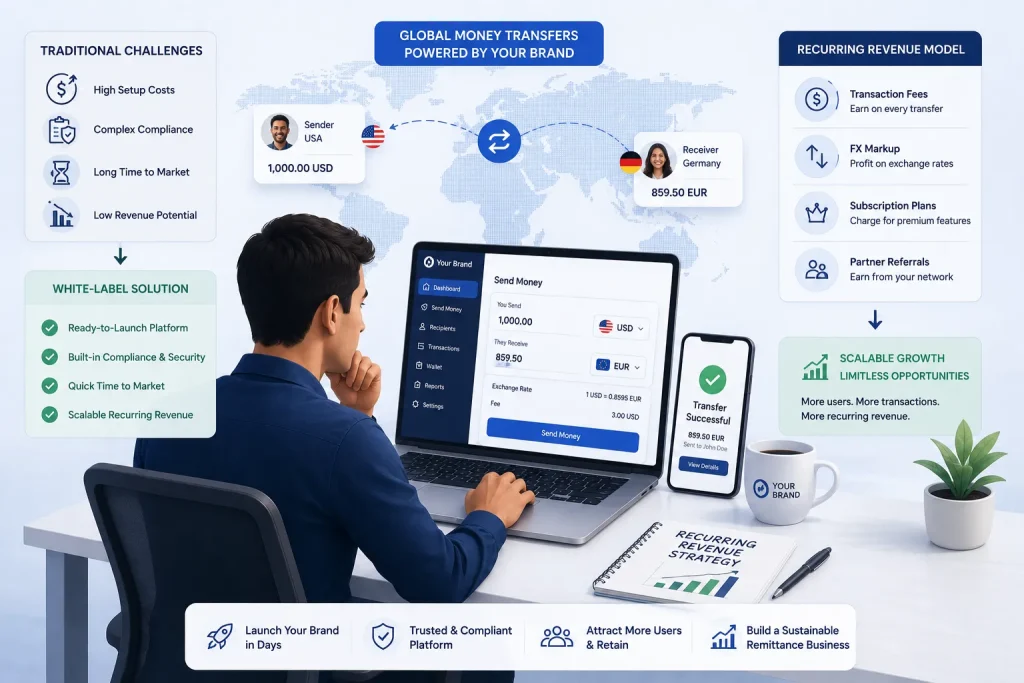
A white-label remittance business model allows an agency, fintech company, or financial service brand to launch money transfer services using a pre-built product foundation that can be branded, configured, customized, and integrated for a specific market.
For agencies, the model works like this:
- The agency partners with a white-label remittance app provider.
- The agency packages the app as a client-ready fintech solution.
- The client receives a branded money transfer platform.
- The agency earns from implementation, customization, integrations, support, and ongoing improvements.
- The end client operates the remittance business with legal, compliance, banking, payout, and operational partners as required.
The agency does not need to become a licensed money transfer operator by default. But the agency must be careful not to claim that software alone solves licensing or compliance. The agency’s role is usually technology delivery, configuration, support, and product enablement.
A strong white-label remittance business model separates three layers:
| Layer | What It Means | Agency Opportunity |
|---|---|---|
| Software layer | Wise clone app, admin dashboard, user flows, transfer workflows, APIs | Setup, branding, customization, support |
| Infrastructure layer | Payment rails, FX, payout providers, banking APIs, KYC/AML tools | Integration, vendor coordination, technical maintenance |
| Compliance and operating layer | Licensing, legal review, AML program, reporting, customer support | Workflow setup, documentation support, admin training, but not legal guarantees |
The strongest agency models understand all three layers without overpromising on regulated responsibilities.
Read More :- Microservices Architecture for Wise Clone Apps: How to Scale a Fintech App for 10K+ Concurrent Users
Why Wise Clone Apps Are Attractive for Agencies
Wise became a reference point in remittance because users associate it with transparent money transfers, international payments, currency conversion, and digital-first cross-border experiences. Wise Platform also offers cross-border payments infrastructure that technology platforms, banks, and financial institutions can connect to via API or Swift.
A Wise clone app is not about copying Wise’s brand, claims, partnerships, or proprietary infrastructure. It is about building a remittance app inspired by common cross-border payment workflows:
- user registration
- identity verification
- sender and receiver profiles
- exchange rate display
- transfer fee calculation
- bank or wallet payout details
- transaction tracking
- transfer history
- notifications
- admin controls
- reporting dashboard
- compliance workflow support
For agencies, this pattern is useful because many clients want the same core remittance foundation but with different markets, corridors, branding, pricing, payout partners, and customer segments.
That creates repeatability.
One agency can package Wise clone apps for different client types:
- a remittance startup targeting Indian migrants in the UAE
- a payroll company paying contractors in the Philippines
- a travel company offering education fee transfers
- a financial consultant launching regional money transfer services
- a community bank offering branded remittance to customers
- a marketplace adding international contractor payouts
Each client may need different corridors, compliance review, payment partners, and brand positioning, but the product foundation can follow a similar structure.
The Agency Revenue Model: How Recurring Revenue Is Created
The strongest agency opportunity is not a single app delivery fee. It is a layered revenue model.
White-Label Remittance Agency Revenue Streams
| Revenue Stream | What the Agency Charges For | Why Clients Pay |
|---|---|---|
| Setup and implementation fee | Initial app setup, branding, configuration, deployment, and launch preparation. | Clients want a faster path to launch without managing technical setup internally. |
| White-label branding package | Logo, colors, app name, onboarding screens, website landing page, app store assets. | Clients need a branded money transfer experience that looks market-ready. |
| Customization fees | Custom flows, dashboards, fee logic, corridor rules, payout methods, reporting changes. | Every remittance business has different market, corridor, and operational requirements. |
| API integration fees | KYC tools, AML tools, payment gateways, FX providers, payout APIs, notification services. | Clients need the app connected to real operational infrastructure. |
| Monthly support retainer | Bug fixes, updates, monitoring, minor changes, admin support, client training. | Fintech apps need ongoing technical support after launch. |
| Compliance workflow support | Configuring KYC flows, audit logs, transaction flags, admin review queues, reporting screens. | Clients need operational workflows that support their compliance program. |
| Feature upgrade packages | Wallets, referrals, multi-currency accounts, business accounts, bulk transfers, analytics. | Clients want to expand product capability as the business grows. |
| Corridor expansion package | New country flows, payout methods, currency settings, fee rules, localization. | Remittance businesses often expand one corridor at a time. |
| Growth and marketing retainer | Landing pages, SEO, paid campaigns, onboarding funnels, referral campaigns. | Clients need customer acquisition after the app launches. |
This is where white-label remittance becomes powerful for agencies. The software is the entry point, but recurring revenue comes from operations, improvement, and expansion.
How Agencies Can Package a Wise Clone App Offer
Agencies should avoid selling “a remittance app” as one vague package. A stronger model is to create structured offers that match client maturity.
1. Launch Package
This is for clients who need a branded remittance product foundation quickly.
It may include:
- white-label Wise clone app setup
- client branding
- basic sender and receiver flows
- admin dashboard setup
- standard transaction history
- notification configuration
- app store preparation support
- basic landing page
- launch documentation
This package is useful for early-stage founders validating a corridor or financial service providers testing a branded remittance channel.
2. Integration Package
This is for clients who already know which providers they want to use.
It may include:
- KYC provider integration
- AML workflow integration
- payment gateway integration
- payout API integration
- FX provider integration
- SMS/email notification setup
- analytics integration
- support tool integration
Wise Platform, Currencycloud, and other infrastructure providers show how cross-border products increasingly depend on APIs and embedded payment rails.
3. Compliance Workflow Package
This is not legal compliance. It is product workflow configuration that supports the client’s compliance program.
It may include:
- KYC step setup
- user risk status fields
- transaction limit configuration
- sanctions screening result storage
- suspicious activity flags
- admin approval queues
- audit logs
- compliance notes
- report export screens
- role-based access controls
Final compliance depends on the client’s jurisdiction, legal review, licensed partners, banking relationships, and operating model. Agencies should repeat this clearly in proposals and contracts.
4. Growth Package
This is where agencies can use their marketing strengths.
It may include:
- remittance corridor landing pages
- SEO content
- paid campaign setup
- referral campaigns
- user onboarding funnels
- app store optimization
- email campaigns
- WhatsApp or SMS reactivation
- trust-building content
- local community outreach campaigns
A client launching a money transfer app still needs customer acquisition. Agencies that combine fintech product delivery with growth support can create stronger monthly retainers.
5. Scale Package
This is for clients expanding beyond the first launch.
It may include:
- new corridor setup
- new currency support
- new payout method integration
- business account features
- bulk payment features
- agent dashboard
- advanced analytics
- fraud monitoring improvements
- custom admin reports
- localization and language support
This is where long-term revenue grows. A remittance business rarely stays static if it gains traction.
Read More :- From Zero to Revenue: How a Remittance Startup Can Scale Using a Wise Clone Foundation
White-Label Remittance Pricing Logic for Agencies
Agencies should avoid pricing remittance projects like simple websites. A remittance app has more technical, operational, and compliance workflow complexity.
A practical pricing model may include:
| Pricing Component | What It Covers | Pricing Logic |
|---|---|---|
| One-time setup fee | Branding, deployment, configuration, initial app preparation | Charged upfront to cover launch work |
| Monthly technical retainer | Updates, bug fixes, monitoring, minor changes | Creates recurring revenue and client support continuity |
| Integration fee | KYC, AML, payment, payout, FX, analytics, notifications | Charged per integration or integration bundle |
| Customization fee | Special workflows, dashboards, reporting, fee logic | Scope-based pricing |
| Compliance workflow setup | Admin queues, audit logs, transaction flags, reporting screens | Product configuration, not legal compliance |
| Growth retainer | Marketing, SEO, paid ads, conversion optimization | Monthly recurring agency revenue |
| Expansion package | New corridors, currencies, payout methods, localization | Charged as the client scales |
Agencies should also separate software licensing, third-party vendor fees, payment provider fees, legal costs, and compliance costs from their own implementation charges. This avoids confusion and protects client trust.
What Features Should a Wise Clone App Include?
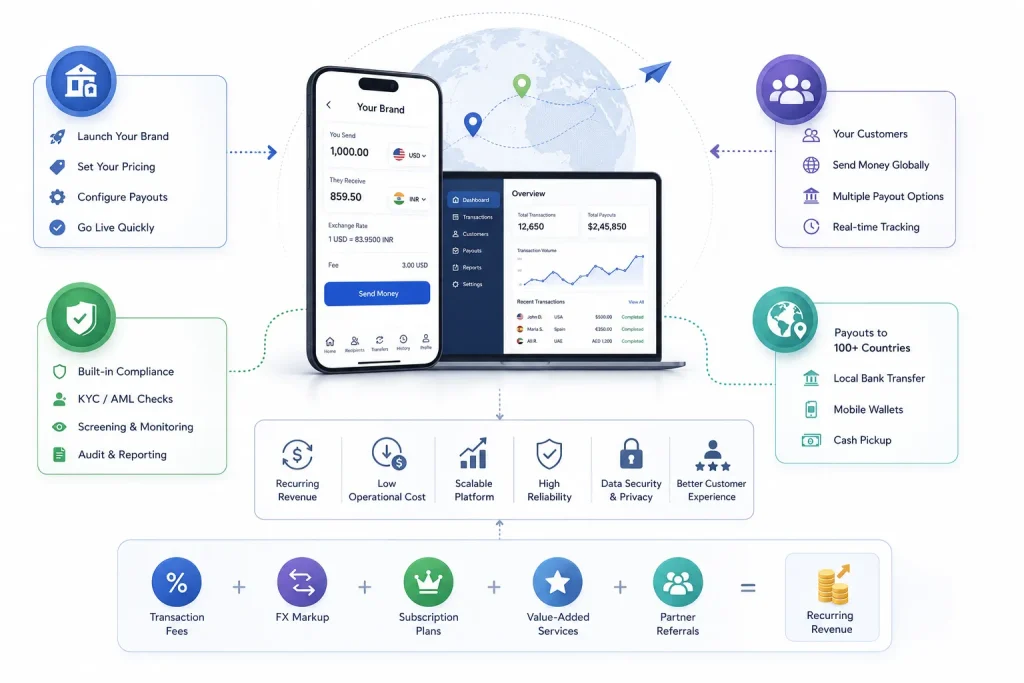
A white-label Wise clone app for remittance should support both user experience and operator control.
User-Side Features
- user registration
- KYC onboarding
- sender profile
- receiver profile
- currency selection
- exchange rate display
- transfer fee display
- transfer amount calculator
- bank or wallet payout details
- payment method selection
- transfer confirmation
- real-time status updates
- transaction history
- receipt download
- notifications
- support request flow
Admin-Side Features
- user management
- KYC status management
- receiver management
- transaction dashboard
- exchange rate controls
- fee and commission settings
- corridor configuration
- payout status tracking
- refund and cancellation controls
- suspicious activity flags
- audit logs
- compliance notes
- reporting dashboard
- admin role permissions
Agency-Side Support Features
Agencies should also think about what they need to manage multiple clients.
- reusable onboarding checklist
- brand asset checklist
- integration requirement form
- compliance workflow configuration checklist
- support SLA templates
- client training documentation
- update logs
- feature request process
- maintenance package structure
The more repeatable the agency process, the easier it becomes to deliver remittance apps profitably.
The Compliance Reality Agencies Must Understand
White-label remittance apps sit inside a regulated category. Agencies must be careful with claims.
The app can support compliance workflows such as:
- KYC verification
- AML workflow support
- transaction monitoring integration
- sanctions screening integration
- audit logs
- role-based access control
- secure payment gateway integration
- suspicious activity flags
- compliance reporting support
- encrypted data transfer
- user verification
- admin access controls
But agencies should avoid saying:
- “fully compliant everywhere”
- “license included”
- “regulator approved”
- “guaranteed AML compliance”
- “banking approval guaranteed”
- “no legal review needed”
The safer and more accurate language is: the app provides a compliance-ready foundation that can be configured for KYC/AML workflows, audit logs, risk review, and reporting support. Final compliance depends on the client’s jurisdiction, legal review, integrations, partners, and operating model. This aligns with Miracuves’ fintech security and compliance wording rules.
Why Source Code Ownership Matters for Agencies
For agencies, source code ownership can be the difference between a scalable fintech service line and a fragile reseller arrangement.
If the agency or end client has no source code access, every change may depend on the original vendor. That can create delays, margin pressure, and client dissatisfaction.
A source-code-owned app foundation gives agencies more control over:
- custom branding
- client-specific workflows
- integrations
- admin dashboards
- reporting modules
- localization
- payout logic
- transaction settings
- future maintenance
- handover documentation
- developer collaboration
Miracuves’ positioning focuses on ready-made, white-label, source-code-owned clone app solutions and custom app development for founders, agencies, and businesses. This is especially useful for agencies that want to build repeatable client offerings without losing control over future customization.
Build vs Partner: Which Model Should Agencies Choose?
Agencies have three main options when entering remittance app delivery.
| Model | How It Works | Best For | Risk |
|---|---|---|---|
| Build from scratch | Agency builds the full remittance platform internally | Large agencies with fintech engineering depth | Long timeline, high cost, compliance workflow complexity |
| Resell SaaS platform | Agency resells a hosted white-label remittance tool | Agencies prioritizing speed and low technical ownership | Less control, lower differentiation, vendor dependency |
| Partner with source-code-owned solution provider | Agency uses a white-label Wise clone foundation and customizes it for clients | Agencies wanting speed plus customization control | Requires strong delivery process and clear client scope |
For most agencies, the third model is the most balanced. It avoids starting from zero but still gives the agency more room for customization, integration, and recurring service revenue.
Founder Decision Signals for Agencies
Agency Decision Signals
Recurring Revenue
If your agency wants monthly retainers, remittance apps create ongoing needs for support, integrations, updates, reporting, growth campaigns, and feature expansion.
Technical Control
If your clients will need custom corridors, payout workflows, fee logic, and dashboards, source-code ownership gives your agency stronger delivery flexibility.
Compliance Sensitivity
If clients operate in regulated markets, your agency should sell compliance-ready workflows while requiring legal and licensing review from qualified experts.
Market Fit
If your agency already serves fintech, migration, payroll, marketplace, or financial service clients, remittance apps can become a natural productized offer.
Mistakes Agencies Should Avoid
Mistakes Agencies Should Avoid
Promising Compliance Approval
Software can support compliance workflows, but it cannot guarantee licensing, regulator approval, or legal compliance in every jurisdiction. Always require proper legal review.
Selling a One-Time App Instead of a Service Line
The real agency opportunity is recurring revenue from support, integrations, customization, reporting, growth campaigns, and corridor expansion.
Ignoring Third-Party Vendor Costs
KYC tools, AML tools, payment gateways, payout APIs, hosting, SMS, email, analytics, and legal fees should be separated from agency implementation pricing.
Choosing a Closed Platform Without Customization Control
If the agency cannot customize workflows, dashboards, or integrations, every client request becomes dependent on the original vendor’s roadmap and pricing.
Forgetting Client Training
Remittance clients need to understand admin controls, transaction review, KYC status, reporting, support workflows, and operational escalation. Training should be part of the package.
How Agencies Can Find Clients for White-Label Remittance Apps
The best clients are not always “anyone who wants a fintech app.” Agencies should target businesses with a clear remittance use case.
Strong client segments include:
- money transfer operators modernizing legacy systems
- migrant community businesses
- payroll providers paying international workers
- freelance marketplaces
- education consultants handling international student payments
- travel and relocation companies
- import/export businesses
- regional fintech startups
- credit unions or local financial institutions
- creator platforms with international payouts
- B2B service platforms paying global contractors
Agencies can build outreach around pain points such as:
- “Launch a branded remittance app faster”
- “Modernize your money transfer customer experience”
- “Add cross-border payout features to your marketplace”
- “Build a remittance app with KYC and admin workflow support”
- “Start with a Wise-style money transfer foundation instead of building from zero”
This keeps messaging practical and business-focused.
Read More :-Wise Clone App Development: Step-by-Step Guide for Developers & Founders
Sample Agency Offer Structure
Here is a simple way to productize the offer.
| Package | Best For | Includes |
|---|---|---|
| Starter Remittance Launch | Early-stage fintech founders | Branding, app setup, basic admin, sender/receiver flows, transaction history |
| Remittance Integration Pro | Clients with provider partners | KYC, AML, payout, FX, notification, and analytics integrations |
| Agency Managed Remittance | Clients needing long-term support | Monthly technical support, minor updates, reporting support, admin training |
| Corridor Expansion Add-On | Growing remittance businesses | New country/currency setup, payout method configuration, localized content |
| Growth Retainer | Clients needing users | SEO, ads, landing pages, referral campaigns, app store optimization |
This structure helps agencies avoid custom quoting every project from scratch.
How Miracuves Supports Agencies With White-Label Remittance Apps
Miracuves helps agencies, founders, and businesses launch white-label fintech and remittance app solutions with ready-made foundations and customization support.
For agencies, Miracuves can support:
- Wise clone app foundation
- white-label branding
- source-code-owned delivery
- admin dashboard control
- sender and receiver workflows
- KYC workflow support
- AML workflow support
- transaction history
- wallet and ledger logic where relevant
- payout API integration support
- secure payment gateway integration
- reporting dashboards
- role-based admin access
- post-launch support where applicable
Final Thoughts: Remittance Apps Can Become a Productized Agency Revenue Stream
The white-label remittance business model gives agencies a way to move beyond one-time development work and build a recurring fintech service line.
A Wise clone app can become the foundation for setup fees, branding packages, integrations, support retainers, compliance workflow configuration, corridor expansion, feature upgrades, and growth marketing services.
But agencies must approach the category responsibly. Remittance is regulated, and software alone does not guarantee compliance, licensing, or financial approval. The stronger agency model is to provide a white-label, compliance-ready, source-code-owned product foundation while helping clients work with the right legal, banking, payout, and compliance partners.
For agencies, the opportunity is clear: package the technology, own the process, support the client long-term, and turn remittance app delivery into a repeatable revenue engine.
Miracuves helps agencies launch white-label Wise clone apps and remittance platforms with source code, admin control, branded experience, and scalable fintech workflows designed for faster market entry.
FAQs :-
What is a white-label remittance business model?
A white-label remittance business model allows an agency or fintech company to launch branded money transfer services using a pre-built remittance platform. Agencies can earn from setup, branding, customization, integrations, support, compliance workflow configuration, and growth services.
How can agencies make recurring revenue with Wise clone apps?
Agencies can create recurring revenue through monthly support retainers, integration maintenance, feature upgrades, compliance workflow support, reporting dashboards, corridor expansion, app marketing, and client training.
Is a Wise clone app the same as Wise?
No. A Wise clone app is a white-label remittance app inspired by common cross-border money transfer workflows. It should not copy Wise’s brand, proprietary systems, claims, partnerships, or regulated infrastructure.
What features should a white-label remittance app include?
A white-label remittance app should include user registration, KYC onboarding, sender and receiver profiles, transfer calculator, FX and fee display, payout details, transaction tracking, admin dashboard, audit logs, reporting, and compliance workflow support.
Can agencies legally sell remittance apps?
Agencies can usually sell technology services, app development, implementation, and support. However, the client’s remittance operations may require legal review, licenses, banking partners, compliance programs, and regulated providers depending on jurisdiction and operating model.
Why does source code matter for agency remittance projects?
Source code ownership gives agencies more control over customization, integrations, dashboards, localization, client-specific workflows, future updates, and technical handover. Without source code access, agencies may become dependent on the original vendor for every change.
Should agencies build remittance apps from scratch or use white-label solutions?
Building from scratch gives maximum control but requires more time, cost, fintech engineering depth, and compliance workflow planning. White-label solutions help agencies launch faster and package repeatable services, especially when source code and customization support are included.
Can Miracuves help agencies launch Wise clone apps?
Yes. Miracuves helps agencies launch white-label Wise clone apps and remittance platforms with source code, branded design, admin dashboards, KYC/AML workflow support, payout integration support, and scalable fintech app foundations.
Related Articles :-
Miracuves is an independent software development company. We are not affiliated with, connected to, sponsored by, or endorsed by any company or product named in this article.
Terms such as “X Clone” are used descriptively. It is how the software industry refers to building a platform with functionality comparable to a known service, and how clients search for it.
The entire design and codebase of our products is built by our own team. Our products contain no code, design, graphics, or content originating from any third-party website or applications.
All third-party names and marks referenced in this article are the property of their respective owners, referenced solely to identify the services discussed.