



You’ve heard the horror stories about delivery apps getting hacked, user data leaked, payments compromised, and businesses losing trust overnight. And if you’re considering launching a white-label Rappi-style app, the biggest question on your mind is obvious: Is it actually safe?
In 2025, on-demand delivery apps operate in one of the highest-risk digital environments—handling sensitive user data, real-time location tracking, gig-worker onboarding, and payment information. Any security flaw can instantly damage your brand.
This guide gives you a clear, research-based, and honest assessment of white-label Rappi-type app security. No sugarcoating. No generic advice. Just practical insights, real risks, and a clear roadmap to building a safe, compliant, and future-ready delivery platform.
And through it all, you’ll see why choosing a security-first technology partner like Miracuves matters more than ever.
Understanding White-Label Rappi App Security Landscape
Before assessing whether a white-label Rappi app is safe, it’s important to understand what “white-label security” actually means and where most misconceptions come from.
What white-label security really means
A white-label Rappi-style app is built on a pre-developed framework that multiple businesses can deploy under their own branding. Security depends on how the framework is engineered, maintained, audited, and updated—not on the fact that it’s white-label.

Why people worry about white-label apps
Delivery platforms like a Rappi-style app handle highly sensitive data:
- customer addresses,
- courier routes,
- order histories,
- payment information,
- personal identification for delivery agents.
Any security flaw can lead to unauthorized access, fraud, or data leaks.
Current threat landscape for Rappi-type platforms
On-demand delivery apps face increasing cyber threats, such as:
- API attacks
- session hijacking
- location spoofing
- fake courier identity creation
- bot-driven order abuse
- account takeovers
- payment gateway exploits
In highly competitive markets, fraud attempts and credential theft incidents have doubled since 2023.
Security standards in 2025
Modern delivery apps are expected to comply with:
- GDPR for data protection
- CCPA for consumer rights
- PCI DSS for payment security
- ISO 27001 for information security
- SOC 2 Type II for internal controls
These aren’t optional anymore—users expect it and regulators enforce it.
Real-world statistics on app security incidents
- Over 46 percent of global app breaches in 2024 came through insecure APIs used by mobile apps.
- Location-based services saw a 32 percent increase in targeted attacks.
- Apps in the on-demand delivery category reported the highest rate of account takeover attempts.
- 57 percent of consumers said they stop using an app permanently after a single security incident.
A white-label Rappi app must be designed to withstand the modern threat ecosystem. Anything less puts your entire business at risk.
Read more : – What is the marketing strategy of Rappi?
Key Security Risks and How to Identify Them
A white-label Rappi-style app operates in a high-risk environment because it handles user data, payments, courier onboarding, and real-time order flows. Below are the major risk areas you must evaluate before choosing any provider.
Data protection and privacy risks
User personal information
Delivery apps store names, phone numbers, full addresses, and order histories. Weak encryption or poorly configured databases can expose this sensitive data.
Payment data security
Any vulnerability in payment flow, tokenization, or gateway integration can lead to financial fraud or unauthorized transactions.
Location tracking concerns
Live GPS tracking is a core feature of Rappi-type apps. Insecure tracking can reveal user movement patterns or expose courier locations.
GDPR and CCPA compliance
Failure to meet global privacy standards can result in penalties and legal action, especially when handling cross-border data.
Technical vulnerabilities
Code quality issues
Low-cost providers often reuse outdated codebases that contain legacy bugs, deprecated libraries, or insecure logic.
Server security gaps
Weak server configurations, outdated OS versions, and lack of firewalls create major attack surfaces.
API vulnerabilities
On-demand delivery platforms rely heavily on APIs. Poorly secured endpoints make APIs the number one attack vector in mobile apps.
Third-party integrations
Payment gateways, mapping systems, analytics tools, SMS providers, and cloud services must be secured and monitored. One weak link can compromise the entire platform.
Business risks
Legal liability
If your app mishandles data or violates compliance laws, the liability falls on the business owner—not the white-label provider.
Reputation damage
A single breach destroys customer trust. Delivery apps rely heavily on repeat usage, meaning reputation is everything.
Financial losses
A security incident can lead to refunds, penalties, customer compensation, and business downtime.
Regulatory penalties
Non-compliant apps can face significant fines under GDPR, CCPA, PCI DSS, and other regional regulations.
Risk assessment checklist
Use this checklist to evaluate any white-label Rappi app provider:
- Does the provider use industry-standard encryption for data at rest and in transit?
- Are APIs protected with authentication, rate limiting, and gateway firewalls?
- Is payment processing PCI DSS compliant?
- Do they conduct regular penetration testing?
- Is the codebase updated frequently with security patches?
- Can they provide audit reports, compliance documentation, and certifications?
- Are server environments isolated and protected through hardened configurations?
- Do they offer backup and disaster recovery systems?
- Is there a clear incident response plan?
- Do they follow GDPR and CCPA requirements by default?
If your current or shortlisted provider cannot confidently answer these questions, the app is not ready for production.
Read more : – Rappi Features Every Startup Needs
Security Standards Your White-Label Rappi App Must Meet
For a white-label Rappi-style app to be considered genuinely safe, it must comply with globally recognized security certifications and follow strict technical practices. These standards protect user data, payment information, courier onboarding details, and platform operations.
Essential certifications
ISO 27001
The global gold standard for information security management. Ensures structured policies for data safety, risk management, access control, and infrastructure protection.
SOC 2 Type II
Validates operational security, data management controls, system monitoring, and internal processes over an extended period. Critical for enterprise-grade delivery platforms.
GDPR compliance
Mandatory for handling any European user data. Covers privacy, data retention, user consent, and rights over personal information.
HIPAA (if applicable)
If your Rappi-style app handles medical deliveries, prescriptions, or health-related data, HIPAA compliance becomes essential.
PCI DSS (for payments)
A must for any platform processing card payments. Ensures card data protection through encryption, tokenization, and secure payment workflows.
Technical requirements
End-to-end encryption
Protects sensitive information throughout every transaction, from user devices to backend servers.
Secure authentication systems
Modern apps must support 2FA, OAuth, or passwordless authentication to reduce account takeover risks.
Regular security audits
Third-party audits help validate that code, APIs, and servers remain secure over time.
Penetration testing
Simulated attacks uncover hidden vulnerabilities before real attackers find them.
SSL certificates
Encrypt all communication between clients, servers, delivery agents, and merchant dashboards.
Secure API design
Includes rate limiting, token-based access, encrypted payloads, and secure error handling. Critical for delivery apps with high API dependency.
Security standards comparison table
| Security Area | Minimum Requirement | Ideal Standard (2025) |
|---|---|---|
| Data Security | Basic encryption | End-to-end AES-256 encryption |
| User Privacy | Basic policy | Full GDPR + CCPA compliance |
| Payments | PCI DSS gateway | PCI DSS Level 1 + tokenization |
| Identity Verification | Simple login | OAuth/2FA/biometric options |
| Server Security | Regular hosting | Hardened cloud infrastructure |
| Monitoring | Manual checks | Automated 24/7 monitoring |
| Code Quality | Internal QA | External audits + penetration testing |
| Deployment Safety | Basic backups | Multi-zone backups & disaster recovery |
A white-label Rappi app must match the “ideal” column to be considered truly secure and scalable.
Red Flags: How to Spot Unsafe White-Label Providers
Not all white-label Rappi app providers follow secure development practices. Many rely on outdated frameworks, low-cost development shortcuts, or minimal security oversight. Here are the biggest warning signs that a provider is unsafe.
No security documentation
If a provider cannot supply security policies, audit reports, or compliance details, the product is not secure.
Unusually cheap pricing
Low cost without technical justification typically means compromised code quality, outdated libraries, or zero security testing.
No compliance certifications
Lack of ISO 27001, SOC 2, GDPR readiness, or PCI compliance is a major red flag.
Outdated technology stack
Using old PHP versions, deprecated frameworks, or unpatched libraries increases vulnerability risk.
Poor code quality
Monolithic codebases, lack of modularity, no linting rules, and absence of version control indicate irresponsible engineering.
No security updates policy
If the provider doesn’t commit to ongoing updates, your app becomes insecure within months.
Lack of data backup systems
No automated backups or recovery plans mean data is at risk during failures or attacks.
No insurance coverage
A serious provider offers liability and security insurance, showing accountability for risk.
Evaluation checklist
Use this checklist before finalizing any white-label Rappi app provider:
Questions to ask providers
- How often do you release security patches?
- What encryption standards do you follow?
- Can you provide recent penetration testing reports?
- Are your servers independently audited?
- Do you isolate client deployments?
Documents to request
- Security policy documentation
- Infrastructure architecture diagrams
- GDPR/CCPA compliance documents
- Payment gateway compliance certificates
- Audit reports or vulnerability assessments
Testing procedures
- Request access to a staging environment
- Run basic penetration testing tools
- Evaluate API response security
- Test authentication flows for weak logic
Due diligence steps
- Verify server provider reputations
- Inspect code through a neutral auditor if possible
- Check client reviews for mentions of security issues
- Assess the provider’s public vulnerability tracking history
If a provider fails even 30 percent of this checklist, the risk level is too high for a delivery platform handling sensitive user data.
Best Practices for Secure White-Label Rappi App Implementation
Launching a white-label Rappi-style app without the right security practices is risky. To ensure your platform stays protected from launch day onward, you need a structured approach covering pre-launch preparation and post-launch monitoring.
Pre-launch security
Security audit process
Before deployment, the entire system must undergo a full security audit covering APIs, servers, mobile apps, dashboards, and payment flows. This reduces risks before the app goes live.
Code review requirements
A senior technical team should perform manual code reviews to identify insecure logic, outdated libraries, and weak authentication flows.
Infrastructure hardening
Servers, firewalls, SSL configurations, access rules, and network setups must be hardened according to industry benchmarks like CIS standards.
Compliance verification
Every integration—payment, SMS, maps, analytics—should align with GDPR, CCPA, PCI DSS, and other relevant regulations.
Staff training programs
Internal teams should be trained in secure operations, data handling, user support protocols, and incident escalation.
Post-launch monitoring
Continuous security monitoring
Delivery apps operate 24/7. Real-time monitoring detects unusual activity, API abuse, or traffic anomalies before they escalate.
Regular updates and patches
New vulnerabilities appear daily. The provider must release ongoing patches for frameworks, libraries, and server components.
Incident response planning
A documented response plan ensures quick action if anything goes wrong—mitigating damage, reducing downtime, and preserving user trust.
User data management
Data retention policies, access control, encryption, and anonymization techniques should be enforced consistently.
Backup and recovery systems
Automated backups, multi-zone storage, and defined recovery times ensure that the business can resume operations quickly after failures.
Security implementation timeline
| Phase | Activities | Expected Timeline |
|---|---|---|
| Initial Assessment | Requirement review, compliance planning | 1–2 days |
| Pre-launch Security | Audits, code review, infrastructure hardening | 5–10 days |
| Implementation | Deployment, integration, configuration | 3–6 days |
| Post-launch Monitoring | Continuous tracking, patches, incident readiness | Ongoing |
| Quarterly Audits | Pen-tests, compliance review, performance tests | Every 90 days |
This timeline ensures your white-label Rappi app remains secure, compliant, and stable as it grows.
Legal and Compliance Considerations
A white-label Rappi-style app doesn’t just need strong technical security. It must also comply with global and regional legal requirements. Non-compliance can lead to penalties, lawsuits, and service shutdowns. This section outlines the essential legal and policy frameworks your platform must follow.
Industry-specific regulations
If your app handles pharmacy deliveries, alcohol orders, or identity-verification services, you may have to follow:
- HIPAA requirements (for medical-related deliveries)
- Age verification laws
- Local licensing requirements
- E-commerce marketplace guidelines
User consent management
Apps must provide:
- Clear consent prompts
- Opt-in options for data usage
- Cookie and tracking disclosures
- Easy data deletion requests
This is essential for GDPR and CCPA compliance.
Privacy policy requirements
Your privacy policy must explain:
- What data is collected
- How it is stored
- Who can access it
- How users can request deletion or changes
- Data retention periods
Terms of service essentials
A strong terms of service covers:
- User responsibilities
- Delivery partner requirements
- App usage rules
- Payment and refund policies
- Liability limitations
Liability protection
Insurance requirements
A safe provider includes cyber liability and technology errors & omissions insurance to cover risks like data breaches or service outages.
Legal disclaimers
Your documentation should clarify:
- What the app is responsible for
- What falls under third-party provider responsibility
- How disputes are handled
- Data protection obligations of merchants and delivery partners
User agreements
End-user license agreements (EULAs) help ensure users understand how their data is used and what rights they have.
Incident reporting protocols
Regulations like GDPR require that breaches be reported within 72 hours. A proper reporting flow must exist long before a breach happens.
Regulatory compliance monitoring
Compliance isn’t one-time. You need ongoing monitoring of:
- New privacy laws
- Payment regulations
- Security standards
- Data storage rules
This prevents unexpected legal issues as your app scales.
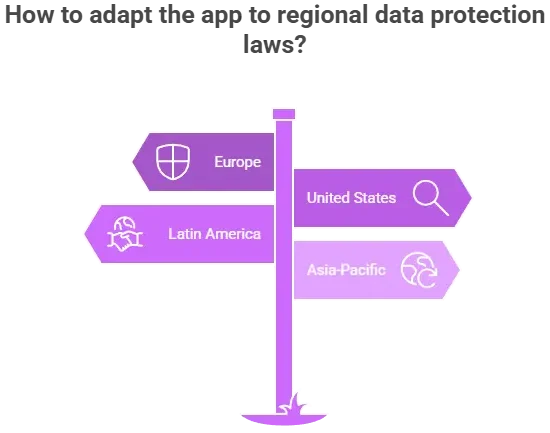
Compliance checklist by region
| Region | Mandatory Compliance | Additional Notes |
|---|---|---|
| Europe | GDPR | Mandatory breach reporting, data minimization |
| USA | CCPA | Strong disclosure requirements, opt-out options |
| Latin America | LGPD | Explicit consent required for data usage |
| Middle East | Local data residency rules | Some countries require local server storage |
| Asia-Pacific | Varies by country | Regular audits required, evolving laws |
| Global Payments | PCI DSS | Required for card transactions |
Following these compliance rules protects your business, users, and brand from legal risks.
Read more : – How to Hire the Best Rappi Clone Developer
Why Miracuves White-Label Rappi App Is Your Safest Choice
Most white-label Rappi-style app providers make big promises but fall short when it comes to real-world security. Miracuves takes a different approach. Security is not a feature we add later—it is built into the architecture from day one. This is why businesses that operate in high-risk delivery, logistics, and on-demand marketplaces trust Miracuves for safe, compliant, and scalable deployments.
Miracuves security advantages
Enterprise-grade security architecture
Miracuves builds every Rappi-style app on a hardened, modular, and scalable framework. The architecture includes encrypted data layers, segregated server environments, secure API design, and strict access control for every system component.
Regular security audits and certifications
We conduct continuous internal audits and schedule third-party penetration testing to ensure vulnerabilities are eliminated before they can be exploited.
GDPR and CCPA compliant by default
Your app launches with built-in compliance. Consent flows, data retention rules, anonymization, privacy controls, and legal documentation are aligned with international data privacy standards.
24/7 security monitoring
Our systems run real-time threat detection, anomaly monitoring, and automated alerts to catch suspicious activities instantly.
Encrypted data transmission
All sensitive data—including user profiles, delivery addresses, courier information, and payment data—is encrypted using modern protocols.
Secure payment processing
Miracuves integrates PCI DSS-compliant payment gateways with tokenization, secure card handling, and fraud detection workflows.
Regular security updates
Your app stays protected with ongoing patches for operating systems, libraries, API gateways, and mobile frameworks. You never fall behind on security.
Insurance coverage included
We maintain technology liability and cyber risk coverage, ensuring your business is protected from unforeseen security incidents.
conclusion
Don’t compromise on security. Miracuves white-label Rappi app solutions come with enterprise-grade security built-in. Our 600 plus successful projects have maintained zero major security breaches. Get a free security assessment and see why businesses trust Miracuves for safe, compliant platforms.
A white-label Rappi app can be completely safe—but only if it’s built on a secure foundation. In 2025, security is not optional. It’s the difference between growth and vulnerability. The right provider protects your users, your business, and your long-term reputation.
FAQs
1. How secure is a white-label Rappi app compared to custom development?
It can be equally or even more secure if the provider follows strict compliance, audits, and security engineering practices.
2. What happens if there’s a security breach?
Immediate incident response, user notifications, containment steps, and regulatory reporting are required within defined timelines.
3. Who is responsible for security updates?
A reliable white-label provider should handle all patches, audits, and updates continuously.
4. How is user data protected?
Through encryption, access control, secure APIs, and strict data retention rules.
5. Which certifications matter most?
ISO 27001, SOC 2 Type II, GDPR, CCPA, and PCI DSS for payments.
6. Can white-label apps meet enterprise security standards?
Yes, if the provider uses modern infrastructure and complies with global standards.
7. How often should security audits be done?
At least quarterly, plus annual third-party penetration tests.
8. What does Miracuves include in its security package?
Encrypted architecture, audits, 24/7 monitoring, compliance setup, secure payments, and regular updates.
9. How to ensure security in different countries?
Follow regional laws (GDPR, CCPA, LGPD) and ensure proper data residency where required.
10. What insurance is needed for app security?
Cyber liability and technology errors and omissions insurance to protect against operational and data risks.
Related Articles: