


Key Takeaways
- Catalogue structure is the one part of a restaurant discovery app that is fully exposed to the public, so it cannot be refactored quietly the way a payment integration or a search engine can.
- Cuisine, category and tag answer three different questions and must live in three separate structures, because collapsing them means you can never retire a tag without disturbing something that owns a URL.
- Storing a single primary cuisine per restaurant causes more rework than any other early schema decision, and a join table on day one removes an entire class of future migration.
- Every filter you want to ship has to exist as structured data first, which makes the filter list a specification for what your onboarding form must ask long before the filter is built.
- Renaming a cuisine, splitting a category or deepening a hierarchy all move URLs, and redirects preserve most of a link’s value without restoring the specificity that made the old page rank.
Catalogue Structure Signals
- Separate the slug from the display name before launch and never regenerate it.
- Model cuisine as a many-to-many relationship, not as a primary field with spares.
- Write the full filter list first, then build the onboarding form to feed it.
- Create the brand layer above outlets while every listing is still independent.
- Name one owner for term creation on the day the platform opens.
Real Insights
- A catalogue decision is the rare kind that gets monotonically more expensive from the day the first listing publishes, rather than cheaper as you learn the market.
- Two levels of hierarchy usually beats both a flat list of forty terms and an elegant tree nobody on an onboarding team will ever navigate.
- Self-classification by restaurants is free and produces the worst data, because owners select terms that look like traffic rather than terms that describe the food.
- A cuisine page and a cuisine-plus-area page are the organic search assets of a food discovery app, which makes taxonomy an acquisition decision wearing a schema disguise.
- Miracuves builds restaurant discovery and delivery platforms with the catalogue structure decided up front, and eligible ready-made scopes deploy in 6 days of build time.
Six months after launch, somebody on the growth team opens a ticket that reads like a formality. The Cafe category has become a dumping ground. It should be three things: Cafe, Bakery, and Dessert. Everyone in the room agrees immediately, because it is obviously correct.
The engineer who picks it up asks for a week. Two days later she asks for a month.
The split itself is trivial. What is not trivial is that by month six the category is no longer a label. It is a URL that ranks, a chip on three screens, an input to the home feed, a targeting option someone already sold advertising against, and a value stamped onto eleven hundred listings. Splitting it means deciding, listing by listing, which of the three new things each restaurant is, then deciding what happens to a year of search traffic pointing at a page that will stop existing.
Before launch, that same change is a conversation and an edit to a spreadsheet. The distance between those two costs is the whole subject here. If you are scoping a food delivery and restaurant discovery app, the catalogue structure is the cheapest thing on your list this month and one of the most expensive things on it next year.
The cuisine and category structure behind a platform like Zomato is cheap to decide now and structural later.
The Catalogue a Restaurant Discovery App Cannot Refactor Quietly
Zomato carries cuisines, categories and chains in one taxonomy, and changing it after launch touches everything above it.
Most parts of a platform can be rewritten without anyone outside the team noticing. Replace a payment integration, swap a search engine, rebuild the restaurant panel, and a diner sees nothing change. The catalogue is not like that. It is the one internal structure fully exposed to the public and to search engines.
What a Taxonomy Is Actually Wired Into
Write out everything that reads your category field and the list gets uncomfortable fast. Search facets read it. The home feed builds rows from it. Every browse URL contains it. Notification segments use it. The advertising tool sells against it. Finance groups revenue by it.
None of those were designed together. They accumulated, each assuming the field means what it meant the day that team shipped. A rename does not break one thing. It breaks six things in six ways, and two of them fail silently.
The Same Change, Drawn on a Whiteboard
Do the same split before there are any listings and it costs an afternoon. No data to migrate, no URL to preserve, no ranking to protect, no advertiser to notify. You are arguing about words on a board, which is the right time to argue about words.
This asymmetry is unusual. Most design decisions get cheaper to reverse as you learn more about the market. Catalogue decisions only get more expensive from the day the first listing publishes, because every day adds records stamped with the old structure and external references pointing at it.
Cuisine, Category and Tag in a Restaurant Discovery Catalogue
The most common structural error is collapsing three concepts into one field, because on day one they look identical: a word attached to a restaurant. They answer different questions, get assigned by different people, and earn their keep in different places.
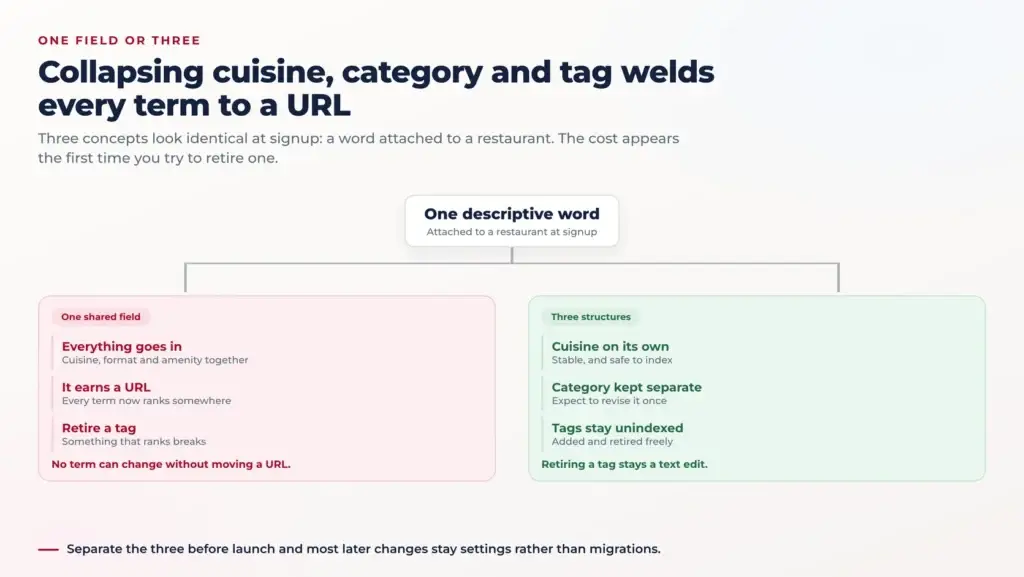
Image Source: AI-generated visual by Miracuves
A Cuisine Describes the Food
Cuisine answers what is on the plate. It is the most stable of the three because it is anchored to a culinary tradition rather than a business model. A restaurant serving one regional cuisine will still be serving it in three years.
Stability is why cuisine makes the best backbone for indexable pages. People search for food by name, in volume, using vocabulary that barely shifts. It is the safest structure to hang permanent URLs on.
A Category Describes the Occasion or the Format
Category answers what kind of place this is and what you would go there to do. Quick service, casual dining, fine dining, cafe, bar, bakery, cloud kitchen. It is a statement about format and occasion, not ingredients.
Category is less stable than cuisine because it tracks business models, and those move. A dine-in restaurant opens a delivery-only kitchen. A bakery adds seating and becomes a cafe. Expect to revise your category list at least once, and your cuisine list almost never.
A Tag Is True but Does Not Organize Anything
Everything else is a tag. Outdoor seating, live music, good for groups, open late, pet friendly, rooftop. Each is a real fact that some diner cares about intensely and most diners ignore.
Tags should be cheap to add and cheap to retire, which is only possible if they sit apart from the things that own URLs. The moment a tag becomes a permanent indexed page it has been promoted into a category, with every cost that carries.
Why a Restaurant Belongs to Many Discovery Categories at Once
Almost no real restaurant is one thing. A neighbourhood place might serve two regional cuisines, work as both a dinner spot and a lunch counter, and be one of the few places nearby with outdoor seating. All of it is true at once, and a diner might arrive looking for any of it.
The Primary Cuisine Field Is the Costliest Shortcut
Storing one cuisine per restaurant causes more rework than any other decision. It looks reasonable in a first schema because it makes the listing card easy to render. Then reality arrives.
Once a restaurant genuinely serves two cuisines you either lie about it or bolt on a field called secondary cuisine, which is a many-to-many relationship in disguise. A third arrives and you add a third column. Every cuisine query now checks three nullable columns, and ranking has to decide whether a match on the third counts as much as the first.
What Many-to-Many Buys You on Day One
A join table between listings and taxonomy terms is not sophisticated engineering. It is the plain version. It costs a few hours at the start and removes a class of migration, because adding a fourth cuisine becomes a row rather than a schema change.
It also holds what a single field cannot. A relationship row can carry a weight, so a place is mainly one cuisine and partly another. It can record who assigned the term and when, which is how you audit quality later. It can mark whether the term shows on the card or only feeds matching.
Depth Versus Breadth in the Cuisine Tree
Once the relationship is right, the next argument is shape. How many terms, and how deep. This is where teams tend to pick one of two extremes, both of which fail, and for opposite reasons.
Forty Items Flat, or Five Levels Deep
A flat list of forty cuisines is quick to build and impossible to browse. On a phone it is a wall of chips nobody reads past the first eight. It also cannot answer the broad question, because no term covers the regional cuisines a diner thinks of as one family.
The opposite failure is the elegant five-level tree that models culinary reality precisely. It is satisfying and operationally dead within a quarter. Nobody on an onboarding team navigates five levels, so they pick whatever is visible at level two and the leaves stay empty.
Two Levels Is Usually Where to Land
Two levels covers both jobs. The parent is broad enough to build a browse experience that fits on a screen and specific enough to be a page worth ranking. The child level holds the long tail and can grow indefinitely without changing the shape of anything.
The practical test: can a person who has never seen your taxonomy classify a restaurant correctly in under fifteen seconds? If not, the depth is wrong, and documentation will not fix it, because the people classifying at volume do not read documentation.
Who Assigns the Taxonomy in a Restaurant Discovery App
A structure is only as good as the data poured into it. Three parties can classify a restaurant, and the choice determines both the quality of your filters and a permanent line item of work. The operator decides which, as part of what the features page sets out.
The Restaurant Chooses During Onboarding
Letting the restaurant self-classify is free and scales without a team. It also produces the worst data, and not because owners are careless. They are optimizing for discovery. If a term looks like it draws traffic they will select it, whether or not it describes the food.
Unchecked, self-classification turns the taxonomy into a marketing surface. Popular terms fill with restaurants that do not belong, and the filter stops being trustworthy, which is the only property a filter has.
Your Team Assigns at Approval
Assigning at approval produces clean data and a cost that never goes away. Every listing needs a minute of somebody’s judgement, and that minute scales linearly with growth at exactly the moment growth is what you are celebrating.
The workable version is a hybrid. The restaurant proposes, your reviewer confirms or corrects during the approval check they are already doing. The marginal cost is small because the human is already looking at the record. Bolting classification onto an existing step is far cheaper than creating a new one.
The Menu Classifies Itself
Deriving cuisine from dish names works better than most expect, because menus share a vocabulary. It is also wrong often enough that shipping it unsupervised will embarrass you. Treat it as a suggestion engine that pre-fills the reviewer’s form, never as the source of truth.
A derived classification is also only as fresh as the menu it read, and menus change without telling you. Run the derivation once at onboarding and never again, and the catalogue drifts from reality in a way nobody notices until a diner complains.
Filters Are Taxonomy Made Visible
Every filter chip on your search screen is a promise that a field somewhere holds that fact for every listing. A filter is not an interface feature. It is structured data you chose to collect months earlier, finally becoming visible.
You Cannot Filter What Nobody Recorded
The request sounds simple. Diners want to filter by good for groups. The interface work is an afternoon. The problem is that no listing was ever asked the question, so the filter returns nothing.
So you are not building a filter. You are running a collection campaign across the whole catalogue: a form change, an outreach effort, and months of partial coverage during which the filter hides restaurants that simply have not answered. Thin coverage is worse than no filter, because it looks authoritative while excluding most of the market.
Write the Filter List Before the Schema
Reverse the usual order. List every filter you can imagine wanting in the first two years, including ones you will not ship immediately. That list specifies what the onboarding form must ask, and asking during onboarding costs almost nothing. Asking retroactively costs a campaign.
Collect more than you display. Fields unused for a year are not waste, they are why a future filter ships in an afternoon instead of a quarter. This is one of the few places where gathering data ahead of a proven need pays, and it belongs in the scope of your food delivery app development work.
The Filter Page Is an Organic Search Asset
On a restaurant discovery app, organic search is not a channel bolted on afterwards. It is the product working. People type a cuisine and an area into a search engine constantly, and the platform with a real page for that combination receives them. Taxonomy is therefore an acquisition decision, which founders usually discover late.
Which Combinations Deserve a Real URL
Cuisine alone deserves a page. Cuisine plus area almost always does, because that is how people search when they are hungry and nearby. Beyond two dimensions the returns collapse and you start generating pages with one listing on them or none.
Set a threshold and enforce it in code. A combination gets a page when it holds enough listings to be a useful answer, and not before. Without that rule, forty cuisines across sixty areas silently generate thousands of near-empty pages, and thin pages damage the pages you care about.
A Listing Grid Is Not a Page
A URL that returns twelve cards and nothing else is a query result. To earn a position it needs a title that reads like an answer, a short piece of writing about that cuisine in that area, and links connecting it to its parent and siblings.
So taxonomy terms are not just identifiers. Each needs a display name, a permanent slug, a short description, and page copy. Decide that at design time. Retrofitting content onto four hundred terms after launch is a project nobody budgeted for, and it gets done badly or not at all. The same discipline applies across the broader food delivery solution.
What Changing the Catalogue Actually Costs
Not every catalogue change is a migration. Some are genuinely a setting you adjust on a Tuesday afternoon. The skill is telling them apart before you promise a date, because the two look identical in a planning meeting and diverge sharply in execution.
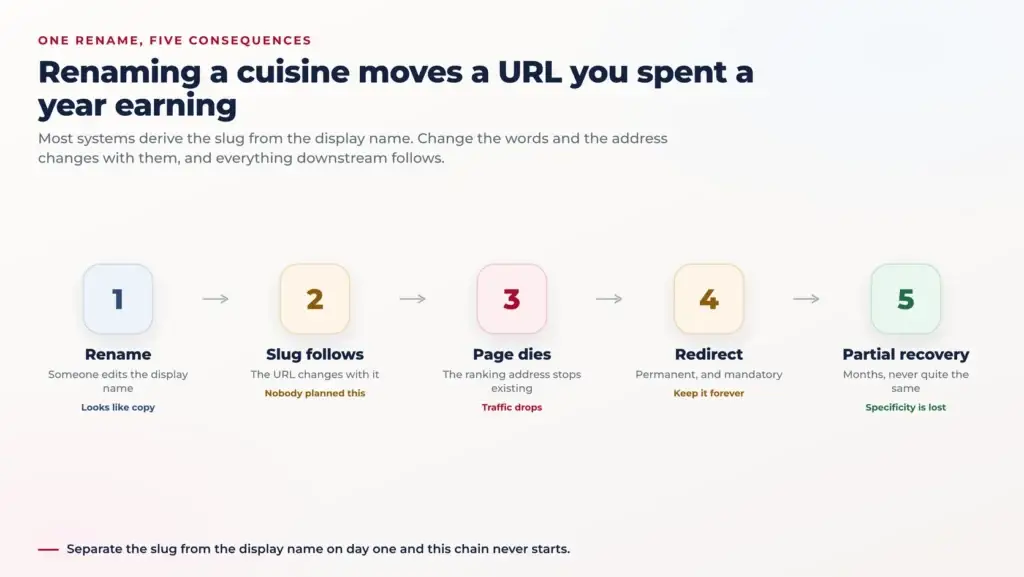
Image Source: AI-generated visual by Miracuves
Merging Two Categories
Merging is the gentler direction, because every listing in both old terms has an obvious home in the new one. The data move is mechanical. What is not mechanical is that one of the two URLs must disappear, and if it was the one earning traffic you have given away a position you spent a year building.
Splitting is harder, because no machine can decide which new term each listing belongs to. That is a judgement call multiplied by your listing count, and no version avoids people reading menus.
Renaming a Cuisine
Renaming feels like the safest change here and usually is not, because most systems derive the slug from the name. Change the display name and the URL moves with it.
The fix is boring and permanent: separate the slug from the display name at the start and never regenerate it. The display name becomes editable copy. The slug becomes an identifier as immutable as a primary key. That one decision converts a class of migrations into a text edit.
Adding a Level to the Hierarchy
Going from flat to two levels after launch is the expensive one. Every URL is rewritten, every term needs a parent assigned, and every page that lists terms needs new logic. It touches data, routing and interface at once.
The defence is to build the hierarchy on day one even if you launch with one level populated. A parent column that is null on every row costs nothing. Adding it two years later costs a rewrite of everything that assumed it did not exist.
Redirects Help and Do Not Repair
A permanent redirect from the old URL to the new one is mandatory and is not a cure. Redirects preserve most of a link’s value, but not the specificity that made the old page rank, because the destination now answers a broader question than the query it satisfied.
Plan on a recovery measured in months, on never quite regaining the old position, and on keeping the redirect forever. Removing it later because the traffic looks small is how a platform loses the value it kept. There is more on the operating side in How to Keep Restaurants, Riders, and Customers Happy Simultaneously.
One Brand, Nine Outlets
A chain signs up with nine locations across the city. One listing or nine? It looks like a display question and it is a data modelling question, and it is among the hardest catalogue decisions to reverse once reviews accumulate.
What Search Results Want
Search wants one result. Nine near-identical cards from one brand is a bad results page and pushes out the variety that makes browsing useful. Left unhandled, a chain with thirty outlets dominates a page that should show a neighbourhood.
Ordering wants the opposite. Nobody orders from a brand, only from a specific kitchen with its own hours, menu availability, delivery radius, and current state of open or closed.
What Ratings and Reviews Want
Ratings split the room. Aggregate to the brand and a genuinely bad outlet hides behind eight good ones, misleading the diner standing outside it. Keep them per outlet and a new location opens with no rating, buried beneath established competitors for months.
The structure that survives both is a brand entity with outlets beneath it, ratings living on the outlet, and a brand aggregate clearly marked as such. That needs the brand layer from the start, which is exactly what a first schema omits because the first fifty signups are independents.
Why the Decision Resists Reversal
Splitting one merged listing into nine means dividing years of reviews between locations, and usually there is no record of which outlet each review described. Merging nine into one means deciding which menu is now the menu. Both are data losses dressed up as refactors.
Model the brand layer before the first chain signs, while every listing is still independent. An empty brand table is cheap. Retrofitting one across a live catalogue with reviews attached is not, and the migration side of that is covered in Migrating from SaaS to Owned Infrastructure: A Peak-Hour Performance Comparison.
The Level Below the Listing
Everything so far has treated the restaurant as the smallest unit in the catalogue. It is not. Below it sits the dish, and whether dishes are structured records or text on a menu determines a surprising amount of what you can offer.
What Dish-Level Data Unlocks
Structured dishes let a diner search for a dish rather than a restaurant, which is how people with a craving behave. They make dish pages possible, an underused source of organic demand. They let a diner narrow a list to places that can actually serve one specific thing.
They also make the catalogue self-correcting. Once dishes carry attributes, a restaurant’s cuisine can be checked against what it serves rather than what it claimed at signup.
What It Costs to Keep True
The cost is not building it. A menu of structured dishes has far more fields that can go stale, and a stale dish is worse than a missing one because it generates an order the kitchen cannot fulfil. Menus change weekly and nobody updates a platform promptly.
Decide early whether the restaurant maintains this, whether you ingest it from their existing system, or whether your team does it. Whoever owns it owns it for the life of the platform. That failure mode is described in The Out-of-Stock Trap: Why Cheap Delivery Scripts Ruin Restaurant Relationships.
Dietary and Attribute Data
Dietary filters are the ones diners want most and platforms most often lack, because they sit between the listing and the dish. A restaurant is rarely entirely one diet, so a flag on the listing is misleading or useless.
The Attributes People Filter On Most
Vegetarian and vegan options, common allergens, halal and kosher preparation, spice level. These are high-intent filters. A diner using one is not browsing, they are looking for somewhere they can safely eat, and answering reliably earns loyalty that discounting cannot buy.
The structure that works is attributes on the dish, rolled up to the listing as a derived summary. The listing then says this place has vegan options rather than this place is vegan, which is both more accurate and more useful.
Attributes Need Provenance, Not Just a Checkbox
Dietary data carries consequences a decorative tag does not. Store who asserted each attribute and when, because when a claim is wrong you need to know whether the restaurant said it, your team inferred it, or an algorithm guessed.
Display language should match the strength of the source. Software gives you the fields, the audit trail and the controls. It does not give you a certification, and no platform should present a restaurant-supplied claim as a verified one. What a build includes is set out on the delivery and scope facts page.
Founder Decision Signals
Speed
Taxonomy is the fastest thing to get right before launch and the slowest to change after. An afternoon with a spreadsheet now replaces a month of migration in year two.
Cost
The expense is never the schema. It is the human judgement needed to reclassify a live catalogue, and the search positions that lapse while URLs move.
Scalability
Many-to-many relationships, immutable slugs and a brand layer above outlets all cost hours at the start and remove entire categories of rework later.
Market Fit
Test the taxonomy against fifty real restaurants in your actual launch city. A structure that cannot classify your own neighbourhood will not classify a market.
Governance After the Catalogue Is Live
A taxonomy without an owner degrades steadily rather than dramatically. Somebody adds a term to close a deal. Somebody else adds a near-duplicate. Within a year the list has grown by a third and half the growth is noise.
Restrict term creation to a named owner from the day the platform opens. Everyone else requests, and requests queue. That sounds bureaucratic for a four-person team, and it is exactly the small constraint that prevents an expensive cleanup later, because the cleanup means touching URLs.
Review the queue on a fixed cadence rather than case by case. Batching surfaces what individual requests hide: six variations on one idea means the parent term is too broad. Track usage per term too, because a term with three listings after a year is either a mistake or a market you never entered. Both are worth knowing before it reaches a navigation menu, and the reporting behind it sits inside the business model of a food discovery app.
Six Ways Founders Get the Catalogue Wrong
These errors show up repeatedly and every one is free to avoid before launch. Each is invisible for the first few months, which is why they survive long enough to become expensive.
One cuisine field per restaurant
It renders nicely on a card and breaks the moment a restaurant serves two things. Every workaround after that is a many-to-many relationship built badly and under pressure.
Slugs generated from display names
An innocent wording change rewrites a ranking URL. Separate the two at the start and a rename becomes editable copy instead of a redirect project.
Cuisine, category and tag in one list
Collapse three concepts into one field and you can never retire a tag without touching something that owns a URL, nor add depth without disturbing all of it.
Filters designed after the onboarding form
Every filter needs a field populated months earlier. Deciding the filter list last turns each new filter into a catalogue-wide collection campaign.
No brand layer above outlets
The first fifty listings are independents, so the schema omits it. The first chain with nine locations makes it structural, and reviews are already on the wrong level.
Anyone can create a term
Without a single owner the term list grows by a third a year and half of it is duplicates. Cleaning up later means merging terms, which means moving URLs.
Write the Taxonomy Before You Write the Schema
The practical recommendation is unglamorous. Before anyone models a table, write the full taxonomy in a document: every cuisine, category, tag and attribute, each with a one-line definition of what it means and what it excludes.
The Fifty-Restaurant Test
Take fifty real restaurants from the city you will actually launch in. Not a notion of a sample, fifty specific places with names and menus. Classify each one using only your written taxonomy, and have a second person do the same independently.
Where you disagree, the definitions are ambiguous. Where neither of you finds a fitting term, the taxonomy has a hole. Where one restaurant needs six terms, the structure is too granular. You will find all three, and finding them costs a morning at this stage.
The Document That Becomes the Schema
A finished taxonomy document is close to a build specification. It states how many terms exist, how deep the tree goes, what the onboarding form must ask, which filters can ship, and which URL patterns must exist. That is most of the catalogue scope decided before a line of code is written.
It also makes the build-or-buy conversation concrete. Handing a ready-made platform a written taxonomy tells you immediately which parts it supports and which need work, a far better question than asking whether it has categories. Approaches are compared in The 36-Month TCO Comparison: SaaS Delivery Builders vs. Owned White-Label Engines, and the configuration surface of a white label delivery platform is where most of these choices get made.
Final Thoughts: The Cheapest Hour You Will Ever Spend
What Zomato cannot quietly refactor is the catalogue. Decide it before it holds a million rows.
Catalogue structure has none of the appeal of the parts founders enjoy scoping. It has no screen, it demos badly, and it never appears in a pitch. It is also the layer every other layer reads from, and the only one whose mistakes are visible to search engines and durable for users.
Almost everything here is nearly free before the first listing publishes and genuinely expensive afterwards. A separate slug, a join table, a nullable parent column, a brand layer, a written definition of every term. None of it is difficult engineering. All of it is difficult retrofitting, and the difference is a decision made in a week when nothing appeared to be at stake.
Whether you build from scratch or configure an existing platform, bring your taxonomy to the first technical conversation rather than the fifth. Review the full solution catalogue, see what a ready-made build covers against what needs custom work on the scoping and delivery page, read how an implementation team approaches it on the development company page, or bring your fifty-restaurant list to a consultation and walk the structure before anything is built on top of it.
FAQs
What does a Zomato clone script include for catalogue and discovery?
A cuisine describes what is on the plate and is anchored to a culinary tradition, so it barely changes. A category describes the occasion or the format, such as quick service or cafe, and it tracks business models, which move. A tag is everything else that is true but organizes nothing, like outdoor seating or open late. They should live in three separate structures because each is assigned differently and each carries a different cost to change.
Why should a restaurant discovery app not store one primary cuisine?
Because real restaurants serve more than one. Once that happens you either misrepresent the listing or bolt on a secondary cuisine field, which is a many-to-many relationship in disguise. A third arrives and you add a third column, so every cuisine query checks three nullable columns and ranking has to decide whether the third counts as much as the first. A join table on day one costs a few hours and removes that whole class of rework.
How deep should a restaurant discovery cuisine hierarchy go?
Two levels is usually right. A flat list of forty terms is fast to build and impossible to browse on a phone, and it gives you no way to answer a broad query. A five-level tree models culinary reality accurately and dies operationally within a quarter, because nobody classifying restaurants at volume will navigate it. The practical test is whether someone new to your taxonomy can classify a restaurant correctly in under fifteen seconds.
Should restaurants classify themselves during onboarding?
Only if somebody checks the result. Self-classification is free and scales without a team, but owners optimize for discovery rather than accuracy, so popular terms fill with restaurants that do not belong in them and the filter stops being trustworthy. The workable version is a hybrid: the restaurant proposes and your reviewer confirms during the approval check they are already performing, which keeps the marginal cost small.
Can a restaurant discovery app add filters later without a rebuild?
Because a filter is structured data becoming visible, not an interface feature. If no listing was ever asked whether it is good for groups, the filter returns nothing, and shipping it means running a data collection campaign across the whole catalogue. That is a form change, an outreach effort, and months of thin coverage during which the filter quietly hides restaurants that simply have not answered yet.
What does changing a category actually break?
More than the category. By the time a platform is live, the field feeds search facets, the home feed, every browse URL, notification segments, advertising targeting and internal reporting, none of which were designed together. Merging or splitting terms moves URLs, which costs positions you spent a year earning. Permanent redirects are mandatory, and they preserve most of a link’s value without restoring the specificity that made the old page rank.
Should a chain with nine outlets be one listing or nine?
Model it as a brand entity with outlets beneath it. Search wants one result, because nine near-identical cards ruin a browse page. Ordering needs the specific kitchen, with its own hours, menu availability and delivery radius. Ratings belong on the outlet, with a brand aggregate clearly marked as such. Build that layer before the first chain signs, because splitting a merged listing later means dividing years of reviews with no record of which outlet each described.
How do we test a taxonomy before building anything?
Write the whole thing in a document first, with a one-line definition of what each term means and excludes. Then take fifty real restaurants from your actual launch city and classify each one using only that document, with a second person doing it independently. Disagreements mean ambiguous definitions, missing terms mean holes, and a restaurant needing six terms means the structure is too granular. Finding all three costs a morning at that stage.
Miracuves is an independent software development company. We are not affiliated with, connected to, sponsored by, or endorsed by any company or product named in this article.
Terms such as “X Clone” are used descriptively. It is how the software industry refers to building a platform with functionality comparable to a known service, and how clients search for it.
The entire design and codebase of our products is built by our own team. Our products contain no code, design, graphics, or content originating from any third-party website or applications.
All third-party names and marks referenced in this article are the property of their respective owners, referenced solely to identify the services discussed.



