


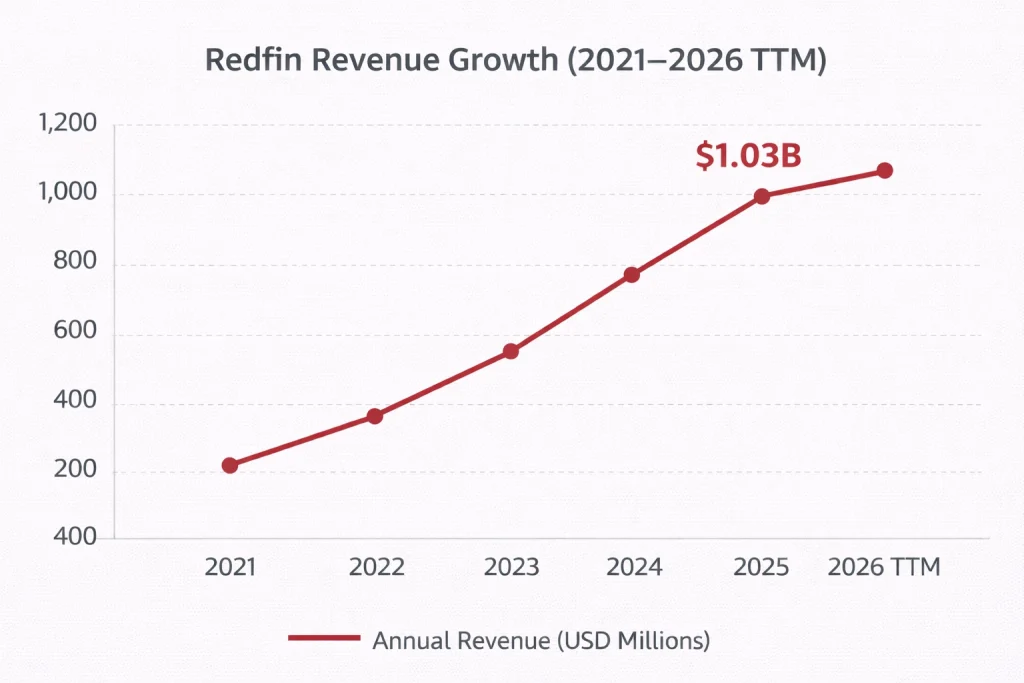
Redfin has transformed the traditional real estate brokerage model by combining technology, online home search, and lower agent commissions. As of early 2026, the company generates approximately $1.03 billion in trailing-twelve-month revenue, positioning itself as one of the largest tech-driven real estate platforms in the United States.
For founders and product builders, Redfin is a powerful example of how marketplace platforms and services can disrupt legacy industries like real estate brokerage.
Redfin Revenue Overview – The Big Picture
Redfin operates a hybrid model combining online property listings, real estate brokerage services, and mortgage products.
Key financial snapshot (latest available data):
• Revenue (TTM): ~$1.03B
• Market focus: U.S. real estate marketplace
• Platform traffic: ~46M monthly users
• Market share: ~0.75% of U.S. home sales by units
• Business model: Real estate marketplace + brokerage + mortgage services
Redfin competes with platforms like:
• Zillow
• Realtor.com
• Compass
• Opendoor
Unlike pure listing platforms, Redfin also employs agents and directly participates in transactions.
Primary Revenue Streams Deep Dive
Redfin earns revenue across several interconnected real estate services.
Revenue Stream #1
Real Estate Brokerage Commissions
The core revenue stream comes from home sale transactions handled by Redfin agents.
When a home is bought or sold through the platform, Redfin earns a commission.
Typical commission model:
• Seller listing fee
• Buyer agent commission share
Redfin typically charges lower listing fees compared to traditional brokerages, helping attract customers.
Estimated revenue contribution: ~50–55%
Revenue Stream #2
Mortgage Services
Redfin provides mortgage lending through Redfin Mortgage.
Revenue sources include:
• mortgage origination fees
• loan processing fees
• interest margin partnerships
Mortgage services are integrated directly into the home-buying process.
Estimated revenue contribution: ~20–25%
Revenue Stream #3
Partner Agent Network
When Redfin cannot service a transaction directly, it routes customers to partner real estate agents.
Revenue comes from:
• referral fees
• transaction commissions
Estimated revenue contribution: ~10–15%
Revenue Stream #4
Rental Listings & Advertising
Redfin also generates revenue from rental marketplaces.
Monetization includes:
• rental listing ads
• property manager subscriptions
• real estate advertising
Estimated revenue contribution: ~5–10%
Revenue Stream #5
Title & Settlement Services
Redfin earns revenue from closing services such as:
• title insurance
• escrow services
• transaction processing
These services capture additional value from each home sale.
Estimated contribution: ~5–8%
Revenue Streams Breakdown (Latest Available Data)
| Revenue Stream | Description | Estimated Revenue Share | Pricing Model |
|---|---|---|---|
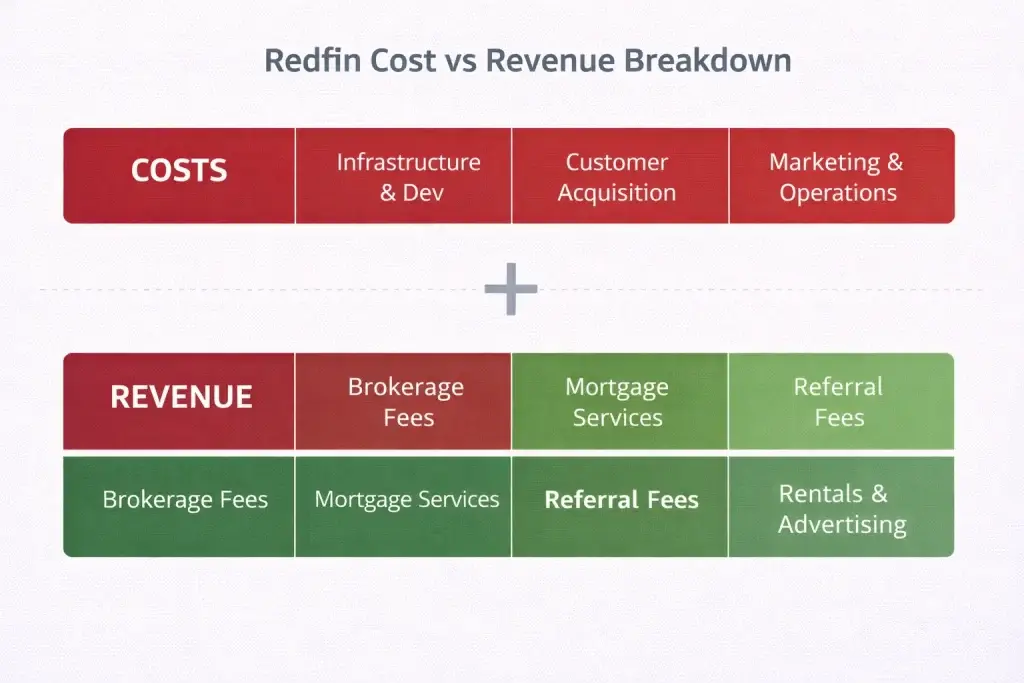
| Brokerage Commissions | Home buying and selling services | ~50–55% | Commission per transaction |
| Mortgage Services | Home loan origination and financing | ~20–25% | Loan fees and lending margin |
| Partner Agent Referrals | Referral commissions from external agents | ~10–15% | Referral fee |
| Rental Listings & Ads | Advertising and property listings | ~5–10% | Listing and advertising fees |
| Title & Closing Services | Escrow and title insurance | ~5–8% | Service fees |
The Fee Structure Explained
Redfin’s monetization model combines real estate brokerage fees with fintech-style services.
Key fee layers include:
• home sale listing commission
• buyer agent commissions
• mortgage origination fees
• referral fees
• listing advertisement fees
Platform Fee Structure (Latest Available Data)
| User Type | Fee Type | Typical Fee Range | Notes |
|---|---|---|---|
| Home sellers | Listing commission | ~1–1.5% | Lower than traditional brokers |
| Home buyers | Agent commission share | ~2–3% | Paid through transaction |
| Mortgage borrowers | Loan origination fee | ~0.5–1% | Mortgage services |
| Partner agents | Referral fee | ~25–35% | For routed leads |
| Property managers | Advertising fee | Variable | Rental listings |
How Redfin Maximizes Revenue Per User
Redfin monetizes users through end-to-end real estate transaction capture.
Customer segmentation
• home buyers
• home sellers
• renters
• real estate investors
Upselling mechanics
Customers searching for homes are encouraged to use:
• Redfin agents
• Redfin mortgage services
• Redfin closing services
Cross-selling systems
Each home purchase can generate revenue across:
• brokerage commission
• mortgage financing
• title services
Dynamic pricing
Commission discounts are used to attract sellers while maintaining profitability through volume.
Retention monetization
Frequent home search usage drives repeat engagement.
LTV optimization
Redfin monetizes a single user across multiple financial services tied to the home transaction.
Psychological pricing tactics
• lower commissions than traditional brokers
• technology-driven experience
• transparent pricing
Cost Structure & Profit Margins
Redfin operates with a technology-heavy real estate brokerage cost structure.
Major expenses include:
Infrastructure costs
• platform development
• listing databases
• search infrastructure
Customer acquisition cost
• digital marketing
• real estate partnerships
Marketing spend
• home search traffic acquisition
• brand advertising
Operations
• employee real estate agents
• brokerage compliance
Research and development
• real estate data analytics
• AI home search tools
Unit economics
Real estate marketplaces become profitable when transaction volumes increase and marketing costs per transaction decrease.
Future Revenue Opportunities (2026–2028 Outlook)
Redfin’s next growth phase focuses on vertical integration of the home buying process.
Emerging monetization opportunities
AI-powered home search
Predictive pricing and property recommendations.
Integrated mortgage platform
Seamless loan approvals within the home search flow.
Real estate fintech services
Insurance, refinancing, and property financing.
Market expansion
• international real estate markets
• digital property transactions
• AI property valuation tools
Key risks
• housing market slowdowns
• high mortgage rates
• competition from Zillow and Compass
Startups entering this space can focus on vertical real estate SaaS tools or transaction automation platforms.
Lessons for Entrepreneurs
What works well in this model
• marketplace-driven real estate discovery
• technology-enabled brokerage
• vertical integration of services
What startups can replicate
• digital marketplaces for offline industries
• service + platform hybrid models
• transaction-based revenue
Market gaps still available
• AI real estate investment tools
• property analytics platforms
• automated real estate transactions
Potential improvements founders could build
• AI real estate assistants
• automated property valuation models
• blockchain property records
Final Thought
Redfin demonstrates how technology can transform even the most traditional industries like real estate. By integrating online property search with brokerage, mortgage, and other home-buying services, the platform creates a seamless experience for buyers and sellers. This end-to-end approach allows Redfin to participate in multiple stages of the home-buying journey, capturing value beyond just property listings. At the same time, leveraging data, automation, and digital tools helps reduce friction in the process, improve transparency, and lower costs for consumers.
As a result, Redfin illustrates how combining technology with vertically integrated services can reshape customer experiences while building a more diversified and scalable business model.
FAQs
1. How much does Redfin make per home sale?
Revenue depends on the property value, but Redfin earns commission percentages on each transaction.
2. What is the most profitable revenue stream for Redfin?
Real estate brokerage commissions generate the majority of revenue.
3. How does Redfin’s pricing compare to traditional brokers?
Redfin usually charges lower listing fees, helping attract sellers.
4. What percentage commission does Redfin take?
Listing commissions typically range between 1% and 1.5%.
5. How has Redfin’s revenue model evolved?
The company expanded from a home search platform into brokerage, mortgage, and closing services.
6. Can startups replicate this model?
Yes, especially by creating marketplaces that digitize traditional industries.
7. What scale is needed for profitability?
Platforms require large transaction volumes to offset operational costs.
8. How can founders implement a similar model?
Build marketplaces that integrate services around major transactions.
9. What alternatives exist to this revenue model today?
Alternatives include listing marketplaces, brokerage SaaS platforms, and property fintech startups.
Miracuves is an independent software development company. We are not affiliated with, connected to, sponsored by, or endorsed by any company or product named in this article.
Terms such as “X Clone” are used descriptively. It is how the software industry refers to building a platform with functionality comparable to a known service, and how clients search for it.
The entire design and codebase of our products is built by our own team. Our products contain no code, design, graphics, or content originating from any third-party website or applications.
All third-party names and marks referenced in this article are the property of their respective owners, referenced solely to identify the services discussed.